"f0d304d7232d0332"{"id":"1002734","slug":"stylized-spruce-forest","title":"Stylized Spruce Forest","category":"Forest \u0026 Jungle","engine":"5.0+","assetVersion":"","engineVersion":"Engine Version: 5.0+","tag":"Forest \u0026 Jungle","accent":"blue","visual":"mech","summary":"Stylized Spruce Forest provides optimized lowpoly foliage, a reactive wind system, procedural seasons, and a paintable landscape automaterial.","platform":"Unreal Engine","indexPolicy":"index","publishedAt":"2026-11-17T19:10:36.432Z","updatedAt":"2026-11-17T19:10:36.432Z","sourceNotes":[],"fileContents":[],"compatibility":["Unreal Engine","Engine Version: 5.0+"],"featuredImage":{"alt":"Stylized Spruce Forest","src":"/wp-content/uploads/published/2026/11/6e3174dd850f-52db4443-2b86-43e0-a375-6f4d21013b18-15e9242537.webp"},"fileSizeBytes":1541510117,"hasDownloadLink":true,"downloads":0,"terms":[{"taxonomy":"category","slug":"forest-and-jungle","name":"Forest \u0026 Jungle"}],"galleryImages":[{"src":"/wp-content/uploads/published/2026/11/2918e5cc12ba-0b2fd86c-b2d0-406b-9339-31147dd6a4d1-571ec9eb53.webp","alt":"Stylized Spruce Forest"},{"src":"/wp-content/uploads/published/2026/11/6a046b0f7067-533c242a-45ce-4bc8-9292-7bb3bb9cec8b-b9562fe081.webp","alt":"Stylized Spruce Forest"},{"src":"/wp-content/uploads/published/2026/11/2eea57e631f2-27947da0-d297-4a82-8356-5fcf50815650-94635bb728.webp","alt":"Stylized Spruce Forest"},{"src":"/wp-content/uploads/published/2026/11/360d5f8dd38a-5061916c-8908-44b1-9f25-66b57a4c964c-5fb2ff4097.webp","alt":"Stylized Spruce Forest"},{"src":"/wp-content/uploads/published/2026/11/626f0fc900f4-b6ced2ed-dee5-4531-8ca7-5a5c1f470df0-503a272696.webp","alt":"Stylized Spruce Forest"},{"src":"/wp-content/uploads/published/2026/11/f99953a13913-c8cec0e4-17ef-4af7-aba4-cfed7252a63b-55f373d139.webp","alt":"Stylized Spruce Forest"},{"src":"/wp-content/uploads/published/2026/11/306afb41c74c-23e325d0-2cf3-432d-852e-3f18b766f77b-29795b1643.webp","alt":"Stylized Spruce Forest"},{"src":"/wp-content/uploads/published/2026/11/8a6605b8ce8d-c4d8732f-9cca-4bc7-afca-ffbc91f0191a-602ea7ec00.webp","alt":"Stylized Spruce Forest"},{"src":"/wp-content/uploads/published/2026/11/6a642a9b652c-c746d98f-71c0-40a9-b19e-088730afb8ee-c8b2c0983a.webp","alt":"Stylized Spruce Forest"},{"src":"/wp-content/uploads/published/2026/11/5bc2684f4256-fc6d99ec-1eed-4e57-a9ba-9754c0581966-859c9a8bbe.webp","alt":"Stylized Spruce Forest"}],"accessPanel":{"kind":"resource","title":"Get this resource","safetyNote":"Resources are manually reviewed before listing to improve quality and reduce obvious risks.","fileName":"Content.7z","resourceType":"Resource archive","versions":[]},"contentHtml":"\u003ch2\u003eConstructing Nature Levels with Stylized Spruce Assets\u003c/h2\u003e\u003cp\u003eBuilding extensive wilderness environments often introduces complex optimization challenges when handling dense arrays of foliage. Detailed plant geometry can rapidly burden rendering budgets, while inconsistent visual styling across different plant types can undermine the cohesion of an outdoor scene. Stylized Spruce Forest addresses these production hurdles by providing an interconnected suite of lowpoly nature assets designed specifically for large-scale level design. Every spruce tree mesh and companion plant element adheres to an optimized polygon footprint, granting environment artists the freedom to assemble thick groves, scattering saplings, and expansive woodland borders across broad open terrain without overextending scene performance budgets.\u003c/p\u003e\u003cp\u003eThe visual direction of the package emphasizes clean silhouettes, bold shapes, and crisp form language. In outdoor nature environments where view distances can span kilometers, maintaining visual clarity from foreground clearings all the way to distant mountain ridges is critical for navigational readability and compositional strength. The lowpoly aesthetic captures the identifiable structure of spruce trees—defined by their tiered branching, distinctive needle clumps, and conical canopies—while remaining lightweight enough to be duplicated repeatedly throughout sprawling level bounds. Because the underlying meshes remain strictly optimized, designers can layer varied plant compositions from dense thickets down to sparse underbrush, shaping believable forest topographies without introducing geometric clutter or erratic framerate dips during runtime gameplay passes.\u003c/p\u003e\u003ch2\u003eDynamic Canopy Motion in the Forest via Integrated Wind\u003c/h2\u003e\u003cp\u003eA persistent risk when assembling stylized outdoor environments is the lifelessness that occurs when static plant assets sit motionless in the game world. Forest canopies, lower branches, and scattered ground flora require natural movement to reflect the presence of ambient air and shifting atmospheric currents. Stylized Spruce Forest counters this issue by incorporating a built-in wind system designed to breathe synchronized motion directly into the stylized plant and tree meshes. Rather than leaving foliage rigid against the sky, the integrated wind mechanics animate individual branches, needle masses, and ground-level plants with coordinated, fluid motion.\u003c/p\u003e\u003cp\u003eBy harmonizing foliage animation through a unified system, the environment avoids the visual discord that arises when different plant meshes react to environmental forces with contrasting speeds, pivot behaviors, or oscillation frequencies. Large spruce trees sway with weight and subtle resistance appropriate for mature timber, while smaller undergrowth foliage exhibits lighter, more sensitive motion. This systemic synchronization ensures that ambient gusts moving across a dense forest valley appear cohesive across every layer of vegetation. Whether configured for quiet, gentle breezes drifting through sunlit clearings or sweeping gales blowing across exposed alpine hillsides, the wind implementation ties the entire plant ecosystem together into a singular, reactive world.\u003c/p\u003e\u003ch2\u003eProcedural Seasons Across Spruce Foliage and Ground Layers\u003c/h2\u003e\u003cp\u003eAltering the visual mood of an outdoor level to match changing seasonal periods is traditionally an asset-heavy, time-consuming undertaking. Teams often face the prospect of authoring, storing, and loading distinct mesh variants or alternate texture sets for spring, summer, fall, and winter states, which inflates project footprint and complicates asset maintenance. Stylized Spruce Forest bypasses this redundant asset overhead by leveraging procedural seasons that modify the appearance of the wilderness environment dynamically.\u003c/p\u003e\u003cp\u003eUnder this procedural architecture, seasonal changes propagate systematically across the spruce forest assets. Needle coloration, plant surfaces, and corresponding terrain tones adjust according to established seasonal rules within the existing map geometry, eliminating the need to swap static meshes or swap out entire level configurations. Creators can transition an environment from the rich greens of early spring and warm summer to the amber and dried hues of autumn, or even into chilled, winterized tones directly within the scene. This procedural flexibility broadens the scope of environmental storytelling, enabling dynamic time-of-day or multi-season narrative progressions across long play sessions while keeping project file sizes and asset pipelines clean, structured, and manageable.\u003c/p\u003e\u003ch2\u003eSurface Shading with the Paintable Landscape Automaterial\u003c/h2\u003e\u003cp\u003eTerrain presentation plays an equally vital role in framing forest foliage, demanding a terrain material that eliminates repetitive manual texturing while still accommodating direct artistic input. Stylized Spruce Forest provides a paintable landscape automaterial engineered to streamline terrain composition across varied elevations. The automaterial evaluates landscape topography procedurally, assigning appropriate surface textures based on the slope angle and inclination of the underlying landscape heightmap. Steep cliff faces, sloping inclines, and level valley floors automatically receive fitting textural coverage, preventing unnatural texture stretching across steep drops and saving environment artists countless hours of repetitive brushwork.\u003c/p\u003e\u003cp\u003eWhile the procedural slope logic forms an automated terrain baseline, complete artistic flexibility is preserved through paintable layers. Designers can hand-paint surface variations directly over the automated landscape, defining specialized zones such as trodden hiking paths, exposed earth beneath thick spruce canopies, rocky clearings, or gravel patches along stream banks. This hybrid approach blends the speed of procedural surface distribution with the deliberate control of manual painting. The resulting landscape surfaces integrate seamlessly with the lowpoly aesthetic of the spruce trees and plant elements, ensuring consistent visual fidelity from wide vista horizons down to the immediate ground plane beneath the player's feet.\u003c/p\u003e\u003ch2\u003eGlobal Material Parameter Collection and Instance Workflows in the Forest\u003c/h2\u003e\u003cp\u003eMaintaining stylistic harmony across extensive outdoor scenes demands centralized material controls rather than fragmented, mesh-by-mesh shader property adjustments. Stylized Spruce Forest structures all asset customization through a hierarchy of preconfigured material instances linked to a Global Material Parameter Collection. This framework enables level designers and technical artists to alter overarching visual attributes from a single centralized interface, updating the look and feel of the entire forest instantly.\u003c/p\u003e\u003cp\u003eThrough the Global Material Parameter Collection, changes made to global color schemes, wind parameters, and seasonal states broadcast across all placed foliage meshes and landscape materials simultaneously. If an environment artist decides to modify the strength of the canopy wind sway or transition the overall foliage palette toward an autumn tint, the change can be enacted globally rather than visiting individual material assets across the project. At the same time, individual material instances remain completely accessible for specialized fine-tuning, allowing creators to adjust localized asset behaviors without severing the link to global parameters. This modular setup drastically accelerates iterative level design passes, offering an efficient and predictable workflow for refining visual style, foliage performance, and environmental atmosphere across complex nature projects.\u003c/p\u003e\n\n\u003ch2\u003eExplore Similar Assets\u003c/h2\u003e\n\u003cul\u003e\n\u003cli\u003e\u003ca href=\"https://3dcghub.com/lush-stylized-environment-set/\" rel=\"noopener noreferrer\"\u003eLUSH: Stylized Environment Set\u003c/a\u003e\u003c/li\u003e\n\u003cli\u003e\u003ca href=\"https://3dcghub.com/stylized-landscape-5-biomes-stylized-low-poly-forest-orasot-bundle/\" rel=\"noopener noreferrer\"\u003eStylized Landscape 5 Biomes + Stylized + Low poly forest : Orasot Bundle\u003c/a\u003e\u003c/li\u003e\n\u003cli\u003e\u003ca href=\"https://3dcghub.com/stylized-forest-trees-and-rocks-forest-rocks-trees-stylized-forest/\" rel=\"noopener noreferrer\"\u003eStylized Forest - Trees \u0026amp; Rocks (Forest, Rocks, Trees, Stylized Forest)\u003c/a\u003e\u003c/li\u003e\n\u003cli\u003e\u003ca href=\"https://3dcghub.com/mw-dead-spruce-forest-trees-biome-2/\" rel=\"noopener noreferrer\"\u003eMW Dead Spruce Forest Trees Biome\u003c/a\u003e\u003c/li\u003e\n\u003cli\u003e\u003ca href=\"https://3dcghub.com/stylized-nature-vol-1-stylized-environment-bundle/\" rel=\"noopener noreferrer\"\u003eStylized Nature Vol. 1 | Stylized Environment Bundle\u003c/a\u003e\u003c/li\u003e\n\u003c/ul\u003e","contentTextLength":7940,"navigation":{"current":6,"total":4660,"previous":{"id":"1002735","slug":"subtropical-waterbody-habitat-brush","title":"Subtropical Waterbody Habitat Brush","category":"Forest \u0026 Jungle","platform":"Unreal Engine","updatedAt":"2026-11-17T19:11:11.403Z"},"next":{"id":"1002733","slug":"stylized-mediterranean-courtyard-stylized-stylised-mediterranean-courtyard","title":"Stylized Mediterranean Courtyard ( Stylized Stylised Mediterranean Courtyard )","category":"Towns \u0026 Villages","platform":"Unreal Engine","updatedAt":"2026-11-17T19:09:36.047Z"}},"relatedResources":[{"id":"1002676","slug":"lush-stylized-environment-set","title":"LUSH: Stylized Environment Set","category":"Forest \u0026 Jungle","engine":"5.0+","assetVersion":"","engineVersion":"Engine Version: 5.0+","tag":"Forest \u0026 Jungle","accent":"blue","visual":"city","summary":"Examine the technical layout, terrain systems, foliage assets, and water tools inside LUSH: Stylized Environment Set for stylized natural environments.","platform":"Unreal Engine","indexPolicy":"index","publishedAt":"2026-11-16T22:26:42.482Z","updatedAt":"2026-11-16T22:26:42.482Z","sourceNotes":[],"fileContents":[],"compatibility":["Unreal Engine","Engine Version: 5.0+"],"featuredImage":{"alt":"LUSH: Stylized Environment Set","src":"/wp-content/uploads/published/2026/11/5372490bf58d-693b3d8c-df53-4b0a-89b9-80662f79decb-1a873cafdc.webp"},"fileSizeBytes":470520656,"hasDownloadLink":true,"downloads":0},{"id":"1000892","slug":"stylized-landscape-5-biomes-stylized-low-poly-forest-orasot-bundle","title":"Stylized Landscape 5 Biomes + Stylized + Low poly forest : Orasot Bundle","category":"Forest \u0026 Jungle","engine":"5.2+","assetVersion":"","engineVersion":"Engine Version: 5.2+","tag":"Forest \u0026 Jungle","accent":"blue","visual":"city","summary":"This bundle merges stylized forest, five-biome landscape, and low-poly forest assets with a practical exposure fix for DefaultEngine.ini and virtual texture set","platform":"Unreal Engine","indexPolicy":"index","publishedAt":"2026-08-06T04:37:15.039Z","updatedAt":"2026-08-06T04:37:15.039Z","sourceNotes":[],"fileContents":[],"compatibility":["Unreal Engine","Engine Version: 5.2+"],"featuredImage":{"alt":"Stylized Landscape 5 Biomes + Stylized + Low poly forest : Orasot Bundle","src":"/wp-content/uploads/published/2026/08/d7e4432aba24-96cbb20e-4693-449f-94da-c2b94b1eecfe-b7d03925eb.webp"},"fileSizeBytes":922868643,"hasDownloadLink":true,"downloads":3},{"id":"1001125","slug":"stylized-forest-trees-and-rocks-forest-rocks-trees-stylized-forest","title":"Stylized Forest - Trees \u0026 Rocks (Forest, Rocks, Trees, Stylized Forest)","category":"Forest \u0026 Jungle","engine":"5.0+","assetVersion":"","engineVersion":"Engine Version: 5.0+","tag":"Forest \u0026 Jungle","accent":"blue","visual":"mech","summary":"A large, optimized collection of stylized trees, rocks, and bushes with modular tree setups. Each tree has three bush variations.","platform":"Unreal Engine","indexPolicy":"index","publishedAt":"2026-09-07T13:23:58.967Z","updatedAt":"2026-09-07T13:23:58.967Z","sourceNotes":[],"fileContents":[],"compatibility":["Unreal Engine","Engine Version: 5.0+"],"featuredImage":{"alt":"Stylized Forest - Trees \u0026 Rocks (Forest, Rocks, Trees, Stylized Forest)","src":"/wp-content/uploads/published/2026/09/f43732e43a20-5d216d25-cf6b-4186-9dcb-255b9927ae4f-d2c3766be6.webp"},"fileSizeBytes":148216227,"hasDownloadLink":true,"downloads":0}]}
Resource screenshots
1 / 10
Join our channel
Follow 3DCGHUB on Telegram for new resource drops, migration updates, and community notices.
Constructing Nature Levels with Stylized Spruce Assets
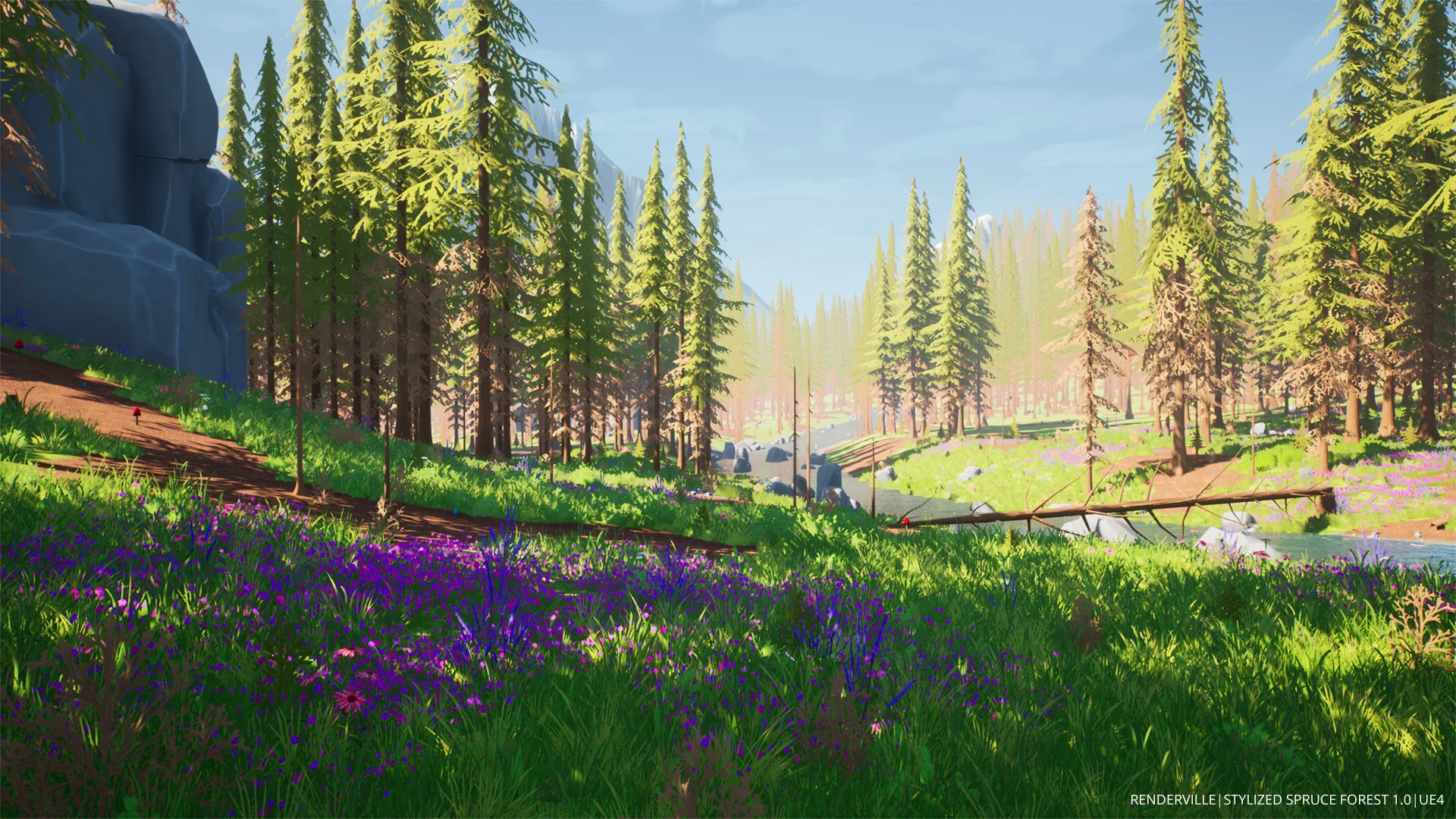
Building extensive wilderness environments often introduces complex optimization challenges when handling dense arrays of foliage. Detailed plant geometry can rapidly burden rendering budgets, while inconsistent visual styling across different plant types can undermine the cohesion of an outdoor scene. Stylized Spruce Forest addresses these production hurdles by providing an interconnected suite of lowpoly nature assets designed specifically for large-scale level design. Every spruce tree mesh and companion plant element adheres to an optimized polygon footprint, granting environment artists the freedom to assemble thick groves, scattering saplings, and expansive woodland borders across broad open terrain without overextending scene performance budgets.
The visual direction of the package emphasizes clean silhouettes, bold shapes, and crisp form language. In outdoor nature environments where view distances can span kilometers, maintaining visual clarity from foreground clearings all the way to distant mountain ridges is critical for navigational readability and compositional strength. The lowpoly aesthetic captures the identifiable structure of spruce trees—defined by their tiered branching, distinctive needle clumps, and conical canopies—while remaining lightweight enough to be duplicated repeatedly throughout sprawling level bounds. Because the underlying meshes remain strictly optimized, designers can layer varied plant compositions from dense thickets down to sparse underbrush, shaping believable forest topographies without introducing geometric clutter or erratic framerate dips during runtime gameplay passes.
Dynamic Canopy Motion in the Forest via Integrated Wind
A persistent risk when assembling stylized outdoor environments is the lifelessness that occurs when static plant assets sit motionless in the game world. Forest canopies, lower branches, and scattered ground flora require natural movement to reflect the presence of ambient air and shifting atmospheric currents. Stylized Spruce Forest counters this issue by incorporating a built-in wind system designed to breathe synchronized motion directly into the stylized plant and tree meshes. Rather than leaving foliage rigid against the sky, the integrated wind mechanics animate individual branches, needle masses, and ground-level plants with coordinated, fluid motion.
By harmonizing foliage animation through a unified system, the environment avoids the visual discord that arises when different plant meshes react to environmental forces with contrasting speeds, pivot behaviors, or oscillation frequencies. Large spruce trees sway with weight and subtle resistance appropriate for mature timber, while smaller undergrowth foliage exhibits lighter, more sensitive motion. This systemic synchronization ensures that ambient gusts moving across a dense forest valley appear cohesive across every layer of vegetation. Whether configured for quiet, gentle breezes drifting through sunlit clearings or sweeping gales blowing across exposed alpine hillsides, the wind implementation ties the entire plant ecosystem together into a singular, reactive world.
Procedural Seasons Across Spruce Foliage and Ground Layers
Altering the visual mood of an outdoor level to match changing seasonal periods is traditionally an asset-heavy, time-consuming undertaking. Teams often face the prospect of authoring, storing, and loading distinct mesh variants or alternate texture sets for spring, summer, fall, and winter states, which inflates project footprint and complicates asset maintenance. Stylized Spruce Forest bypasses this redundant asset overhead by leveraging procedural seasons that modify the appearance of the wilderness environment dynamically.
Under this procedural architecture, seasonal changes propagate systematically across the spruce forest assets. Needle coloration, plant surfaces, and corresponding terrain tones adjust according to established seasonal rules within the existing map geometry, eliminating the need to swap static meshes or swap out entire level configurations. Creators can transition an environment from the rich greens of early spring and warm summer to the amber and dried hues of autumn, or even into chilled, winterized tones directly within the scene. This procedural flexibility broadens the scope of environmental storytelling, enabling dynamic time-of-day or multi-season narrative progressions across long play sessions while keeping project file sizes and asset pipelines clean, structured, and manageable.
Surface Shading with the Paintable Landscape Automaterial
Terrain presentation plays an equally vital role in framing forest foliage, demanding a terrain material that eliminates repetitive manual texturing while still accommodating direct artistic input. Stylized Spruce Forest provides a paintable landscape automaterial engineered to streamline terrain composition across varied elevations. The automaterial evaluates landscape topography procedurally, assigning appropriate surface textures based on the slope angle and inclination of the underlying landscape heightmap. Steep cliff faces, sloping inclines, and level valley floors automatically receive fitting textural coverage, preventing unnatural texture stretching across steep drops and saving environment artists countless hours of repetitive brushwork.
While the procedural slope logic forms an automated terrain baseline, complete artistic flexibility is preserved through paintable layers. Designers can hand-paint surface variations directly over the automated landscape, defining specialized zones such as trodden hiking paths, exposed earth beneath thick spruce canopies, rocky clearings, or gravel patches along stream banks. This hybrid approach blends the speed of procedural surface distribution with the deliberate control of manual painting. The resulting landscape surfaces integrate seamlessly with the lowpoly aesthetic of the spruce trees and plant elements, ensuring consistent visual fidelity from wide vista horizons down to the immediate ground plane beneath the player's feet.
Global Material Parameter Collection and Instance Workflows in the Forest
Maintaining stylistic harmony across extensive outdoor scenes demands centralized material controls rather than fragmented, mesh-by-mesh shader property adjustments. Stylized Spruce Forest structures all asset customization through a hierarchy of preconfigured material instances linked to a Global Material Parameter Collection. This framework enables level designers and technical artists to alter overarching visual attributes from a single centralized interface, updating the look and feel of the entire forest instantly.
Through the Global Material Parameter Collection, changes made to global color schemes, wind parameters, and seasonal states broadcast across all placed foliage meshes and landscape materials simultaneously. If an environment artist decides to modify the strength of the canopy wind sway or transition the overall foliage palette toward an autumn tint, the change can be enacted globally rather than visiting individual material assets across the project. At the same time, individual material instances remain completely accessible for specialized fine-tuning, allowing creators to adjust localized asset behaviors without severing the link to global parameters. This modular setup drastically accelerates iterative level design passes, offering an efficient and predictable workflow for refining visual style, foliage performance, and environmental atmosphere across complex nature projects.
 Forest & Jungle
 Forest & Jungle
 Forest & Jungle