"4481da9c895ef786"{"id":"1001308","slug":"voyager-cover-system","title":"Voyager: Cover System","category":"Gameplay Features","engine":"5.5+","assetVersion":"","engineVersion":"Engine Version: 5.5+","tag":"Gameplay Features","accent":"blue","visual":"mech","summary":"Explore Voyager: Cover System, a 100% Blueprint TPS template with automatic cover detection, Data Asset animations, and modular gameplay components.","platform":"Unreal Engine","publishedAt":"2026-10-02T06:21:52.066Z","updatedAt":"2026-10-02T06:21:52.066Z","sourceNotes":[],"fileContents":[],"compatibility":["Unreal Engine","Engine Version: 5.5+"],"featuredImage":{"alt":"Voyager: Cover System","src":"/wp-content/uploads/published/2026/10/beaf349d95bd-de542065-7c38-4c5e-816c-93c284e8cfde-5069b8b183.webp"},"hasDownloadLink":true,"downloads":1,"terms":[{"taxonomy":"category","slug":"gameplay-features","name":"Gameplay Features"}],"galleryImages":[{"src":"/wp-content/uploads/published/2026/10/c612d3effdb8-18779535-402c-4681-a782-39c1ee3e6156-171baede32.webp","alt":"Voyager: Cover System"},{"src":"/wp-content/uploads/published/2026/10/5719eb928d80-0dc5dcd0-8235-4846-b23e-44d82dcceba8-85d6798abf.webp","alt":"Voyager: Cover System"},{"src":"/wp-content/uploads/published/2026/10/f44e8f93fa00-a317b118-b3f9-485e-9d14-807262d0ed92-35b26ef9de.webp","alt":"Voyager: Cover System"},{"src":"/wp-content/uploads/published/2026/10/c3a1b1a9008b-c172553e-2b7a-4795-a5b0-1185858819b5-ad353a1bab.webp","alt":"Voyager: Cover System"},{"src":"/wp-content/uploads/published/2026/10/14b0f07fa4df-62ac9b6d-5030-4181-acad-ed04dcdad743-de00a591c0.webp","alt":"Voyager: Cover System"},{"src":"/wp-content/uploads/published/2026/10/5057a4194b97-e4d0b326-099c-482d-a668-ee2209cc3094-67f50dc250.webp","alt":"Voyager: Cover System"},{"src":"/wp-content/uploads/published/2026/10/78fc998e15be-7989e88b-5b01-4e0d-bcd0-ea80cd6e9599-cbc6d0293a.webp","alt":"Voyager: Cover System"},{"src":"/wp-content/uploads/published/2026/10/5f252dd3dc6f-0fe1a913-6c4d-40b8-ae63-b65cf85f2f20-120b208514.webp","alt":"Voyager: Cover System"},{"src":"/wp-content/uploads/published/2026/10/297fad8fdde3-c560f493-9448-4414-8024-9c3066456fba-0e8cef8498.webp","alt":"Voyager: Cover System"},{"src":"/wp-content/uploads/published/2026/10/4eb56ef6eefe-fec3e6fb-e7d5-4ae4-8a69-742a84042697-949a300ddc.webp","alt":"Voyager: Cover System"}],"accessPanel":{"kind":"resource","title":"Download this resource","eyebrow":"Free Download","message":"Log in or create a free account to start your download.","fileName":"VoyagerCoverSystem.7z","safetyNote":"Resources are manually reviewed before listing to improve quality and reduce obvious risks.","actionLabel":"Download Free","resourceType":"Resource archive"},"contentHtml":"\u003ch2\u003eIntegration via BP_ActionCover and Action System Architecture\u003c/h2\u003e\n\u003cp\u003eImplementing third-person cover mechanics often introduces complex dependencies across character Blueprints, animation instances, and input routers. Voyager: Cover System structures this workflow through an action-centric architecture derived from the Voyager: Action System. The primary bridge between the player character and the cover mechanics is contained within a dedicated action Blueprint designated as \u003ccode\u003eBP_ActionCover\u003c/code\u003e. By consolidating state changes, raycasts, and positioning routines into this single action module, the system bypasses the spaghetti networks typically associated with sprawling player controllers.\u003c/p\u003e\n\u003cp\u003eThe entire implementation is 100% Blueprint, organized with descriptive comments and built specifically to serve educational and production purposes. Rather than relying on heavy per-tick casts to fetch player status, weapon states, or camera orientations, the logic is strictly event-driven. Event dispatchers and listeners notify individual subsystems when the character enters, traverses, or breaks away from cover. This decoupled structure minimizes performance overhead and simplifies the integration pipeline, enabling developers to merge the system into an established project using the provided step-by-step Migration Guide without re-architecting their existing game code.\u003c/p\u003e \u003ch2\u003eData Asset Animation Configuration\u003c/h2\u003e\n\u003cp\u003eSeparating mathematical placement from visual presentation is essential when building adaptable combat mechanics. Voyager: Cover System accomplishes this by driving all cover-related animations through Data Assets. Rather than hardcoding animation sequences, blend spaces, or montage references directly inside state machines or Blueprint logic graphs, developers assign animation assets inside external data containers.\u003c/p\u003e\n\u003cp\u003eThis design pattern allows teams to restyle character performances without touching the underlying calculation algorithms. If a project requires transitioning from tight, tactical low-profile stances to stylized, upright movements, the developer only needs to populate the Data Asset fields with the corresponding animation files. The core logic executes the appropriate transitions, stance changes, and positional offsets purely by reading values from the Data Asset, eliminating regression bugs during visual iteration passes.\u003c/p\u003e \u003ch2\u003eAutomatic Cover Detection and Mesh Rules Using NoCover\u003c/h2\u003e\n\u003cp\u003eLevel design workflows frequently bottleneck when level designers are forced to place invisible volumes, collision proxies, or spline guides along every wall to define valid cover. Voyager: Cover System eliminates manual level setup through an automatic cover detection algorithm. When the character requests to enter cover, the system performs environmental checks that evaluate the geometry in proximity, automatically resolving normals, heights, and surface contours across static or dynamic meshes.\u003c/p\u003e\n\u003cp\u003eWhile arbitrary meshes can function as cover automatically, real production scenes inevitably feature decorative props, fragile objects, or irregular geometry that should never serve as viable shielding. To exclude specific objects from the trace evaluation, developers simply add the keyword tag \u003ccode\u003eNoCover\u003c/code\u003e To the component tags of any static mesh. When the detection algorithm processes potential surfaces, any mesh bearing the \u003ccode\u003eNoCover\u003c/code\u003e Tag is ignored entirely, allowing the character to filter out small obstacles, decorative trim, or non-viable foliage while snapping cleanly to structural walls and barricades.\u003c/p\u003e \u003ch2\u003eCover Navigation Using MovementInputRotation and Combat Stances\u003c/h2\u003e\n\u003cp\u003eMoving along a surface requires translating camera-relative controller inputs into surface-relative locomotion. Voyager: Cover System resolves this vector translation via \u003ccode\u003eMovementInputRotation\u003c/code\u003e, an internal calculation that maps the player’s directional inputs against the orientation and normal of the active cover mesh. This ensures smooth movement along wall faces, around corners, and through transitions without character detachment or erratic snapping.\u003c/p\u003e\n\u003cp\u003eCombat capability within cover demands dynamic directional awareness. The system tracks movement direction and proximity to geometry edges, automatically switching weapon hands between left and right depending on whether the player moves or aims toward the corresponding side. When engaging targets from behind protection, weapon firing logic references mirrored animations tailored to the active side, maintaining natural physical posture and unobstructed lines of fire. In addition to standard ballistic fire, specialized grenade-tossing logic is integrated directly into the cover state, enabling players to aim, arc, and release projectiles while remaining anchored to defensive positions.\u003c/p\u003e \u003ch2\u003eDissolveComp, Dynamic HP Bar, and Feedback Components\u003c/h2\u003e\n\u003cp\u003eAlongside its locomotion and defensive logic, Voyager: Cover System includes a collection of independent, component-based utilities suited to general game development tasks. These modular pieces can be detached from the cover framework and dropped onto any actor:\u003c/p\u003e\n\u003cul\u003e \u003cli\u003e\u003cstrong\u003eDissolveComp:\u003c/strong\u003e A material-based dissolve component that handles automated visual transitions across character materials, useful for spawning effects, phasing mechanics, or death animations.\u003c/li\u003e \u003cli\u003e\u003cstrong\u003eDynamic HP Bar Component:\u003c/strong\u003e A drop-on interface component that renders health states with a built-in lazy HP bar feature, displaying immediate damage followed by a gradual decay trail to enhance hit feedback.\u003c/li\u003e \u003cli\u003e\u003cstrong\u003eMulti-Message System:\u003c/strong\u003e A lightweight messaging framework capable of managing and stacking multiple concurrent in-game screen notices efficiently without interface clutter.\u003c/li\u003e \u003cli\u003e\u003cstrong\u003eSurface-Aware Footsteps:\u003c/strong\u003e An environmental audio detection routine that maps movement audio triggers to physical material types across different ground surfaces.\u003c/li\u003e \u003cli\u003e\u003cstrong\u003eCrosshair Variety System:\u003c/strong\u003e A modular targeting interface providing multiple reticle designs to accommodate different weapon types, combat profiles, or aiming states.\u003c/li\u003e\n\u003c/ul\u003e \u003ch2\u003eProduction Alignment and Framework Maintenance\u003c/h2\u003e\n\u003cp\u003eOriginally battle-tested within Voyager: Third Person Shooter, this cover template is architecturally compatible with Voyager: Third Person Shooter v3. Because it relies exclusively on standard component-driven patterns, developers can integrate its functional systems piece by piece—extracting the standalone cover calculations, the auxiliary combat components, or the entire starter template as an end-to-end foundation. Technical documentation, active community discord channels, and an external playable demo provide reference points for validating input feel, animation timing, and migration steps prior to deploying the system into full production.\u003c/p\u003e\n\n\u003ch2\u003eExplore Similar Assets\u003c/h2\u003e\n\u003cul\u003e\n\u003cli\u003e\u003ca href=\"https://3dcghub.com/true-fighting-game-engine/\" title=\"TRUE Fighting Game Engine\"\u003eTRUE Fighting Game Engine\u003c/a\u003e\u003c/li\u003e\n\u003cli\u003e\u003ca href=\"https://3dcghub.com/ai-shooter/\" title=\"AI Shooter\"\u003eAI Shooter\u003c/a\u003e\u003c/li\u003e\n\u003cli\u003e\u003ca href=\"https://3dcghub.com/advanced-tactical-based-system/\" title=\"Advanced Tactical-based System\"\u003eAdvanced Tactical-based System\u003c/a\u003e\u003c/li\u003e\n\u003cli\u003e\u003ca href=\"https://3dcghub.com/open-world-locomotion-system/\" title=\"Open World Locomotion System\"\u003eOpen World Locomotion System\u003c/a\u003e\u003c/li\u003e\n\u003cli\u003e\u003ca href=\"https://3dcghub.com/get-away-system/\" title=\"Get Away System\"\u003eGet Away System\u003c/a\u003e\u003c/li\u003e\n\u003c/ul\u003e","contentTextLength":6790,"navigation":{"current":30,"total":3269,"previous":{"id":"1001309","slug":"exec-cmd-dtcmd","title":"Exec CMD - DTCmd","category":"Engine Tools","platform":"Unreal Engine","updatedAt":"2026-10-02T08:07:36.704Z"},"next":{"id":"1001307","slug":"ultimate-spell-system","title":"Ultimate Spell System","category":"Gameplay Features","platform":"Unreal Engine","updatedAt":"2026-10-02T06:21:12.194Z"}},"relatedResources":[{"id":"27803","slug":"true-fighting-game-engine","title":"TRUE Fighting Game Engine","category":"Gameplay Features","engine":"5.5+","assetVersion":"Engine version: 5.5+","engineVersion":"Asset Version:1.6.2","tag":"Gameplay Features","accent":"blue","visual":"animation","summary":"TRUE Fighting Game Engine focuses on getting a fighting game scene moving quickly, from character selection to attacks, hit reactions, and multiplayer play. Its feature set covers both setup work and the moment-to-moment feel of combat, with support for 2.5...","platform":"Unreal Engine","publishedAt":"2026-04-29T06:07:36.000Z","updatedAt":"2026-04-29T06:07:37.000Z","sourceNotes":[],"fileContents":[],"compatibility":["Unreal Engine","Engine version: 5.5+","Asset Version: 1.6.2"],"featuredImage":{"alt":"TRUE Fighting Game Engine","src":"https://3dcghub.com/wp-content/uploads/2026/04/bd8f97d07537_6587df2c-727a-45b1-892a-3f3ed68e341b.webp"},"hasDownloadLink":true,"downloads":1},{"id":"1000936","slug":"ai-shooter","title":"AI Shooter","category":"Gameplay Features","engine":"5.3+","assetVersion":"","engineVersion":"Engine Version: 5.3+","tag":"Gameplay Features","accent":"blue","visual":"mech","summary":"AI Shooter is a starter pack for shooting-game AI, covering patrolling, flanking, cover seeking, sight, hearing, damage, and touch behaviors.","platform":"Unreal Engine","publishedAt":"2026-08-10T02:47:39.341Z","updatedAt":"2026-08-10T02:47:39.341Z","sourceNotes":[],"fileContents":[],"compatibility":["Unreal Engine","Engine Version: 5.3+"],"featuredImage":{"alt":"AI Shooter","src":"/wp-content/uploads/published/2026/08/4b2c0a56342a-043d1833-9b88-46a2-9b9f-3c2f0a0dc80a-2bfb059ea5.webp"},"hasDownloadLink":true,"downloads":1},{"id":"10564","slug":"advanced-tactical-based-system","title":"Advanced Tactical-based System","category":"Gameplay Features","engine":"4.26+,5.0+","assetVersion":"Engine version: 4.26+,5.0+","engineVersion":"4.26","tag":"Gameplay Features","accent":"blue","visual":"mech","summary":"Build professional turn-based strategy games with the Advanced Tactical-based System. This resource includes dynamic cover, grid-based movement, and advanced AI behavior for developers.","platform":"Unreal Engine","publishedAt":"2026-03-03T15:40:42.000Z","updatedAt":"2026-04-19T15:49:59.000Z","sourceNotes":[],"fileContents":[],"compatibility":["Unreal Engine","Engine version: 4.26+,5.0+"],"featuredImage":{"alt":"Advanced Tactical-based System","src":"https://3dcghub.com/wp-content/uploads/2026/03/5696fc64-1997-4079-bac3-49b1e7de5b99.webp"},"hasDownloadLink":true,"downloads":1}]}
Gameplay Features
Voyager: Cover System
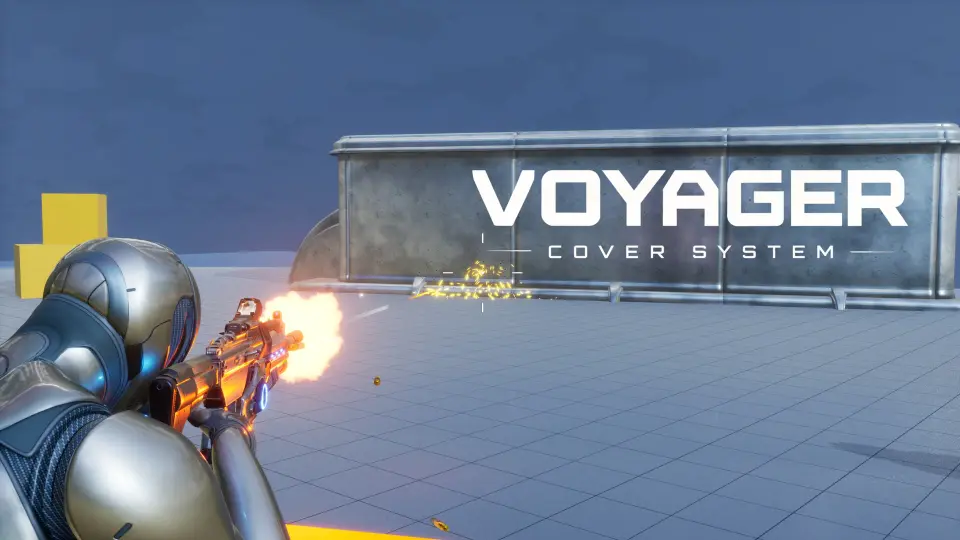
Explore Voyager: Cover System, a 100% Blueprint TPS template with automatic cover detection, Data Asset animations, and modular gameplay components.
Integration via BP_ActionCover and Action System Architecture
Implementing third-person cover mechanics often introduces complex dependencies across character Blueprints, animation instances, and input routers. Voyager: Cover System structures this workflow through an action-centric architecture derived from the Voyager: Action System. The primary bridge between the player character and the cover mechanics is contained within a dedicated action Blueprint designated as BP_ActionCover. By consolidating state changes, raycasts, and positioning routines into this single action module, the system bypasses the spaghetti networks typically associated with sprawling player controllers.
The entire implementation is 100% Blueprint, organized with descriptive comments and built specifically to serve educational and production purposes. Rather than relying on heavy per-tick casts to fetch player status, weapon states, or camera orientations, the logic is strictly event-driven. Event dispatchers and listeners notify individual subsystems when the character enters, traverses, or breaks away from cover. This decoupled structure minimizes performance overhead and simplifies the integration pipeline, enabling developers to merge the system into an established project using the provided step-by-step Migration Guide without re-architecting their existing game code.
Data Asset Animation Configuration
Separating mathematical placement from visual presentation is essential when building adaptable combat mechanics. Voyager: Cover System accomplishes this by driving all cover-related animations through Data Assets. Rather than hardcoding animation sequences, blend spaces, or montage references directly inside state machines or Blueprint logic graphs, developers assign animation assets inside external data containers.
This design pattern allows teams to restyle character performances without touching the underlying calculation algorithms. If a project requires transitioning from tight, tactical low-profile stances to stylized, upright movements, the developer only needs to populate the Data Asset fields with the corresponding animation files. The core logic executes the appropriate transitions, stance changes, and positional offsets purely by reading values from the Data Asset, eliminating regression bugs during visual iteration passes.
Automatic Cover Detection and Mesh Rules Using NoCover
Level design workflows frequently bottleneck when level designers are forced to place invisible volumes, collision proxies, or spline guides along every wall to define valid cover. Voyager: Cover System eliminates manual level setup through an automatic cover detection algorithm. When the character requests to enter cover, the system performs environmental checks that evaluate the geometry in proximity, automatically resolving normals, heights, and surface contours across static or dynamic meshes.
While arbitrary meshes can function as cover automatically, real production scenes inevitably feature decorative props, fragile objects, or irregular geometry that should never serve as viable shielding. To exclude specific objects from the trace evaluation, developers simply add the keyword tag NoCover To the component tags of any static mesh. When the detection algorithm processes potential surfaces, any mesh bearing the NoCover Tag is ignored entirely, allowing the character to filter out small obstacles, decorative trim, or non-viable foliage while snapping cleanly to structural walls and barricades.
Cover Navigation Using MovementInputRotation and Combat Stances
Moving along a surface requires translating camera-relative controller inputs into surface-relative locomotion. Voyager: Cover System resolves this vector translation via MovementInputRotation, an internal calculation that maps the player’s directional inputs against the orientation and normal of the active cover mesh. This ensures smooth movement along wall faces, around corners, and through transitions without character detachment or erratic snapping.
Combat capability within cover demands dynamic directional awareness. The system tracks movement direction and proximity to geometry edges, automatically switching weapon hands between left and right depending on whether the player moves or aims toward the corresponding side. When engaging targets from behind protection, weapon firing logic references mirrored animations tailored to the active side, maintaining natural physical posture and unobstructed lines of fire. In addition to standard ballistic fire, specialized grenade-tossing logic is integrated directly into the cover state, enabling players to aim, arc, and release projectiles while remaining anchored to defensive positions.
DissolveComp, Dynamic HP Bar, and Feedback Components
Alongside its locomotion and defensive logic, Voyager: Cover System includes a collection of independent, component-based utilities suited to general game development tasks. These modular pieces can be detached from the cover framework and dropped onto any actor:
DissolveComp: A material-based dissolve component that handles automated visual transitions across character materials, useful for spawning effects, phasing mechanics, or death animations.
Dynamic HP Bar Component: A drop-on interface component that renders health states with a built-in lazy HP bar feature, displaying immediate damage followed by a gradual decay trail to enhance hit feedback.
Multi-Message System: A lightweight messaging framework capable of managing and stacking multiple concurrent in-game screen notices efficiently without interface clutter.
Surface-Aware Footsteps: An environmental audio detection routine that maps movement audio triggers to physical material types across different ground surfaces.
Crosshair Variety System: A modular targeting interface providing multiple reticle designs to accommodate different weapon types, combat profiles, or aiming states.
Production Alignment and Framework Maintenance
Originally battle-tested within Voyager: Third Person Shooter, this cover template is architecturally compatible with Voyager: Third Person Shooter v3. Because it relies exclusively on standard component-driven patterns, developers can integrate its functional systems piece by piece—extracting the standalone cover calculations, the auxiliary combat components, or the entire starter template as an end-to-end foundation. Technical documentation, active community discord channels, and an external playable demo provide reference points for validating input feel, animation timing, and migration steps prior to deploying the system into full production.
 Gameplay Features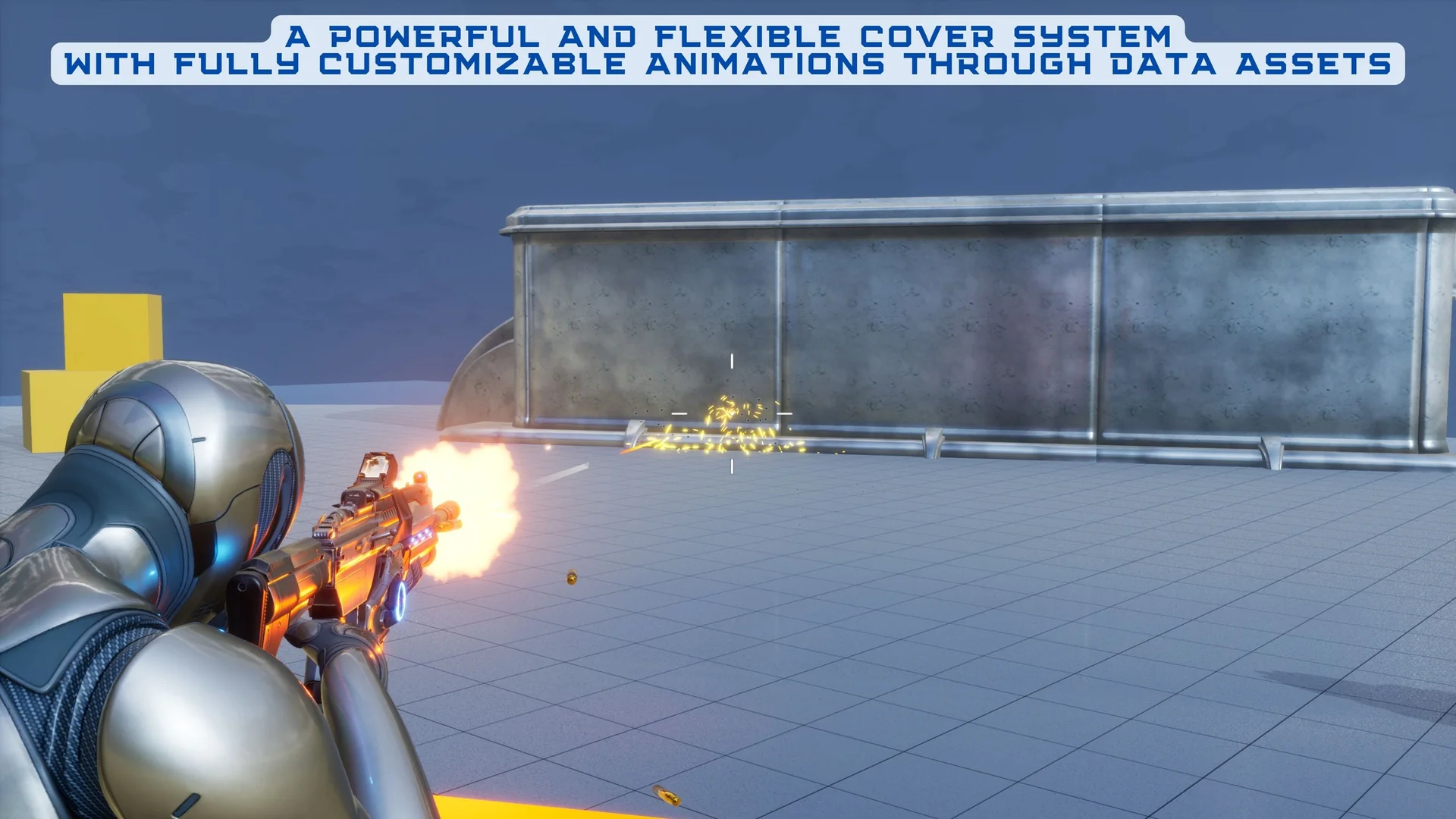
 Gameplay Features
 Gameplay Features
 Gameplay Features