"efaa631e936fd3ee"{"id":"1002247","slug":"ultimate-greyboxing-kit","title":"Ultimate Greyboxing Kit","category":"Procedural Systems","engine":"4.26+,5.0+","assetVersion":"","engineVersion":"Engine Version: 4.26+,5.0+","tag":"Procedural Systems","accent":"blue","visual":"mech","summary":"A rapid level design kit featuring 73 modular shapes, world-aligned materials, and 18 interactive blueprints to block out gameplay before creating final art.","platform":"Unreal Engine","publishedAt":"2026-10-29T16:05:37.804Z","updatedAt":"2026-10-29T16:05:37.804Z","sourceNotes":[],"fileContents":[],"compatibility":["Unreal Engine","Engine Version: 4.26+,5.0+"],"featuredImage":{"alt":"Ultimate Greyboxing Kit","src":"/wp-content/uploads/published/2026/10/c5f8bddc80d5-27f71971-a0bf-4fa3-80be-dfe992256b08-8b95e2cbe5.webp"},"hasDownloadLink":true,"downloads":0,"terms":[{"taxonomy":"category","slug":"procedural-systems","name":"Procedural Systems"}],"galleryImages":[{"src":"/wp-content/uploads/published/2026/10/7e0061f66a25-a0fec99a-f4a4-4951-9b03-184b5ae8aac3-9e31cbc1cd.webp","alt":"Ultimate Greyboxing Kit"},{"src":"/wp-content/uploads/published/2026/10/b0335d9e2e3d-91dcb937-d594-4d04-9f56-7565c6ab6fdf-cb58ce5a27.webp","alt":"Ultimate Greyboxing Kit"},{"src":"/wp-content/uploads/published/2026/10/ce1e7e651abe-c40b9f1b-00c2-4a70-979e-c52bda658f42-de68142eb9.webp","alt":"Ultimate Greyboxing Kit"},{"src":"/wp-content/uploads/published/2026/10/151267c92b96-e33fc605-a298-4ee0-83a9-a9cbcb8aea1a-28eee0129b.webp","alt":"Ultimate Greyboxing Kit"}],"accessPanel":{"kind":"resource","title":"Download this resource","eyebrow":"Free Download","message":"Log in or create a free account to start your download.","fileName":"Content.7z","safetyNote":"Resources are manually reviewed before listing to improve quality and reduce obvious risks.","actionLabel":"Download Free","resourceType":"Resource archive"},"contentHtml":"\u003cp\u003eGreyboxing serves as the foundational phase of level design, letting creators block out architectural spaces and sightlines with primitive geometry to test whether a level layout supports intended movement and combat mechanics before committing resources to final art production. The Ultimate Greyboxing Kit directly targets this stage of development with an integrated setup of 73 modular shapes, 18 functional blueprints, and 14 materials that prioritize measurement accuracy, layout clarity, and immediate gameplay testing.\u003c/p\u003e \u003ch2\u003eModular Shapes and the 100 Unreal Unit Grid\u003c/h2\u003e \u003cp\u003eScale discrepancies early in level construction can derail combat encounters, platforming jumps, and camera angles. Every modular shape in this package is constructed to a standardized scale of 100 unreal units, mapping directly to a 1-meter standard. Because the pieces respect uniform metric metrics, modular components snap together along level grids without awkward offsets or micro-gaps between adjoining floors, walls, and ledges.\u003c/p\u003e \u003cp\u003eAll 73 shapes ship with pre-configured collision meshes. When dropping shapes into a scene, characters instantly register solid boundaries, step heights, and ceiling clearance without requiring manual collision adjustments. This structure allows designers to construct multi-tiered environments, winding corridors, and vertical arena spaces while maintaining predictable collision boundaries throughout testing.\u003c/p\u003e \u003cp\u003eVisual reading of scale during blockouts is maintained through the kit's custom world-aligned material setup. Traditional UV mapping often distorts, stretches, or breaks continuity when static meshes undergo non-uniform scaling or arbitrary rotations during rapid layout sessions. The world-aligned materials used here bypass local UV coordinates, mapping textures according to world space coordinates instead. As designers stretch a block to cover an expansive floor or rotate a wedge into a steep ramp, the grid texture stays consistent in scale, preserves its surface alignment, and shows spatial dimensions at a single glance.\u003c/p\u003e \u003ch2\u003eReplacing BSP Brushes to Maintain Editor Performance\u003c/h2\u003e \u003cp\u003eBlocking out layouts historically involved carving geometry out of binary space partitioning (BSP) brushes. While flexible for quick subtraction and addition, BSP setups introduce serious production friction once levels expand. Adding, subtracting, or shifting a significant volume of BSP geometry triggers level rebuild delays, forcing creators to wait as the engine recalculates geometric intersections and lighting structures.\u003c/p\u003e \u003cp\u003eWorking directly with dedicated modular static mesh shapes eliminates those geometry rebuild pauses. Meshes can be duplicated, transformed, grouped, and deleted instantly without waiting on editor recalculation pipelines. Shifting from BSP brushes to lightweight modular shapes also yields significantly better runtime performance across dense blockouts, ensuring frame rates stay high and gameplay tests reflect actual traversal dynamics rather than engine editor overhead.\u003c/p\u003e \u003ch2\u003eInteractive Blueprints for Level Mechanics and Hazards\u003c/h2\u003e \u003cp\u003eA static layout provides spatial awareness, but gameplay pacing depends heavily on interactive mechanisms, timed obstacles, and environmental threats. The package includes 18 blueprints configured to prototype core puzzle flow, gated progression, and platforming challenges without requiring custom code from scratch.\u003c/p\u003e \u003cp\u003eInteractive traversal can be built out using the included button and trigger plate actors. These triggers link directly to provided moving platforms and dynamic doors, allowing designers to stage locked doorways, pressure-plate elevator ascents, and timed puzzle sequences. Because testing requires iterative tuning, all blueprints are cleanly organized and commented throughout their logic graphs, allowing developers to inspect event flows, modify trigger distances, or tailor activation responses to specific character requirements.\u003c/p\u003e \u003cp\u003eLevel pacing also demands pressure from environmental hazards. The kit incorporates pre-built hazard blueprints, including damaging lava zones, spike traps, and kinetic obstacles that spin or translate continuously along pathways. By dropping these hazard actors into narrow corridors or across platforming chasms, level designers can establish danger zones and test whether jump timing, evade maneuvers, and player survival windows feel fair and readable in raw layout form.\u003c/p\u003e \u003ch2\u003eEvaluating Spatial Flow in the Example Map and Playground\u003c/h2\u003e \u003cp\u003eTwo distinct map environments are bundled with the kit to show practical implementation and asset organization. The first is an example map assembled entirely with the kit's modular components and blueprints, demonstrating how individual 1-meter shapes, world-aligned surfaces, and interactive actors unite into a cohesive, playable greybox layout. Walking through this environment provides immediate insight into pacing, room transitions, and obstacle placement.\u003c/p\u003e \u003cp\u003eThe second bundled environment is a dedicated playground space. This level functions as a hands-on catalogue where designers can directly inspect all 73 modular meshes, test the 14 included materials under consistent lighting, and trigger each of the 18 blueprints. Having an open staging ground allows teams to evaluate mechanical behaviors, observe how moving platforms and damaging zones interact with characters, and test scale relationships before assembling new maps from the library.\u003c/p\u003e \u003ch2\u003eValidating Mechanics Before Production\u003c/h2\u003e \u003cp\u003eSuccessful game production relies on resolving pacing errors, spatial cramps, and sightline problems before environmental artists begin dressing rooms with bespoke models and heavy textures. By providing metric-locked modular shapes, clean collision setups, performance-friendly mesh workflows, and plug-and-play interactive blueprints, this toolset gives level designers a rapid, reliable framework to validate core gameplay loops from the earliest prototype stage.\u003c/p\u003e\n\n\u003ch2\u003eRelated Resources Worth Checking\u003c/h2\u003e\n\u003cul\u003e\n\u003cli\u003e\u003ca href=\"https://3dcghub.com/ultimate-archvis-kit/\" title=\"Ultimate Archvis Kit\"\u003eUltimate Archvis Kit\u003c/a\u003e\u003c/li\u003e\n\u003cli\u003e\u003ca href=\"https://3dcghub.com/ultimate-river-tool/\" title=\"Ultimate River Tool\"\u003eUltimate River Tool\u003c/a\u003e\u003c/li\u003e\n\u003cli\u003e\u003ca href=\"https://3dcghub.com/b2bp-slide-show/\" title=\"B2BP Slide Show\"\u003eB2BP Slide Show\u003c/a\u003e\u003c/li\u003e\n\u003cli\u003e\u003ca href=\"https://3dcghub.com/dynamic-radial-menu-x/\" title=\"DYNAMIC RADIAL MENU X\"\u003eDYNAMIC RADIAL MENU X\u003c/a\u003e\u003c/li\u003e\n\u003cli\u003e\u003ca href=\"https://3dcghub.com/black-hole-creator/\" title=\"Black Hole Creator\"\u003eBlack Hole Creator\u003c/a\u003e\u003c/li\u003e\n\u003c/ul\u003e","contentTextLength":6043,"navigation":{"current":38,"total":4209,"previous":{"id":"1002248","slug":"ultimate-master-shader","title":"Ultimate Master Shader","category":"Nature \u0026 Terrain","platform":"Unreal Engine","updatedAt":"2026-10-29T16:06:20.588Z"},"next":{"id":"1002246","slug":"ultimate-gamedev-bundle","title":"Ultimate GameDev Bundle","category":"Engine Tools","platform":"Unreal Engine","updatedAt":"2026-10-29T16:05:10.720Z"}},"relatedResources":[{"id":"1000407","slug":"ultimate-archvis-kit","title":"Ultimate Archvis Kit","category":"Procedural Systems","engine":"5.1+","assetVersion":"","engineVersion":"Engine Version: 5.1+","tag":"Procedural Systems","accent":"blue","visual":"mech","summary":"A comprehensive Blueprint toolkit for architectural visualization, featuring dynamic UI controls, material swapping, interactive lighting, and profile managemen","platform":"Unreal Engine","publishedAt":"2026-07-08T11:46:44.936Z","updatedAt":"2026-07-08T11:46:44.936Z","sourceNotes":[],"fileContents":[],"compatibility":["Unreal Engine","Engine Version: 5.1+"],"featuredImage":{"alt":"Ultimate Archvis Kit","src":"/wp-content/uploads/published/2026/07/060c703e9991-c4935242-c4ab-41df-bdd0-12d5f98e689c-b6473af33f.webp"},"hasDownloadLink":true,"downloads":0},{"id":"11595","slug":"ultimate-river-tool","title":"Ultimate River Tool","category":"Procedural Systems","engine":"4.26+,5.0+","assetVersion":"Engine version: 4.26+,5.0+","engineVersion":"4.16","tag":"Procedural Systems","accent":"blue","visual":"audio","summary":"The Ultimate River Tool is a powerful component for Unreal Engine 4 designed to simplify the creation of realistic rivers. It features automatic flow-map UV warping and includes a variety of high-resolution forest assets.","platform":"Unreal Engine","publishedAt":"2026-03-05T17:56:24.000Z","updatedAt":"2026-04-19T15:48:09.000Z","sourceNotes":[],"fileContents":[],"compatibility":["Unreal Engine","Engine version: 4.26+,5.0+"],"featuredImage":{"alt":"Ultimate River Tool","src":"https://3dcghub.com/wp-content/uploads/2026/03/69683c65-339f-4f0a-b404-5892c0ef8924.webp"},"hasDownloadLink":true,"downloads":1},{"id":"1002004","slug":"dynamic-radial-menu-x","title":"DYNAMIC RADIAL MENU X","category":"Procedural Systems","engine":"4.26+,5.0+","assetVersion":"","engineVersion":"Engine Version: 4.26+,5.0+","tag":"Procedural Systems","accent":"blue","visual":"mech","summary":"DYNAMIC RADIAL MENU X delivers a data-table-driven radial menu system featuring material-based slices, gamepad controls, and deep trigonometric logic.","platform":"Unreal Engine","publishedAt":"2026-10-26T12:22:30.459Z","updatedAt":"2026-10-26T12:22:30.459Z","sourceNotes":[],"fileContents":[],"compatibility":["Unreal Engine","Engine Version: 4.26+,5.0+"],"featuredImage":{"alt":"DYNAMIC RADIAL MENU X","src":"/wp-content/uploads/published/2026/10/3bb00ef82986-3cc8594e-e9f1-4186-bd3c-c85f855c50c3-f3e5843abf.webp"},"hasDownloadLink":true,"downloads":0}]}
Procedural Systems
Ultimate Greyboxing Kit
A rapid level design kit featuring 73 modular shapes, world-aligned materials, and 18 interactive blueprints to block out gameplay before creating final art.
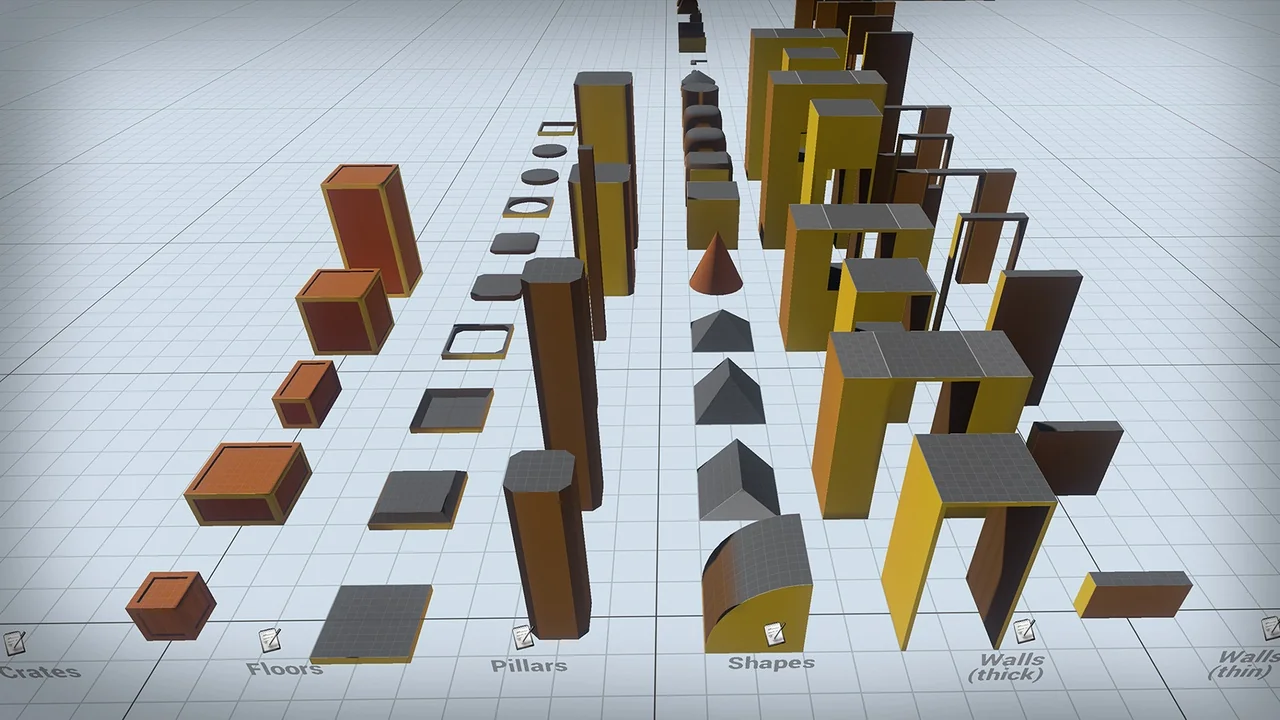
Greyboxing serves as the foundational phase of level design, letting creators block out architectural spaces and sightlines with primitive geometry to test whether a level layout supports intended movement and combat mechanics before committing resources to final art production. The Ultimate Greyboxing Kit directly targets this stage of development with an integrated setup of 73 modular shapes, 18 functional blueprints, and 14 materials that prioritize measurement accuracy, layout clarity, and immediate gameplay testing.
Modular Shapes and the 100 Unreal Unit Grid
Scale discrepancies early in level construction can derail combat encounters, platforming jumps, and camera angles. Every modular shape in this package is constructed to a standardized scale of 100 unreal units, mapping directly to a 1-meter standard. Because the pieces respect uniform metric metrics, modular components snap together along level grids without awkward offsets or micro-gaps between adjoining floors, walls, and ledges.
All 73 shapes ship with pre-configured collision meshes. When dropping shapes into a scene, characters instantly register solid boundaries, step heights, and ceiling clearance without requiring manual collision adjustments. This structure allows designers to construct multi-tiered environments, winding corridors, and vertical arena spaces while maintaining predictable collision boundaries throughout testing.
Visual reading of scale during blockouts is maintained through the kit's custom world-aligned material setup. Traditional UV mapping often distorts, stretches, or breaks continuity when static meshes undergo non-uniform scaling or arbitrary rotations during rapid layout sessions. The world-aligned materials used here bypass local UV coordinates, mapping textures according to world space coordinates instead. As designers stretch a block to cover an expansive floor or rotate a wedge into a steep ramp, the grid texture stays consistent in scale, preserves its surface alignment, and shows spatial dimensions at a single glance.
Replacing BSP Brushes to Maintain Editor Performance
Blocking out layouts historically involved carving geometry out of binary space partitioning (BSP) brushes. While flexible for quick subtraction and addition, BSP setups introduce serious production friction once levels expand. Adding, subtracting, or shifting a significant volume of BSP geometry triggers level rebuild delays, forcing creators to wait as the engine recalculates geometric intersections and lighting structures.
Working directly with dedicated modular static mesh shapes eliminates those geometry rebuild pauses. Meshes can be duplicated, transformed, grouped, and deleted instantly without waiting on editor recalculation pipelines. Shifting from BSP brushes to lightweight modular shapes also yields significantly better runtime performance across dense blockouts, ensuring frame rates stay high and gameplay tests reflect actual traversal dynamics rather than engine editor overhead.
Interactive Blueprints for Level Mechanics and Hazards
A static layout provides spatial awareness, but gameplay pacing depends heavily on interactive mechanisms, timed obstacles, and environmental threats. The package includes 18 blueprints configured to prototype core puzzle flow, gated progression, and platforming challenges without requiring custom code from scratch.
Interactive traversal can be built out using the included button and trigger plate actors. These triggers link directly to provided moving platforms and dynamic doors, allowing designers to stage locked doorways, pressure-plate elevator ascents, and timed puzzle sequences. Because testing requires iterative tuning, all blueprints are cleanly organized and commented throughout their logic graphs, allowing developers to inspect event flows, modify trigger distances, or tailor activation responses to specific character requirements.
Level pacing also demands pressure from environmental hazards. The kit incorporates pre-built hazard blueprints, including damaging lava zones, spike traps, and kinetic obstacles that spin or translate continuously along pathways. By dropping these hazard actors into narrow corridors or across platforming chasms, level designers can establish danger zones and test whether jump timing, evade maneuvers, and player survival windows feel fair and readable in raw layout form.
Evaluating Spatial Flow in the Example Map and Playground
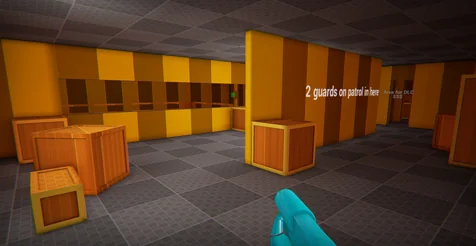
Two distinct map environments are bundled with the kit to show practical implementation and asset organization. The first is an example map assembled entirely with the kit's modular components and blueprints, demonstrating how individual 1-meter shapes, world-aligned surfaces, and interactive actors unite into a cohesive, playable greybox layout. Walking through this environment provides immediate insight into pacing, room transitions, and obstacle placement.
The second bundled environment is a dedicated playground space. This level functions as a hands-on catalogue where designers can directly inspect all 73 modular meshes, test the 14 included materials under consistent lighting, and trigger each of the 18 blueprints. Having an open staging ground allows teams to evaluate mechanical behaviors, observe how moving platforms and damaging zones interact with characters, and test scale relationships before assembling new maps from the library.
Validating Mechanics Before Production
Successful game production relies on resolving pacing errors, spatial cramps, and sightline problems before environmental artists begin dressing rooms with bespoke models and heavy textures. By providing metric-locked modular shapes, clean collision setups, performance-friendly mesh workflows, and plug-and-play interactive blueprints, this toolset gives level designers a rapid, reliable framework to validate core gameplay loops from the earliest prototype stage.
 Procedural Systems
 Procedural Systems
 Procedural Systems
 Procedural Systems