"efaa631e936fd3ee"{"id":"1002248","slug":"ultimate-master-shader","title":"Ultimate Master Shader","category":"Nature \u0026 Terrain","engine":"5.0+","assetVersion":"","engineVersion":"Engine Version: 5.0+","tag":"Nature \u0026 Terrain","accent":"blue","visual":"mech","summary":"An in-depth look at Ultimate Master Shader, covering world aligned overlays, precomputed AO dirt masking, parallax mapping, and asset references.","platform":"Unreal Engine","publishedAt":"2026-10-29T16:06:20.588Z","updatedAt":"2026-10-29T16:06:20.588Z","sourceNotes":[],"fileContents":[],"compatibility":["Unreal Engine","Engine Version: 5.0+"],"featuredImage":{"alt":"Ultimate Master Shader","src":"/wp-content/uploads/published/2026/10/37b90ac65d55-22462fa3-b190-4846-8b49-2b7f255ff657-c2bdcdba46.webp"},"hasDownloadLink":true,"downloads":0,"terms":[{"taxonomy":"category","slug":"nature-and-terrain","name":"Nature \u0026 Terrain"}],"galleryImages":[{"src":"/wp-content/uploads/published/2026/10/846c0a2996a2-32157a86-0171-48dd-a287-eb56f2ba0b04-046b3489b1.webp","alt":"Ultimate Master Shader"},{"src":"/wp-content/uploads/published/2026/10/4d3df4e34993-4d1526bc-c471-404e-bc3f-7e60cfb3141c-635184f0d8.webp","alt":"Ultimate Master Shader"},{"src":"/wp-content/uploads/published/2026/10/45443ba1c38c-2f0a2eb8-1957-46cb-8cf4-27e1ee0b37a5-f6c6f03f1a.webp","alt":"Ultimate Master Shader"},{"src":"/wp-content/uploads/published/2026/10/04e7a1b5a700-1e522b72-160b-464e-afa2-9994b045ce00-b92ef45bff.webp","alt":"Ultimate Master Shader"},{"src":"/wp-content/uploads/published/2026/10/dac4fac5ae8d-976b6b96-1bf4-47a9-baab-772a23da7ef1-1a88b53fb0.webp","alt":"Ultimate Master Shader"},{"src":"/wp-content/uploads/published/2026/10/c1d48a421dac-359200de-2089-47bd-a795-469956f50837-adea65654e.webp","alt":"Ultimate Master Shader"},{"src":"/wp-content/uploads/published/2026/10/aa87afd166d4-9bd2e9b5-1106-4ffc-bc32-35f404e714f2-8c739829a5.webp","alt":"Ultimate Master Shader"},{"src":"/wp-content/uploads/published/2026/10/d268d62b963d-54ae832f-16e5-4ccd-97e0-3b2deadc5137-b7c3f10a55.webp","alt":"Ultimate Master Shader"},{"src":"/wp-content/uploads/published/2026/10/bcbdfeefebe4-a348dcf4-c165-43c1-b776-f9ba0377e17d-75cdd596a3.webp","alt":"Ultimate Master Shader"},{"src":"/wp-content/uploads/published/2026/10/4d77ceb961a3-34c15e6a-9cba-401f-b730-59942d255859-506f50e06a.webp","alt":"Ultimate Master Shader"}],"accessPanel":{"kind":"resource","title":"Download this resource","eyebrow":"Free Download","message":"Log in or create a free account to start your download.","fileName":"Content.7z","safetyNote":"Resources are manually reviewed before listing to improve quality and reduce obvious risks.","actionLabel":"Download Free","resourceType":"Resource archive"},"contentHtml":"\u003cp\u003eSurfaces across complex environment geometry often break down at UV boundaries, requiring unified coordinate spaces to maintain visual continuity. Ultimate Master Shader addresses projection seams and modular blending by operating across coordinate systems that prioritize triplanar projection, precomputed ambient occlusion data, and vertex-driven layer distribution. Rather than locking textures strictly to local UV coordinates, the material architecture incorporates world aligned projection and dedicated world aligned albedo overlays to cast textures across static meshes without requiring unique texture bakes for every discrete prop.\u003c/p\u003e \u003ch2\u003eWorld Aligned Mapping and Albedo Overlay Mechanics\u003c/h2\u003e\n\u003cp\u003eTriplanar projection across world space prevents texture distortion on continuous architectural meshes, cliffs, and expansive landscape formations. In large-scale environment assemblies, objects scaled or tiled non-uniformly run the risk of stretching base textures. Ultimate Master Shader counters this behavior through its world aligned toolset, which decouples texture mapping from local UV unwraps.\u003c/p\u003e\n\u003cp\u003eThe system features a dedicated world aligned albedo overlay. This overlay acts as a macro-level surface pass, allowing environmental artists to project continuous tone variations, generalized surface grime, or secondary colorations across multiple intersecting meshes simultaneously. A key revision resolved issues where world alignment failed to process correctly on emissive material channels. With emissive world alignment functioning alongside diffuse and normal components, light-emitting details, glowing veins, or illuminated scientific markings adhere uniformly to world coordinates across complex assemblies without spatial offsets.\u003c/p\u003e \u003ch2\u003ePrecomputed AO Dirt Masking and Vertex Controls\u003c/h2\u003e\n\u003cp\u003eGrounding assets within a scene demands accurate contact shadows and localized grime accumulation. Ultimate Master Shader leverages dirt calculated directly from precomputed ambient occlusion. By extracting occlusion data calculated during lighting precomputations or baked surface passes, the shader generates realistic dirt deposition in occluded crevices, underhangs, and contact points between intersecting props.\u003c/p\u003e\n\u003cp\u003eThis automated dirt pass operates in tandem with direct vertex controls. Using vertex channels, artists can paint and manipulate secondary material layers directly within the viewport. The framework supports localized layer transitions tailored for:\u003c/p\u003e\n\u003cul\u003e \u003cli\u003eDirt and environmental sediment gathering in structural recesses\u003c/li\u003e \u003cli\u003eMoss growth clinging to damp stone faces and rock groupings\u003c/li\u003e \u003cli\u003eBlood splatter applications for combat zones or environmental storytelling\u003c/li\u003e \u003cli\u003ePeeling or layered paint applied across structural elements\u003c/li\u003e \u003cli\u003eCustom boundary transitions across diverse ground and meshing assets\u003c/li\u003e\n\u003c/ul\u003e\n\u003cp\u003eBecause these layers rely on vertex painting and calculated occlusion rather than bespoke unique texture sets per model, repetitive geometry can be scattered throughout a level while maintaining unique wear patterns across every instance.\u003c/p\u003e \u003ch2\u003eParallax, Snow, and Ice Surface Layers\u003c/h2\u003e\n\u003cp\u003eGeometric relief without geometry overhead relies on advanced shading algorithms. Ultimate Master Shader integrates parallax mapping, shifting texture coordinates based on the camera view angle to simulate physical depth across surface crevices. This optical displacement gives dramatic depth to cobblestone walkways, rough ground planes, and rugged stone surfaces that would otherwise look flat under glancing light angles.\u003c/p\u003e\n\u003cp\u003eBeyond standard rock and ground textures, the shader implements dedicated logic for dynamic weather conditions like snow and ice. The snow layer works through directional masking, allowing clean or melting snow to accumulate naturally on upward-facing polygon faces. In cold-weather settings or sub-surface conditions, the ice framework provides the necessary visual translucency and gloss profiles, fitting both organic landscape formations and prop-scale applications.\u003c/p\u003e \u003ch2\u003eMegascans Texture Setup and Included Assets\u003c/h2\u003e\n\u003cp\u003eThe package ships directly with 9 bonus textures configured for the master material, providing immediate out-of-the-box utility for core shading functions. For expanded scene production, the shader is matched against specific surface and prop scans from the Megascans library via Bridge. Production teams seeking identical surface responses can reference the exact scan identifiers used across demonstration configurations:\u003c/p\u003e\n\u003cul\u003e \u003cli\u003e\u003cstrong\u003eRust:\u003c/strong\u003e \u003ccode\u003eTjzmddvew\u003c/code\u003e\u003c/li\u003e \u003cli\u003e\u003cstrong\u003eMailbox:\u003c/strong\u003e \u003ccode\u003eUhcjaisfa\u003c/code\u003e\u003c/li\u003e \u003cli\u003e\u003cstrong\u003eCobblestone:\u003c/strong\u003e \u003ccode\u003eTlimejvew\u003c/code\u003e\u003c/li\u003e \u003cli\u003e\u003cstrong\u003eWooden carafe:\u003c/strong\u003e \u003ccode\u003eUdzjebtfa\u003c/code\u003e\u003c/li\u003e \u003cli\u003e\u003cstrong\u003eIce:\u003c/strong\u003e \u003ccode\u003eTcbkdcfr\u003c/code\u003e\u003c/li\u003e \u003cli\u003e\u003cstrong\u003eIvy:\u003c/strong\u003e \u003ccode\u003eTg1ohjh\u003c/code\u003e\u003c/li\u003e \u003cli\u003e\u003cstrong\u003eSnow:\u003c/strong\u003e \u003ccode\u003eUgspafgdy\u003c/code\u003e\u003c/li\u003e \u003cli\u003e\u003cstrong\u003eCliff:\u003c/strong\u003e \u003ccode\u003eUbhubhyda\u003c/code\u003e\u003c/li\u003e\n\u003c/ul\u003e\n\u003cp\u003eThese assets demonstrate the material's range across diverse surface physicalities, covering weathered man-made props such as the mailbox, worn organic materials like the wooden carafe, deep natural cliff geometry, and dense cobblestone surfaces.\u003c/p\u003e \u003ch2\u003eBook Generator Compatibility and Production Role\u003c/h2\u003e\n\u003cp\u003eIn addition to standard environment, ground, and studio meshing, the shader maintains verified compatibility with Book Generator workflows. This integration allows automated prop generation systems to ingest the shader's wear passes, vertex-driven distress, and surface overlays directly onto generated book assets, library clutter, and tabletop scatter.\u003c/p\u003e\n\u003cp\u003eBy pairing world aligned projection, precomputed AO dirt accumulation, and parallax mapping in a single master material, Ultimate Master Shader provides environment artists with an efficient path to texture blending. Whether populating rugged natural biomes layered in snow and moss or structuring cluttered prop assemblies, the asset eliminates repetitive manual UV unwrapping in favor of unified, world-aware surface rendering.\u003c/p\u003e\n\n\u003ch2\u003eExplore Similar Assets\u003c/h2\u003e\n\u003cul\u003e\n\u003cli\u003e\u003ca href=\"https://3dcghub.com/ultimate-water-shader-ue4-and-5/\" title=\"Ultimate Water Shader UE4 and 5\"\u003eUltimate Water Shader UE4 and 5\u003c/a\u003e\u003c/li\u003e\n\u003cli\u003e\u003ca href=\"https://3dcghub.com/ground-material-texture-pack-advanced-materials-5-variations/\" title=\"Ground Material Texture Pack (Advanced Materials / 5 Variations)\"\u003eGround Material Texture Pack (Advanced Materials / 5 Variations)\u003c/a\u003e\u003c/li\u003e\n\u003cli\u003e\u003ca href=\"https://3dcghub.com/ice-world/\" title=\"Ice World\"\u003eIce World\u003c/a\u003e\u003c/li\u003e\n\u003cli\u003e\u003ca href=\"https://3dcghub.com/lava-shader/\" title=\"Lava Shader\"\u003eLava Shader\u003c/a\u003e\u003c/li\u003e\n\u003cli\u003e\u003ca href=\"https://3dcghub.com/brushify-environment-shaders-pack/\" title=\"Brushify - Environment Shaders Pack\"\u003eBrushify - Environment Shaders Pack\u003c/a\u003e\u003c/li\u003e\n\u003c/ul\u003e","contentTextLength":5827,"navigation":{"current":37,"total":4209,"previous":{"id":"1002249","slug":"ultimate-rts-camera","title":"Ultimate RTS Camera","category":"Gameplay Features","platform":"Unreal Engine","updatedAt":"2026-10-29T16:09:33.483Z"},"next":{"id":"1002247","slug":"ultimate-greyboxing-kit","title":"Ultimate Greyboxing Kit","category":"Procedural Systems","platform":"Unreal Engine","updatedAt":"2026-10-29T16:05:37.804Z"}},"relatedResources":[{"id":"1000110","slug":"ultimate-water-shader-ue4-and-5","title":"Ultimate Water Shader UE4 and 5","category":"Nature \u0026 Terrain","engine":"5.5+","assetVersion":"","engineVersion":"Engine Version: 5.5+","tag":"Nature \u0026 Terrain","accent":"blue","visual":"mech","summary":"A closer look at Ultimate Water Shader UE4 and 5, including the foam switch update, demonstration asset limits, and vertex-paint usage details.","platform":"Unreal Engine","publishedAt":"2026-06-07T23:05:08.990Z","updatedAt":"2026-10-21T04:23:33.864Z","sourceNotes":[],"fileContents":[],"compatibility":["Unreal Engine","Engine Version: 5.5+"],"featuredImage":{"alt":"Ultimate Water Shader UE4 and 5","src":"/wp-content/uploads/published/2026/06/e5b4054377ff-711c52d1-2ae1-456d-bcb4-5cd0d403477f-aa527e6a9f.webp"},"hasDownloadLink":true,"downloads":2},{"id":"12770","slug":"ground-material-texture-pack-advanced-materials-5-variations","title":"Ground Material Texture Pack (Advanced Materials / 5 Variations)","category":"Nature \u0026 Terrain","engine":"5.1+","assetVersion":"Engine version: 5.1+","engineVersion":"5.1","tag":"Nature \u0026 Terrain","accent":"blue","visual":"luts","summary":"Build believable natural landscapes with this versatile ground material pack. It includes five unique tiling textures, master materials, and material instances for easy customization.","platform":"Unreal Engine","publishedAt":"2026-03-09T16:36:13.000Z","updatedAt":"2026-04-19T15:46:36.000Z","sourceNotes":[],"fileContents":[],"compatibility":["Unreal Engine","Engine version: 5.1+"],"featuredImage":{"alt":"Ground Material Texture Pack (Advanced Materials / 5 Variations)","src":"https://3dcghub.com/wp-content/uploads/2026/03/3f181444-e9ff-4f49-91c9-f3cec31921a1.webp"},"hasDownloadLink":true,"downloads":3},{"id":"12818","slug":"ice-world","title":"Ice World","category":"Nature \u0026 Terrain","engine":"5.1+","assetVersion":"Engine version: 5.1+","engineVersion":"4.14","tag":"Nature \u0026 Terrain","accent":"blue","visual":"luts","summary":"Ice World provides a comprehensive library of ice materials designed for lakes, rivers, and standard lit models. This asset pack features advanced shaders that remove tiling and offer deep customization for realistic or stylized winter scenes.","platform":"Unreal Engine","publishedAt":"2026-03-09T17:38:04.000Z","updatedAt":"2026-04-19T15:46:36.000Z","sourceNotes":[],"fileContents":[],"compatibility":["Unreal Engine","Engine version: 5.1+"],"featuredImage":{"alt":"Ice World","src":"https://3dcghub.com/wp-content/uploads/2026/03/59b80838-ea0a-4fe4-b1cf-79456bfdbe76.webp"},"hasDownloadLink":true,"downloads":0}]}
Nature & Terrain
Ultimate Master Shader
An in-depth look at Ultimate Master Shader, covering world aligned overlays, precomputed AO dirt masking, parallax mapping, and asset references.
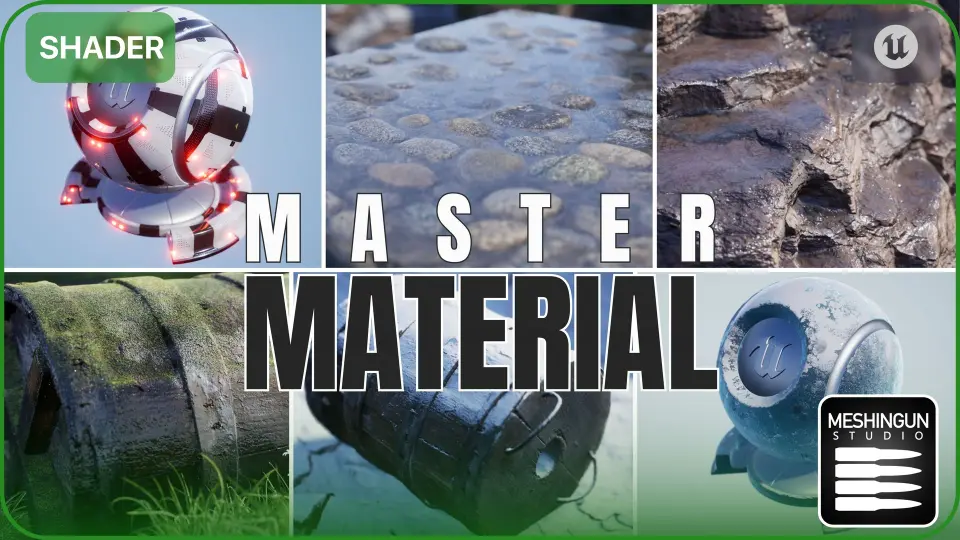
Surfaces across complex environment geometry often break down at UV boundaries, requiring unified coordinate spaces to maintain visual continuity. Ultimate Master Shader addresses projection seams and modular blending by operating across coordinate systems that prioritize triplanar projection, precomputed ambient occlusion data, and vertex-driven layer distribution. Rather than locking textures strictly to local UV coordinates, the material architecture incorporates world aligned projection and dedicated world aligned albedo overlays to cast textures across static meshes without requiring unique texture bakes for every discrete prop.
World Aligned Mapping and Albedo Overlay Mechanics
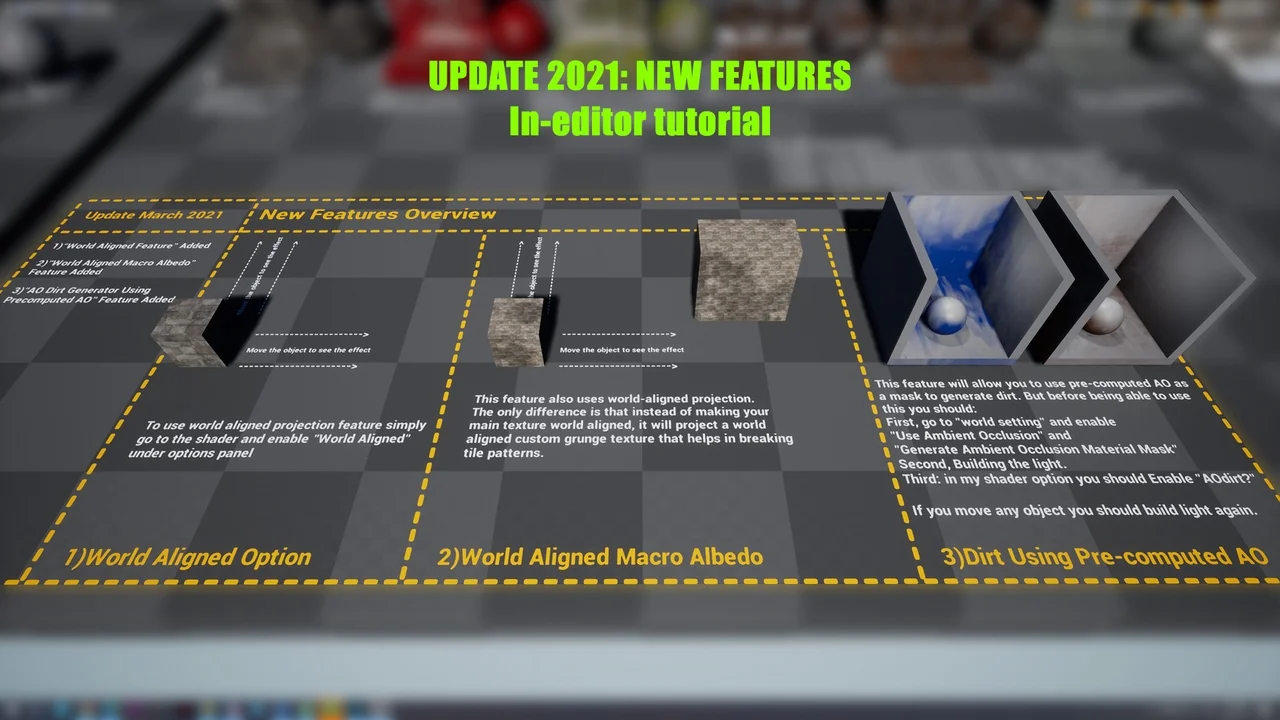
Triplanar projection across world space prevents texture distortion on continuous architectural meshes, cliffs, and expansive landscape formations. In large-scale environment assemblies, objects scaled or tiled non-uniformly run the risk of stretching base textures. Ultimate Master Shader counters this behavior through its world aligned toolset, which decouples texture mapping from local UV unwraps.
The system features a dedicated world aligned albedo overlay. This overlay acts as a macro-level surface pass, allowing environmental artists to project continuous tone variations, generalized surface grime, or secondary colorations across multiple intersecting meshes simultaneously. A key revision resolved issues where world alignment failed to process correctly on emissive material channels. With emissive world alignment functioning alongside diffuse and normal components, light-emitting details, glowing veins, or illuminated scientific markings adhere uniformly to world coordinates across complex assemblies without spatial offsets.
Precomputed AO Dirt Masking and Vertex Controls
Grounding assets within a scene demands accurate contact shadows and localized grime accumulation. Ultimate Master Shader leverages dirt calculated directly from precomputed ambient occlusion. By extracting occlusion data calculated during lighting precomputations or baked surface passes, the shader generates realistic dirt deposition in occluded crevices, underhangs, and contact points between intersecting props.
This automated dirt pass operates in tandem with direct vertex controls. Using vertex channels, artists can paint and manipulate secondary material layers directly within the viewport. The framework supports localized layer transitions tailored for:
Dirt and environmental sediment gathering in structural recesses
Moss growth clinging to damp stone faces and rock groupings
Blood splatter applications for combat zones or environmental storytelling
Peeling or layered paint applied across structural elements
Custom boundary transitions across diverse ground and meshing assets
Because these layers rely on vertex painting and calculated occlusion rather than bespoke unique texture sets per model, repetitive geometry can be scattered throughout a level while maintaining unique wear patterns across every instance.
Parallax, Snow, and Ice Surface Layers
Geometric relief without geometry overhead relies on advanced shading algorithms. Ultimate Master Shader integrates parallax mapping, shifting texture coordinates based on the camera view angle to simulate physical depth across surface crevices. This optical displacement gives dramatic depth to cobblestone walkways, rough ground planes, and rugged stone surfaces that would otherwise look flat under glancing light angles.
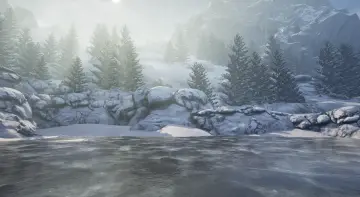
Beyond standard rock and ground textures, the shader implements dedicated logic for dynamic weather conditions like snow and ice. The snow layer works through directional masking, allowing clean or melting snow to accumulate naturally on upward-facing polygon faces. In cold-weather settings or sub-surface conditions, the ice framework provides the necessary visual translucency and gloss profiles, fitting both organic landscape formations and prop-scale applications.
Megascans Texture Setup and Included Assets
The package ships directly with 9 bonus textures configured for the master material, providing immediate out-of-the-box utility for core shading functions. For expanded scene production, the shader is matched against specific surface and prop scans from the Megascans library via Bridge. Production teams seeking identical surface responses can reference the exact scan identifiers used across demonstration configurations:
Rust:Tjzmddvew
Mailbox:Uhcjaisfa
Cobblestone:Tlimejvew
Wooden carafe:Udzjebtfa
Ice:Tcbkdcfr
Ivy:Tg1ohjh
Snow:Ugspafgdy
Cliff:Ubhubhyda
These assets demonstrate the material's range across diverse surface physicalities, covering weathered man-made props such as the mailbox, worn organic materials like the wooden carafe, deep natural cliff geometry, and dense cobblestone surfaces.
Book Generator Compatibility and Production Role
In addition to standard environment, ground, and studio meshing, the shader maintains verified compatibility with Book Generator workflows. This integration allows automated prop generation systems to ingest the shader's wear passes, vertex-driven distress, and surface overlays directly onto generated book assets, library clutter, and tabletop scatter.
By pairing world aligned projection, precomputed AO dirt accumulation, and parallax mapping in a single master material, Ultimate Master Shader provides environment artists with an efficient path to texture blending. Whether populating rugged natural biomes layered in snow and moss or structuring cluttered prop assemblies, the asset eliminates repetitive manual UV unwrapping in favor of unified, world-aware surface rendering.
 Nature & Terrain
 Nature & Terrain
 Nature & Terrain
 Nature & Terrain