"ddd0e3fb95b0aec2"{"id":"1001564","slug":"ucreate-fractal-toolkit","title":"UCreate - Fractal Toolkit","category":"Buildings \u0026 Architecture","engine":"5.3+","assetVersion":"","engineVersion":"Engine Version: 5.3+","tag":"Buildings","accent":"blue","visual":"mech","summary":"Explore UCreate - Fractal Toolkit for Unreal Engine, featuring 43 materials, procedural deformation blueprints, and modular architectural setups.","platform":"Unreal Engine","publishedAt":"2026-10-10T03:55:40.075Z","updatedAt":"2026-10-10T03:55:40.075Z","sourceNotes":[],"fileContents":[],"compatibility":["Unreal Engine","Engine Version: 5.3+"],"featuredImage":{"alt":"UCreate - Fractal Toolkit","src":"/wp-content/uploads/published/2026/10/e35586eedaeb-85a00bc5-fc61-4b36-8410-f9b57967ce59-4a9eac4256.webp"},"hasDownloadLink":true,"downloads":0,"terms":[{"taxonomy":"category","slug":"buildings-and-architecture","name":"Buildings \u0026 Architecture"}],"galleryImages":[{"src":"/wp-content/uploads/published/2026/10/830f702acfb2-b4105942-c2db-4c3c-af62-bff007064277-bb68f59aeb.webp","alt":"UCreate - Fractal Toolkit"},{"src":"/wp-content/uploads/published/2026/10/2f4869c96edd-b3696c0d-6f93-4f7d-911f-8c45334ae39c-0eb4294753.webp","alt":"UCreate - Fractal Toolkit"},{"src":"/wp-content/uploads/published/2026/10/2adb7fa6371d-366e30b3-f9d7-4c6e-887d-0a2ecc2a462d-7a471e50f0.webp","alt":"UCreate - Fractal Toolkit"},{"src":"/wp-content/uploads/published/2026/10/d0a336dbb858-6146ef6e-625e-4e4e-99c4-bfc4c898acd3-545e90c755.webp","alt":"UCreate - Fractal Toolkit"},{"src":"/wp-content/uploads/published/2026/10/d6cfe25237ca-8907832d-ba1d-427f-a4ec-c966308ee871-d16aaf6456.webp","alt":"UCreate - Fractal Toolkit"},{"src":"/wp-content/uploads/published/2026/10/bae1bfe6bb75-183c9fc1-0a2a-422e-bbac-444ae2671fcb-40555c21d2.webp","alt":"UCreate - Fractal Toolkit"},{"src":"/wp-content/uploads/published/2026/10/9bdc9cf77eec-fdd881a5-2183-4c8a-b95b-de99cd947e7b-15d920fdf0.webp","alt":"UCreate - Fractal Toolkit"},{"src":"/wp-content/uploads/published/2026/10/8d16fcc4a1bd-a45030c7-b82e-4bfb-ad1b-3d387118fb8a-e80cbaf648.webp","alt":"UCreate - Fractal Toolkit"},{"src":"/wp-content/uploads/published/2026/10/5ac32f54b056-9b078b4f-f16f-4a2c-9685-6383e9602447-293450791a.webp","alt":"UCreate - Fractal Toolkit"},{"src":"/wp-content/uploads/published/2026/10/1d566e0fd440-cfaec550-ef0b-479e-965f-14b8795877f1-2d805ad6b4.webp","alt":"UCreate - Fractal Toolkit"}],"accessPanel":{"kind":"resource","title":"Download this resource","eyebrow":"Free Download","message":"Log in or create a free account to start your download.","fileName":"Content.7z","safetyNote":"Resources are manually reviewed before listing to improve quality and reduce obvious risks.","actionLabel":"Download Free","resourceType":"Resource archive"},"contentHtml":"\u003ch2\u003eConstructing Complex Environments with UCreate - Fractal Toolkit\u003c/h2\u003e\u003cp\u003eUCreate - Fractal Toolkit is based on a collection of intricate geometric meshes originally created in free fractal software, then refined, cleaned, and adapted for direct use inside Unreal Engine. Rather than limiting users to static geometric sculptures, the toolkit approaches fractals as modular building blocks. The included components are shaped to construct complete strongholds, sprawling temples, subterranean dungeons, and alien horizons across surreal, fantasy, sci-fi, and horror settings.\u003c/p\u003e\u003cp\u003eThe geometry carries the sharp, repetitive complexity characteristic of mathematical fractals while maintaining practical performance inside modern engine pipelines that leverage Nanite and Lumen. Because these forms feature high-density visual detail, the toolkit pairs them with dedicated generation tools and surface shaders that keep structural assembly fluid.\u003c/p\u003e\u003ch2\u003eArray and Mesh Multi Deform Blueprints\u003c/h2\u003e\u003cp\u003eAssembling large-scale architecture out of individual fractal assets can quickly become tedious without automated transformation tools. To address this, the toolkit includes four dedicated blueprints designed to expedite environmental layout: 3D Array, Circular Array, Spline Deform, and Mesh Multi Deform, which is supported in Unreal Engine 5.1 and newer versions.\u003c/p\u003e\u003cp\u003eThe 3D Array blueprint duplicates and steps geometry across three-dimensional coordinate spaces, allowing artists to rapidly assemble recurring modular halls, lattice-like pillars, and vast temple complexes. The Circular Array blueprint distributes assets along rotational axes, making it straightforward to construct circular arenas, rotunda ceilings, and radial strongholds. When winding paths or fluid, organic shapes are required, the Spline Deform blueprint twists and directs fractal meshes along custom curve trajectories. Mesh Multi Deform extends this manipulation further by chaining and combining shape deformations, transforming standard stock meshes into entirely novel architectural silhouettes without leaving the editor.\u003c/p\u003e\u003ch2\u003eMaster Material Pipeline and Curvature Blending\u003c/h2\u003e\u003cp\u003eManaging surface data across dense, non-standard fractal geometry presents distinct texturing challenges. The master material in the toolkit incorporates both standard UV tiling and triplanar projection modes. Triplanar mapping allows meshes without clean UV unwrapping—or custom geometric imports—to receive textures without visible seams or stretching across complex topology.\u003c/p\u003e\u003cp\u003eSurface fidelity is driven by tailored texture bakes. Every fractal asset includes a dedicated Normal map baked directly from high-polygon source geometry, an optional Ambient Occlusion map to preserve recessed shadowing, and a specialized RGA mask. This RGA mask enables precise curvature-based blending between two distinct material layers, alongside a dedicated, adjustable dirt pass that settles grime into crevices.\u003c/p\u003e\u003cp\u003eTo simulate environmental weathering across scenes, the master material provides an automatic, slope- and angle-based dust mask. This procedural mask can be switched to deposit layers of snow, moss, sand, rust, or cooling lava on upward-facing surfaces. Every component—including ambient occlusion blending, curvature transitions, and surface dust—can be toggled and calibrated directly within individual material instances, giving artists granular control over local surface properties.\u003c/p\u003e\u003ch2\u003eThe 43-Material Library and Texture Flexibility\u003c/h2\u003e\u003cp\u003eThe package comes equipped with 43 ready-to-use materials, split between abstract surfaces and realistic terrain types. The core fractal set contains 32 materials derived from 10 distinct fractal patterns, with two to three aesthetic variations supplied for each set. These patterns mirror the geometric cadence of the underlying meshes, reinforcing the alien aesthetic of the architecture.\u003c/p\u003e\u003cp\u003eAlongside the mathematical textures, the pack provides 11 traditional surface materials: rock, lava, ice, marble, snow, moss, sand, rust, and gold, as well as three abstract minerals. These standard materials allow modular pieces to blend naturally into rocky caves, molten underworlds, or frozen wastes. For studios working with internal look-development libraries, the master material is not locked to the provided patterns; it fully accepts external texture sets to align with custom art directions.\u003c/p\u003e\u003ch2\u003eProcedural Foliage and Example Levels\u003c/h2\u003e\u003cp\u003eTo demonstrate practical implementation methods, the toolkit includes seven distinct example scenes that showcase different environmental scales and styling directions. These demonstration levels illustrate how structural modularity, blueprint arrays, and material variations interact under active lighting setups.\u003c/p\u003e\u003cp\u003eAmong these showcases, the level named Example_level_Fantasy illustrates how fractal pieces can interface with Unreal Engine’s Procedural Foliage system. In this environment, fractal meshes are treated as foliage instances to generate expansive, alien fractal forests with dense canopies and unusual branch networks across landscape terrains. When loading this specific level, Virtual Texture support must be enabled within the Project Settings to guarantee that all mesh materials render and stream properly.\u003c/p\u003e\u003ch2\u003eProduction Takeaway\u003c/h2\u003e\u003cp\u003eUCreate - Fractal Toolkit provides a focused bridge between mathematical fractal generation and real-time level design. By combining high-poly baked normal maps, triplanar projection fallbacks, procedural scattering blueprints, and curvature-driven weathering, the asset pack gives technical artists and level designers the practical framework needed to assemble vast, surreal structures without battling the typical technical bottlenecks of abstract geometry.\u003c/p\u003e\n\n\u003ch2\u003eMore From The Same Workflow\u003c/h2\u003e\n\u003cul\u003e\n\u003cli\u003e\u003ca href=\"https://3dcghub.com/suburbs-vol-11-rugs-nanite-and-low-poly/\" title=\"Suburbs VOL.11 - Rugs (Nanite and Low Poly)\"\u003eSuburbs VOL.11 - Rugs (Nanite and Low Poly)\u003c/a\u003e\u003c/li\u003e\n\u003cli\u003e\u003ca href=\"https://3dcghub.com/post-apocalyptic-office/\" title=\"Post Apocalyptic Office\"\u003ePost Apocalyptic Office\u003c/a\u003e\u003c/li\u003e\n\u003cli\u003e\u003ca href=\"https://3dcghub.com/suburbs-vol-10-fireplaces-nanite-and-low-poly/\" title=\"Suburbs VOL.10 - Fireplaces (Nanite and Low Poly)\"\u003eSuburbs VOL.10 - Fireplaces (Nanite and Low Poly)\u003c/a\u003e\u003c/li\u003e\n\u003cli\u003e\u003ca href=\"https://3dcghub.com/school-vol-2-classroom/\" title=\"School VOL.2 - Classroom\"\u003eSchool VOL.2 - Classroom\u003c/a\u003e\u003c/li\u003e\n\u003cli\u003e\u003ca href=\"https://3dcghub.com/medieval-watchtowers-and-platforms-v1/\" title=\"Medieval Watchtowers and Platforms - v1\"\u003eMedieval Watchtowers and Platforms - v1\u003c/a\u003e\u003c/li\u003e\n\u003c/ul\u003e","contentTextLength":5907,"navigation":{"current":10,"total":3511,"previous":{"id":"1001565","slug":"ultra-game-template-1-3","title":"Ultra Game Template 1.3","category":"Action-Adventure","platform":"Unreal Engine","updatedAt":"2026-10-10T03:57:01.695Z"},"next":{"id":"1001563","slug":"train-wreck-refuge","title":"Train Wreck Refuge","category":"Apocalyptic / Post-apocalyptic","platform":"Unreal Engine","updatedAt":"2026-10-10T03:54:08.294Z"}},"relatedResources":[{"id":"1001459","slug":"suburbs-vol-11-rugs-nanite-and-low-poly","title":"Suburbs VOL.11 - Rugs (Nanite and Low Poly)","category":"Buildings \u0026 Architecture","engine":"5.1+","assetVersion":"","engineVersion":"Engine Version: 5.1+","tag":"Buildings","accent":"blue","visual":"mech","summary":"Explore Suburbs VOL.11 - Rugs featuring 30 Nanite and low-poly meshes, 4K channel-packed textures, master materials, and Lumen support in Unreal Engine.","platform":"Unreal Engine","publishedAt":"2026-10-08T01:04:12.761Z","updatedAt":"2026-10-08T01:04:12.761Z","sourceNotes":[],"fileContents":[],"compatibility":["Unreal Engine","Engine Version: 5.1+"],"featuredImage":{"alt":"Suburbs VOL.11 - Rugs (Nanite and Low Poly)","src":"/wp-content/uploads/published/2026/10/0586d3855e14-a9bb8f28-4c7f-4dd4-916f-6d288e7880b4-2b15276468.webp"},"hasDownloadLink":true,"downloads":1},{"id":"1001545","slug":"post-apocalyptic-office","title":"Post Apocalyptic Office","category":"Buildings \u0026 Architecture","engine":"5.1+","assetVersion":"","engineVersion":"Engine Version: 5.1+","tag":"Buildings","accent":"blue","visual":"mech","summary":"Explore how the Post Apocalyptic Office uses texture baking to achieve real-time rendering fidelity for web 3D viewers and VR art gallery environments.","platform":"Unreal Engine","publishedAt":"2026-10-10T03:08:38.961Z","updatedAt":"2026-10-10T03:08:38.961Z","sourceNotes":[],"fileContents":[],"compatibility":["Unreal Engine","Engine Version: 5.1+"],"featuredImage":{"alt":"Post Apocalyptic Office","src":"/wp-content/uploads/published/2026/10/ea2a4ed6d14d-a58794dc-33d3-40c4-90b9-bc15d8c233c1-1206803040.webp"},"hasDownloadLink":true,"downloads":0},{"id":"1001458","slug":"suburbs-vol-10-fireplaces-nanite-and-low-poly","title":"Suburbs VOL.10 - Fireplaces (Nanite and Low Poly)","category":"Buildings \u0026 Architecture","engine":"5.1+","assetVersion":"","engineVersion":"Engine Version: 5.1+","tag":"Buildings","accent":"blue","visual":"mech","summary":"Examine Suburbs VOL.10 - Fireplaces for Unreal Engine, featuring Nanite and low-poly meshes, 4K packed textures, Lumen lighting, and master materials.","platform":"Unreal Engine","publishedAt":"2026-10-08T01:01:52.468Z","updatedAt":"2026-10-08T01:01:52.468Z","sourceNotes":[],"fileContents":[],"compatibility":["Unreal Engine","Engine Version: 5.1+"],"featuredImage":{"alt":"Suburbs VOL.10 - Fireplaces (Nanite and Low Poly)","src":"/wp-content/uploads/published/2026/10/e0dcd09a87f4-ee618294-2a9c-4769-9118-aca415fe5b06-1dfe033979.webp"},"hasDownloadLink":true,"downloads":0}]}
Buildings
UCreate - Fractal Toolkit
Explore UCreate - Fractal Toolkit for Unreal Engine, featuring 43 materials, procedural deformation blueprints, and modular architectural setups.
Constructing Complex Environments with UCreate - Fractal Toolkit
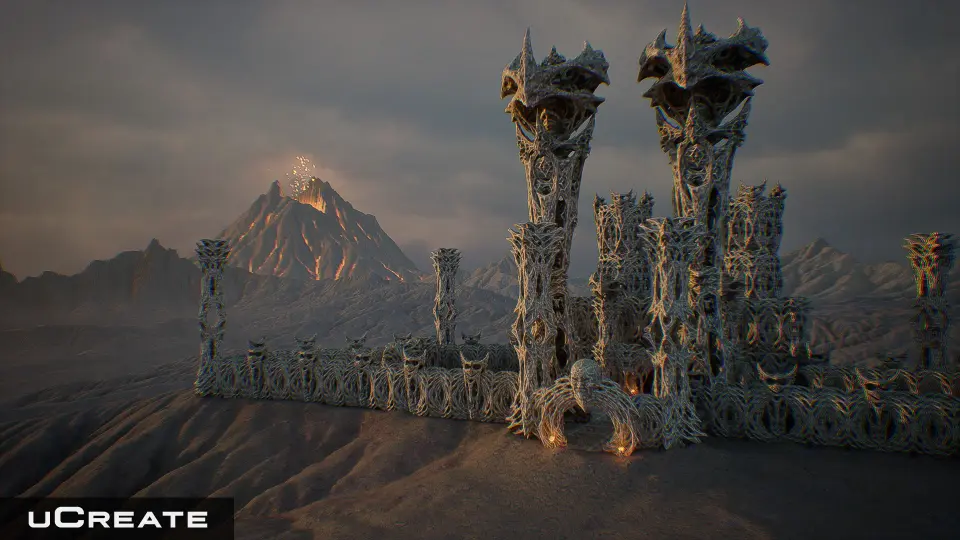
UCreate - Fractal Toolkit is based on a collection of intricate geometric meshes originally created in free fractal software, then refined, cleaned, and adapted for direct use inside Unreal Engine. Rather than limiting users to static geometric sculptures, the toolkit approaches fractals as modular building blocks. The included components are shaped to construct complete strongholds, sprawling temples, subterranean dungeons, and alien horizons across surreal, fantasy, sci-fi, and horror settings.
The geometry carries the sharp, repetitive complexity characteristic of mathematical fractals while maintaining practical performance inside modern engine pipelines that leverage Nanite and Lumen. Because these forms feature high-density visual detail, the toolkit pairs them with dedicated generation tools and surface shaders that keep structural assembly fluid.
Array and Mesh Multi Deform Blueprints
Assembling large-scale architecture out of individual fractal assets can quickly become tedious without automated transformation tools. To address this, the toolkit includes four dedicated blueprints designed to expedite environmental layout: 3D Array, Circular Array, Spline Deform, and Mesh Multi Deform, which is supported in Unreal Engine 5.1 and newer versions.
The 3D Array blueprint duplicates and steps geometry across three-dimensional coordinate spaces, allowing artists to rapidly assemble recurring modular halls, lattice-like pillars, and vast temple complexes. The Circular Array blueprint distributes assets along rotational axes, making it straightforward to construct circular arenas, rotunda ceilings, and radial strongholds. When winding paths or fluid, organic shapes are required, the Spline Deform blueprint twists and directs fractal meshes along custom curve trajectories. Mesh Multi Deform extends this manipulation further by chaining and combining shape deformations, transforming standard stock meshes into entirely novel architectural silhouettes without leaving the editor.
Master Material Pipeline and Curvature Blending
Managing surface data across dense, non-standard fractal geometry presents distinct texturing challenges. The master material in the toolkit incorporates both standard UV tiling and triplanar projection modes. Triplanar mapping allows meshes without clean UV unwrapping—or custom geometric imports—to receive textures without visible seams or stretching across complex topology.
Surface fidelity is driven by tailored texture bakes. Every fractal asset includes a dedicated Normal map baked directly from high-polygon source geometry, an optional Ambient Occlusion map to preserve recessed shadowing, and a specialized RGA mask. This RGA mask enables precise curvature-based blending between two distinct material layers, alongside a dedicated, adjustable dirt pass that settles grime into crevices.
To simulate environmental weathering across scenes, the master material provides an automatic, slope- and angle-based dust mask. This procedural mask can be switched to deposit layers of snow, moss, sand, rust, or cooling lava on upward-facing surfaces. Every component—including ambient occlusion blending, curvature transitions, and surface dust—can be toggled and calibrated directly within individual material instances, giving artists granular control over local surface properties.
The 43-Material Library and Texture Flexibility
The package comes equipped with 43 ready-to-use materials, split between abstract surfaces and realistic terrain types. The core fractal set contains 32 materials derived from 10 distinct fractal patterns, with two to three aesthetic variations supplied for each set. These patterns mirror the geometric cadence of the underlying meshes, reinforcing the alien aesthetic of the architecture.
Alongside the mathematical textures, the pack provides 11 traditional surface materials: rock, lava, ice, marble, snow, moss, sand, rust, and gold, as well as three abstract minerals. These standard materials allow modular pieces to blend naturally into rocky caves, molten underworlds, or frozen wastes. For studios working with internal look-development libraries, the master material is not locked to the provided patterns; it fully accepts external texture sets to align with custom art directions.
Procedural Foliage and Example Levels
To demonstrate practical implementation methods, the toolkit includes seven distinct example scenes that showcase different environmental scales and styling directions. These demonstration levels illustrate how structural modularity, blueprint arrays, and material variations interact under active lighting setups.
Among these showcases, the level named Example_level_Fantasy illustrates how fractal pieces can interface with Unreal Engine’s Procedural Foliage system. In this environment, fractal meshes are treated as foliage instances to generate expansive, alien fractal forests with dense canopies and unusual branch networks across landscape terrains. When loading this specific level, Virtual Texture support must be enabled within the Project Settings to guarantee that all mesh materials render and stream properly.
Production Takeaway
UCreate - Fractal Toolkit provides a focused bridge between mathematical fractal generation and real-time level design. By combining high-poly baked normal maps, triplanar projection fallbacks, procedural scattering blueprints, and curvature-driven weathering, the asset pack gives technical artists and level designers the practical framework needed to assemble vast, surreal structures without battling the typical technical bottlenecks of abstract geometry.
 Buildings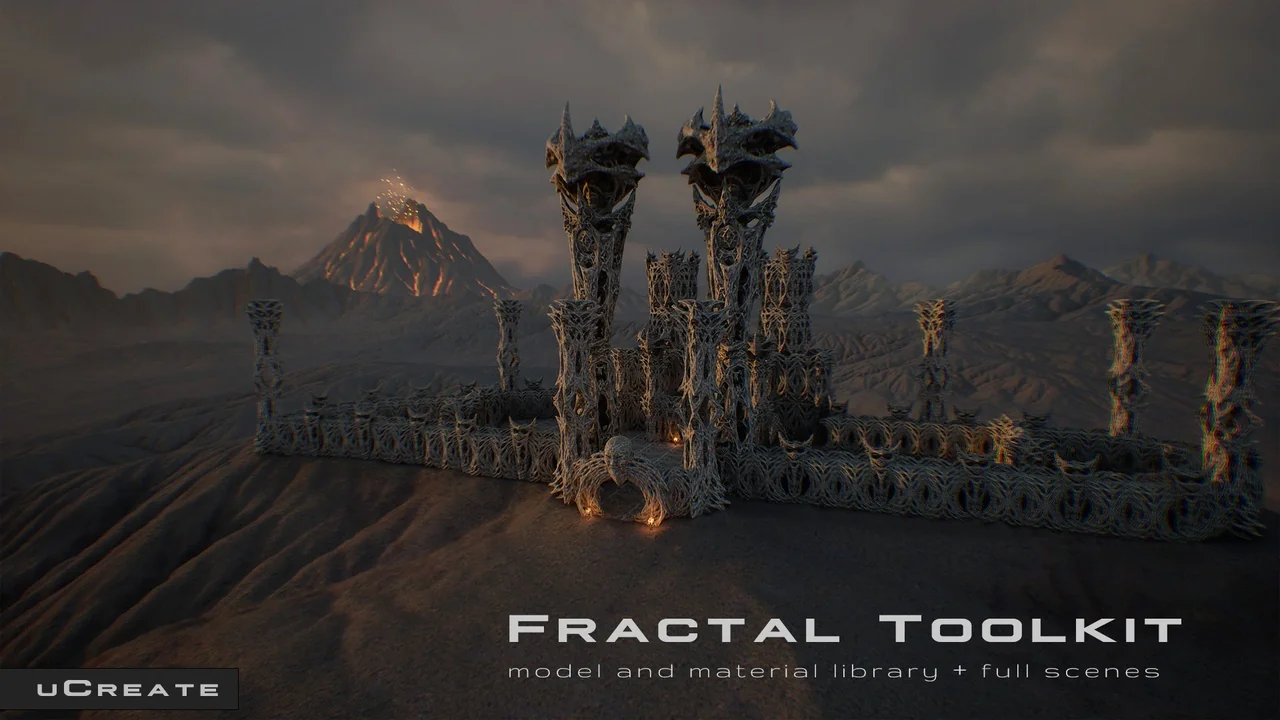
 Buildings
 Buildings
 Buildings