"c68a05d5e51405b3"{"id":"1000645","slug":"medieval-watchtowers-and-platforms-v1","title":"Medieval Watchtowers and Platforms - v1","category":"Buildings \u0026 Architecture","engine":"5.0+","assetVersion":"","engineVersion":"Engine Version: 5.0+","tag":"Buildings","accent":"blue","visual":"mech","summary":"Nine medieval watchtowers and platforms built for Unreal Engine 5 with Nanite, Lumen support, tiled materials, and multiple LODs for AAA fantasy RPG production.","platform":"Unreal Engine","publishedAt":"2026-07-21T17:44:36.382Z","updatedAt":"2026-07-21T17:44:36.382Z","sourceNotes":[],"fileContents":[],"compatibility":["Unreal Engine","Engine Version: 5.0+"],"featuredImage":{"alt":"Medieval Watchtowers and Platforms - v1","src":"/wp-content/uploads/published/2026/07/13bfec9e8e92-e3924236-632f-4dc1-b2f2-286bcfc59f88-7a8b235e94.webp"},"hasDownloadLink":true,"downloads":0,"terms":[{"taxonomy":"category","slug":"buildings-and-architecture","name":"Buildings \u0026 Architecture"}],"galleryImages":[{"src":"/wp-content/uploads/published/2026/07/e48af263f865-4d442514-e120-4730-bf7c-346ad19abd71-26f5c685a8.webp","alt":"Medieval Watchtowers and Platforms - v1"},{"src":"/wp-content/uploads/published/2026/07/84708eb95f05-f60720d2-7847-469c-828b-2bbd57909ea9-1b1d173eef.webp","alt":"Medieval Watchtowers and Platforms - v1"},{"src":"/wp-content/uploads/published/2026/07/52a6a13bd8ff-7a365fc4-786e-4432-926b-013784b2032b-6b1ac5b8fb.webp","alt":"Medieval Watchtowers and Platforms - v1"},{"src":"/wp-content/uploads/published/2026/07/5ad949eb66e2-f01038b2-9b64-49a7-bcc0-5d409eca36b4-3672be05ca.webp","alt":"Medieval Watchtowers and Platforms - v1"},{"src":"/wp-content/uploads/published/2026/07/49a56c4b6090-7e5ee909-e6d5-450c-aec4-6e7332f63f8a-84d26892c1.webp","alt":"Medieval Watchtowers and Platforms - v1"},{"src":"/wp-content/uploads/published/2026/07/0c6dc4225bb7-80192486-98f2-4c72-879d-51928ffe0430-88361963a0.webp","alt":"Medieval Watchtowers and Platforms - v1"},{"src":"/wp-content/uploads/published/2026/07/4dcc492768d1-18af56d0-22a8-473c-8535-932bde01ca33-7ca0ae0307.webp","alt":"Medieval Watchtowers and Platforms - v1"},{"src":"/wp-content/uploads/published/2026/07/684f93a6d86e-08fa92ab-963d-4c28-9237-2a90778fb8b3-ed9ffc8a2f.webp","alt":"Medieval Watchtowers and Platforms - v1"},{"src":"/wp-content/uploads/published/2026/07/53002f1b8c01-e305ac57-35c3-4f95-bdcb-9483e2356834-fa36353351.webp","alt":"Medieval Watchtowers and Platforms - v1"},{"src":"/wp-content/uploads/published/2026/07/34704ebb7845-62f954d3-ee5c-46c3-b9ea-9a3fdf40824f-e0161eda16.webp","alt":"Medieval Watchtowers and Platforms - v1"}],"accessPanel":{"kind":"resource","title":"Download this resource","eyebrow":"Free Download","message":"Log in or create a free account to start your download.","fileName":"Content.7z","safetyNote":"Resources are manually reviewed before listing to improve quality and reduce obvious risks.","actionLabel":"Download Free","resourceType":"Resource archive"},"contentHtml":"\u003ch2\u003eSolving the Watchtower Problem in Fantasy RPG Environments\u003c/h2\u003e\u003cp\u003eBuilding a medieval fantasy RPG often means hunting for watchtower assets that hold up under close scrutiny. Creators frequently run into roadblocks: models that look dated up close, interiors you cannot enter, or geometry so rigid that customization becomes impossible. When a project demands AAA production values, those limitations become visible to players almost immediately.\u003c/p\u003e\u003cp\u003eThis collection of nine medieval watchtowers and platforms targets those exact pain points. The models start at high-poly density, ensuring that tight close-up shots retain definition rather than falling apart into blurred normals or stretched textures. The set includes 6 watchtowers, 3 platforms, 5 doors, and 2 ladders, giving level designers enough variety to construct defensive perimeters, scout outposts, or fortress approaches without reusing a single silhouette across an entire map.\u003c/p\u003e\u003ch2\u003eWorking with Tiled and Seamless Materials\u003c/h2\u003e\u003cp\u003eEvery model in the collection uses tiled, seamless materials exclusively. That decision has a direct impact on workflow flexibility once the assets live inside a project.\u003c/p\u003e\u003cp\u003eBecause the geometry relies on tiling textures rather than baked unique maps, you can swap in your own tiled materials or pull from Quixel libraries without re-UVing anything. A watchtower that ships with a weathered wood look can become stone, plaster, or metal by assigning a different tiled material instance. This becomes useful when a level needs visual variety across multiple towers but the underlying silhouette should remain consistent for faction identity or architectural continuity.\u003c/p\u003e\u003cp\u003eTiled materials also keep texture memory footprint predictable. Since the same tiling textures repeat across surfaces, you are not loading dozens of unique 4K maps for a cluster of towers in a single scene. That efficiency matters when watchtowers are used as repeated environmental props rather than one-off hero pieces.\u003c/p\u003e\u003ch2\u003eNanite, Lumen, and Unreal Engine 5 Setup\u003c/h2\u003e\u003cp\u003eThis collection is built for Unreal Engine 5.0 and later. Nanite is enabled on every model by default, which pairs naturally with the high-poly starting density the creator chose. With Nanite active, the high vertex counts that make close-up shots look sharp do not necessarily translate into a performance cost during gameplay, since Nanite handles polygon reduction on the fly based on screen coverage.\u003c/p\u003e\u003cp\u003eLumen support is present on the preview map by default. The preview environment is already configured to take advantage of Lumen's real-time global illumination, so opening the included map gives an immediate sense of how the watchtowers and platforms respond to dynamic lighting. Enabling Lumen in your own project maps is possible, though it is not a requirement to use the collection. Static or baked lighting workflows remain fully compatible since every model includes lightmaps that have been prepared for that purpose.\u003c/p\u003e\u003ch2\u003eLOD Structure and Performance Scaling\u003c/h2\u003e\u003cp\u003eEach object in the set includes 5 to 6 levels of detail, scaling from high-poly down to a very low-poly representation. This is relevant for scenes where watchtowers appear at multiple distances, such as a fortress wall visible from a distant ridge and then explorable up close.\u003c/p\u003e\u003cp\u003eThe LOD chain works alongside Nanite rather than against it. For projects running on hardware or build configurations where Nanite is not active, the manual LODs provide a fallback optimization path. The very-low-poly final LOD ensures that distant watchtowers scattered across a landscape do not contribute meaningful render cost, while the higher LODs step in as the camera approaches. Having 5-6 stages means the transitions between detail levels can be spaced more granularly, reducing pop-in on towers that sit at mid-range distances from the player camera.\u003c/p\u003e\u003ch2\u003eCollision Setup for Interior Exploration\u003c/h2\u003e\u003cp\u003eMany watchtower assets on marketplaces are solid shells, visually convincing but impossible to enter. This collection specifically addresses that limitation. Precise collisions have been prepared on every model, and the setup is geared toward interior exploration.\u003c/p\u003e\u003cp\u003eWhat this means in practice is that a player character can move through the tower interior, climb ladders, and interact with doors without clipping through walls or getting stuck on uneven collision surfaces. The 5 included doors and 2 ladders reinforce that the towers are meant to be navigated, not just viewed from the outside. The collision work supports gameplay scenarios like reaching a vantage point at the top of a tower, garrisoning units inside a fortified structure, or creating multi-level combat encounters where verticality matters.\u003c/p\u003e\u003cp\u003eFor level designers, precise collisions reduce the time spent generating custom collision meshes in the engine. The towers are ready to place and play, which matters when a map calls for a cluster of defensive structures and each one needs to be walkable without manual physics volume tweaks.\u003c/p\u003e\u003ch2\u003eFitting Watchtowers into a Medieval Build\u003c/h2\u003e\u003cp\u003eThe collection is tagged across a range of medieval and fantasy structural types: fortress, fort, palisade, scout, lighthouse, and tower. Those tags reflect the intended use cases. A watchtower can serve as a scout outpost on a hillside, part of a palisade wall defending a settlement, or even stand in as a lighthouse variant with the right material assignment.\u003c/p\u003e\u003cp\u003e#a#Compatibility extends to the broader Medieval MEGA BUILDER COLLECTION#a#, meaning these watchtowers are built to sit alongside other medieval structures within the same framework rather than functioning as isolated props. The rely on tiled materials, ship with lightmaps, and carry Nanite compatibility, so they conform to the technical standards a modular medieval build demands.\u003c/p\u003e\u003ch2\u003eWhere These Towers Belong in Production\u003c/h2\u003e\u003cp\u003eThese watchtowers and platforms earn their place in projects that demand explorable, high-detail medieval structures. The high-poly source density serves hero shots and cinematics where the camera gets close enough to read surface detail. The LOD chain and Nanite support keep those towers viable when the same props need to stand on a distant ridgeline without dragging down frame rate. Tiled materials free artists to reskin the set for different regions or factions without touching geometry, while the precise collision setup means the towers participate in gameplay rather than acting as static backdrop scenery.\u003c/p\u003e\u003cp\u003eFor a fantasy RPG where verticality, defense, and atmosphere matter, this is a collection built to be placed, entered, and reskinned rather than workaround'd around.\u003c/p\u003e\n\n\u003ch2\u003eMore From The Same Workflow\u003c/h2\u003e\n\u003cul\u003e\n\u003cli\u003e\u003ca href=\"https://3dcghub.com/lake-house-01-with-interiors-4k-pbr/\" title=\"LAKE HOUSE 01 with INTERIORS 4K PBR\"\u003eLAKE HOUSE 01 with INTERIORS 4K PBR\u003c/a\u003e\u003c/li\u003e\n\u003cli\u003e\u003ca href=\"https://3dcghub.com/palisade-walls-and-barriers-v1/\" title=\"Palisade Walls and Barriers - v1\"\u003ePalisade Walls and Barriers - v1\u003c/a\u003e\u003c/li\u003e\n\u003cli\u003e\u003ca href=\"https://3dcghub.com/wood-structures/\" title=\"Wood Structures\"\u003eWood Structures\u003c/a\u003e\u003c/li\u003e\n\u003cli\u003e\u003ca href=\"https://3dcghub.com/enterable-medieval-houses-and-cottages-v1/\" title=\"Enterable Medieval Houses and Cottages - v1\"\u003eEnterable Medieval Houses and Cottages - v1\u003c/a\u003e\u003c/li\u003e\n\u003cli\u003e\u003ca href=\"https://3dcghub.com/signage-vol-4-small-town/\" title=\"Signage VOL.4 - Small Town\"\u003eSignage VOL.4 - Small Town\u003c/a\u003e\u003c/li\u003e\n\u003c/ul\u003e","contentTextLength":6758,"navigation":{"current":1361,"total":3860,"previous":{"id":"1000646","slug":"meta-foam","title":"Meta Foam","category":"Procedural Systems","platform":"Unreal Engine","updatedAt":"2026-07-21T17:47:33.872Z"},"next":{"id":"1000644","slug":"medieval-props-vol-3-farm-2","title":"Medieval Props Vol 3 Farm","category":"Tools, Objects \u0026 Decor","platform":"Unreal Engine","updatedAt":"2026-07-21T17:39:05.852Z"}},"relatedResources":[{"id":"1264","slug":"lake-house-01-with-interiors-4k-pbr","title":"LAKE HOUSE 01 with INTERIORS 4K PBR","category":"Buildings \u0026 Architecture","engine":"5.5+","assetVersion":"Engine version: 5.5+","engineVersion":"5.5","tag":"Buildings","accent":"blue","visual":"mech","summary":"Enhance your digital environments with 20 detailed 3D lake houses. Featuring 4K PBR textures, full interiors, and optimized assets for games and cinematics.","platform":"Unreal Engine","publishedAt":"2026-02-06T17:29:31.000Z","updatedAt":"2026-04-19T15:58:12.000Z","sourceNotes":[],"fileContents":[],"compatibility":["Unreal Engine","Engine version: 5.5+"],"featuredImage":{"alt":"LAKE HOUSE 01 with INTERIORS 4K PBR","src":"https://3dcghub.com/wp-content/uploads/2026/02/e2f52c34-b0af-40e2-8e2a-be4767d64935.jpg"},"hasDownloadLink":true,"downloads":1},{"id":"4463","slug":"palisade-walls-and-barriers-v1","title":"Palisade Walls and Barriers - v1","category":"Towns \u0026 Villages","engine":"5.0+","assetVersion":"Engine version: 5.0+","engineVersion":"4.22","tag":"Towns \u0026 Villages","accent":"blue","visual":"character","summary":"Enhance your fantasy RPG with 12 AAA-quality palisade walls and barriers. Fully optimized for Unreal Engine 5 with Nanite, Lumen, and tiled material support.","platform":"Unreal Engine","publishedAt":"2026-02-13T08:09:44.000Z","updatedAt":"2026-04-19T15:57:08.000Z","sourceNotes":[],"fileContents":[],"compatibility":["Unreal Engine","Engine version: 5.0+"],"featuredImage":{"alt":"Palisade Walls and Barriers - v1","src":"https://3dcghub.com/wp-content/uploads/2026/02/14a8c609-4a10-4984-993b-9c5d2b3fc6b1.webp"},"hasDownloadLink":true,"downloads":0},{"id":"1418","slug":"wood-structures","title":"Wood Structures","category":"Buildings \u0026 Architecture","engine":"4.25","assetVersion":"","engineVersion":"4.25","tag":"Buildings","accent":"blue","visual":"luts","summary":"Create stunning medieval environments with this modular wood structures pack. Features 60+ low-poly models with PBR textures for realistic game design.","platform":"Unreal Engine","publishedAt":"2026-02-06T18:16:46.000Z","updatedAt":"2026-04-19T15:58:10.000Z","sourceNotes":[],"fileContents":[],"compatibility":["Unreal Engine"],"featuredImage":{"alt":"Wood Structures","src":"https://3dcghub.com/wp-content/uploads/2026/02/577be2a3-c950-4205-b89c-436a60eebf1b.png"},"hasDownloadLink":true,"downloads":1}]}
Buildings
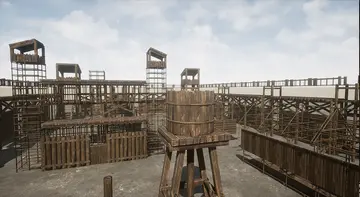
Medieval Watchtowers and Platforms - v1
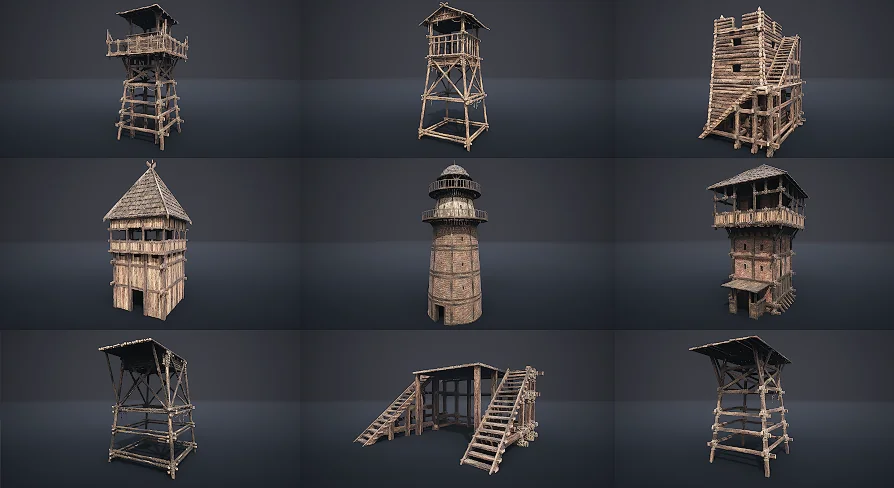
Nine medieval watchtowers and platforms built for Unreal Engine 5 with Nanite, Lumen support, tiled materials, and multiple LODs for AAA fantasy RPG production.
Solving the Watchtower Problem in Fantasy RPG Environments
Building a medieval fantasy RPG often means hunting for watchtower assets that hold up under close scrutiny. Creators frequently run into roadblocks: models that look dated up close, interiors you cannot enter, or geometry so rigid that customization becomes impossible. When a project demands AAA production values, those limitations become visible to players almost immediately.
This collection of nine medieval watchtowers and platforms targets those exact pain points. The models start at high-poly density, ensuring that tight close-up shots retain definition rather than falling apart into blurred normals or stretched textures. The set includes 6 watchtowers, 3 platforms, 5 doors, and 2 ladders, giving level designers enough variety to construct defensive perimeters, scout outposts, or fortress approaches without reusing a single silhouette across an entire map.
Working with Tiled and Seamless Materials
Every model in the collection uses tiled, seamless materials exclusively. That decision has a direct impact on workflow flexibility once the assets live inside a project.
Because the geometry relies on tiling textures rather than baked unique maps, you can swap in your own tiled materials or pull from Quixel libraries without re-UVing anything. A watchtower that ships with a weathered wood look can become stone, plaster, or metal by assigning a different tiled material instance. This becomes useful when a level needs visual variety across multiple towers but the underlying silhouette should remain consistent for faction identity or architectural continuity.
Tiled materials also keep texture memory footprint predictable. Since the same tiling textures repeat across surfaces, you are not loading dozens of unique 4K maps for a cluster of towers in a single scene. That efficiency matters when watchtowers are used as repeated environmental props rather than one-off hero pieces.
Nanite, Lumen, and Unreal Engine 5 Setup
This collection is built for Unreal Engine 5.0 and later. Nanite is enabled on every model by default, which pairs naturally with the high-poly starting density the creator chose. With Nanite active, the high vertex counts that make close-up shots look sharp do not necessarily translate into a performance cost during gameplay, since Nanite handles polygon reduction on the fly based on screen coverage.
Lumen support is present on the preview map by default. The preview environment is already configured to take advantage of Lumen's real-time global illumination, so opening the included map gives an immediate sense of how the watchtowers and platforms respond to dynamic lighting. Enabling Lumen in your own project maps is possible, though it is not a requirement to use the collection. Static or baked lighting workflows remain fully compatible since every model includes lightmaps that have been prepared for that purpose.
LOD Structure and Performance Scaling
Each object in the set includes 5 to 6 levels of detail, scaling from high-poly down to a very low-poly representation. This is relevant for scenes where watchtowers appear at multiple distances, such as a fortress wall visible from a distant ridge and then explorable up close.
The LOD chain works alongside Nanite rather than against it. For projects running on hardware or build configurations where Nanite is not active, the manual LODs provide a fallback optimization path. The very-low-poly final LOD ensures that distant watchtowers scattered across a landscape do not contribute meaningful render cost, while the higher LODs step in as the camera approaches. Having 5-6 stages means the transitions between detail levels can be spaced more granularly, reducing pop-in on towers that sit at mid-range distances from the player camera.
Collision Setup for Interior Exploration
Many watchtower assets on marketplaces are solid shells, visually convincing but impossible to enter. This collection specifically addresses that limitation. Precise collisions have been prepared on every model, and the setup is geared toward interior exploration.
What this means in practice is that a player character can move through the tower interior, climb ladders, and interact with doors without clipping through walls or getting stuck on uneven collision surfaces. The 5 included doors and 2 ladders reinforce that the towers are meant to be navigated, not just viewed from the outside. The collision work supports gameplay scenarios like reaching a vantage point at the top of a tower, garrisoning units inside a fortified structure, or creating multi-level combat encounters where verticality matters.
For level designers, precise collisions reduce the time spent generating custom collision meshes in the engine. The towers are ready to place and play, which matters when a map calls for a cluster of defensive structures and each one needs to be walkable without manual physics volume tweaks.
Fitting Watchtowers into a Medieval Build
The collection is tagged across a range of medieval and fantasy structural types: fortress, fort, palisade, scout, lighthouse, and tower. Those tags reflect the intended use cases. A watchtower can serve as a scout outpost on a hillside, part of a palisade wall defending a settlement, or even stand in as a lighthouse variant with the right material assignment.
#a#Compatibility extends to the broader Medieval MEGA BUILDER COLLECTION#a#, meaning these watchtowers are built to sit alongside other medieval structures within the same framework rather than functioning as isolated props. The rely on tiled materials, ship with lightmaps, and carry Nanite compatibility, so they conform to the technical standards a modular medieval build demands.
Where These Towers Belong in Production
These watchtowers and platforms earn their place in projects that demand explorable, high-detail medieval structures. The high-poly source density serves hero shots and cinematics where the camera gets close enough to read surface detail. The LOD chain and Nanite support keep those towers viable when the same props need to stand on a distant ridgeline without dragging down frame rate. Tiled materials free artists to reskin the set for different regions or factions without touching geometry, while the precise collision setup means the towers participate in gameplay rather than acting as static backdrop scenery.
For a fantasy RPG where verticality, defense, and atmosphere matter, this is a collection built to be placed, entered, and reskinned rather than workaround'd around.
 Buildings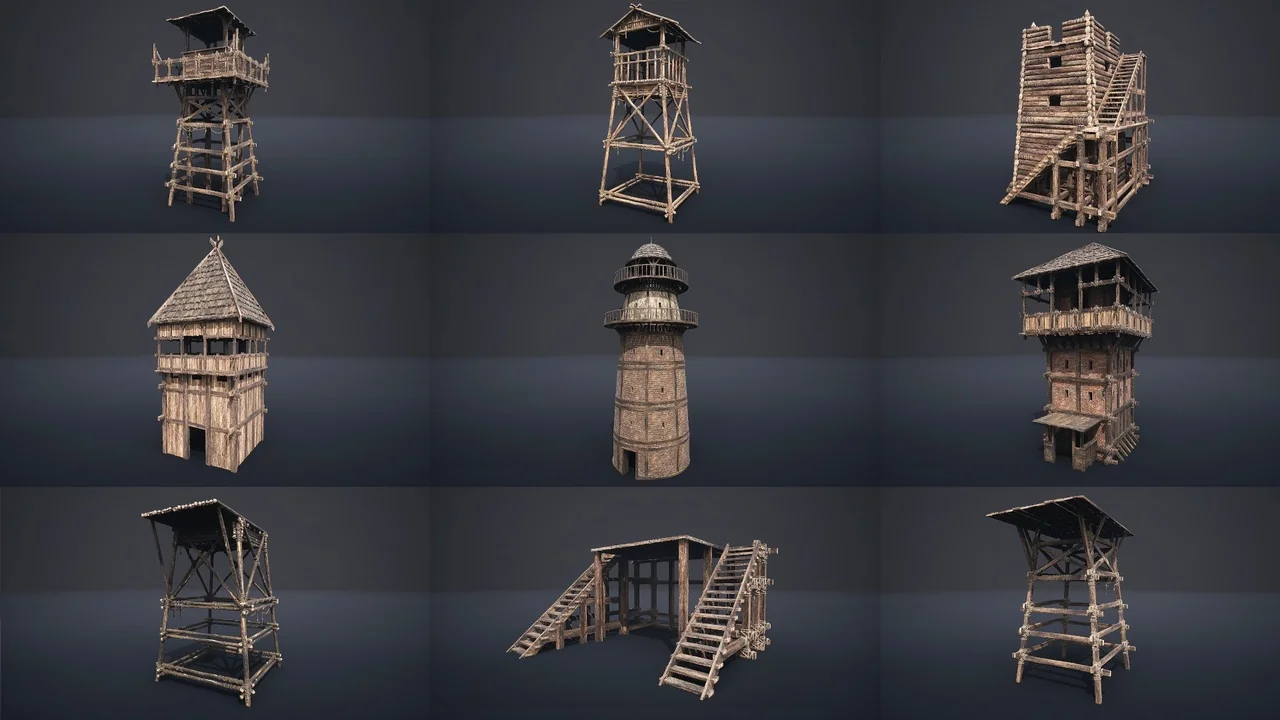
 Buildings
 Towns & Villages
 Buildings