"1f00f67f9253451b"{"id":"1000967","slug":"tokyo-back-alleys-buildings","title":"Tokyo Back Alleys - Buildings","category":"Buildings \u0026 Architecture","engine":"5.3+","assetVersion":"","engineVersion":"Engine Version: 5.3+","tag":"Buildings","accent":"blue","visual":"mech","summary":"Modular buildings for Unreal Engine that fill Tokyo street scenes with hero structures, background volumes, posed characters, bikes, and a day/night blueprint c","platform":"Unreal Engine","publishedAt":"2026-08-15T12:13:52.457Z","updatedAt":"2026-08-15T12:13:52.457Z","sourceNotes":[],"fileContents":[],"compatibility":["Unreal Engine","Engine Version: 5.3+"],"featuredImage":{"alt":"Tokyo Back Alleys - Buildings","src":"/wp-content/uploads/published/2026/08/cb8b4c6ab294-2e8f8dfa-2db0-4571-bb98-4d269a507e93-56cc6ae33c.webp"},"hasDownloadLink":true,"downloads":1,"terms":[{"taxonomy":"category","slug":"buildings-and-architecture","name":"Buildings \u0026 Architecture"}],"galleryImages":[{"src":"/wp-content/uploads/published/2026/08/adcf3ca7d6a2-f33c9dfc-d21e-4558-bb49-fa8ca06bb4af-4095381b29.webp","alt":"Tokyo Back Alleys - Buildings"},{"src":"/wp-content/uploads/published/2026/08/f7949320138f-369004fb-6a5a-46f1-87d1-df46863785c3-b30c8cbfbc.webp","alt":"Tokyo Back Alleys - Buildings"},{"src":"/wp-content/uploads/published/2026/08/229d211e64c2-9b5a66a1-0266-4de9-9624-c1f29c609f8e-63888d57af.webp","alt":"Tokyo Back Alleys - Buildings"},{"src":"/wp-content/uploads/published/2026/08/f8efce551847-567d7ef8-633a-4c55-a1b5-11d912acf6b7-227720f1f6.webp","alt":"Tokyo Back Alleys - Buildings"},{"src":"/wp-content/uploads/published/2026/08/335e5747254a-f96c020a-c94d-4c0c-a815-20287d14b815-18294fdace.webp","alt":"Tokyo Back Alleys - Buildings"},{"src":"/wp-content/uploads/published/2026/08/270887d4bfed-34391a07-9ee4-49c1-88f8-c1d152883744-a8cf51fea1.webp","alt":"Tokyo Back Alleys - Buildings"},{"src":"/wp-content/uploads/published/2026/08/0f506e5ba9b6-fd596336-9d7d-43c0-873a-6c6847f6abcc-5db334533b.webp","alt":"Tokyo Back Alleys - Buildings"},{"src":"/wp-content/uploads/published/2026/08/ed2cbc4ff183-1c6bd1f0-6dae-41da-9b34-483b45385810-afb93150a0.webp","alt":"Tokyo Back Alleys - Buildings"},{"src":"/wp-content/uploads/published/2026/08/8455e5b4fa95-46b39cb2-9775-460d-b214-24a859462ca6-571b1a07b0.webp","alt":"Tokyo Back Alleys - Buildings"},{"src":"/wp-content/uploads/published/2026/08/b0ceee067ee7-0e760816-52ff-4b0e-a4f0-98576f0ff680-70705ee2e7.webp","alt":"Tokyo Back Alleys - Buildings"}],"accessPanel":{"kind":"resource","title":"Download this resource","eyebrow":"Free Download","message":"Log in or create a free account to start your download.","fileName":"Tokyo Back Alleys - Buildings.7z","safetyNote":"Resources are manually reviewed before listing to improve quality and reduce obvious risks.","actionLabel":"Download Free","resourceType":"Resource archive"},"contentHtml":"\u003ch2\u003eA Hand-Crafted Answer to Repetitive Street Fills\u003c/h2\u003e\u003cp\u003eWhen a Tokyo alleyway needs to feel dense and lived-in, the usual problem is repetition. The same window patterns, the same rooflines, the same flat facade treatments. Tokyo Back Alleys - Buildings steps into that gap as a collection of hand-crafted modular buildings, assembled specifically to fill Tokyo street scenes while remaining optimized for real-time rendering in Unreal Engine. Instead of a few hero structures floating on an empty street, the pack is based on a layered approach: main buildings for attention, background volumes for skyline depth, and small props that give the scene scale and activity.\u003c/p\u003e\u003cp\u003eThe modular nature means the kit is not a set of static, unchangeable meshes. Each building can be adjusted in practical ways. Floor counts can be raised or lowered, specific parts can be hidden, and light groups can be controlled during blueprinted day and night transitions. That makes the collection useful when a single layout needs multiple variations across different shots, or when the same street needs to read as a different block on another day.\u003c/p\u003e\u003ch2\u003eHero Buildings, Background Scale, and the Blueprint Controls\u003c/h2\u003e\u003cp\u003eThe core of the kit is a group of seven hero building assemblies, each highly detailed and designed to carry attention in a scene. Their adjustable floor counts mean a two-story laundry can become a four-story apartment without breaking the silhouette. More importantly, they ship with both day and night setups, so the same building can be re-lit for different moods without manually swapping materials or duplicating geometry.\u003c/p\u003e\u003cp\u003eAlongside the seven hero buildings, ten background buildings handle the depth that takes a street corner from a set to a city. These are lighter in scale and meant to sit further back, forming the skyline steps that give the foreground structures a sense of place. The distinction between hero and background assemblies is practical: it tells the artist exactly where to focus detail and where a simpler volume will do.\u003c/p\u003e\u003cp\u003eAll of this is coordinated through a Blueprint System that acts as the control panel for the pack. The day and night setup includes controls for light groups and window randomization, which means a row of windows won't all flicker on or off together. Color change controls work per building and per light group, so neon signs, storefronts, and interior lights can be tinted independently. The modular building controls let you adjust floor count and hide or reveal specific parts without breaking the assembly. This is not a simple mesh swap system; it is a set of parameters that can be triggered and adjusted from the blueprint, making it possible to shuffle the look of an entire block in a few clicks.\u003c/p\u003e\u003ch2\u003ePosed Characters and Bikes: Street Level Activity That Requires No Rigging\u003c/h2\u003e\u003cp\u003eA street filled with architecture still reads as empty if nothing moves at eye level. The pack includes 19 posed character meshes that are already set into static poses, ready to be dropped into doorways, crosswalks, and shop fronts. Since they are posed, they do not need rigs or animation systems to contribute to the composition. They are simply part of the scene's tableau.\u003c/p\u003e\u003cp\u003eBikes add another layer of everyday presence. The bike meshes come in various poses and parking setups, from leaned-up-against-wall positions to neat rows. These small props do a lot of work in making the alley feel used. Because they are static meshes in the current version, they can be freely rotated and placed by hand, and they sit naturally alongside the modular buildings without requiring any runtime setup.\u003c/p\u003e\u003ch2\u003eBuilt for Cinematic Work, With Clear Boundaries\u003c/h2\u003e\u003cp\u003eThe practical scope of this kit is defined by its limitations, which are stated plainly. It is not optimized for games; the assets are made for cinematic and high-quality visual projects, so any game use would require adjustments. There is no rigging or animations included in the current version; everything ships as static meshes. The example scenes that accompany the pack are described as artistic interpretations, which means they may include background elements not included in the pack. These boundaries are useful to know before a project starts, because they set expectations: this is a kit for creating images and films, not a plug-and-play game asset.\u003c/p\u003e\u003cp\u003eBecause the buildings, characters, and bikes are all static, the performance budget can be controlled more directly in a cinematic context. The real-time rendering optimization for Unreal Engine keeps the street viewable in viewport without hiding details, while the blueprint system gives the director or art finisher quick control over lighting and building variations.\u003c/p\u003e\u003ch2\u003eBehind the Art Direction: Michael Yoshimura\u003c/h2\u003e\u003cp\u003eThe pack was designed with the help of Michael Yoshimura, a 3D artist based in Toronto known for a blend of architecture, cinematography, and CG design. That combination shows in the way the kit treats the street not just as a set of boxes, but as a series of framed shots. The hero buildings have presence, the background buildings shape the skyline, the characters pick their spots, and the bikes find their parking. It all adds up to a kit that supports a specific kind of work: creating believable Tokyo street scenes for real-time cinematics, archviz, and other imagery where the camera has room to look around.\u003c/p\u003e\u003cp\u003eFor anyone setting up a Japanese urban environment in Unreal Engine, the collection covers the key layers in one pass. The seven hero buildings give the story focus, the ten background buildings hold the environment together, the character and bike meshes make the street populated, and the blueprint controls tie the whole set together with day/night and color variation. The only preparation required is understanding that the assets are intended for high-quality visual work, not for gameplay systems. With that in mind, the kit becomes a direct way to build a full Tokyo alley of your own.\u003c/p\u003e\n\n\u003ch2\u003eExplore Similar Assets\u003c/h2\u003e\n\u003cul\u003e\n\u003cli\u003e\u003ca href=\"https://3dcghub.com/chinese-alley-environment-chinese-alley-alley-alley-chinese-alley-chinese-3d/\" title=\"Chinese Alley Environment ( Chinese Alley Alley Alley Chinese Alley Chinese 3D )\"\u003eChinese Alley Environment ( Chinese Alley Alley Alley Chinese Alley Chinese 3D )\u003c/a\u003e\u003c/li\u003e\n\u003cli\u003e\u003ca href=\"https://3dcghub.com/japanese-street/\" title=\"Japanese Street\"\u003eJapanese Street\u003c/a\u003e\u003c/li\u003e\n\u003cli\u003e\u003ca href=\"https://3dcghub.com/school-vol-2-classroom/\" title=\"School VOL.2 - Classroom\"\u003eSchool VOL.2 - Classroom\u003c/a\u003e\u003c/li\u003e\n\u003cli\u003e\u003ca href=\"https://3dcghub.com/animated-curtains-vol-1/\" title=\"Animated Curtains vol. 1\"\u003eAnimated Curtains vol. 1\u003c/a\u003e\u003c/li\u003e\n\u003cli\u003e\u003ca href=\"https://3dcghub.com/medieval-watchtowers-and-platforms-v1/\" title=\"Medieval Watchtowers and Platforms - v1\"\u003eMedieval Watchtowers and Platforms - v1\u003c/a\u003e\u003c/li\u003e\n\u003c/ul\u003e","contentTextLength":6152,"navigation":{"current":360,"total":3222,"previous":{"id":"1000968","slug":"top-down-rpg-template","title":"Top Down RPG Template","category":"RPG","platform":"Unreal Engine","updatedAt":"2026-08-15T14:14:08.269Z"},"next":{"id":"1000966","slug":"stationary-weapon-ciws","title":"Stationary weapon : CIWS","category":"Gameplay Features","platform":"Unreal Engine","updatedAt":"2026-08-15T11:38:12.595Z"}},"relatedResources":[{"id":"1000041","slug":"chinese-alley-environment-chinese-alley-alley-alley-chinese-alley-chinese-3d","title":"Chinese Alley Environment ( Chinese Alley Alley Alley Chinese Alley Chinese 3D )","category":"Streets \u0026 Construction","engine":"5.3+","assetVersion":"","engineVersion":"5.3+","tag":"Streets","accent":"blue","visual":"city","summary":"A detailed look at a Chinese alley environment pack with 172 unique meshes, dynamic rain and sparks, and ULAT support for modular scene building.","platform":"Unreal Engine","publishedAt":"2026-05-22T07:46:25.262Z","updatedAt":"2026-05-22T07:46:25.262Z","sourceNotes":[],"fileContents":[],"compatibility":["Unreal Engine","Engine version: 5.3+"],"featuredImage":{"alt":"Chinese Alley Environment ( Chinese Alley Alley Alley Chinese Alley Chinese 3D )","src":"/wp-content/uploads/published/2026/05/394da2c56c7a-34d05e27-e83c-4481-b967-fda79903f28a-d3661197cb.webp"},"hasDownloadLink":true,"downloads":0},{"id":"1000228","slug":"japanese-street","title":"Japanese Street","category":"Buildings \u0026 Architecture","engine":"4.26+,5.0+","assetVersion":"","engineVersion":"Engine Version: 4.26+,5.0+","tag":"Buildings","accent":"blue","visual":"mech","summary":"Construct dense urban layouts with the Japanese Street asset, featuring modular cozy houses, material swapping, and functional interior door systems.","platform":"Unreal Engine","publishedAt":"2026-06-27T18:42:28.315Z","updatedAt":"2026-06-27T18:42:28.315Z","sourceNotes":[],"fileContents":[],"compatibility":["Unreal Engine","Engine Version: 4.26+,5.0+"],"featuredImage":{"alt":"Japanese Street","src":"/wp-content/uploads/published/2026/06/3de2d3bd432a-b89297f6-a639-4d09-9015-f7c5f39252c0-ee5d879f21.webp"},"hasDownloadLink":true,"downloads":3},{"id":"1001166","slug":"lost-temple-vol-1-ancient-ruins","title":"Lost Temple VOL.1 - Ancient Ruins","category":"Buildings \u0026 Architecture","engine":"5.0+","assetVersion":"","engineVersion":"Engine Version: 5.0+","tag":"Buildings","accent":"blue","visual":"mech","summary":"An architectural library of 91 modular Balinese stone meshes and photogrammetry sculptures created by Rendertale Artists for Unreal Engine 5.4.","platform":"Unreal Engine","publishedAt":"2026-09-16T13:47:47.064Z","updatedAt":"2026-09-16T13:47:47.064Z","sourceNotes":[],"fileContents":[],"compatibility":["Unreal Engine","Engine Version: 5.0+"],"featuredImage":{"alt":"Lost Temple VOL.1 - Ancient Ruins","src":"/wp-content/uploads/published/2026/09/0808c34dfd67-d317756b-ea0b-4514-88e7-e39dac67cd02-ad0279ed47.webp"},"hasDownloadLink":true,"downloads":0}]}
Buildings
Tokyo Back Alleys - Buildings
Modular buildings for Unreal Engine that fill Tokyo street scenes with hero structures, background volumes, posed characters, bikes, and a day/night blueprint c
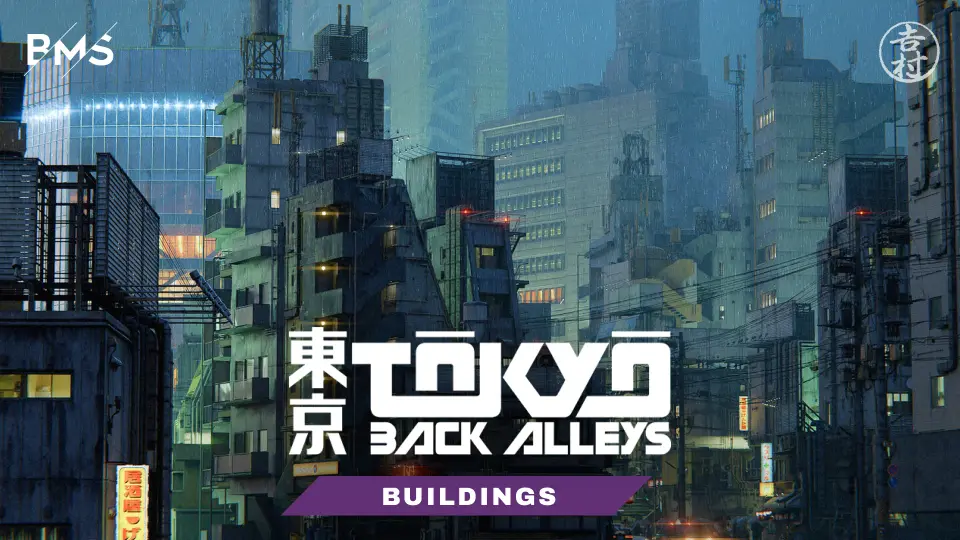
When a Tokyo alleyway needs to feel dense and lived-in, the usual problem is repetition. The same window patterns, the same rooflines, the same flat facade treatments. Tokyo Back Alleys - Buildings steps into that gap as a collection of hand-crafted modular buildings, assembled specifically to fill Tokyo street scenes while remaining optimized for real-time rendering in Unreal Engine. Instead of a few hero structures floating on an empty street, the pack is based on a layered approach: main buildings for attention, background volumes for skyline depth, and small props that give the scene scale and activity.
The modular nature means the kit is not a set of static, unchangeable meshes. Each building can be adjusted in practical ways. Floor counts can be raised or lowered, specific parts can be hidden, and light groups can be controlled during blueprinted day and night transitions. That makes the collection useful when a single layout needs multiple variations across different shots, or when the same street needs to read as a different block on another day.
Hero Buildings, Background Scale, and the Blueprint Controls
The core of the kit is a group of seven hero building assemblies, each highly detailed and designed to carry attention in a scene. Their adjustable floor counts mean a two-story laundry can become a four-story apartment without breaking the silhouette. More importantly, they ship with both day and night setups, so the same building can be re-lit for different moods without manually swapping materials or duplicating geometry.
Alongside the seven hero buildings, ten background buildings handle the depth that takes a street corner from a set to a city. These are lighter in scale and meant to sit further back, forming the skyline steps that give the foreground structures a sense of place. The distinction between hero and background assemblies is practical: it tells the artist exactly where to focus detail and where a simpler volume will do.
All of this is coordinated through a Blueprint System that acts as the control panel for the pack. The day and night setup includes controls for light groups and window randomization, which means a row of windows won't all flicker on or off together. Color change controls work per building and per light group, so neon signs, storefronts, and interior lights can be tinted independently. The modular building controls let you adjust floor count and hide or reveal specific parts without breaking the assembly. This is not a simple mesh swap system; it is a set of parameters that can be triggered and adjusted from the blueprint, making it possible to shuffle the look of an entire block in a few clicks.
Posed Characters and Bikes: Street Level Activity That Requires No Rigging
A street filled with architecture still reads as empty if nothing moves at eye level. The pack includes 19 posed character meshes that are already set into static poses, ready to be dropped into doorways, crosswalks, and shop fronts. Since they are posed, they do not need rigs or animation systems to contribute to the composition. They are simply part of the scene's tableau.
Bikes add another layer of everyday presence. The bike meshes come in various poses and parking setups, from leaned-up-against-wall positions to neat rows. These small props do a lot of work in making the alley feel used. Because they are static meshes in the current version, they can be freely rotated and placed by hand, and they sit naturally alongside the modular buildings without requiring any runtime setup.
Built for Cinematic Work, With Clear Boundaries
The practical scope of this kit is defined by its limitations, which are stated plainly. It is not optimized for games; the assets are made for cinematic and high-quality visual projects, so any game use would require adjustments. There is no rigging or animations included in the current version; everything ships as static meshes. The example scenes that accompany the pack are described as artistic interpretations, which means they may include background elements not included in the pack. These boundaries are useful to know before a project starts, because they set expectations: this is a kit for creating images and films, not a plug-and-play game asset.
Because the buildings, characters, and bikes are all static, the performance budget can be controlled more directly in a cinematic context. The real-time rendering optimization for Unreal Engine keeps the street viewable in viewport without hiding details, while the blueprint system gives the director or art finisher quick control over lighting and building variations.
Behind the Art Direction: Michael Yoshimura
The pack was designed with the help of Michael Yoshimura, a 3D artist based in Toronto known for a blend of architecture, cinematography, and CG design. That combination shows in the way the kit treats the street not just as a set of boxes, but as a series of framed shots. The hero buildings have presence, the background buildings shape the skyline, the characters pick their spots, and the bikes find their parking. It all adds up to a kit that supports a specific kind of work: creating believable Tokyo street scenes for real-time cinematics, archviz, and other imagery where the camera has room to look around.
For anyone setting up a Japanese urban environment in Unreal Engine, the collection covers the key layers in one pass. The seven hero buildings give the story focus, the ten background buildings hold the environment together, the character and bike meshes make the street populated, and the blueprint controls tie the whole set together with day/night and color variation. The only preparation required is understanding that the assets are intended for high-quality visual work, not for gameplay systems. With that in mind, the kit becomes a direct way to build a full Tokyo alley of your own.
 Buildings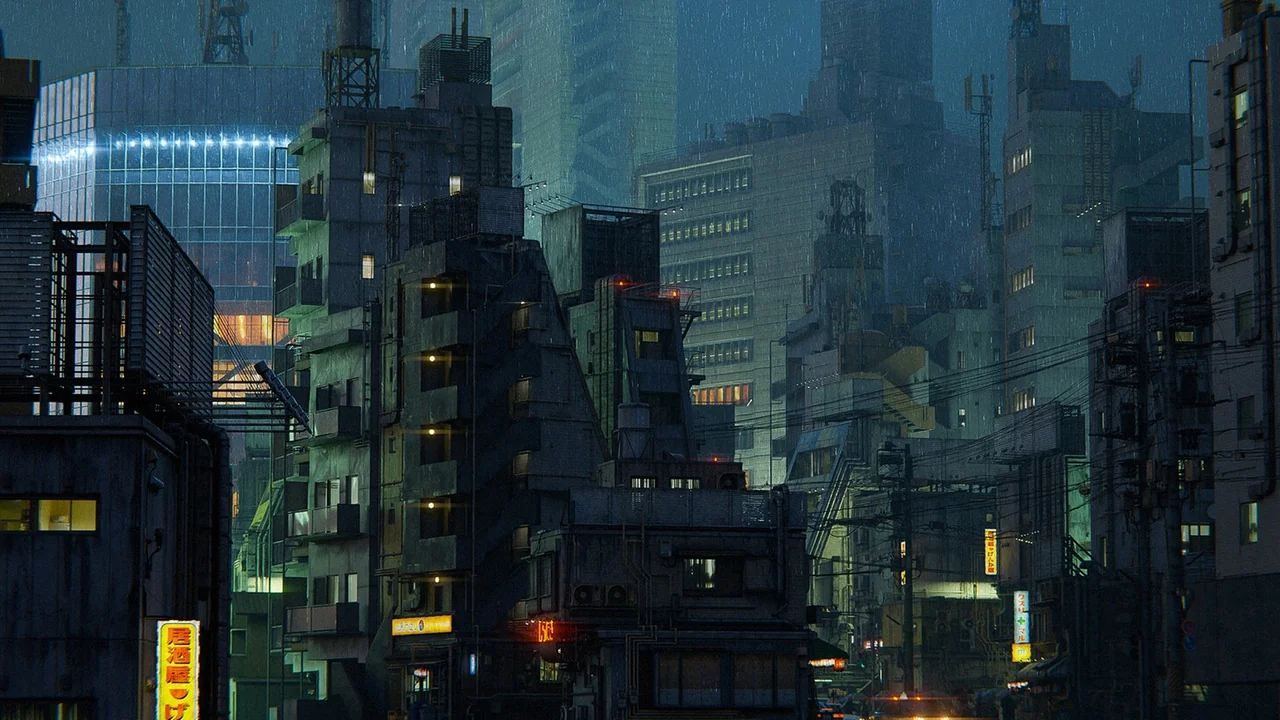
 Streets
 Buildings
 Buildings