"7b46a695175d8694"{"id":"1000041","slug":"chinese-alley-environment-chinese-alley-alley-alley-chinese-alley-chinese-3d","title":"Chinese Alley Environment ( Chinese Alley Alley Alley Chinese Alley Chinese 3D )","category":"Streets \u0026 Construction","engine":"5.3+","assetVersion":"","engineVersion":"5.3+","tag":"Streets","accent":"blue","visual":"city","summary":"A detailed look at a Chinese alley environment pack with 172 unique meshes, dynamic rain and sparks, and ULAT support for modular scene building.","platform":"Unreal Engine","publishedAt":"2026-05-22T07:46:25.262Z","updatedAt":"2026-05-22T07:46:25.262Z","sourceNotes":[],"fileContents":[],"compatibility":["Unreal Engine","Engine version: 5.3+"],"featuredImage":{"alt":"Chinese Alley Environment ( Chinese Alley Alley Alley Chinese Alley Chinese 3D )","src":"/wp-content/uploads/published/2026/05/394da2c56c7a-34d05e27-e83c-4481-b967-fda79903f28a-d3661197cb.webp"},"hasDownloadLink":true,"downloads":0,"terms":[{"taxonomy":"category","slug":"streets-and-construction","name":"Streets \u0026 Construction"}],"galleryImages":[{"src":"/wp-content/uploads/published/2026/05/c1d256ddf16f-c0b45b58-61cd-4721-8fc2-5e03ae0947c9-28fdbdc30c.webp","alt":"Chinese Alley Environment ( Chinese Alley Alley Alley Chinese Alley Chinese 3D )"},{"src":"/wp-content/uploads/published/2026/05/854c9aee2b97-1982606f-225f-4226-b823-e19f5088ad5d-e4d131fdf7.webp","alt":"Chinese Alley Environment ( Chinese Alley Alley Alley Chinese Alley Chinese 3D )"},{"src":"/wp-content/uploads/published/2026/05/21d634326cd4-d4f2001f-d088-434a-b495-5d4c06702903-95e0e860cc.webp","alt":"Chinese Alley Environment ( Chinese Alley Alley Alley Chinese Alley Chinese 3D )"},{"src":"/wp-content/uploads/published/2026/05/4f691378e0ef-be2c0d9e-5589-438d-bd55-52a6c6e4a824-7e60b18b2a.webp","alt":"Chinese Alley Environment ( Chinese Alley Alley Alley Chinese Alley Chinese 3D )"},{"src":"/wp-content/uploads/published/2026/05/35e23d324bb3-a672cfd2-2739-466f-8188-3cb8d86def54-65effcfd2b.webp","alt":"Chinese Alley Environment ( Chinese Alley Alley Alley Chinese Alley Chinese 3D )"},{"src":"/wp-content/uploads/published/2026/05/dc3301ad584b-a25288b6-def3-4bca-8dc5-3f0d00e71c91-f1ac4231a1.webp","alt":"Chinese Alley Environment ( Chinese Alley Alley Alley Chinese Alley Chinese 3D )"},{"src":"/wp-content/uploads/published/2026/05/c2720484dae8-d0edd4ad-b531-48b4-bf71-feb49aa07de5-3318979963.webp","alt":"Chinese Alley Environment ( Chinese Alley Alley Alley Chinese Alley Chinese 3D )"},{"src":"/wp-content/uploads/published/2026/05/2b671db95012-6fe8738b-2271-413e-baed-131b930cce31-0dd8a4c746.webp","alt":"Chinese Alley Environment ( Chinese Alley Alley Alley Chinese Alley Chinese 3D )"},{"src":"/wp-content/uploads/published/2026/05/8ac6a8a6c5d7-dab9df5a-a314-4899-93a5-59a716a55a9e-4c31633e01.webp","alt":"Chinese Alley Environment ( Chinese Alley Alley Alley Chinese Alley Chinese 3D )"},{"src":"/wp-content/uploads/published/2026/05/a39d7476c691-2a2db11c-f057-4323-8c15-b8f88a83ec86-01db23a38a.webp","alt":"Chinese Alley Environment ( Chinese Alley Alley Alley Chinese Alley Chinese 3D )"}],"accessPanel":{"kind":"resource","title":"Access this resource","eyebrow":"Free Download","message":"Log in or create a free account to start your download.","fileName":"Content.7z","safetyNote":"Resources are manually reviewed before listing to improve quality and reduce obvious risks.","actionLabel":"Download Free","resourceType":"Resource archive"},"contentHtml":"\u003cp\u003eBuilding a convincing alley scene usually slows down once the space needs more than walls and props. The moment a project calls for a narrow street with atmosphere, layered surfaces, and enough variety to avoid repetition, the environment work becomes a layout problem as much as an art problem. Chinese Alley Environment addresses that kind of production task directly with a ready-made set of high-quality meshes and textures aimed at Asian-themed scenes, along with dynamic elements such as rain and sparks among ruined surroundings.\u003c/p\u003e\n\u003cp\u003eThe pack centers on the creation of chaotic Chinese environments. That wording matters because the emphasis is not on a clean, empty backstreet, but on a scene with movement, disruption, and visual density. It includes 172 unique meshes and all showcased assets, with a stated focus on good detail and game-ready optimization. That gives the pack a practical role in projects that need a complete alley setting rather than a handful of isolated decorative pieces.\u003c/p\u003e \u003ch2\u003eChinese Alley Environment as a scene-building shortcut\u003c/h2\u003e\n\u003cp\u003eThis environment is meant to shorten the path from blockout to a finished street space. Instead of treating the alley as a single backdrop, it provides a pool of unique meshes and textures that can be arranged into a fuller composition. The pack is aimed at Asian-themed work, which gives it a clear visual direction from the start.\u003c/p\u003e\n\u003cp\u003eThe included themes and tags point to a setting shaped by lanterns, old-town streets, traditional shops, narrow passages, historic districts, marketplaces, paper lanterns, hanging signs, wooden doors, cobblestone paths, courtyards, archways, and traditional roofs. Other details suggest more specialized set dressing possibilities, including tea houses, night market touches, street vendors, decorative walls, carved doors, calligraphy signs, and noodle or dumpling shop elements. Taken together, these cues place the pack in a recognizable urban environment with a strong street-level identity.\u003c/p\u003e\n\u003cp\u003eThat makes it useful when a production needs a lived-in alley instead of a broad architectural statement. The setting reads as intimate and layered: winding paths, shadowed streets, hidden alleys, and Chinatown-style market spaces fit more naturally here than wide plazas or open landscapes.\u003c/p\u003e \u003ch2\u003e172 unique meshes and the density of a Chinese alley\u003c/h2\u003e\n\u003cp\u003eThe most concrete content detail is the mesh count. Chinese Alley Environment includes 172 unique meshes, and those meshes are presented as the core of the package rather than an extra add-on around a few hero pieces.\u003c/p\u003e\n\u003cp\u003eFor environment work, uniqueness matters because repeated forms can flatten an alley scene very quickly. A narrow urban space needs variation at close viewing distance: shopfront changes, surface interruptions, hanging objects, architectural breaks, and smaller decorative accents all help maintain visual interest. While the exact asset breakdown is not specified, the combination of mesh count, texture quality, and the long list of street and cultural motifs points to a set intended for composition-heavy scenes rather than a minimal modular kit.\u003c/p\u003e\n\u003cp\u003eThe tags also help clarify the kind of atmosphere these meshes support. Red lanterns, neon lights, bamboo, stone paths, dragon motifs, pagoda references, scroll art, ink painting, decorative fans, and folk-art details all lean toward a stylized but still environment-focused street presentation. Historic street and traditional house references sit alongside more vibrant urban notes such as night market, marketplace, red aesthetic, and hanging signs. That mix gives artists room to push the scene toward heritage, mystery, bustle, or decay without leaving the pack's central identity.\u003c/p\u003e \u003ch2\u003eRain, sparks, and ruined surroundings\u003c/h2\u003e\n\u003cp\u003eNot every environment pack tries to solve motion and atmosphere at the same time. This one does. Chinese Alley Environment specifically includes elements like rain and sparks among the ruins, adding dynamic effects to the setting.\u003c/p\u003e\n\u003cp\u003eThat detail shifts the pack from static architecture toward mood-driven scene work. Rain can reinforce tight reflective alley compositions and nocturnal street tone, while sparks introduce instability, friction, or recent damage. The mention of ruins suggests that the environment is not limited to a polished market street. It can also support rougher or more chaotic spaces where broken structure, debris, or distressed surroundings play a role in the scene.\u003c/p\u003e\n\u003cp\u003eThose effects are especially relevant for projects that want the alley to feel active without needing to build atmosphere separately. A quiet traditional street, a mysterious hidden passage, or a harsher urban ruin can all benefit from weather and particulate motion. For production work, the pack is positioned not only as a collection of objects but as a staging ground for dramatic environment lighting and cinematic composition.\u003c/p\u003e \u003ch2\u003eULAT inside the pack\u003c/h2\u003e\n\u003cp\u003eChinese Alley Environment includes ULAT, short for Ultimate Level Art Tool. It is also described by its original name as a modular design development tool for mobile and web-based systems. Within this pack, ULAT is presented as part of the workflow rather than as an unrelated extra.\u003c/p\u003e\n\u003cp\u003eIts practical function is clearly stated: ULAT allows fast creation of custom modular buildings and offers a seamless, distinctive way to populate scenes naturally. That fits the environment's strongest need. Alley scenes often depend on quick iteration of facades, connected structures, and repeated urban forms that still need to feel varied. A modular building workflow can speed up that process while helping the scene remain cohesive.\u003c/p\u003e\n\u003cp\u003eThe environment pack is compatible with ULAT, which makes the relationship between the two straightforward. The pack supplies the thematic content and visual direction; ULAT supports faster assembly and natural population of the space. For teams or solo artists working on a street-based environment, that is likely to matter most during layout and revision, where changing building arrangements and filling visual gaps usually costs time.\u003c/p\u003e \u003ch2\u003eNanite, Lumen, and game-ready Unreal Engine use\u003c/h2\u003e\n\u003cp\u003eChinese Alley Environment supports Nanite for Unreal Engine 5.0+ and Lumen for Unreal Engine 5.0+. Those two implementation details place the pack firmly in a modern Unreal Engine environment workflow.\u003c/p\u003e\n\u003cp\u003eNanite support is relevant for scenes that need detailed geometry across a dense alley space, especially where repeated close-up viewing can expose weak forms. Lumen support matters for the kind of environment this pack suggests: narrow streets, red lanterns, neon accents, shadowed passages, reflective rain, and sparks all benefit from responsive lighting. Since the environment is also described as optimized for game-ready projects, the technical positioning is not purely visual. It is meant to be used in production contexts where assets need to function as part of a real-time scene rather than only as display pieces.\u003c/p\u003e\n\u003cp\u003eThe combination of high-quality assets, a good level of detail, Nanite support, and Lumen support makes the pack most relevant for Unreal Engine projects that want atmosphere without giving up practical deployment. The focus remains specific: an alley environment with cultural and urban identity, not a broad library of unrelated props.\u003c/p\u003e \u003ch2\u003eWhere Chinese Alley fits best\u003c/h2\u003e\n\u003cp\u003eThis pack is strongest when a project needs an Asian-inspired street environment with clear mood and close-range detail. The tags and descriptive cues point toward old-town alleys, Chinatown streets, traditional market corridors, hidden passages, night market scenes, and historic urban districts layered with lanterns, signs, and decorative architectural elements.\u003c/p\u003e\n\u003cp\u003eIt should be especially useful for artists who need to move quickly from environment concept to a populated scene. The 172 unique meshes establish the physical space, the textures carry the surface quality, the rain and sparks add dynamic atmosphere, and ULAT supports modular building and natural scene population. In production terms, it fits best as a street-level environment solution for Unreal Engine 5.0+ work where dense composition, lighting mood, and rapid scene assembly all matter at once.\u003c/p\u003e\n\n\u003ch2\u003eMore From The Same Workflow\u003c/h2\u003e\n\u003cul\u003e\n\u003cli\u003e\u003ca href=\"https://3dcghub.com/railway-street-environment-railway-street-environment-alley-scan/\" title=\"Railway Street Environment ( Railway , Street , Environment , Alley , Scan )\"\u003eRailway Street Environment ( Railway , Street , Environment , Alley , Scan )\u003c/a\u003e\u003c/li\u003e\n\u003cli\u003e\u003ca href=\"https://3dcghub.com/brushify-natural-roads-pack/\" title=\"Brushify - Natural Roads Pack\"\u003eBrushify - Natural Roads Pack\u003c/a\u003e\u003c/li\u003e\n\u003cli\u003e\u003ca href=\"https://3dcghub.com/cartoon-street/\" title=\"Cartoon Street\"\u003eCartoon Street\u003c/a\u003e\u003c/li\u003e\n\u003cli\u003e\u003ca href=\"https://3dcghub.com/abandoned-subway-station-in-berlin-abandoned-subway-station-berlin-subway/\" title=\"Abandoned Subway Station in Berlin ( Abandoned Subway Station Berlin Subway )\"\u003eAbandoned Subway Station in Berlin ( Abandoned Subway Station Berlin Subway )\u003c/a\u003e\u003c/li\u003e\n\u003cli\u003e\u003ca href=\"https://3dcghub.com/amusement-park-environment-kit/\" title=\"Amusement Park Environment Kit\"\u003eAmusement Park Environment Kit\u003c/a\u003e\u003c/li\u003e\n\u003c/ul\u003e","contentTextLength":8404,"navigation":{"current":1584,"total":3481,"previous":{"id":"1000042","slug":"cinematic-fire-3d-vdb-pack-loop","title":"Cinematic Fire 3D VDB Pack loop","category":"Fire \u0026 Explosions","platform":"Unreal Engine","updatedAt":"2026-05-22T08:25:52.982Z"},"next":{"id":"1000040","slug":"cgr-shotguns-pack","title":"CGr Shotguns Pack","category":"Guns","platform":"Unreal Engine","updatedAt":"2026-05-22T07:23:04.999Z"}},"relatedResources":[{"id":"9837","slug":"railway-street-environment-railway-street-environment-alley-scan","title":"Railway Street Environment ( Railway , Street , Environment , Alley , Scan )","category":"Streets \u0026 Construction","engine":"5.3+","assetVersion":"Engine version: 5.3+","engineVersion":"5.0","tag":"Streets","accent":"blue","visual":"city","summary":"Enhance your virtual production and cinematic projects with the Railway Street Environment. This pack features 79 unique, high-quality meshes optimized for Unreal Engine 5.","platform":"Unreal Engine","publishedAt":"2026-03-02T15:49:09.000Z","updatedAt":"2026-04-19T15:50:10.000Z","sourceNotes":[],"fileContents":[],"compatibility":["Unreal Engine","Engine version: 5.3+"],"featuredImage":{"alt":"Railway Street Environment ( Railway , Street , Environment , Alley , Scan )","src":"https://3dcghub.com/wp-content/uploads/2026/03/116c7f05-c79a-40ce-9dc9-aadaf08dbd8d.webp"},"hasDownloadLink":true,"downloads":0},{"id":"1001382","slug":"sci-fi-high-city","title":"Sci Fi High City","category":"Streets \u0026 Construction","engine":"5.0+","assetVersion":"","engineVersion":"Engine Version: 5.0+","tag":"Streets","accent":"blue","visual":"city","summary":"Build sprawling futuristic urban layouts using the modular Sci Fi High City environment, optimized for Unreal Engine 5.0 with Nanite and Lumen support.","platform":"Unreal Engine","publishedAt":"2026-10-04T12:53:22.126Z","updatedAt":"2026-10-04T12:53:22.126Z","sourceNotes":[],"fileContents":[],"compatibility":["Unreal Engine","Engine Version: 5.0+"],"featuredImage":{"alt":"Sci Fi High City","src":"/wp-content/uploads/published/2026/10/99997bcd1b48-f978accb-00cf-4acc-9592-70f4c524d5d4-3c94a2f8cb.webp"},"hasDownloadLink":true,"downloads":0},{"id":"1000432","slug":"modern-hospital-environment","title":"Modern Hospital Environment","category":"Streets \u0026 Construction","engine":"5.1+","assetVersion":"","engineVersion":"Engine Version: 5.1+","tag":"Streets","accent":"blue","visual":"city","summary":"A game-ready hospital environment pack with 229 unique meshes, UE5 compatibility, and Ultimate Level Art Tool support for assembling clinical interiors and exte","platform":"Unreal Engine","publishedAt":"2026-07-09T21:35:18.420Z","updatedAt":"2026-07-09T21:35:18.420Z","sourceNotes":[],"fileContents":[],"compatibility":["Unreal Engine","Engine Version: 5.1+"],"featuredImage":{"alt":"Modern Hospital Environment","src":"/wp-content/uploads/published/2026/07/22981ee0d2e9-b69a819c-9042-425f-a043-eb5685a8ee71-97c383bfd9.webp"},"hasDownloadLink":true,"downloads":5}]}
Streets
Chinese Alley Environment ( Chinese Alley Alley Alley Chinese Alley Chinese 3D )
A detailed look at a Chinese alley environment pack with 172 unique meshes, dynamic rain and sparks, and ULAT support for modular scene building.
Building a convincing alley scene usually slows down once the space needs more than walls and props. The moment a project calls for a narrow street with atmosphere, layered surfaces, and enough variety to avoid repetition, the environment work becomes a layout problem as much as an art problem. Chinese Alley Environment addresses that kind of production task directly with a ready-made set of high-quality meshes and textures aimed at Asian-themed scenes, along with dynamic elements such as rain and sparks among ruined surroundings.
The pack centers on the creation of chaotic Chinese environments. That wording matters because the emphasis is not on a clean, empty backstreet, but on a scene with movement, disruption, and visual density. It includes 172 unique meshes and all showcased assets, with a stated focus on good detail and game-ready optimization. That gives the pack a practical role in projects that need a complete alley setting rather than a handful of isolated decorative pieces.
Chinese Alley Environment as a scene-building shortcut
This environment is meant to shorten the path from blockout to a finished street space. Instead of treating the alley as a single backdrop, it provides a pool of unique meshes and textures that can be arranged into a fuller composition. The pack is aimed at Asian-themed work, which gives it a clear visual direction from the start.
The included themes and tags point to a setting shaped by lanterns, old-town streets, traditional shops, narrow passages, historic districts, marketplaces, paper lanterns, hanging signs, wooden doors, cobblestone paths, courtyards, archways, and traditional roofs. Other details suggest more specialized set dressing possibilities, including tea houses, night market touches, street vendors, decorative walls, carved doors, calligraphy signs, and noodle or dumpling shop elements. Taken together, these cues place the pack in a recognizable urban environment with a strong street-level identity.
That makes it useful when a production needs a lived-in alley instead of a broad architectural statement. The setting reads as intimate and layered: winding paths, shadowed streets, hidden alleys, and Chinatown-style market spaces fit more naturally here than wide plazas or open landscapes.
172 unique meshes and the density of a Chinese alley
The most concrete content detail is the mesh count. Chinese Alley Environment includes 172 unique meshes, and those meshes are presented as the core of the package rather than an extra add-on around a few hero pieces.
For environment work, uniqueness matters because repeated forms can flatten an alley scene very quickly. A narrow urban space needs variation at close viewing distance: shopfront changes, surface interruptions, hanging objects, architectural breaks, and smaller decorative accents all help maintain visual interest. While the exact asset breakdown is not specified, the combination of mesh count, texture quality, and the long list of street and cultural motifs points to a set intended for composition-heavy scenes rather than a minimal modular kit.
The tags also help clarify the kind of atmosphere these meshes support. Red lanterns, neon lights, bamboo, stone paths, dragon motifs, pagoda references, scroll art, ink painting, decorative fans, and folk-art details all lean toward a stylized but still environment-focused street presentation. Historic street and traditional house references sit alongside more vibrant urban notes such as night market, marketplace, red aesthetic, and hanging signs. That mix gives artists room to push the scene toward heritage, mystery, bustle, or decay without leaving the pack's central identity.
Rain, sparks, and ruined surroundings
Not every environment pack tries to solve motion and atmosphere at the same time. This one does. Chinese Alley Environment specifically includes elements like rain and sparks among the ruins, adding dynamic effects to the setting.
That detail shifts the pack from static architecture toward mood-driven scene work. Rain can reinforce tight reflective alley compositions and nocturnal street tone, while sparks introduce instability, friction, or recent damage. The mention of ruins suggests that the environment is not limited to a polished market street. It can also support rougher or more chaotic spaces where broken structure, debris, or distressed surroundings play a role in the scene.
Those effects are especially relevant for projects that want the alley to feel active without needing to build atmosphere separately. A quiet traditional street, a mysterious hidden passage, or a harsher urban ruin can all benefit from weather and particulate motion. For production work, the pack is positioned not only as a collection of objects but as a staging ground for dramatic environment lighting and cinematic composition.
ULAT inside the pack
Chinese Alley Environment includes ULAT, short for Ultimate Level Art Tool. It is also described by its original name as a modular design development tool for mobile and web-based systems. Within this pack, ULAT is presented as part of the workflow rather than as an unrelated extra.
Its practical function is clearly stated: ULAT allows fast creation of custom modular buildings and offers a seamless, distinctive way to populate scenes naturally. That fits the environment's strongest need. Alley scenes often depend on quick iteration of facades, connected structures, and repeated urban forms that still need to feel varied. A modular building workflow can speed up that process while helping the scene remain cohesive.
The environment pack is compatible with ULAT, which makes the relationship between the two straightforward. The pack supplies the thematic content and visual direction; ULAT supports faster assembly and natural population of the space. For teams or solo artists working on a street-based environment, that is likely to matter most during layout and revision, where changing building arrangements and filling visual gaps usually costs time.
Nanite, Lumen, and game-ready Unreal Engine use
Chinese Alley Environment supports Nanite for Unreal Engine 5.0+ and Lumen for Unreal Engine 5.0+. Those two implementation details place the pack firmly in a modern Unreal Engine environment workflow.
Nanite support is relevant for scenes that need detailed geometry across a dense alley space, especially where repeated close-up viewing can expose weak forms. Lumen support matters for the kind of environment this pack suggests: narrow streets, red lanterns, neon accents, shadowed passages, reflective rain, and sparks all benefit from responsive lighting. Since the environment is also described as optimized for game-ready projects, the technical positioning is not purely visual. It is meant to be used in production contexts where assets need to function as part of a real-time scene rather than only as display pieces.
The combination of high-quality assets, a good level of detail, Nanite support, and Lumen support makes the pack most relevant for Unreal Engine projects that want atmosphere without giving up practical deployment. The focus remains specific: an alley environment with cultural and urban identity, not a broad library of unrelated props.
Where Chinese Alley fits best
This pack is strongest when a project needs an Asian-inspired street environment with clear mood and close-range detail. The tags and descriptive cues point toward old-town alleys, Chinatown streets, traditional market corridors, hidden passages, night market scenes, and historic urban districts layered with lanterns, signs, and decorative architectural elements.
It should be especially useful for artists who need to move quickly from environment concept to a populated scene. The 172 unique meshes establish the physical space, the textures carry the surface quality, the rain and sparks add dynamic atmosphere, and ULAT supports modular building and natural scene population. In production terms, it fits best as a street-level environment solution for Unreal Engine 5.0+ work where dense composition, lighting mood, and rapid scene assembly all matter at once.
 Streets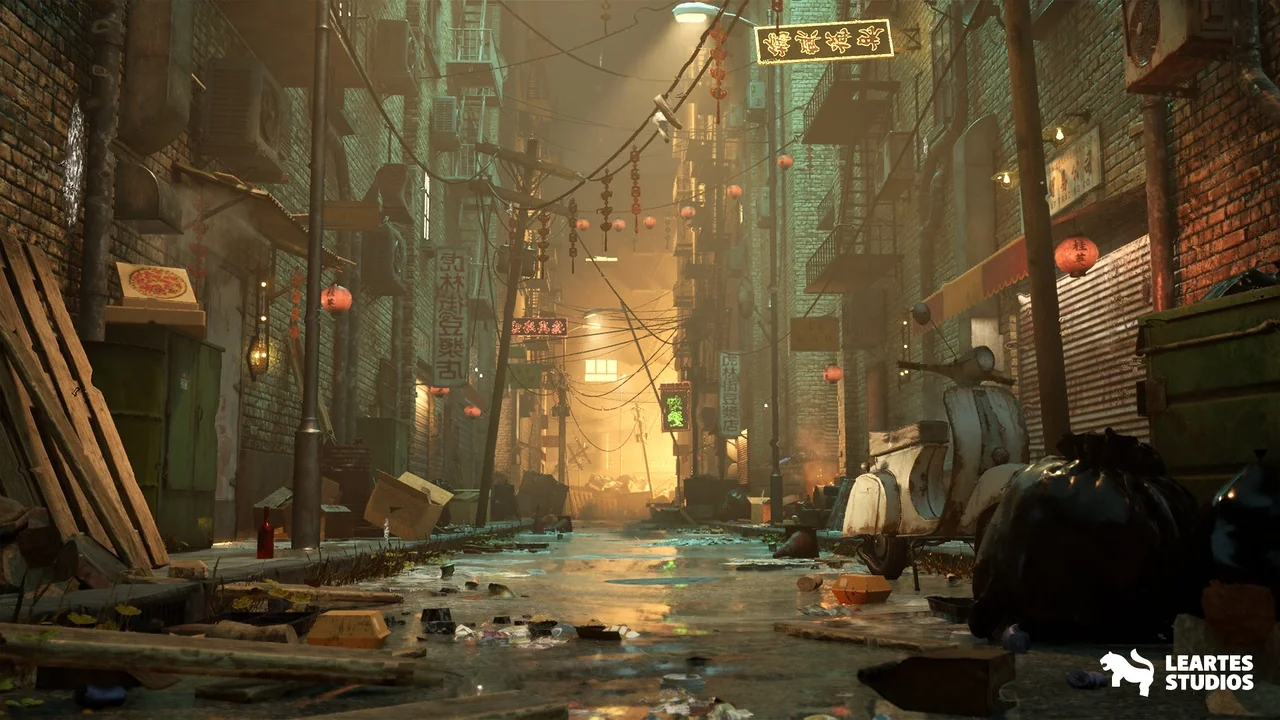
 Streets
 Streets
 Streets