"c14ff6bd758dadb1"{"id":"1001069","slug":"spectrum-galaxy-modular-sci-fi-environment-kit","title":"Spectrum Galaxy | Modular Sci-Fi Environment Kit","category":"Sci-Fi","engine":"4.27,5.0+","assetVersion":"","engineVersion":"Engine Version: 4.27,5.0+","tag":"Sci-Fi","accent":"blue","visual":"city","summary":"Sci-fi environment kit for UE5 with Lumen and Nanite support, over 400 meshes, 8K textures, and a new Research Lab expansion. A complete modular scene pack.","platform":"Unreal Engine","publishedAt":"2026-09-03T17:01:31.709Z","updatedAt":"2026-09-03T17:01:31.709Z","sourceNotes":[],"fileContents":[],"compatibility":["Unreal Engine","Engine Version: 4.27,5.0+"],"featuredImage":{"alt":"Spectrum Galaxy | Modular Sci-Fi Environment Kit","src":"/wp-content/uploads/published/2026/09/a929babec07b-eb0ba3f1-d300-4718-b914-cb6aef94d500-123fa9c06c.webp"},"hasDownloadLink":true,"downloads":0,"terms":[{"taxonomy":"category","slug":"sci-fi","name":"Sci-Fi"}],"galleryImages":[{"src":"/wp-content/uploads/published/2026/09/21285d905a50-32b32e00-5425-4626-94fe-52134f52c01f-156488c485.webp","alt":"Spectrum Galaxy | Modular Sci-Fi Environment Kit"},{"src":"/wp-content/uploads/published/2026/09/c79f32f1cf10-c72c71b6-c802-465f-9211-e89f34ed13f7-24537bd45e.webp","alt":"Spectrum Galaxy | Modular Sci-Fi Environment Kit"},{"src":"/wp-content/uploads/published/2026/09/976fdc4bf71f-b6a18f8d-7d73-4633-ba18-72c3e0611dfb-a039ccc0c4.webp","alt":"Spectrum Galaxy | Modular Sci-Fi Environment Kit"},{"src":"/wp-content/uploads/published/2026/09/cb88220d5eaa-94d4cc88-796a-4fc0-928d-8f802be9213f-7883730b34.webp","alt":"Spectrum Galaxy | Modular Sci-Fi Environment Kit"},{"src":"/wp-content/uploads/published/2026/09/d7e846741ec3-a024993a-6b5e-4b28-8f4e-b19350457f51-7f68783453.webp","alt":"Spectrum Galaxy | Modular Sci-Fi Environment Kit"},{"src":"/wp-content/uploads/published/2026/09/a8854a77fd12-10a9896d-162e-449f-93ce-1452e071d5b7-26159489be.webp","alt":"Spectrum Galaxy | Modular Sci-Fi Environment Kit"},{"src":"/wp-content/uploads/published/2026/09/6ad9cbd9ecaa-644f7bf7-8e78-40bb-b318-6edbac353b7f-71d1a584bc.webp","alt":"Spectrum Galaxy | Modular Sci-Fi Environment Kit"},{"src":"/wp-content/uploads/published/2026/09/270ceb930802-28e8a0a9-4442-4cc7-afd4-402478ea5823-0aea716382.webp","alt":"Spectrum Galaxy | Modular Sci-Fi Environment Kit"},{"src":"/wp-content/uploads/published/2026/09/2b52ff609b16-31ba29bb-f1eb-4e22-9bda-76ee2b6babb7-3c3559376a.webp","alt":"Spectrum Galaxy | Modular Sci-Fi Environment Kit"},{"src":"/wp-content/uploads/published/2026/09/299236b25571-749152c2-6c53-443d-a24c-8c42546370e7-d3084bb48e.webp","alt":"Spectrum Galaxy | Modular Sci-Fi Environment Kit"}],"accessPanel":{"kind":"resource","title":"Download this resource","eyebrow":"Free Download","message":"Log in or create a free account to start your download.","fileName":"Content.7z","safetyNote":"Resources are manually reviewed before listing to improve quality and reduce obvious risks.","actionLabel":"Download Free","resourceType":"Resource archive"},"contentHtml":"\u003cp\u003eSpectrum Galaxy is a complete environment for a futuristic sci-fi setting, designed around the feel of a hopeful future surrounded by natural beauty and technological progress. It combines modular architecture, customizable shaders, and a large library of props intended for people building levels in Unreal Engine. A quick read of the customer reviews shows why it stands out: “No doubt. This is one of the most beautiful assets in UE store.” That word, beautiful, comes up repeatedly because the pack was built as a full world, not a simple prop collection.\u003c/p\u003e\u003ch2\u003eA 10-Unit Grid and a Library That Passes 400 Static Meshes\u003c/h2\u003e\u003cp\u003eSpectrum Galaxy's construction system revolves around a clean modular grid. Most pieces snap to a 10-unit grid, so walls, floors, and structural props line up right away when building complex layouts. A few custom assets break that pattern, however. Chairs and picture frames are intentionally non-modular, which gives a scene a more polished and unique feel instead of a repetitive, blocky look. The scale of the library becomes clear once the asset count passes 400 unique static meshes. On top of that, there are more than 330 material instances, so a single mesh can cover many surface variations. The material instances also provide room for creators to extend the library with their own variations without building new static meshes from scratch.\u003c/p\u003e\u003ch2\u003eFrom Unreal Engine 4 to UE5: Lumen, Nanite, and Ray Tracing\u003c/h2\u003e\u003cp\u003eThe move to Unreal Engine 5 is one of the strongest reasons to look at this environment today. Spectrum Galaxy is fully compatible with UE5 and uses Lumen for global illumination and reflections, making bounced light read naturally across hallways and open worlds. Nanite is supported for foliage, vistas, and most static meshes, which means geometry can carry more detail without the usual level-of-detail management overhead. The pack is also ready for both hardware and software ray tracing, giving teams another way to set their rendering approach. That compatibility is not a last-minute patch. More than 20 updates have shipped since the project's release, all focused on improving texture memory usage, polishing asset geometry, and keeping material performance stable on both UE4 and UE5. A full version history is available to check before implementing it in a project.\u003c/p\u003e\u003ch2\u003eCommunity Feedback Meets the Research Lab Expansion\u003c/h2\u003e\u003cp\u003eThe project keeps changing based on what users actually need. Interactive screens, modular ladders, and a dedicated unlit map were all introduced after the developer listened to requests. The unlit map stands out because it acts as a blank canvas for custom lighting, letting a creator build their own mood from the ground up instead of fighting a pre-baked setup. Another major addition came in the form of a Research Lab expansion. This expansion adds a new area of content, a set of new assets, and functional blueprints that move a scene from decoration to interaction. For a team using Spectrum Galaxy in a level, those blueprints can shorten the distance between placing a console and having that console respond in gameplay.\u003c/p\u003e\u003ch2\u003eHand-Painted Foliage, 8K Textures, and Trim Sets\u003c/h2\u003e\u003cp\u003eThe visual quality starts with the color palettes and material response, but the texture pipeline follows the same high bar. Foliage comes through with 4K hand-painted textures, which makes leaves and alien plants look deliberate rather than procedurally noisy. Certain hero assets can carry up to 20,000 vertices, so a close-up on a key prop still shows real sculpted detail. At the other end, texture resolutions reach 8K, which gives art teams the headroom to use the same map on large surfaces or camera-facing details. The shader side includes customizable water, planet, and lens flare materials, giving the skybox and any exterior shots a stronger pull. Trim texture sets work as a lightweight way to add panels, piping, seams, and other surface detail to a mesh without pulling extra texture maps into memory. Combined with the material instance list, this makes the kit unusually flexible for a finished product.\u003c/p\u003e\u003ch2\u003eCollision, LODs, and the Tools Under the Hood\u003c/h2\u003e\u003cp\u003eLighting and texture do not handle everything. Spectrum Galaxy brings along custom collision meshes for its assets, which give characters and physics objects a shape that fits the modeled geometry instead of coarse boxes. Multiple levels of detail appear across the mesh set, helping performance with vistas that push many static meshes at once. The project includes in-game sequences, so creators can drop ready-made camera moves into a cinematic timeline. IES profiles let lighting artists attach real-world photometric behavior to a fixture; then high-quality lens flare particles add the final optical response that brings a sci-fi glow to life. Having these details built into the asset means a small team can focus on composition instead of building collision from scratch.\u003c/p\u003e\u003ch2\u003eWhat Artists Keep Pointing Out\u003c/h2\u003e\u003cp\u003eReviews for the environment frequently lean on the word beauty. “No doubt,” wrote one customer, “this is one of the most beautiful assets in UE store.” Another praised the environment's aesthetics and called it glorious. There is more to the praise than style: a reviewer mentioned that the in-depth videos on the environment's setting supported their own character-building work. The environment has also been through community makeovers, including a VRChat world called Lost Worlds, a Spectrum Galaxy Re-light, and a Spectrum Galaxy Relight. Each version takes the same modular system and interprets it differently, proving that the asset kit's base supports new looks.\u003c/p\u003e\u003cp\u003eFor a team about to start a sci-fi scene, the route from empty level to polished environment is fairly direct. Lay out modular pieces on the 10-unit grid, build a palette from the 330-plus material instances, and then let Lumen or ray tracing handle the light. The documented version history and after-sales technical support provide some security that the asset will keep working when the engine changes. A free two-part UE5 environment lighting tutorial and the support articles are additional materials. If the goal is a beautiful world that can still be modified by hand, Spectrum Galaxy is built for exactly that.\u003c/p\u003e\n\n\u003ch2\u003eContinue Browsing Similar Packs\u003c/h2\u003e\n\u003cul\u003e\n\u003cli\u003e\u003ca href=\"https://3dcghub.com/sci-fi-modular-station/\" title=\"Sci-Fi Modular Station\"\u003eSci-Fi Modular Station\u003c/a\u003e\u003c/li\u003e\n\u003cli\u003e\u003ca href=\"https://3dcghub.com/sci-fi-hangar/\" title=\"Sci-Fi Hangar\"\u003eSci-Fi Hangar\u003c/a\u003e\u003c/li\u003e\n\u003cli\u003e\u003ca href=\"https://3dcghub.com/modular-sci-fi-environment-a/\" title=\"Modular sci-fi Environment A\"\u003eModular sci-fi Environment A\u003c/a\u003e\u003c/li\u003e\n\u003cli\u003e\u003ca href=\"https://3dcghub.com/iss-international-space-station/\" title=\"ISS INTERNATIONAL SPACE STATION\"\u003eISS INTERNATIONAL SPACE STATION\u003c/a\u003e\u003c/li\u003e\n\u003cli\u003e\u003ca href=\"https://3dcghub.com/sci-fi-orion-mars-living-quarters/\" title=\"Sci Fi Orion Mars Living Quarters\"\u003eSci Fi Orion Mars Living Quarters\u003c/a\u003e\u003c/li\u003e\n\u003c/ul\u003e","contentTextLength":6377,"navigation":{"current":761,"total":3719,"previous":{"id":"1001070","slug":"suburb-neighborhood-house-pack-modular","title":"Suburb Neighborhood House Pack (Modular)","category":"Towns \u0026 Villages","platform":"Unreal Engine","updatedAt":"2026-09-03T17:09:53.903Z"},"next":{"id":"1001068","slug":"smart-locomotion","title":"Smart Locomotion","category":"Animations","platform":"Unreal Engine","updatedAt":"2026-09-03T16:46:08.418Z"}},"relatedResources":[{"id":"1001680","slug":"modular-sci-fi-interior","title":"Modular Sci-Fi Interior","category":"Sci-Fi","engine":"4.26+,5.0+","assetVersion":"","engineVersion":"Engine Version: 4.26+,5.0+","tag":"Sci-Fi","accent":"blue","visual":"mech","summary":"Build AAA spaceship corridors, engineering bays, and laboratories with Modular Sci-Fi Interior, featuring 68 compatible parts and customizable materials.","platform":"Unreal Engine","publishedAt":"2026-10-13T15:31:32.670Z","updatedAt":"2026-10-13T15:31:32.670Z","sourceNotes":[],"fileContents":[],"compatibility":["Unreal Engine","Engine Version: 4.26+,5.0+"],"featuredImage":{"alt":"Modular Sci-Fi Interior","src":"/wp-content/uploads/published/2026/10/5f742de1385a-81f27987-eea8-4083-8247-e2f32ed77b80-110aed85b4.webp"},"hasDownloadLink":true,"downloads":1},{"id":"1001665","slug":"scifi-corridor-environment","title":"SciFi Corridor Environment","category":"Sci-Fi","engine":"4.20+,5.0+","assetVersion":"","engineVersion":"Engine Version: 4.20+,5.0+","tag":"Sci-Fi","accent":"blue","visual":"city","summary":"Explore the SciFi Corridor Environment, a modular lowpoly level scene built for current gen games with customizable PBR materials and prop compatibility.","platform":"Unreal Engine","publishedAt":"2026-10-13T15:05:15.324Z","updatedAt":"2026-10-13T15:05:15.324Z","sourceNotes":[],"fileContents":[],"compatibility":["Unreal Engine","Engine Version: 4.20+,5.0+"],"featuredImage":{"alt":"SciFi Corridor Environment","src":"/wp-content/uploads/published/2026/10/522388a562b7-365997bb-848d-475f-be61-3d69c5e3307e-42292051e6.webp"},"hasDownloadLink":true,"downloads":1},{"id":"1001660","slug":"sci-fi-interior-pack","title":"Sci-Fi Interior Pack","category":"Sci-Fi","engine":"4.16+,5.0+","assetVersion":"","engineVersion":"Engine Version: 4.16+,5.0+","tag":"Sci-Fi","accent":"blue","visual":"mech","summary":"Build AAA sci-fi corridors, rooms, and space station halls with the modular meshes, props, and realistic PBR materials in the Sci-Fi Interior Pack.","platform":"Unreal Engine","publishedAt":"2026-10-13T14:49:18.243Z","updatedAt":"2026-10-13T14:49:18.243Z","sourceNotes":[],"fileContents":[],"compatibility":["Unreal Engine","Engine Version: 4.16+,5.0+"],"featuredImage":{"alt":"Sci-Fi Interior Pack","src":"/wp-content/uploads/published/2026/10/feeee675490c-ab3f77c7-91c9-47ea-82e1-43d047947c91-e6293b0541.webp"},"hasDownloadLink":true,"downloads":1}]}
Sci-Fi
Spectrum Galaxy | Modular Sci-Fi Environment Kit
Sci-fi environment kit for UE5 with Lumen and Nanite support, over 400 meshes, 8K textures, and a new Research Lab expansion. A complete modular scene pack.
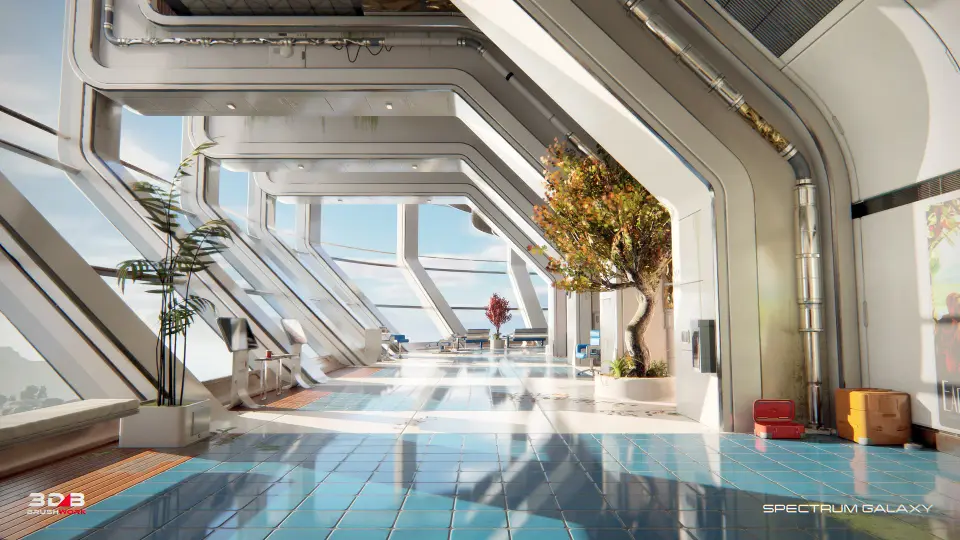
Spectrum Galaxy is a complete environment for a futuristic sci-fi setting, designed around the feel of a hopeful future surrounded by natural beauty and technological progress. It combines modular architecture, customizable shaders, and a large library of props intended for people building levels in Unreal Engine. A quick read of the customer reviews shows why it stands out: “No doubt. This is one of the most beautiful assets in UE store.” That word, beautiful, comes up repeatedly because the pack was built as a full world, not a simple prop collection.
A 10-Unit Grid and a Library That Passes 400 Static Meshes
Spectrum Galaxy's construction system revolves around a clean modular grid. Most pieces snap to a 10-unit grid, so walls, floors, and structural props line up right away when building complex layouts. A few custom assets break that pattern, however. Chairs and picture frames are intentionally non-modular, which gives a scene a more polished and unique feel instead of a repetitive, blocky look. The scale of the library becomes clear once the asset count passes 400 unique static meshes. On top of that, there are more than 330 material instances, so a single mesh can cover many surface variations. The material instances also provide room for creators to extend the library with their own variations without building new static meshes from scratch.
From Unreal Engine 4 to UE5: Lumen, Nanite, and Ray Tracing
The move to Unreal Engine 5 is one of the strongest reasons to look at this environment today. Spectrum Galaxy is fully compatible with UE5 and uses Lumen for global illumination and reflections, making bounced light read naturally across hallways and open worlds. Nanite is supported for foliage, vistas, and most static meshes, which means geometry can carry more detail without the usual level-of-detail management overhead. The pack is also ready for both hardware and software ray tracing, giving teams another way to set their rendering approach. That compatibility is not a last-minute patch. More than 20 updates have shipped since the project's release, all focused on improving texture memory usage, polishing asset geometry, and keeping material performance stable on both UE4 and UE5. A full version history is available to check before implementing it in a project.
Community Feedback Meets the Research Lab Expansion
The project keeps changing based on what users actually need. Interactive screens, modular ladders, and a dedicated unlit map were all introduced after the developer listened to requests. The unlit map stands out because it acts as a blank canvas for custom lighting, letting a creator build their own mood from the ground up instead of fighting a pre-baked setup. Another major addition came in the form of a Research Lab expansion. This expansion adds a new area of content, a set of new assets, and functional blueprints that move a scene from decoration to interaction. For a team using Spectrum Galaxy in a level, those blueprints can shorten the distance between placing a console and having that console respond in gameplay.
Hand-Painted Foliage, 8K Textures, and Trim Sets
The visual quality starts with the color palettes and material response, but the texture pipeline follows the same high bar. Foliage comes through with 4K hand-painted textures, which makes leaves and alien plants look deliberate rather than procedurally noisy. Certain hero assets can carry up to 20,000 vertices, so a close-up on a key prop still shows real sculpted detail. At the other end, texture resolutions reach 8K, which gives art teams the headroom to use the same map on large surfaces or camera-facing details. The shader side includes customizable water, planet, and lens flare materials, giving the skybox and any exterior shots a stronger pull. Trim texture sets work as a lightweight way to add panels, piping, seams, and other surface detail to a mesh without pulling extra texture maps into memory. Combined with the material instance list, this makes the kit unusually flexible for a finished product.
Collision, LODs, and the Tools Under the Hood
Lighting and texture do not handle everything. Spectrum Galaxy brings along custom collision meshes for its assets, which give characters and physics objects a shape that fits the modeled geometry instead of coarse boxes. Multiple levels of detail appear across the mesh set, helping performance with vistas that push many static meshes at once. The project includes in-game sequences, so creators can drop ready-made camera moves into a cinematic timeline. IES profiles let lighting artists attach real-world photometric behavior to a fixture; then high-quality lens flare particles add the final optical response that brings a sci-fi glow to life. Having these details built into the asset means a small team can focus on composition instead of building collision from scratch.
What Artists Keep Pointing Out
Reviews for the environment frequently lean on the word beauty. “No doubt,” wrote one customer, “this is one of the most beautiful assets in UE store.” Another praised the environment's aesthetics and called it glorious. There is more to the praise than style: a reviewer mentioned that the in-depth videos on the environment's setting supported their own character-building work. The environment has also been through community makeovers, including a VRChat world called Lost Worlds, a Spectrum Galaxy Re-light, and a Spectrum Galaxy Relight. Each version takes the same modular system and interprets it differently, proving that the asset kit's base supports new looks.
For a team about to start a sci-fi scene, the route from empty level to polished environment is fairly direct. Lay out modular pieces on the 10-unit grid, build a palette from the 330-plus material instances, and then let Lumen or ray tracing handle the light. The documented version history and after-sales technical support provide some security that the asset will keep working when the engine changes. A free two-part UE5 environment lighting tutorial and the support articles are additional materials. If the goal is a beautiful world that can still be modified by hand, Spectrum Galaxy is built for exactly that.
 Sci-Fi
 Sci-Fi
 Sci-Fi
 Sci-Fi