"7b46a695175d8694"{"id":"1000400","slug":"scifi-railroad-terminal-facility-nanite","title":"Scifi Railroad Terminal Facility (Nanite)","category":"Industrial","engine":"5.0+","assetVersion":"","engineVersion":"Engine Version: 5.0+","tag":"Industrial","accent":"cyan","visual":"mech","summary":"A comprehensive Unreal Engine 5 environment package featuring 383 modular meshes, Nanite geometry, and Lumen lighting for high-end sci-fi transit hubs.","platform":"Unity","publishedAt":"2026-07-07T18:47:57.483Z","updatedAt":"2026-07-07T18:47:57.483Z","sourceNotes":[],"fileContents":[],"compatibility":["Unreal Engine","Engine Version: 5.0+"],"featuredImage":{"alt":"Scifi Railroad Terminal Facility (Nanite)","src":"/wp-content/uploads/published/2026/07/6493e7358832-d461389d-18c9-4920-93cf-6c39d3705eb2-601a9c1318.webp"},"hasDownloadLink":true,"downloads":2,"terms":[{"taxonomy":"category","slug":"unity-3d-environments-industrial","name":"Industrial"}],"galleryImages":[{"src":"/wp-content/uploads/published/2026/07/5389ddf732cf-67d91905-08fc-42bf-94a9-c1616f0895c6-c62ef2cced.webp","alt":"Scifi Railroad Terminal Facility (Nanite)"},{"src":"/wp-content/uploads/published/2026/07/8346c10cb4e4-387e1b81-f03f-4072-8427-bc6039fe9467-5c2ebb9076.webp","alt":"Scifi Railroad Terminal Facility (Nanite)"},{"src":"/wp-content/uploads/published/2026/07/e609044a33c5-795851d0-b07a-42b6-a80a-8b5aa481f65d-04a74837cb.webp","alt":"Scifi Railroad Terminal Facility (Nanite)"},{"src":"/wp-content/uploads/published/2026/07/ef254b8a3370-857d9c37-2684-43e9-89ce-59e2d120f637-297217ceee.webp","alt":"Scifi Railroad Terminal Facility (Nanite)"},{"src":"/wp-content/uploads/published/2026/07/25e31a098b87-74ba7017-b54f-4f1b-8fde-1d4e73395d93-aeb6817d1c.webp","alt":"Scifi Railroad Terminal Facility (Nanite)"},{"src":"/wp-content/uploads/published/2026/07/15f18587bca5-15d2a392-e4cf-4546-a196-947586e456aa-e8c6151733.webp","alt":"Scifi Railroad Terminal Facility (Nanite)"},{"src":"/wp-content/uploads/published/2026/07/7aa5d076a624-331be373-2ba8-4c69-9502-395bb78eb1d7-d10880a52e.webp","alt":"Scifi Railroad Terminal Facility (Nanite)"},{"src":"/wp-content/uploads/published/2026/07/428e5090973b-8f06d63c-a2af-4e6f-90e0-d120cd970286-ffa090f07e.webp","alt":"Scifi Railroad Terminal Facility (Nanite)"},{"src":"/wp-content/uploads/published/2026/07/e0703653b1a6-f1ac01f0-43f4-4d42-980e-b41c7108a93b-e4df13110a.webp","alt":"Scifi Railroad Terminal Facility (Nanite)"},{"src":"/wp-content/uploads/published/2026/07/c1b24a2e6368-49f7dee6-a0d3-4148-959d-7c129406ae3e-8fba860731.webp","alt":"Scifi Railroad Terminal Facility (Nanite)"}],"accessPanel":{"kind":"resource","title":"Download this resource","eyebrow":"Free Download","message":"Log in or create a free account to start your download.","fileName":"Scifi Railroad Terminal Facility (Nanite).7z","safetyNote":"Resources are manually reviewed before listing to improve quality and reduce obvious risks.","actionLabel":"Download Free","resourceType":"Resource archive"},"contentHtml":"\u003cp\u003eDeveloping expansive, futuristic transit environments for high-end games requires a delicate balance between dense geometric detail and strict performance parameters. The Scifi Railroad Terminal Facility (Nanite) project addresses this technical requirement by providing a comprehensive, fully configured environment tailored specifically for Unreal Engine 5.0 and newer. Built to achieve realistic AAA visuals, the package supplies developers with the structural components necessary to construct abandoned, futuristic rail networks and complex exterior cityscapes.\u003c/p\u003e \u003ch2\u003eConstructing Modular Sci-Fi Transit Networks\u003c/h2\u003e \u003cp\u003eAt the core of the environment is a massive library of 383 individual meshes. This deep modularity provides environment artists with the foundational building blocks required to piece together sprawling train infrastructure. Because the components are modular, they are not locked into a single rigid layout. Developers can snap together continuous rail lines, towering terminal exteriors, and complex transit hubs that fit the exact layout requirements of their specific level design.\u003c/p\u003e \u003cp\u003eThe sheer volume of parts ensures that large cityscapes can be constructed without obvious, repetitive tiling that often breaks immersion in high-fidelity projects. When assembling an exterior level, the variety of structural components allows for seamless transitions between heavy railway architecture and the surrounding futuristic city elements. The thematic direction leans heavily into an abandoned, futuristic aesthetic. Industrial metal surfaces dominate the structural pieces, providing a grounded, realistic foundation for sci-fi level design. By combining heavy railway architecture with a neglected atmosphere, the environment assets serve projects that require a gritty, lived-in universe rather than a pristine, sterile sci-fi setting.\u003c/p\u003e \u003ch2\u003eHeavy Industrial Geometry Through Nanite\u003c/h2\u003e \u003cp\u003eIndustrial scenes featuring dense metal trusses, complex rail tracks, and wire netting traditionally consume massive rendering budgets. The inclusion of industrial nets and intricate metalwork can often create bottlenecks in standard rendering pipelines due to overdraw and complex silhouettes. To circumvent these traditional polygon limits, the assets rely entirely on Unreal Engine 5’s Nanite virtualized geometry system.\u003c/p\u003e \u003cp\u003eThis integration allows for large amounts of geometry per asset, preserving the intricate physical details of the sci-fi machinery without the need for aggressive, manual Level of Detail (LOD) generation. By utilizing Nanite, the high-density meshes maintain optimal performance even when duplicated hundreds of times across a sprawling exterior cityscape. This ensures the project remains optimized for high-end games, allowing level designers to populate their scenes with heavy industrial clutter, abandoned debris, and intricate architectural supports without compromising the target frame rate.\u003c/p\u003e \u003ch2\u003eSurfacing Abandoned Metal and PBR Materials\u003c/h2\u003e \u003cp\u003eSupporting the dense geometry is a robust physically based rendering (PBR) material pipeline. The project includes high-quality and high-fidelity texture sets designed to hold up under close camera scrutiny. Moving beyond static textures, the material architecture includes additional built-in controls for fine-tuning the surface response. Environment artists have direct access to parameters governing roughness, albedo, and normals.\u003c/p\u003e \u003cp\u003eThese material controls are essential when adapting the assets to different areas of a level. A developer might adjust the roughness values to make exterior metal panels appear more weathered and oxidized, pushing the abandoned aesthetic further. Alternatively, tweaking the albedo and normals can restore a cleaner, more reflective finish to specific train components or interior terminal walls. This flexibility ensures that the included materials can be calibrated to match the specific artistic direction of a given high-end project without requiring artists to author entirely new texture maps from scratch.\u003c/p\u003e \u003ch2\u003eDynamic Lumen Illumination for Exterior Cityscapes\u003c/h2\u003e \u003cp\u003eLighting an expansive sci-fi terminal requires a system capable of handling complex bounce light across varied metallic surfaces. The project is built entirely around dynamic lighting, specifically utilizing Unreal Engine’s Lumen system for Unreal Engine 5.0 and above. By abandoning pre-baked static lighting, the environment allows for real-time global illumination and reflections that react accurately to moving light sources. This is particularly crucial in a rail environment where dynamic elements, such as moving trains or shifting exterior sunlight, need to cast accurate, real-time shadows across the complex metal frameworks.\u003c/p\u003e \u003cp\u003eTo demonstrate the intended visual target, the package includes a dedicated test dynamic lighting scene. This pre-configured map utilizes dynamic Lumen lighting to showcase how the materials, geometry, and light interact under ideal conditions. Environment artists can use this test scene as a baseline benchmark, studying the lighting setup to replicate the AAA visual fidelity in their own custom exterior levels.\u003c/p\u003e \u003ch2\u003eColor Grading with the Included Look Up Table\u003c/h2\u003e \u003cp\u003eAchieving a cohesive cinematic look in Unreal Engine relies heavily on final image processing. Alongside the geometry and lighting, the project includes a realistic Post Process setup and a custom Look Up Table (LUT). The LUT handles the color grading, mapping the raw rendered colors to a specific, realistic sci-fi palette. This built-in post-processing volume ensures that the deep shadows of the abandoned facility and the bright highlights of the metallic surfaces are balanced correctly right out of the box, matching the precise style pictured in the original environment art.\u003c/p\u003e \u003cp\u003eCreated by Filipp Sparak in collaboration with Dekogon Studios, the assets prioritize the strict quality and optimization demands of modern development. Teams building detailed exterior cityscapes or gritty, abandoned transit hubs gain immediate access to a production-ready ecosystem. By combining Nanite-driven geometry with Lumen illumination and deep material customization, environment artists are equipped with the precise tools needed to construct massive, high-fidelity sci-fi rail networks that perform efficiently at scale.\u003c/p\u003e\n\n\u003ch2\u003eMore From The Same Workflow\u003c/h2\u003e\n\u003cul\u003e\n\u003cli\u003e\u003ca href=\"https://3dcghub.com/scifi-environment-offworld/\" title=\"SciFi Environment — \u0026#039;Offworld\u0026#039;\"\u003eSciFi Environment — \u0026#039;Offworld\u0026#039;\u003c/a\u003e\u003c/li\u003e\n\u003cli\u003e\u003ca href=\"https://3dcghub.com/jobsite-vol-7-barber-nanite-low-poly/\" title=\"Jobsite VOL.7 - Barber (Nanite + Low Poly)\"\u003eJobsite VOL.7 - Barber (Nanite + Low Poly)\u003c/a\u003e\u003c/li\u003e\n\u003cli\u003e\u003ca href=\"https://3dcghub.com/underground-facility/\" title=\"Underground Facility\"\u003eUnderground Facility\u003c/a\u003e\u003c/li\u003e\n\u003cli\u003e\u003ca href=\"https://3dcghub.com/victorian-train-station-and-railroad-modular-set/\" title=\"Victorian Train Station and Railroad Modular Set\"\u003eVictorian Train Station and Railroad Modular Set\u003c/a\u003e\u003c/li\u003e\n\u003cli\u003e\u003ca href=\"https://3dcghub.com/coastal-wetland-and-railroad-bridge/\" title=\"Coastal Wetland \u0026amp; Railroad Bridge\"\u003eCoastal Wetland \u0026amp; Railroad Bridge\u003c/a\u003e\u003c/li\u003e\n\u003c/ul\u003e","contentTextLength":6494,"navigation":{"current":1220,"total":3481,"previous":{"id":"1000401","slug":"space-launch-ground-control-command-center","title":"Space Launch Ground Control Command Center","category":"Sky \u0026 Space","platform":"Unreal Engine","updatedAt":"2026-07-08T06:50:30.997Z"},"next":{"id":"1000399","slug":"robot-13","title":"Robot 13","category":"Mechanical \u0026 Robots","platform":"Unreal Engine","updatedAt":"2026-07-07T15:42:38.985Z"}},"relatedResources":[{"id":"1000740","slug":"modular-warehouse-warehouse-industrial-warehouse-hangar-factory-warehouse","title":"Modular Warehouse (Warehouse, Industrial Warehouse, Hangar, Factory, Warehouse)","category":"Industrial","engine":"5.5+","assetVersion":"","engineVersion":"Engine Version: 5.5+","tag":"Industrial","accent":"cyan","visual":"mech","summary":"A fully modular UE5 warehouse, hangar, and factory construction kit featuring spline cable tools, functional doors, decals, props, Lumen, and Nanite support.","platform":"Unity","publishedAt":"2026-07-27T08:45:52.949Z","updatedAt":"2026-07-27T08:45:52.949Z","sourceNotes":[],"fileContents":[],"compatibility":["Unreal Engine","Engine Version: 5.5+"],"featuredImage":{"alt":"Modular Warehouse (Warehouse, Industrial Warehouse, Hangar, Factory, Warehouse)","src":"/wp-content/uploads/published/2026/07/d54aa0962d9c-46ce60b9-4893-430a-a802-017e66669ea6-b637cffc5f.webp"},"hasDownloadLink":true,"downloads":4},{"id":"21115","slug":"toon-industries","title":"Toon Industries","category":"Industrial","engine":"Original Unity version: 2019.4.0","assetVersion":"Original Unity version: 2019.4.0","engineVersion":"Asset Version:1.3.0","tag":"Industrial","accent":"cyan","visual":"city","summary":"Toon Industries provides a library of 291 prefabs designed for stylized industrial environments. The collection ranges from modular railroad kits and heavy machinery to custom toon shaders compatible with modern Unity render pipelines.","platform":"Unity","publishedAt":"2026-03-26T10:37:40.000Z","updatedAt":"2026-04-19T15:42:49.000Z","sourceNotes":[],"fileContents":[],"compatibility":["Unity","Original Unity version: 2019.4.0","Asset Version: 1.3.0"],"featuredImage":{"alt":"Toon Industries","src":"https://3dcghub.com/wp-content/uploads/2026/03/330992fbb5b8_060bc5fd-ac84-447d-9257-00b54c7cd7b1_1280x720_stretch.webp"},"hasDownloadLink":true,"downloads":0},{"id":"9639","slug":"scifi-environment-offworld","title":"SciFi Environment — 'Offworld'","category":"Sci-Fi","engine":"5.4+","assetVersion":"Engine version: 5.4+","engineVersion":"4.27","tag":"Sci-Fi","accent":"blue","visual":"city","summary":"Create an eerie, dark, and moody sci-fi exterior on a distant planet with this Unreal Engine 5 environment pack. It features Nanite meshes, Lumen lighting, and dynamic rain VFX for high-end cinematic projects.","platform":"Unreal Engine","publishedAt":"2026-03-01T17:28:42.000Z","updatedAt":"2026-04-19T15:51:04.000Z","sourceNotes":[],"fileContents":[],"compatibility":["Unreal Engine","Engine version: 5.4+"],"featuredImage":{"alt":"SciFi Environment — 'Offworld'","src":"https://3dcghub.com/wp-content/uploads/2026/03/1852dd96-bdd5-4225-af24-95bdef601d5f.webp"},"hasDownloadLink":true,"downloads":0}]}
Industrial
Scifi Railroad Terminal Facility (Nanite)
A comprehensive Unreal Engine 5 environment package featuring 383 modular meshes, Nanite geometry, and Lumen lighting for high-end sci-fi transit hubs.
Developing expansive, futuristic transit environments for high-end games requires a delicate balance between dense geometric detail and strict performance parameters. The Scifi Railroad Terminal Facility (Nanite) project addresses this technical requirement by providing a comprehensive, fully configured environment tailored specifically for Unreal Engine 5.0 and newer. Built to achieve realistic AAA visuals, the package supplies developers with the structural components necessary to construct abandoned, futuristic rail networks and complex exterior cityscapes.
Constructing Modular Sci-Fi Transit Networks
At the core of the environment is a massive library of 383 individual meshes. This deep modularity provides environment artists with the foundational building blocks required to piece together sprawling train infrastructure. Because the components are modular, they are not locked into a single rigid layout. Developers can snap together continuous rail lines, towering terminal exteriors, and complex transit hubs that fit the exact layout requirements of their specific level design.
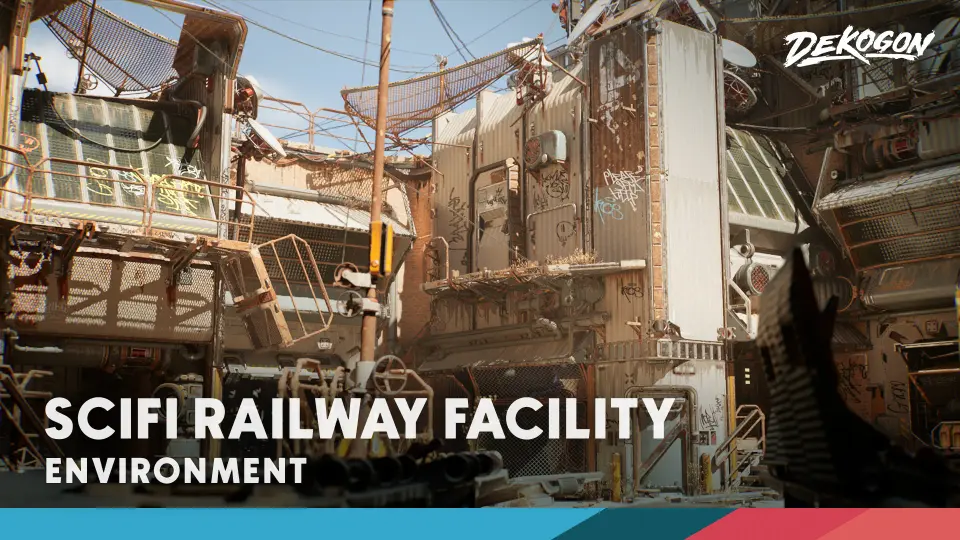
The sheer volume of parts ensures that large cityscapes can be constructed without obvious, repetitive tiling that often breaks immersion in high-fidelity projects. When assembling an exterior level, the variety of structural components allows for seamless transitions between heavy railway architecture and the surrounding futuristic city elements. The thematic direction leans heavily into an abandoned, futuristic aesthetic. Industrial metal surfaces dominate the structural pieces, providing a grounded, realistic foundation for sci-fi level design. By combining heavy railway architecture with a neglected atmosphere, the environment assets serve projects that require a gritty, lived-in universe rather than a pristine, sterile sci-fi setting.
Heavy Industrial Geometry Through Nanite
Industrial scenes featuring dense metal trusses, complex rail tracks, and wire netting traditionally consume massive rendering budgets. The inclusion of industrial nets and intricate metalwork can often create bottlenecks in standard rendering pipelines due to overdraw and complex silhouettes. To circumvent these traditional polygon limits, the assets rely entirely on Unreal Engine 5’s Nanite virtualized geometry system.
This integration allows for large amounts of geometry per asset, preserving the intricate physical details of the sci-fi machinery without the need for aggressive, manual Level of Detail (LOD) generation. By utilizing Nanite, the high-density meshes maintain optimal performance even when duplicated hundreds of times across a sprawling exterior cityscape. This ensures the project remains optimized for high-end games, allowing level designers to populate their scenes with heavy industrial clutter, abandoned debris, and intricate architectural supports without compromising the target frame rate.
Surfacing Abandoned Metal and PBR Materials
Supporting the dense geometry is a robust physically based rendering (PBR) material pipeline. The project includes high-quality and high-fidelity texture sets designed to hold up under close camera scrutiny. Moving beyond static textures, the material architecture includes additional built-in controls for fine-tuning the surface response. Environment artists have direct access to parameters governing roughness, albedo, and normals.
These material controls are essential when adapting the assets to different areas of a level. A developer might adjust the roughness values to make exterior metal panels appear more weathered and oxidized, pushing the abandoned aesthetic further. Alternatively, tweaking the albedo and normals can restore a cleaner, more reflective finish to specific train components or interior terminal walls. This flexibility ensures that the included materials can be calibrated to match the specific artistic direction of a given high-end project without requiring artists to author entirely new texture maps from scratch.
Dynamic Lumen Illumination for Exterior Cityscapes
Lighting an expansive sci-fi terminal requires a system capable of handling complex bounce light across varied metallic surfaces. The project is built entirely around dynamic lighting, specifically utilizing Unreal Engine’s Lumen system for Unreal Engine 5.0 and above. By abandoning pre-baked static lighting, the environment allows for real-time global illumination and reflections that react accurately to moving light sources. This is particularly crucial in a rail environment where dynamic elements, such as moving trains or shifting exterior sunlight, need to cast accurate, real-time shadows across the complex metal frameworks.
To demonstrate the intended visual target, the package includes a dedicated test dynamic lighting scene. This pre-configured map utilizes dynamic Lumen lighting to showcase how the materials, geometry, and light interact under ideal conditions. Environment artists can use this test scene as a baseline benchmark, studying the lighting setup to replicate the AAA visual fidelity in their own custom exterior levels.
Color Grading with the Included Look Up Table
Achieving a cohesive cinematic look in Unreal Engine relies heavily on final image processing. Alongside the geometry and lighting, the project includes a realistic Post Process setup and a custom Look Up Table (LUT). The LUT handles the color grading, mapping the raw rendered colors to a specific, realistic sci-fi palette. This built-in post-processing volume ensures that the deep shadows of the abandoned facility and the bright highlights of the metallic surfaces are balanced correctly right out of the box, matching the precise style pictured in the original environment art.
Created by Filipp Sparak in collaboration with Dekogon Studios, the assets prioritize the strict quality and optimization demands of modern development. Teams building detailed exterior cityscapes or gritty, abandoned transit hubs gain immediate access to a production-ready ecosystem. By combining Nanite-driven geometry with Lumen illumination and deep material customization, environment artists are equipped with the precise tools needed to construct massive, high-fidelity sci-fi rail networks that perform efficiently at scale.
 Industrial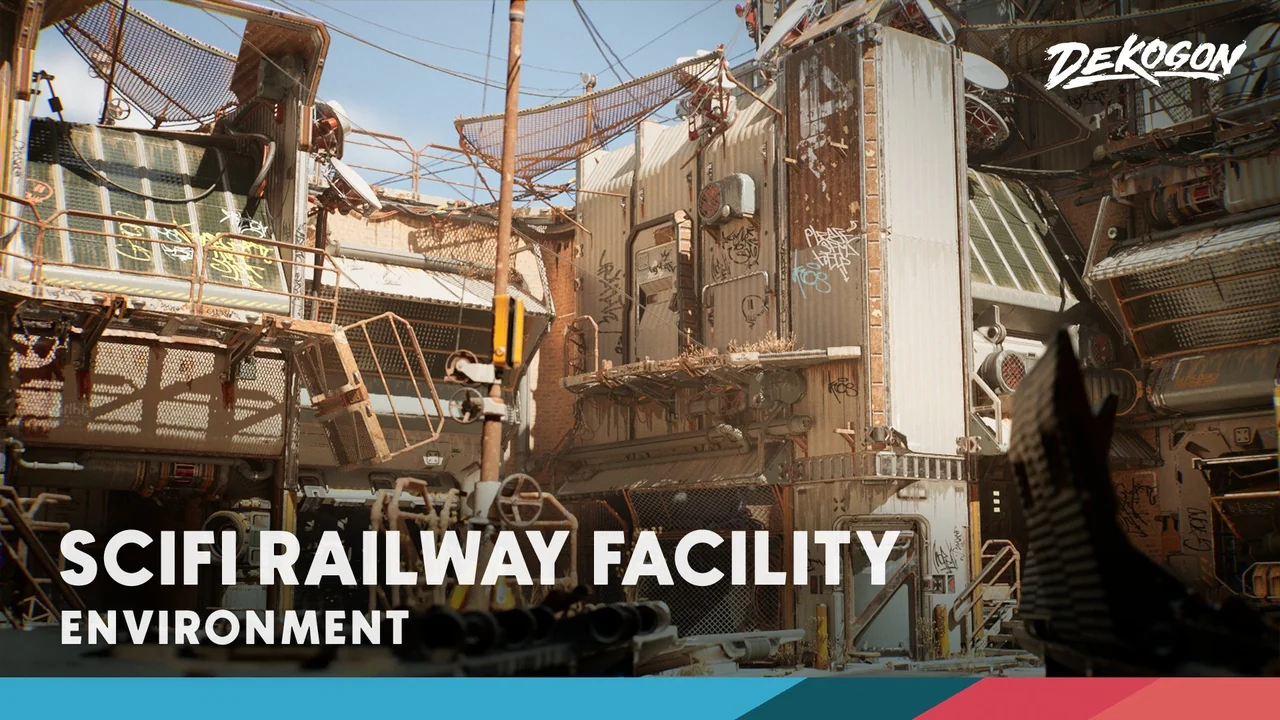
 Industrial
 Industrial
 Sci-Fi