"a338a1d501976271"{"id":"1001358","slug":"ready-map-vol-2-bridge-environment-nature","title":"Ready Map Vol 2 - Bridge Environment / Nature","category":"Apocalyptic / Post-apocalyptic","engine":"5.0+","assetVersion":"","engineVersion":"Engine Version: 5.0+","tag":"Apocalyptic","accent":"blue","visual":"city","summary":"Examine the technical layout, RVT setup, LOD hierarchy, and collision pipeline in Ready Map Vol 2 - Bridge Environment / Nature by Six Sides Studios.","platform":"Unreal Engine","publishedAt":"2026-10-04T10:26:35.727Z","updatedAt":"2026-10-04T10:26:35.727Z","sourceNotes":[],"fileContents":[],"compatibility":["Unreal Engine","Engine Version: 5.0+"],"featuredImage":{"alt":"Ready Map Vol 2 - Bridge Environment / Nature","src":"/wp-content/uploads/published/2026/10/2d8c73dc0cd1-9923139d-6e59-4dfd-8370-421d0a51b49a-0aa8801421.webp"},"hasDownloadLink":true,"downloads":0,"terms":[{"taxonomy":"category","slug":"apocalyptic-post-apocalyptic","name":"Apocalyptic / Post-apocalyptic"}],"galleryImages":[{"src":"/wp-content/uploads/published/2026/10/3001a1e0782e-60a4b79b-1767-4dad-86fa-927fac40f6cb-538860c9e4.webp","alt":"Ready Map Vol 2 - Bridge Environment / Nature"},{"src":"/wp-content/uploads/published/2026/10/fe349e209e39-09184e3e-29ae-49f6-8b1a-71c0b0a5d3b5-9861fd5b67.webp","alt":"Ready Map Vol 2 - Bridge Environment / Nature"},{"src":"/wp-content/uploads/published/2026/10/155413fb1af8-8c28e735-0b7c-49dd-a45a-18bad60e285a-ecc26bcb75.webp","alt":"Ready Map Vol 2 - Bridge Environment / Nature"},{"src":"/wp-content/uploads/published/2026/10/0e58d6e2b6a8-3399d4af-c218-4380-b9c9-7503a0c14703-59768e70c1.webp","alt":"Ready Map Vol 2 - Bridge Environment / Nature"},{"src":"/wp-content/uploads/published/2026/10/d15a18e11118-77e45f34-b0dd-407f-8506-453cf1d95586-2200b154c1.webp","alt":"Ready Map Vol 2 - Bridge Environment / Nature"},{"src":"/wp-content/uploads/published/2026/10/b7af9714c2a1-3a7f47f8-f185-47cd-af4b-6d7069e440b1-6243c5b3f1.webp","alt":"Ready Map Vol 2 - Bridge Environment / Nature"},{"src":"/wp-content/uploads/published/2026/10/2a0f3b0c574f-b31c8b46-a09a-403f-9d19-7964edd2d78b-650fe145f3.webp","alt":"Ready Map Vol 2 - Bridge Environment / Nature"},{"src":"/wp-content/uploads/published/2026/10/fe857c09b436-34b78961-47ad-4ca1-beb6-6f4cfe0a3399-a802eda25d.webp","alt":"Ready Map Vol 2 - Bridge Environment / Nature"},{"src":"/wp-content/uploads/published/2026/10/3433566b3a83-f3230bcd-e30f-426e-bfc7-0781d1ca8832-2ead40d599.webp","alt":"Ready Map Vol 2 - Bridge Environment / Nature"},{"src":"/wp-content/uploads/published/2026/10/34d07ea1d8e5-d664be45-0e78-430f-9f9b-3e6414e1417f-8dd28ddf6b.webp","alt":"Ready Map Vol 2 - Bridge Environment / Nature"}],"accessPanel":{"kind":"resource","title":"Download this resource","eyebrow":"Free Download","message":"Log in or create a free account to start your download.","fileName":"Content.7z","safetyNote":"Resources are manually reviewed before listing to improve quality and reduce obvious risks.","actionLabel":"Download Free","resourceType":"Resource archive"},"contentHtml":"\u003ch2\u003eProject Settings and Virtual Texture Support\u003c/h2\u003e\u003cp\u003eGetting the landscape ready requires configuring project rendering features to match the materials used across the terrain. Specific landscape items rely on Runtime Virtual Texturing (RVT). To ensure these items render properly, open the Unreal Engine Project Settings and enable the Virtual Texture Support flag. Projects that do not intend to leverage virtual texturing can bypass this setting by toggling the RVT option off directly inside the individual landscape materials.\u003c/p\u003e\u003cp\u003eTerrain surfaces are driven by an Auto Material Landscape capable of procedurally populating high-quality vegetation across slope and height variations. This automaterial structure isolates the technical placement rules from manual dressing, letting artists paint surface layers while procedural foliage fills out surrounding banks, cliffs, and ground patches automatically.\u003c/p\u003e\u003ch2\u003eBridge Architecture, Prefabs, and Dynamic Wiring\u003c/h2\u003e\u003cp\u003eThe library contains 342 unique static meshes tailored to building damaged, abandoned crossings over natural ravines, rivers, and roadways. Scene assembly relies heavily on modular construction blocks, spanning structural piers, fractured asphalt spans, damaged barriers, and street poles that capture the distinct stylized visual signature created by Six Sides Studios.\u003c/p\u003e\u003cp\u003eRather than assembling every complex crossing piece by piece, the collection supplies 128 prefabs, including 122 Blueprint prefabs. These prefabs bundle structural bridge segments with street furniture, barriers, and environmental accents into ready-to-place modules. A single driveable or static vehicle asset is included to anchor roadway storytelling alongside the destroyed infrastructure.\u003c/p\u003e\u003cp\u003eConnecting utility poles across large chasms can quickly become tedious when adjusting hanging wires manually. To solve this, three dynamic Blueprints handle wire connections between posts. Dropping these actors into a level allows rapid stringing of power lines and cables from pole to pole, dynamically maintaining sag and alignment regardless of bridge elevation changes or post spacing.\u003c/p\u003e\u003ch2\u003eLOD Draw Call Consolidation and Mesh Optimization\u003c/h2\u003e\u003cp\u003eLarge-scale modular scenes often create high draw-call volumes when complex assemblies reference multiple unique shading networks. Within this environment, five heavy prefabs that normally require between three and nine individual materials incorporate a specialized level of detail. Their designated LOD collapses the entire assembly down to a single material call. This consolidated version is also made available as a standalone Static Mesh, allowing artists to populate distant background skylines without incurring multi-material draw penalties.\u003c/p\u003e\u003cp\u003eIntermediate LOD tiers, ranging from step one through five, systematically strip non-essential geometry. Polygons and shadow-casting surfaces are selectively culled from internal or visual-neutral areas where reductions will not degrade visual silhouettes. At extreme viewing distances, all tree assets and six distinct grass meshes drop down to an eight-triangle billboard LOD. This transition cuts polygon budgets across heavy forest clusters while preserving the volume of distant horizons.\u003c/p\u003e\u003ch2\u003eCollision Profiles and LOD-Based Physics Colliders\u003c/h2\u003e\u003cp\u003eHandling collisions in modular civil environments requires balancing player footstep precision against physics evaluation costs. Most structural bridge pieces and large props implement the complex collision as simple configuration. This delivers exact contact surfaces along fractured pavement, curbs, and exposed steel components.\u003c/p\u003e\u003cp\u003eTo prevent this approach from straining physics performance, collision geometry is mapped directly to simplified intermediate LODs. The pack assigns the LOD for collision setting to evaluate between LOD 2 and LOD 4, turning lower-resolution mesh stages into the active physics collider instead of testing against the base geometric detail.\u003c/p\u003e\u003cp\u003eFor standard environmental props, static meshes include simplified collision shapes, housing anywhere from one to six collision primitives at most. Foliage meshes that do not require physical interaction, such as field grass, default to the no-collision preset to eliminate unnecessary sweep checks and raycasts entirely.\u003c/p\u003e\u003ch2\u003eMaterial Instances, Seasonal Shifts, and Lumen Lighting\u003c/h2\u003e\u003cp\u003eThe visual framework is based on 16 master materials feeding 82 material instances. These instances expose parameters for surface tinting, roughness variation, and wear adjustments across both architectural elements and nature props. Shaders assigned to trees and plants incorporate a simplified seasonal color transition system, letting creators tint the canopy and undergrowth between warmer and cooler palettes without rebuilding underlying texture sets. Foliage textures are prepared to accommodate prospective asset updates smoothly.\u003c/p\u003e\u003cp\u003eLighting behavior is calibrated for real-time global illumination workflows, functioning natively with Unreal Engine's Lumen system. Indirect bounce light naturally wraps around bridge pillars, underpasses, and thick vegetation canopies while honoring the stylized art direction of the assets.\u003c/p\u003e\u003ch2\u003eProduction Integration and Companion Environments\u003c/h2\u003e\u003cp\u003eArtists planning expanded wasteland or post-apocalyptic sequences can pair this package with Ready Map Vol 1 - Gas Station Post Apocalyptic, as the visual style and technical architecture match between releases. Real-time evaluation is supported through an external playable demo on Itch.io, alongside a full map overview video and technical documentation covering asset configuration.\u003c/p\u003e\n\n\u003ch2\u003eRelated Resources Worth Checking\u003c/h2\u003e\n\u003cul\u003e\n\u003cli\u003e\u003ca href=\"https://3dcghub.com/grass-landscape-material-vol-i/\" title=\"Grass Landscape Material Vol. I\"\u003eGrass Landscape Material Vol. I\u003c/a\u003e\u003c/li\u003e\n\u003cli\u003e\u003ca href=\"https://3dcghub.com/forest-landscape-materials-vol-ii/\" title=\"Forest Landscape Materials Vol. II\"\u003eForest Landscape Materials Vol. II\u003c/a\u003e\u003c/li\u003e\n\u003cli\u003e\u003ca href=\"https://3dcghub.com/stylized-nature-vol-1-stylized-environment-bundle/\" title=\"Stylized Nature Vol. 1 | Stylized Environment Bundle\"\u003eStylized Nature Vol. 1 | Stylized Environment Bundle\u003c/a\u003e\u003c/li\u003e\n\u003cli\u003e\u003ca href=\"https://3dcghub.com/anime-sky-hdri-plus/\" title=\"Anime Sky HDRI Plus\"\u003eAnime Sky HDRI Plus\u003c/a\u003e\u003c/li\u003e\n\u003cli\u003e\u003ca href=\"https://3dcghub.com/forest-landscape-materials-vol-i/\" title=\"Forest Landscape Materials Vol.I\"\u003eForest Landscape Materials Vol.I\u003c/a\u003e\u003c/li\u003e\n\u003c/ul\u003e","contentTextLength":5774,"navigation":{"current":44,"total":3338,"previous":{"id":"1001359","slug":"sci-fi-heavy-bot","title":"Sci Fi Heavy Bot","category":"Characters \u0026 Creatures","platform":"Unreal Engine","updatedAt":"2026-10-04T10:28:57.469Z"},"next":{"id":"1001357","slug":"rainy-neon-streets","title":"Rainy Neon Streets","category":"Cyberpunk","platform":"Unreal Engine","updatedAt":"2026-10-04T10:25:36.152Z"}},"relatedResources":[{"id":"1001211","slug":"grass-landscape-material-vol-i","title":"Grass Landscape Material Vol. I","category":"Nature \u0026 Terrain","engine":"5.0+","assetVersion":"","engineVersion":"Engine Version: 5.0+","tag":"Nature \u0026 Terrain","accent":"blue","visual":"luts","summary":"Examine Grass Landscape Material Vol. I, featuring photoscanned 3mx3m grass and mud surfaces with multiple displacement methods for realistic terrains.","platform":"Unreal Engine","publishedAt":"2026-09-19T08:44:44.049Z","updatedAt":"2026-09-19T08:44:44.049Z","sourceNotes":[],"fileContents":[],"compatibility":["Unreal Engine","Engine Version: 5.0+"],"featuredImage":{"alt":"Grass Landscape Material Vol. I","src":"/wp-content/uploads/published/2026/09/223a06048e45-13f8af89-33ba-43d2-bfbb-9135eb638f57-b26e938f50.webp"},"hasDownloadLink":true,"downloads":1},{"id":"1001209","slug":"forest-landscape-materials-vol-ii","title":"Forest Landscape Materials Vol. II","category":"Nature \u0026 Terrain","engine":"5.0+","assetVersion":"","engineVersion":"Engine Version: 5.0+","tag":"Nature \u0026 Terrain","accent":"blue","visual":"luts","summary":"A detailed look at Forest Landscape Materials Vol. II, featuring 3mx3m photoscanned deciduous forest textures and multiple displacement methods.","platform":"Unreal Engine","publishedAt":"2026-09-19T08:41:22.784Z","updatedAt":"2026-09-19T08:41:22.784Z","sourceNotes":[],"fileContents":[],"compatibility":["Unreal Engine","Engine Version: 5.0+"],"featuredImage":{"alt":"Forest Landscape Materials Vol. II","src":"/wp-content/uploads/published/2026/09/87bf5469786d-c8f44977-9c23-4412-9186-783fc612d0d0-bae97017a8.webp"},"hasDownloadLink":true,"downloads":0},{"id":"1000481","slug":"stylized-nature-vol-1-stylized-environment-bundle","title":"Stylized Nature Vol. 1 | Stylized Environment Bundle","category":"Forest \u0026 Jungle","engine":"5.2+","assetVersion":"","engineVersion":"Engine Version: 5.2+","tag":"Forest \u0026 Jungle","accent":"blue","visual":"city","summary":"A stylized environment bundle for Unreal Engine featuring landscape tools for cliffs, grass distribution, runtime virtual textures, interactive foliage, and dyn","platform":"Unreal Engine","publishedAt":"2026-07-12T06:08:17.870Z","updatedAt":"2026-07-12T06:08:17.870Z","sourceNotes":[],"fileContents":[],"compatibility":["Unreal Engine","Engine Version: 5.2+"],"featuredImage":{"alt":"Stylized Nature Vol. 1 | Stylized Environment Bundle","src":"/wp-content/uploads/published/2026/07/26ef167c9a89-bc3026b6-a0c9-4dcc-82d5-8ee5de21e891-9887ed431f.webp"},"hasDownloadLink":true,"downloads":3}]}
Apocalyptic
Ready Map Vol 2 - Bridge Environment / Nature
Examine the technical layout, RVT setup, LOD hierarchy, and collision pipeline in Ready Map Vol 2 - Bridge Environment / Nature by Six Sides Studios.
Getting the landscape ready requires configuring project rendering features to match the materials used across the terrain. Specific landscape items rely on Runtime Virtual Texturing (RVT). To ensure these items render properly, open the Unreal Engine Project Settings and enable the Virtual Texture Support flag. Projects that do not intend to leverage virtual texturing can bypass this setting by toggling the RVT option off directly inside the individual landscape materials.
Terrain surfaces are driven by an Auto Material Landscape capable of procedurally populating high-quality vegetation across slope and height variations. This automaterial structure isolates the technical placement rules from manual dressing, letting artists paint surface layers while procedural foliage fills out surrounding banks, cliffs, and ground patches automatically.
Bridge Architecture, Prefabs, and Dynamic Wiring
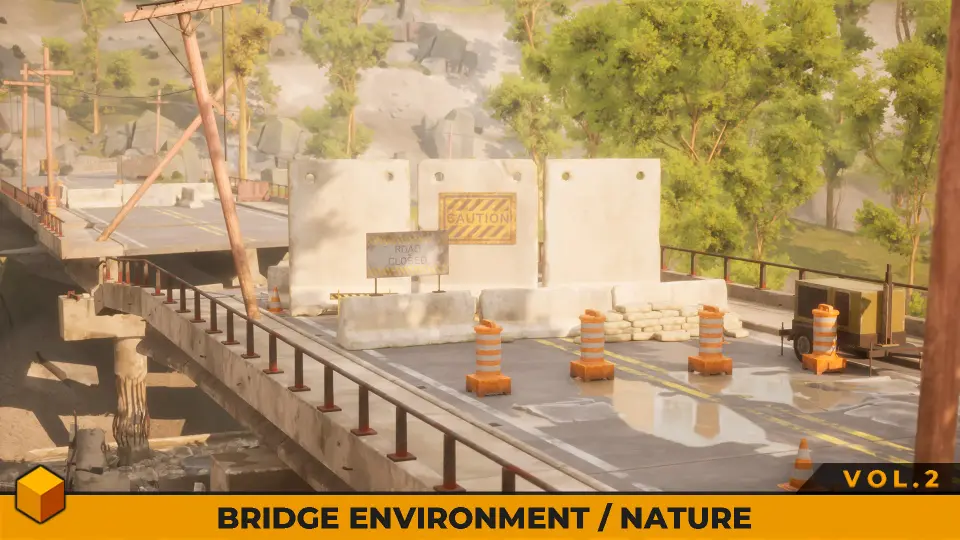
The library contains 342 unique static meshes tailored to building damaged, abandoned crossings over natural ravines, rivers, and roadways. Scene assembly relies heavily on modular construction blocks, spanning structural piers, fractured asphalt spans, damaged barriers, and street poles that capture the distinct stylized visual signature created by Six Sides Studios.
Rather than assembling every complex crossing piece by piece, the collection supplies 128 prefabs, including 122 Blueprint prefabs. These prefabs bundle structural bridge segments with street furniture, barriers, and environmental accents into ready-to-place modules. A single driveable or static vehicle asset is included to anchor roadway storytelling alongside the destroyed infrastructure.
Connecting utility poles across large chasms can quickly become tedious when adjusting hanging wires manually. To solve this, three dynamic Blueprints handle wire connections between posts. Dropping these actors into a level allows rapid stringing of power lines and cables from pole to pole, dynamically maintaining sag and alignment regardless of bridge elevation changes or post spacing.
LOD Draw Call Consolidation and Mesh Optimization
Large-scale modular scenes often create high draw-call volumes when complex assemblies reference multiple unique shading networks. Within this environment, five heavy prefabs that normally require between three and nine individual materials incorporate a specialized level of detail. Their designated LOD collapses the entire assembly down to a single material call. This consolidated version is also made available as a standalone Static Mesh, allowing artists to populate distant background skylines without incurring multi-material draw penalties.
Intermediate LOD tiers, ranging from step one through five, systematically strip non-essential geometry. Polygons and shadow-casting surfaces are selectively culled from internal or visual-neutral areas where reductions will not degrade visual silhouettes. At extreme viewing distances, all tree assets and six distinct grass meshes drop down to an eight-triangle billboard LOD. This transition cuts polygon budgets across heavy forest clusters while preserving the volume of distant horizons.
Collision Profiles and LOD-Based Physics Colliders
Handling collisions in modular civil environments requires balancing player footstep precision against physics evaluation costs. Most structural bridge pieces and large props implement the complex collision as simple configuration. This delivers exact contact surfaces along fractured pavement, curbs, and exposed steel components.
To prevent this approach from straining physics performance, collision geometry is mapped directly to simplified intermediate LODs. The pack assigns the LOD for collision setting to evaluate between LOD 2 and LOD 4, turning lower-resolution mesh stages into the active physics collider instead of testing against the base geometric detail.
For standard environmental props, static meshes include simplified collision shapes, housing anywhere from one to six collision primitives at most. Foliage meshes that do not require physical interaction, such as field grass, default to the no-collision preset to eliminate unnecessary sweep checks and raycasts entirely.
Material Instances, Seasonal Shifts, and Lumen Lighting
The visual framework is based on 16 master materials feeding 82 material instances. These instances expose parameters for surface tinting, roughness variation, and wear adjustments across both architectural elements and nature props. Shaders assigned to trees and plants incorporate a simplified seasonal color transition system, letting creators tint the canopy and undergrowth between warmer and cooler palettes without rebuilding underlying texture sets. Foliage textures are prepared to accommodate prospective asset updates smoothly.
Lighting behavior is calibrated for real-time global illumination workflows, functioning natively with Unreal Engine's Lumen system. Indirect bounce light naturally wraps around bridge pillars, underpasses, and thick vegetation canopies while honoring the stylized art direction of the assets.
Production Integration and Companion Environments
Artists planning expanded wasteland or post-apocalyptic sequences can pair this package with Ready Map Vol 1 - Gas Station Post Apocalyptic, as the visual style and technical architecture match between releases. Real-time evaluation is supported through an external playable demo on Itch.io, alongside a full map overview video and technical documentation covering asset configuration.
 Apocalyptic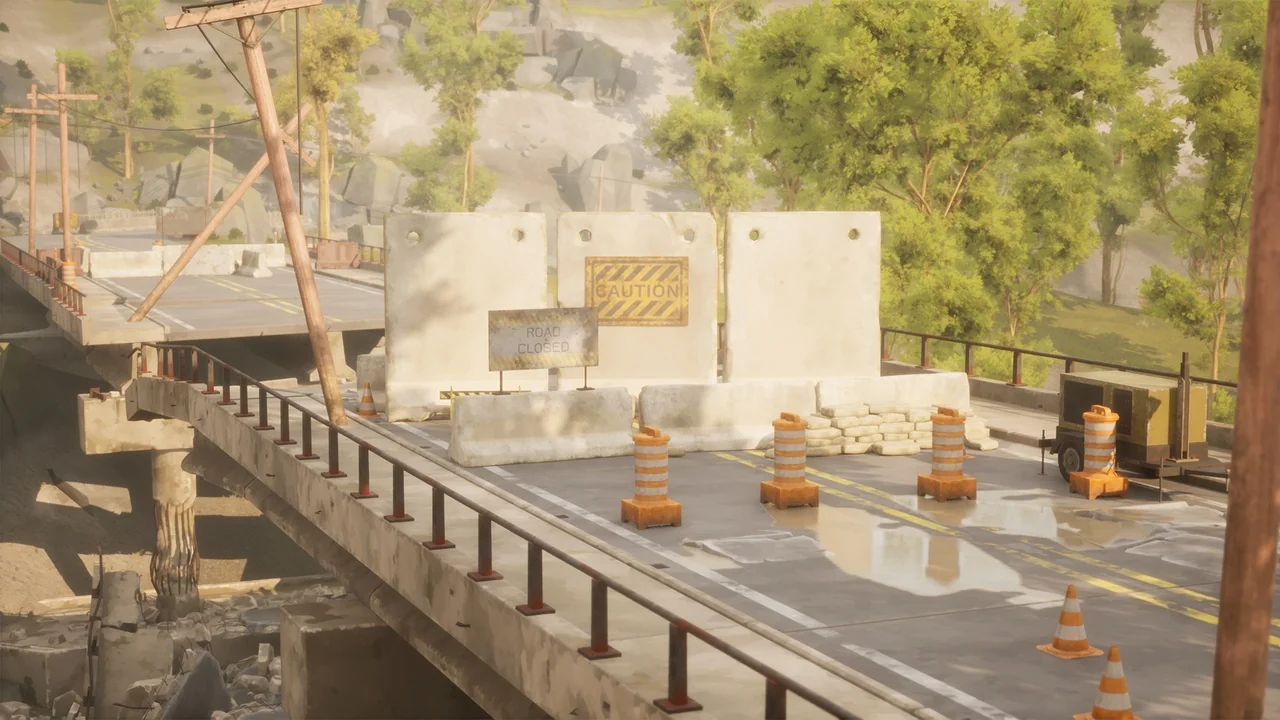
 Nature & Terrain
 Nature & Terrain
 Forest & Jungle