"82ee98b2ee2793f1"{"id":"1002445","slug":"rats-complete-pack","title":"Rats Complete Pack","category":"Characters \u0026 Creatures","engine":"4.26+,5.0+","assetVersion":"","engineVersion":"Engine Version: 4.26+,5.0+","tag":"Characters","accent":"blue","visual":"character","summary":"Explore the Rats Complete Pack featuring common, mutant, fanged, cub, and naked rat models, custom animation sets, and Animationblueprint integration.","platform":"Unreal Engine","indexPolicy":"index","publishedAt":"2026-11-10T18:46:12.021Z","updatedAt":"2026-11-10T18:46:12.021Z","sourceNotes":[],"fileContents":[],"compatibility":["Unreal Engine","Engine Version: 4.26+,5.0+"],"featuredImage":{"alt":"Rats Complete Pack","src":"/wp-content/uploads/published/2026/11/f7971f8b242d-e3410fea-b396-4984-8caf-561a3d686e9a-49c1429459.webp"},"hasDownloadLink":true,"downloads":0,"terms":[{"taxonomy":"category","slug":"characters-and-creatures","name":"Characters \u0026 Creatures"}],"galleryImages":[{"src":"/wp-content/uploads/published/2026/11/a67e21e13c1b-ff60156f-45df-4f00-a433-2c33666b3dc8-70e5d56fcb.webp","alt":"Rats Complete Pack"},{"src":"/wp-content/uploads/published/2026/11/2776bcc0530b-f5e20cf7-5ca6-40a0-982e-2cb45b8988f8-ac7058cfba.webp","alt":"Rats Complete Pack"},{"src":"/wp-content/uploads/published/2026/11/1f806198be9d-00583c37-d4a2-4d1b-a07d-4b0f40b00480-e3a9261f8d.webp","alt":"Rats Complete Pack"}],"accessPanel":{"kind":"resource","title":"Get this resource","eyebrow":"Free resource","message":"Download this resource in your browser.","fileName":"Content.7z","safetyNote":"Resources are manually reviewed before listing to improve quality and reduce obvious risks.","actionLabel":"Get this resource","resourceType":"Resource archive","versions":[]},"contentHtml":"\u003ch2\u003eEnvironmental Staging with Rats Complete Pack\u003c/h2\u003e\u003cp\u003eDark subterranean tunnels, abandoned urban alleys, plague-ravaged ruins, and compromised research facilities rely heavily on ambient vermin to establish atmosphere, tension, and decay. Small fauna grounds an environment, turning sterile architecture into spaces that feel neglected, inhabited, or actively deteriorating. The Rats Complete Pack delivers a collection of rodent assets tailored for these exact atmospheric conditions, spanning natural species, hairless variations, and aggressive genetic anomalies designed to populate both mundane real-world spaces and high-threat horror environments.\u003c/p\u003e\u003cp\u003ePopulating a level with ambient rodents involves more than scattering identical meshes across the floor. By providing a diverse spectrum of conditions—from healthy common scavengers to diseased or genetically altered monstrosities—the asset set allows level designers to visually communicate environmental states. Common rodents establish typical urban decay or rural storehouses, while hairless and mutant varieties signal toxic spills, radiological leaks, or zombie contamination without requiring explicit exposition. The pack offers the necessary visual variety to scale environmental storytelling from subtle ambient movements in shadows to direct creature encounters in contaminated zones.\u003c/p\u003e\u003ch2\u003eMorphological Range in the Rats Complete Pack\u003c/h2\u003e\u003cp\u003eThe collection organizes its creature roster into distinct physical archetypes, accommodating mundane wildlife behaviors as well as extreme biological deviations. The baseline Common Rats provide the classic rodent silhouette needed for standard urban, medieval, or industrial settings. These assets serve as everyday ground-level wildlife, moving through clutter, scurrying beneath floorboards, and gathering around debris piles.\u003c/p\u003e\u003cp\u003eFor sterile, laboratory, or diseased contexts, the Naked Rat introduces an exposed skin surface, stripped of fur. This visual state instantly evokes medical testing facilities, subterranean infestations, or severe malnutrition, lending itself well to biological thrillers and survival scenarios where visual sickness heightens the sense of vulnerability.\u003c/p\u003e\u003cp\u003eWhen environments drift into supernatural disaster or bio-hazard themes, the Mutant Rat and Fanged Mutant Rat introduce grotesque body deviations. The mutant variations emphasize biological decay and infection, suiting zombie outbreaks and toxic wasteland biomes. The Fanged Mutant Rat pushes predatory attributes further, incorporating exaggerated dental geometry that transforms a passive scavenger into an overt threat capable of threatening the player character or attacking in predatory swarms.\u003c/p\u003e\u003cp\u003eRounding out the life cycle is the Cub Rat, a juvenile form suited for nests, breeding dens, and localized cluster points. Placing cubs alongside adult variants allows developers to build functional burrows, giving the vermin population realistic nesting areas rather than appearing as spontaneous spawns.\u003c/p\u003e\u003ch2\u003eLocomotion Profiles and Dedicated Animation Suites\u003c/h2\u003e\u003cp\u003eMovement authenticity makes or breaks small ambient creatures. Rodents possess a distinct, frenetic movement rhythm consisting of rapid scurrying, abrupt pauses, alert sniffing, and twitching exploratory adjustments. To preserve individuality across different physical builds, the collection pairs its distinct models with individualized animation tracks tailored to their specific weight classes and physical profiles.\u003c/p\u003e\u003cp\u003eThe standard Rat Animations provide foundational locomotion and idling for normal activity, capturing the agile, low-slung scuttle typical of sewer rats. In contrast, the Fat Rat Animations account for extra body mass, adjusting stride rate and torso sway to communicate a heavier, overfed specimen that cannot dart with the immediate speed of leaner variants. These specialized locomotion profiles keep large groups from sharing identical mechanical timings.\u003c/p\u003e\u003cp\u003eThe Naked Rat Animations reflect the sensitivity of hairless skin, while the Cub Rat Animations present the erratic, rapid, and uncoordinated footwork characteristic of juvenile rodents. For the hostile variations, the Mutant Rat Animations and Fanged Mutant Rat Animations shift away from passive avoidance toward unnatural gaits, spasming posture, and predatory threat displays. These specialized motions allow the mutated variants to telegraph hostility and erratic biological deterioration before initiating an attack.\u003c/p\u003e\u003ch2\u003eImplementation via Scripting and Animationblueprint Structures\u003c/h2\u003e\u003cp\u003eDeploying responsive creature AI requires robust integration between raw motion tracks and engine-level behavior trees. The collection incorporates an Animationblueprint alongside dedicated script elements to bridge model data with interactive gameplay logic. This architecture ensures smooth blending between locomotion cycles, alert pauses, directional pivots, and transitions into aggressive or fleeing states.\u003c/p\u003e\u003cp\u003eUsing the Animationblueprint, developers can link movement parameters like ground velocity, turning angles, and player proximity directly to the motion suites. When an actor moves through a sewer tunnel, the blueprint manages state switches from a calm foraging idle into high-speed escape cycles seamlessly. If the scenario calls for zombie or mutant swarms, the scripting foundation permits rapid deployment of multiple instances without manually assembling state machines from scratch, ensuring that the behavioral differences between a docile Common Rat and an aggressive Fanged Mutant Rat are executed consistently.\u003c/p\u003e\u003ch2\u003eProduction Workflows and Compatibility Context\u003c/h2\u003e\u003cp\u003eThe collection focuses on a realistic aesthetic, ensuring that surface textures, muscular definition, and skeletal structures blend with photorealistic architectural and outdoor scene packs. While the visual finish leans into genuine anatomical detail for both natural and mutant variants, the technical framework maintains cross-project utility, including documented compatibility with Stylized Horse assets. This level of cross-asset compatibility allows the models and behavioral setups to interface smoothly within wider character and creature ecosystems across complex project scenes.\u003c/p\u003e\u003cp\u003eWhether implemented as background critters scattering before a player's footsteps or deployed as active hostiles in a zombie infestation, the assets within the collection provide the necessary model variety, motion range, and logic architecture to handle realistic ambient staging and high-tension survival encounters.\u003c/p\u003e\n\n\u003ch2\u003eExplore Similar Assets\u003c/h2\u003e\n\u003cul\u003e\n\u003cli\u003e\u003ca href=\"https://3dcghub.com/mutant-rat-mouse/\" rel=\"noopener noreferrer\"\u003eMutant Rat Mouse\u003c/a\u003e\u003c/li\u003e\n\u003cli\u003e\u003ca href=\"https://3dcghub.com/poly-art-bear/\" rel=\"noopener noreferrer\"\u003ePoly Art Bear\u003c/a\u003e\u003c/li\u003e\n\u003cli\u003e\u003ca href=\"https://3dcghub.com/darkness-spider/\" rel=\"noopener noreferrer\"\u003eDarkness Spider\u003c/a\u003e\u003c/li\u003e\n\u003cli\u003e\u003ca href=\"https://3dcghub.com/poly-art-tiger/\" rel=\"noopener noreferrer\"\u003ePoly Art Tiger\u003c/a\u003e\u003c/li\u003e\n\u003cli\u003e\u003ca href=\"https://3dcghub.com/luminous-monster/\" rel=\"noopener noreferrer\"\u003eLuminous Monster\u003c/a\u003e\u003c/li\u003e\n\u003c/ul\u003e","contentTextLength":6590,"navigation":{"current":5,"total":4372,"previous":{"id":"1002446","slug":"scary-shark-assets","title":"Scary Shark Assets","category":"Characters \u0026 Creatures","platform":"Unreal Engine","updatedAt":"2026-11-10T18:47:32.151Z"},"next":{"id":"1002444","slug":"poly-art-wolf","title":"Poly Art Wolf","category":"Characters \u0026 Creatures","platform":"Unreal Engine","updatedAt":"2026-11-10T18:41:27.353Z"}},"relatedResources":[{"id":"1002436","slug":"mutant-rat-mouse","title":"Mutant Rat Mouse","category":"Characters \u0026 Creatures","engine":"4.20+,5.0+","assetVersion":"","engineVersion":"Engine Version: 4.20+,5.0+","tag":"Characters","accent":"blue","visual":"character","summary":"Explore the Mutant Rat Mouse asset package, featuring raw FBX meshes, 11 combat animations, a 4096x4096 diffuse texture, and multi-role gameplay flexibility.","platform":"Unreal Engine","indexPolicy":"index","publishedAt":"2026-11-10T18:31:52.675Z","updatedAt":"2026-11-10T18:31:52.675Z","sourceNotes":[],"fileContents":[],"compatibility":["Unreal Engine","Engine Version: 4.20+,5.0+"],"featuredImage":{"alt":"Mutant Rat Mouse","src":"/wp-content/uploads/published/2026/11/a4253623c018-dfa609bb-fc7a-4485-866a-25be88271a63-7251fa4fa1.webp"},"hasDownloadLink":true,"downloads":0},{"id":"1002437","slug":"poly-art-bear","title":"Poly Art Bear","category":"Characters \u0026 Creatures","engine":"4.26+,5.0+","assetVersion":"","engineVersion":"Engine Version: 4.26+,5.0+","tag":"Characters","accent":"blue","visual":"character","summary":"Explore the Poly Art Bear asset, featuring low-poly bear, polar, and cub models with textures, animations, and Horse Animset compatibility.","platform":"Unreal Engine","indexPolicy":"index","publishedAt":"2026-11-10T18:33:07.742Z","updatedAt":"2026-11-10T18:33:07.742Z","sourceNotes":[],"fileContents":[],"compatibility":["Unreal Engine","Engine Version: 4.26+,5.0+"],"featuredImage":{"alt":"Poly Art Bear","src":"/wp-content/uploads/published/2026/11/455cc90f0380-33f14d0e-fb09-4fbc-8445-92cd1c94d1cb-d340a2ffc5.webp"},"hasDownloadLink":true,"downloads":0},{"id":"1002430","slug":"darkness-spider","title":"Darkness Spider","category":"Characters \u0026 Creatures","engine":"4.26+,5.0+","assetVersion":"","engineVersion":"Engine Version: 4.26+,5.0+","tag":"Characters","accent":"blue","visual":"character","summary":"Technical review of Darkness Spider, featuring 6.2 Ktris geometry, a 61-bone rig, 4K textures, 22 animations, and AnimationBlueprint integration.","platform":"Unreal Engine","indexPolicy":"index","publishedAt":"2026-11-10T18:26:38.496Z","updatedAt":"2026-11-10T18:26:38.496Z","sourceNotes":[],"fileContents":[],"compatibility":["Unreal Engine","Engine Version: 4.26+,5.0+"],"featuredImage":{"alt":"Darkness Spider","src":"/wp-content/uploads/published/2026/11/f3b879ba1cb8-f32667a7-e261-4eb4-b45b-4e66c1f5b187-98451b7b38.webp"},"hasDownloadLink":true,"downloads":0}]}
Characters
Rats Complete Pack
Explore the Rats Complete Pack featuring common, mutant, fanged, cub, and naked rat models, custom animation sets, and Animationblueprint integration.
Dark subterranean tunnels, abandoned urban alleys, plague-ravaged ruins, and compromised research facilities rely heavily on ambient vermin to establish atmosphere, tension, and decay. Small fauna grounds an environment, turning sterile architecture into spaces that feel neglected, inhabited, or actively deteriorating. The Rats Complete Pack delivers a collection of rodent assets tailored for these exact atmospheric conditions, spanning natural species, hairless variations, and aggressive genetic anomalies designed to populate both mundane real-world spaces and high-threat horror environments.
Populating a level with ambient rodents involves more than scattering identical meshes across the floor. By providing a diverse spectrum of conditions—from healthy common scavengers to diseased or genetically altered monstrosities—the asset set allows level designers to visually communicate environmental states. Common rodents establish typical urban decay or rural storehouses, while hairless and mutant varieties signal toxic spills, radiological leaks, or zombie contamination without requiring explicit exposition. The pack offers the necessary visual variety to scale environmental storytelling from subtle ambient movements in shadows to direct creature encounters in contaminated zones.
Morphological Range in the Rats Complete Pack
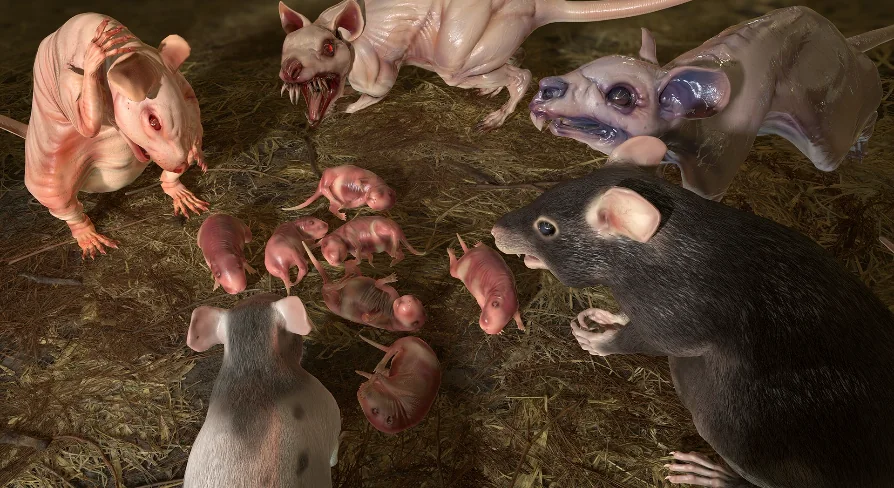
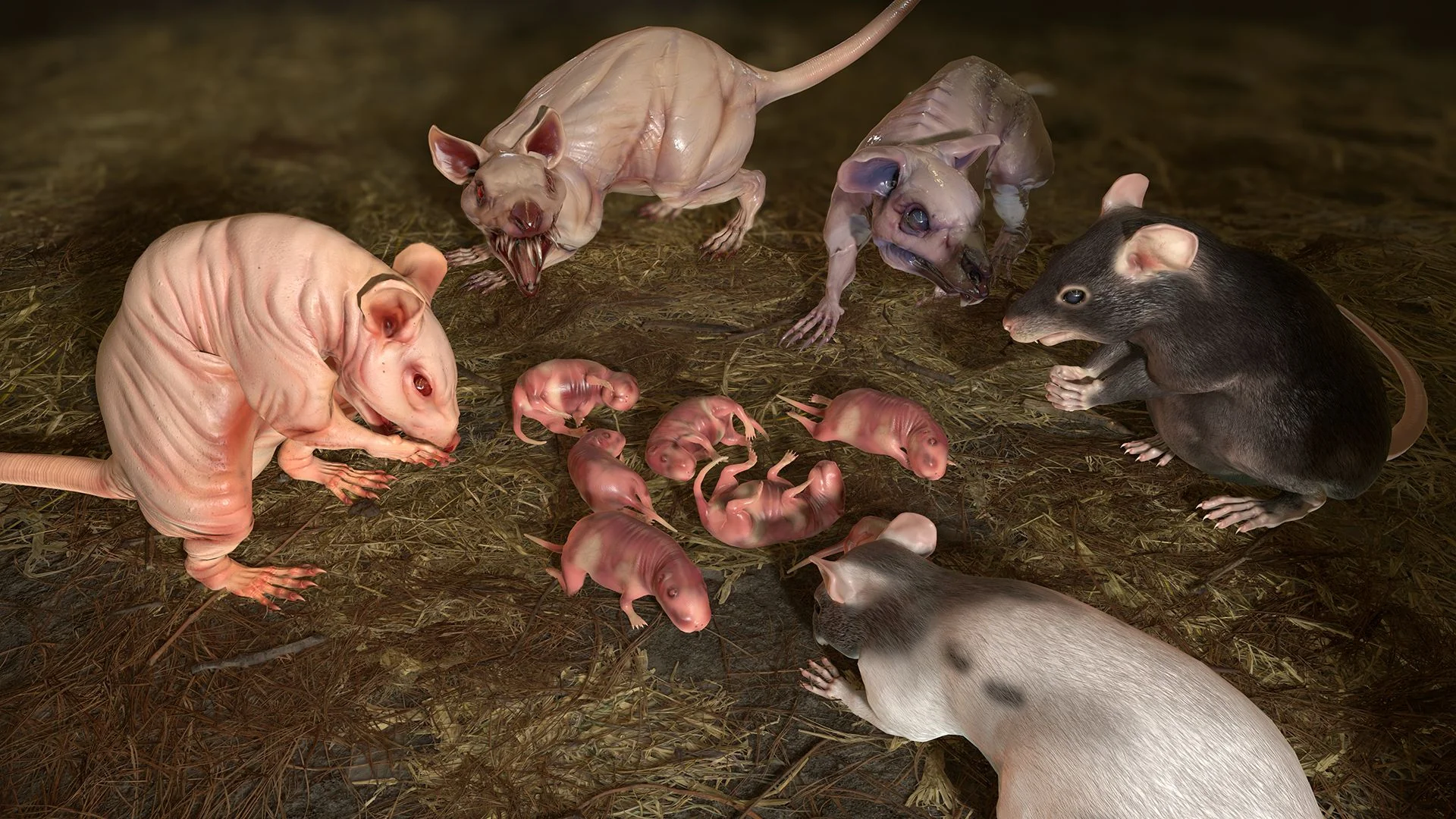
The collection organizes its creature roster into distinct physical archetypes, accommodating mundane wildlife behaviors as well as extreme biological deviations. The baseline Common Rats provide the classic rodent silhouette needed for standard urban, medieval, or industrial settings. These assets serve as everyday ground-level wildlife, moving through clutter, scurrying beneath floorboards, and gathering around debris piles.
For sterile, laboratory, or diseased contexts, the Naked Rat introduces an exposed skin surface, stripped of fur. This visual state instantly evokes medical testing facilities, subterranean infestations, or severe malnutrition, lending itself well to biological thrillers and survival scenarios where visual sickness heightens the sense of vulnerability.
When environments drift into supernatural disaster or bio-hazard themes, the Mutant Rat and Fanged Mutant Rat introduce grotesque body deviations. The mutant variations emphasize biological decay and infection, suiting zombie outbreaks and toxic wasteland biomes. The Fanged Mutant Rat pushes predatory attributes further, incorporating exaggerated dental geometry that transforms a passive scavenger into an overt threat capable of threatening the player character or attacking in predatory swarms.
Rounding out the life cycle is the Cub Rat, a juvenile form suited for nests, breeding dens, and localized cluster points. Placing cubs alongside adult variants allows developers to build functional burrows, giving the vermin population realistic nesting areas rather than appearing as spontaneous spawns.
Locomotion Profiles and Dedicated Animation Suites
Movement authenticity makes or breaks small ambient creatures. Rodents possess a distinct, frenetic movement rhythm consisting of rapid scurrying, abrupt pauses, alert sniffing, and twitching exploratory adjustments. To preserve individuality across different physical builds, the collection pairs its distinct models with individualized animation tracks tailored to their specific weight classes and physical profiles.
The standard Rat Animations provide foundational locomotion and idling for normal activity, capturing the agile, low-slung scuttle typical of sewer rats. In contrast, the Fat Rat Animations account for extra body mass, adjusting stride rate and torso sway to communicate a heavier, overfed specimen that cannot dart with the immediate speed of leaner variants. These specialized locomotion profiles keep large groups from sharing identical mechanical timings.
The Naked Rat Animations reflect the sensitivity of hairless skin, while the Cub Rat Animations present the erratic, rapid, and uncoordinated footwork characteristic of juvenile rodents. For the hostile variations, the Mutant Rat Animations and Fanged Mutant Rat Animations shift away from passive avoidance toward unnatural gaits, spasming posture, and predatory threat displays. These specialized motions allow the mutated variants to telegraph hostility and erratic biological deterioration before initiating an attack.
Implementation via Scripting and Animationblueprint Structures
Deploying responsive creature AI requires robust integration between raw motion tracks and engine-level behavior trees. The collection incorporates an Animationblueprint alongside dedicated script elements to bridge model data with interactive gameplay logic. This architecture ensures smooth blending between locomotion cycles, alert pauses, directional pivots, and transitions into aggressive or fleeing states.
Using the Animationblueprint, developers can link movement parameters like ground velocity, turning angles, and player proximity directly to the motion suites. When an actor moves through a sewer tunnel, the blueprint manages state switches from a calm foraging idle into high-speed escape cycles seamlessly. If the scenario calls for zombie or mutant swarms, the scripting foundation permits rapid deployment of multiple instances without manually assembling state machines from scratch, ensuring that the behavioral differences between a docile Common Rat and an aggressive Fanged Mutant Rat are executed consistently.
Production Workflows and Compatibility Context
The collection focuses on a realistic aesthetic, ensuring that surface textures, muscular definition, and skeletal structures blend with photorealistic architectural and outdoor scene packs. While the visual finish leans into genuine anatomical detail for both natural and mutant variants, the technical framework maintains cross-project utility, including documented compatibility with Stylized Horse assets. This level of cross-asset compatibility allows the models and behavioral setups to interface smoothly within wider character and creature ecosystems across complex project scenes.
Whether implemented as background critters scattering before a player's footsteps or deployed as active hostiles in a zombie infestation, the assets within the collection provide the necessary model variety, motion range, and logic architecture to handle realistic ambient staging and high-tension survival encounters.
 Characters
 Characters
 Characters
 Characters