"c68a05d5e51405b3"{"id":"1001119","slug":"plant-fruits-and-vegetables","title":"plant Fruits and vegetables","category":"Nature \u0026 Plants","engine":"4.26+,5.0+","assetVersion":"","engineVersion":"Engine Version: 4.26+,5.0+","tag":"Nature \u0026 Plants","accent":"blue","visual":"mech","summary":"Nine high-precision plants with multiple models each, previewed in UE4, covering coffee, spinach, wheat, strawberry, raspberry, tomato, garlic, and more.","platform":"Unreal Engine","publishedAt":"2026-09-07T12:55:52.646Z","updatedAt":"2026-09-07T12:55:52.646Z","sourceNotes":[],"fileContents":[],"compatibility":["Unreal Engine","Engine Version: 4.26+,5.0+"],"featuredImage":{"alt":"plant Fruits and vegetables","src":"/wp-content/uploads/published/2026/09/43038826c872-8220691f-86a4-437c-a121-220d40179627-8de6da649a.webp"},"hasDownloadLink":true,"downloads":0,"terms":[{"taxonomy":"category","slug":"nature-and-plants","name":"Nature \u0026 Plants"}],"galleryImages":[{"src":"/wp-content/uploads/published/2026/09/1e620b411660-e5318bb3-bef5-4119-b217-222d2c4e9b20-49689c4424.webp","alt":"plant Fruits and vegetables"},{"src":"/wp-content/uploads/published/2026/09/1f10ebe41c19-338b6c4d-5fef-4aee-a52d-7c574212a6da-64852b91fb.webp","alt":"plant Fruits and vegetables"},{"src":"/wp-content/uploads/published/2026/09/8f19045358c1-9e7ea131-ba72-4384-bbd8-43e654cc083c-7c8fb124cd.webp","alt":"plant Fruits and vegetables"},{"src":"/wp-content/uploads/published/2026/09/246071a877ac-6b082021-f801-4eb8-a15c-0fbe4a70448b-c8cdfd5e6f.webp","alt":"plant Fruits and vegetables"},{"src":"/wp-content/uploads/published/2026/09/0c0fe1d8de21-55087ed3-3f41-4e64-ad96-62d485c530b6-80b7280447.webp","alt":"plant Fruits and vegetables"},{"src":"/wp-content/uploads/published/2026/09/a81741106f0e-bbb55846-652e-4ae7-b5c6-a6d96e968bea-29d64f7f2d.webp","alt":"plant Fruits and vegetables"},{"src":"/wp-content/uploads/published/2026/09/f4208ef6ea0e-c95810e5-e064-4663-b9f0-08092853578a-f44b8f70dd.webp","alt":"plant Fruits and vegetables"},{"src":"/wp-content/uploads/published/2026/09/cdefc428f057-99df3420-8ea8-47fb-8962-3e8c35eae83e-725d531f21.webp","alt":"plant Fruits and vegetables"},{"src":"/wp-content/uploads/published/2026/09/8631907a4057-c0f61c4b-92d2-4be7-8e14-4fa42b5f06e5-4facd54fd3.webp","alt":"plant Fruits and vegetables"}],"accessPanel":{"kind":"resource","title":"Download this resource","eyebrow":"Free Download","message":"Log in or create a free account to start your download.","fileName":"Content.7z","safetyNote":"Resources are manually reviewed before listing to improve quality and reduce obvious risks.","actionLabel":"Download Free","resourceType":"Resource archive"},"contentHtml":"\u003cp\u003ePlant Fruits and vegetables is a small-but-dense UE4 resource for any scene that needs edible plants. It contains nine high-precision vegetables, and each vegetable is accompanied by multiple different models. That split between species count and model count is often what makes a vegetation pack feel alive in a farm setting or across an open meadow. The product visuals are captured in the UE4 rendering environment, so light and material behavior appear in a real-time context. The compatibility tag reads plant vegetables V2, which gives returning users a clean version marker when they update their library.\u003c/p\u003e \u003ch2\u003eNine Plant Types With Variation Inside Each One\u003c/h2\u003e\n\u003cp\u003eHaving multiple different models within a single plant type changes how you distribute vegetation in a level. If you place a spinach row with three or four spinach variants in a line, the edge of the bed keeps a natural irregularity. The same applies to strawberry or raspberry patches: a collection of slightly different plants can fill a large grow bed with a single asset family and still avoid an artificial pattern. For a crop type such as wheat or maize seedling, where fields tend to be dense, the multiple-model approach lets you seed a whole area without visible clones.\u003c/p\u003e\n\u003cp\u003eThe pack does not force you to build an entire scene out of one asset. Because each of the nine subjects has its own set of variant meshes, you can mix and match within one species or across the whole library. That flexibility is useful for level art, virtual production, or any real-time project where plant repetition becomes obvious.\u003c/p\u003e \u003ch2\u003eFrom Coffee Shrubs to Garlic With Yellow Flowers\u003c/h2\u003e\n\u003cp\u003eThe nine plant types in this set include spinach, wheat, strawberry, raspberry, potato vine, maize seedling, garlic with yellow flowers, tomato, and coffee. The final entry is listed as “breed coffee”, meaning the pack contains a cultivated coffee plant rather than a generic wild shrub. The species list spans several growth habits. Spinach stays low and leafy, wheat and maize seedling push upward as grass-like crops, and raspberry and potato vine spread and climb. Tomato, garlic, and coffee each carry their own branching or upright shape.\u003c/p\u003e\n\u003cp\u003eGarlic with yellow flowers is the most distinctive addition. Most garlic references stop at the bulb or a thin green scape. Showing garlic at the flowering stage opens up a different visual lane: the plant can sit in a herb garden, along a fantasy forest path, or anywhere it needs to read as useful and blooming at the same time. Coffee, by contrast, is commonly associated with plantation scenes, so it grounds the pack in a more cultivated, worldbuilding-oriented direction. Together, the list gives a level builder a spread of plants that would be tedious to source individually.\u003c/p\u003e \u003ch2\u003eUE4 Render Environment Gives the First Visual Read\u003c/h2\u003e\n\u003cp\u003eAll of the preview imagery is displayed inside the UE4 rendering environment. That choice matters because it previsualizes the models under real-time light similar to what an actual level would produce. Instead of static studio turntables, the images show how leaves, stems, and small flowers behave when the materials are lit by a game camera with shadows and bounce. For a pack that spans delicate wheat awns, broad spinach leaves, and dense potato vine foliage, this makes it easier to judge the asset before import.\u003c/p\u003e\n\u003cp\u003eThe UE4 rendering environment also sets an expectation for the workflow. Sinking these plants into an Unreal project does not require a guess about whether the model style matches engine-based assets. The version tag plant vegetables V2 sits right next to this environment note, so the pack carries a clear identity inside a UE4 collection. For a level designer, that is a practical checkpoint before building a garden mock-up.\u003c/p\u003e \u003ch2\u003eFantasy and Character Tags Suggest a Broader Use\u003c/h2\u003e\n\u003cp\u003e“Fantasy” and “Character” are the metadata tags attached to this release. Those labels point the pack past pure farming simulation into settings that allow for story-driven placement. A garlic plant with yellow flowers feels natural in a potion-making corner, while a strawberry patch can support a cottage exterior in an RPG. The word “Character” hints that each plant has its own presence instead of acting as fill only.\u003c/p\u003e\n\u003cp\u003eThat broad set of uses helps with placement decisions. Coffee and tomato plants can reinforce an inhabited space, spinach and maize seedlings can mark a cultivated border, and potato vine plus raspberry can blur the line between wild and tended ground. Because the asset carries Fantasy and Character tags, even small details like the garlic bloom or the coffee berry cluster can be treated as scene story cues rather than background noise.\u003c/p\u003e \u003ch2\u003eStored as plant vegetables V2\u003c/h2\u003e\n\u003cp\u003eThe versioned naming is direct: plant vegetables V2. For anyone organizing a personal mesh library, this label makes it easy to keep future revisions separate. It also helps on a team project where an asset manager needs to identify which edition of these vegetables is currently in the build. The V2 marker does not force a particular art style, but it gives the pack a clean place to live next to other UE4 vegetation.\u003c/p\u003e\n\u003cp\u003eWhen a project calls for a mixed row of crops or a fantasy garden with recognizable produce, having nine plant types plus their internal variants is a practical starting point. The high-precision detail shows up in the UE4 rendering environment preview, and the version tag removes ambiguity about what is being installed. It is a focused collection: not an endless field kit, but a specific set of plants with enough variation inside each species to keep a scene from looking like an array of identical prefabs.\u003c/p\u003e\n\n\u003ch2\u003eMore From The Same Workflow\u003c/h2\u003e\n\u003cul\u003e\n\u003cli\u003e\u003ca href=\"https://3dcghub.com/fruit-tree-v1/\" title=\"fruit tree V1\"\u003efruit tree V1\u003c/a\u003e\u003c/li\u003e\n\u003cli\u003e\u003ca href=\"https://3dcghub.com/cliff-faces-2/\" title=\"Cliff Faces 2\"\u003eCliff Faces 2\u003c/a\u003e\u003c/li\u003e\n\u003cli\u003e\u003ca href=\"https://3dcghub.com/anime-skybox-v1/\" title=\"ANIME SKYBOX V1\"\u003eANIME SKYBOX V1\u003c/a\u003e\u003c/li\u003e\n\u003cli\u003e\u003ca href=\"https://3dcghub.com/cobwebs-spider-webs-pack/\" title=\"Cobwebs / Spider Webs Pack\"\u003eCobwebs / Spider Webs Pack\u003c/a\u003e\u003c/li\u003e\n\u003cli\u003e\u003ca href=\"https://3dcghub.com/nature-set/\" title=\"Nature Set\"\u003eNature Set\u003c/a\u003e\u003c/li\u003e\n\u003c/ul\u003e","contentTextLength":5741,"navigation":{"current":856,"total":3860,"previous":{"id":"1001120","slug":"point-and-click-adventure-toolkit","title":"Point and Click Adventure Toolkit","category":"Action-Adventure","platform":"Unreal Engine","updatedAt":"2026-09-07T12:59:10.534Z"},"next":{"id":"1001118","slug":"pcg-geometry-decals","title":"PCG Geometry Decals","category":"Procedural Systems","platform":"Unreal Engine","updatedAt":"2026-09-07T12:52:22.101Z"}},"relatedResources":[{"id":"1001139","slug":"fruit-tree-v2","title":"Fruit Tree V2","category":"Nature \u0026 Plants","engine":"4.26+,5.0+","assetVersion":"","engineVersion":"Engine Version: 4.26+,5.0+","tag":"Nature \u0026 Plants","accent":"blue","visual":"mech","summary":"Fruit Tree V2 delivers 30 high-precision mesh bodies across five fruit tree species with six immature to mature growth stages for UE4 PBR fantasy scenes.","platform":"Unreal Engine","publishedAt":"2026-09-09T04:49:23.716Z","updatedAt":"2026-09-09T04:49:23.716Z","sourceNotes":[],"fileContents":[],"compatibility":["Unreal Engine","Engine Version: 4.26+,5.0+"],"featuredImage":{"alt":"Fruit Tree V2","src":"/wp-content/uploads/published/2026/09/209064fa00e9-ecbc433e-6e6d-4c74-9696-eeea50ff0412-b204aee103.webp"},"hasDownloadLink":true,"downloads":1},{"id":"1001092","slug":"fruit-tree-v1","title":"fruit tree V1","category":"Nature \u0026 Plants","engine":"4.26+,5.0+","assetVersion":"","engineVersion":"Engine Version: 4.26+,5.0+","tag":"Nature \u0026 Plants","accent":"blue","visual":"mech","summary":"A look at fruit tree V1, a UE4 pack with five high-precision fruit trees—pomegranate, peach, fig, cherry, persimmon—each in six immature-to-mature mesh variants","platform":"Unreal Engine","publishedAt":"2026-09-05T18:16:54.177Z","updatedAt":"2026-09-05T18:16:54.177Z","sourceNotes":[],"fileContents":[],"compatibility":["Unreal Engine","Engine Version: 4.26+,5.0+"],"featuredImage":{"alt":"fruit tree V1","src":"/wp-content/uploads/published/2026/09/932275ac7b40-33df8cb7-f483-4907-84e5-2f6957fdc44d-83ea0af954.webp"},"hasDownloadLink":true,"downloads":1},{"id":"1001893","slug":"meadow-environment-set","title":"Meadow - Environment Set","category":"Nature \u0026 Plants","engine":"4.26+,5.0+","assetVersion":"","engineVersion":"Engine Version: 4.26+,5.0+","tag":"Nature \u0026 Plants","accent":"blue","visual":"city","summary":"Explore the Meadow - Environment Set by Nature Manufacture, featuring photoscanned foliage, rocks with angle masking, ground textures, and fence systems.","platform":"Unreal Engine","publishedAt":"2026-10-22T11:33:14.167Z","updatedAt":"2026-10-22T11:33:14.167Z","sourceNotes":[],"fileContents":[],"compatibility":["Unreal Engine","Engine Version: 4.26+,5.0+"],"featuredImage":{"alt":"Meadow - Environment Set","src":"/wp-content/uploads/published/2026/10/e047d0852b2d-b99b7dc6-ebb5-403f-bb1a-454afc060c32-ed1d6072f4.webp"},"hasDownloadLink":true,"downloads":0}]}
Nature & Plants
plant Fruits and vegetables
Nine high-precision plants with multiple models each, previewed in UE4, covering coffee, spinach, wheat, strawberry, raspberry, tomato, garlic, and more.
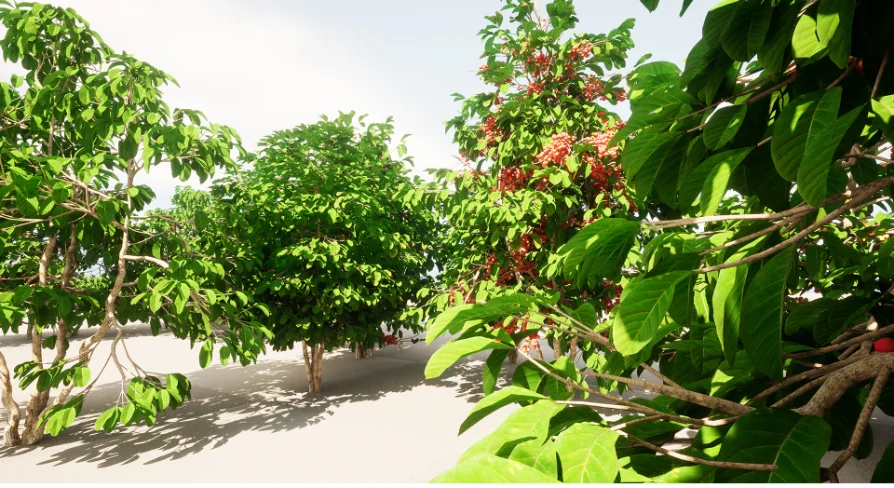
Plant Fruits and vegetables is a small-but-dense UE4 resource for any scene that needs edible plants. It contains nine high-precision vegetables, and each vegetable is accompanied by multiple different models. That split between species count and model count is often what makes a vegetation pack feel alive in a farm setting or across an open meadow. The product visuals are captured in the UE4 rendering environment, so light and material behavior appear in a real-time context. The compatibility tag reads plant vegetables V2, which gives returning users a clean version marker when they update their library.
Nine Plant Types With Variation Inside Each One
Having multiple different models within a single plant type changes how you distribute vegetation in a level. If you place a spinach row with three or four spinach variants in a line, the edge of the bed keeps a natural irregularity. The same applies to strawberry or raspberry patches: a collection of slightly different plants can fill a large grow bed with a single asset family and still avoid an artificial pattern. For a crop type such as wheat or maize seedling, where fields tend to be dense, the multiple-model approach lets you seed a whole area without visible clones.
The pack does not force you to build an entire scene out of one asset. Because each of the nine subjects has its own set of variant meshes, you can mix and match within one species or across the whole library. That flexibility is useful for level art, virtual production, or any real-time project where plant repetition becomes obvious.
From Coffee Shrubs to Garlic With Yellow Flowers
The nine plant types in this set include spinach, wheat, strawberry, raspberry, potato vine, maize seedling, garlic with yellow flowers, tomato, and coffee. The final entry is listed as “breed coffee”, meaning the pack contains a cultivated coffee plant rather than a generic wild shrub. The species list spans several growth habits. Spinach stays low and leafy, wheat and maize seedling push upward as grass-like crops, and raspberry and potato vine spread and climb. Tomato, garlic, and coffee each carry their own branching or upright shape.
Garlic with yellow flowers is the most distinctive addition. Most garlic references stop at the bulb or a thin green scape. Showing garlic at the flowering stage opens up a different visual lane: the plant can sit in a herb garden, along a fantasy forest path, or anywhere it needs to read as useful and blooming at the same time. Coffee, by contrast, is commonly associated with plantation scenes, so it grounds the pack in a more cultivated, worldbuilding-oriented direction. Together, the list gives a level builder a spread of plants that would be tedious to source individually.
UE4 Render Environment Gives the First Visual Read
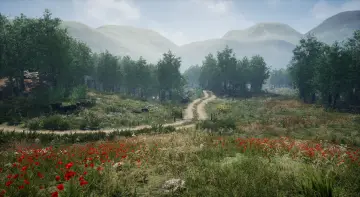
All of the preview imagery is displayed inside the UE4 rendering environment. That choice matters because it previsualizes the models under real-time light similar to what an actual level would produce. Instead of static studio turntables, the images show how leaves, stems, and small flowers behave when the materials are lit by a game camera with shadows and bounce. For a pack that spans delicate wheat awns, broad spinach leaves, and dense potato vine foliage, this makes it easier to judge the asset before import.
The UE4 rendering environment also sets an expectation for the workflow. Sinking these plants into an Unreal project does not require a guess about whether the model style matches engine-based assets. The version tag plant vegetables V2 sits right next to this environment note, so the pack carries a clear identity inside a UE4 collection. For a level designer, that is a practical checkpoint before building a garden mock-up.
Fantasy and Character Tags Suggest a Broader Use
“Fantasy” and “Character” are the metadata tags attached to this release. Those labels point the pack past pure farming simulation into settings that allow for story-driven placement. A garlic plant with yellow flowers feels natural in a potion-making corner, while a strawberry patch can support a cottage exterior in an RPG. The word “Character” hints that each plant has its own presence instead of acting as fill only.
That broad set of uses helps with placement decisions. Coffee and tomato plants can reinforce an inhabited space, spinach and maize seedlings can mark a cultivated border, and potato vine plus raspberry can blur the line between wild and tended ground. Because the asset carries Fantasy and Character tags, even small details like the garlic bloom or the coffee berry cluster can be treated as scene story cues rather than background noise.
Stored as plant vegetables V2
The versioned naming is direct: plant vegetables V2. For anyone organizing a personal mesh library, this label makes it easy to keep future revisions separate. It also helps on a team project where an asset manager needs to identify which edition of these vegetables is currently in the build. The V2 marker does not force a particular art style, but it gives the pack a clean place to live next to other UE4 vegetation.
When a project calls for a mixed row of crops or a fantasy garden with recognizable produce, having nine plant types plus their internal variants is a practical starting point. The high-precision detail shows up in the UE4 rendering environment preview, and the version tag removes ambiguity about what is being installed. It is a focused collection: not an endless field kit, but a specific set of plants with enough variation inside each species to keep a scene from looking like an array of identical prefabs.
 Nature & Plants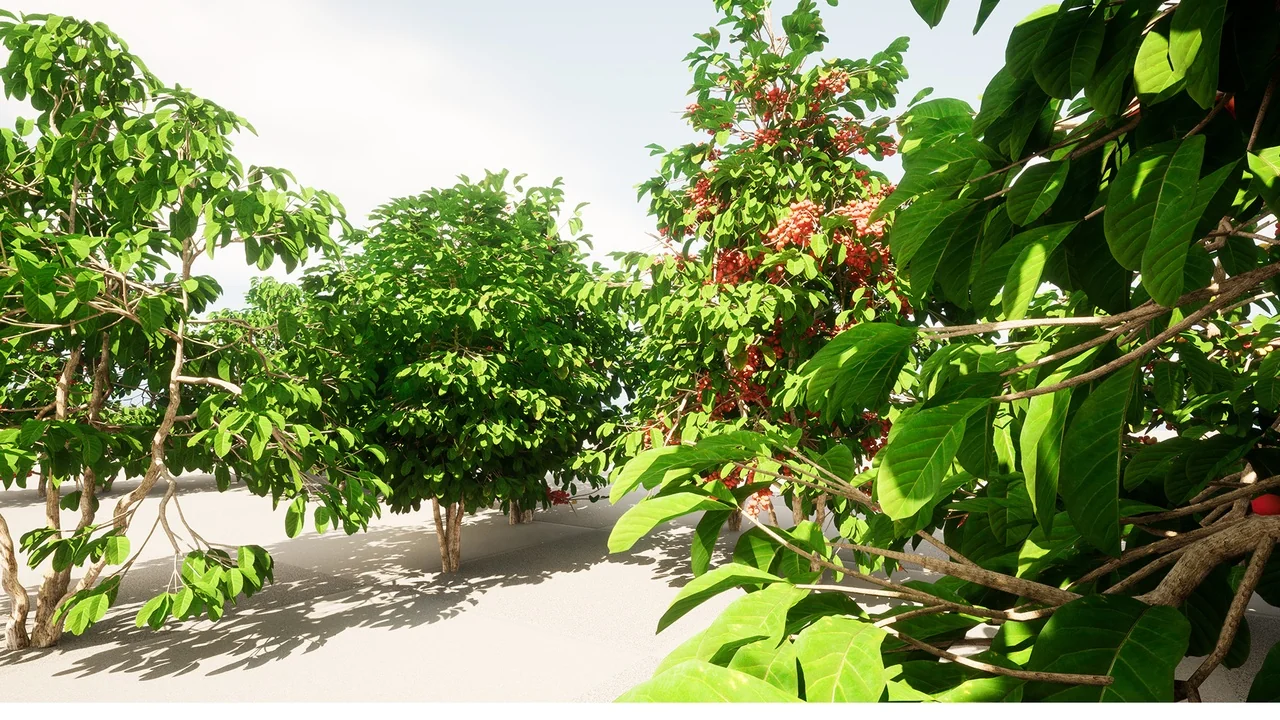
 Nature & Plants
 Nature & Plants
 Nature & Plants