"7aa4acc705f0d80b"{"id":"1001139","slug":"fruit-tree-v2","title":"Fruit Tree V2","category":"Nature \u0026 Plants","engine":"4.26+,5.0+","assetVersion":"","engineVersion":"Engine Version: 4.26+,5.0+","tag":"Nature \u0026 Plants","accent":"blue","visual":"mech","summary":"Fruit Tree V2 delivers 30 high-precision mesh bodies across five fruit tree species with six immature to mature growth stages for UE4 PBR fantasy scenes.","platform":"Unreal Engine","publishedAt":"2026-09-09T04:49:23.716Z","updatedAt":"2026-09-09T04:49:23.716Z","sourceNotes":[],"fileContents":[],"compatibility":["Unreal Engine","Engine Version: 4.26+,5.0+"],"featuredImage":{"alt":"Fruit Tree V2","src":"/wp-content/uploads/published/2026/09/209064fa00e9-ecbc433e-6e6d-4c74-9696-eeea50ff0412-b204aee103.webp"},"hasDownloadLink":true,"downloads":1,"terms":[{"taxonomy":"category","slug":"nature-and-plants","name":"Nature \u0026 Plants"}],"galleryImages":[{"src":"/wp-content/uploads/published/2026/09/e8efef8f85a1-ca0cbff4-36a2-4692-b83b-17fde03b2659-cc130bb150.webp","alt":"Fruit Tree V2"},{"src":"/wp-content/uploads/published/2026/09/2c20ad23a19d-02be9435-310a-41a2-94ff-16803da2dd48-ed102dcf24.webp","alt":"Fruit Tree V2"},{"src":"/wp-content/uploads/published/2026/09/46977d592105-d409fa6f-8a59-46d9-b0a4-acbad90656ad-ca3884b8f1.webp","alt":"Fruit Tree V2"},{"src":"/wp-content/uploads/published/2026/09/d6c76551065d-75dbb630-8c7a-4500-b8f0-fa3de72133c4-e7d621430c.webp","alt":"Fruit Tree V2"},{"src":"/wp-content/uploads/published/2026/09/ad121e2dcf2e-3cb88c4d-b6d9-4248-8662-6c0f26d0ee3b-880fa28fa0.webp","alt":"Fruit Tree V2"},{"src":"/wp-content/uploads/published/2026/09/5ec5877ccb67-b98c2f69-1bd7-48cb-90c8-a006f785d348-eeceb985a6.webp","alt":"Fruit Tree V2"},{"src":"/wp-content/uploads/published/2026/09/25b8b1590a7f-9c17a1f8-f1f3-46e3-a433-8637bc1a88af-f978ee7f84.webp","alt":"Fruit Tree V2"},{"src":"/wp-content/uploads/published/2026/09/0d7b8501c41e-fdce28bc-f735-45be-ba19-e2a175a8c9ff-e1b2eb6460.webp","alt":"Fruit Tree V2"},{"src":"/wp-content/uploads/published/2026/09/1a95dca14082-3356937f-048e-41b3-9551-a00a7cc95442-5a59d5bcaa.webp","alt":"Fruit Tree V2"},{"src":"/wp-content/uploads/published/2026/09/46ae3a46120b-7a694464-b29d-442e-a00b-4a91962c1375-ce7ab9caea.webp","alt":"Fruit Tree V2"}],"accessPanel":{"kind":"resource","title":"Download this resource","eyebrow":"Free Download","message":"Log in or create a free account to start your download.","fileName":"Content.7z","safetyNote":"Resources are manually reviewed before listing to improve quality and reduce obvious risks.","actionLabel":"Download Free","resourceType":"Resource archive"},"contentHtml":"\u003ch2\u003eStructuring Fruit Tree V2 Meshes from Immature to Mature Stages\u003c/h2\u003e\u003cp\u003ePopulating digital environments with believable flora requires variation in scale, silhouette, and developmental age. Fruit Tree V2 addresses this requirement by supplying five distinct fruit tree species, each modeled across six separate growth stages ranging from immature sapling forms to fully mature canopies. Rather than relying on uniform scaling to simulate age, the collection provides distinct geometric representations for each phase of tree development.\u003c/p\u003e\u003cp\u003eDeploying these assets in a scene involves organizing the 30 total mesh bodies according to environmental density and landscape age. Immature meshes present compact branching structures and sparser canopy mass, allowing level designers to construct young groves, domestic gardens, or edge-of-forest transitions. As the progression moves toward the mature stages, the meshes expand in volume, featuring developed crown silhouettes, denser foliage distribution, and prominent fruit-bearing forms. This step-by-step variation prevents repetitive visual patterning when planting orchards or populating natural woodlands.\u003c/p\u003e\u003ch2\u003eSpecies Breakdown Across the 30 Mesh Bodies\u003c/h2\u003e\u003cp\u003eThe library divides its 30 mesh bodies evenly among five botanical varieties, providing six structural variations for each designated plant type:\u003c/p\u003e\u003cul\u003e\u003cli\u003e\u003cstrong\u003eApricot tree (6 grid bodies):\u003c/strong\u003e Structured across six developmental forms, moving from lean young growth to broad, fruit-laden mature canopies.\u003c/li\u003e\u003cli\u003e\u003cstrong\u003ePear tree (6 grid bodies):\u003c/strong\u003e Characterized by distinct vertical branching and upright growth habits across its six individual mesh stages.\u003c/li\u003e\u003cli\u003e\u003cstrong\u003eSour Jujube tree (6 grid bodies):\u003c/strong\u003e Features intricate, thorny branch architecture and specialized canopy profiles captured throughout six growth phases.\u003c/li\u003e\u003cli\u003e\u003cstrong\u003eMango tree (6 grid bodies):\u003c/strong\u003e Built with dense, domed canopy structures that expand from compact juvenile shapes into large, shaded foliage crowns across six meshes.\u003c/li\u003e\u003cli\u003e\u003cstrong\u003ePlum trees (6 grid bodies):\u003c/strong\u003e Configured with spreading limb configurations and varying foliage clusters across six progressive models.\u003c/li\u003e\u003c/ul\u003e\u003cp\u003eBy supplying six individual grid bodies per species, large-scale planting workflows avoid the artificial uniformity common to single-mesh foliage packs. Designers can cluster several variations of the apricot tree or plum tree within the same field, alternating between younger, middle-stage, and fully mature variations to suggest multi-year growth cycles and natural propagation.\u003c/p\u003e\u003ch2\u003eHigh-Precision Meshes and UE4 Rendering\u003c/h2\u003e\u003cp\u003eGeometry across Fruit Tree V2 is constructed as high-precision meshes, giving close-up shots and hero placements the surface fidelity needed for modern real-time visualization. The high-precision definition covers trunk curvatures, branching bifurcations, and foliage card anchors, ensuring that silhouette transitions hold up under direct camera proximity.\u003c/p\u003e\u003cp\u003eThe package is set up for rendering in UE4, taking advantage of Unreal Engine 4's illumination pipelines and foliage shading features. High-precision mesh geometry works directly with static light baking through lightmaps as well as fully dynamic lighting configurations using directional sun sources and skylights. The detailed mesh framework ensures that light penetration through leaves, branch shadowing onto trunks, and ground contact shadows cast accurately without polygonal faceting along major structural limbs.\u003c/p\u003e\u003ch2\u003ePBR Material Workflow and Fantasy World Dressing\u003c/h2\u003e\u003cp\u003eAll thirty tree models conform to a PBR (Physically Based Rendering) standard, establishing predictable surface reactions across differing environmental light conditions. Bark roughness, light reflection on leaf surfaces, and the coloration of developing and ripe fruit react naturally whether placed under harsh midday sun, twilight, or overcast skies. This standardization simplifies integration into complex master materials or customized foliage shaders within the engine.\u003c/p\u003e\u003cp\u003eTagged for fantasy settings and categorized under plant, fruits, and vegetables, Fruit Tree V2 fits specific narrative and environmental world-building tasks. Fantasy environments often depend on functional landscapes—such as village farmsteads, royal orchards, secluded wild gardens, or mystical foraging forests—where edible vegetation anchors the setting in a tangible, lived-in reality. The combination of classic agricultural species like the pear, plum, and apricot alongside more specialized varieties like the sour jujube and mango gives world builders the geographical breadth to dress both temperate settlements and exotic, stylized realms.\u003c/p\u003e\u003ch2\u003eTechnical Distribution for Scene Layouts\u003c/h2\u003e\u003cp\u003eWorking with thirty pre-sorted mesh bodies enables straightforward management within the engine's foliage painting tools and actor placement panels. Instead of managing complex dynamic procedural growth setups, environment artists can directly drag and paint specific maturity stages to reflect environmental constraints. Rocky or dry areas of a terrain can receive early, immature forms of the sour jujube or apricot, while lush, irrigated farm plots can showcase the denser, mature stages of pear and mango trees.\u003c/p\u003e\u003cp\u003eBecause the five species share a unified high-precision modeling standard and PBR surface profile, mixing varieties within a single biome maintains visual consistency. Artists can position immature plum trees alongside fully grown pear trees, establishing naturalistic woodland borders or multi-tier cultivation plots that remain visually unified under Unreal Engine 4's rendering framework.\u003c/p\u003e\n\n\u003ch2\u003eExplore Similar Assets\u003c/h2\u003e\n\u003cul\u003e\n\u003cli\u003e\u003ca href=\"https://3dcghub.com/fruit-tree-v1/\" title=\"fruit tree V1\"\u003efruit tree V1\u003c/a\u003e\u003c/li\u003e\n\u003cli\u003e\u003ca href=\"https://3dcghub.com/plant-fruits-and-vegetables/\" title=\"plant Fruits and vegetables\"\u003eplant Fruits and vegetables\u003c/a\u003e\u003c/li\u003e\n\u003cli\u003e\u003ca href=\"https://3dcghub.com/nature-set/\" title=\"Nature Set\"\u003eNature Set\u003c/a\u003e\u003c/li\u003e\n\u003cli\u003e\u003ca href=\"https://3dcghub.com/realistic-pine-treesv3/\" title=\"Realistic pine treesV3\"\u003eRealistic pine treesV3\u003c/a\u003e\u003c/li\u003e\n\u003cli\u003e\u003ca href=\"https://3dcghub.com/xbh-tree-vol-1/\" title=\"XBH TREE Vol. 1\"\u003eXBH TREE Vol. 1\u003c/a\u003e\u003c/li\u003e\n\u003c/ul\u003e","contentTextLength":5607,"navigation":{"current":902,"total":3925,"previous":{"id":"1001140","slug":"hdri-winter-mixed-8k","title":"HDRI Winter Mixed - 8k","category":"Nature \u0026 Plants","platform":"Unreal Engine","updatedAt":"2026-09-09T05:02:23.276Z"},"next":{"id":"1001138","slug":"french-open-and-blueprint","title":"French Open \u0026 Blueprint","category":"Streets \u0026 Construction","platform":"Unreal Engine","updatedAt":"2026-09-09T03:49:10.965Z"}},"relatedResources":[{"id":"1001092","slug":"fruit-tree-v1","title":"fruit tree V1","category":"Nature \u0026 Plants","engine":"4.26+,5.0+","assetVersion":"","engineVersion":"Engine Version: 4.26+,5.0+","tag":"Nature \u0026 Plants","accent":"blue","visual":"mech","summary":"A look at fruit tree V1, a UE4 pack with five high-precision fruit trees—pomegranate, peach, fig, cherry, persimmon—each in six immature-to-mature mesh variants","platform":"Unreal Engine","publishedAt":"2026-09-05T18:16:54.177Z","updatedAt":"2026-09-05T18:16:54.177Z","sourceNotes":[],"fileContents":[],"compatibility":["Unreal Engine","Engine Version: 4.26+,5.0+"],"featuredImage":{"alt":"fruit tree V1","src":"/wp-content/uploads/published/2026/09/932275ac7b40-33df8cb7-f483-4907-84e5-2f6957fdc44d-83ea0af954.webp"},"hasDownloadLink":true,"downloads":1},{"id":"1001119","slug":"plant-fruits-and-vegetables","title":"plant Fruits and vegetables","category":"Nature \u0026 Plants","engine":"4.26+,5.0+","assetVersion":"","engineVersion":"Engine Version: 4.26+,5.0+","tag":"Nature \u0026 Plants","accent":"blue","visual":"mech","summary":"Nine high-precision plants with multiple models each, previewed in UE4, covering coffee, spinach, wheat, strawberry, raspberry, tomato, garlic, and more.","platform":"Unreal Engine","publishedAt":"2026-09-07T12:55:52.646Z","updatedAt":"2026-09-07T12:55:52.646Z","sourceNotes":[],"fileContents":[],"compatibility":["Unreal Engine","Engine Version: 4.26+,5.0+"],"featuredImage":{"alt":"plant Fruits and vegetables","src":"/wp-content/uploads/published/2026/09/43038826c872-8220691f-86a4-437c-a121-220d40179627-8de6da649a.webp"},"hasDownloadLink":true,"downloads":0},{"id":"28163","slug":"nature-set","title":"Nature Set","category":"Nature \u0026 Plants","engine":"4.26+,5.0+","assetVersion":"Engine version: 4.26+,5.0+","engineVersion":"","tag":"Nature \u0026 Plants","accent":"blue","visual":"luts","summary":"Nature Set targets outdoor environments with rocks, trees, grass-related textures, and a range of landscape ground materials. Its focus stays practical: prepared LODs, optimized assets, and texture resolutions suited to assembling realistic terrain scenes.","platform":"Unreal Engine","publishedAt":"2026-05-04T15:50:51.000Z","updatedAt":"2026-05-04T15:50:52.000Z","sourceNotes":[],"fileContents":[],"compatibility":["Unreal Engine","Engine version: 4.26+,5.0+"],"featuredImage":{"alt":"Nature Set","src":"https://3dcghub.com/wp-content/uploads/2026/05/4db63e9ac45d_87baa7be-9d99-4292-a5dc-903912f95d86.webp"},"hasDownloadLink":true,"downloads":1}]}
Nature & Plants
Fruit Tree V2
Fruit Tree V2 delivers 30 high-precision mesh bodies across five fruit tree species with six immature to mature growth stages for UE4 PBR fantasy scenes.
Structuring Fruit Tree V2 Meshes from Immature to Mature Stages
Populating digital environments with believable flora requires variation in scale, silhouette, and developmental age. Fruit Tree V2 addresses this requirement by supplying five distinct fruit tree species, each modeled across six separate growth stages ranging from immature sapling forms to fully mature canopies. Rather than relying on uniform scaling to simulate age, the collection provides distinct geometric representations for each phase of tree development.
Deploying these assets in a scene involves organizing the 30 total mesh bodies according to environmental density and landscape age. Immature meshes present compact branching structures and sparser canopy mass, allowing level designers to construct young groves, domestic gardens, or edge-of-forest transitions. As the progression moves toward the mature stages, the meshes expand in volume, featuring developed crown silhouettes, denser foliage distribution, and prominent fruit-bearing forms. This step-by-step variation prevents repetitive visual patterning when planting orchards or populating natural woodlands.
Species Breakdown Across the 30 Mesh Bodies
The library divides its 30 mesh bodies evenly among five botanical varieties, providing six structural variations for each designated plant type:
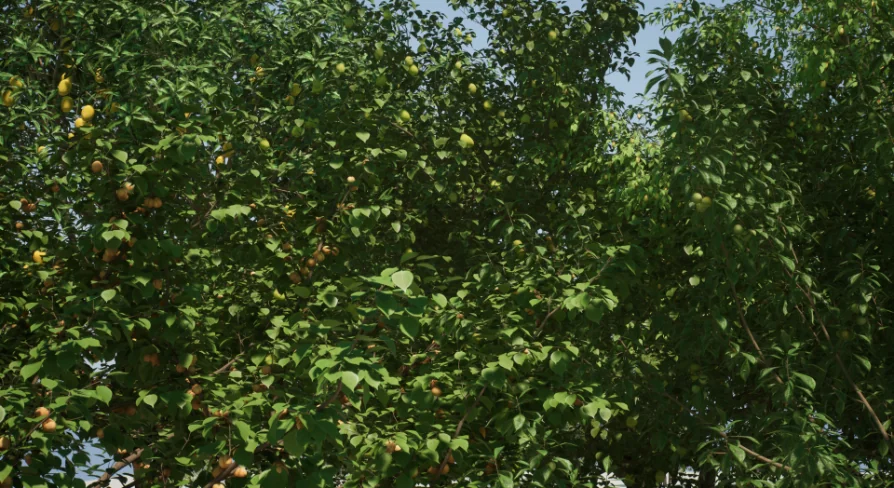
Apricot tree (6 grid bodies): Structured across six developmental forms, moving from lean young growth to broad, fruit-laden mature canopies.
Pear tree (6 grid bodies): Characterized by distinct vertical branching and upright growth habits across its six individual mesh stages.
Sour Jujube tree (6 grid bodies): Features intricate, thorny branch architecture and specialized canopy profiles captured throughout six growth phases.
Mango tree (6 grid bodies): Built with dense, domed canopy structures that expand from compact juvenile shapes into large, shaded foliage crowns across six meshes.
Plum trees (6 grid bodies): Configured with spreading limb configurations and varying foliage clusters across six progressive models.
By supplying six individual grid bodies per species, large-scale planting workflows avoid the artificial uniformity common to single-mesh foliage packs. Designers can cluster several variations of the apricot tree or plum tree within the same field, alternating between younger, middle-stage, and fully mature variations to suggest multi-year growth cycles and natural propagation.
High-Precision Meshes and UE4 Rendering
Geometry across Fruit Tree V2 is constructed as high-precision meshes, giving close-up shots and hero placements the surface fidelity needed for modern real-time visualization. The high-precision definition covers trunk curvatures, branching bifurcations, and foliage card anchors, ensuring that silhouette transitions hold up under direct camera proximity.
The package is set up for rendering in UE4, taking advantage of Unreal Engine 4's illumination pipelines and foliage shading features. High-precision mesh geometry works directly with static light baking through lightmaps as well as fully dynamic lighting configurations using directional sun sources and skylights. The detailed mesh framework ensures that light penetration through leaves, branch shadowing onto trunks, and ground contact shadows cast accurately without polygonal faceting along major structural limbs.
PBR Material Workflow and Fantasy World Dressing
All thirty tree models conform to a PBR (Physically Based Rendering) standard, establishing predictable surface reactions across differing environmental light conditions. Bark roughness, light reflection on leaf surfaces, and the coloration of developing and ripe fruit react naturally whether placed under harsh midday sun, twilight, or overcast skies. This standardization simplifies integration into complex master materials or customized foliage shaders within the engine.
Tagged for fantasy settings and categorized under plant, fruits, and vegetables, Fruit Tree V2 fits specific narrative and environmental world-building tasks. Fantasy environments often depend on functional landscapes—such as village farmsteads, royal orchards, secluded wild gardens, or mystical foraging forests—where edible vegetation anchors the setting in a tangible, lived-in reality. The combination of classic agricultural species like the pear, plum, and apricot alongside more specialized varieties like the sour jujube and mango gives world builders the geographical breadth to dress both temperate settlements and exotic, stylized realms.
Technical Distribution for Scene Layouts
Working with thirty pre-sorted mesh bodies enables straightforward management within the engine's foliage painting tools and actor placement panels. Instead of managing complex dynamic procedural growth setups, environment artists can directly drag and paint specific maturity stages to reflect environmental constraints. Rocky or dry areas of a terrain can receive early, immature forms of the sour jujube or apricot, while lush, irrigated farm plots can showcase the denser, mature stages of pear and mango trees.
Because the five species share a unified high-precision modeling standard and PBR surface profile, mixing varieties within a single biome maintains visual consistency. Artists can position immature plum trees alongside fully grown pear trees, establishing naturalistic woodland borders or multi-tier cultivation plots that remain visually unified under Unreal Engine 4's rendering framework.
 Nature & Plants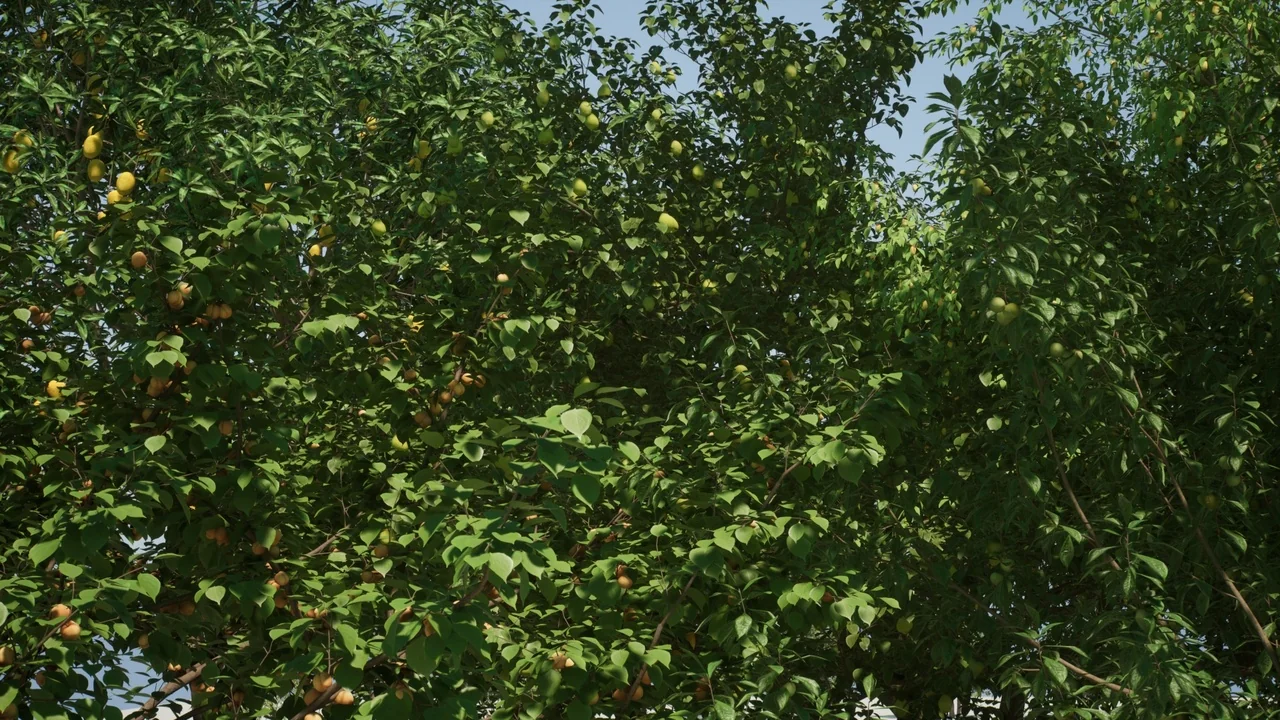
 Nature & Plants
 Nature & Plants
 Nature & Plants