"7aa4acc705f0d80b"{"id":"1001138","slug":"french-open-and-blueprint","title":"French Open \u0026 Blueprint","category":"Streets \u0026 Construction","engine":"4.26+,5.0+","assetVersion":"","engineVersion":"Engine Version: 4.26+,5.0+","tag":"Streets","accent":"blue","visual":"mech","summary":"Build regulation tennis environments with French Open \u0026 Blueprint, featuring clay, grass, and hard courts, PBR props, and a static training blueprint.","platform":"Unreal Engine","publishedAt":"2026-09-09T03:49:10.965Z","updatedAt":"2026-09-09T03:49:10.965Z","sourceNotes":[],"fileContents":[],"compatibility":["Unreal Engine","Engine Version: 4.26+,5.0+"],"featuredImage":{"alt":"French Open \u0026 Blueprint","src":"/wp-content/uploads/published/2026/09/6de6b9d57558-9dcfe8db-2636-4e64-a717-c385b0dfb6f2-138f44d4b6.webp"},"hasDownloadLink":true,"downloads":0,"terms":[{"taxonomy":"category","slug":"streets-and-construction","name":"Streets \u0026 Construction"}],"galleryImages":[{"src":"/wp-content/uploads/published/2026/09/8d3f50320a14-592bef49-5261-4e28-8d45-badb4cf34812-b422a1d52e.webp","alt":"French Open \u0026 Blueprint"},{"src":"/wp-content/uploads/published/2026/09/4142c907e828-8a43b10b-d530-44a6-81bf-093a31b65136-029c9e96c3.webp","alt":"French Open \u0026 Blueprint"},{"src":"/wp-content/uploads/published/2026/09/496b1d1b4d7e-7f154b5f-f640-44ec-8288-afa7f703d960-9eefe03362.webp","alt":"French Open \u0026 Blueprint"},{"src":"/wp-content/uploads/published/2026/09/dc4fa18a863e-70dce4a9-fe0c-4b6f-b7a0-8c38c86dab4b-946e66e4d4.webp","alt":"French Open \u0026 Blueprint"},{"src":"/wp-content/uploads/published/2026/09/f858d0c61a47-797229fe-0b60-48e6-a2a0-93f1ba938919-54f53221ec.webp","alt":"French Open \u0026 Blueprint"},{"src":"/wp-content/uploads/published/2026/09/5f0a6660741a-8e9c551e-7d8e-4bad-bb26-31bef910f6cb-0f1568180c.webp","alt":"French Open \u0026 Blueprint"},{"src":"/wp-content/uploads/published/2026/09/b4c764e74c43-23ee2aa2-6d69-4d06-825f-d42e93aa5f6f-8fe2acb8b9.webp","alt":"French Open \u0026 Blueprint"},{"src":"/wp-content/uploads/published/2026/09/6225c618bfc0-88a5b803-5c29-4586-83c6-b6a5b8f7e4a4-99d296abd4.webp","alt":"French Open \u0026 Blueprint"},{"src":"/wp-content/uploads/published/2026/09/21727e90f3f9-4dc306e6-0dc8-4950-b68b-4ecbf4a2d09e-5487d9965c.webp","alt":"French Open \u0026 Blueprint"},{"src":"/wp-content/uploads/published/2026/09/389069360b38-3af7862e-646a-428e-8f72-e826ff76f3df-cec0926792.webp","alt":"French Open \u0026 Blueprint"}],"accessPanel":{"kind":"resource","title":"Download this resource","eyebrow":"Free Download","message":"Log in or create a free account to start your download.","fileName":"Content.7z","safetyNote":"Resources are manually reviewed before listing to improve quality and reduce obvious risks.","actionLabel":"Download Free","resourceType":"Resource archive"},"contentHtml":"\u003ch2\u003eConfiguring Courts from the French Open Base\u003c/h2\u003e\n\u003cp\u003eIntegrating French Open \u0026 Blueprint into a sports production environment begins with laying down regulation-accurate playing surfaces. The project establishes its primary environment on the real-world French Open Court, capturing the distinct profile of competitive red clay. From that baseline, the package expands into three additional court configurations with different field specifications, incorporating both grass and hard court variants.\u003c/p\u003e\n\u003cp\u003eDeploying a new court layout involves straightforward configuration steps. The project structure allows developers to set up new courts without rebuilding foundational geometry or manually recalibrating court markings. Because court dimensions are fixed according to real-world tennis rules, baseline distances, service boxes, singles lines, doubles alleys, and net placements immediately adhere to standard competitive metrics. This spatial fidelity eliminates guesswork when setting up collision boundaries, camera angles, and ball bounce trigger volumes.\u003c/p\u003e\n\u003cp\u003eSetting up secondary courts follows this same structured framework. Technical artists can swap between the granular visual profile of the French Open clay court, the turf characteristics of a grass field, or the uniform surface of a hard court while preserving exact regulation spacing across every match level.\u003c/p\u003e \u003ch2\u003eBlueprint Logic and Static Character Training Mechanics\u003c/h2\u003e\n\u003cp\u003eThe included game blueprint handles ball interactions within a focused operational scope. Rather than functioning as a full game template with comprehensive match logic, referee AI, or free-roaming player movement, the blueprint implements a dedicated training mode. In this mode, character position is static. The player character remains in a standing position on the court, designed specifically to hit the ball in place.\u003c/p\u003e\n\u003cp\u003eThis stationary structure serves a practical purpose during sports gameplay development. Isolating character movement removes the immediate need to manage complex footwork locomotion trees, court sliding physics, or dynamic stamina systems. Instead, developers can use the training blueprint to test strike collision windows, racket-to-ball impact detection, trajectory calculations, and return velocity.\u003c/p\u003e\n\u003cp\u003eThe static standing mechanic effectively turns the court into a target practice or ball machine drill station. Gameplay programmers can test hit timing, ball launch vectors, and boundary detection without the unpredictable variables introduced by full-court navigation systems.\u003c/p\u003e \u003ch2\u003eSurface Specifications Across Clay, Grass, and Hard Courts\u003c/h2\u003e\n\u003cp\u003eSurface properties play a critical role in tennis simulation, and the package provides four distinct court setups to represent diverse competitive conditions. The core French Open layout delivers a clay court aesthetic, reflecting the visual identity of Roland Garros. Alongside clay, the package integrates three other courts featuring alternate field specifications, covering hard court and grass court formats.\u003c/p\u003e\n\u003cp\u003eEach court maintains the same strict real-world dimensions while presenting unique surface materials. Because real tennis surfaces exhibit vastly different traction and ball-rebound qualities, having dedicated presets for clay, grass, and hard surfaces simplifies environmental testing. Level designers can switch between stadium scenes to evaluate how different lighting setups, line markings, and court colors display within the wider arena geometry.\u003c/p\u003e\n\u003cp\u003eCreating additional custom courts remains straightforward. Developers can build on the established presets to alter colorways, sponsor board zones, or court perimeters while keeping the underlying court boundaries locked to official dimensions.\u003c/p\u003e \u003ch2\u003ePBR Textured Props and Stadium Environment Architecture\u003c/h2\u003e\n\u003cp\u003eVisual fidelity across the scene is driven by physically based rendering. Each prop in the project is textured with standard PBR workflows, ensuring materials respond naturally to scene lighting, shadows, and reflections. The environmental scope extends beyond the court floor to encompass stadium structures, building assets, and essential court gear.\u003c/p\u003e\n\u003cp\u003eThe tennis ball prop is textured to provide distinct visibility against each of the four court surfaces, supporting both high-speed gameplay tracking and close-up camera angles. Structural level pieces, fencing, and stadium building meshes provide the context needed to present an authentic arena atmosphere rather than an isolated practice plane.\u003c/p\u003e\n\u003cp\u003eBecause the props adhere to PBR texturing standards, material roughness, metallic values, and surface details maintain consistency under varying directional light setups, whether staging midday matches under clear skies or evening training drills under artificial stadium floodlights.\u003c/p\u003e \u003ch2\u003eProduction Workflow and Compatibility Setup\u003c/h2\u003e\n\u003cp\u003ePositioning French Open \u0026 Blueprint within a broader production pipeline requires clarity regarding its intended purpose. Because it is explicitly not a full game template, developers should treat it as an environment and training framework rather than an off-the-shelf tennis title. It functions cleanly as an arena backdrop, a mini-game foundation, or a modular training mode inside a larger sports simulation.\u003c/p\u003e\n\u003cp\u003eThe package maintains verified compatibility with Football Game Maker frameworks, allowing creators working within that ecosystem to introduce tennis gameplay mechanics and multi-court environments into their sports collections. The ability to rapidly spawn clay, grass, or hard courts over regulation line dimensions accelerates prototype assembly and stadium level design, giving technical artists a dependable, pre-calibrated tennis arena ready for interactive ball mechanics.\u003c/p\u003e\n\n\u003ch2\u003eRelated Resources Worth Checking\u003c/h2\u003e\n\u003cul\u003e\n\u003cli\u003e\u003ca href=\"https://3dcghub.com/brushify-country-roads-pack/\" title=\"Brushify - Country Roads Pack\"\u003eBrushify - Country Roads Pack\u003c/a\u003e\u003c/li\u003e\n\u003cli\u003e\u003ca href=\"https://3dcghub.com/race-track-construction-kit/\" title=\"Race Track Construction Kit\"\u003eRace Track Construction Kit\u003c/a\u003e\u003c/li\u003e\n\u003cli\u003e\u003ca href=\"https://3dcghub.com/french-quarter-street-environment-french-quarter-street-environment-house-3d/\" title=\"French Quarter Street Environment ( French Quarter Street Environment House 3D )\"\u003eFrench Quarter Street Environment ( French Quarter Street Environment House 3D )\u003c/a\u003e\u003c/li\u003e\n\u003cli\u003e\u003ca href=\"https://3dcghub.com/cartoon-street/\" title=\"Cartoon Street\"\u003eCartoon Street\u003c/a\u003e\u003c/li\u003e\n\u003cli\u003e\u003ca href=\"https://3dcghub.com/polygon-street-racer/\" title=\"POLYGON - Street Racer\"\u003ePOLYGON - Street Racer\u003c/a\u003e\u003c/li\u003e\n\u003c/ul\u003e","contentTextLength":5884,"navigation":{"current":903,"total":3925,"previous":{"id":"1001139","slug":"fruit-tree-v2","title":"Fruit Tree V2","category":"Nature \u0026 Plants","platform":"Unreal Engine","updatedAt":"2026-09-09T04:49:23.716Z"},"next":{"id":"1001137","slug":"elvish-forest","title":"Elvish Forest","category":"Fantasy","platform":"Unreal Engine","updatedAt":"2026-09-09T03:27:15.273Z"}},"relatedResources":[{"id":"1001822","slug":"modular-stylized-christmas-market-christmas-modular-environment-exterior","title":"Modular Stylized Christmas Market ( Christmas Modular Environment Exterior )","category":"Streets \u0026 Construction","engine":"4.26+,5.0+","assetVersion":"","engineVersion":"Engine Version: 4.26+,5.0+","tag":"Streets","accent":"blue","visual":"city","summary":"Explore the Modular Stylized Christmas Market pack, featuring modular building assets, Blueprint actors, vertex paint, and Ultimate Level Art Tool support.","platform":"Unreal Engine","publishedAt":"2026-10-21T08:15:29.046Z","updatedAt":"2026-10-21T08:15:29.046Z","sourceNotes":[],"fileContents":[],"compatibility":["Unreal Engine","Engine Version: 4.26+,5.0+"],"featuredImage":{"alt":"Modular Stylized Christmas Market ( Christmas Modular Environment Exterior )","src":"/wp-content/uploads/published/2026/10/5da8228fb331-ca5c9f80-6384-47c1-a9f0-a935dc03b31e-20f1123a49.webp"},"hasDownloadLink":true,"downloads":0},{"id":"1001467","slug":"the-rally-point-environment-rally-point-scifi-scifi-sci-fi-sci-fi-rally","title":"The Rally Point Environment ( Rally Point Scifi Scifi Sci-Fi Sci-Fi Rally )","category":"Streets \u0026 Construction","engine":"4.20+,5.0+","assetVersion":"","engineVersion":"Engine Version: 4.20+,5.0+","tag":"Streets","accent":"blue","visual":"city","summary":"Explore The Rally Point Environment, featuring 257 modular meshes on a 50cm grid, 183 materials, 27 blueprints, and Ultimate Level Art Tool integration.","platform":"Unreal Engine","publishedAt":"2026-10-08T07:56:34.224Z","updatedAt":"2026-10-08T07:56:34.224Z","sourceNotes":[],"fileContents":[],"compatibility":["Unreal Engine","Engine Version: 4.20+,5.0+"],"featuredImage":{"alt":"The Rally Point Environment ( Rally Point Scifi Scifi Sci-Fi Sci-Fi Rally )","src":"/wp-content/uploads/published/2026/10/a13b14f095d9-63221c78-87e0-4020-9b57-77a9539bda31-68efc58a2f.webp"},"hasDownloadLink":true,"downloads":0},{"id":"1000941","slug":"brushify-country-roads-pack","title":"Brushify - Country Roads Pack","category":"Streets \u0026 Construction","engine":"4.26+,5.0+","assetVersion":"","engineVersion":"Engine Version: 4.26+,5.0+","tag":"Streets","accent":"blue","visual":"mech","summary":"Spline-based country roads for UE5 with parallax road materials, roadwork props, barricade spline blueprint, and a landscape auto material for biome-rich terrai","platform":"Unreal Engine","publishedAt":"2026-08-10T04:31:02.697Z","updatedAt":"2026-08-10T04:31:02.697Z","sourceNotes":[],"fileContents":[],"compatibility":["Unreal Engine","Engine Version: 4.26+,5.0+"],"featuredImage":{"alt":"Brushify - Country Roads Pack","src":"/wp-content/uploads/published/2026/08/89a8ea838abe-02383cd9-3898-4a87-a534-50332f6212bd-86fba8c86b.webp"},"hasDownloadLink":true,"downloads":0}]}
Streets
French Open & Blueprint
Build regulation tennis environments with French Open & Blueprint, featuring clay, grass, and hard courts, PBR props, and a static training blueprint.
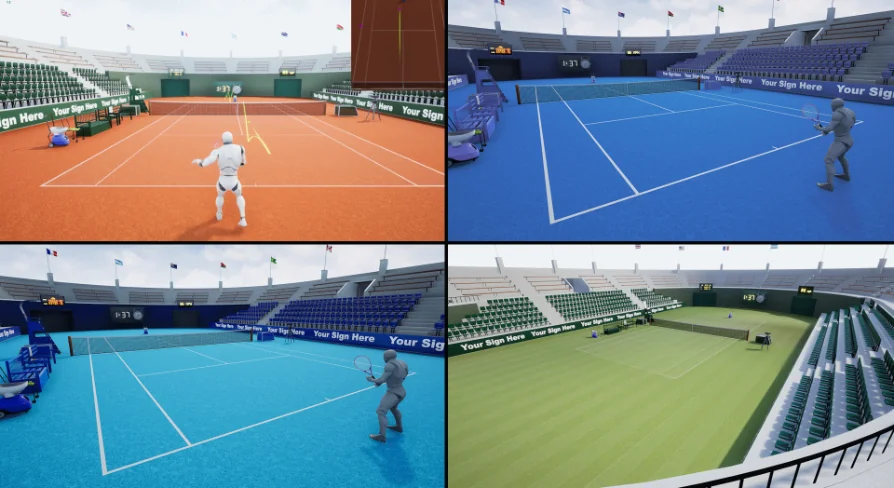
Integrating French Open & Blueprint into a sports production environment begins with laying down regulation-accurate playing surfaces. The project establishes its primary environment on the real-world French Open Court, capturing the distinct profile of competitive red clay. From that baseline, the package expands into three additional court configurations with different field specifications, incorporating both grass and hard court variants.
Deploying a new court layout involves straightforward configuration steps. The project structure allows developers to set up new courts without rebuilding foundational geometry or manually recalibrating court markings. Because court dimensions are fixed according to real-world tennis rules, baseline distances, service boxes, singles lines, doubles alleys, and net placements immediately adhere to standard competitive metrics. This spatial fidelity eliminates guesswork when setting up collision boundaries, camera angles, and ball bounce trigger volumes.
Setting up secondary courts follows this same structured framework. Technical artists can swap between the granular visual profile of the French Open clay court, the turf characteristics of a grass field, or the uniform surface of a hard court while preserving exact regulation spacing across every match level.
Blueprint Logic and Static Character Training Mechanics
The included game blueprint handles ball interactions within a focused operational scope. Rather than functioning as a full game template with comprehensive match logic, referee AI, or free-roaming player movement, the blueprint implements a dedicated training mode. In this mode, character position is static. The player character remains in a standing position on the court, designed specifically to hit the ball in place.
This stationary structure serves a practical purpose during sports gameplay development. Isolating character movement removes the immediate need to manage complex footwork locomotion trees, court sliding physics, or dynamic stamina systems. Instead, developers can use the training blueprint to test strike collision windows, racket-to-ball impact detection, trajectory calculations, and return velocity.
The static standing mechanic effectively turns the court into a target practice or ball machine drill station. Gameplay programmers can test hit timing, ball launch vectors, and boundary detection without the unpredictable variables introduced by full-court navigation systems.
Surface Specifications Across Clay, Grass, and Hard Courts
Surface properties play a critical role in tennis simulation, and the package provides four distinct court setups to represent diverse competitive conditions. The core French Open layout delivers a clay court aesthetic, reflecting the visual identity of Roland Garros. Alongside clay, the package integrates three other courts featuring alternate field specifications, covering hard court and grass court formats.
Each court maintains the same strict real-world dimensions while presenting unique surface materials. Because real tennis surfaces exhibit vastly different traction and ball-rebound qualities, having dedicated presets for clay, grass, and hard surfaces simplifies environmental testing. Level designers can switch between stadium scenes to evaluate how different lighting setups, line markings, and court colors display within the wider arena geometry.
Creating additional custom courts remains straightforward. Developers can build on the established presets to alter colorways, sponsor board zones, or court perimeters while keeping the underlying court boundaries locked to official dimensions.
PBR Textured Props and Stadium Environment Architecture
Visual fidelity across the scene is driven by physically based rendering. Each prop in the project is textured with standard PBR workflows, ensuring materials respond naturally to scene lighting, shadows, and reflections. The environmental scope extends beyond the court floor to encompass stadium structures, building assets, and essential court gear.
The tennis ball prop is textured to provide distinct visibility against each of the four court surfaces, supporting both high-speed gameplay tracking and close-up camera angles. Structural level pieces, fencing, and stadium building meshes provide the context needed to present an authentic arena atmosphere rather than an isolated practice plane.
Because the props adhere to PBR texturing standards, material roughness, metallic values, and surface details maintain consistency under varying directional light setups, whether staging midday matches under clear skies or evening training drills under artificial stadium floodlights.
Production Workflow and Compatibility Setup
Positioning French Open & Blueprint within a broader production pipeline requires clarity regarding its intended purpose. Because it is explicitly not a full game template, developers should treat it as an environment and training framework rather than an off-the-shelf tennis title. It functions cleanly as an arena backdrop, a mini-game foundation, or a modular training mode inside a larger sports simulation.
The package maintains verified compatibility with Football Game Maker frameworks, allowing creators working within that ecosystem to introduce tennis gameplay mechanics and multi-court environments into their sports collections. The ability to rapidly spawn clay, grass, or hard courts over regulation line dimensions accelerates prototype assembly and stadium level design, giving technical artists a dependable, pre-calibrated tennis arena ready for interactive ball mechanics.
 Streets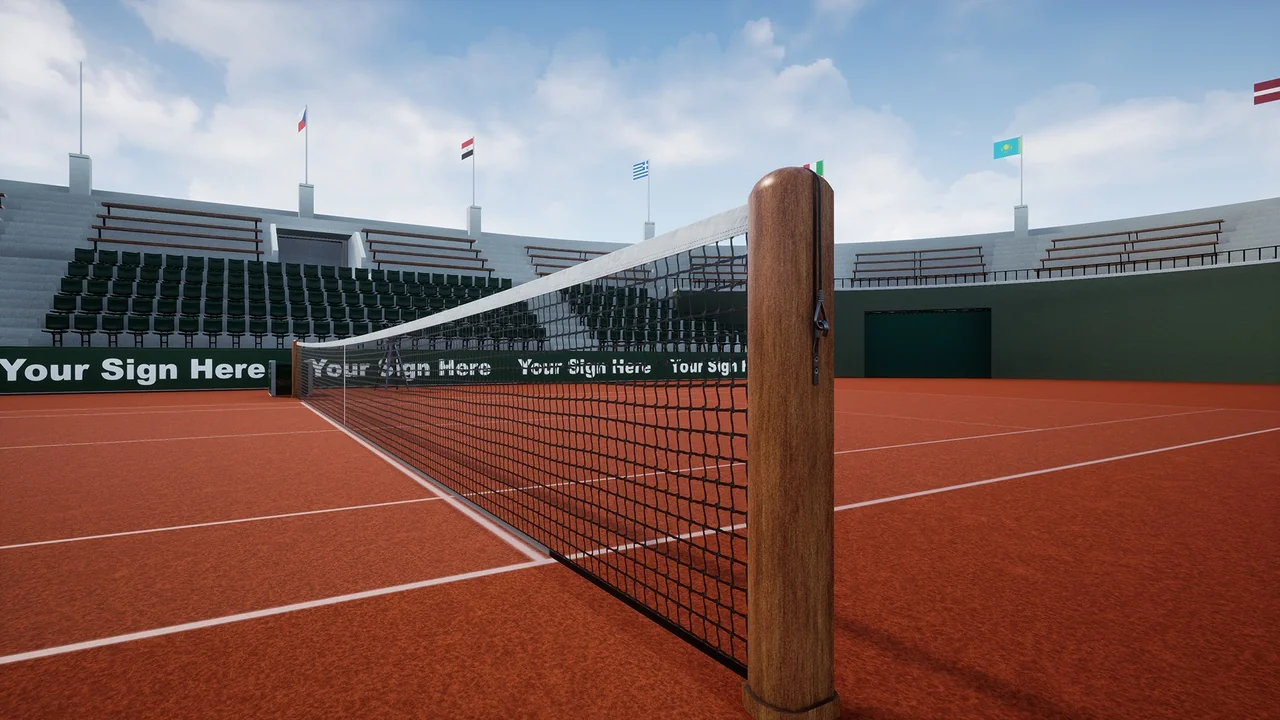
 Streets
 Streets
 Streets