"95fdaf16012263fa"{"id":"1002337","slug":"open-world-helper","title":"Open World Helper","category":"Automations","engine":"4.26+,5.0+","assetVersion":"","engineVersion":"Engine Version: 4.26+,5.0+","tag":"Automations","accent":"blue","visual":"mech","summary":"Open World Helper is a Blueprint spawn system for open-world NPCs, using one optimization level to support large NPC counts and SuS template compatibility.","platform":"Unreal Engine","indexPolicy":"index","publishedAt":"2026-11-06T06:42:47.191Z","updatedAt":"2026-11-06T06:42:47.191Z","sourceNotes":[],"fileContents":[],"compatibility":["Unreal Engine","Engine Version: 4.26+,5.0+"],"featuredImage":{"alt":"Open World Helper","src":"/wp-content/uploads/published/2026/11/b35d1f88243e-0926e10e-95dd-417e-97cf-b5402d98abe8-21743e4dcc.webp"},"hasDownloadLink":true,"downloads":0,"terms":[{"taxonomy":"category","slug":"automations","name":"Automations"}],"galleryImages":[{"src":"/wp-content/uploads/published/2026/11/e6ed17fd9436-63097e91-e8d0-4fc9-8a92-41c92105b414-a45bdd4d96.webp","alt":"Open World Helper"},{"src":"/wp-content/uploads/published/2026/11/8ed04a59d866-9d09767f-c719-490c-b0f8-c977f050e769-f8e7fd75e4.webp","alt":"Open World Helper"},{"src":"/wp-content/uploads/published/2026/11/803de4772bca-a20202ad-0cb8-4cae-830f-265a95bb406d-2589ac33e2.webp","alt":"Open World Helper"},{"src":"/wp-content/uploads/published/2026/11/3a0dce212301-c6025b8f-539d-43a3-8a62-5a8ad35cf234-697c213181.webp","alt":"Open World Helper"},{"src":"/wp-content/uploads/published/2026/11/c190b3a53924-cbe15a4b-d8ec-4969-9b3d-f4df4ce24d9f-e49edddba5.webp","alt":"Open World Helper"}],"accessPanel":{"kind":"resource","title":"Get this resource","eyebrow":"Free resource","message":"3DCGHUB is the service provider for this listing. Access is fulfilled through the official publisher channel.","fileName":"Content.7z","safetyNote":"Resources are manually reviewed before listing to improve quality and reduce obvious risks.","actionLabel":"Get this resource","resourceType":"Resource archive","versions":[]},"contentHtml":"\u003ch2\u003eHow Open World Helper Handles NPC Presence\u003c/h2\u003e\n\u003cp\u003eOpen World Helper enters a scene as a spawn system for NPCs in an open world. Its job is to populate the game world without leaving the creator to set up and manage separate spawners. The system handles the spawn side while the open-world layout remains the scene context.\u003c/p\u003e\n\u003cp\u003eTwo entry points define the helper: open-world use and spawner avoidance. A creator who wants NPCs moving through a broad world can use the system instead of wiring a spawner for each population point. The package then offers a simpler population layer, with the spawn work centralized rather than scattered across separate spawner setups.\u003c/p\u003e\n\u003cp\u003eThe spawn logic is Blueprint-based. That places population behavior in the visual scripting layer, which suits teams that already assemble gameplay in Blueprint graphs. Blueprint is the implementation route attached to the resource.\u003c/p\u003e\n\u003cp\u003eThe labels around the resource are Spawn, Open, System, Arena, Mob, Optimized, Blueprint, and World. They keep the focus on spawning and world population. The name points to the same territory: a helper for open-world scenes that need NPCs present without a spawner built for each case.\u003c/p\u003e \u003ch2\u003eThe One Optimization Level and NPC Volume\u003c/h2\u003e\n\u003cp\u003eOpen World Helper contains one optimization level. That is the complete optimization model in the system. The single level exists to help a project use a large number of NPCs in the game world.\u003c/p\u003e\n\u003cp\u003eThis is a narrow scaling control. A creator works with one optimization level, not a menu of performance tiers. The optimization level is not a toggle or a selectable profile; the system contains one level, so the creator plans around that single level from the start. The helper does not advertise an unlimited NPC budget. \"Large number\" depends on the NPCs, the scene, and how the rest of the project is assembled. What the helper provides is the optimization layer for high NPC counts within that scope.\u003c/p\u003e\n\u003cp\u003eTreat the one optimization level as the system's main performance decision. There is no second level to engage inside Open World Helper. If the NPC load grows past what that level supports, the spawn system itself does not offer another in-system tier.\u003c/p\u003e \u003ch2\u003eBlueprint Spawn Logic and the SuS Social Deduction Game Template\u003c/h2\u003e\n\u003cp\u003eOpen World Helper is compatible with the SuS Social Deduction Game Template. A project using that template can add the spawn helper with compatibility already established. The helper and the template remain separate pieces, but they can share a project.\u003c/p\u003e\n\u003cp\u003eBlueprint is the implementation detail tied to the spawn system. In a template-based workflow, the spawn logic sits in Blueprint alongside other gameplay Blueprints. Population stays editable in the same visual scripting environment rather than requiring a code-only integration.\u003c/p\u003e\n\u003cp\u003eSuS is the template compatibility named for the resource. If a project uses the SuS Social Deduction Game Template, the helper fits. If it does not, the open-world spawn function still stands on its own; the helper does not require the template to perform its core job. The template name refers to a social deduction game template, so compatibility means the helper can be used in that template's project context.\u003c/p\u003e \u003ch2\u003eOpen World, Arena, and Mob Placements\u003c/h2\u003e\n\u003cp\u003eThe tags widen the spawn system beyond a single scene type. Open world is the main case: the helper fills a world with NPCs and avoids a spawner-by-spawner setup. Arena and mob tags add two more placements. An arena can use the spawn system to bring NPCs into the arena space, and a mob scene can use it to place groups of NPCs.\u003c/p\u003e\n\u003cp\u003eThose contexts do not change the optimization model. The same one optimization level applies. An arena does not get a separate performance tier, and a mob setup does not unlock a second optimization mode. The system stays consistent across the placements named in its tags.\u003c/p\u003e\n\u003cp\u003eThe open-world label is the strongest signal. It names the scale the helper is meant to address and pairs with the large-NPC-count goal. Arena and mob describe alternate uses. An open-world scene and an arena scene may have different layouts, but the spawn system's job remains bringing NPCs in. The spawn behavior remains the center in each case.\u003c/p\u003e \u003ch2\u003eSetting Up a Scene Without Spawner Sprawl\u003c/h2\u003e\n\u003cp\u003eImplementation starts with the decision to let Open World Helper handle NPC population. The system removes the need to configure a separate spawner for every population point. Instead of treating each spawn location as its own setup task, the creator works through the helper's Blueprint spawn logic and applies the single optimization level to the NPC load.\u003c/p\u003e\n\u003cp\u003eFor a SuS Social Deduction Game Template project, that setup happens with compatibility in place. The helper can sit in the same project as the template while open-world population runs through the spawn system. Arena and mob scenes can use the same arrangement, with the scene context changing but the spawn approach staying the same.\u003c/p\u003e\n\u003cp\u003eNPC volume remains relative rather than fixed to a published count. The helper's scope covers spawn, optimization, Blueprint implementation, open-world population, and SuS compatibility. That scope is enough to judge whether it fits a project: it is for teams that want NPCs spread through a world without building and maintaining a spawner for each case.\u003c/p\u003e\n\u003cp\u003eFor evaluation, the decisive question is whether one optimization level and a Blueprint spawn system match the NPC load a project expects. If the project uses the SuS template, compatibility is already part of the picture. If the scene is an arena or a mob setup, those tags indicate a place for the same spawn logic. The strongest concrete takeaway is the removal of spawner management from open-world NPC population, with one optimization level carrying the NPC-count side of the job.\u003c/p\u003e\n\n\u003ch2\u003eRelated Resources Worth Checking\u003c/h2\u003e\n\u003cul\u003e\n\u003cli\u003e\u003ca href=\"https://3dcghub.com/open-world-animset/\" rel=\"noopener noreferrer\"\u003eOpen World Animset\u003c/a\u003e\u003c/li\u003e\n\u003cli\u003e\u003ca href=\"https://3dcghub.com/open-world-ai-multiplayer-spawn-system/\" rel=\"noopener noreferrer\"\u003eOpen World AI Multiplayer Spawn System\u003c/a\u003e\u003c/li\u003e\n\u003cli\u003e\u003ca href=\"https://3dcghub.com/ultimate-open-world/\" rel=\"noopener noreferrer\"\u003eUltimate Open World\u003c/a\u003e\u003c/li\u003e\n\u003cli\u003e\u003ca href=\"https://3dcghub.com/advanced-actor-transform/\" rel=\"noopener noreferrer\"\u003eAdvanced Actor Transform\u003c/a\u003e\u003c/li\u003e\n\u003cli\u003e\u003ca href=\"https://3dcghub.com/multiplayer-world-origin-rebase-tool/\" rel=\"noopener noreferrer\"\u003eMultiplayer World Origin Rebase Tool\u003c/a\u003e\u003c/li\u003e\n\u003c/ul\u003e","contentTextLength":5926,"navigation":{"current":31,"total":4291,"previous":{"id":"1002338","slug":"parallax-occlusion-brick-materials-vol-1","title":"Parallax Occlusion Brick Materials Vol.1","category":"Building \u0026 Human-made","platform":"Unreal Engine","updatedAt":"2026-11-06T06:44:03.448Z"},"next":{"id":"1002336","slug":"nuclear-bomb-shelter","title":"Nuclear Bomb Shelter","category":"Apocalyptic / Post-apocalyptic","platform":"Unreal Engine","updatedAt":"2026-11-06T06:41:39.157Z"}},"relatedResources":[{"id":"1001583","slug":"open-world-animset","title":"Open World Animset","category":"Variety","engine":"4.8+,5.0+","assetVersion":"","engineVersion":"Engine Version: 4.8+,5.0+","tag":"Variety","accent":"blue","visual":"mech","summary":"Over 500 motion capture animations for humanoid character movement, traversal, cover mechanics, firearm handling, and melee combat.","platform":"Unreal Engine","indexPolicy":"index","publishedAt":"2026-10-10T08:55:24.492Z","updatedAt":"2026-10-10T08:55:24.492Z","sourceNotes":[],"fileContents":[],"compatibility":["Unreal Engine","Engine Version: 4.8+,5.0+"],"featuredImage":{"alt":"Open World Animset","src":"/wp-content/uploads/published/2026/10/5316a1357041-5e3578f2-c647-450e-a63b-ea83d2aa1e89-94597b32fa.webp"},"hasDownloadLink":true,"downloads":2},{"id":"1000922","slug":"open-world-ai-multiplayer-spawn-system","title":"Open World AI Multiplayer Spawn System","category":"Gameplay Features","engine":"4.26+,5.0+","assetVersion":"","engineVersion":"Engine Version: 4.26+,5.0+","tag":"Gameplay Features","accent":"blue","visual":"mech","summary":"A server-side Blueprint spawn system for open-world multiplayer games, with roaming, stationary, and path AI, friendly or zombie variants.","platform":"Unreal Engine","indexPolicy":"index","publishedAt":"2026-08-08T05:05:40.195Z","updatedAt":"2026-08-08T05:05:40.195Z","sourceNotes":[],"fileContents":[],"compatibility":["Unreal Engine","Engine Version: 4.26+,5.0+"],"featuredImage":{"alt":"Open World AI Multiplayer Spawn System","src":"/wp-content/uploads/published/2026/08/c4917032d21c-cb7e3ead-ba0b-445c-8608-4fe8a4722c7e-d50d7d81fc.webp"},"hasDownloadLink":true,"downloads":2},{"id":"24823","slug":"ultimate-open-world","title":"Ultimate Open World","category":"Shooter","engine":"5.5+","assetVersion":"Engine version: 5.5+","engineVersion":"Asset Version:1.1 - 1.2","tag":"Shooter","accent":"blue","visual":"character","summary":"Ultimate Open World is set up as a starting point for open world games that need a clear, organized base. It combines the studioâs work in models, animations, programming, and ready-to-use environments with materials that help frame setup and implementation.","platform":"Unreal Engine","indexPolicy":"index","publishedAt":"2026-04-17T09:16:54.000Z","updatedAt":"2026-04-29T05:47:19.000Z","sourceNotes":[],"fileContents":[],"compatibility":["Unreal Engine","Engine version: 5.5+","Asset Version: 1.1 - 1.2"],"featuredImage":{"alt":"Ultimate Open World","src":"https://3dcghub.com/wp-content/uploads/2026/04/f6218a722e6e_0253a61c-4a7a-4655-abf5-4f829b521192.webp"},"hasDownloadLink":true,"downloads":17}]}
Automations
Open World Helper
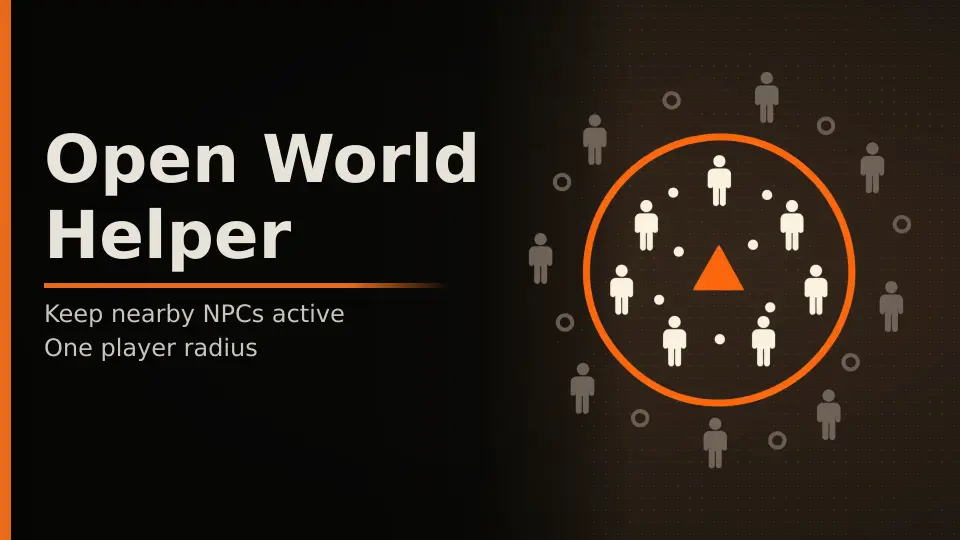
Open World Helper is a Blueprint spawn system for open-world NPCs, using one optimization level to support large NPC counts and SuS template compatibility.
Category:Unreal Engine,AutomationsPlatform: Unreal EngineEngine Version: 4.26+,5.0+Published: Nov 6, 2026
Automations
Resource overview
How Open World Helper Handles NPC Presence
Open World Helper enters a scene as a spawn system for NPCs in an open world. Its job is to populate the game world without leaving the creator to set up and manage separate spawners. The system handles the spawn side while the open-world layout remains the scene context.
Two entry points define the helper: open-world use and spawner avoidance. A creator who wants NPCs moving through a broad world can use the system instead of wiring a spawner for each population point. The package then offers a simpler population layer, with the spawn work centralized rather than scattered across separate spawner setups.
The spawn logic is Blueprint-based. That places population behavior in the visual scripting layer, which suits teams that already assemble gameplay in Blueprint graphs. Blueprint is the implementation route attached to the resource.
The labels around the resource are Spawn, Open, System, Arena, Mob, Optimized, Blueprint, and World. They keep the focus on spawning and world population. The name points to the same territory: a helper for open-world scenes that need NPCs present without a spawner built for each case.
The One Optimization Level and NPC Volume
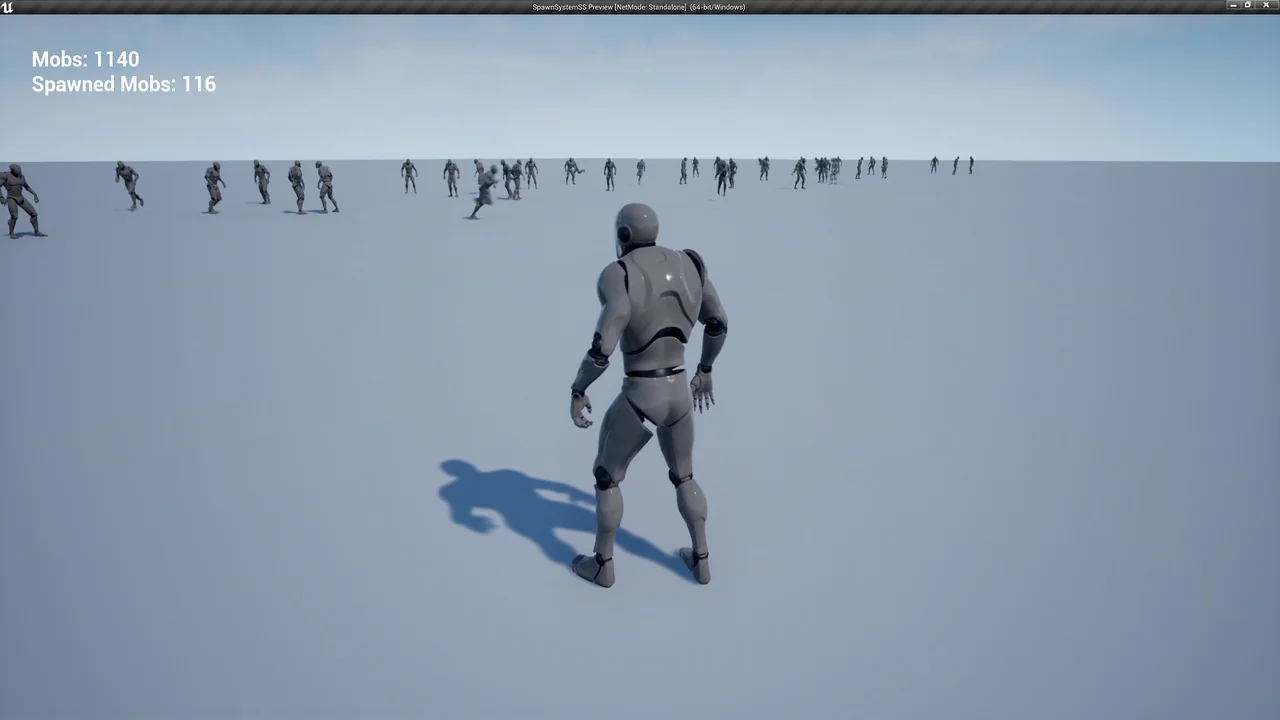
Open World Helper contains one optimization level. That is the complete optimization model in the system. The single level exists to help a project use a large number of NPCs in the game world.
This is a narrow scaling control. A creator works with one optimization level, not a menu of performance tiers. The optimization level is not a toggle or a selectable profile; the system contains one level, so the creator plans around that single level from the start. The helper does not advertise an unlimited NPC budget. "Large number" depends on the NPCs, the scene, and how the rest of the project is assembled. What the helper provides is the optimization layer for high NPC counts within that scope.
Treat the one optimization level as the system's main performance decision. There is no second level to engage inside Open World Helper. If the NPC load grows past what that level supports, the spawn system itself does not offer another in-system tier.
Blueprint Spawn Logic and the SuS Social Deduction Game Template
Open World Helper is compatible with the SuS Social Deduction Game Template. A project using that template can add the spawn helper with compatibility already established. The helper and the template remain separate pieces, but they can share a project.
Blueprint is the implementation detail tied to the spawn system. In a template-based workflow, the spawn logic sits in Blueprint alongside other gameplay Blueprints. Population stays editable in the same visual scripting environment rather than requiring a code-only integration.
SuS is the template compatibility named for the resource. If a project uses the SuS Social Deduction Game Template, the helper fits. If it does not, the open-world spawn function still stands on its own; the helper does not require the template to perform its core job. The template name refers to a social deduction game template, so compatibility means the helper can be used in that template's project context.
Open World, Arena, and Mob Placements
The tags widen the spawn system beyond a single scene type. Open world is the main case: the helper fills a world with NPCs and avoids a spawner-by-spawner setup. Arena and mob tags add two more placements. An arena can use the spawn system to bring NPCs into the arena space, and a mob scene can use it to place groups of NPCs.
Those contexts do not change the optimization model. The same one optimization level applies. An arena does not get a separate performance tier, and a mob setup does not unlock a second optimization mode. The system stays consistent across the placements named in its tags.
The open-world label is the strongest signal. It names the scale the helper is meant to address and pairs with the large-NPC-count goal. Arena and mob describe alternate uses. An open-world scene and an arena scene may have different layouts, but the spawn system's job remains bringing NPCs in. The spawn behavior remains the center in each case.
Setting Up a Scene Without Spawner Sprawl
Implementation starts with the decision to let Open World Helper handle NPC population. The system removes the need to configure a separate spawner for every population point. Instead of treating each spawn location as its own setup task, the creator works through the helper's Blueprint spawn logic and applies the single optimization level to the NPC load.
For a SuS Social Deduction Game Template project, that setup happens with compatibility in place. The helper can sit in the same project as the template while open-world population runs through the spawn system. Arena and mob scenes can use the same arrangement, with the scene context changing but the spawn approach staying the same.
NPC volume remains relative rather than fixed to a published count. The helper's scope covers spawn, optimization, Blueprint implementation, open-world population, and SuS compatibility. That scope is enough to judge whether it fits a project: it is for teams that want NPCs spread through a world without building and maintaining a spawner for each case.
For evaluation, the decisive question is whether one optimization level and a Blueprint spawn system match the NPC load a project expects. If the project uses the SuS template, compatibility is already part of the picture. If the scene is an arena or a mob setup, those tags indicate a place for the same spawn logic. The strongest concrete takeaway is the removal of spawner management from open-world NPC population, with one optimization level carrying the NPC-count side of the job.
 Automations
 Variety
 Gameplay Features
 Shooter