"7ad89cffa44984cf"{"id":"1002554","slug":"npc-zombie-woman","title":"NPC Zombie Woman","category":"Characters \u0026 Creatures","engine":"4.26+,5.0+","assetVersion":"","engineVersion":"Engine Version: 4.26+,5.0+","tag":"Characters","accent":"blue","visual":"character","summary":"Implement the lowpoly NPC Zombie Woman character, featuring built-in horror animations, Animation Blueprint support, and Crime Scene Assets compatibility.","platform":"Unreal Engine","indexPolicy":"index","publishedAt":"2026-11-13T10:45:37.029Z","updatedAt":"2026-11-13T10:45:37.029Z","sourceNotes":[],"fileContents":[],"compatibility":["Unreal Engine","Engine Version: 4.26+,5.0+"],"featuredImage":{"alt":"NPC Zombie Woman","src":"/wp-content/uploads/published/2026/11/f01a60fe4227-aef61dd6-a600-4242-af51-a535dc45cb81-062719f84c.webp"},"hasDownloadLink":true,"downloads":0,"terms":[{"taxonomy":"category","slug":"characters-and-creatures","name":"Characters \u0026 Creatures"}],"galleryImages":[{"src":"/wp-content/uploads/published/2026/11/b974900ba1e9-9cd6dbc5-ef69-4edc-bacc-f7b34c51ec0a-974c4d0adb.webp","alt":"NPC Zombie Woman"},{"src":"/wp-content/uploads/published/2026/11/2d8c51ae9532-2af33644-b061-4ffd-9807-f4d37b322a90-2e71008977.webp","alt":"NPC Zombie Woman"}],"accessPanel":{"kind":"resource","title":"Get this resource","eyebrow":"Free resource","message":"Download this resource in your browser.","fileName":"Content.7z","safetyNote":"Resources are manually reviewed before listing to improve quality and reduce obvious risks.","actionLabel":"Get this resource","resourceType":"Resource archive","versions":[]},"contentHtml":"\u003ch2\u003eAnimation Blueprint Routing for the NPC Zombie Woman\u003c/h2\u003e\u003cp\u003eIntegrating a dedicated character into an interactive horror pipeline requires clean alignment between the mesh structure, state machine nodes, and underlying logic graphs. The NPC Zombie Woman arrives structured as an animated, humanoid character configured with an Animation Blueprint and script implementation. This setup enables direct handoff of locomotion parameters and action triggers without requiring manual rigging or external retargeting workflows. Because the asset belongs to the lowpoly category while retaining a realistic aesthetic profile, it provides predictable evaluation performance across scenes populated by multiple AI entities.\u003c/p\u003e\u003cp\u003eWiring the Animation Blueprint into a project begins by targeting the character's core movement and behavioral variables. Speed floats, directional inputs, and alert booleans translate naturally into the asset's pre-configured animation clips. Implementing transition rules within the state machine allows instant switching between standard ambulation and heightened pursuit dynamics. The presence of script tags ensures that logic calls—such as tracking proximity to player entities or toggling behavioral states—can directly trigger corresponding montages or blend spaces supported by the internal humanoid hierarchy.\u003c/p\u003e\u003ch2\u003eBehavioral State Machines and Locomotion for the Zombie\u003c/h2\u003e\u003cp\u003eMotion design for apocalyptic enemy types relies on distinct contrasts between dormant wandering and aggressive closing speeds. Within the asset package, locomotion is segmented across three primary velocities: Walk, Hungry Walk, and Run. Each locomotion clip addresses a distinct tier of awareness and physical desperation, giving technical artists granular control over pathfinding states.\u003c/p\u003e\u003cp\u003eThe standard Walk clip establishes a steady baseline cadence suitable for standard wandering routes along navigation meshes. When transitioned into the Hungry Walk, the movement signature alters to reflect hunger-driven focus, presenting a slower, more deliberate, or strained forward lean ideal for searching phases. Once an alert threshold is met, switching the movement parameter drives the character directly into the Run clip. Because these clips share humanoid proportions, setting up linear blend spaces driven by movement velocity produces seamless transitions from an unhurried prowl to an all-out sprint without visual foot sliding.\u003c/p\u003e\u003cp\u003eSurrounding these transit nodes is the core Idle animation alongside the specialized Rage state. The Idle clip provides subtle weight shifts and natural postural instability expected of an unalerted infected entity standing guard or drifting aimlessly. Triggering the Rage clip breaks this stillness instantly. Rage can be implemented either as an interruptive montage layered across the upper body or as an exclusive state transition when the character first acquires a target, signaling an aggressive state change before pathfinding switches to the high-speed pursuit cycle.\u003c/p\u003e\u003ch2\u003eStaged Ground Transitions and Feeding Actions\u003c/h2\u003e\u003cp\u003eBeyond horizontal locomotion, horror choreography frequently depends on sudden changes in stance, elevation, and ground interactions. The package supplies dedicated clips for ground recovery, specifically Rise, Up(Cycle), and Up(Element). These separate sequences allow developers to stage encounters where the character begins prone or incapacitated before engaging the player.\u003c/p\u003e\u003cp\u003eThe Rise clip provides a complete motion path from a downed position up to full standing posture. In modular animation pipelines, this works effectively as a recovery montage after high-impact physical hits or as an environmental reveal where a seemingly motionless body pushes itself upright. The pairing of Up(Element) and Up(Cycle) enables looped vertical transitions, allowing level designers to hold the character at a specific stage of rising or loop a struggling ascent until a specific trigger volume or scripted gameplay condition is satisfied.\u003c/p\u003e\u003cp\u003eFor narrative set pieces and ambient scene dressing, two feeding animations are provided: Eating and Seizure-Eating. The standard Eating clip loops steady, grotesque feeding motions suited for an NPC discovered over an environmental corpse. Seizure-Eating intensifies this interaction, adding erratic, violent convulsions and frantic physical jerks. This variant is suited for moments of sensory overload, heightened contagion, or sudden player interruption, delivering an unsettling visual shift that contrasts sharply with standard idle states.\u003c/p\u003e\u003ch2\u003eLowpoly Aesthetic in Post-Apocalyptic Environments\u003c/h2\u003e\u003cp\u003eThe visual framework of the NPC Zombie Woman balances a lowpoly polygon distribution with realistic humanoid proportions and horror-driven design. This design approach allows the model to function across resource-constrained rendering pipelines, background hoard formations, or dense staging areas without incurring the heavy vertex-processing costs associated with high-density hero models. The realistic styling ensures that even with lowpoly construction, the character maintains grounded physical silhouettes, anatomical fidelity, and convincing motion lines under dynamic lighting.\u003c/p\u003e\u003cp\u003eWithin post-apocalyptic and apocalyptic level contexts, the female humanoid framing provides immediate narrative clarity. The character reads clearly from distance, whether partially obscured by fog, silhouette backlighting, or low-light corridor environments. Because the mesh is constructed to honor realistic humanoid proportions, environmental lighting interacts convincingly with the lowpoly geometry, casting sharp, dramatic shadows that complement the horror atmosphere.\u003c/p\u003e\u003ch2\u003eScene Staging with Crime Scene Assets and the NPC Zombies Collection\u003c/h2\u003e\u003cp\u003eContextual cohesion is essential when building complex horror levels. The NPC Zombie Woman is built as an integral part of the broader NPC Zombies collection, ensuring thematic consistency, skeletal scaling, and design compatibility when deployed alongside related characters from the same series. This modular continuity allows creators to populate entire zones with matching infected archetypes without encountering clashing visual styles or disjointed animation systems.\u003c/p\u003e\u003cp\u003eCompatibility with Crime Scene Assets provides direct opportunities for contextual environmental storytelling. Level designers can anchor the character seamlessly around blood splatters, forensic markers, barricades, compromised vehicles, or abandoned investigation zones. Placing the character in an Eating or Seizure-Eating loop over an asset from the Crime Scene collection creates an immediate, self-contained narrative beat that players can identify from a distance. Similarly, utilizing the Rise sequence inside an abandoned perimeter or beside emergency barriers allows for tightly scripted encounters that flow naturally from the surrounding environment.\u003c/p\u003e\u003cp\u003eBy unifying lowpoly performance, ready-to-run Animation Blueprint parameters, and a dedicated ten-clip motion library, the character provides an integrated, practical solution for developers engineering responsive, menacing encounters in apocalyptic horror environments.\u003c/p\u003e\n\n\u003ch2\u003eExplore Similar Assets\u003c/h2\u003e\n\u003cul\u003e\n\u003cli\u003e\u003ca href=\"https://3dcghub.com/npc-zombie-man/\" rel=\"noopener noreferrer\"\u003eNPC Zombie Man\u003c/a\u003e\u003c/li\u003e\n\u003cli\u003e\u003ca href=\"https://3dcghub.com/npc-zombies/\" rel=\"noopener noreferrer\"\u003eNPC Zombies\u003c/a\u003e\u003c/li\u003e\n\u003cli\u003e\u003ca href=\"https://3dcghub.com/npc-blacksmith/\" rel=\"noopener noreferrer\"\u003eNPC Blacksmith\u003c/a\u003e\u003c/li\u003e\n\u003cli\u003e\u003ca href=\"https://3dcghub.com/zombie-mutant-2/\" rel=\"noopener noreferrer\"\u003eZombie mutant 2\u003c/a\u003e\u003c/li\u003e\n\u003cli\u003e\u003ca href=\"https://3dcghub.com/baker-character-npc-baker-character-worker-npc-sculpt-3d-model-man-art-old/\" rel=\"noopener noreferrer\"\u003eBaker Character / NPC ( Baker Character Worker NPC Sculpt 3D Model Man Art Old )\u003c/a\u003e\u003c/li\u003e\n\u003c/ul\u003e","contentTextLength":7275,"navigation":{"current":23,"total":4499,"previous":{"id":"1002555","slug":"parasite-fat","title":"Parasite Fat","category":"Characters \u0026 Creatures","platform":"Unreal Engine","updatedAt":"2026-11-13T10:46:56.136Z"},"next":{"id":"1002553","slug":"dragons-pack-pbr","title":"Dragons Pack PBR","category":"Characters \u0026 Creatures","platform":"Unreal Engine","updatedAt":"2026-11-13T10:44:04.939Z"}},"relatedResources":[{"id":"1002552","slug":"npc-zombie-man","title":"NPC Zombie Man","category":"Characters \u0026 Creatures","engine":"4.26+,5.0+","assetVersion":"","engineVersion":"Engine Version: 4.26+,5.0+","tag":"Characters","accent":"blue","visual":"character","summary":"Explore the implementation, animation state setup, and scene integration of the lowpoly realistic male NPC Zombie Man character.","platform":"Unreal Engine","indexPolicy":"index","publishedAt":"2026-11-13T10:05:07.335Z","updatedAt":"2026-11-13T10:05:07.335Z","sourceNotes":[],"fileContents":[],"compatibility":["Unreal Engine","Engine Version: 4.26+,5.0+"],"featuredImage":{"alt":"NPC Zombie Man","src":"/wp-content/uploads/published/2026/11/d18ab5b5c1ab-63237373-bab7-49b9-b385-f2258e413def-e6fe9e4fc2.webp"},"hasDownloadLink":true,"downloads":0},{"id":"1002335","slug":"npc-zombies","title":"NPC Zombies","category":"Characters \u0026 Creatures","engine":"4.16+,5.0+","assetVersion":"","engineVersion":"Engine Version: 4.16+,5.0+","tag":"Characters","accent":"blue","visual":"character","summary":"NPC Zombies gives horror scenes Zombie Man and Zombie Woman as animated NPC characters with simple animations,.max rig source files, and lowpoly-realistic tags","platform":"Unreal Engine","indexPolicy":"index","publishedAt":"2026-11-06T06:39:53.860Z","updatedAt":"2026-11-06T06:39:53.860Z","sourceNotes":[],"fileContents":[],"compatibility":["Unreal Engine","Engine Version: 4.16+,5.0+"],"featuredImage":{"alt":"NPC Zombies","src":"/wp-content/uploads/published/2026/11/d02aefd69737-29bbaa93-24aa-4764-8ce1-f10fbdf4dea0-be8939a943.webp"},"hasDownloadLink":true,"downloads":0},{"id":"1002133","slug":"npc-blacksmith","title":"NPC Blacksmith","category":"Characters \u0026 Creatures","engine":"4.26+,5.0+","assetVersion":"","engineVersion":"Engine Version: 4.26+,5.0+","tag":"Characters","accent":"blue","visual":"character","summary":"Explore the NPC Blacksmith character kit, featuring modular body parts, forge props, 4K AORM textures, 4 LODs, and a dedicated UE5 Control Rig.","platform":"Unreal Engine","indexPolicy":"index","publishedAt":"2026-10-29T09:13:53.309Z","updatedAt":"2026-10-29T09:13:53.309Z","sourceNotes":[],"fileContents":[],"compatibility":["Unreal Engine","Engine Version: 4.26+,5.0+"],"featuredImage":{"alt":"NPC Blacksmith","src":"/wp-content/uploads/published/2026/10/2eb972717b44-c3d9c9ab-b472-4a34-b992-f3c4bea8b40f-10713d2ce9.webp"},"hasDownloadLink":true,"downloads":2}]}
Characters
NPC Zombie Woman
Implement the lowpoly NPC Zombie Woman character, featuring built-in horror animations, Animation Blueprint support, and Crime Scene Assets compatibility.
Animation Blueprint Routing for the NPC Zombie Woman
Integrating a dedicated character into an interactive horror pipeline requires clean alignment between the mesh structure, state machine nodes, and underlying logic graphs. The NPC Zombie Woman arrives structured as an animated, humanoid character configured with an Animation Blueprint and script implementation. This setup enables direct handoff of locomotion parameters and action triggers without requiring manual rigging or external retargeting workflows. Because the asset belongs to the lowpoly category while retaining a realistic aesthetic profile, it provides predictable evaluation performance across scenes populated by multiple AI entities.
Wiring the Animation Blueprint into a project begins by targeting the character's core movement and behavioral variables. Speed floats, directional inputs, and alert booleans translate naturally into the asset's pre-configured animation clips. Implementing transition rules within the state machine allows instant switching between standard ambulation and heightened pursuit dynamics. The presence of script tags ensures that logic calls—such as tracking proximity to player entities or toggling behavioral states—can directly trigger corresponding montages or blend spaces supported by the internal humanoid hierarchy.
Behavioral State Machines and Locomotion for the Zombie
Motion design for apocalyptic enemy types relies on distinct contrasts between dormant wandering and aggressive closing speeds. Within the asset package, locomotion is segmented across three primary velocities: Walk, Hungry Walk, and Run. Each locomotion clip addresses a distinct tier of awareness and physical desperation, giving technical artists granular control over pathfinding states.
The standard Walk clip establishes a steady baseline cadence suitable for standard wandering routes along navigation meshes. When transitioned into the Hungry Walk, the movement signature alters to reflect hunger-driven focus, presenting a slower, more deliberate, or strained forward lean ideal for searching phases. Once an alert threshold is met, switching the movement parameter drives the character directly into the Run clip. Because these clips share humanoid proportions, setting up linear blend spaces driven by movement velocity produces seamless transitions from an unhurried prowl to an all-out sprint without visual foot sliding.
Surrounding these transit nodes is the core Idle animation alongside the specialized Rage state. The Idle clip provides subtle weight shifts and natural postural instability expected of an unalerted infected entity standing guard or drifting aimlessly. Triggering the Rage clip breaks this stillness instantly. Rage can be implemented either as an interruptive montage layered across the upper body or as an exclusive state transition when the character first acquires a target, signaling an aggressive state change before pathfinding switches to the high-speed pursuit cycle.
Staged Ground Transitions and Feeding Actions
Beyond horizontal locomotion, horror choreography frequently depends on sudden changes in stance, elevation, and ground interactions. The package supplies dedicated clips for ground recovery, specifically Rise, Up(Cycle), and Up(Element). These separate sequences allow developers to stage encounters where the character begins prone or incapacitated before engaging the player.
The Rise clip provides a complete motion path from a downed position up to full standing posture. In modular animation pipelines, this works effectively as a recovery montage after high-impact physical hits or as an environmental reveal where a seemingly motionless body pushes itself upright. The pairing of Up(Element) and Up(Cycle) enables looped vertical transitions, allowing level designers to hold the character at a specific stage of rising or loop a struggling ascent until a specific trigger volume or scripted gameplay condition is satisfied.
For narrative set pieces and ambient scene dressing, two feeding animations are provided: Eating and Seizure-Eating. The standard Eating clip loops steady, grotesque feeding motions suited for an NPC discovered over an environmental corpse. Seizure-Eating intensifies this interaction, adding erratic, violent convulsions and frantic physical jerks. This variant is suited for moments of sensory overload, heightened contagion, or sudden player interruption, delivering an unsettling visual shift that contrasts sharply with standard idle states.
Lowpoly Aesthetic in Post-Apocalyptic Environments
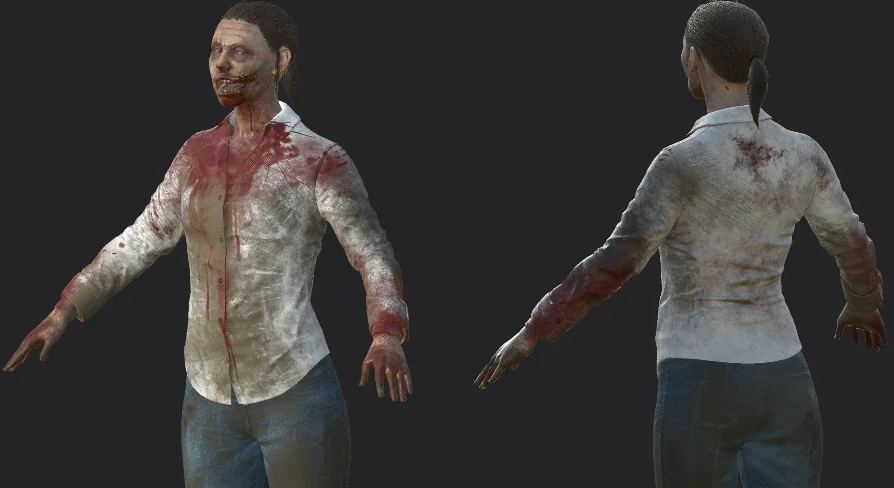
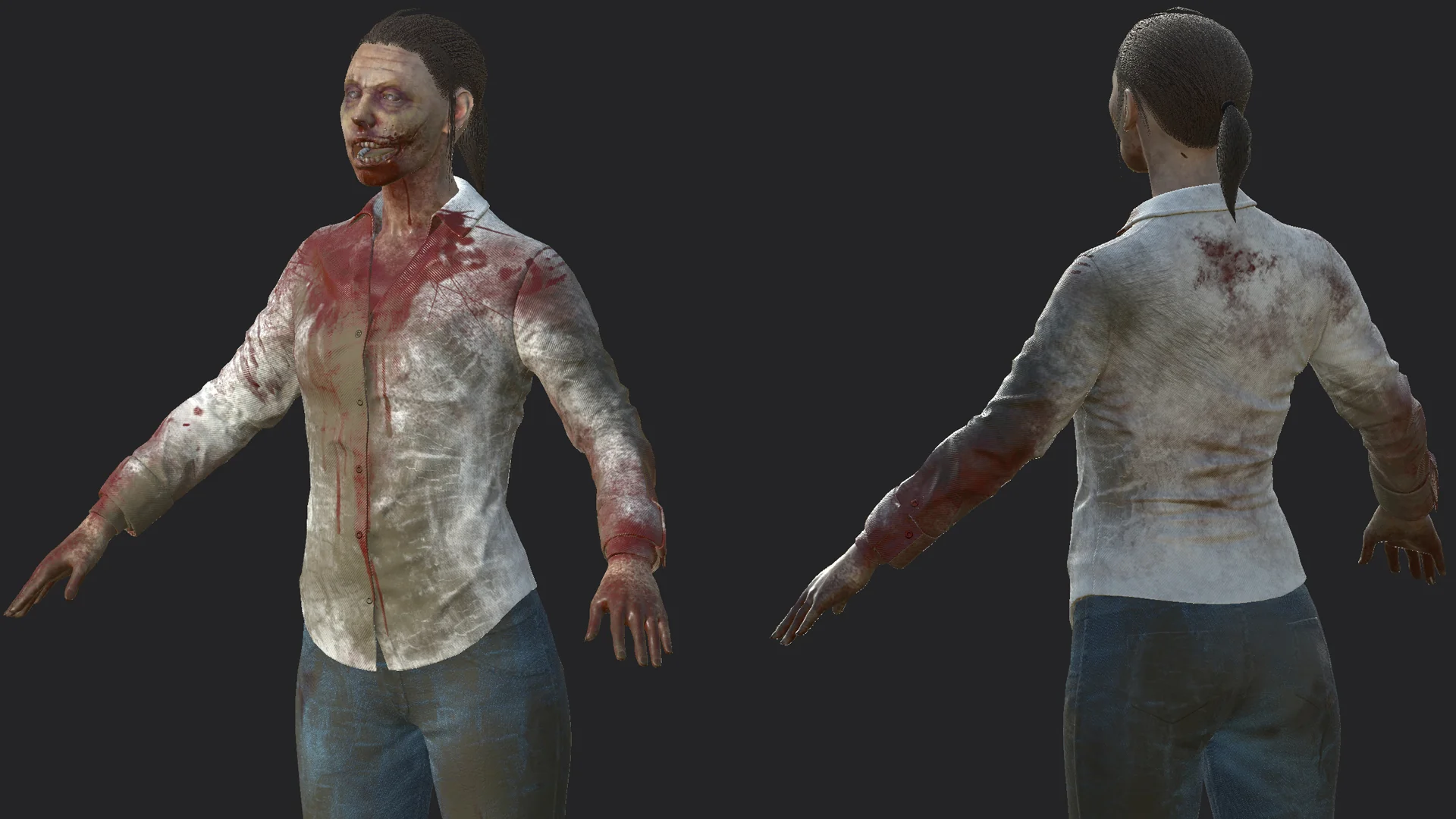
The visual framework of the NPC Zombie Woman balances a lowpoly polygon distribution with realistic humanoid proportions and horror-driven design. This design approach allows the model to function across resource-constrained rendering pipelines, background hoard formations, or dense staging areas without incurring the heavy vertex-processing costs associated with high-density hero models. The realistic styling ensures that even with lowpoly construction, the character maintains grounded physical silhouettes, anatomical fidelity, and convincing motion lines under dynamic lighting.
Within post-apocalyptic and apocalyptic level contexts, the female humanoid framing provides immediate narrative clarity. The character reads clearly from distance, whether partially obscured by fog, silhouette backlighting, or low-light corridor environments. Because the mesh is constructed to honor realistic humanoid proportions, environmental lighting interacts convincingly with the lowpoly geometry, casting sharp, dramatic shadows that complement the horror atmosphere.
Scene Staging with Crime Scene Assets and the NPC Zombies Collection
Contextual cohesion is essential when building complex horror levels. The NPC Zombie Woman is built as an integral part of the broader NPC Zombies collection, ensuring thematic consistency, skeletal scaling, and design compatibility when deployed alongside related characters from the same series. This modular continuity allows creators to populate entire zones with matching infected archetypes without encountering clashing visual styles or disjointed animation systems.
Compatibility with Crime Scene Assets provides direct opportunities for contextual environmental storytelling. Level designers can anchor the character seamlessly around blood splatters, forensic markers, barricades, compromised vehicles, or abandoned investigation zones. Placing the character in an Eating or Seizure-Eating loop over an asset from the Crime Scene collection creates an immediate, self-contained narrative beat that players can identify from a distance. Similarly, utilizing the Rise sequence inside an abandoned perimeter or beside emergency barriers allows for tightly scripted encounters that flow naturally from the surrounding environment.
By unifying lowpoly performance, ready-to-run Animation Blueprint parameters, and a dedicated ten-clip motion library, the character provides an integrated, practical solution for developers engineering responsive, menacing encounters in apocalyptic horror environments.
 Characters
 Characters
 Characters
 Characters