"b00678cacce53329"{"id":"1002872","slug":"niagaraactionfx","title":"NiagaraActionFX","category":"Game Development Resource","engine":"4.26+,5.0+","assetVersion":"","engineVersion":"Engine Version: 4.26+,5.0+","tag":"Game Development R","accent":"blue","visual":"mech","summary":"An in-depth look at NiagaraActionFX, covering realistic projectile and trail visual effects across fire, magic, light, darkness, and electrical properties.","platform":"Unreal Engine","indexPolicy":"index","publishedAt":"2026-11-20T16:49:32.926Z","updatedAt":"2026-11-20T16:49:32.926Z","sourceNotes":[],"fileContents":[],"compatibility":["Unreal Engine","Engine Version: 4.26+,5.0+"],"featuredImage":{"alt":"NiagaraActionFX","src":"/wp-content/uploads/published/2026/11/e423213b4a48-423d8680-c5c2-44da-a66e-89fc30b72283-f0037fb0c0.webp"},"fileSizeBytes":203864927,"hasDownloadLink":true,"downloads":0,"terms":[],"galleryImages":[{"src":"/wp-content/uploads/published/2026/11/aa67092a611c-6e6ba00f-efc5-420f-a319-e194da6bc1c8-c6b1a34b89.webp","alt":"NiagaraActionFX"},{"src":"/wp-content/uploads/published/2026/11/8b8349b66591-1192f0ff-1b93-4596-a6c0-c9d9f8a1791b-de61ae772a.webp","alt":"NiagaraActionFX"},{"src":"/wp-content/uploads/published/2026/11/31a90977d2c5-9f9bc845-52f2-4e62-b96d-7cff0a34ff72-6dcc0ba941.webp","alt":"NiagaraActionFX"},{"src":"/wp-content/uploads/published/2026/11/bc2eebbeb73d-b0a9752b-e383-4002-8da2-27a9ca78b3d7-a95c33b854.webp","alt":"NiagaraActionFX"},{"src":"/wp-content/uploads/published/2026/11/c74a2848a382-4a02e0bc-4668-4e45-a002-3939505e7d06-fe26830c62.webp","alt":"NiagaraActionFX"}],"accessPanel":{"kind":"resource","title":"Get this resource","safetyNote":"Resources are manually reviewed before listing to improve quality and reduce obvious risks.","fileName":"Content.7z","resourceType":"Resource archive","versions":[]},"contentHtml":"\u003cp\u003eA high-velocity projectile cutting across a combat arena immediately defines the rhythm of an encounter. In fast-paced action sequences, the eye tracks the origin, trajectory, and dissipation of energy long before an impact register occurs. NiagaraActionFX centers directly on this critical window of movement. By focusing on projectile behaviors and complementary trail visual effects, the package provides the core kinetic visual language required for real-time combat systems.\u003c/p\u003e \u003ch2\u003eProjectile Motion and Trail Dynamics in NiagaraActionFX\u003c/h2\u003e\n\u003cp\u003eProjectiles in action titles operate under strict mechanical and artistic demands. A projectile cannot simply be a static glowing sprite moving along an axis; it requires volume, directionality, and an accompanying wake that communicates mass, acceleration, and intensity. NiagaraActionFX addresses these dynamics by pairing active projectile heads with trailing effects designed to anchor the movement within the 3D environment.\u003c/p\u003e \u003cp\u003eTrails serve a dual functional role in real-time gameplay. Mechanically, they preserve the history of a projectile's path, giving players the necessary visual cues to dodge, parry, or track incoming threats across crowded visual fields. Artistically, trails sustain the energy of an attack across space, bridging the gap between weapon release and target impact. Because NiagaraActionFX focuses on these paired dynamics, each projectile system functions as a continuous visual stroke rather than an isolated point of light.\u003c/p\u003e \u003cp\u003eThe movement profiles of these effects suit direct-fire ballistics, arcing spell trajectories, and rapid-fire combat exchanges. Whether applied to player abilities, hostile projectile salvos, or environmental energy hazards, the motion profiles emphasize momentum. Particle velocities inherit parent momentum naturally, ensuring that high-speed projectiles leave behind cohesive streaks rather than fragmented particle clumps.\u003c/p\u003e \u003ch2\u003eFive Elemental Properties: Fire, Magic, Light, Darkness, and Electricity\u003c/h2\u003e\n\u003cp\u003eCombat systems frequently rely on distinct elemental damage types or thematic alignments to distinguish factions, character classes, and gameplay mechanics. NiagaraActionFX structures its visual effects around five core elemental properties, each exhibiting unique behavioral traits and visual signatures.\u003c/p\u003e \u003cp\u003eFire effects capture the volatile nature of combustion. Flame projectiles project heat, turbulence, and residual embers that shed outward as the core travels through the air. The associated fire trails linger with warm dissipation, giving attacks a heavy, scorching presence that fits incendiary weapons or pyromantic abilities.\u003c/p\u003e \u003cp\u003eMagic properties shift the aesthetic toward esoteric energy. Rather than mimicking physical combustion, magical projectiles emphasize ethereal currents, flowing energy wakes, and subtle spatial distortions. The trailing effects reinforce an otherworldly quality, suited for arcane spells, mystical projectiles, or specialized energy barrages.\u003c/p\u003e \u003cp\u003eLight properties introduce sharp luminance and radiant intensity. These effects emphasize clarity, focused beams, and bright, crystalline particle dispersal. Light projectiles cut through darker scenes with stark contrast, making them particularly useful for precision abilities, holy alignments, or high-tier kinetic strikes where immediate visual recognition is essential.\u003c/p\u003e \u003cp\u003eDarkness properties operate on the opposite end of the spectrum, utilizing deep tones, umbral dissipation, and energy-absorbing silhouettes. Darkness projectiles and their trailing trails convey weight and corruption, giving hostile abilities or shadow-based character skills a menacing, heavy presence in the play space.\u003c/p\u003e \u003cp\u003eElectrical properties focus on instability, rapid direction shifts, and sudden discharge. Electric projectiles crackle with erratic energy arcs, while the accompanying electrical trails leave snapping residual currents behind the projectile path. This high-frequency motion provides immediate sensory feedback, instantly signaling shock damage, lightning spells, or energized technological attacks.\u003c/p\u003e \u003ch2\u003eRealistic Visual Presentation Within NiagaraActionFX\u003c/h2\u003e\n\u003cp\u003eWhile visual effects in action games frequently skew toward abstract stylization, NiagaraActionFX adheres to a realistic visual style. This realism informs how light interacts with particles, how dissipations behave over time, and how energy densities scale from the projectile core to its outer perimeter.\u003c/p\u003e \u003cp\u003eRealistic particle behavior prevents visual effects from appearing flat or disconnected from physically grounded environments. When an electrical projectile arcs through a scene, its lighting falls naturally across nearby geometry and surfaces. Fire effects feature realistic smoke transitions, cooling thermal gradients, and fading embers rather than abrupt texture cutoffs. Light and darkness effects maintain balanced contrast thresholds, preventing visual blowout or unreadable muddy silhouettes.\u003c/p\u003e \u003cp\u003eThis grounding makes the package adaptable to high-fidelity environments. Action games featuring realistic lighting models, detailed material shaders, and physically based rendering require visual effects that match that standard. NiagaraActionFX delivers particle behaviors that blend seamlessly into detailed worlds without shattering scene cohesion.\u003c/p\u003e \u003ch2\u003eCombat Readability and Action Game Flow\u003c/h2\u003e\n\u003cp\u003eAction game development constantly balances visual spectacle against gameplay clarity. When multiple characters cast spells or discharge weapons simultaneously, particle clutter can quickly overwhelm the player's ability to assess the battlefield. A well-designed effect package must communicate critical gameplay information instantaneously without generating unreadable visual noise.\u003c/p\u003e \u003cp\u003eThe structured division between projectile cores and trail FX in NiagaraActionFX directly supports combat readability. The projectile head acts as the primary collision indicator, marking the exact hit volume and trajectory vector. The trail acts as secondary narrative information, displaying speed, elemental type, and threat level without obscuring the target.\u003c/p\u003e \u003cp\u003eBecause the five elemental properties are visually distinct in both color profile and motion behavior, players can immediately recognize threat types at a glance. An incoming fire projectile telegraphs an entirely different encounter dynamic than an electrical surge or an umbral dart. This clarity allows gameplay designers to assign specific debuffs, damage resistances, or tactical reactions directly linked to the visual profile of each effect.\u003c/p\u003e \u003ch2\u003eEvaluating Niagara Action FX for Fast-Paced Combat\u003c/h2\u003e\n\u003cp\u003eConstructing distinct projectile and trail systems from the ground up requires significant setup time in Unreal Engine's Niagara framework. NiagaraActionFX provides an established suite of action-ready components across fire, magic, light, darkness, and electrical properties, allowing teams to integrate realistic combat visuals immediately into their combat prototypes and production stages.\u003c/p\u003e \u003cp\u003eFor projects requiring high-impact visual feedback, distinct elemental categorization, and grounded particle realism, the package delivers a focused, highly functional toolkit structured through the exact kinetics of action gameplay.\u003c/p\u003e\n\n\u003ch2\u003eRelated Resources Worth Checking\u003c/h2\u003e\n\u003cul\u003e\n\u003cli\u003e\u003ca href=\"https://3dcghub.com/fantasy-fx-starter-pack/\" rel=\"noopener noreferrer\"\u003eFantasy FX Starter Pack\u003c/a\u003e\u003c/li\u003e\n\u003cli\u003e\u003ca href=\"https://3dcghub.com/aurora-borealis/\" rel=\"noopener noreferrer\"\u003eAurora Borealis\u003c/a\u003e\u003c/li\u003e\n\u003cli\u003e\u003ca href=\"https://3dcghub.com/advanced-magic-fx-15/\" rel=\"noopener noreferrer\"\u003eAdvanced Magic FX 15\u003c/a\u003e\u003c/li\u003e\n\u003cli\u003e\u003ca href=\"https://3dcghub.com/space-explosion-pack/\" rel=\"noopener noreferrer\"\u003eSpace Explosion Pack\u003c/a\u003e\u003c/li\u003e\n\u003cli\u003e\u003ca href=\"https://3dcghub.com/hit-vfx-pack/\" rel=\"noopener noreferrer\"\u003eHit Vfx Pack\u003c/a\u003e\u003c/li\u003e\n\u003c/ul\u003e","contentTextLength":7323,"navigation":{"current":8,"total":4797,"previous":{"id":"1001503","slug":"audio-analyzer","title":"Audio Analyzer","category":"Engine Tools","platform":"Unreal Engine","updatedAt":"2026-11-20T17:30:29.499Z"},"next":{"id":"1002871","slug":"niagara-dissolution-examples","title":"Niagara Dissolution Examples","category":"Variety","platform":"Unreal Engine","updatedAt":"2026-11-20T16:36:06.698Z"}},"relatedResources":[{"id":"1002786","slug":"fantasy-fx-starter-pack","title":"Fantasy FX Starter Pack","category":"Game Development Resource","engine":"4.16+,5.0+","assetVersion":"","engineVersion":"Engine Version: 4.16+,5.0+","tag":"Game Development R","accent":"blue","visual":"mech","summary":"A realistic visual effects set tailored for fantasy games on mobile. Analyze how timing, visual scope, and starter assets fit early production pipelines.","platform":"Unreal Engine","indexPolicy":"index","publishedAt":"2026-11-20T07:09:12.751Z","updatedAt":"2026-11-20T07:09:12.751Z","sourceNotes":[],"fileContents":[],"compatibility":["Unreal Engine","Engine Version: 4.16+,5.0+"],"featuredImage":{"alt":"Fantasy FX Starter Pack","src":"/wp-content/uploads/published/2026/11/06e58c6b2aee-589309a0-33c3-4fb5-a867-4845061aeb4e-2f2592418b.webp"},"fileSizeBytes":87665970,"hasDownloadLink":true,"downloads":0},{"id":"1002774","slug":"aurora-borealis","title":"Aurora Borealis","category":"Game Development Resource","engine":"4.15+,5.0+","assetVersion":"","engineVersion":"Engine Version: 4.15+,5.0+","tag":"Game Development R","accent":"blue","visual":"mech","summary":"Create customizable northern lights using spline ribbons, an instant spiral setup, dynamic Blueprints, and an included shooting star particle effect.","platform":"Unreal Engine","indexPolicy":"index","publishedAt":"2026-11-20T06:53:18.862Z","updatedAt":"2026-11-20T06:53:18.862Z","sourceNotes":[],"fileContents":[],"compatibility":["Unreal Engine","Engine Version: 4.15+,5.0+"],"featuredImage":{"alt":"Aurora Borealis","src":"/wp-content/uploads/published/2026/11/ba5e06e7ac87-78d31ae3-e4ee-4f24-b4ec-2bbf0deeac8d-f9c217fdb2.webp"},"fileSizeBytes":40973089,"hasDownloadLink":true,"downloads":0},{"id":"1002766","slug":"advanced-magic-fx-15","title":"Advanced Magic FX 15","category":"Game Development Resource","engine":"4.12+,5.0+","assetVersion":"","engineVersion":"Engine Version: 4.12+,5.0+","tag":"Game Development R","accent":"blue","visual":"mech","summary":"Advanced Magic FX 15 delivers star, flare, burst, and spark particle systems for Unreal Engine, featuring Cascade particle LODs and NiagaraFX for UE4.26+.","platform":"Unreal Engine","indexPolicy":"index","publishedAt":"2026-11-20T06:45:09.419Z","updatedAt":"2026-11-20T06:45:09.419Z","sourceNotes":[],"fileContents":[],"compatibility":["Unreal Engine","Engine Version: 4.12+,5.0+"],"featuredImage":{"alt":"Advanced Magic FX 15","src":"/wp-content/uploads/published/2026/11/2c4f6f921429-95ee0df1-07a8-4f2f-8889-ee3a29552eb8-f701f26d6e.webp"},"fileSizeBytes":107928622,"hasDownloadLink":true,"downloads":0}]}
Resource screenshots
1 / 5
Join our channel
Follow 3DCGHUB on Telegram for new resource drops, migration updates, and community notices.
Resources are manually reviewed before listing to improve quality and reduce obvious risks.
No account required
Game Development R
NiagaraActionFX
An in-depth look at NiagaraActionFX, covering realistic projectile and trail visual effects across fire, magic, light, darkness, and electrical properties.
A high-velocity projectile cutting across a combat arena immediately defines the rhythm of an encounter. In fast-paced action sequences, the eye tracks the origin, trajectory, and dissipation of energy long before an impact register occurs. NiagaraActionFX centers directly on this critical window of movement. By focusing on projectile behaviors and complementary trail visual effects, the package provides the core kinetic visual language required for real-time combat systems.
Projectile Motion and Trail Dynamics in NiagaraActionFX
Projectiles in action titles operate under strict mechanical and artistic demands. A projectile cannot simply be a static glowing sprite moving along an axis; it requires volume, directionality, and an accompanying wake that communicates mass, acceleration, and intensity. NiagaraActionFX addresses these dynamics by pairing active projectile heads with trailing effects designed to anchor the movement within the 3D environment.
Trails serve a dual functional role in real-time gameplay. Mechanically, they preserve the history of a projectile's path, giving players the necessary visual cues to dodge, parry, or track incoming threats across crowded visual fields. Artistically, trails sustain the energy of an attack across space, bridging the gap between weapon release and target impact. Because NiagaraActionFX focuses on these paired dynamics, each projectile system functions as a continuous visual stroke rather than an isolated point of light.
The movement profiles of these effects suit direct-fire ballistics, arcing spell trajectories, and rapid-fire combat exchanges. Whether applied to player abilities, hostile projectile salvos, or environmental energy hazards, the motion profiles emphasize momentum. Particle velocities inherit parent momentum naturally, ensuring that high-speed projectiles leave behind cohesive streaks rather than fragmented particle clumps.
Five Elemental Properties: Fire, Magic, Light, Darkness, and Electricity
Combat systems frequently rely on distinct elemental damage types or thematic alignments to distinguish factions, character classes, and gameplay mechanics. NiagaraActionFX structures its visual effects around five core elemental properties, each exhibiting unique behavioral traits and visual signatures.
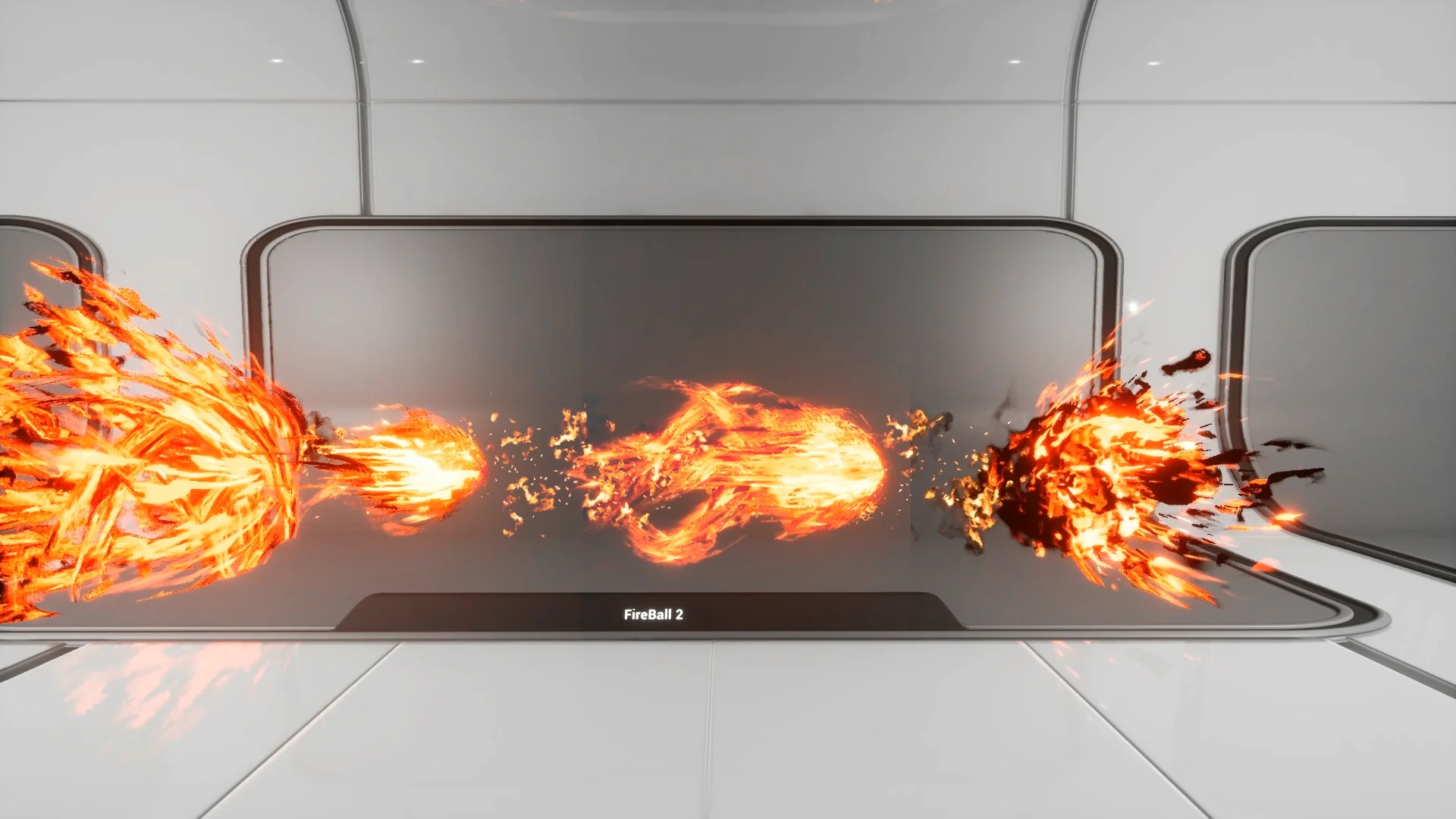
Fire effects capture the volatile nature of combustion. Flame projectiles project heat, turbulence, and residual embers that shed outward as the core travels through the air. The associated fire trails linger with warm dissipation, giving attacks a heavy, scorching presence that fits incendiary weapons or pyromantic abilities.
Magic properties shift the aesthetic toward esoteric energy. Rather than mimicking physical combustion, magical projectiles emphasize ethereal currents, flowing energy wakes, and subtle spatial distortions. The trailing effects reinforce an otherworldly quality, suited for arcane spells, mystical projectiles, or specialized energy barrages.
Light properties introduce sharp luminance and radiant intensity. These effects emphasize clarity, focused beams, and bright, crystalline particle dispersal. Light projectiles cut through darker scenes with stark contrast, making them particularly useful for precision abilities, holy alignments, or high-tier kinetic strikes where immediate visual recognition is essential.
Darkness properties operate on the opposite end of the spectrum, utilizing deep tones, umbral dissipation, and energy-absorbing silhouettes. Darkness projectiles and their trailing trails convey weight and corruption, giving hostile abilities or shadow-based character skills a menacing, heavy presence in the play space.
Electrical properties focus on instability, rapid direction shifts, and sudden discharge. Electric projectiles crackle with erratic energy arcs, while the accompanying electrical trails leave snapping residual currents behind the projectile path. This high-frequency motion provides immediate sensory feedback, instantly signaling shock damage, lightning spells, or energized technological attacks.
Realistic Visual Presentation Within NiagaraActionFX
While visual effects in action games frequently skew toward abstract stylization, NiagaraActionFX adheres to a realistic visual style. This realism informs how light interacts with particles, how dissipations behave over time, and how energy densities scale from the projectile core to its outer perimeter.
Realistic particle behavior prevents visual effects from appearing flat or disconnected from physically grounded environments. When an electrical projectile arcs through a scene, its lighting falls naturally across nearby geometry and surfaces. Fire effects feature realistic smoke transitions, cooling thermal gradients, and fading embers rather than abrupt texture cutoffs. Light and darkness effects maintain balanced contrast thresholds, preventing visual blowout or unreadable muddy silhouettes.
This grounding makes the package adaptable to high-fidelity environments. Action games featuring realistic lighting models, detailed material shaders, and physically based rendering require visual effects that match that standard. NiagaraActionFX delivers particle behaviors that blend seamlessly into detailed worlds without shattering scene cohesion.
Combat Readability and Action Game Flow
Action game development constantly balances visual spectacle against gameplay clarity. When multiple characters cast spells or discharge weapons simultaneously, particle clutter can quickly overwhelm the player's ability to assess the battlefield. A well-designed effect package must communicate critical gameplay information instantaneously without generating unreadable visual noise.
The structured division between projectile cores and trail FX in NiagaraActionFX directly supports combat readability. The projectile head acts as the primary collision indicator, marking the exact hit volume and trajectory vector. The trail acts as secondary narrative information, displaying speed, elemental type, and threat level without obscuring the target.
Because the five elemental properties are visually distinct in both color profile and motion behavior, players can immediately recognize threat types at a glance. An incoming fire projectile telegraphs an entirely different encounter dynamic than an electrical surge or an umbral dart. This clarity allows gameplay designers to assign specific debuffs, damage resistances, or tactical reactions directly linked to the visual profile of each effect.
Evaluating Niagara Action FX for Fast-Paced Combat
Constructing distinct projectile and trail systems from the ground up requires significant setup time in Unreal Engine's Niagara framework. NiagaraActionFX provides an established suite of action-ready components across fire, magic, light, darkness, and electrical properties, allowing teams to integrate realistic combat visuals immediately into their combat prototypes and production stages.
For projects requiring high-impact visual feedback, distinct elemental categorization, and grounded particle realism, the package delivers a focused, highly functional toolkit structured through the exact kinetics of action gameplay.
 Game Development R
 Game Development R
 Game Development R