"1f00f67f9253451b"{"id":"1001278","slug":"netobject","title":"NetObject","category":"Network \u0026 Multiplayer","engine":"5.2 - 5.4","assetVersion":"Asset Version: 1.0","engineVersion":"Engine Version: 5.2 - 5.4","tag":"Network","accent":"blue","visual":"mech","summary":"NetObject brings network replication and RPC support directly to UObjects without requiring dedicated actor spawning in Unreal Engine projects.","platform":"Unreal Engine","publishedAt":"2026-09-30T06:13:08.529Z","updatedAt":"2026-09-30T06:13:08.529Z","sourceNotes":[],"fileContents":[],"compatibility":["Unreal Engine","Asset Version: 1.0","Engine Version: 5.2 - 5.4"],"featuredImage":{"alt":"NetObject","src":"/wp-content/uploads/published/2026/09/7f3423b35d44-9258d5b5-fe24-4322-8ba6-e6a0de903265-5ee28427f6.webp"},"hasDownloadLink":true,"downloads":0,"terms":[{"taxonomy":"category","slug":"network-and-multiplayer-tools-and-plugins","name":"Network \u0026 Multiplayer"}],"galleryImages":[{"src":"/wp-content/uploads/published/2026/09/cc0bd4315a0c-a9bffd80-0694-40e9-8ed3-248cbc91e68a-fc3d5fb1af.webp","alt":"NetObject"},{"src":"/wp-content/uploads/published/2026/09/b3ad25990d3e-90cf9cba-aab7-4a16-bbc2-f0d9c6081d9b-342de750e7.webp","alt":"NetObject"}],"accessPanel":{"kind":"resource","title":"Download this resource","eyebrow":"Free Download","message":"Log in or create a free account to start your download.","fileName":"NetObject.7z","safetyNote":"Resources are manually reviewed before listing to improve quality and reduce obvious risks.","actionLabel":"Download Free","resourceType":"Resource archive"},"contentHtml":"\u003ch2\u003eReplicating UObjects Outside the Standard Actor Lifecycle\u003c/h2\u003e\u003cp\u003eIn standard Unreal Engine networking architecture, actor instances serve as the fundamental unit of network communication. Replicating state or dispatching remote procedure calls traditionally necessitates spawning an actor into the world or channeling data strictly through actor components. NetObject shifts this paradigm by injecting network support directly into lightweight UObjects. By allowing UObjects to replicate data and execute RPCs independently, the system removes the requirement to instantiate, track, and destroy actors whenever isolated data structures require server-client synchronization.\u003c/p\u003e\u003cp\u003eThis architectural adjustment fundamentally alters how state-heavy subsystems operate. Systems that manage inventory slots, ability configurations, character status effects, or interaction mechanics often consist of data classes that do not require physical representations, spatial transforms, or collision profiles in the 3D world. Forcing these constructs into actor classes generates unnecessary overhead. NetObject enables these data containers to remain plain UObjects while maintaining full parity with the replication routines and execution channels expected in networked multiplayer environments.\u003c/p\u003e\u003ch2\u003eRemote Procedure Calls and State Synchronization in UObjects\u003c/h2\u003e\u003cp\u003eNetwork functionality within NetObject centers on two core mechanics: continuous data replication and remote procedure call (RPC) dispatching. Replicating data directly across UObject instances allows server authorities to update variables and push those modifications to connected clients automatically. Rather than maintaining manual serialization routines or routing property changes through master actor variables, the object handles its own network state.\u003c/p\u003e\u003cp\u003eRemote procedure calls function alongside variable synchronization, giving UObjects the capacity to send explicit directives across the network boundary. Whether signaling an interaction event, confirming a client-initiated transaction, or updating stateful logic, the object can trigger execution on the opposing side of the network connection. Because RPCs execute directly within the context of the UObject, logic remains encapsulated within the class responsible for the behavior rather than spreading across player controllers, game states, or dedicated network bridge actors.\u003c/p\u003e\u003ch2\u003eEnabling and Disabling Replication via Functions and Details Properties\u003c/h2\u003e\u003cp\u003eNetwork synchronization requires precise regulation to avoid saturating communication channels with unnecessary variable updates. NetObject incorporates mechanisms to toggle replication states both at design time and dynamically during runtime. Developers can adjust network behavior directly within the details property panel, configuring whether an object begins its lifecycle in an active replication state or remains completely dormant until explicitly instructed to sync.\u003c/p\u003e\u003cp\u003eFor runtime management, NetObject provides dedicated functions to enable and disable replication on the fly. This dual-layer approach allows objects to halt data transmission entirely when their associated gameplay context is idle. For example, an object governing an inactive gameplay interaction or an unequipped item can disable its replication routine, preserving networking performance. When a player engages with the system, an explicit function call re-engages replication, synchronizing current properties before network broadcasting is toggled off again once the action concludes.\u003c/p\u003e\u003ch2\u003eHierarchical Synchronization Through Nested Objects\u003c/h2\u003e\u003cp\u003eComplex gameplay systems rarely exist as flat data structures. NetObject accounts for structured data sets by providing explicit support for nested objects. When a replicating UObject maintains references to child UObjects, the network layer propagates synchronization through the hierarchy, ensuring that nested subobjects receive property updates and process their respective replication directives accurately.\u003c/p\u003e\u003cp\u003eNested object replication prevents developers from having to manually unroll subobjects into primitive arrays or flat structs on an actor. Hierarchies such as modular interaction steps, layered skill trees, or sub-components of an inventory structure maintain their clean object-oriented layout. The primary UObject acts as the entry point, while its internal nested instances retain their own state synchronization, preserving logical boundaries across complex multiplayer gameplay setups.\u003c/p\u003e\u003ch2\u003eBlueprint Integration and Project Implementation\u003c/h2\u003e\u003cp\u003eFull support for Blueprint scripting ensures that both variable replication and RPC invocations can be configured and triggered within visual scripting graphs. NetObject operates cleanly in Blueprint-centric pipelines, allowing technical designers to set up networked UObjects without writing native C++ network serializers or overriding low-level replication channels.\u003c/p\u003e\u003cp\u003eThe system serves as an underlying technology in the InteractSystem plugin, proving its utility in modular, interaction-focused gameplay workflows where lightweight objects handle dynamic world interaction. NetObject also maintains direct compatibility with the free version of BetterBlueprint - ToolNodes, integrating into existing editor workflow enhancements and node-based toolsets. By combining nested hierarchy support, flexible details-level controls, and runtime function toggles, NetObject delivers a clean framework for handling networked data structures without cluttering levels with unnecessary actors.\u003c/p\u003e\n\n\u003ch2\u003eExplore Similar Assets\u003c/h2\u003e\n\u003cul\u003e\n\u003cli\u003e\u003ca href=\"https://3dcghub.com/mysql-and-mariadb-integration/\" title=\"MySQL and MariaDB Integration\"\u003eMySQL and MariaDB Integration\u003c/a\u003e\u003c/li\u003e\n\u003cli\u003e\u003ca href=\"https://3dcghub.com/advanced-crafting-system-plugin/\" title=\"Advanced Crafting System - Plugin\"\u003eAdvanced Crafting System - Plugin\u003c/a\u003e\u003c/li\u003e\n\u003cli\u003e\u003ca href=\"https://3dcghub.com/kronos-matchmaking/\" title=\"Kronos Matchmaking\"\u003eKronos Matchmaking\u003c/a\u003e\u003c/li\u003e\n\u003cli\u003e\u003ca href=\"https://3dcghub.com/eos-integration-kit/\" title=\"EOS Integration Kit\"\u003eEOS Integration Kit\u003c/a\u003e\u003c/li\u003e\n\u003cli\u003e\u003ca href=\"https://3dcghub.com/host-migration-system-v2/\" title=\"Host Migration System V2\"\u003eHost Migration System V2\u003c/a\u003e\u003c/li\u003e\n\u003c/ul\u003e","contentTextLength":5658,"navigation":{"current":3,"total":3222,"previous":{"id":"1001279","slug":"ai-image-and-text-generator","title":"AI Image and Text Generator","category":"Procedural Systems","platform":"Unreal Engine","updatedAt":"2026-09-30T06:14:54.896Z"},"next":{"id":"1001277","slug":"http-request","title":"Http Request","category":"Network \u0026 Multiplayer","platform":"Unreal Engine","updatedAt":"2026-09-30T06:10:41.021Z"}},"relatedResources":[{"id":"15144","slug":"mysql-and-mariadb-integration","title":"MySQL and MariaDB Integration","category":"Network \u0026 Multiplayer","engine":"5.1 - 5.8","assetVersion":"Asset Version:4.1 - 4.3","engineVersion":"Engine version: 5.1 - 5.8","tag":"Network","accent":"blue","visual":"mech","summary":"The MySQL and MariaDB Integration plugin bridges the gap between game development and database management. It enables creators to build dynamic, data-driven applications within Unreal Engine.","platform":"Unreal Engine","publishedAt":"2026-03-12T08:03:21.000Z","updatedAt":"2026-09-30T04:34:24.995Z","sourceNotes":[],"fileContents":[],"compatibility":["Unreal Engine","Asset Version:4.1 - 4.3","Engine version: 5.1 - 5.8"],"featuredImage":{"alt":"MySQL and MariaDB Integration","src":"https://3dcghub.com/wp-content/uploads/2026/03/b9903b50-a5f5-4840-ab32-cd62e363c7a5.webp"},"hasDownloadLink":true,"downloads":0},{"id":"1000785","slug":"advanced-crafting-system-plugin","title":"Advanced Crafting System - Plugin","category":"Network \u0026 Multiplayer","engine":"5.6","assetVersion":"Asset Version: 1.0","engineVersion":"Engine Version: 5.6","tag":"Network","accent":"blue","visual":"mech","summary":"Unreal Engine plugin version of a survival and multiplayer crafting system with Discord support, documentation, and free migration for previous buyers before Ju","platform":"Unreal Engine","publishedAt":"2026-07-30T11:54:43.085Z","updatedAt":"2026-07-30T11:54:43.085Z","sourceNotes":[],"fileContents":[],"compatibility":["Unreal Engine","Asset Version: 1.0","Engine Version: 5.6"],"featuredImage":{"alt":"Advanced Crafting System - Plugin","src":"/wp-content/uploads/published/2026/07/e0cef0609162-b72934a1-6676-40d9-91c2-a468db00c7ca-6af95748e4.webp"},"hasDownloadLink":true,"downloads":0},{"id":"1000632","slug":"kronos-matchmaking","title":"Kronos Matchmaking","category":"Network \u0026 Multiplayer","engine":"5.2,5.5","assetVersion":"Asset Version: 1.9.0 - 2.6.0","engineVersion":"Engine Version: 5.2,5.5","tag":"Network","accent":"blue","visual":"mech","summary":"Complete Unreal Engine matchmaking plugin with skill-based pairing, party and reservation systems, Steam and EOS support, and listen-server hosting.","platform":"Unreal Engine","publishedAt":"2026-07-21T14:46:21.329Z","updatedAt":"2026-07-21T14:46:21.329Z","sourceNotes":[],"fileContents":[],"compatibility":["Unreal Engine","Asset Version: 1.9.0 - 2.6.0","Engine Version: 5.2,5.5"],"featuredImage":{"alt":"Kronos Matchmaking","src":"/wp-content/uploads/published/2026/07/3bf316672af3-3dc1eaef-3090-47e4-9779-b8a8509d071a-31efec86de.webp"},"hasDownloadLink":true,"downloads":0}]}
Network
NetObject
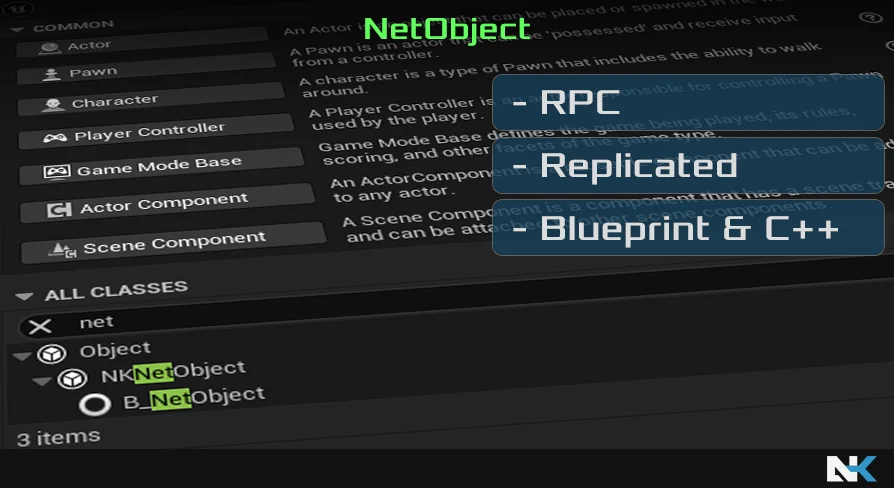
NetObject brings network replication and RPC support directly to UObjects without requiring dedicated actor spawning in Unreal Engine projects.
Replicating UObjects Outside the Standard Actor Lifecycle
In standard Unreal Engine networking architecture, actor instances serve as the fundamental unit of network communication. Replicating state or dispatching remote procedure calls traditionally necessitates spawning an actor into the world or channeling data strictly through actor components. NetObject shifts this paradigm by injecting network support directly into lightweight UObjects. By allowing UObjects to replicate data and execute RPCs independently, the system removes the requirement to instantiate, track, and destroy actors whenever isolated data structures require server-client synchronization.
This architectural adjustment fundamentally alters how state-heavy subsystems operate. Systems that manage inventory slots, ability configurations, character status effects, or interaction mechanics often consist of data classes that do not require physical representations, spatial transforms, or collision profiles in the 3D world. Forcing these constructs into actor classes generates unnecessary overhead. NetObject enables these data containers to remain plain UObjects while maintaining full parity with the replication routines and execution channels expected in networked multiplayer environments.
Remote Procedure Calls and State Synchronization in UObjects
Network functionality within NetObject centers on two core mechanics: continuous data replication and remote procedure call (RPC) dispatching. Replicating data directly across UObject instances allows server authorities to update variables and push those modifications to connected clients automatically. Rather than maintaining manual serialization routines or routing property changes through master actor variables, the object handles its own network state.
Remote procedure calls function alongside variable synchronization, giving UObjects the capacity to send explicit directives across the network boundary. Whether signaling an interaction event, confirming a client-initiated transaction, or updating stateful logic, the object can trigger execution on the opposing side of the network connection. Because RPCs execute directly within the context of the UObject, logic remains encapsulated within the class responsible for the behavior rather than spreading across player controllers, game states, or dedicated network bridge actors.
Enabling and Disabling Replication via Functions and Details Properties
Network synchronization requires precise regulation to avoid saturating communication channels with unnecessary variable updates. NetObject incorporates mechanisms to toggle replication states both at design time and dynamically during runtime. Developers can adjust network behavior directly within the details property panel, configuring whether an object begins its lifecycle in an active replication state or remains completely dormant until explicitly instructed to sync.
For runtime management, NetObject provides dedicated functions to enable and disable replication on the fly. This dual-layer approach allows objects to halt data transmission entirely when their associated gameplay context is idle. For example, an object governing an inactive gameplay interaction or an unequipped item can disable its replication routine, preserving networking performance. When a player engages with the system, an explicit function call re-engages replication, synchronizing current properties before network broadcasting is toggled off again once the action concludes.
Hierarchical Synchronization Through Nested Objects
Complex gameplay systems rarely exist as flat data structures. NetObject accounts for structured data sets by providing explicit support for nested objects. When a replicating UObject maintains references to child UObjects, the network layer propagates synchronization through the hierarchy, ensuring that nested subobjects receive property updates and process their respective replication directives accurately.
Nested object replication prevents developers from having to manually unroll subobjects into primitive arrays or flat structs on an actor. Hierarchies such as modular interaction steps, layered skill trees, or sub-components of an inventory structure maintain their clean object-oriented layout. The primary UObject acts as the entry point, while its internal nested instances retain their own state synchronization, preserving logical boundaries across complex multiplayer gameplay setups.
Blueprint Integration and Project Implementation
Full support for Blueprint scripting ensures that both variable replication and RPC invocations can be configured and triggered within visual scripting graphs. NetObject operates cleanly in Blueprint-centric pipelines, allowing technical designers to set up networked UObjects without writing native C++ network serializers or overriding low-level replication channels.
The system serves as an underlying technology in the InteractSystem plugin, proving its utility in modular, interaction-focused gameplay workflows where lightweight objects handle dynamic world interaction. NetObject also maintains direct compatibility with the free version of BetterBlueprint - ToolNodes, integrating into existing editor workflow enhancements and node-based toolsets. By combining nested hierarchy support, flexible details-level controls, and runtime function toggles, NetObject delivers a clean framework for handling networked data structures without cluttering levels with unnecessary actors.
 Network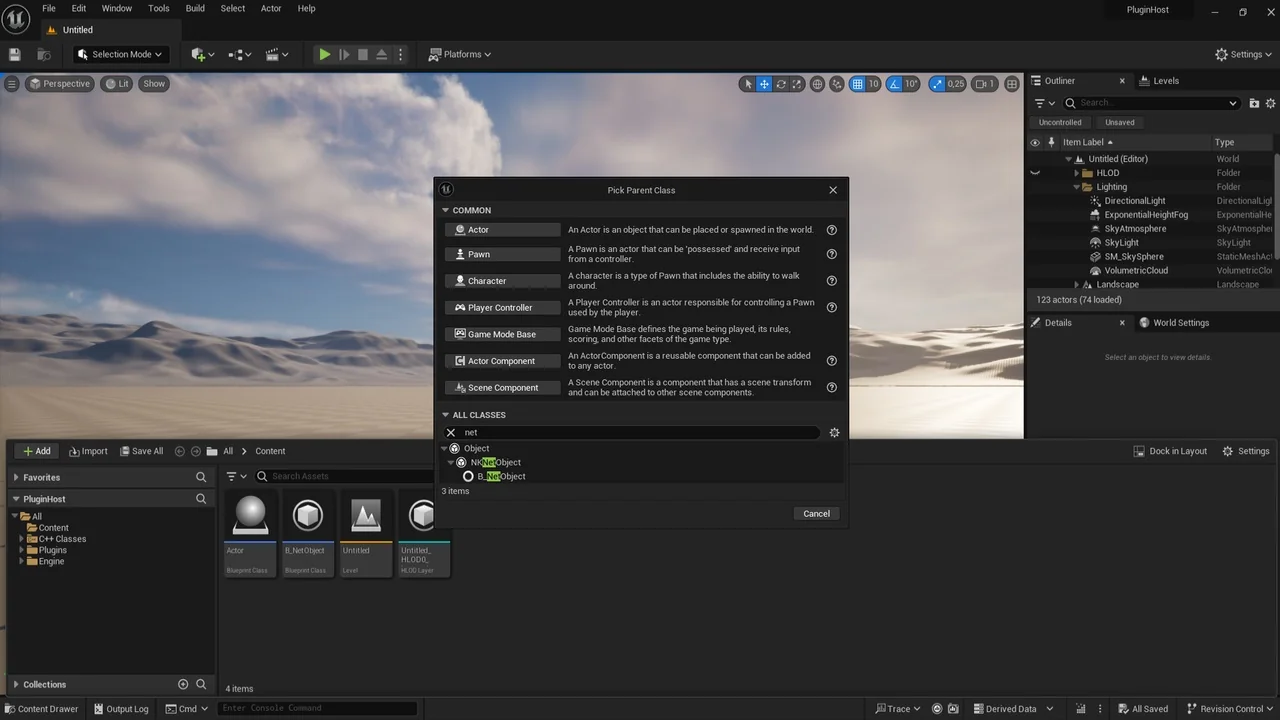
 Network
 Network
 Network