"f813c18d2170b1f6"{"id":"1000066","slug":"host-migration-system-v2","title":"Host Migration System V2","category":"Network \u0026 Multiplayer","engine":"5.4 - 5.6","assetVersion":"1.0","engineVersion":"5.4 - 5.6","tag":"Network","accent":"blue","visual":"mech","summary":"Host Migration System V2 keeps multiplayer sessions alive after a host disconnects by transferring game state to a new host with a fast C++ backend.","platform":"Unreal Engine","publishedAt":"2026-05-29T13:41:52.845Z","updatedAt":"2026-05-29T13:41:52.845Z","sourceNotes":[],"fileContents":[],"compatibility":["Unreal Engine","Asset Version: 1.0","Engine version: 5.4 - 5.6"],"featuredImage":{"alt":"Host Migration System V2","src":"/wp-content/uploads/published/2026/05/f4a04c66bbd6-69574ae4-3438-44ad-bc2b-55ed9e8a7ddb-a285090a0d.webp"},"hasDownloadLink":true,"downloads":1,"terms":[{"taxonomy":"category","slug":"network-and-multiplayer-tools-and-plugins","name":"Network \u0026 Multiplayer"}],"galleryImages":[{"src":"/wp-content/uploads/published/2026/05/7af6215885d3-d4c28592-829a-41b4-af70-92d9f08e7cc9-95440a9dc7.webp","alt":"Host Migration System V2"},{"src":"/wp-content/uploads/published/2026/05/831fddab758a-9107a6ab-ddff-40ec-ac38-cc9e4ca1ba87-12f8dc60da.webp","alt":"Host Migration System V2"},{"src":"/wp-content/uploads/published/2026/05/b9d6e411c3d7-d77394b2-5f05-4eca-8cc3-18e80cfbec49-46116bc4d4.webp","alt":"Host Migration System V2"}],"accessPanel":{"kind":"resource","title":"Access this resource","eyebrow":"Free Download","message":"Log in or create a free account to start your download.","fileName":"Host Migration System V2.7z","safetyNote":"Resources are manually reviewed before listing to improve quality and reduce obvious risks.","actionLabel":"Download Free","resourceType":"Resource archive"},"contentHtml":"\u003cp\u003eGetting multiplayer sessions through a host disconnect usually means dealing with a painful break in flow, or moving to dedicated servers to avoid the problem altogether. Host Migration System V2 takes a different route. Its setup path centers on avoiding dedicated server overhead while still keeping a live session running when the host leaves, transferring the entire game state to a new host selected from the connected clients and bringing the game back up in a mere instant.\u003c/p\u003e \u003cp\u003eThat core behavior defines the package. This is a plugin focused on multiplayer, networking, server flow, cloud-oriented deployment paths, and code-level implementation. The stated goal is direct and practical: keep sessions alive, keep players together, and remove the need to set up and pay for dedicated servers just to protect a match from a host disconnect.\u003c/p\u003e \u003ch2\u003eHost Migration System V2 starts with session continuity\u003c/h2\u003e\n\u003cp\u003eThe main function here is not broad networking support in the abstract. It is session continuity during host loss. When the host disconnects, Host Migration System V2 transfers the entire game state to a replacement host chosen among the clients. After that, the game is re-hosted almost immediately. The emphasis on speed is repeated through the package’s positioning, including a showcase focused on how fast that transition can happen.\u003c/p\u003e \u003cp\u003eThat makes the plugin most relevant for multiplayer projects where the host machine still plays a central role, but where an interrupted session would be a major problem. Instead of treating host departure as the end of a match, the system treats it as a recoverable event. The practical use case is easy to understand: players stay in the session instead of being thrown out because one machine stops being the authority.\u003c/p\u003e \u003cp\u003eThe package also frames this as an alternative to dedicated server setup. For teams that want to avoid that infrastructure path, the plugin presents host migration as the way to preserve continuity without moving everything to a permanently hosted server model. That is a concrete production angle, not just a convenience feature.\u003c/p\u003e \u003ch2\u003eIntegration into large projects and the C++ backend\u003c/h2\u003e\n\u003cp\u003eHost Migration System V2 is described as easy to integrate into large projects, which points to one of its more important production-facing claims. A networking system can solve the right problem and still be difficult to bring into an existing game. Here, the focus is on fitting the migration workflow into projects that are already substantial, rather than only into tiny test scenes or isolated prototypes.\u003c/p\u003e \u003cp\u003eThe speed side of that workflow is tied to a brand new C++ backend. The package specifically highlights this backend as part of why the system is super fast. That is useful because host migration is only useful when the interruption window stays short enough to preserve the feel of a live session. The article does not need speculative performance numbers to show the intent: the backend is positioned as the technical foundation for rapid state transfer and rapid re-hosting.\u003c/p\u003e \u003cp\u003eFor teams looking at implementation, those two details belong together. Easy integration into large projects suggests the plugin is meant to fit into serious multiplayer development rather than remain a feature demo. The C++ backend points to the performance-sensitive side of the problem, where migration has to happen quickly enough to be practical in play.\u003c/p\u003e \u003ch2\u003eExample Project, Real Project Example, and documentation paths\u003c/h2\u003e\n\u003cp\u003eThe package does not stop at a feature claim. It also emphasizes materials that help developers see the system in action and work through implementation. A real project example is included as a shared demonstration, which gives the system a more concrete frame than a feature list alone. There is also a showcase video focused on visible migration speed, making the handoff behavior easier to evaluate for production work.\u003c/p\u003e \u003cp\u003eTwo example project tracks are highlighted. One is an example project using Advanced Steam Sessions and Steam Sockets, marked as shipping ready. The other is an older example project. Even without adding assumptions beyond those labels, this gives a clear picture of how the package is presented: there is a current, production-oriented example path and an older reference path. That is useful for developers who want to compare implementation styles or understand how the system has been packaged across iterations.\u003c/p\u003e \u003cp\u003eDocumentation is explicitly part of the resource as well. For a networking plugin, that matters as much as the core feature pitch. Host migration touches session state, authority changes, and reconnect or continuation flow, so documentation becomes part of the implementation experience rather than an optional extra. The presence of both examples and documentation suggests that the package is not only selling the result of migration, but also the path to getting it working in a real project.\u003c/p\u003e \u003ch2\u003eSteam, EOS, Amazon Gamelift, Android, and iOS support\u003c/h2\u003e\n\u003cp\u003eCompatibility is described in broad but concrete terms: Host Migration System V2 supports any platform, with EOS, Steam, Amazon Gamelift, Android, and iOS named directly. Those references show the plugin is not locked to a single service path or device type. Instead, it is positioned for projects that may combine different online backends or target different platform categories while still needing the same host migration behavior.\u003c/p\u003e \u003cp\u003eEOS and Steam place the plugin in familiar multiplayer service territory. Amazon Gamelift extends that picture into another backend environment named by the package. Android and iOS show that the scope is not limited to desktop-hosted session ideas. Taken together, these support notes make the plugin easier to place in real production scenarios, especially when a team wants one migration approach that is not restricted to a single online stack.\u003c/p\u003e \u003cp\u003eThe wording around platform support is also broad enough to suggest flexibility without requiring added claims. What is concrete is the named set: EOS, Steam, Amazon Gamelift, Android, and iOS. For teams evaluating fit, those names are the practical anchors.\u003c/p\u003e \u003ch2\u003eWhere Host Migration System V2 is most useful\u003c/h2\u003e\n\u003cp\u003eThe strongest use cases come directly from the plugin’s stated purpose. Any multiplayer project where a player-hosted session needs to survive host departure is a natural fit. Games that rely on session continuity, where dropping every player back to a menu would be disruptive, are the clearest match for this system. It also suits developers who want to avoid dedicated server setup and the associated cost and maintenance path implied by that choice.\u003c/p\u003e \u003cp\u003eThe package’s tags reinforce that identity. This is a plugin focused on multiplayer, network behavior, server transition, cloud-connected deployment contexts, and code. It is less about visual systems or broad gameplay tooling and more about solving a narrow but important online gameplay problem.\u003c/p\u003e \u003cp\u003eThe inclusion of a shipping-ready Steam-oriented example project gives it particular relevance for teams who want to study a more production-facing implementation track rather than only a basic demo. The older example project still has value as a reference point, while the real project example and showcase video help ground the migration feature in observable behavior instead of abstract description.\u003c/p\u003e \u003ch2\u003eBest fit for teams that need production-ready session recovery\u003c/h2\u003e\n\u003cp\u003eHost Migration System V2 will be most useful to developers building multiplayer games that cannot afford to let a host disconnect end the session. Its appeal is straightforward: no dedicated server requirement, fast migration through a new C++ backend, integration aimed at large projects, and support across EOS, Steam, Amazon Gamelift, Android, and iOS.\u003c/p\u003e \u003cp\u003eWith documentation, a real project example, a shipping-ready Steam Sessions and Steam Sockets example project, and an older example project also included in its presentation, the package is geared toward teams that want to move beyond theory and into implementation. The practical takeaway is simple: if host departure is a risk to the flow of your multiplayer game, this plugin exists to hand the session to another client and keep play moving.\u003c/p\u003e\n\n\u003ch2\u003eContinue Browsing Similar Packs\u003c/h2\u003e\n\u003cul\u003e\n\u003cli\u003e\u003ca href=\"https://3dcghub.com/fps-first-person-shooter-framework-skg-shooter-framework-v2/\" title=\"FPS First Person Shooter Framework (SKG Shooter Framework V2)\"\u003eFPS First Person Shooter Framework (SKG Shooter Framework V2)\u003c/a\u003e\u003c/li\u003e\n\u003cli\u003e\u003ca href=\"https://3dcghub.com/mysql-and-mariadb-integration/\" title=\"MySQL and MariaDB Integration\"\u003eMySQL and MariaDB Integration\u003c/a\u003e\u003c/li\u003e\n\u003cli\u003e\u003ca href=\"https://3dcghub.com/skills-indicators-customizable/\" title=\"Skills Indicators (Customizable)\"\u003eSkills Indicators (Customizable)\u003c/a\u003e\u003c/li\u003e\n\u003cli\u003e\u003ca href=\"https://3dcghub.com/blueprint-web-communication-helper-http-websocket/\" title=\"[Blueprint] Web Communication Helper (Http / Websocket)\"\u003e[Blueprint] Web Communication Helper (Http / Websocket)\u003c/a\u003e\u003c/li\u003e\n\u003cli\u003e\u003ca href=\"https://3dcghub.com/quest-editor-plugin/\" title=\"Quest Editor Plugin\"\u003eQuest Editor Plugin\u003c/a\u003e\u003c/li\u003e\n\u003c/ul\u003e","contentTextLength":8389,"navigation":{"current":1729,"total":3651,"previous":{"id":"1000067","slug":"industrial-vol-4-electricity-hydro-and-water-treatment","title":"Industrial VOL.4 - Electricity, Hydro, and Water Treatment","category":"Buildings \u0026 Architecture","platform":"Unreal Engine","updatedAt":"2026-05-29T13:50:53.215Z"},"next":{"id":"1000065","slug":"horror-farm","title":"Horror Farm","category":"Interior","platform":"Unreal Engine","updatedAt":"2026-05-29T13:38:07.885Z"}},"relatedResources":[{"id":"1000785","slug":"advanced-crafting-system-plugin","title":"Advanced Crafting System - Plugin","category":"Network \u0026 Multiplayer","engine":"5.6","assetVersion":"Asset Version: 1.0","engineVersion":"Engine Version: 5.6","tag":"Network","accent":"blue","visual":"mech","summary":"Unreal Engine plugin version of a survival and multiplayer crafting system with Discord support, documentation, and free migration for previous buyers before Ju","platform":"Unreal Engine","publishedAt":"2026-07-30T11:54:43.085Z","updatedAt":"2026-07-30T11:54:43.085Z","sourceNotes":[],"fileContents":[],"compatibility":["Unreal Engine","Asset Version: 1.0","Engine Version: 5.6"],"featuredImage":{"alt":"Advanced Crafting System - Plugin","src":"/wp-content/uploads/published/2026/07/e0cef0609162-b72934a1-6676-40d9-91c2-a468db00c7ca-6af95748e4.webp"},"hasDownloadLink":true,"downloads":0},{"id":"15136","slug":"fps-first-person-shooter-framework-skg-shooter-framework-v2","title":"FPS First Person Shooter Framework (SKG Shooter Framework V2)","category":"Network \u0026 Multiplayer","engine":"5.5 - 5.7","assetVersion":"Engine version: 5.5 - 5.7","engineVersion":"Asset Version:1.4.1 - 1.4.3","tag":"Network","accent":"blue","visual":"city","summary":"The SKG Shooter Framework V2 is a performant, modular, component-based solution for building realistic first-person shooters in Unreal Engine 5.3 and beyond.","platform":"Unreal Engine","publishedAt":"2026-03-12T08:01:31.000Z","updatedAt":"2026-04-19T15:44:53.000Z","sourceNotes":[],"fileContents":[],"compatibility":["Unreal Engine","Engine version: 5.5 - 5.7","Asset Version: 1.4.1 - 1.4.3"],"featuredImage":{"alt":"FPS First Person Shooter Framework (SKG Shooter Framework V2)","src":"https://3dcghub.com/wp-content/uploads/2026/03/1ef8f873-5cad-4190-b092-53ba5e385464.webp"},"hasDownloadLink":true,"downloads":12},{"id":"1001325","slug":"network-clock","title":"Network Clock","category":"Network \u0026 Multiplayer","engine":"5.2 - 5.4","assetVersion":"Asset Version: 1.0.1","engineVersion":"Engine Version: 5.2 - 5.4","tag":"Network","accent":"blue","visual":"mech","summary":"Network Clock is an open-source Unreal Engine plugin designed to synchronize client and server time, compensating for network latency across multiplayer games.","platform":"Unreal Engine","publishedAt":"2026-10-02T09:54:03.857Z","updatedAt":"2026-10-02T09:54:03.857Z","sourceNotes":[],"fileContents":[],"compatibility":["Unreal Engine","Asset Version: 1.0.1","Engine Version: 5.2 - 5.4"],"featuredImage":{"alt":"Network Clock","src":"/wp-content/uploads/published/2026/10/1141f81ad01b-8fcc2205-a0ea-4f78-8f41-d5f6170fde51-4c0f489913.webp"},"hasDownloadLink":true,"downloads":0}]}
Network
Host Migration System V2
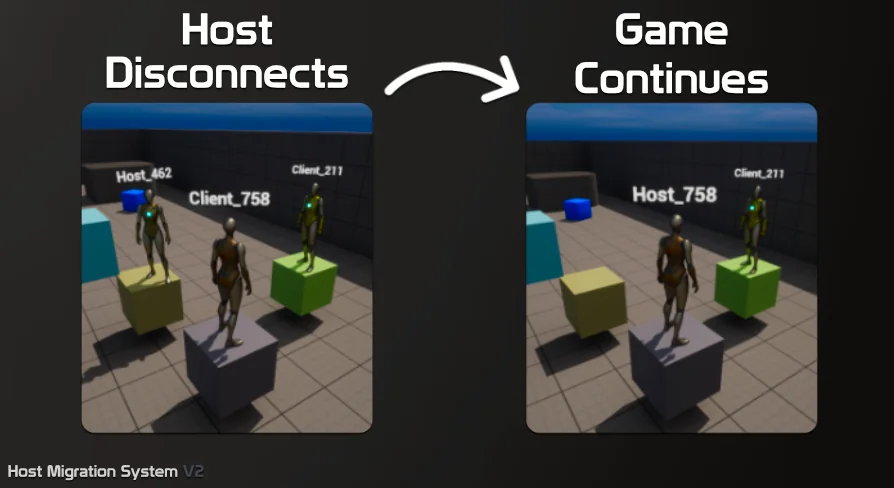
Host Migration System V2 keeps multiplayer sessions alive after a host disconnects by transferring game state to a new host with a fast C++ backend.
Getting multiplayer sessions through a host disconnect usually means dealing with a painful break in flow, or moving to dedicated servers to avoid the problem altogether. Host Migration System V2 takes a different route. Its setup path centers on avoiding dedicated server overhead while still keeping a live session running when the host leaves, transferring the entire game state to a new host selected from the connected clients and bringing the game back up in a mere instant.
That core behavior defines the package. This is a plugin focused on multiplayer, networking, server flow, cloud-oriented deployment paths, and code-level implementation. The stated goal is direct and practical: keep sessions alive, keep players together, and remove the need to set up and pay for dedicated servers just to protect a match from a host disconnect.
Host Migration System V2 starts with session continuity
The main function here is not broad networking support in the abstract. It is session continuity during host loss. When the host disconnects, Host Migration System V2 transfers the entire game state to a replacement host chosen among the clients. After that, the game is re-hosted almost immediately. The emphasis on speed is repeated through the package’s positioning, including a showcase focused on how fast that transition can happen.
That makes the plugin most relevant for multiplayer projects where the host machine still plays a central role, but where an interrupted session would be a major problem. Instead of treating host departure as the end of a match, the system treats it as a recoverable event. The practical use case is easy to understand: players stay in the session instead of being thrown out because one machine stops being the authority.
The package also frames this as an alternative to dedicated server setup. For teams that want to avoid that infrastructure path, the plugin presents host migration as the way to preserve continuity without moving everything to a permanently hosted server model. That is a concrete production angle, not just a convenience feature.
Integration into large projects and the C++ backend
Host Migration System V2 is described as easy to integrate into large projects, which points to one of its more important production-facing claims. A networking system can solve the right problem and still be difficult to bring into an existing game. Here, the focus is on fitting the migration workflow into projects that are already substantial, rather than only into tiny test scenes or isolated prototypes.
The speed side of that workflow is tied to a brand new C++ backend. The package specifically highlights this backend as part of why the system is super fast. That is useful because host migration is only useful when the interruption window stays short enough to preserve the feel of a live session. The article does not need speculative performance numbers to show the intent: the backend is positioned as the technical foundation for rapid state transfer and rapid re-hosting.
For teams looking at implementation, those two details belong together. Easy integration into large projects suggests the plugin is meant to fit into serious multiplayer development rather than remain a feature demo. The C++ backend points to the performance-sensitive side of the problem, where migration has to happen quickly enough to be practical in play.
Example Project, Real Project Example, and documentation paths
The package does not stop at a feature claim. It also emphasizes materials that help developers see the system in action and work through implementation. A real project example is included as a shared demonstration, which gives the system a more concrete frame than a feature list alone. There is also a showcase video focused on visible migration speed, making the handoff behavior easier to evaluate for production work.
Two example project tracks are highlighted. One is an example project using Advanced Steam Sessions and Steam Sockets, marked as shipping ready. The other is an older example project. Even without adding assumptions beyond those labels, this gives a clear picture of how the package is presented: there is a current, production-oriented example path and an older reference path. That is useful for developers who want to compare implementation styles or understand how the system has been packaged across iterations.
Documentation is explicitly part of the resource as well. For a networking plugin, that matters as much as the core feature pitch. Host migration touches session state, authority changes, and reconnect or continuation flow, so documentation becomes part of the implementation experience rather than an optional extra. The presence of both examples and documentation suggests that the package is not only selling the result of migration, but also the path to getting it working in a real project.
Steam, EOS, Amazon Gamelift, Android, and iOS support
Compatibility is described in broad but concrete terms: Host Migration System V2 supports any platform, with EOS, Steam, Amazon Gamelift, Android, and iOS named directly. Those references show the plugin is not locked to a single service path or device type. Instead, it is positioned for projects that may combine different online backends or target different platform categories while still needing the same host migration behavior.
EOS and Steam place the plugin in familiar multiplayer service territory. Amazon Gamelift extends that picture into another backend environment named by the package. Android and iOS show that the scope is not limited to desktop-hosted session ideas. Taken together, these support notes make the plugin easier to place in real production scenarios, especially when a team wants one migration approach that is not restricted to a single online stack.
The wording around platform support is also broad enough to suggest flexibility without requiring added claims. What is concrete is the named set: EOS, Steam, Amazon Gamelift, Android, and iOS. For teams evaluating fit, those names are the practical anchors.
Where Host Migration System V2 is most useful
The strongest use cases come directly from the plugin’s stated purpose. Any multiplayer project where a player-hosted session needs to survive host departure is a natural fit. Games that rely on session continuity, where dropping every player back to a menu would be disruptive, are the clearest match for this system. It also suits developers who want to avoid dedicated server setup and the associated cost and maintenance path implied by that choice.
The package’s tags reinforce that identity. This is a plugin focused on multiplayer, network behavior, server transition, cloud-connected deployment contexts, and code. It is less about visual systems or broad gameplay tooling and more about solving a narrow but important online gameplay problem.
The inclusion of a shipping-ready Steam-oriented example project gives it particular relevance for teams who want to study a more production-facing implementation track rather than only a basic demo. The older example project still has value as a reference point, while the real project example and showcase video help ground the migration feature in observable behavior instead of abstract description.
Best fit for teams that need production-ready session recovery
Host Migration System V2 will be most useful to developers building multiplayer games that cannot afford to let a host disconnect end the session. Its appeal is straightforward: no dedicated server requirement, fast migration through a new C++ backend, integration aimed at large projects, and support across EOS, Steam, Amazon Gamelift, Android, and iOS.
With documentation, a real project example, a shipping-ready Steam Sessions and Steam Sockets example project, and an older example project also included in its presentation, the package is geared toward teams that want to move beyond theory and into implementation. The practical takeaway is simple: if host departure is a risk to the flow of your multiplayer game, this plugin exists to hand the session to another client and keep play moving.
 Network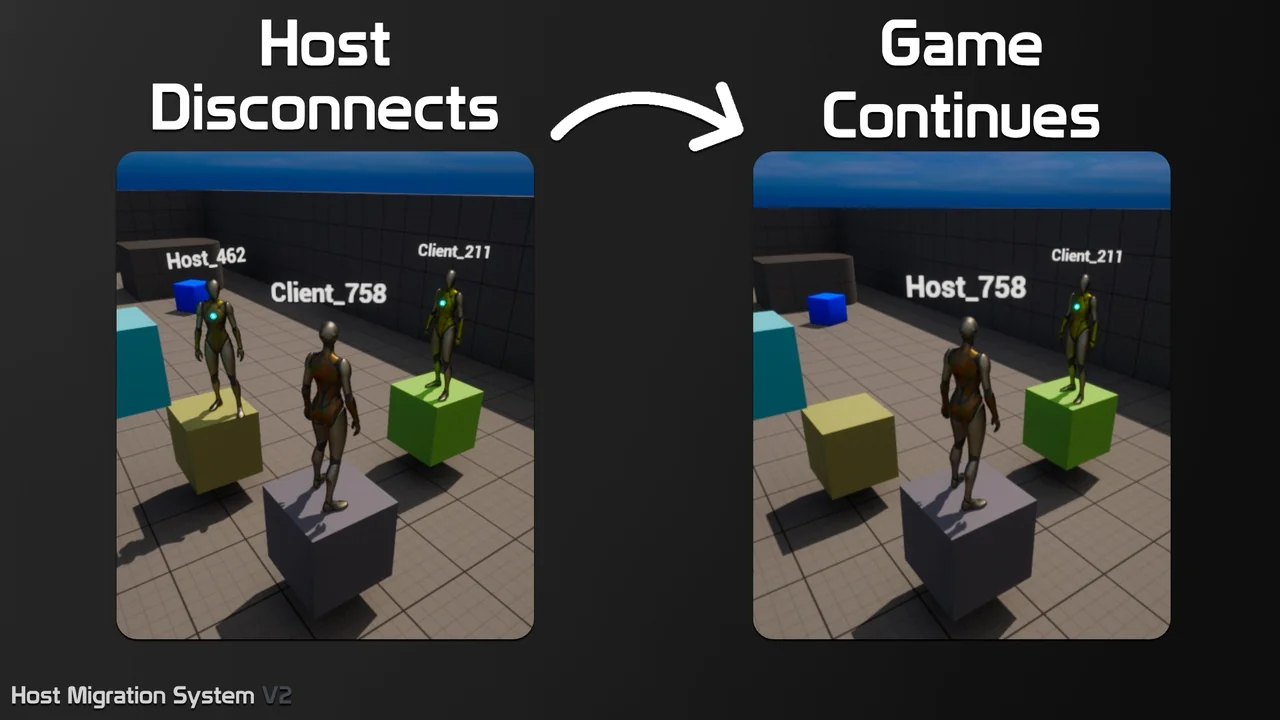
 Network
 Network
 Network