"f813c18d2170b1f6"{"id":"1000067","slug":"industrial-vol-4-electricity-hydro-and-water-treatment","title":"Industrial VOL.4 - Electricity, Hydro, and Water Treatment","category":"Buildings \u0026 Architecture","engine":"4.26+,5.0+","assetVersion":"","engineVersion":"4.26+,5.0+","tag":"Buildings","accent":"blue","visual":"city","summary":"A 30-mesh Unreal Engine industrial set with 2k+ textures, master materials, fake water shaders, and a test lighting scene for game-ready work.","platform":"Unreal Engine","publishedAt":"2026-05-29T13:50:53.215Z","updatedAt":"2026-05-29T13:50:53.215Z","sourceNotes":[],"fileContents":[],"compatibility":["Unreal Engine","Engine version: 4.26+,5.0+"],"featuredImage":{"alt":"Industrial VOL.4 - Electricity, Hydro, and Water Treatment","src":"/wp-content/uploads/published/2026/05/b143e96a436b-be91d910-a62c-4429-9d9f-1cddb6be762d-53d0bf0025.webp"},"hasDownloadLink":true,"downloads":1,"terms":[{"taxonomy":"category","slug":"buildings-and-architecture","name":"Buildings \u0026 Architecture"}],"galleryImages":[{"src":"/wp-content/uploads/published/2026/05/d3e27ae4d20b-37bd0a60-a947-45d6-85f9-be91843e8b50-4942c9d5d1.webp","alt":"Industrial VOL.4 - Electricity, Hydro, and Water Treatment"},{"src":"/wp-content/uploads/published/2026/05/0aa2abeb5bb8-8022285d-439d-41b4-b412-c2b566a8619d-a0e3ee5cbb.webp","alt":"Industrial VOL.4 - Electricity, Hydro, and Water Treatment"},{"src":"/wp-content/uploads/published/2026/05/5b88a6deeef1-79f1a730-8a67-4331-8aff-66b4c98b4377-9820f9f3ea.webp","alt":"Industrial VOL.4 - Electricity, Hydro, and Water Treatment"},{"src":"/wp-content/uploads/published/2026/05/b79aefcc8ad0-d213ea83-555d-49ae-a454-3d116984b6e6-6edcd77fe3.webp","alt":"Industrial VOL.4 - Electricity, Hydro, and Water Treatment"},{"src":"/wp-content/uploads/published/2026/05/675453dbc09d-c7c30ba8-ec8d-4c9c-877a-01e4e8a37bb8-969d089327.webp","alt":"Industrial VOL.4 - Electricity, Hydro, and Water Treatment"},{"src":"/wp-content/uploads/published/2026/05/96d9713906a4-3a64cc46-5821-4aa9-8a8f-0a4b964dc69f-a54c1cd53c.webp","alt":"Industrial VOL.4 - Electricity, Hydro, and Water Treatment"},{"src":"/wp-content/uploads/published/2026/05/a93e07cf54a0-921c8532-ef9f-4567-99c7-af5dfc652b15-b99aa9006b.webp","alt":"Industrial VOL.4 - Electricity, Hydro, and Water Treatment"},{"src":"/wp-content/uploads/published/2026/05/c7b57ceba8a3-9cadfc88-67d2-4bcc-aa64-6d060136c9c2-3b00f5d0c7.webp","alt":"Industrial VOL.4 - Electricity, Hydro, and Water Treatment"},{"src":"/wp-content/uploads/published/2026/05/3d1fc1b7686e-a9f2aa15-8ff3-4efd-a823-82f8f3eb90ff-63cd17287a.webp","alt":"Industrial VOL.4 - Electricity, Hydro, and Water Treatment"},{"src":"/wp-content/uploads/published/2026/05/e575482889fd-f58ee3cf-e9b8-46a5-9a91-f05f2c3e6891-6b020d10d5.webp","alt":"Industrial VOL.4 - Electricity, Hydro, and Water Treatment"}],"accessPanel":{"kind":"resource","title":"Access this resource","eyebrow":"Free Download","message":"Log in or create a free account to start your download.","fileName":"Content.7z","safetyNote":"Resources are manually reviewed before listing to improve quality and reduce obvious risks.","actionLabel":"Download Free","resourceType":"Resource archive"},"contentHtml":"\u003cp\u003e30 meshes, project materials, maps, and supporting scene elements form the core of Industrial VOL.4 - Electricity, Hydro, and Water Treatment. The package is assembled inside Unreal Engine and centers on industrial subjects tied to electricity, hydro systems, and water treatment, with props and structures that fit themes such as power, filtering, tanks, chemical handling, cleaning systems, towers, and liquid processing.\u003c/p\u003e\n\u003cp\u003eEverything pictured is included, and the project is not limited to geometry alone. Materials are part of the package, along with a setup that extends into post processing, a look up table, and a fake water shader for liquid containers. That combination gives the pack a more complete implementation footprint than a simple collection of static models, especially for scenes that need both hard-surface industrial forms and environmental surface behavior.\u003c/p\u003e \u003ch2\u003e30 meshes for electricity, hydro, and water treatment scenes\u003c/h2\u003e\n\u003cp\u003eThe pack contains 30 meshes, each created for realistic AAA quality visuals, style, and budget. That emphasis places the set in a space where visual fidelity matters, but where assets also need to stay practical enough for game work. The subject matter points toward industrial pipelines, treatment infrastructure, electrical support elements, tanks, filters, and related equipment rather than loosely themed background dressing.\u003c/p\u003e\n\u003cp\u003eFully detailed models from all sides also affect how the set can be used in a level. Assets that hold up from every angle are more flexible for close camera placement, walkable spaces, and layouts where players can move around props rather than only viewing them from a fixed direction. In an industrial environment, that matters for machinery rows, processing areas, liquid containers, and utility spaces where side and rear surfaces often remain visible.\u003c/p\u003e\n\u003cp\u003eThe included themes reflected by the tags reinforce that direction. Power, electric, line, water, liquid, tank, filter, cleaner, chemical, tower, and industry all point toward infrastructure-heavy scenes instead of generalized factory decoration. The resource fits best where a project needs a connected visual language for treatment systems and utility equipment.\u003c/p\u003e \u003ch2\u003eMaster material setup and 2k+ texture workflow\u003c/h2\u003e\n\u003cp\u003eSurface control is one of the stronger practical parts of the project. High quality and fidelity texture sets are included at 2k and above, supporting the pack's realistic visual target. That resolution range pairs with the stated AAA-style goal and gives the materials enough detail to carry close inspection across industrial surfaces, where wear, hard edges, painted metal, and utility labeling often need to read clearly.\u003c/p\u003e\n\u003cp\u003eA master material setup controls the majority of props and models. In production terms, that means many assets share a common material framework rather than relying on isolated one-off shader setups. Shared control is useful when a scene needs consistency across a larger group of industrial elements, especially if the goal is to adjust the look of multiple pieces without rebuilding materials asset by asset.\u003c/p\u003e\n\u003cp\u003eAdditional controls for roughness, albedo, normals, and more extend that workflow. Those controls are directly relevant to implementation inside Unreal Engine because they allow scene-level tuning of how clean, worn, reflective, painted, or industrial a surface reads under different lighting conditions. For utility structures and process equipment, small roughness changes can significantly alter whether metal feels dry, coated, polished, or exposed to damp conditions. Albedo and normal adjustments also help maintain cohesion between props when assembling larger treatment or power-related spaces.\u003c/p\u003e\n\u003cp\u003eThe textures also use channel packing for Roughness, Metalness, and Ambient Occlusion. That detail signals a workflow that is structured for efficiency as well as fidelity. In a practical environment-building context, channel-packed maps are useful for managing material data in a way that aligns with game production needs while still preserving key surface information.\u003c/p\u003e \u003ch2\u003eFake water shader setup and liquid containers\u003c/h2\u003e\n\u003cp\u003eOne of the more specific scene features in the pack is the fake water shader setup for liquid containers. That makes the resource more than a static collection of industrial props, because it includes a ready-made visual treatment for one of the most recognizable parts of hydro and water treatment spaces: visible contained liquid.\u003c/p\u003e\n\u003cp\u003eLiquid containers can otherwise feel incomplete if tanks and basins are modeled without any surface response inside them. A fake water shader gives those areas a distinct read and helps industrial equipment tied to treatment, storage, or chemical processing feel active rather than empty. Since the pack already points toward water, cleaning, filtering, and liquid handling, the shader setup supports the subject in a direct way.\u003c/p\u003e\n\u003cp\u003eThis is also one of the places where the package's implementation focus becomes clearer. Instead of stopping at models and textures, it includes a material behavior intended for a specific use case. That can help when blocking out water treatment or hydro-related spaces that need immediate visual feedback in containers without building a separate liquid solution from scratch.\u003c/p\u003e \u003ch2\u003eRealistic post process, look up table, and the test dynamic lighting scene\u003c/h2\u003e\n\u003cp\u003eThe project includes a realistic post process and look up table, along with a test dynamic lighting scene. Together, those pieces support presentation and setup inside Unreal Engine rather than leaving the assets entirely uncontextualized. A lighting test scene gives the pack a practical staging area for viewing how materials, mesh detail, and surface controls respond under dynamic light.\u003c/p\u003e\n\u003cp\u003eFor industrial content, lighting is often where the readability of forms is won or lost. Pipes, tanks, structural edges, machinery housings, and utility enclosures depend on specular response and tonal separation to avoid flattening out. The included post process and LUT contribute to the intended realistic visual direction, while the dynamic lighting scene offers a direct way to inspect how those choices behave in motion or under changing light conditions.\u003c/p\u003e\n\u003cp\u003eThis also complements the material controls already in the pack. Roughness, albedo, and normal adjustments become more meaningful when there is a scene context for evaluating them. Instead of treating the resource as a disconnected library of parts, the project provides a lighting and grading environment that helps users judge the final read of the industrial surfaces and forms.\u003c/p\u003e \u003ch2\u003eGame-ready structure and custom-made branding\u003c/h2\u003e\n\u003cp\u003eThe package is optimized for games, which places an important limit on how its realism is meant to function. The goal is not realism in isolation, but realism shaped to fit interactive production. That aligns with the use of a master material setup, channel-packed texture data, and a focused asset count of 30 meshes rather than an undefined sprawl of disconnected content.\u003c/p\u003e\n\u003cp\u003eThe project is also free of legal issues because all branding and labels are custom made by the studio. For industrial scenes, labels, decals, and branded markings can strongly affect believability. Having those elements custom made keeps the pack's visual identity in place without introducing the complications that can come from real-world marks or copied packaging.\u003c/p\u003e\n\u003cp\u003eThat detail is easy to overlook, but it matters in implementation. Industrial environments often rely on signage, warnings, labels, and technical surface markings to feel convincing. When those touches are custom built for the pack, they can contribute to the realism of the scene while remaining part of a controlled art direction.\u003c/p\u003e \u003ch2\u003eWhere Industrial VOL.4 fits in an Unreal Engine workflow\u003c/h2\u003e\n\u003cp\u003eIndustrial VOL.4 - Electricity, Hydro, and Water Treatment is set up to handle a fairly specific type of environment work: industrial spaces where power systems, fluid handling, tanks, filtration, and treatment infrastructure need to share one visual language. Its contents support assembly at several levels at once, from the mesh layer to the material layer and into lighting and post process presentation.\u003c/p\u003e\n\u003cp\u003eThe pack's practical value comes from how those pieces connect. Thirty fully detailed meshes provide the physical structure. The 2k+ texture sets and master materials shape the surface response. Channel-packed Roughness, Metalness, and Ambient Occlusion support the material workflow. The fake water shader gives liquid containers an immediate visual function. The realistic post process, look up table, and test dynamic lighting scene create a space to evaluate the whole setup inside Unreal Engine.\u003c/p\u003e\n\u003cp\u003eThat leaves the project ready for scenes that need industrial treatment equipment and utility-focused visuals without separating props, materials, and look development into unrelated tasks.\u003c/p\u003e\n\n\u003ch2\u003eRelated Resources Worth Checking\u003c/h2\u003e\n\u003cul\u003e\n\u003cli\u003e\u003ca href=\"https://3dcghub.com/military-supplies-vol-4-furniture/\" title=\"Military Supplies - VOL.4 - Furniture\"\u003eMilitary Supplies - VOL.4 - Furniture\u003c/a\u003e\u003c/li\u003e\n\u003cli\u003e\u003ca href=\"https://3dcghub.com/signage-vol-4-small-town/\" title=\"Signage VOL.4 - Small Town\"\u003eSignage VOL.4 - Small Town\u003c/a\u003e\u003c/li\u003e\n\u003cli\u003e\u003ca href=\"https://3dcghub.com/lightning-electricity-vfx-pack/\" title=\"Lightning / Electricity VFX Pack\"\u003eLightning / Electricity VFX Pack\u003c/a\u003e\u003c/li\u003e\n\u003cli\u003e\u003ca href=\"https://3dcghub.com/realistic-materials-vol-7-water-ice-25-materials/\" title=\"Realistic Materials Vol. 7 - Water \u0026amp; Ice (25+ Materials)\"\u003eRealistic Materials Vol. 7 - Water \u0026amp; Ice (25+ Materials)\u003c/a\u003e\u003c/li\u003e\n\u003cli\u003e\u003ca href=\"https://3dcghub.com/advanced-water-material/\" title=\"Advanced Water Material\"\u003eAdvanced Water Material\u003c/a\u003e\u003c/li\u003e\n\u003c/ul\u003e","contentTextLength":9046,"navigation":{"current":1728,"total":3651,"previous":{"id":"1000069","slug":"introduction-to-materials-in-unreal-engine-5","title":"Introduction to Materials in Unreal Engine 5","category":"Unreal Engine","platform":"Unreal Engine","updatedAt":"2026-05-30T15:32:26.149Z"},"next":{"id":"1000066","slug":"host-migration-system-v2","title":"Host Migration System V2","category":"Network \u0026 Multiplayer","platform":"Unreal Engine","updatedAt":"2026-05-29T13:41:52.845Z"}},"relatedResources":[{"id":"4055","slug":"military-supplies-vol-4-furniture","title":"Military Supplies - VOL.4 - Furniture","category":"Tables","engine":"4.26+,5.0+","assetVersion":"Engine version: 4.26+,5.0+","engineVersion":"4.17","tag":"Tables","accent":"blue","visual":"audio","summary":"Enhance your game environments with AAA-quality military furniture for Unreal Engine. Optimized props with master materials and high-fidelity textures.","platform":"Unreal Engine","publishedAt":"2026-02-09T13:15:34.000Z","updatedAt":"2026-04-19T15:57:30.000Z","sourceNotes":[],"fileContents":[],"compatibility":["Unreal Engine","Engine version: 4.26+,5.0+"],"featuredImage":{"alt":"Military Supplies - VOL.4 - Furniture","src":"https://3dcghub.com/wp-content/uploads/2026/02/fe03d19d-4179-4f9a-9d20-17ef7830827b.webp"},"hasDownloadLink":true,"downloads":0},{"id":"1000025","slug":"signage-vol-4-small-town","title":"Signage VOL.4 - Small Town","category":"Buildings \u0026 Architecture","engine":"5.1+","assetVersion":"","engineVersion":"5.1+","tag":"Buildings","accent":"blue","visual":"mech","summary":"A small-town signage collection for Unreal Engine with 416 meshes, 4K textures, Nanite and low poly versions, master materials, and Lumen support.","platform":"Unreal Engine","publishedAt":"2026-05-20T13:23:30.361Z","updatedAt":"2026-05-20T13:23:30.361Z","sourceNotes":[],"fileContents":[],"compatibility":["Unreal Engine","Engine version: 5.1+"],"featuredImage":{"alt":"Signage VOL.4 - Small Town","src":"/wp-content/uploads/published/2026/05/06d30df1da7b-994ddd19-8eac-4094-a2c8-3b1bc01234cb-7bf0bec89d.webp"},"hasDownloadLink":true,"downloads":0},{"id":"17185","slug":"lightning-electricity-vfx-pack","title":"Lightning / Electricity VFX Pack","category":"Variety","engine":"4.26+,5.0+","assetVersion":"Engine version: 4.26+,5.0+","engineVersion":"4.24","tag":"Variety","accent":"blue","visual":"city","summary":"Enhance your project with the Lightning / Electricity VFX Pack, a versatile collection of Niagara effects ranging from electric arcs to storms. This pack includes turnkey examples and VR-optimized maps for high-performance development.","platform":"Unreal Engine","publishedAt":"2026-03-13T13:55:56.000Z","updatedAt":"2026-04-19T15:43:36.000Z","sourceNotes":[],"fileContents":[],"compatibility":["Unreal Engine","Engine version: 4.26+,5.0+"],"featuredImage":{"alt":"Lightning / Electricity VFX Pack","src":"https://3dcghub.com/wp-content/uploads/2026/03/7fdd3a51-39bb-4954-9f95-8abd86e3500c.webp"},"hasDownloadLink":true,"downloads":2}]}
Buildings
Industrial VOL.4 - Electricity, Hydro, and Water Treatment
A 30-mesh Unreal Engine industrial set with 2k+ textures, master materials, fake water shaders, and a test lighting scene for game-ready work.
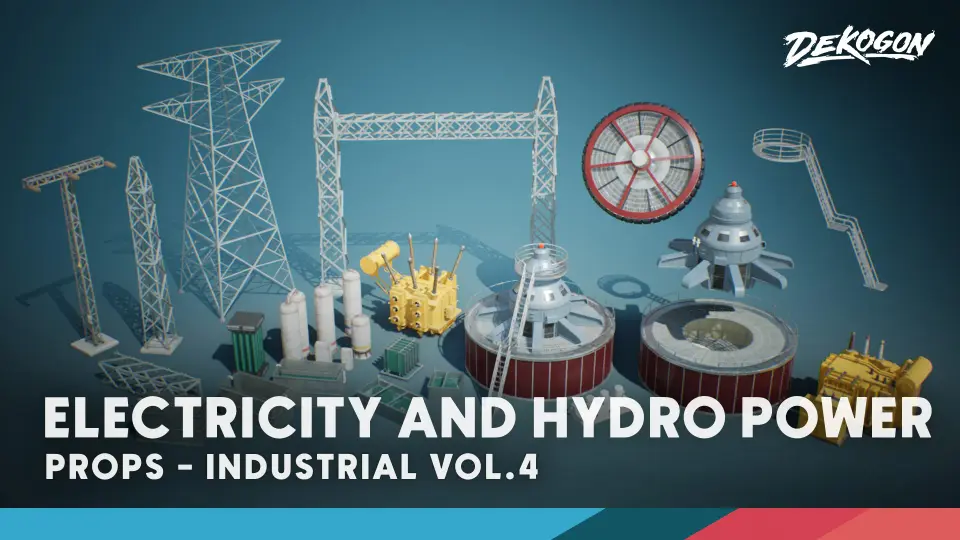
30 meshes, project materials, maps, and supporting scene elements form the core of Industrial VOL.4 - Electricity, Hydro, and Water Treatment. The package is assembled inside Unreal Engine and centers on industrial subjects tied to electricity, hydro systems, and water treatment, with props and structures that fit themes such as power, filtering, tanks, chemical handling, cleaning systems, towers, and liquid processing.
Everything pictured is included, and the project is not limited to geometry alone. Materials are part of the package, along with a setup that extends into post processing, a look up table, and a fake water shader for liquid containers. That combination gives the pack a more complete implementation footprint than a simple collection of static models, especially for scenes that need both hard-surface industrial forms and environmental surface behavior.
30 meshes for electricity, hydro, and water treatment scenes
The pack contains 30 meshes, each created for realistic AAA quality visuals, style, and budget. That emphasis places the set in a space where visual fidelity matters, but where assets also need to stay practical enough for game work. The subject matter points toward industrial pipelines, treatment infrastructure, electrical support elements, tanks, filters, and related equipment rather than loosely themed background dressing.
Fully detailed models from all sides also affect how the set can be used in a level. Assets that hold up from every angle are more flexible for close camera placement, walkable spaces, and layouts where players can move around props rather than only viewing them from a fixed direction. In an industrial environment, that matters for machinery rows, processing areas, liquid containers, and utility spaces where side and rear surfaces often remain visible.
The included themes reflected by the tags reinforce that direction. Power, electric, line, water, liquid, tank, filter, cleaner, chemical, tower, and industry all point toward infrastructure-heavy scenes instead of generalized factory decoration. The resource fits best where a project needs a connected visual language for treatment systems and utility equipment.
Master material setup and 2k+ texture workflow
Surface control is one of the stronger practical parts of the project. High quality and fidelity texture sets are included at 2k and above, supporting the pack's realistic visual target. That resolution range pairs with the stated AAA-style goal and gives the materials enough detail to carry close inspection across industrial surfaces, where wear, hard edges, painted metal, and utility labeling often need to read clearly.
A master material setup controls the majority of props and models. In production terms, that means many assets share a common material framework rather than relying on isolated one-off shader setups. Shared control is useful when a scene needs consistency across a larger group of industrial elements, especially if the goal is to adjust the look of multiple pieces without rebuilding materials asset by asset.
Additional controls for roughness, albedo, normals, and more extend that workflow. Those controls are directly relevant to implementation inside Unreal Engine because they allow scene-level tuning of how clean, worn, reflective, painted, or industrial a surface reads under different lighting conditions. For utility structures and process equipment, small roughness changes can significantly alter whether metal feels dry, coated, polished, or exposed to damp conditions. Albedo and normal adjustments also help maintain cohesion between props when assembling larger treatment or power-related spaces.
The textures also use channel packing for Roughness, Metalness, and Ambient Occlusion. That detail signals a workflow that is structured for efficiency as well as fidelity. In a practical environment-building context, channel-packed maps are useful for managing material data in a way that aligns with game production needs while still preserving key surface information.
Fake water shader setup and liquid containers
One of the more specific scene features in the pack is the fake water shader setup for liquid containers. That makes the resource more than a static collection of industrial props, because it includes a ready-made visual treatment for one of the most recognizable parts of hydro and water treatment spaces: visible contained liquid.
Liquid containers can otherwise feel incomplete if tanks and basins are modeled without any surface response inside them. A fake water shader gives those areas a distinct read and helps industrial equipment tied to treatment, storage, or chemical processing feel active rather than empty. Since the pack already points toward water, cleaning, filtering, and liquid handling, the shader setup supports the subject in a direct way.
This is also one of the places where the package's implementation focus becomes clearer. Instead of stopping at models and textures, it includes a material behavior intended for a specific use case. That can help when blocking out water treatment or hydro-related spaces that need immediate visual feedback in containers without building a separate liquid solution from scratch.
Realistic post process, look up table, and the test dynamic lighting scene
The project includes a realistic post process and look up table, along with a test dynamic lighting scene. Together, those pieces support presentation and setup inside Unreal Engine rather than leaving the assets entirely uncontextualized. A lighting test scene gives the pack a practical staging area for viewing how materials, mesh detail, and surface controls respond under dynamic light.
For industrial content, lighting is often where the readability of forms is won or lost. Pipes, tanks, structural edges, machinery housings, and utility enclosures depend on specular response and tonal separation to avoid flattening out. The included post process and LUT contribute to the intended realistic visual direction, while the dynamic lighting scene offers a direct way to inspect how those choices behave in motion or under changing light conditions.
This also complements the material controls already in the pack. Roughness, albedo, and normal adjustments become more meaningful when there is a scene context for evaluating them. Instead of treating the resource as a disconnected library of parts, the project provides a lighting and grading environment that helps users judge the final read of the industrial surfaces and forms.
Game-ready structure and custom-made branding
The package is optimized for games, which places an important limit on how its realism is meant to function. The goal is not realism in isolation, but realism shaped to fit interactive production. That aligns with the use of a master material setup, channel-packed texture data, and a focused asset count of 30 meshes rather than an undefined sprawl of disconnected content.
The project is also free of legal issues because all branding and labels are custom made by the studio. For industrial scenes, labels, decals, and branded markings can strongly affect believability. Having those elements custom made keeps the pack's visual identity in place without introducing the complications that can come from real-world marks or copied packaging.
That detail is easy to overlook, but it matters in implementation. Industrial environments often rely on signage, warnings, labels, and technical surface markings to feel convincing. When those touches are custom built for the pack, they can contribute to the realism of the scene while remaining part of a controlled art direction.
Where Industrial VOL.4 fits in an Unreal Engine workflow
Industrial VOL.4 - Electricity, Hydro, and Water Treatment is set up to handle a fairly specific type of environment work: industrial spaces where power systems, fluid handling, tanks, filtration, and treatment infrastructure need to share one visual language. Its contents support assembly at several levels at once, from the mesh layer to the material layer and into lighting and post process presentation.
The pack's practical value comes from how those pieces connect. Thirty fully detailed meshes provide the physical structure. The 2k+ texture sets and master materials shape the surface response. Channel-packed Roughness, Metalness, and Ambient Occlusion support the material workflow. The fake water shader gives liquid containers an immediate visual function. The realistic post process, look up table, and test dynamic lighting scene create a space to evaluate the whole setup inside Unreal Engine.
That leaves the project ready for scenes that need industrial treatment equipment and utility-focused visuals without separating props, materials, and look development into unrelated tasks.
 Buildings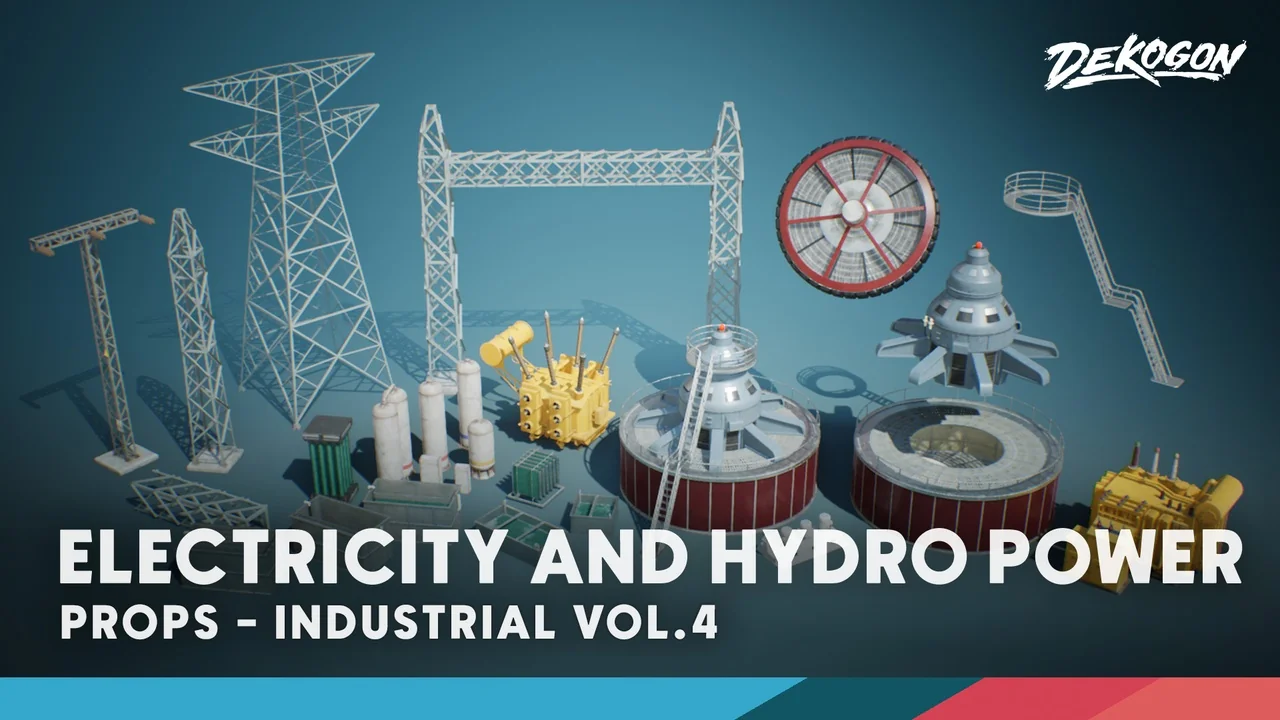
 Tables
 Buildings
 Variety