"1f00f67f9253451b"{"id":"1001279","slug":"ai-image-and-text-generator","title":"AI Image and Text Generator","category":"Procedural Systems","engine":"4.27 - 5.5","assetVersion":"Asset Version: 1.4","engineVersion":"Engine Version: 4.27 - 5.5","tag":"Procedural Systems","accent":"blue","visual":"mech","summary":"Integrate OpenAI technology into Unreal Engine with AI Image and Text Generator to produce text completions and save generated images directly to the Content Br","platform":"Unreal Engine","publishedAt":"2026-09-30T06:14:54.896Z","updatedAt":"2026-09-30T06:14:54.896Z","sourceNotes":[],"fileContents":[],"compatibility":["Unreal Engine","Asset Version: 1.4","Engine Version: 4.27 - 5.5"],"featuredImage":{"alt":"AI Image and Text Generator","src":"/wp-content/uploads/published/2026/09/9a776e22f234-55491afc-6d7b-407e-8169-c7ee2d141085-4cec02e41f.webp"},"hasDownloadLink":true,"downloads":0,"terms":[{"taxonomy":"category","slug":"procedural-systems-tools-and-plugins","name":"Procedural Systems"}],"galleryImages":[{"src":"/wp-content/uploads/published/2026/09/b9097a48d9b9-a86779c5-3df8-475a-998d-4cc04408abca-56d2e72fc5.webp","alt":"AI Image and Text Generator"},{"src":"/wp-content/uploads/published/2026/09/4433b139f923-2efb4d73-5f7b-4f48-91e9-c926565124b9-1879c437b0.webp","alt":"AI Image and Text Generator"},{"src":"/wp-content/uploads/published/2026/09/860006b48f1c-ff99f127-1c48-4002-8f42-3071329f2c0d-113a01177c.webp","alt":"AI Image and Text Generator"},{"src":"/wp-content/uploads/published/2026/09/5d9ce345c225-26318ca8-6351-4274-9e90-1b17e06ca3f1-4146a0c7aa.webp","alt":"AI Image and Text Generator"}],"accessPanel":{"kind":"resource","title":"Download this resource","eyebrow":"Free Download","message":"Log in or create a free account to start your download.","fileName":"AI Image and Text Generator.7z","safetyNote":"Resources are manually reviewed before listing to improve quality and reduce obvious risks.","actionLabel":"Download Free","resourceType":"Resource archive"},"contentHtml":"\u003ch2\u003eConnecting Unreal Engine to Open AI Technology\u003c/h2\u003e\n\u003cp\u003eIntegrating artificial intelligence into a real-time production environment alters how game teams iterate on creative assets. AI Image and Text Generator provides a direct bridge between project graphs and OpenAI technology, allowing developers to execute procedural workflows without leaving the editor. By routing network requests through engine-native logic, the plugin enables creators to leverage remote generative models for two fundamental content types: visual 2D outputs and natural language completions.\u003c/p\u003e\n\u003cp\u003eHandling procedural and generative workflows directly within an interactive engine eliminates constant switching between standalone browser interfaces and production software. Instead of generating materials or text externally, copying strings, and importing graphic files manually, the integration brings remote intelligence into the engine pipeline. This immediate link between prompt execution and asset generation establishes a unified workspace for experimental prototyping and dynamic data generation.\u003c/p\u003e \u003ch2\u003eImage Generation and Direct Content Browser Storage\u003c/h2\u003e\n\u003cp\u003eVisual exploration often demands rapid iteration across multiple concepts, texture ideas, and interface mockups. AI Image and Text Generator allows artists to request images directly through its integrated tools, handling the query and downloading the resulting visual data automatically. What sets this workflow apart from external web-based generators is the ability to commit outputs directly to the engine workspace.\u003c/p\u003e\n\u003cp\u003eGenerated images can be saved immediately to the Content Browser for later use. Storing generated graphics directly in the asset hierarchy converts temporary generative queries into persistent project assets. Once an image is saved in the Content Browser, it behaves like any standard imported asset:\u003c/p\u003e\n\u003cul\u003e \u003cli\u003eIt remains organized inside chosen project folders rather than floating in temporary local cache files.\u003c/li\u003e \u003cli\u003eIt can be directly assigned to UI elements, material networks, billboard sprites, or environment decals.\u003c/li\u003e \u003cli\u003eIt is immediately accessible across multiple maps, levels, and team members working within the shared project file structure.\u003c/li\u003e\n\u003c/ul\u003e\n\u003cp\u003eThis automated save pathway bypasses intermediate steps such as saving files to an operating system folder, navigating manual import dialogues, and re-encoding textures. Artists can produce, assess, and catalog multiple visual variations within the same environment where those images will ultimately be rendered.\u003c/p\u003e \u003ch2\u003eText Completions for Procedural and Narrative Systems\u003c/h2\u003e\n\u003cp\u003eBeyond visual imagery, the plugin handles text completions by communicating requests directly to OpenAI technology. Text generation serves a wide range of developmental roles, spanning from lore crafting and dialogue generation to procedural label creation and worldbuilding notes.\u003c/p\u003e\n\u003cp\u003eBecause text completions are generated in engine, developers can wire generative calls into dynamic gameplay systems or editor utility tools. A designer can assemble prompt structures, dispatch them through the service, and capture the returned completion strings to populate interactive elements. Whether generating contextual character remarks, crafting dynamic item descriptions, or filling in procedural objective boards, processing text completions within the project graph simplifies procedural generation pipelines that depend on adaptive linguistic data.\u003c/p\u003e \u003ch2\u003eBlueprint Subsystem Architecture and Implementation\u003c/h2\u003e\n\u003cp\u003eAt the engineering level, AI Image and Text Generator is implemented as a Blueprint Subsystem. Structuring the tool around a subsystem provides distinct advantages for both clean architecture and technical accessibility across a project:\u003c/p\u003e\n\u003cp\u003eSubsystems in Unreal Engine manage their own lifecycles automatically, instantiating when their operating context initializes and clearing memory when that context shuts down. Because the generator functions as a Blueprint Subsystem, developers do not need to drop custom manager actors into every scene or build convoluted wrapper objects to establish a line of communication with the remote service. Blueprint graphs can call the subsystem functions directly from virtually any execution context, whether running an Editor Utility Widget, processing an actor component script, or orchestrating game mode logic.\u003c/p\u003e\n\u003cp\u003eThis accessibility lowers the barrier for technical artists and game designers who work primarily in visual scripting. Complex network communications, request formation, and response parsing are condensed behind straightforward Blueprint nodes, making generative features accessible without requiring dedicated C++ network plumbing for every single project implementation.\u003c/p\u003e \u003ch2\u003eAccount Configuration and Service Parameters\u003c/h2\u003e\n\u003cp\u003eDeploying the plugin in an active production environment involves specific external requirements. Operational communication with the underlying intelligence systems requires the user to establish a dedicated account on the OpenAI platform. Because the plugin interfaces directly with this external infrastructure, API access managed under the developer's platform account serves as the authentication layer for all image generation and text completion tasks.\u003c/p\u003e\n\u003cp\u003eThe plugin operates purely as a third-party bridge; it is not affiliated with or endorsed by OpenAI. Teams planning to integrate this tool into their production or pre-production routines should account for platform connectivity prerequisites and ensure project systems adhere to external operational guidelines when executing procedural requests.\u003c/p\u003e \u003ch2\u003eProduction Utility in Modern Pipelines\u003c/h2\u003e\n\u003cp\u003eAI Image and Text Generator offers a compact, functional pipeline for studios seeking to integrate procedural intelligence into their daily workflows. Combining text completions with direct-to-Content Browser image saving under a Blueprint Subsystem creates a flexible environment for prototyping, narrative drafting, and rapid asset generation directly inside the engine environment.\u003c/p\u003e\n\n\u003ch2\u003eRelated Resources Worth Checking\u003c/h2\u003e\n\u003cul\u003e\n\u003cli\u003e\u003ca href=\"https://3dcghub.com/rodinbridge-unreal-engine-add-on/\" title=\"RodinBridge - Unreal Engine Add-on\"\u003eRodinBridge - Unreal Engine Add-on\u003c/a\u003e\u003c/li\u003e\n\u003cli\u003e\u003ca href=\"https://3dcghub.com/runtime-speech-recognizer-real-time-offline-ai/\" title=\"Runtime Speech Recognizer (Real-Time, Offline, AI)\"\u003eRuntime Speech Recognizer (Real-Time, Offline, AI)\u003c/a\u003e\u003c/li\u003e\n\u003cli\u003e\u003ca href=\"https://3dcghub.com/procedural-city-generator-omniscape/\" title=\"Procedural City Generator – OmniScape\"\u003eProcedural City Generator – OmniScape\u003c/a\u003e\u003c/li\u003e\n\u003cli\u003e\u003ca href=\"https://3dcghub.com/ultimate-engine-copilot-formerly-ultimate-blueprint-generator/\" title=\"Ultimate Engine CoPilot (formerly Ultimate Blueprint Generator)\"\u003eUltimate Engine CoPilot (formerly Ultimate Blueprint Generator)\u003c/a\u003e\u003c/li\u003e\n\u003cli\u003e\u003ca href=\"https://3dcghub.com/c-generator/\" title=\"C++ Generator\"\u003eC++ Generator\u003c/a\u003e\u003c/li\u003e\n\u003c/ul\u003e","contentTextLength":6177,"navigation":{"current":2,"total":3222,"previous":{"id":"1001280","slug":"maze-generator","title":"Maze Generator","category":"Procedural Systems","platform":"Unreal Engine","updatedAt":"2026-09-30T06:16:46.774Z"},"next":{"id":"1001278","slug":"netobject","title":"NetObject","category":"Network \u0026 Multiplayer","platform":"Unreal Engine","updatedAt":"2026-09-30T06:13:08.529Z"}},"relatedResources":[{"id":"15349","slug":"rodinbridge-unreal-engine-add-on","title":"RodinBridge - Unreal Engine Add-on","category":"Procedural Systems","engine":"5.6 - 5.7","assetVersion":"Engine version: 5.6 - 5.7","engineVersion":"Asset Version:2.2.0","tag":"Procedural Systems","accent":"blue","visual":"mech","summary":"RodinBridge integrates advanced generative AI technology into the Unreal Engine environment. This add-on allows creators to transform simple text or images into realistic, CG-friendly 3D models with photorealistic materials.","platform":"Unreal Engine","publishedAt":"2026-03-12T08:42:41.000Z","updatedAt":"2026-04-19T15:44:49.000Z","sourceNotes":[],"fileContents":[],"compatibility":["Unreal Engine","Engine version: 5.6 - 5.7","Asset Version: 2.2.0"],"featuredImage":{"alt":"RodinBridge - Unreal Engine Add-on","src":"https://3dcghub.com/wp-content/uploads/2026/03/33842b32-d11e-4c78-88d7-17ca976d07f0.webp"},"hasDownloadLink":true,"downloads":0},{"id":"1001280","slug":"maze-generator","title":"Maze Generator","category":"Procedural Systems","engine":"4.27 - 5.6","assetVersion":"Asset Version: 1.0","engineVersion":"Engine Version: 4.27 - 5.6","tag":"Procedural Systems","accent":"blue","visual":"mech","summary":"Generate perfect procedural mazes of any size with Maze Generator, featuring multiple algorithms and guaranteed path connectivity without loops.","platform":"Unreal Engine","publishedAt":"2026-09-30T06:16:46.774Z","updatedAt":"2026-09-30T06:16:46.774Z","sourceNotes":[],"fileContents":[],"compatibility":["Unreal Engine","Asset Version: 1.0","Engine Version: 4.27 - 5.6"],"featuredImage":{"alt":"Maze Generator","src":"/wp-content/uploads/published/2026/09/e60c608e211b-75285b83-2b22-4316-a837-54b19820b8c8-c733fd47ed.webp"},"hasDownloadLink":true,"downloads":0},{"id":"14519","slug":"runtime-speech-recognizer-real-time-offline-ai","title":"Runtime Speech Recognizer (Real-Time, Offline, AI)","category":"Engine Tools","engine":"4.27 - 5.8","assetVersion":"Asset Version:1.0","engineVersion":"Engine version: 4.27 - 5.8","tag":"Engine Tools","accent":"blue","visual":"city","summary":"Enhance your project with Runtime Speech Recognizer (Real-Time, Offline, AI), a plugin that enables high-performance voice commands and speech-to-text without an internet connection. Powered by OpenAI Whisper, it supports over 95 languages and features GPU...","platform":"Unreal Engine","publishedAt":"2026-03-11T18:21:42.000Z","updatedAt":"2026-09-30T02:57:30.475Z","sourceNotes":[],"fileContents":[],"compatibility":["Unreal Engine","Asset Version:1.0","Engine version: 4.27 - 5.8"],"featuredImage":{"alt":"Runtime Speech Recognizer (Real-Time, Offline, AI)","src":"https://3dcghub.com/wp-content/uploads/2026/03/865b5e7a-61c2-4de8-83da-c2cc3aa6c0a4.webp"},"hasDownloadLink":true,"downloads":1}]}
Procedural Systems
AI Image and Text Generator
Integrate OpenAI technology into Unreal Engine with AI Image and Text Generator to produce text completions and save generated images directly to the Content Br
Integrating artificial intelligence into a real-time production environment alters how game teams iterate on creative assets. AI Image and Text Generator provides a direct bridge between project graphs and OpenAI technology, allowing developers to execute procedural workflows without leaving the editor. By routing network requests through engine-native logic, the plugin enables creators to leverage remote generative models for two fundamental content types: visual 2D outputs and natural language completions.
Handling procedural and generative workflows directly within an interactive engine eliminates constant switching between standalone browser interfaces and production software. Instead of generating materials or text externally, copying strings, and importing graphic files manually, the integration brings remote intelligence into the engine pipeline. This immediate link between prompt execution and asset generation establishes a unified workspace for experimental prototyping and dynamic data generation.
Image Generation and Direct Content Browser Storage
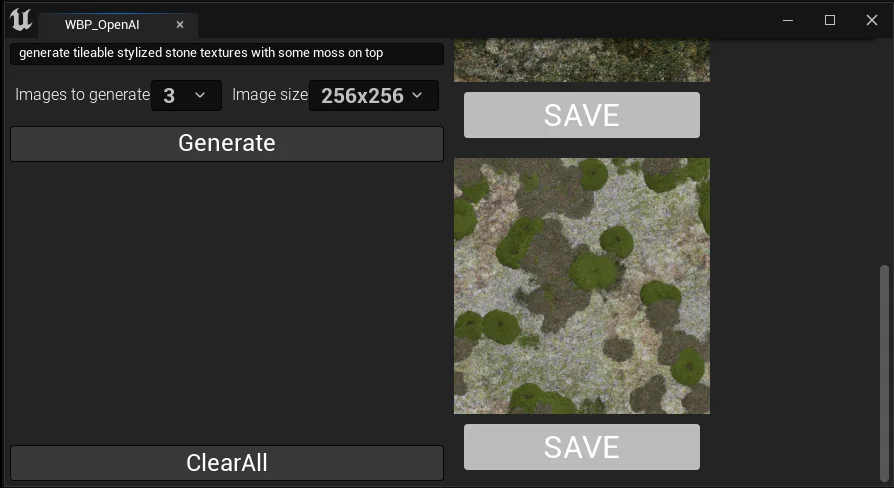
Visual exploration often demands rapid iteration across multiple concepts, texture ideas, and interface mockups. AI Image and Text Generator allows artists to request images directly through its integrated tools, handling the query and downloading the resulting visual data automatically. What sets this workflow apart from external web-based generators is the ability to commit outputs directly to the engine workspace.
Generated images can be saved immediately to the Content Browser for later use. Storing generated graphics directly in the asset hierarchy converts temporary generative queries into persistent project assets. Once an image is saved in the Content Browser, it behaves like any standard imported asset:
It remains organized inside chosen project folders rather than floating in temporary local cache files.
It can be directly assigned to UI elements, material networks, billboard sprites, or environment decals.
It is immediately accessible across multiple maps, levels, and team members working within the shared project file structure.
This automated save pathway bypasses intermediate steps such as saving files to an operating system folder, navigating manual import dialogues, and re-encoding textures. Artists can produce, assess, and catalog multiple visual variations within the same environment where those images will ultimately be rendered.
Text Completions for Procedural and Narrative Systems
Beyond visual imagery, the plugin handles text completions by communicating requests directly to OpenAI technology. Text generation serves a wide range of developmental roles, spanning from lore crafting and dialogue generation to procedural label creation and worldbuilding notes.
Because text completions are generated in engine, developers can wire generative calls into dynamic gameplay systems or editor utility tools. A designer can assemble prompt structures, dispatch them through the service, and capture the returned completion strings to populate interactive elements. Whether generating contextual character remarks, crafting dynamic item descriptions, or filling in procedural objective boards, processing text completions within the project graph simplifies procedural generation pipelines that depend on adaptive linguistic data.
Blueprint Subsystem Architecture and Implementation
At the engineering level, AI Image and Text Generator is implemented as a Blueprint Subsystem. Structuring the tool around a subsystem provides distinct advantages for both clean architecture and technical accessibility across a project:
Subsystems in Unreal Engine manage their own lifecycles automatically, instantiating when their operating context initializes and clearing memory when that context shuts down. Because the generator functions as a Blueprint Subsystem, developers do not need to drop custom manager actors into every scene or build convoluted wrapper objects to establish a line of communication with the remote service. Blueprint graphs can call the subsystem functions directly from virtually any execution context, whether running an Editor Utility Widget, processing an actor component script, or orchestrating game mode logic.
This accessibility lowers the barrier for technical artists and game designers who work primarily in visual scripting. Complex network communications, request formation, and response parsing are condensed behind straightforward Blueprint nodes, making generative features accessible without requiring dedicated C++ network plumbing for every single project implementation.
Account Configuration and Service Parameters
Deploying the plugin in an active production environment involves specific external requirements. Operational communication with the underlying intelligence systems requires the user to establish a dedicated account on the OpenAI platform. Because the plugin interfaces directly with this external infrastructure, API access managed under the developer's platform account serves as the authentication layer for all image generation and text completion tasks.
The plugin operates purely as a third-party bridge; it is not affiliated with or endorsed by OpenAI. Teams planning to integrate this tool into their production or pre-production routines should account for platform connectivity prerequisites and ensure project systems adhere to external operational guidelines when executing procedural requests.
Production Utility in Modern Pipelines
AI Image and Text Generator offers a compact, functional pipeline for studios seeking to integrate procedural intelligence into their daily workflows. Combining text completions with direct-to-Content Browser image saving under a Blueprint Subsystem creates a flexible environment for prototyping, narrative drafting, and rapid asset generation directly inside the engine environment.
 Procedural Systems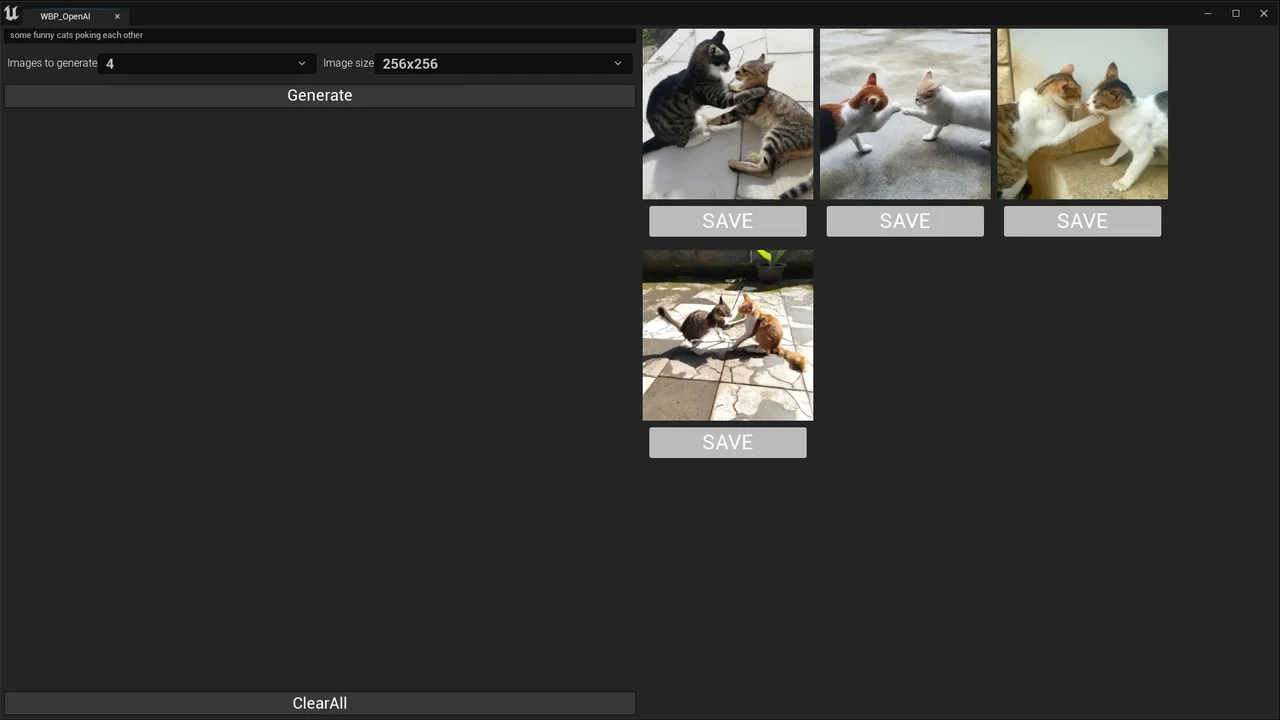
 Procedural Systems
 Procedural Systems
 Engine Tools