"1f00f67f9253451b"{"id":"1001280","slug":"maze-generator","title":"Maze Generator","category":"Procedural Systems","engine":"4.27 - 5.6","assetVersion":"Asset Version: 1.0","engineVersion":"Engine Version: 4.27 - 5.6","tag":"Procedural Systems","accent":"blue","visual":"mech","summary":"Generate perfect procedural mazes of any size with Maze Generator, featuring multiple algorithms and guaranteed path connectivity without loops.","platform":"Unreal Engine","publishedAt":"2026-09-30T06:16:46.774Z","updatedAt":"2026-09-30T06:16:46.774Z","sourceNotes":[],"fileContents":[],"compatibility":["Unreal Engine","Asset Version: 1.0","Engine Version: 4.27 - 5.6"],"featuredImage":{"alt":"Maze Generator","src":"/wp-content/uploads/published/2026/09/e60c608e211b-75285b83-2b22-4316-a837-54b19820b8c8-c733fd47ed.webp"},"hasDownloadLink":true,"downloads":0,"terms":[{"taxonomy":"category","slug":"procedural-systems-tools-and-plugins","name":"Procedural Systems"}],"galleryImages":[{"src":"/wp-content/uploads/published/2026/09/412b0f0d0026-817dc690-75da-4418-a347-43c3675b9000-2b10931d21.webp","alt":"Maze Generator"},{"src":"/wp-content/uploads/published/2026/09/081e237d231a-7ae7389f-c802-45ef-9c8c-e40141ba1537-ad4ed0747c.webp","alt":"Maze Generator"},{"src":"/wp-content/uploads/published/2026/09/74312bc9a50d-b8748301-a4b4-46d3-81eb-da3cfa6d7bf4-66838d1827.webp","alt":"Maze Generator"},{"src":"/wp-content/uploads/published/2026/09/054f9ffa4108-6f1ba59b-5a1f-42bf-8b52-f1c2a9302d32-4b221ae81f.webp","alt":"Maze Generator"},{"src":"/wp-content/uploads/published/2026/09/0050bc089201-14bee770-da23-4d78-a770-c87370eb1d94-1d0c053677.webp","alt":"Maze Generator"}],"accessPanel":{"kind":"resource","title":"Download this resource","eyebrow":"Free Download","message":"Log in or create a free account to start your download.","fileName":"Maze Generator.7z","safetyNote":"Resources are manually reviewed before listing to improve quality and reduce obvious risks.","actionLabel":"Download Free","resourceType":"Resource archive"},"contentHtml":"\u003ch2\u003eProcedural Maze Setup and Layout Generation\u003c/h2\u003e\u003cp\u003eSetting up spatial logic for labyrinthine environments often requires balancing pure randomness with strict architectural rules. Maze Generator approaches this through procedural generation, delivering configurations based on defined mathematical principles rather than static layout work. By utilizing procedural techniques, the tool creates mazes of any size while providing systematic controls over the overall setup.\u003c/p\u003e\u003cp\u003eThe setup process relies on programmatic generation routines that can construct environments dynamically. Instead of relying on pre-authored geometry or fixed grid boundaries, the system handles arbitrary dimensions, allowing projects to instantiate small localized puzzles, sprawling navigational challenges, or expansive multi-room structures. The automated pipeline takes the foundational layout parameters and executes the structural logic directly, ensuring that the boundaries, passages, and open corridors conform strictly to the intended scale.\u003c/p\u003e\u003ch2\u003eThe Structural Anatomy of a Perfect Maze\u003c/h2\u003e\u003cp\u003eA critical characteristic of the layouts produced by Maze Generator is adherence to the standard of a perfect maze. In topological and geometric terms, a perfect maze possesses very specific structural constraints that distinguish it from standard labyrinth designs. A perfect maze is strictly defined as one without any loops, without closed circuits, and without any inaccessible areas.\u003c/p\u003e\u003cp\u003eUnderstanding these three constraints reveals how the underlying network operates:\u003c/p\u003e\u003cul\u003e\u003cli\u003e\u003cstrong\u003eNo loops:\u003c/strong\u003e Corridors never circle back onto themselves. In systems containing loops, alternative paths can rejoin an earlier passage, creating multiple cyclical routes through the space. In this generator, pathways branch outward without recombining, eliminating redundant circular navigation.\u003c/li\u003e\u003cli\u003e\u003cstrong\u003eNo closed circuits:\u003c/strong\u003e Because pathways never close into isolated circular rings, navigational logic remains clean and predictable. Every corridor either leads deeper toward a junction or terminates at a dead end, preventing looping paths from trapping movement patterns.\u003c/li\u003e\u003cli\u003e\u003cstrong\u003eNo inaccessible areas:\u003c/strong\u003e Every segment of the generated grid connects back to the broader network. There are no isolated islands, walled-off cells, or orphan rooms cut off from the main passages. Every single corridor can be physically reached from every other corridor.\u003c/li\u003e\u003c/ul\u003e\u003cp\u003eBecause these three rules govern every iteration, the generated maze effectively forms a single mathematical spanning tree across the chosen grid space. This topological integrity guarantees that navigation follows unambiguous branching logic across every sector of the map.\u003c/p\u003e\u003ch2\u003eMultiple Generation Algorithms Across Varying Dimensions\u003c/h2\u003e\u003cp\u003eDifferent procedural routines produce distinctly different aesthetic and navigational qualities. Maze Generator incorporates different generation algorithms to accommodate distinct design requirements, giving developers alternative methods for carving out walkable space across their designated dimensions.\u003c/p\u003e\u003cp\u003eAlgorithmic variation directly influences how branching structures manifest throughout the grid. Certain procedural algorithms favor long, winding corridors with fewer junctions, creating extended traversal routes that stretch across the perimeter. Other generation routines yield dense, highly branched networks full of frequent intersections and short, abrupt dead ends. Because the system includes multiple generation algorithms, developers can select an approach that aligns with their desired pacing, sightlines, and structural complexity.\u003c/p\u003e\u003cp\u003eAlso, these varying algorithms operate irrespective of scale. The generator supports mazes of any size, scaling its mathematical routines to fill compact puzzle chambers or expansive outdoor hedge layouts with equal reliability. As the dimensions increase, the chosen algorithm continues enforcing structural rules uniformly across the expanded cell count, ensuring consistency across small rooms and massive game spaces alike.\u003c/p\u003e\u003ch2\u003eGuaranteed Path Connectivity Between Any Two Points\u003c/h2\u003e\u003cp\u003eOne of the primary gameplay and practical advantages of a perfect maze is guaranteed traversal. In Maze Generator, you can build a path connecting any two points across the entire structure. This functionality is an inherent byproduct of the topological rules governing the generation process.\u003c/p\u003e\u003cp\u003eBecause the generated maze contains zero closed loops and zero inaccessible areas, exactly one distinct, non-looping path exists between any two arbitrarily selected points within the grid. Whether choosing opposing corners, central intersections, or scattered objective coordinates, the system ensures a valid pathway connects the target locations. This eliminates common pitfalls encountered in purely random generation systems, such as blocked progression routes, severed navigation paths, or disconnected sub-regions.\u003c/p\u003e\u003cp\u003eIn practical implementation, this reliable connectivity allows level designers to anchor gameplay objectives with certainty:\u003c/p\u003e\u003cul\u003e\u003cli\u003eEntry points and exit thresholds can be placed anywhere along the boundary or interior, confident that a traversable solution exists between them.\u003c/li\u003e\u003cli\u003eKey items, objective nodes, or checkpoints can be scattered throughout arbitrary coordinates without manual verification of accessibility.\u003c/li\u003e\u003cli\u003ePacing and traversal distances can be accurately evaluated because path progression cannot be short-circuited by accidental bypass loops.\u003c/li\u003e\u003c/ul\u003e\u003ch2\u003eProcedural Randomness in Production Workflows\u003c/h2\u003e\u003cp\u003eRandomness without structure often introduces production headaches, requiring secondary validation passes to ensure that play spaces are functional. Maze Generator resolves this friction by integrating procedural rules directly into the random generation workflow. The randomization operates within strict algorithmic parameters, producing fresh layouts on demand while ensuring structural validity every time.\u003c/p\u003e\u003cp\u003eThis level of procedural consistency makes the generator suitable for iterative level design and dynamic in-game scenarios. When prototyping, level designers can rapidly test different generation algorithms across various scales, discovering which density and branching pattern best suits player movement. In live gameplay setups, random generation can be triggered to provide fresh spatial layouts that remain reliably solvable and fully navigable.\u003c/p\u003e\u003cp\u003eBy unifying arbitrary sizing, algorithmic variety, and strict perfect-maze topology, Maze Generator provides a direct solution for any setup requiring structured, loop-free spatial networks.\u003c/p\u003e\n\n\u003ch2\u003eContinue Browsing Similar Packs\u003c/h2\u003e\n\u003cul\u003e\n\u003cli\u003e\u003ca href=\"https://3dcghub.com/ai-image-and-text-generator/\" title=\"AI Image and Text Generator\"\u003eAI Image and Text Generator\u003c/a\u003e\u003c/li\u003e\n\u003cli\u003e\u003ca href=\"https://3dcghub.com/procedural-city-generator-omniscape/\" title=\"Procedural City Generator – OmniScape\"\u003eProcedural City Generator – OmniScape\u003c/a\u003e\u003c/li\u003e\n\u003cli\u003e\u003ca href=\"https://3dcghub.com/crazy-ivy-realistic-ivy-generator-vine-plugin-grow-procedural-plants-in-editor/\" title=\"Crazy Ivy Realistic Ivy Generator Vine Plugin - Grow Procedural Plants in Editor\"\u003eCrazy Ivy Realistic Ivy Generator Vine Plugin - Grow Procedural Plants in Editor\u003c/a\u003e\u003c/li\u003e\n\u003cli\u003e\u003ca href=\"https://3dcghub.com/procedural-nature-generator/\" title=\"Procedural Nature Generator\"\u003eProcedural Nature Generator\u003c/a\u003e\u003c/li\u003e\n\u003cli\u003e\u003ca href=\"https://3dcghub.com/procedural-terrain-generator-v2/\" title=\"Procedural Terrain Generator v2\"\u003eProcedural Terrain Generator v2\u003c/a\u003e\u003c/li\u003e\n\u003c/ul\u003e","contentTextLength":6727,"navigation":{"current":1,"total":3222,"next":{"id":"1001279","slug":"ai-image-and-text-generator","title":"AI Image and Text Generator","category":"Procedural Systems","platform":"Unreal Engine","updatedAt":"2026-09-30T06:14:54.896Z"}},"relatedResources":[{"id":"1001279","slug":"ai-image-and-text-generator","title":"AI Image and Text Generator","category":"Procedural Systems","engine":"4.27 - 5.5","assetVersion":"Asset Version: 1.4","engineVersion":"Engine Version: 4.27 - 5.5","tag":"Procedural Systems","accent":"blue","visual":"mech","summary":"Integrate OpenAI technology into Unreal Engine with AI Image and Text Generator to produce text completions and save generated images directly to the Content Br","platform":"Unreal Engine","publishedAt":"2026-09-30T06:14:54.896Z","updatedAt":"2026-09-30T06:14:54.896Z","sourceNotes":[],"fileContents":[],"compatibility":["Unreal Engine","Asset Version: 1.4","Engine Version: 4.27 - 5.5"],"featuredImage":{"alt":"AI Image and Text Generator","src":"/wp-content/uploads/published/2026/09/9a776e22f234-55491afc-6d7b-407e-8169-c7ee2d141085-4cec02e41f.webp"},"hasDownloadLink":true,"downloads":0},{"id":"1001121","slug":"procedural-city-generator-omniscape","title":"Procedural City Generator – OmniScape","category":"Procedural Systems","engine":"5.7 - 5.8","assetVersion":"Asset Version: 2.0","engineVersion":"Engine Version: 5.7 - 5.8","tag":"Procedural Systems","accent":"blue","visual":"city","summary":"Generate cities, towns, and ruins from one Unreal Engine panel with OmniScape. Live preview, five layout patterns, road hierarchies, and production-ready preset","platform":"Unreal Engine","publishedAt":"2026-09-07T13:02:45.053Z","updatedAt":"2026-09-07T13:02:45.053Z","sourceNotes":[],"fileContents":[],"compatibility":["Unreal Engine","Asset Version: 2.0","Engine Version: 5.7 - 5.8"],"featuredImage":{"alt":"Procedural City Generator – OmniScape","src":"/wp-content/uploads/published/2026/09/ebdcb6552420-0ec43ed5-0d32-4263-921b-c32c52d60e76-ce214ea98e.webp"},"hasDownloadLink":true,"downloads":0},{"id":"15225","slug":"crazy-ivy-realistic-ivy-generator-vine-plugin-grow-procedural-plants-in-editor","title":"Crazy Ivy Realistic Ivy Generator Vine Plugin - Grow Procedural Plants in Editor","category":"Procedural Systems","engine":"5.0 - 5.4","assetVersion":"Engine version: 5.0 - 5.4","engineVersion":"4.27","tag":"Procedural Systems","accent":"blue","visual":"animation","summary":"Crazy Ivy is a powerful procedural tool designed to grow realistic ivy directly within your editor. By automatically detecting static meshes, this plugin allows for the creation of unique, optimized vegetation systems.","platform":"Unreal Engine","publishedAt":"2026-03-12T08:22:47.000Z","updatedAt":"2026-04-19T15:44:52.000Z","sourceNotes":[],"fileContents":[],"compatibility":["Unreal Engine","Engine version: 5.0 - 5.4"],"featuredImage":{"alt":"Crazy Ivy Realistic Ivy Generator Vine Plugin - Grow Procedural Plants in Editor","src":"https://3dcghub.com/wp-content/uploads/2026/03/82ad95ba-cc8c-422c-b4cc-dff51937564d.webp"},"hasDownloadLink":true,"downloads":0}]}
Procedural Systems
Maze Generator
Generate perfect procedural mazes of any size with Maze Generator, featuring multiple algorithms and guaranteed path connectivity without loops.
Setting up spatial logic for labyrinthine environments often requires balancing pure randomness with strict architectural rules. Maze Generator approaches this through procedural generation, delivering configurations based on defined mathematical principles rather than static layout work. By utilizing procedural techniques, the tool creates mazes of any size while providing systematic controls over the overall setup.
The setup process relies on programmatic generation routines that can construct environments dynamically. Instead of relying on pre-authored geometry or fixed grid boundaries, the system handles arbitrary dimensions, allowing projects to instantiate small localized puzzles, sprawling navigational challenges, or expansive multi-room structures. The automated pipeline takes the foundational layout parameters and executes the structural logic directly, ensuring that the boundaries, passages, and open corridors conform strictly to the intended scale.
The Structural Anatomy of a Perfect Maze
A critical characteristic of the layouts produced by Maze Generator is adherence to the standard of a perfect maze. In topological and geometric terms, a perfect maze possesses very specific structural constraints that distinguish it from standard labyrinth designs. A perfect maze is strictly defined as one without any loops, without closed circuits, and without any inaccessible areas.
Understanding these three constraints reveals how the underlying network operates:
No loops: Corridors never circle back onto themselves. In systems containing loops, alternative paths can rejoin an earlier passage, creating multiple cyclical routes through the space. In this generator, pathways branch outward without recombining, eliminating redundant circular navigation.
No closed circuits: Because pathways never close into isolated circular rings, navigational logic remains clean and predictable. Every corridor either leads deeper toward a junction or terminates at a dead end, preventing looping paths from trapping movement patterns.
No inaccessible areas: Every segment of the generated grid connects back to the broader network. There are no isolated islands, walled-off cells, or orphan rooms cut off from the main passages. Every single corridor can be physically reached from every other corridor.
Because these three rules govern every iteration, the generated maze effectively forms a single mathematical spanning tree across the chosen grid space. This topological integrity guarantees that navigation follows unambiguous branching logic across every sector of the map.
Multiple Generation Algorithms Across Varying Dimensions
Different procedural routines produce distinctly different aesthetic and navigational qualities. Maze Generator incorporates different generation algorithms to accommodate distinct design requirements, giving developers alternative methods for carving out walkable space across their designated dimensions.
Algorithmic variation directly influences how branching structures manifest throughout the grid. Certain procedural algorithms favor long, winding corridors with fewer junctions, creating extended traversal routes that stretch across the perimeter. Other generation routines yield dense, highly branched networks full of frequent intersections and short, abrupt dead ends. Because the system includes multiple generation algorithms, developers can select an approach that aligns with their desired pacing, sightlines, and structural complexity.
Also, these varying algorithms operate irrespective of scale. The generator supports mazes of any size, scaling its mathematical routines to fill compact puzzle chambers or expansive outdoor hedge layouts with equal reliability. As the dimensions increase, the chosen algorithm continues enforcing structural rules uniformly across the expanded cell count, ensuring consistency across small rooms and massive game spaces alike.
Guaranteed Path Connectivity Between Any Two Points
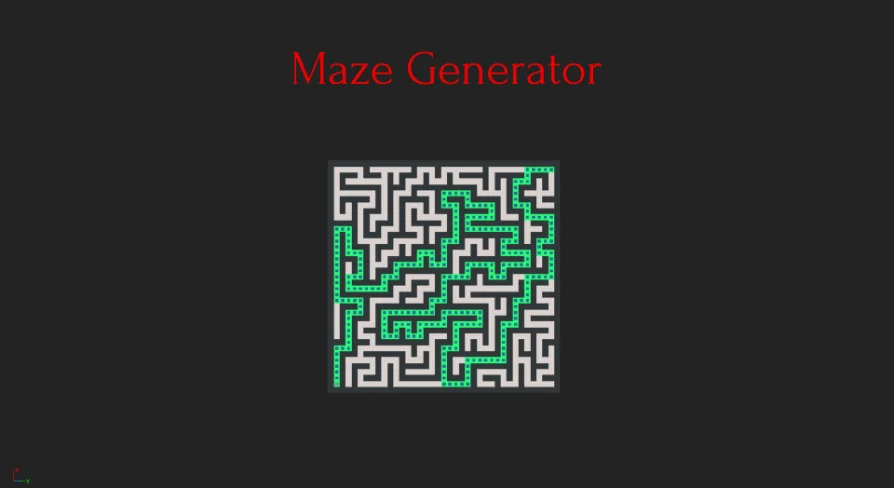
One of the primary gameplay and practical advantages of a perfect maze is guaranteed traversal. In Maze Generator, you can build a path connecting any two points across the entire structure. This functionality is an inherent byproduct of the topological rules governing the generation process.
Because the generated maze contains zero closed loops and zero inaccessible areas, exactly one distinct, non-looping path exists between any two arbitrarily selected points within the grid. Whether choosing opposing corners, central intersections, or scattered objective coordinates, the system ensures a valid pathway connects the target locations. This eliminates common pitfalls encountered in purely random generation systems, such as blocked progression routes, severed navigation paths, or disconnected sub-regions.
In practical implementation, this reliable connectivity allows level designers to anchor gameplay objectives with certainty:
Entry points and exit thresholds can be placed anywhere along the boundary or interior, confident that a traversable solution exists between them.
Key items, objective nodes, or checkpoints can be scattered throughout arbitrary coordinates without manual verification of accessibility.
Pacing and traversal distances can be accurately evaluated because path progression cannot be short-circuited by accidental bypass loops.
Procedural Randomness in Production Workflows
Randomness without structure often introduces production headaches, requiring secondary validation passes to ensure that play spaces are functional. Maze Generator resolves this friction by integrating procedural rules directly into the random generation workflow. The randomization operates within strict algorithmic parameters, producing fresh layouts on demand while ensuring structural validity every time.
This level of procedural consistency makes the generator suitable for iterative level design and dynamic in-game scenarios. When prototyping, level designers can rapidly test different generation algorithms across various scales, discovering which density and branching pattern best suits player movement. In live gameplay setups, random generation can be triggered to provide fresh spatial layouts that remain reliably solvable and fully navigable.
By unifying arbitrary sizing, algorithmic variety, and strict perfect-maze topology, Maze Generator provides a direct solution for any setup requiring structured, loop-free spatial networks.
 Procedural Systems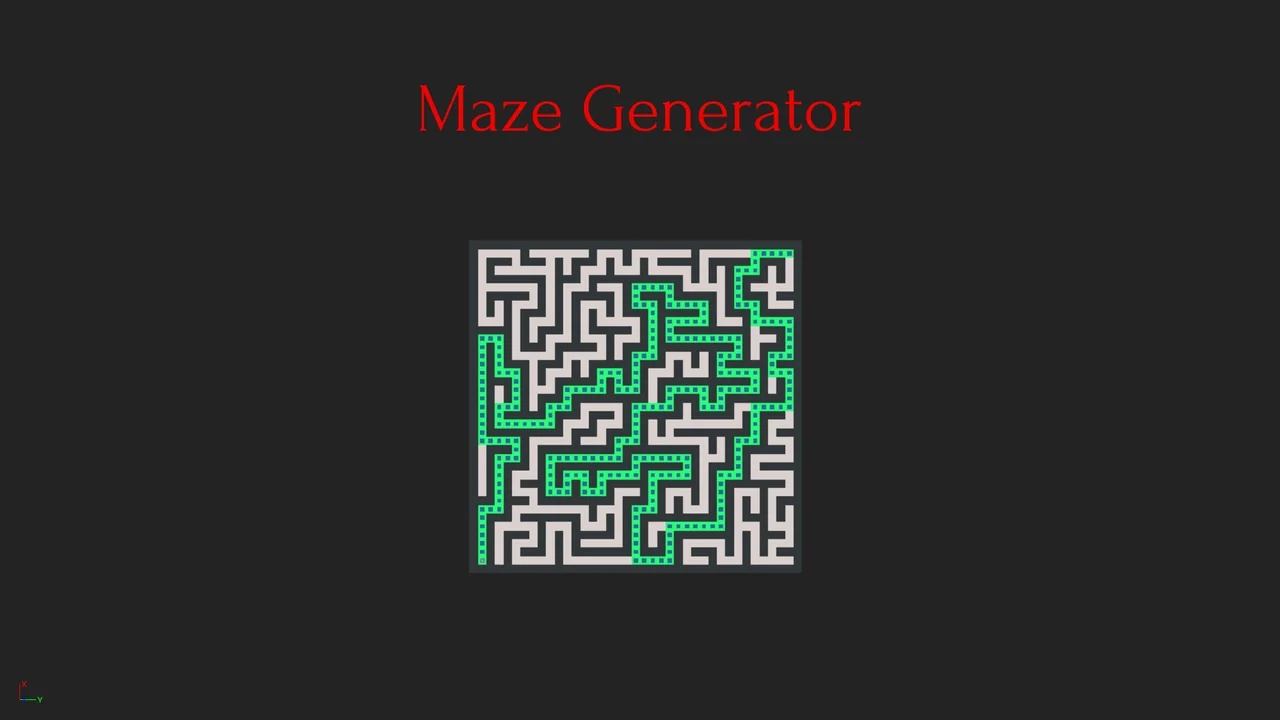
 Procedural Systems
 Procedural Systems
 Procedural Systems