"a19e0535960bd083"{"id":"1002038","slug":"generic-guard-system","title":"Generic Guard System","category":"Procedural Systems","engine":"4.25+,5.0+","assetVersion":"","engineVersion":"Engine Version: 4.25+,5.0+","tag":"Procedural Systems","accent":"blue","visual":"mech","summary":"Generic Guard System provides an extendable, customizable Blueprint framework for building stealth and AI guard behaviors across diverse game types.","platform":"Unreal Engine","publishedAt":"2026-10-26T14:20:28.057Z","updatedAt":"2026-10-26T14:20:28.057Z","sourceNotes":[],"fileContents":[],"compatibility":["Unreal Engine","Engine Version: 4.25+,5.0+"],"featuredImage":{"alt":"Generic Guard System","src":"/wp-content/uploads/published/2026/10/2d6a972ad1d1-181b38de-b05f-4b86-aeb1-2502f9959502-43c0b72433.webp"},"hasDownloadLink":true,"downloads":0,"terms":[{"taxonomy":"category","slug":"procedural-systems-tools-and-plugins","name":"Procedural Systems"}],"galleryImages":[{"src":"/wp-content/uploads/published/2026/10/64033f381b7c-d3fd8cc4-5939-42da-bc96-e1d90a6d7503-d658a9b183.webp","alt":"Generic Guard System"}],"accessPanel":{"kind":"resource","title":"Download this resource","eyebrow":"Free Download","message":"Log in or create a free account to start your download.","fileName":"Generic Guard System.7z","safetyNote":"Resources are manually reviewed before listing to improve quality and reduce obvious risks.","actionLabel":"Download Free","resourceType":"Resource archive"},"contentHtml":"\u003ch2\u003eHandling Stealth and Guard Encounters Across Different Game Styles\u003c/h2\u003e\n\u003cp\u003eStealth and security encounters require consistent, responsive behavior to feel convincing in real-time scenarios. Whether a project features a top-down tactical perspective, a first-person infiltration setup, or a third-person adventure layout, the core requirements for an adversarial guard remain fundamentally aligned. The entity must monitor space, react to player intrusion, and transition between passive observation and active response. Generic Guard System addresses this problem space by establishing a foundational framework that works across any style or type of game rather than confining its functionality to a single aesthetic or camera perspective.\u003c/p\u003e\n\u003cp\u003eBecause the mechanics are decoupled from genre-specific visual constraints, the underlying logic functions as a versatile baseline. In standard production pipelines, crafting enemy patrol routes, awareness parameters, and alert sequences often involves re-engineering basic decision trees from scratch for each prototype. A generic approach eliminates this redundant setup time, providing a dependable architecture that developers can drop into various level configurations without being forced to rewrite core awareness rules.\u003c/p\u003e \u003ch2\u003eBlueprint Architecture for Customizable AI Logic\u003c/h2\u003e\n\u003cp\u003eThe asset is shaped by Blueprints, providing visual scripting clarity for developers who need to understand, adjust, and reconfigure logic without digging through compiled code. Blueprints allow teams to trace execution paths easily, verify when state changes occur, and tweak behavioral responses directly inside an interactive graph editor. This visual structure plays a significant role in keeping the system accessible and straightforward to operate during day-to-day development.\u003c/p\u003e\n\u003cp\u003eCustomizability sits at the center of the package. Because guard behaviors rarely match a single universal template across every project, the logic allows creators to adjust parameters and reshape behavioral responses to fit precise design mandates. One game might require guards that react swiftly to the slightest disruption, while another project might demand relaxed surveillance routines with wider margins for player error. Modifying these responses within Blueprint graphs ensures that balancing can happen iteratively without disrupting the overall stability of the entity's baseline logic.\u003c/p\u003e \u003ch2\u003eTrigger Execution and Detection Systems\u003c/h2\u003e\n\u003cp\u003eA core element of modern guard AI involves spatial awareness, typically driven by trigger events. In Generic Guard System, triggers form the operational backbone that registers presence, evaluates proximity, and prompts state transitions. When an entity enters an alert zone or crosses an established threshold, trigger events execute the appropriate logic branches within the Blueprint script.\u003c/p\u003e\n\u003cp\u003eRelying on trigger mechanisms makes surveillance mechanics predictable and easy to manage within level layouts. Level designers can place environmental triggers, line-of-sight boundaries, or detection volumes to dictate exactly where and how a guard interacts with the surrounding geometry. This modularity prevents AI logic from becoming overly entangled with level geometry, enabling clean level blockouts where patrol routes, checkpoint boundaries, and detection fields remain transparent to test and adjust.\u003c/p\u003e\n\u003cp\u003eUsing trigger-based logic also benefits overall performance by restricting heavy computation to active boundaries. Instead of requiring complex continuous global queries across an entire map, guards can activate or escalate their monitoring states specifically when relevant triggers fire. This keeps interaction clean, legible, and lightweight across diverse scene scales.\u003c/p\u003e \u003ch2\u003eExtending the Generic Guard System for Varied Gameplay Needs\u003c/h2\u003e\n\u003cp\u003eBeyond standard parameter customization, Generic Guard System is engineered to be extendable. Games frequently evolve during production, requiring supplementary mechanics such as specialized alarm systems, unique investigative states, communication networks between multiple sentries, or custom search patterns. An extendable system ensures that programmers and designers can graft new features onto the core Blueprint architecture without breaking baseline functionality.\u003c/p\u003e\n\u003cp\u003eBecause the framework does not impose arbitrary design restrictions, developers can create child classes, implement custom interface calls, or introduce additional event dispatchers alongside the existing logic. Teams looking to expand basic guard responses can append bespoke detection rules, unique audio-visual cues, or specialized combat transitions directly onto the existing framework. This flexibility prevents the asset from becoming a rigid dead-end when project requirements scale up in complexity.\u003c/p\u003e \u003ch2\u003eImplementing Guard Behaviors Across Project Types\u003c/h2\u003e\n\u003cp\u003eDevelopers working on stealth prototypes, narrative-heavy adventure titles, or systemic sandbox experiences benefit significantly from a modular AI guard framework. Crafting believable sentries requires balancing ease of setup with enough depth to support tension and player agency. By delivering an easy-to-use foundation driven by Blueprints, trigger handling, and broad customization, Generic Guard System removes the initial technical barrier to establishing reliable security and stealth mechanics across virtually any game genre.\u003c/p\u003e\n\n\u003ch2\u003eRelated Resources Worth Checking\u003c/h2\u003e\n\u003cul\u003e\n\u003cli\u003e\u003ca href=\"https://3dcghub.com/landscaping/\" title=\"Landscaping\"\u003eLandscaping\u003c/a\u003e\u003c/li\u003e\n\u003cli\u003e\u003ca href=\"https://3dcghub.com/ai-image-and-text-generator/\" title=\"AI Image and Text Generator\"\u003eAI Image and Text Generator\u003c/a\u003e\u003c/li\u003e\n\u003cli\u003e\u003ca href=\"https://3dcghub.com/crowd-simulation-system-pro/\" title=\"Crowd Simulation System Pro\"\u003eCrowd Simulation System Pro\u003c/a\u003e\u003c/li\u003e\n\u003cli\u003e\u003ca href=\"https://3dcghub.com/maze-generator/\" title=\"Maze Generator\"\u003eMaze Generator\u003c/a\u003e\u003c/li\u003e\n\u003cli\u003e\u003ca href=\"https://3dcghub.com/simplecharts/\" title=\"SimpleCharts\"\u003eSimpleCharts\u003c/a\u003e\u003c/li\u003e\n\u003c/ul\u003e","contentTextLength":5471,"navigation":{"current":53,"total":4026,"previous":{"id":"1002039","slug":"generic-npc-anim-pack","title":"Generic NPC Anim Pack","category":"Variety","platform":"Unreal Engine","updatedAt":"2026-10-26T14:21:19.385Z"},"next":{"id":"1002037","slug":"gangster-3","title":"Gangster 3","category":"Humans","platform":"Unreal Engine","updatedAt":"2026-10-26T14:17:08.633Z"}},"relatedResources":[{"id":"15285","slug":"landscaping","title":"Landscaping","category":"Procedural Systems","engine":"4.26 - 5.6","assetVersion":"Asset Version: 4.3 - 7.25","engineVersion":"Engine version: 4.26 - 5.6","tag":"Procedural Systems","accent":"blue","visual":"luts","summary":"Streamline your terrain creation process with Landscaping, a tool designed to import GIS data directly into Unreal Engine. Transform DTMs and satellite imagery into high-fidelity landscapes without external preparation.","platform":"Unreal Engine","publishedAt":"2026-03-12T08:29:46.000Z","updatedAt":"2026-09-30T05:04:36.509Z","sourceNotes":[],"fileContents":[],"compatibility":["Unreal Engine","Asset Version: 4.3 - 7.25","Engine version: 4.26 - 5.6"],"featuredImage":{"alt":"Landscaping","src":"https://3dcghub.com/wp-content/uploads/2026/03/9f060901-3780-434e-948f-d12892bf7327.webp"},"hasDownloadLink":true,"downloads":3},{"id":"1001279","slug":"ai-image-and-text-generator","title":"AI Image and Text Generator","category":"Procedural Systems","engine":"4.27 - 5.5","assetVersion":"Asset Version: 1.4","engineVersion":"Engine Version: 4.27 - 5.5","tag":"Procedural Systems","accent":"blue","visual":"mech","summary":"Integrate OpenAI technology into Unreal Engine with AI Image and Text Generator to produce text completions and save generated images directly to the Content Br","platform":"Unreal Engine","publishedAt":"2026-09-30T06:14:54.896Z","updatedAt":"2026-09-30T06:14:54.896Z","sourceNotes":[],"fileContents":[],"compatibility":["Unreal Engine","Asset Version: 1.4","Engine Version: 4.27 - 5.5"],"featuredImage":{"alt":"AI Image and Text Generator","src":"/wp-content/uploads/published/2026/09/9a776e22f234-55491afc-6d7b-407e-8169-c7ee2d141085-4cec02e41f.webp"},"hasDownloadLink":true,"downloads":1},{"id":"1001315","slug":"crowd-simulation-system-pro","title":"Crowd Simulation System Pro","category":"Procedural Systems","engine":"4.26 - 5.8","assetVersion":"Asset Version: 1.1 - 3.1","engineVersion":"Engine Version: 4.26 - 5.8","tag":"Procedural Systems","accent":"blue","visual":"mech","summary":"An Unreal Engine plugin simplifying crowd and pedestrian simulation through splines, behavior trees, blueprints, and World Partition support.","platform":"Unreal Engine","publishedAt":"2026-10-02T08:13:04.139Z","updatedAt":"2026-10-02T08:13:04.139Z","sourceNotes":[],"fileContents":[],"compatibility":["Unreal Engine","Asset Version: 1.1 - 3.1","Engine Version: 4.26 - 5.8"],"featuredImage":{"alt":"Crowd Simulation System Pro","src":"/wp-content/uploads/published/2026/10/64854778b56b-3fe5bcf9-229b-4a8a-95f1-b1a678635185-9327fd7cd0.webp"},"hasDownloadLink":true,"downloads":0}]}
Procedural Systems
Generic Guard System
Generic Guard System provides an extendable, customizable Blueprint framework for building stealth and AI guard behaviors across diverse game types.
Handling Stealth and Guard Encounters Across Different Game Styles
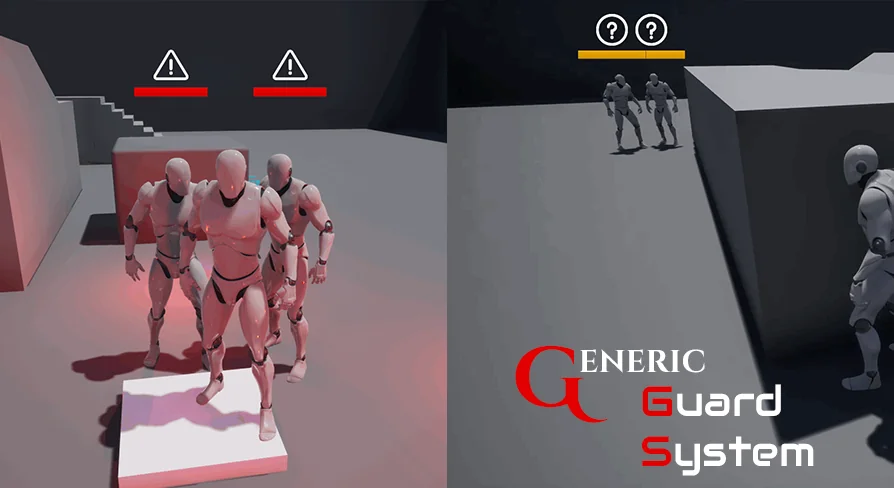
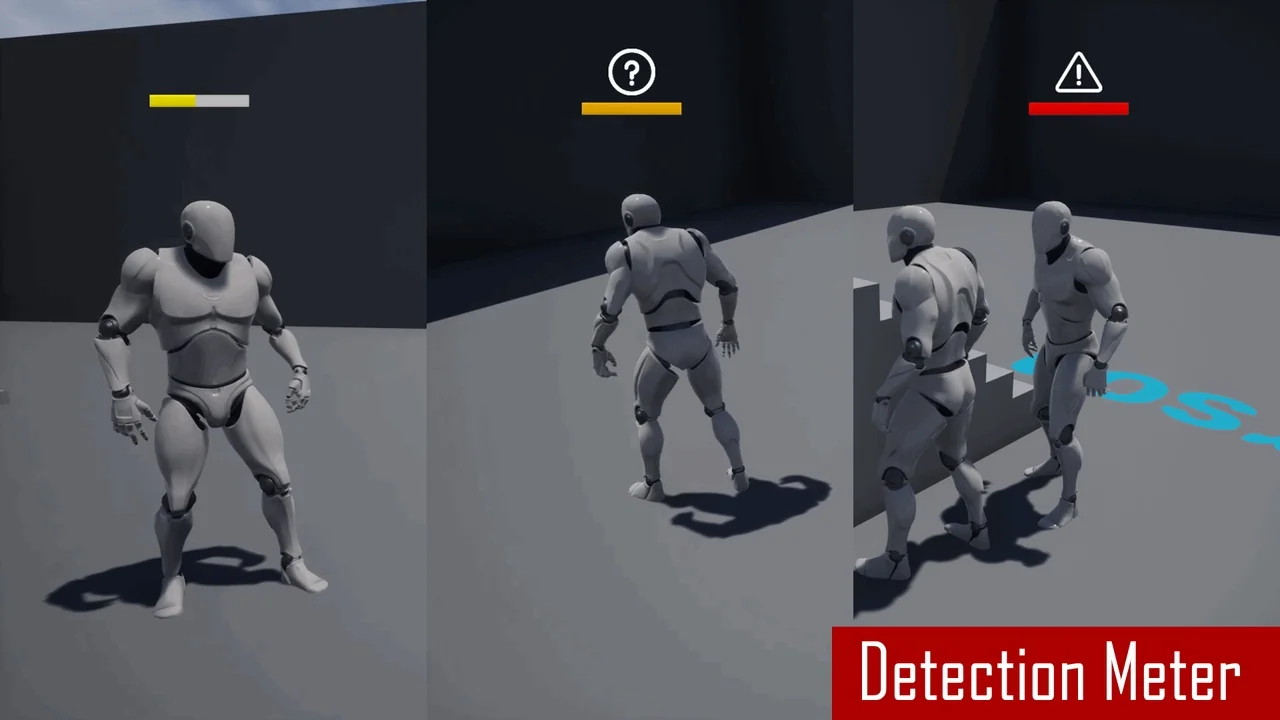
Stealth and security encounters require consistent, responsive behavior to feel convincing in real-time scenarios. Whether a project features a top-down tactical perspective, a first-person infiltration setup, or a third-person adventure layout, the core requirements for an adversarial guard remain fundamentally aligned. The entity must monitor space, react to player intrusion, and transition between passive observation and active response. Generic Guard System addresses this problem space by establishing a foundational framework that works across any style or type of game rather than confining its functionality to a single aesthetic or camera perspective.
Because the mechanics are decoupled from genre-specific visual constraints, the underlying logic functions as a versatile baseline. In standard production pipelines, crafting enemy patrol routes, awareness parameters, and alert sequences often involves re-engineering basic decision trees from scratch for each prototype. A generic approach eliminates this redundant setup time, providing a dependable architecture that developers can drop into various level configurations without being forced to rewrite core awareness rules.
Blueprint Architecture for Customizable AI Logic
The asset is shaped by Blueprints, providing visual scripting clarity for developers who need to understand, adjust, and reconfigure logic without digging through compiled code. Blueprints allow teams to trace execution paths easily, verify when state changes occur, and tweak behavioral responses directly inside an interactive graph editor. This visual structure plays a significant role in keeping the system accessible and straightforward to operate during day-to-day development.
Customizability sits at the center of the package. Because guard behaviors rarely match a single universal template across every project, the logic allows creators to adjust parameters and reshape behavioral responses to fit precise design mandates. One game might require guards that react swiftly to the slightest disruption, while another project might demand relaxed surveillance routines with wider margins for player error. Modifying these responses within Blueprint graphs ensures that balancing can happen iteratively without disrupting the overall stability of the entity's baseline logic.
Trigger Execution and Detection Systems
A core element of modern guard AI involves spatial awareness, typically driven by trigger events. In Generic Guard System, triggers form the operational backbone that registers presence, evaluates proximity, and prompts state transitions. When an entity enters an alert zone or crosses an established threshold, trigger events execute the appropriate logic branches within the Blueprint script.
Relying on trigger mechanisms makes surveillance mechanics predictable and easy to manage within level layouts. Level designers can place environmental triggers, line-of-sight boundaries, or detection volumes to dictate exactly where and how a guard interacts with the surrounding geometry. This modularity prevents AI logic from becoming overly entangled with level geometry, enabling clean level blockouts where patrol routes, checkpoint boundaries, and detection fields remain transparent to test and adjust.
Using trigger-based logic also benefits overall performance by restricting heavy computation to active boundaries. Instead of requiring complex continuous global queries across an entire map, guards can activate or escalate their monitoring states specifically when relevant triggers fire. This keeps interaction clean, legible, and lightweight across diverse scene scales.
Extending the Generic Guard System for Varied Gameplay Needs
Beyond standard parameter customization, Generic Guard System is engineered to be extendable. Games frequently evolve during production, requiring supplementary mechanics such as specialized alarm systems, unique investigative states, communication networks between multiple sentries, or custom search patterns. An extendable system ensures that programmers and designers can graft new features onto the core Blueprint architecture without breaking baseline functionality.
Because the framework does not impose arbitrary design restrictions, developers can create child classes, implement custom interface calls, or introduce additional event dispatchers alongside the existing logic. Teams looking to expand basic guard responses can append bespoke detection rules, unique audio-visual cues, or specialized combat transitions directly onto the existing framework. This flexibility prevents the asset from becoming a rigid dead-end when project requirements scale up in complexity.
Implementing Guard Behaviors Across Project Types
Developers working on stealth prototypes, narrative-heavy adventure titles, or systemic sandbox experiences benefit significantly from a modular AI guard framework. Crafting believable sentries requires balancing ease of setup with enough depth to support tension and player agency. By delivering an easy-to-use foundation driven by Blueprints, trigger handling, and broad customization, Generic Guard System removes the initial technical barrier to establishing reliable security and stealth mechanics across virtually any game genre.
 Procedural Systems
 Procedural Systems
 Procedural Systems
 Procedural Systems