"efaa631e936fd3ee"{"id":"1002123","slug":"multi-seated-vehicles-multiplayer-ready","title":"Multi-Seated Vehicles (Multiplayer Ready)","category":"Vehicles \u0026 Transportation","engine":"5.0+","assetVersion":"","engineVersion":"Engine Version: 5.0+","tag":"Vehicles","accent":"blue","visual":"mech","summary":"Explore the Multi-Seated Vehicles (Multiplayer Ready) system for UE4 and UE5, featuring seat switching, driver steering IK, and multiplayer replication.","platform":"Unreal Engine","publishedAt":"2026-10-29T09:03:54.419Z","updatedAt":"2026-10-29T09:03:54.419Z","sourceNotes":[],"fileContents":[],"compatibility":["Unreal Engine","Engine Version: 5.0+"],"featuredImage":{"alt":"Multi-Seated Vehicles (Multiplayer Ready)","src":"/wp-content/uploads/published/2026/10/cd3e6d8d38ae-a3ca367b-e61d-4a26-9ac8-f6b3cde20581-e211d4e006.webp"},"hasDownloadLink":true,"downloads":0,"terms":[{"taxonomy":"category","slug":"vehicles-and-transportation","name":"Vehicles \u0026 Transportation"}],"galleryImages":[{"src":"/wp-content/uploads/published/2026/10/254e1e2a85f9-c20e753f-c71c-4662-80f7-002e7cafd682-e5acd0711f.webp","alt":"Multi-Seated Vehicles (Multiplayer Ready)"},{"src":"/wp-content/uploads/published/2026/10/2619155d2fdf-396cab02-bb45-4fa4-b166-48b2b4572715-eb18c1e2ee.webp","alt":"Multi-Seated Vehicles (Multiplayer Ready)"},{"src":"/wp-content/uploads/published/2026/10/f02cbb742224-fc31d743-d4a0-4dfe-ba75-6385576c125c-d40cf4bbe4.webp","alt":"Multi-Seated Vehicles (Multiplayer Ready)"},{"src":"/wp-content/uploads/published/2026/10/a5234ebb14d4-a9fe77aa-1f9f-4e3b-8957-a25ff87921c0-2abaca370e.webp","alt":"Multi-Seated Vehicles (Multiplayer Ready)"}],"accessPanel":{"kind":"resource","title":"Download this resource","eyebrow":"Free Download","message":"Log in or create a free account to start your download.","fileName":"Multi-Seated Vehicles (Multiplayer Ready).7z","safetyNote":"Resources are manually reviewed before listing to improve quality and reduce obvious risks.","actionLabel":"Download Free","resourceType":"Resource archive"},"contentHtml":"\u003ch2\u003eCoordinated Transport and Multi-Seated Vehicle Gameplay\u003c/h2\u003e\u003cp\u003ePopulating a multiplayer environment with functional cars demands reliable handling of passenger distribution and responsive transit across large game spaces. Group movement shifts the pacing of encounters, allowing squads to travel together rather than navigating long stretches solely on foot. Implementing vehicles capable of carrying several players at once establishes a foundation for tactical retreats, coordinated assaults, and convoy formations across open terrain.\u003c/p\u003e\u003cp\u003eThe system is built as an easy-to-implement solution driven by vehicle actors equipped with multiple seats. Instead of locking players into rigid passenger roles, the structure accommodates flexible team movement. Characters can board a vehicle together, maintain spatial awareness while riding, and coordinate maneuvers as a collective unit. By removing complicated setup steps, the underlying Blueprints streamline the process of getting multi-seated cars running within cooperative and competitive game loops.\u003c/p\u003e\u003ch2\u003eSeat Management, Driving Control, and Free Dismounting\u003c/h2\u003e\u003cp\u003eManaging who steers and who rides requires explicit logic to prevent conflicting inputs while granting freedom of movement inside the cabin. Under this setup, authority over the vehicle is tied strictly to seat positioning. The individual occupying the designated driving seat retains full control of the vehicle, directing its throttle, braking, and steering. Other passengers inside the car ride along without overriding the driver's steering inputs.\u003c/p\u003e\u003cp\u003eDynamic seat relocation functions cleanly while the vehicle is in motion or parked. Any player inside the cabin can change seats at any moment, provided that the desired target seat is not already occupied by another participant. This allows a passenger to quickly slide into the driver's position if the original driver vacates the spot, maintaining vehicle momentum during high-pressure engagements. If a seat is already filled, the swap is blocked, preventing overlapping character models or conflicting passenger states.\u003c/p\u003e\u003cp\u003eEntering and exiting the vehicle is equally unconstrained. Players can enter and leave the vehicle at any time. When an occupant chooses to exit, control over the vehicle or passenger seat is instantly relinquished, and the player regains direct control of their individual character. This immediate transition back to foot control allows teams to bail out during ambushes, dismount to secure an objective, or scramble back into the cabin when rapid extraction is required.\u003c/p\u003e\u003ch2\u003eDriver IK Animation for Steering Wheel Interaction\u003c/h2\u003e\u003cp\u003eVisual fidelity inside the cockpit plays an important role in selling vehicular motion, especially when players look closely at character interactions within the vehicle interior. Simple static poses often fail when a vehicle turns, causing hands to clip through or detach from the steering wheel during aggressive cornering.\u003c/p\u003e\u003cp\u003eTo solve this, the driver utilizes a dedicated inverse kinematics animation system. This IK setup dynamically anchors the driver's hands directly to the steering wheel while driving and steering. As the player steers through turns or corrects vehicle trajectory, the IK system updates the driver's arms in real time to match wheel rotation. This continuous hand-to-wheel alignment keeps character motion visually anchored to the vehicle controls, avoiding detached limbs and awkward steering poses across both interior and exterior viewing angles.\u003c/p\u003e\u003ch2\u003eMultiplayer Blueprint Replication Across UE4 and UE5\u003c/h2\u003e\u003cp\u003eOperating vehicles across a network requires continuous synchronization of physics, player positions, and seat assignments. Built as a multiplayer-ready system, the logic is fully replicated across client and server connections. When a player boards a car, switches to an empty seat, or leaps back onto the ground, those state changes propagate accurately to everyone in the session.\u003c/p\u003e\u003cp\u003eNetwork replication prevents desynchronization issues where a passenger might appear outside the cabin on one screen while driving on another. The script and Blueprint foundation governs seat availability, entry validation, and driving delegation reliably across the network. Developers working across generations can implement this toolset seamlessly, as the system is fully functional across both Unreal Engine 4 and Unreal Engine 5 environments without requiring complete networking rewrites between engine upgrades.\u003c/p\u003e\u003ch2\u003eIntegration with the Advanced FPS Framework\u003c/h2\u003e\u003cp\u003eTactical shooters and first-person military games frequently pair vehicle transit with intricate weapon handling and boots-on-the-ground infantry mechanics. Compatibility with the Advanced FPS Framework ensures that these multi-passenger vehicles align smoothly with advanced first-person gameplay systems. Players can transition between first-person gun handling on foot and vehicle occupant roles without breaking underlying character state machines.\u003c/p\u003e\u003cp\u003eCombining multiplayer-ready multi-seat functionality with an advanced shooter framework yields cohesive mission profiles. Squads can navigate contested territories in a single transport car, swap seated roles to react to threats, and dismount instantly with their weapon systems ready for immediate combat. The combination of verified compatibility, clean entry-exit cycles, responsive driver IK, and synchronized seat switching offers an accessible architecture for any project driven by team-based vehicular play.\u003c/p\u003e\n\n\u003ch2\u003eRelated Resources Worth Checking\u003c/h2\u003e\n\u003cul\u003e\n\u003cli\u003e\u003ca href=\"https://3dcghub.com/replicated-drivable-gokart-blueprint/\" title=\"Replicated Drivable Gokart (Blueprint)\"\u003eReplicated Drivable Gokart (Blueprint)\u003c/a\u003e\u003c/li\u003e\n\u003cli\u003e\u003ca href=\"https://3dcghub.com/road-bike/\" title=\"Road Bike\"\u003eRoad Bike\u003c/a\u003e\u003c/li\u003e\n\u003cli\u003e\u003ca href=\"https://3dcghub.com/replicated-modular-vehicle-v2/\" title=\"Replicated Modular Vehicle V2\"\u003eReplicated Modular Vehicle V2\u003c/a\u003e\u003c/li\u003e\n\u003cli\u003e\u003ca href=\"https://3dcghub.com/advanced-fuel-system-multiplayer-vehicle-addon/\" title=\"Advanced Fuel System: Multiplayer Vehicle Addon\"\u003eAdvanced Fuel System: Multiplayer Vehicle Addon\u003c/a\u003e\u003c/li\u003e\n\u003cli\u003e\u003ca href=\"https://3dcghub.com/gui-with-multiplayer/\" title=\"GUI with Multiplayer\"\u003eGUI with Multiplayer\u003c/a\u003e\u003c/li\u003e\n\u003c/ul\u003e","contentTextLength":5626,"navigation":{"current":161,"total":4209,"previous":{"id":"1002124","slug":"multiplayer-fps-procedural-animation-toolkit","title":"Multiplayer FPS Procedural Animation Toolkit","category":"Network \u0026 Multiplayer","platform":"Unreal Engine","updatedAt":"2026-10-29T09:04:51.154Z"},"next":{"id":"1002122","slug":"mud-material-pack-4","title":"Mud Material Pack 4","category":"Damage \u0026 Grunge","platform":"Unreal Engine","updatedAt":"2026-10-29T09:03:23.830Z"}},"relatedResources":[{"id":"1001828","slug":"replicated-drivable-gokart-blueprint","title":"Replicated Drivable Gokart (Blueprint)","category":"Vehicles \u0026 Transportation","engine":"5.0+","assetVersion":"","engineVersion":"Engine Version: 5.0+","tag":"Vehicles","accent":"blue","visual":"mech","summary":"Explore the Replicated Drivable Gokart for Unreal Engine, featuring native vehicle physics, multiplayer replication, rigged skeletal meshes, and custom lighting","platform":"Unreal Engine","publishedAt":"2026-10-21T08:20:49.526Z","updatedAt":"2026-10-21T08:20:49.526Z","sourceNotes":[],"fileContents":[],"compatibility":["Unreal Engine","Engine Version: 5.0+"],"featuredImage":{"alt":"Replicated Drivable Gokart (Blueprint)","src":"/wp-content/uploads/published/2026/10/0158e36d8f36-baa6c062-d685-4943-b955-32c41359465d-ce1bf6a53f.webp"},"hasDownloadLink":true,"downloads":0},{"id":"1000021","slug":"road-bike","title":"Road Bike","category":"Vehicles \u0026 Transportation","engine":"5.1+","assetVersion":"","engineVersion":"5.1+","tag":"Vehicles","accent":"blue","visual":"mech","summary":"Road Bike brings fully rideable motorbikes to Unreal scenes with Chaos Vehicle physics, multiplayer replication, dynamic suspension, and built-in effects.","platform":"Unreal Engine","publishedAt":"2026-05-20T09:47:57.371Z","updatedAt":"2026-05-22T20:13:10.843Z","sourceNotes":[],"fileContents":[],"compatibility":["Unreal Engine","Engine version: 5.1+"],"featuredImage":{"alt":"Road Bike","src":"/wp-content/uploads/published/2026/05/ac5f375a8a2f-00f8907a-308d-4b69-a761-c4c89b42724c-6dfbbc2c98.webp"},"hasDownloadLink":true,"downloads":1},{"id":"25115","slug":"replicated-modular-vehicle-v2","title":"Replicated Modular Vehicle V2","category":"Game Mechanics","engine":"5.0+","assetVersion":"Engine version: 5.0+","engineVersion":"","tag":"Game Mechanics","accent":"blue","visual":"luts","summary":"Replicated Modular Vehicle V2 brings a Blueprint-only vehicle system to multiplayer Unreal Engine projects. It includes five game-ready vehicle models, modular placement options, and example blueprints for both 2-seater and 4-seater setups.","platform":"Unreal Engine","publishedAt":"2026-04-19T06:08:54.000Z","updatedAt":"2026-04-20T06:12:32.000Z","sourceNotes":[],"fileContents":[],"compatibility":["Unreal Engine","Engine version: 5.0+"],"featuredImage":{"alt":"Replicated Modular Vehicle V2","src":"https://3dcghub.com/wp-content/uploads/2026/04/be84efcf1880_96c4bb56-ed09-4e2c-8675-750650ec87e5.webp"},"hasDownloadLink":true,"downloads":1}]}
Vehicles
Multi-Seated Vehicles (Multiplayer Ready)
Explore the Multi-Seated Vehicles (Multiplayer Ready) system for UE4 and UE5, featuring seat switching, driver steering IK, and multiplayer replication.
Coordinated Transport and Multi-Seated Vehicle Gameplay
Populating a multiplayer environment with functional cars demands reliable handling of passenger distribution and responsive transit across large game spaces. Group movement shifts the pacing of encounters, allowing squads to travel together rather than navigating long stretches solely on foot. Implementing vehicles capable of carrying several players at once establishes a foundation for tactical retreats, coordinated assaults, and convoy formations across open terrain.
The system is built as an easy-to-implement solution driven by vehicle actors equipped with multiple seats. Instead of locking players into rigid passenger roles, the structure accommodates flexible team movement. Characters can board a vehicle together, maintain spatial awareness while riding, and coordinate maneuvers as a collective unit. By removing complicated setup steps, the underlying Blueprints streamline the process of getting multi-seated cars running within cooperative and competitive game loops.
Seat Management, Driving Control, and Free Dismounting
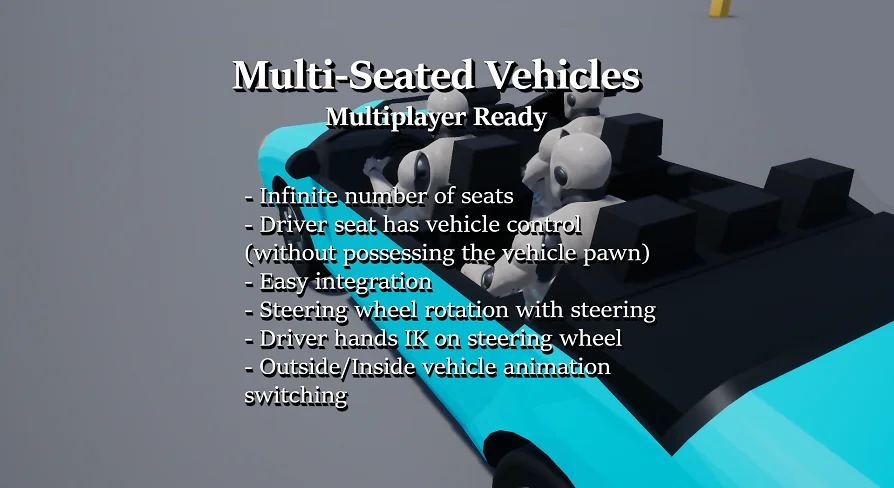
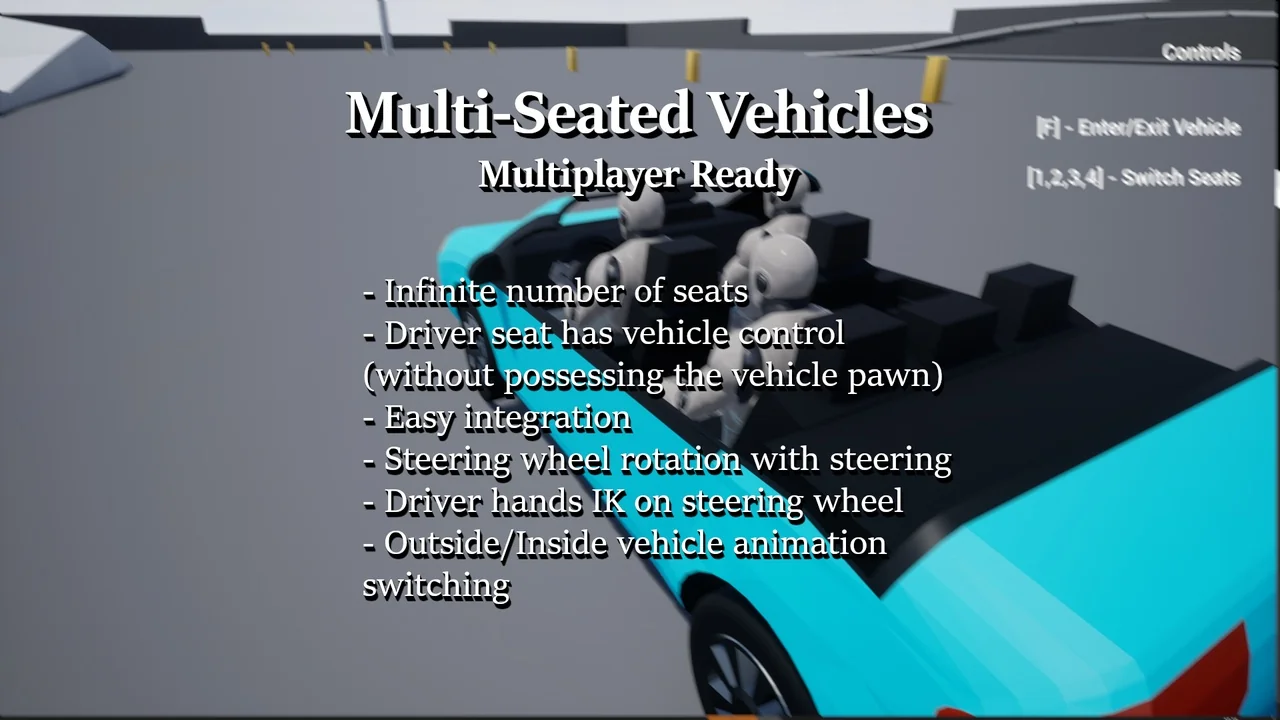
Managing who steers and who rides requires explicit logic to prevent conflicting inputs while granting freedom of movement inside the cabin. Under this setup, authority over the vehicle is tied strictly to seat positioning. The individual occupying the designated driving seat retains full control of the vehicle, directing its throttle, braking, and steering. Other passengers inside the car ride along without overriding the driver's steering inputs.
Dynamic seat relocation functions cleanly while the vehicle is in motion or parked. Any player inside the cabin can change seats at any moment, provided that the desired target seat is not already occupied by another participant. This allows a passenger to quickly slide into the driver's position if the original driver vacates the spot, maintaining vehicle momentum during high-pressure engagements. If a seat is already filled, the swap is blocked, preventing overlapping character models or conflicting passenger states.
Entering and exiting the vehicle is equally unconstrained. Players can enter and leave the vehicle at any time. When an occupant chooses to exit, control over the vehicle or passenger seat is instantly relinquished, and the player regains direct control of their individual character. This immediate transition back to foot control allows teams to bail out during ambushes, dismount to secure an objective, or scramble back into the cabin when rapid extraction is required.
Driver IK Animation for Steering Wheel Interaction
Visual fidelity inside the cockpit plays an important role in selling vehicular motion, especially when players look closely at character interactions within the vehicle interior. Simple static poses often fail when a vehicle turns, causing hands to clip through or detach from the steering wheel during aggressive cornering.
To solve this, the driver utilizes a dedicated inverse kinematics animation system. This IK setup dynamically anchors the driver's hands directly to the steering wheel while driving and steering. As the player steers through turns or corrects vehicle trajectory, the IK system updates the driver's arms in real time to match wheel rotation. This continuous hand-to-wheel alignment keeps character motion visually anchored to the vehicle controls, avoiding detached limbs and awkward steering poses across both interior and exterior viewing angles.
Multiplayer Blueprint Replication Across UE4 and UE5
Operating vehicles across a network requires continuous synchronization of physics, player positions, and seat assignments. Built as a multiplayer-ready system, the logic is fully replicated across client and server connections. When a player boards a car, switches to an empty seat, or leaps back onto the ground, those state changes propagate accurately to everyone in the session.
Network replication prevents desynchronization issues where a passenger might appear outside the cabin on one screen while driving on another. The script and Blueprint foundation governs seat availability, entry validation, and driving delegation reliably across the network. Developers working across generations can implement this toolset seamlessly, as the system is fully functional across both Unreal Engine 4 and Unreal Engine 5 environments without requiring complete networking rewrites between engine upgrades.
Integration with the Advanced FPS Framework
Tactical shooters and first-person military games frequently pair vehicle transit with intricate weapon handling and boots-on-the-ground infantry mechanics. Compatibility with the Advanced FPS Framework ensures that these multi-passenger vehicles align smoothly with advanced first-person gameplay systems. Players can transition between first-person gun handling on foot and vehicle occupant roles without breaking underlying character state machines.
Combining multiplayer-ready multi-seat functionality with an advanced shooter framework yields cohesive mission profiles. Squads can navigate contested territories in a single transport car, swap seated roles to react to threats, and dismount instantly with their weapon systems ready for immediate combat. The combination of verified compatibility, clean entry-exit cycles, responsive driver IK, and synchronized seat switching offers an accessible architecture for any project driven by team-based vehicular play.
 Vehicles
 Vehicles
 Vehicles
 Game Mechanics