"0283a5a6392d9fd6"{"id":"1000021","slug":"road-bike","title":"Road Bike","category":"Vehicles \u0026 Transportation","engine":"5.1+","assetVersion":"","engineVersion":"5.1+","tag":"Vehicles","accent":"blue","visual":"mech","summary":"Road Bike brings fully rideable motorbikes to Unreal scenes with Chaos Vehicle physics, multiplayer replication, dynamic suspension, and built-in effects.","platform":"Unreal Engine","publishedAt":"2026-05-20T09:47:57.371Z","updatedAt":"2026-05-22T20:13:10.843Z","sourceNotes":[],"fileContents":[],"compatibility":["Unreal Engine","Engine version: 5.1+"],"featuredImage":{"alt":"Road Bike","src":"/wp-content/uploads/published/2026/05/ac5f375a8a2f-00f8907a-308d-4b69-a761-c4c89b42724c-6dfbbc2c98.webp"},"hasDownloadLink":true,"downloads":1,"terms":[{"taxonomy":"category","slug":"vehicles-and-transportation","name":"Vehicles \u0026 Transportation"}],"galleryImages":[{"src":"/wp-content/uploads/published/2026/05/dd8bf137fe77-47bf4e2c-b462-4f1e-a599-06290abe6d7c-80dd88eb9c.webp","alt":"Road Bike"},{"src":"/wp-content/uploads/published/2026/05/65b609e75663-9cf95cf7-8129-40ff-8f11-88eb702fb3af-42a8870b99.webp","alt":"Road Bike"},{"src":"/wp-content/uploads/published/2026/05/befaf01ab2bc-4d33b41e-82a0-4926-b080-5ed878a9b4a0-c7c796cf46.webp","alt":"Road Bike"}],"accessPanel":{"kind":"resource","title":"Access this resource","eyebrow":"Free Download","message":"Log in or create a free account to start your download.","fileName":"Content.7z","safetyNote":"Resources are manually reviewed before listing to improve quality and reduce obvious risks.","actionLabel":"Download Free","resourceType":"Resource archive"},"contentHtml":"\u003cp\u003eStreet sequences, open-road traversal, and action scenes all benefit from a vehicle that can do more than sit in the background. Road Bike is driven by that moment when a motorcycle needs to be part of gameplay rather than a static prop. It is a game-ready system for fully rideable motorbikes, with streamlined blueprints intended to bring responsive riding into a scene in minutes and a set of effects that support the motion on screen.\u003c/p\u003e\n\u003cp\u003eThe setup requirement is direct: the Chaos Vehicles Plugin needs to be enabled, followed by an editor restart. From there, the package is aimed at two-wheeled driving with a stronger emphasis on real movement and rider feedback than on decorative presentation alone. The bike is skeletal mesh based and uses Chaos Vehicle physics, which places it firmly in a workflow where handling behavior and animation structure are tied together.\u003c/p\u003e \u003ch2\u003eRoad Bike in playable scene setup\u003c/h2\u003e\n\u003cp\u003eThis resource fits projects that need a motorcycle to function immediately as part of gameplay. The blueprints are presented as streamlined, and that shapes how the asset reads in production terms: it is not just a model with a few moving parts, but a system meant to drop into active scenes where steering, suspension, lighting, and effects all need to respond together.\u003c/p\u003e\n\u003cp\u003eIts driving layer is framed around advanced driving and physics, with support for multiplayer through full replication. That matters most in scenes where the motorcycle is not only ridden by one local player, but also needs to behave consistently across networked play. Replication is treated as a core feature rather than an afterthought, so the bike is positioned for projects where vehicle interaction can be shared across players.\u003c/p\u003e\n\u003cp\u003eBecause the system is skeletal mesh based with Chaos Vehicle physics, the motion is supported by a rigged structure rather than a simple rigid setup. The fully rigged skeleton includes individual bones for the front and rear wheels, the handlebars and front forks, the swingarm and chain, and the kickstand. Those named parts make the asset easier to place mentally in a scene-building pipeline: visible movement is not restricted to wheel rotation, but extends to steering components and rear assembly elements that help the bike read as mechanically active.\u003c/p\u003e \u003ch2\u003eChaos Vehicle physics and the way the bike moves\u003c/h2\u003e\n\u003cp\u003eThe strongest implementation detail here is the emphasis on real-world physics behavior for a two-wheeled vehicle. Road Bike includes automatic leaning and banking mechanics based on speed and turning angle. In practice, that gives the motorcycle a response pattern closer to how a rider expects a bike to behave in a curve, instead of remaining unnaturally upright through every turn.\u003c/p\u003e\n\u003cp\u003eThat leaning behavior is supported by dynamic suspension. The forks and rear shock show visible compression, which adds motion cues that matter both at a distance and in closer gameplay cameras. Suspension movement often carries a lot of the perceived weight of a vehicle, and visible compression helps communicate acceleration, braking, terrain response, and cornering load without requiring extra explanation elsewhere in the scene.\u003c/p\u003e\n\u003cp\u003eFunctional handlebars are linked to steering input, reinforcing that connection between player control and on-screen mechanics. Since the front end is rigged with handlebars and forks as individual skeletal elements, steering is not abstracted into hidden motion alone. The player sees the bike answer the turn input through components that visibly react.\u003c/p\u003e\n\u003cp\u003eThese features make the asset useful for more than just forward travel. They support sequences where the motorcycle needs to sell balance, corner entry, braking, and road contact. Whether the bike is moving through a sparse roadway, a rougher postapocalyptic environment, or a more cinematic chase setup, the listed motion systems push it toward active use rather than background dressing.\u003c/p\u003e \u003ch2\u003eInstrument Cluster, lighting, and the on-bike details\u003c/h2\u003e\n\u003cp\u003eRoad Bike does not stop at core locomotion. It also includes several immersive features that help the motorcycle feel complete once it is placed in a playable or cinematic space. The instrument cluster has functional odometer and RPM gauges, giving the cockpit area live feedback rather than static display surfaces. For projects that use close camera framing, first-person or near-bike angles, these details can make the difference between a vehicle that merely moves and one that feels switched on.\u003c/p\u003e\n\u003cp\u003eThe lighting system covers the expected road-bike signals: headlight, brake lights, and turn indicators. Those functions give the vehicle a wider range of scene roles. A headlight supports nighttime or low-light use, brake lights help stopping and deceleration read more clearly, and turn indicators add another layer of road behavior that can matter in more grounded environments. Together, they allow the bike to contribute not just movement, but recognizable traffic and rider language.\u003c/p\u003e\n\u003cp\u003eThis is where the asset’s scene value becomes broader. A bike that leans correctly is one thing; a bike that also signals, brakes visibly, and presents working gauges can fill a more believable role in urban roads, roadside cutscenes, checkpoint travel, or multiplayer meet-up spaces. The package keeps those details inside the same gameplay-oriented system instead of isolating them as separate decorative additions.\u003c/p\u003e \u003ch2\u003eEngine revs, tire smoke, and the curated effects suite\u003c/h2\u003e\n\u003cp\u003eThe effects package is another major part of how Road Bike is meant to be used. Audio covers engine revs, idling, and tire skids. That combination addresses the bike at rest, under throttle, and under strain. Idle sound gives the vehicle presence when parked or waiting. Engine revs support acceleration and active riding. Tire skid audio helps sell braking or loss of traction moments.\u003c/p\u003e\n\u003cp\u003eParticle effects extend that response visually with tire smoke, exhaust fumes, and skid marks. These are not random extras; they line up closely with the kinds of actions the physics and handling systems invite. When a bike accelerates, brakes hard, or moves aggressively through a scene, the particles give those actions traces and atmosphere. Exhaust fumes reinforce the machine’s presence even when it is not moving fast, while tire smoke and skid marks help sharper maneuvers leave a readable impact on the environment.\u003c/p\u003e\n\u003cp\u003eThe description of the system as a curated suite of effects is useful because it frames these pieces as selected to support riding rather than overwhelm it. The focus stays on a compact set of vehicle responses that enhance motion, road contact, and mechanical identity. In use, that makes Road Bike easier to imagine in a working scene: the vehicle can arrive with sound, visible signals, and environmental traces already considered as part of the same package.\u003c/p\u003e \u003ch2\u003eSmart Actor performance and where Road Bike fits best\u003c/h2\u003e\n\u003cp\u003ePerformance features are treated explicitly. The bike includes a Smart Actor system with near-zero cost when idle, along with instanced and dynamic meshes for performance and hand-made LODs. Those details point to a resource that is not only interested in ride feel, but also in how the motorcycle behaves when it is present in a level without constantly demanding attention.\u003c/p\u003e\n\u003cp\u003eAn idle-cost reduction approach is especially relevant for scenes that keep vehicles around even when they are not being used every second. Parked bikes, bikes waiting for player interaction, or multiplayer spaces with several vehicle actors can all benefit from that kind of behavior. Instanced and dynamic meshes further underline the performance angle, while hand-made LODs suggest that visible complexity has been considered across viewing distances.\u003c/p\u003e\n\u003cp\u003eRoad Bike is a strong fit when a project needs an actively drivable motorcycle with more than baseline movement. The combination of Chaos Vehicle physics, automatic leaning and banking, visible suspension compression, steering-linked handlebars, working gauges, complete lighting, audio, and particle effects gives it a clear place in scene production. It is most at home in workflows that need a motorcycle to be playable, readable, and presentable from both gameplay and presentation angles, with a setup path that begins by enabling the Chaos Vehicles Plugin and restarting the editor.\u003c/p\u003e\n\n\u003ch2\u003eMore From The Same Workflow\u003c/h2\u003e\n\u003cul\u003e\n\u003cli\u003e\u003ca href=\"https://3dcghub.com/scifi-grasshopper-mono-bike/\" title=\"SciFi Grasshopper Mono Bike\"\u003eSciFi Grasshopper Mono Bike\u003c/a\u003e\u003c/li\u003e\n\u003cli\u003e\u003ca href=\"https://3dcghub.com/real-shape-shifting-mesh-morph-system/\" title=\"Real Shape Shifting - Mesh Morph System\"\u003eReal Shape Shifting - Mesh Morph System\u003c/a\u003e\u003c/li\u003e\n\u003cli\u003e\u003ca href=\"https://3dcghub.com/driveable-steampunk-car-vehicle-steampunk-car-retro-futuristic-victorian/\" title=\"Driveable SteamPunk Car / Vehicle ( SteamPunk Car Retro Futuristic Victorian)\"\u003eDriveable SteamPunk Car / Vehicle ( SteamPunk Car Retro Futuristic Victorian)\u003c/a\u003e\u003c/li\u003e\n\u003cli\u003e\u003ca href=\"https://3dcghub.com/driveable-vehicle-ah-raider/\" title=\"Driveable Vehicle : AH-Raider\"\u003eDriveable Vehicle : AH-Raider\u003c/a\u003e\u003c/li\u003e\n\u003cli\u003e\u003ca href=\"https://3dcghub.com/intelligent-traffic-system/\" title=\"Intelligent Traffic System\"\u003eIntelligent Traffic System\u003c/a\u003e\u003c/li\u003e\n\u003c/ul\u003e","contentTextLength":8487,"navigation":{"current":1439,"total":3354,"previous":{"id":"1000013","slug":"ghost-town-vol-4-abandoned-houses","title":"Ghost Town VOL.4 - Abandoned Houses","category":"Buildings \u0026 Architecture","platform":"Unreal Engine","updatedAt":"2026-05-22T20:13:21.456Z"},"next":{"id":"1000043","slug":"cinemotion-3-real-handheld-camera-motion-kit","title":"Cinemotion 3 Real Handheld Camera Motion Kit","category":"Variety","platform":"Unreal Engine","updatedAt":"2026-05-22T20:12:55.612Z"}},"relatedResources":[{"id":"5223","slug":"scifi-grasshopper-mono-bike","title":"SciFi Grasshopper Mono Bike","category":"Vehicles \u0026 Transportation","engine":"4.27,5.0+","assetVersion":"Engine version: 4.27,5.0+","engineVersion":"4.26","tag":"Vehicles","accent":"blue","visual":"city","summary":"Enhance your game with the SciFi Grasshopper Mono Bike. Features drivable blueprints, high-res textures, and customizable materials for Unreal Engine.","platform":"Unreal Engine","publishedAt":"2026-02-14T18:16:43.000Z","updatedAt":"2026-04-19T15:56:59.000Z","sourceNotes":[],"fileContents":[],"compatibility":["Unreal Engine","Engine version: 4.27,5.0+"],"featuredImage":{"alt":"SciFi Grasshopper Mono Bike","src":"https://3dcghub.com/wp-content/uploads/2026/02/08ab6918-9a2f-467d-b55a-ab9e65dd1194.webp"},"hasDownloadLink":true,"downloads":0},{"id":"1000989","slug":"emergency-vehicles-premium-drivable-and-interactable","title":"Emergency Vehicles - Premium - Drivable and Interactable","category":"Vehicles \u0026 Transportation","engine":"5.3+","assetVersion":"","engineVersion":"Engine Version: 5.3+","tag":"Vehicles","accent":"blue","visual":"mech","summary":"Add drivable emergency vehicles with a full rig, functional interior, sirens, destructible parts, and level designer tools. Chaos Vehicles and OpenXR required.","platform":"Unreal Engine","publishedAt":"2026-08-18T06:37:54.815Z","updatedAt":"2026-08-18T06:37:54.815Z","sourceNotes":[],"fileContents":[],"compatibility":["Unreal Engine","Engine Version: 5.3+"],"featuredImage":{"alt":"Emergency Vehicles - Premium - Drivable and Interactable","src":"/wp-content/uploads/published/2026/08/1c514b2e1f8f-66ce2b26-a13c-4ac2-af06-f1e66e8c1668-e2131ac210.webp"},"hasDownloadLink":true,"downloads":2},{"id":"1001027","slug":"vehicle-variety-first-person-vehicle-interaction-system-fpvis","title":"Vehicle Variety First Person Vehicle Interaction System (FPVIS)","category":"Vehicles \u0026 Transportation","engine":"5.1+","assetVersion":"","engineVersion":"Engine Version: 5.1+","tag":"Vehicles","accent":"blue","visual":"mech","summary":"Four drivable vehicles with interiors, a first-person interaction system for opening doors and picking up physics objects, plus 31 props for Unreal Engine.","platform":"Unreal Engine","publishedAt":"2026-08-23T06:31:45.549Z","updatedAt":"2026-08-23T06:31:45.549Z","sourceNotes":[],"fileContents":[],"compatibility":["Unreal Engine","Engine Version: 5.1+"],"featuredImage":{"alt":"Vehicle Variety First Person Vehicle Interaction System (FPVIS)","src":"/wp-content/uploads/published/2026/08/931540a117b2-fae03a09-f100-4f0e-b0e9-1501943e1998-36105223ac.webp"},"hasDownloadLink":true,"downloads":0}]}
Vehicles
Road Bike
Road Bike brings fully rideable motorbikes to Unreal scenes with Chaos Vehicle physics, multiplayer replication, dynamic suspension, and built-in effects.
Street sequences, open-road traversal, and action scenes all benefit from a vehicle that can do more than sit in the background. Road Bike is driven by that moment when a motorcycle needs to be part of gameplay rather than a static prop. It is a game-ready system for fully rideable motorbikes, with streamlined blueprints intended to bring responsive riding into a scene in minutes and a set of effects that support the motion on screen.
The setup requirement is direct: the Chaos Vehicles Plugin needs to be enabled, followed by an editor restart. From there, the package is aimed at two-wheeled driving with a stronger emphasis on real movement and rider feedback than on decorative presentation alone. The bike is skeletal mesh based and uses Chaos Vehicle physics, which places it firmly in a workflow where handling behavior and animation structure are tied together.
Road Bike in playable scene setup
This resource fits projects that need a motorcycle to function immediately as part of gameplay. The blueprints are presented as streamlined, and that shapes how the asset reads in production terms: it is not just a model with a few moving parts, but a system meant to drop into active scenes where steering, suspension, lighting, and effects all need to respond together.
Its driving layer is framed around advanced driving and physics, with support for multiplayer through full replication. That matters most in scenes where the motorcycle is not only ridden by one local player, but also needs to behave consistently across networked play. Replication is treated as a core feature rather than an afterthought, so the bike is positioned for projects where vehicle interaction can be shared across players.
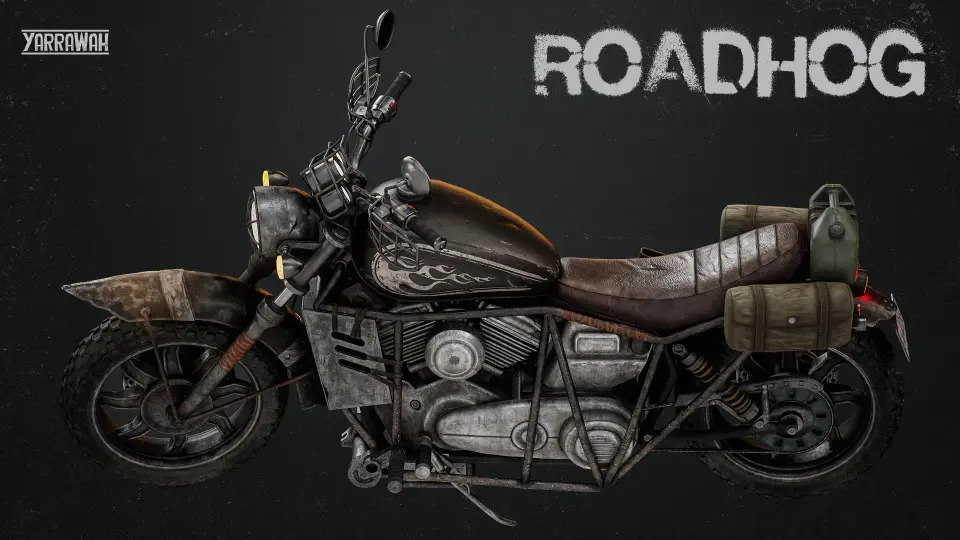
Because the system is skeletal mesh based with Chaos Vehicle physics, the motion is supported by a rigged structure rather than a simple rigid setup. The fully rigged skeleton includes individual bones for the front and rear wheels, the handlebars and front forks, the swingarm and chain, and the kickstand. Those named parts make the asset easier to place mentally in a scene-building pipeline: visible movement is not restricted to wheel rotation, but extends to steering components and rear assembly elements that help the bike read as mechanically active.
Chaos Vehicle physics and the way the bike moves
The strongest implementation detail here is the emphasis on real-world physics behavior for a two-wheeled vehicle. Road Bike includes automatic leaning and banking mechanics based on speed and turning angle. In practice, that gives the motorcycle a response pattern closer to how a rider expects a bike to behave in a curve, instead of remaining unnaturally upright through every turn.
That leaning behavior is supported by dynamic suspension. The forks and rear shock show visible compression, which adds motion cues that matter both at a distance and in closer gameplay cameras. Suspension movement often carries a lot of the perceived weight of a vehicle, and visible compression helps communicate acceleration, braking, terrain response, and cornering load without requiring extra explanation elsewhere in the scene.
Functional handlebars are linked to steering input, reinforcing that connection between player control and on-screen mechanics. Since the front end is rigged with handlebars and forks as individual skeletal elements, steering is not abstracted into hidden motion alone. The player sees the bike answer the turn input through components that visibly react.
These features make the asset useful for more than just forward travel. They support sequences where the motorcycle needs to sell balance, corner entry, braking, and road contact. Whether the bike is moving through a sparse roadway, a rougher postapocalyptic environment, or a more cinematic chase setup, the listed motion systems push it toward active use rather than background dressing.
Instrument Cluster, lighting, and the on-bike details
Road Bike does not stop at core locomotion. It also includes several immersive features that help the motorcycle feel complete once it is placed in a playable or cinematic space. The instrument cluster has functional odometer and RPM gauges, giving the cockpit area live feedback rather than static display surfaces. For projects that use close camera framing, first-person or near-bike angles, these details can make the difference between a vehicle that merely moves and one that feels switched on.
The lighting system covers the expected road-bike signals: headlight, brake lights, and turn indicators. Those functions give the vehicle a wider range of scene roles. A headlight supports nighttime or low-light use, brake lights help stopping and deceleration read more clearly, and turn indicators add another layer of road behavior that can matter in more grounded environments. Together, they allow the bike to contribute not just movement, but recognizable traffic and rider language.
This is where the asset’s scene value becomes broader. A bike that leans correctly is one thing; a bike that also signals, brakes visibly, and presents working gauges can fill a more believable role in urban roads, roadside cutscenes, checkpoint travel, or multiplayer meet-up spaces. The package keeps those details inside the same gameplay-oriented system instead of isolating them as separate decorative additions.
Engine revs, tire smoke, and the curated effects suite
The effects package is another major part of how Road Bike is meant to be used. Audio covers engine revs, idling, and tire skids. That combination addresses the bike at rest, under throttle, and under strain. Idle sound gives the vehicle presence when parked or waiting. Engine revs support acceleration and active riding. Tire skid audio helps sell braking or loss of traction moments.
Particle effects extend that response visually with tire smoke, exhaust fumes, and skid marks. These are not random extras; they line up closely with the kinds of actions the physics and handling systems invite. When a bike accelerates, brakes hard, or moves aggressively through a scene, the particles give those actions traces and atmosphere. Exhaust fumes reinforce the machine’s presence even when it is not moving fast, while tire smoke and skid marks help sharper maneuvers leave a readable impact on the environment.
The description of the system as a curated suite of effects is useful because it frames these pieces as selected to support riding rather than overwhelm it. The focus stays on a compact set of vehicle responses that enhance motion, road contact, and mechanical identity. In use, that makes Road Bike easier to imagine in a working scene: the vehicle can arrive with sound, visible signals, and environmental traces already considered as part of the same package.
Smart Actor performance and where Road Bike fits best
Performance features are treated explicitly. The bike includes a Smart Actor system with near-zero cost when idle, along with instanced and dynamic meshes for performance and hand-made LODs. Those details point to a resource that is not only interested in ride feel, but also in how the motorcycle behaves when it is present in a level without constantly demanding attention.
An idle-cost reduction approach is especially relevant for scenes that keep vehicles around even when they are not being used every second. Parked bikes, bikes waiting for player interaction, or multiplayer spaces with several vehicle actors can all benefit from that kind of behavior. Instanced and dynamic meshes further underline the performance angle, while hand-made LODs suggest that visible complexity has been considered across viewing distances.
Road Bike is a strong fit when a project needs an actively drivable motorcycle with more than baseline movement. The combination of Chaos Vehicle physics, automatic leaning and banking, visible suspension compression, steering-linked handlebars, working gauges, complete lighting, audio, and particle effects gives it a clear place in scene production. It is most at home in workflows that need a motorcycle to be playable, readable, and presentable from both gameplay and presentation angles, with a setup path that begins by enabling the Chaos Vehicles Plugin and restarting the editor.
 Vehicles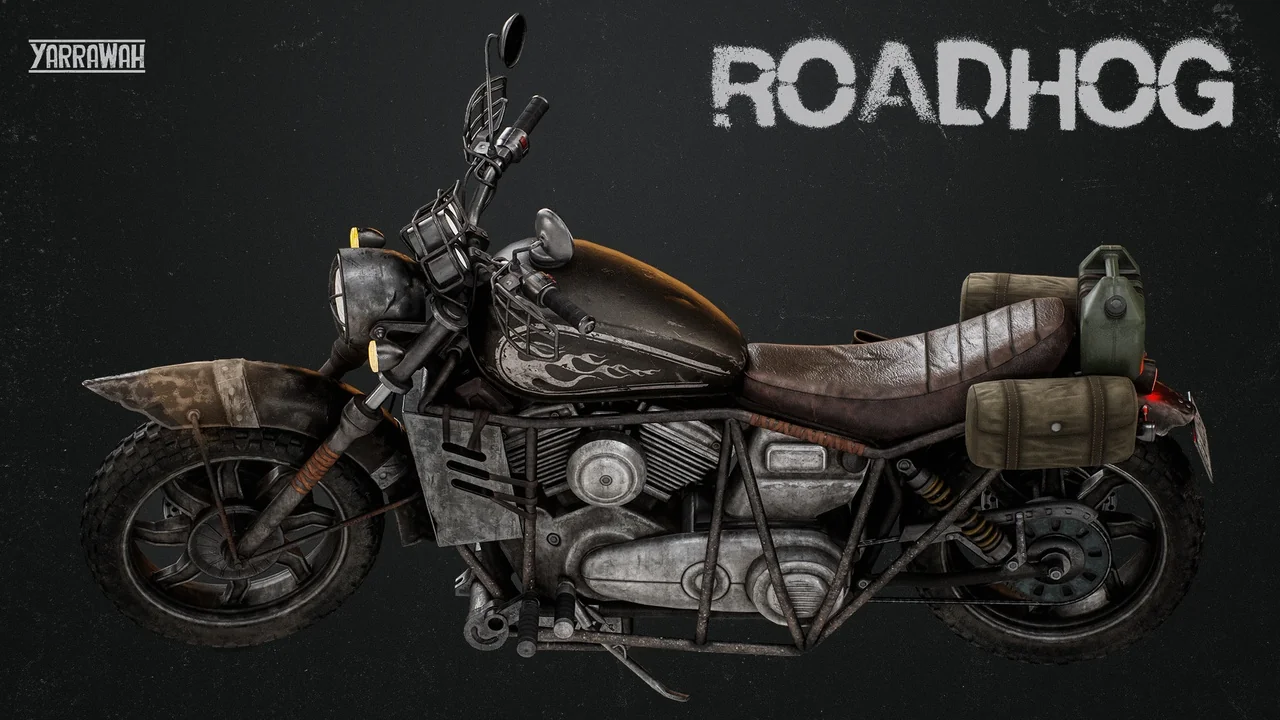
 Vehicles
 Vehicles
 Vehicles