"b9100eca121078f1"{"id":"1000020","slug":"swim-component-150-animations-blueprints","title":"Swim Component : 150 Animations + Blueprints","category":"Locomotion / Gaits","engine":"5.1+","assetVersion":"","engineVersion":"5.1+","tag":"Locomotion / Gaits","accent":"blue","visual":"animation","summary":"A configurable Unreal Engine swimming system with 150 animations, commented Blueprints, buoyancy, underwater movement, replication, and water support.","platform":"Unreal Engine","publishedAt":"2026-05-20T09:44:51.233Z","updatedAt":"2026-08-23T13:10:29.178Z","sourceNotes":[],"fileContents":[],"compatibility":["Unreal Engine","Engine version: 5.1+"],"featuredImage":{"alt":"Swim Component : 150 Animations + Blueprints","src":"/wp-content/uploads/published/2026/05/3f1a788194c2-3859b48c-3c9b-44b5-9bb5-f9e573de330f-692f035541.webp"},"hasDownloadLink":true,"downloads":5,"terms":[{"taxonomy":"category","slug":"locomotion-gaits","name":"Locomotion / Gaits"}],"galleryImages":[{"src":"/wp-content/uploads/published/2026/05/f849e6642259-e091fa79-1366-4642-b8ed-c7f7ebf9a24d-7f357644be.webp","alt":"Swim Component : 150 Animations + Blueprints"},{"src":"/wp-content/uploads/published/2026/05/baa894acd8d1-cea4936c-1505-4408-887c-5601e4128004-03db755a78.webp","alt":"Swim Component : 150 Animations + Blueprints"},{"src":"/wp-content/uploads/published/2026/05/46256bd34174-416f67e1-8a5a-4c62-8f1f-13e7075c2829-11da1d710b.webp","alt":"Swim Component : 150 Animations + Blueprints"},{"src":"/wp-content/uploads/published/2026/05/db0214997524-d3b5bd47-0d33-463e-9ce1-0ce56f514d1c-d193b45b93.webp","alt":"Swim Component : 150 Animations + Blueprints"},{"src":"/wp-content/uploads/published/2026/05/3b9deac0de36-f4446e08-feb0-4948-8a4a-4cd5ba9443e6-92aa45fd8f.webp","alt":"Swim Component : 150 Animations + Blueprints"},{"src":"/wp-content/uploads/published/2026/05/9694e2afd8b9-d4b7dddb-09da-40b2-a97a-9cd8257055f4-0f999ce4c7.webp","alt":"Swim Component : 150 Animations + Blueprints"},{"src":"/wp-content/uploads/published/2026/05/34b0f272e128-cdf4e99c-7688-4804-a42c-095b73a45fd6-46046af1cd.webp","alt":"Swim Component : 150 Animations + Blueprints"},{"src":"/wp-content/uploads/published/2026/05/8a965cddbffc-e0aed5c3-05a0-465e-8b78-f38d7c91eadc-b454cdb9b9.webp","alt":"Swim Component : 150 Animations + Blueprints"},{"src":"/wp-content/uploads/published/2026/05/981fe14ceb3c-71c00e95-bb4a-456f-ab70-936b00b504f8-01967bfe1a.webp","alt":"Swim Component : 150 Animations + Blueprints"},{"src":"/wp-content/uploads/published/2026/05/521d45c4da38-30cb32db-c2bd-446a-ab65-2f0e4384495d-2b6a6778d6.webp","alt":"Swim Component : 150 Animations + Blueprints"}],"accessPanel":{"kind":"resource","title":"Download this resource","eyebrow":"Free Download","message":"Log in or create a free account to start your download.","fileName":"SwimComponent.7z","safetyNote":"Resources are manually reviewed before listing to improve quality and reduce obvious risks.","actionLabel":"Download Free","resourceType":"Resource archive"},"contentHtml":"\u003cp\u003eGetting a swimming feature into a project usually becomes a mix of movement logic, animation state handling, and water-specific edge cases. Swim Component: 150 Animations + Blueprints approaches that path as a ready-made configurable system, pairing 150 animations with Blueprints and keeping the setup readable through commented Blueprint logic. The package then offers not just a collection of swim motions, but a structured component aimed at putting character swimming into production with less guesswork around how each part is meant to behave.\u003c/p\u003e \u003cp\u003eThe package centers on a configurable swimming system that is described as simple and easy to use. That matters most during implementation, where clarity often decides whether a feature can be adapted quickly or turns into a long pass of reverse engineering. Here, all Blueprints are commented to describe what each part does, which gives the system a more maintainable feel for teams that need to understand behavior before changing it. Instead of treating animation and control as separate pieces, it presents them together as one working swim component.\u003c/p\u003e \u003ch2\u003eGetting the Swim Component into a character workflow\u003c/h2\u003e\n\u003cp\u003eThis resource fits the stage of production where a project already needs interactive water movement rather than placeholder behavior. It is not framed as a single animation drop. It is a full swim component with Blueprints, meant to be configured for a character and adjusted as needed, including values such as swim speed. That makes it suitable for teams that want a swimming layer they can tune instead of a locked behavior set.\u003c/p\u003e \u003cp\u003eThe presence of commented Blueprints suggests a workflow where the system can be read, configured, and maintained over time. For developers and technical artists, that can reduce the friction of onboarding the feature into an existing project. For designers, the customizable side is just as important, since the package explicitly supports changes to swimming behavior rather than treating every movement value as fixed.\u003c/p\u003e \u003cp\u003eIts tag set points toward adventure, action, underwater, realistic movement, character work, and blueprint-driven setup. In practice, that places it in projects where water traversal is not an occasional background effect but a meaningful part of movement, encounter design, or scene navigation. Whether the need is surface travel, underwater exploration, or transitional movement between the two, the component is structured around the swimming state as a real gameplay layer.\u003c/p\u003e \u003ch2\u003e150 Animations and commented Blueprints\u003c/h2\u003e\n\u003cp\u003eThe largest production-facing detail is the combination of 150 animations with Blueprint support. A count like that signals coverage across multiple swim states rather than a minimal set of loops. The system includes overwater and underwater swimming, sprint behavior, swim up and down movement, strafing, leaning, turn in place behavior, deceleration, contextual animations, drowning and death animations, water walking animations, auto diving animations, and a special jumping system. Taken together, those details show that the package is built to handle movement variety around water rather than only forward swim locomotion.\u003c/p\u003e \u003cp\u003eThe Blueprint side gives those animations a practical runtime structure. Because all Blueprints are commented, the asset is easier to inspect when adjusting transitions or understanding how a given action is triggered. That kind of documentation inside the Blueprint graph can be especially helpful when a project reaches the polishing stage and teams need to change small interaction details without breaking the larger swim state.\u003c/p\u003e \u003cp\u003eThis also changes where the package fits in a pipeline. A plain animation library usually still leaves movement rules, state management, and water interaction logic to the developer. Here, the animation set is already tied to a component system, which moves the resource closer to a gameplay implementation layer. For productions that need swimming to work as a playable character feature, that is a different role than a pack used only for cinematic motion.\u003c/p\u003e \u003ch2\u003eBuoyancy, surface control, and underwater state changes\u003c/h2\u003e\n\u003cp\u003eOne of the named standout features is a unique buoyancy feature. Within a swimming system, buoyancy is one of the elements that shapes how water movement feels, especially near the surface where characters can otherwise look unstable or mechanical. This package pairs buoyancy with a set of related controls that focus on those difficult transitions: auto surface lock, anti-surface pop, and auto diving animations.\u003c/p\u003e \u003cp\u003eThose details show attention to the moments where swim systems often break immersion. Surface interaction can easily become abrupt when a character rises too quickly, clips through the top of the water state, or snaps between movement modes. Auto surface lock and anti-surface pop point directly at stabilizing that layer of behavior. Auto diving animations handle the opposite direction, giving the system a defined way to transition from surface movement down into underwater motion.\u003c/p\u003e \u003cp\u003eThe system also includes swim up and down controls, which are central to underwater navigation, along with leaning and strafing systems that add directional nuance. Sprint support adds another variable for pacing, while the deceleration system helps define what happens when movement input eases off. None of these features are presented as isolated extras; they form a broader control stack for making character movement in water feel responsive across different depths and movement states.\u003c/p\u003e \u003cp\u003eDrowning and death animations add another practical layer. In game production terms, that means the component reaches beyond ideal traversal and into failure states as well. Water walking animations and a special jumping system widen the coverage around the waterline, showing that the package is concerned with interactions around water surfaces, not only with submerged movement.\u003c/p\u003e \u003ch2\u003eUnreal Engine water plugin support and network replicated behavior\u003c/h2\u003e\n\u003cp\u003eCompatibility details stay focused and specific. The system supports the Unreal Engine water plugin, and both Water and Bridge plugin are enabled. Those notes place the component inside a broader Unreal water workflow rather than treating it as a standalone movement experiment. For projects already using Unreal's water features, that support matters because swimming systems become far more useful when they align with the existing water setup in the scene.\u003c/p\u003e \u003cp\u003eThe package is also network replicated. That makes it relevant for productions where swimming is not only seen locally but needs to function across connected players or synchronized gameplay states. Replication is one of the details that separates a prototype-friendly movement system from one that is more prepared for multiplayer or shared-session development. It does not guarantee every production need is covered, but it does show that the swim behavior has been considered beyond a single-player-only implementation.\u003c/p\u003e \u003cp\u003ePhysics-Based Animation is another part of that technical picture. In context with buoyancy and layered movement states, it suggests that the system is not limited to basic animation playback. It is set up to support more physically grounded motion behavior around water, which matches the realistic and motion capture-oriented tags associated with the package.\u003c/p\u003e \u003ch2\u003eUpdate 1.1 and Water Exclusion Volume\u003c/h2\u003e\n\u003cp\u003eUpdate 1.1 adds Water Exclusion Volume, which is a concrete sign that the system is being maintained with water-specific control needs in mind. Water areas in production scenes rarely behave as a single uninterrupted space. A feature like Water Exclusion Volume points to handling spaces where swimming behavior should be prevented or separated, which is the kind of adjustment that tends to matter once levels become more complex.\u003c/p\u003e \u003cp\u003eThis update detail is small, but it says something useful about production readiness. The package is not presented only as a static animation drop; it has at least one documented update that refines how the water system can be managed. Combined with customizable swim speed, Blueprint comments, plugin support, and replication, the component reads as a system that is intended to be worked into an actual project rather than viewed only as a demo of motion capture content.\u003c/p\u003e \u003cp\u003eThe practical takeaway is straightforward: this is a swimming implementation layer for Unreal projects that need more than a few water animations. It combines 150 animations, commented Blueprints, buoyancy, surface and underwater control, replication, and water plugin support into a configurable setup that looks ready for teams to inspect, tune, and carry forward in production.\u003c/p\u003e\n\n\u003ch2\u003eContinue Browsing Similar Packs\u003c/h2\u003e\n\u003cul\u003e\n\u003cli\u003e\u003ca href=\"https://3dcghub.com/26-zombie-animations-starter-pack-with-blueprints/\" title=\"26 Zombie Animations Starter Pack With Blueprints\"\u003e26 Zombie Animations Starter Pack With Blueprints\u003c/a\u003e\u003c/li\u003e\n\u003cli\u003e\u003ca href=\"https://3dcghub.com/grab-component-system/\" title=\"Grab Component System\"\u003eGrab Component System\u003c/a\u003e\u003c/li\u003e\n\u003cli\u003e\u003ca href=\"https://3dcghub.com/dismemberment-kit-v2/\" title=\"Dismemberment Kit V2\"\u003eDismemberment Kit V2\u003c/a\u003e\u003c/li\u003e\n\u003cli\u003e\u003ca href=\"https://3dcghub.com/natural-and-insects-p1/\" title=\"Natural And Insects P1\"\u003eNatural And Insects P1\u003c/a\u003e\u003c/li\u003e\n\u003cli\u003e\u003ca href=\"https://3dcghub.com/instant-photo-camera/\" title=\"Instant Photo Camera\"\u003eInstant Photo Camera\u003c/a\u003e\u003c/li\u003e\n\u003c/ul\u003e","contentTextLength":8791,"navigation":{"current":434,"total":3352,"previous":{"id":"1000068","slug":"atmospheric-house-modular-2","title":"Atmospheric House (Modular)","category":"Urban","platform":"Unity","updatedAt":"2026-08-23T13:12:26.539Z"},"next":{"id":"8974","slug":"post-soviet-hostel","title":"Post Soviet Hostel","category":"Interior","platform":"Unreal Engine","updatedAt":"2026-08-23T13:06:38.716Z"}},"relatedResources":[{"id":"1001050","slug":"balance-component-53-animations-blueprints","title":"Balance Component : 53 Animations + Blueprints","category":"Locomotion / Gaits","engine":"5.1+","assetVersion":"","engineVersion":"Engine Version: 5.1+","tag":"Locomotion / Gaits","accent":"blue","visual":"animation","summary":"53 balance animations and commented Blueprints for edge-following movement. Includes in-place locomotion, idle, jumps, root motion, and 20 bonus audio files.","platform":"Unreal Engine","publishedAt":"2026-08-30T13:06:44.987Z","updatedAt":"2026-08-30T13:06:44.987Z","sourceNotes":[],"fileContents":[],"compatibility":["Unreal Engine","Engine Version: 5.1+"],"featuredImage":{"alt":"Balance Component : 53 Animations + Blueprints","src":"/wp-content/uploads/published/2026/08/5982fe84cdb2-cdaf80ce-5f3c-462c-bf10-dcb88b61589c-f58c9dcf53.webp"},"hasDownloadLink":true,"downloads":1},{"id":"1000661","slug":"procedural-animation-framework","title":"Procedural Animation Framework","category":"Locomotion / Gaits","engine":"5.4+","assetVersion":"","engineVersion":"Engine Version: 5.4+","tag":"Locomotion / Gaits","accent":"blue","visual":"animation","summary":"A modular Procedural Animation Framework for generating dynamic character movements. This blueprint-based tool offers a GUI to adjust speed, intensity, and styl","platform":"Unreal Engine","publishedAt":"2026-07-21T20:41:27.608Z","updatedAt":"2026-07-21T20:41:27.608Z","sourceNotes":[],"fileContents":[],"compatibility":["Unreal Engine","Engine Version: 5.4+"],"featuredImage":{"alt":"Procedural Animation Framework","src":"/wp-content/uploads/published/2026/07/b4f435dfaf31-35648f2c-79b6-4caf-a383-bb746751dd1b-2bb23f5fcb.webp"},"hasDownloadLink":true,"downloads":3},{"id":"6091","slug":"26-zombie-animations-starter-pack-with-blueprints","title":"26 Zombie Animations Starter Pack With Blueprints","category":"Locomotion / Gaits","engine":"4.27,5.0+","assetVersion":"Engine version: 4.27,5.0+","engineVersion":"4.27","tag":"Locomotion / Gaits","accent":"blue","visual":"animation","summary":"Enhance your horror game with 26 professional MOCAP zombie animations. Includes AI blueprints for chasing and roaming to speed up your development process.","platform":"Unreal Engine","publishedAt":"2026-02-18T16:49:41.000Z","updatedAt":"2026-04-19T15:56:31.000Z","sourceNotes":[],"fileContents":[],"compatibility":["Unreal Engine","Engine version: 4.27,5.0+"],"featuredImage":{"alt":"26 Zombie Animations Starter Pack With Blueprints","src":"https://3dcghub.com/wp-content/uploads/2026/02/04e05fcb-8faf-4558-9329-87677d4b4b19.webp"},"hasDownloadLink":true,"downloads":1}]}
Locomotion / Gaits
Swim Component : 150 Animations + Blueprints
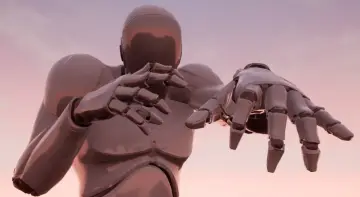
A configurable Unreal Engine swimming system with 150 animations, commented Blueprints, buoyancy, underwater movement, replication, and water support.
Category:Unreal Engine,Locomotion / GaitsPlatform: Unreal EngineEngine version: 5.1+Published: May 20, 2026Updated: Aug 23, 2026
Locomotion / Gaits
Resource overview
Getting a swimming feature into a project usually becomes a mix of movement logic, animation state handling, and water-specific edge cases. Swim Component: 150 Animations + Blueprints approaches that path as a ready-made configurable system, pairing 150 animations with Blueprints and keeping the setup readable through commented Blueprint logic. The package then offers not just a collection of swim motions, but a structured component aimed at putting character swimming into production with less guesswork around how each part is meant to behave.
The package centers on a configurable swimming system that is described as simple and easy to use. That matters most during implementation, where clarity often decides whether a feature can be adapted quickly or turns into a long pass of reverse engineering. Here, all Blueprints are commented to describe what each part does, which gives the system a more maintainable feel for teams that need to understand behavior before changing it. Instead of treating animation and control as separate pieces, it presents them together as one working swim component.
Getting the Swim Component into a character workflow
This resource fits the stage of production where a project already needs interactive water movement rather than placeholder behavior. It is not framed as a single animation drop. It is a full swim component with Blueprints, meant to be configured for a character and adjusted as needed, including values such as swim speed. That makes it suitable for teams that want a swimming layer they can tune instead of a locked behavior set.
The presence of commented Blueprints suggests a workflow where the system can be read, configured, and maintained over time. For developers and technical artists, that can reduce the friction of onboarding the feature into an existing project. For designers, the customizable side is just as important, since the package explicitly supports changes to swimming behavior rather than treating every movement value as fixed.
Its tag set points toward adventure, action, underwater, realistic movement, character work, and blueprint-driven setup. In practice, that places it in projects where water traversal is not an occasional background effect but a meaningful part of movement, encounter design, or scene navigation. Whether the need is surface travel, underwater exploration, or transitional movement between the two, the component is structured around the swimming state as a real gameplay layer.
150 Animations and commented Blueprints
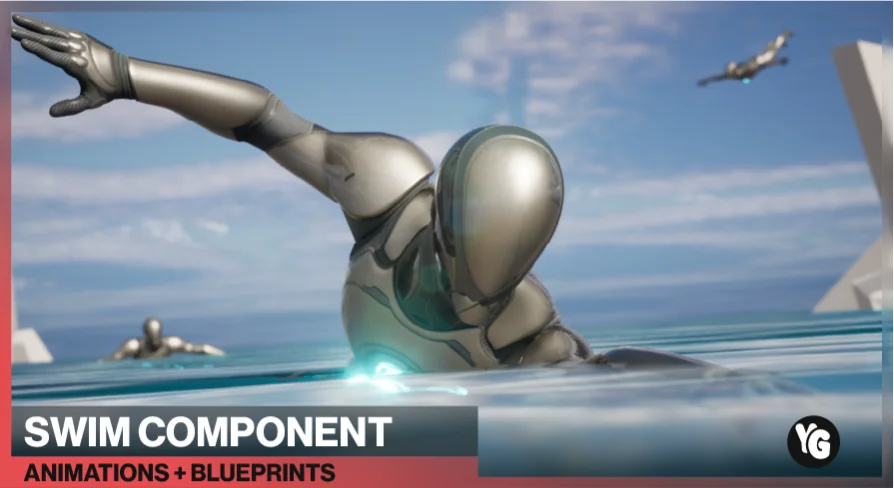
The largest production-facing detail is the combination of 150 animations with Blueprint support. A count like that signals coverage across multiple swim states rather than a minimal set of loops. The system includes overwater and underwater swimming, sprint behavior, swim up and down movement, strafing, leaning, turn in place behavior, deceleration, contextual animations, drowning and death animations, water walking animations, auto diving animations, and a special jumping system. Taken together, those details show that the package is built to handle movement variety around water rather than only forward swim locomotion.
The Blueprint side gives those animations a practical runtime structure. Because all Blueprints are commented, the asset is easier to inspect when adjusting transitions or understanding how a given action is triggered. That kind of documentation inside the Blueprint graph can be especially helpful when a project reaches the polishing stage and teams need to change small interaction details without breaking the larger swim state.
This also changes where the package fits in a pipeline. A plain animation library usually still leaves movement rules, state management, and water interaction logic to the developer. Here, the animation set is already tied to a component system, which moves the resource closer to a gameplay implementation layer. For productions that need swimming to work as a playable character feature, that is a different role than a pack used only for cinematic motion.
Buoyancy, surface control, and underwater state changes
One of the named standout features is a unique buoyancy feature. Within a swimming system, buoyancy is one of the elements that shapes how water movement feels, especially near the surface where characters can otherwise look unstable or mechanical. This package pairs buoyancy with a set of related controls that focus on those difficult transitions: auto surface lock, anti-surface pop, and auto diving animations.
Those details show attention to the moments where swim systems often break immersion. Surface interaction can easily become abrupt when a character rises too quickly, clips through the top of the water state, or snaps between movement modes. Auto surface lock and anti-surface pop point directly at stabilizing that layer of behavior. Auto diving animations handle the opposite direction, giving the system a defined way to transition from surface movement down into underwater motion.
The system also includes swim up and down controls, which are central to underwater navigation, along with leaning and strafing systems that add directional nuance. Sprint support adds another variable for pacing, while the deceleration system helps define what happens when movement input eases off. None of these features are presented as isolated extras; they form a broader control stack for making character movement in water feel responsive across different depths and movement states.
Drowning and death animations add another practical layer. In game production terms, that means the component reaches beyond ideal traversal and into failure states as well. Water walking animations and a special jumping system widen the coverage around the waterline, showing that the package is concerned with interactions around water surfaces, not only with submerged movement.
Unreal Engine water plugin support and network replicated behavior
Compatibility details stay focused and specific. The system supports the Unreal Engine water plugin, and both Water and Bridge plugin are enabled. Those notes place the component inside a broader Unreal water workflow rather than treating it as a standalone movement experiment. For projects already using Unreal's water features, that support matters because swimming systems become far more useful when they align with the existing water setup in the scene.
The package is also network replicated. That makes it relevant for productions where swimming is not only seen locally but needs to function across connected players or synchronized gameplay states. Replication is one of the details that separates a prototype-friendly movement system from one that is more prepared for multiplayer or shared-session development. It does not guarantee every production need is covered, but it does show that the swim behavior has been considered beyond a single-player-only implementation.
Physics-Based Animation is another part of that technical picture. In context with buoyancy and layered movement states, it suggests that the system is not limited to basic animation playback. It is set up to support more physically grounded motion behavior around water, which matches the realistic and motion capture-oriented tags associated with the package.
Update 1.1 and Water Exclusion Volume
Update 1.1 adds Water Exclusion Volume, which is a concrete sign that the system is being maintained with water-specific control needs in mind. Water areas in production scenes rarely behave as a single uninterrupted space. A feature like Water Exclusion Volume points to handling spaces where swimming behavior should be prevented or separated, which is the kind of adjustment that tends to matter once levels become more complex.
This update detail is small, but it says something useful about production readiness. The package is not presented only as a static animation drop; it has at least one documented update that refines how the water system can be managed. Combined with customizable swim speed, Blueprint comments, plugin support, and replication, the component reads as a system that is intended to be worked into an actual project rather than viewed only as a demo of motion capture content.
The practical takeaway is straightforward: this is a swimming implementation layer for Unreal projects that need more than a few water animations. It combines 150 animations, commented Blueprints, buoyancy, surface and underwater control, replication, and water plugin support into a configurable setup that looks ready for teams to inspect, tune, and carry forward in production.
 Locomotion / Gaits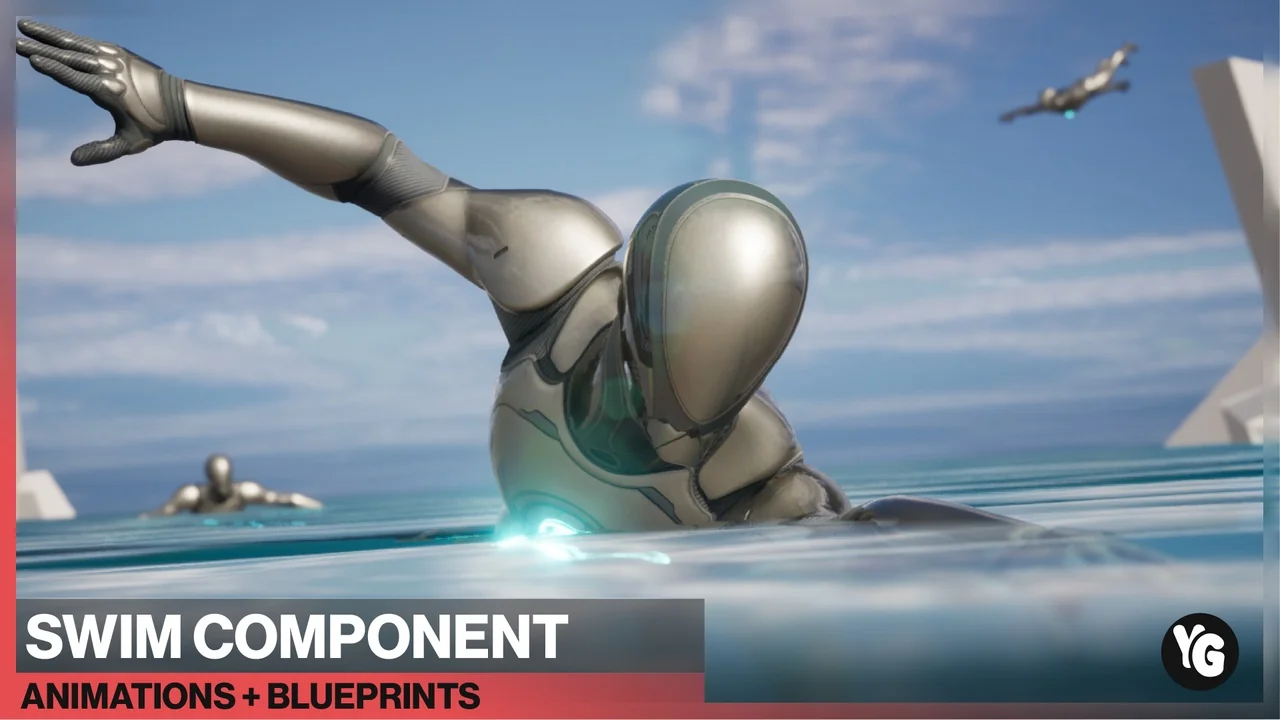
 Locomotion / Gaits
 Locomotion / Gaits
 Locomotion / Gaits