"a338a1d501976271"{"id":"1000019","slug":"post-apocalyptic-signs-vol-2","title":"Post Apocalyptic Signs - VOL 2","category":"Buildings \u0026 Architecture","engine":"4.26+,5.0+","assetVersion":"","engineVersion":"4.26+,5.0+","tag":"Buildings","accent":"blue","visual":"mech","summary":"An Unreal Engine sign pack with 13 meshes, 2K-focused texture sets, master material controls, and a test lighting scene for post-apocalyptic environments.","platform":"Unreal Engine","publishedAt":"2026-05-20T08:56:10.607Z","updatedAt":"2026-05-20T08:56:10.607Z","sourceNotes":[],"fileContents":[],"compatibility":["Unreal Engine","Engine version: 4.26+,5.0+"],"featuredImage":{"alt":"Post Apocalyptic Signs - VOL 2","src":"/wp-content/uploads/published/2026/05/e6ffdf8a377c-71495d9c-c13f-4d54-880a-c78595efa7f4-fdcef70fe3.webp"},"hasDownloadLink":true,"downloads":0,"terms":[{"taxonomy":"category","slug":"buildings-and-architecture","name":"Buildings \u0026 Architecture"}],"galleryImages":[{"src":"/wp-content/uploads/published/2026/05/cb3d71365039-79b10aa8-efd6-4f6b-81b7-53747663ff49-28a420c1db.webp","alt":"Post Apocalyptic Signs - VOL 2"},{"src":"/wp-content/uploads/published/2026/05/d012a2ded579-7fe8ddbd-edaa-4b74-a0ed-923190fc1c4c-8fd92cdb3f.webp","alt":"Post Apocalyptic Signs - VOL 2"},{"src":"/wp-content/uploads/published/2026/05/29a2113e2da8-c39157a2-951e-4769-821a-d2718f7db3bc-b9d0da13fe.webp","alt":"Post Apocalyptic Signs - VOL 2"},{"src":"/wp-content/uploads/published/2026/05/2e9973caffd4-f2ff9be3-8e08-4f0f-a7b9-7f6cf93a8381-ea847c8c62.webp","alt":"Post Apocalyptic Signs - VOL 2"},{"src":"/wp-content/uploads/published/2026/05/2dedaac30250-6a108f18-d1a2-477b-96ab-de80f8404240-fab5ac7ce2.webp","alt":"Post Apocalyptic Signs - VOL 2"},{"src":"/wp-content/uploads/published/2026/05/73e93cb3cb5d-9ff96dff-5cfb-4ea7-b963-1d0bb5d4b641-2341f224ab.webp","alt":"Post Apocalyptic Signs - VOL 2"},{"src":"/wp-content/uploads/published/2026/05/6bf585f0332d-399377c5-8031-4a99-a963-a16b7473c72f-c024d58aab.webp","alt":"Post Apocalyptic Signs - VOL 2"},{"src":"/wp-content/uploads/published/2026/05/ded54b57211a-147075c4-b70e-4f66-97be-9107db431c02-771909889a.webp","alt":"Post Apocalyptic Signs - VOL 2"},{"src":"/wp-content/uploads/published/2026/05/f37a85ff3349-8eba617b-32b4-4530-88ff-0b77add7279a-61f65e44fc.webp","alt":"Post Apocalyptic Signs - VOL 2"},{"src":"/wp-content/uploads/published/2026/05/7178a185f557-bdd1d63b-3209-481c-838e-ecd1d5a7a6fc-595b790176.webp","alt":"Post Apocalyptic Signs - VOL 2"}],"accessPanel":{"kind":"resource","title":"Access this resource","eyebrow":"Free Download","message":"Log in or create a free account to start your download.","fileName":"Content.7z","safetyNote":"Resources are manually reviewed before listing to improve quality and reduce obvious risks.","actionLabel":"Download Free","resourceType":"Resource archive"},"contentHtml":"\u003cp\u003eThe setup path here is straightforward: the project includes the pictured assets, maps, and materials already created in Unreal Engine, so the pack sits naturally inside an environment workflow that starts with placement and look development rather than basic asset assembly. Instead of treating signage as an afterthought, this collection gives it the same level of attention as a hero prop set, with realistic AAA-quality visuals, style, and budget guiding the presentation.\u003c/p\u003e\n\u003cp\u003eThat makes the pack easy to place in the middle of production. A scene artist blocking out an abandoned street, a retro commercial strip, or a damaged exterior can drop in the sign assets, evaluate them under lighting, and then move directly into material adjustment and scene polish. The package is not framed as a loose grab bag. It reads more like a small, focused environment component built to cover a specific visual need in post-apocalyptic worldbuilding.\u003c/p\u003e \u003ch2\u003eGetting Post Apocalyptic Signs - VOL 2 into a scene\u003c/h2\u003e\n\u003cp\u003eThe core of the pack is a set of 13 meshes. That number is specific enough to signal a compact collection and broad enough to support variation across a scene without becoming hard to manage. For production, this is relevant because signage usually works in clusters: one sign helps identify a location, several signs help establish the history of a district. A set of this size can support repeated use across alleys, storefronts, roadside spaces, or ruined business exteriors while still keeping the asset group readable for the artist assembling the level.\u003c/p\u003e\n\u003cp\u003eEverything pictured is included with its assets, maps, and materials. Inside a project, that points to a package intended to arrive with the supporting elements needed to preserve its intended look inside Unreal Engine. That leaves a workflow where the user is not only placing meshes but also working with the material and texture structure that belongs to them.\u003c/p\u003e\n\u003cp\u003eThe thematic tags attached to the pack help define where these signs fit best. Retro, street, abandoned, business, rusty, horror, war, exterior, and apocalyptic all point in the same direction. These are not clean modern branding pieces or neutral filler props. They are environmental storytelling objects for spaces that need visible age, damage, or social collapse. Even the inclusion of fantasy as a tag broadens the application slightly, suggesting the signs can work anywhere a distressed, weathered urban language is useful.\u003c/p\u003e \u003ch2\u003eMaster material controls across props and models\u003c/h2\u003e\n\u003cp\u003eOne of the strongest production-facing details is the master material setup that controls the majority of the props and models. That kind of structure is valuable in a sign pack because signage rarely works in isolation. Artists usually need to coordinate wear, surface response, and overall balance across multiple pieces so the district reads as a single place rather than a row of unrelated props.\u003c/p\u003e\n\u003cp\u003eHere, the pack includes additional controls for roughness, albedo, normals, and more. Those controls create room for look adjustment after the assets are in the level. Roughness changes can push a sign toward a drier, chalkier, or more reflective surface response depending on the environment. Albedo control helps with color balance and scene matching, especially when multiple signs need to sit under the same grade. Normal-related adjustment supports the readability of surface detail, which is important when rust, wear, dents, or age need to hold up at gameplay distance as well as in closer views.\u003c/p\u003e\n\u003cp\u003eBecause the master material controls the majority of the pack, the benefits are not limited to a single prop. The setup supports consistent tuning across the broader collection. In a real workflow, that reduces friction when an artist needs to unify a street set quickly, iterate under changing lighting, or shift the scene from one mood to another without rebuilding every material by hand.\u003c/p\u003e \u003ch2\u003e2K texture sets and channel packed maps\u003c/h2\u003e\n\u003cp\u003eThe texture side is clearly aimed at high-quality presentation. The pack includes high-quality and high-fidelity texture sets, with 2K textures called out as a headline feature. The listed texture sizes are 2048 for 72 textures, 1024 for 2, 512 for 1, and 128 for 4. That distribution shows where the visual emphasis sits: most of the texture work is concentrated at 2048 resolution, which aligns with the pack’s stated target of realistic AAA-quality visuals.\u003c/p\u003e\n\u003cp\u003eFor artists, that texture spread says a lot about how the asset group is meant to function. The bulk of the surface information is being carried by the higher-resolution maps, while a smaller number of textures exist at lower sizes where that is appropriate. It suggests attention to both visual fidelity and production practicality rather than a one-size-fits-all texture approach.\u003c/p\u003e\n\u003cp\u003eThe maps also use channel packing for Roughness, Metalness, and Ambient Occlusion. That detail matters in the material workflow because those are fundamental surface-definition channels for grounded environment assets. Roughness shapes how worn or fresh the sign materials feel under light. Metalness helps define the response of metallic sections and supports believable material separation. Ambient occlusion contributes contact and depth, helping smaller forms and recesses read more clearly.\u003c/p\u003e\n\u003cp\u003ePutting those channels into a packed workflow is a practical choice for game-oriented asset production. It keeps the asset set aligned with an optimized pipeline while still supporting the kind of detailed material behavior expected from realistic environment props.\u003c/p\u003e \u003ch2\u003eRealistic post process, LUT, and the test dynamic lighting scene\u003c/h2\u003e\n\u003cp\u003eRendering support is another area where the pack shows its intended use inside a real production environment. It includes a realistic post process and Look Up Table, along with a test dynamic lighting scene. Those elements push the package beyond raw props and into presentation and validation.\u003c/p\u003e\n\u003cp\u003eA test dynamic lighting scene gives users a direct place to inspect the assets under active lighting conditions rather than only as isolated models. For sign assets, this is especially useful. Surface wear, edge damage, rust tones, and the overall readability of shapes can change dramatically depending on light angle, intensity, and contrast. A dedicated testing setup helps the user evaluate whether the materials and textures are landing correctly before the props are migrated into a larger level.\u003c/p\u003e\n\u003cp\u003eThe realistic post process and LUT also support that evaluation. Signage in a post-apocalyptic environment often needs to sit inside a broader grade where decay, mood, and atmosphere are reinforced by the image treatment as much as by the prop textures. Having those rendering components present means the look is being considered as part of the asset experience, not left entirely for the end user to reconstruct.\u003c/p\u003e\n\u003cp\u003eThis does not turn the pack into a full environment scene, but it does make it easier to move from import to visual review. That is useful during look-dev, set dressing, and polish, when artists need to judge how environment props behave under final or near-final rendering conditions.\u003c/p\u003e \u003ch2\u003eWhere the 13 meshes fit in production\u003c/h2\u003e\n\u003cp\u003eThe pack is optimized for games, and that point helps place it in a production pipeline. It is not only trying to look realistic; it is also prepared for interactive use. That makes it suitable for exterior spaces where signs need to appear repeatedly across traversal routes, environmental storytelling moments, and abandoned business areas without feeling like purely cinematic one-offs.\u003c/p\u003e\n\u003cp\u003eThe models are described as fully detailed from all sides, which expands how they can be staged. A sign that only holds up from a single angle is harder to reuse in an open or exploratory layout. Full side coverage gives more freedom for rotating, reusing, and exposing the asset in different placements, whether it is hanging above a path, leaning against debris, or visible from multiple approach angles in a street scene.\u003c/p\u003e\n\u003cp\u003eAnother practical detail is that all branding and labels are custom made by the studio, with the pack being free of legal issues. In production terms, that helps remove one of the common concerns attached to sign assets: recognizable or borrowed commercial marks. Custom branding keeps the distressed commercial look while avoiding conflicts that can complicate project use.\u003c/p\u003e\n\u003cp\u003eThe style direction remains consistent throughout the pack’s stated themes. These signs belong in post-apocalyptic, horror, war-damaged, retro, and abandoned exterior settings. They can support business districts that need to feel long deserted, roadside environments with remnants of commerce, or fantasy-adjacent spaces that borrow from ruined urban language. Because the assets are presented with realistic quality and game optimization in mind, they are best understood as scene-building props that carry both visual detail and narrative residue.\u003c/p\u003e\n\u003cp\u003eAs a practical takeaway, this pack is most useful when signage needs to do more than decorate a wall. The 13-mesh set, strong emphasis on 2K texture fidelity, master material controls, packed surface maps, custom branding, and included lighting test scene make it a production-ready signage layer for Unreal Engine environments that rely on decay, atmosphere, and believable exterior storytelling.\u003c/p\u003e\n\n\u003ch2\u003eContinue Browsing Similar Packs\u003c/h2\u003e\n\u003cul\u003e\n\u003cli\u003e\u003ca href=\"https://3dcghub.com/post-apocalyptic-melee-weapons-vol-2-post-apocalyptic-melee-weapons-weapon-old/\" title=\"Post Apocalyptic Melee Weapons VOL.2 (Post Apocalyptic Melee Weapons Weapon Old)\"\u003ePost Apocalyptic Melee Weapons VOL.2 (Post Apocalyptic Melee Weapons Weapon Old)\u003c/a\u003e\u003c/li\u003e\n\u003cli\u003e\u003ca href=\"https://3dcghub.com/post-apocalyptic-melee-weapons/\" title=\"Post Apocalyptic Melee Weapons\"\u003ePost Apocalyptic Melee Weapons\u003c/a\u003e\u003c/li\u003e\n\u003cli\u003e\u003ca href=\"https://3dcghub.com/abandoned-train-pack/\" title=\"Abandoned Train Pack\"\u003eAbandoned Train Pack\u003c/a\u003e\u003c/li\u003e\n\u003cli\u003e\u003ca href=\"https://3dcghub.com/customizable-survival-girl/\" title=\"Customizable Survival Girl\"\u003eCustomizable Survival Girl\u003c/a\u003e\u003c/li\u003e\n\u003cli\u003e\u003ca href=\"https://3dcghub.com/ghost-town-vol-3-modular-fences/\" title=\"Ghost Town VOL.3 - Modular Fences\"\u003eGhost Town VOL.3 - Modular Fences\u003c/a\u003e\u003c/li\u003e\n\u003c/ul\u003e","contentTextLength":9506,"navigation":{"current":1455,"total":3338,"previous":{"id":"1000022","slug":"rocket-attack-fx","title":"Rocket Attack FX","category":"Spells \u0026 Combat","platform":"Unreal Engine","updatedAt":"2026-05-20T09:54:08.803Z"},"next":{"id":"1000018","slug":"playground-equipment-vol-2-playground-equipment-swings-slides-climbing-3d","title":"Playground Equipment VOL.2 ( Playground Equipment Swings Slides Climbing 3D )","category":"Outdoors","platform":"Unreal Engine","updatedAt":"2026-05-20T08:50:10.492Z"}},"relatedResources":[{"id":"1000067","slug":"industrial-vol-4-electricity-hydro-and-water-treatment","title":"Industrial VOL.4 - Electricity, Hydro, and Water Treatment","category":"Buildings \u0026 Architecture","engine":"4.26+,5.0+","assetVersion":"","engineVersion":"4.26+,5.0+","tag":"Buildings","accent":"blue","visual":"city","summary":"A 30-mesh Unreal Engine industrial set with 2k+ textures, master materials, fake water shaders, and a test lighting scene for game-ready work.","platform":"Unreal Engine","publishedAt":"2026-05-29T13:50:53.215Z","updatedAt":"2026-05-29T13:50:53.215Z","sourceNotes":[],"fileContents":[],"compatibility":["Unreal Engine","Engine version: 4.26+,5.0+"],"featuredImage":{"alt":"Industrial VOL.4 - Electricity, Hydro, and Water Treatment","src":"/wp-content/uploads/published/2026/05/b143e96a436b-be91d910-a62c-4429-9d9f-1cddb6be762d-53d0bf0025.webp"},"hasDownloadLink":true,"downloads":1},{"id":"1001064","slug":"post-apocalyptic-desert","title":"Post Apocalyptic Desert","category":"Apocalyptic / Post-apocalyptic","engine":"4.26+,5.0+","assetVersion":"","engineVersion":"Engine Version: 4.26+,5.0+","tag":"Apocalyptic","accent":"blue","visual":"mech","summary":"Post Apocalyptic Desert is a Unreal Engine desert environment with a drivable vehicle, extensive props and foliage, advanced materials, plus Nanite/Lumen suppor","platform":"Unreal Engine","publishedAt":"2026-09-03T15:10:50.530Z","updatedAt":"2026-09-03T15:10:50.530Z","sourceNotes":[],"fileContents":[],"compatibility":["Unreal Engine","Engine Version: 4.26+,5.0+"],"featuredImage":{"alt":"Post Apocalyptic Desert","src":"/wp-content/uploads/published/2026/09/c03aaff5c58e-a4df247e-4355-4450-95e8-7efd4f43611d-aba4e12f2c.webp"},"hasDownloadLink":true,"downloads":0},{"id":"28100","slug":"post-apocalyptic-melee-weapons-vol-2-post-apocalyptic-melee-weapons-weapon-old","title":"Post Apocalyptic Melee Weapons VOL.2 (Post Apocalyptic Melee Weapons Weapon Old)","category":"Weapons \u0026 Combat","engine":"4.26+,5.0+","assetVersion":"Engine version: 4.26+,5.0+","engineVersion":"","tag":"Weapons \u0026 Combat","accent":"blue","visual":"city","summary":"Post Apocalyptic Melee Weapons VOL.2 brings together the pictured assets, maps, and materials in an Unreal Engine project. Its stated focus is realistic AAA-quality visuals, with compatibility noted for the Ultimate Level Art Tool.","platform":"Unreal Engine","publishedAt":"2026-05-04T08:21:39.000Z","updatedAt":"2026-05-04T08:21:40.000Z","sourceNotes":[],"fileContents":[],"compatibility":["Unreal Engine","Engine version: 4.26+,5.0+"],"featuredImage":{"alt":"Post Apocalyptic Melee Weapons VOL.2 (Post Apocalyptic Melee Weapons Weapon Old)","src":"https://3dcghub.com/wp-content/uploads/2026/05/1f2485f883aa_16c8546e-3b13-454e-bb27-7b23a3cbdac7.webp"},"hasDownloadLink":true,"downloads":0}]}
Buildings
Post Apocalyptic Signs - VOL 2
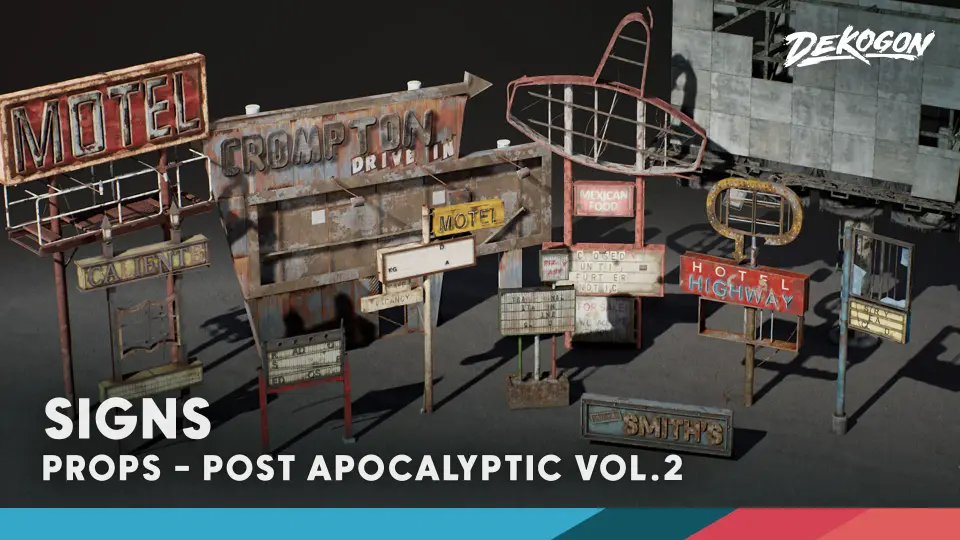
An Unreal Engine sign pack with 13 meshes, 2K-focused texture sets, master material controls, and a test lighting scene for post-apocalyptic environments.
The setup path here is straightforward: the project includes the pictured assets, maps, and materials already created in Unreal Engine, so the pack sits naturally inside an environment workflow that starts with placement and look development rather than basic asset assembly. Instead of treating signage as an afterthought, this collection gives it the same level of attention as a hero prop set, with realistic AAA-quality visuals, style, and budget guiding the presentation.
That makes the pack easy to place in the middle of production. A scene artist blocking out an abandoned street, a retro commercial strip, or a damaged exterior can drop in the sign assets, evaluate them under lighting, and then move directly into material adjustment and scene polish. The package is not framed as a loose grab bag. It reads more like a small, focused environment component built to cover a specific visual need in post-apocalyptic worldbuilding.
Getting Post Apocalyptic Signs - VOL 2 into a scene
The core of the pack is a set of 13 meshes. That number is specific enough to signal a compact collection and broad enough to support variation across a scene without becoming hard to manage. For production, this is relevant because signage usually works in clusters: one sign helps identify a location, several signs help establish the history of a district. A set of this size can support repeated use across alleys, storefronts, roadside spaces, or ruined business exteriors while still keeping the asset group readable for the artist assembling the level.
Everything pictured is included with its assets, maps, and materials. Inside a project, that points to a package intended to arrive with the supporting elements needed to preserve its intended look inside Unreal Engine. That leaves a workflow where the user is not only placing meshes but also working with the material and texture structure that belongs to them.
The thematic tags attached to the pack help define where these signs fit best. Retro, street, abandoned, business, rusty, horror, war, exterior, and apocalyptic all point in the same direction. These are not clean modern branding pieces or neutral filler props. They are environmental storytelling objects for spaces that need visible age, damage, or social collapse. Even the inclusion of fantasy as a tag broadens the application slightly, suggesting the signs can work anywhere a distressed, weathered urban language is useful.
Master material controls across props and models
One of the strongest production-facing details is the master material setup that controls the majority of the props and models. That kind of structure is valuable in a sign pack because signage rarely works in isolation. Artists usually need to coordinate wear, surface response, and overall balance across multiple pieces so the district reads as a single place rather than a row of unrelated props.
Here, the pack includes additional controls for roughness, albedo, normals, and more. Those controls create room for look adjustment after the assets are in the level. Roughness changes can push a sign toward a drier, chalkier, or more reflective surface response depending on the environment. Albedo control helps with color balance and scene matching, especially when multiple signs need to sit under the same grade. Normal-related adjustment supports the readability of surface detail, which is important when rust, wear, dents, or age need to hold up at gameplay distance as well as in closer views.
Because the master material controls the majority of the pack, the benefits are not limited to a single prop. The setup supports consistent tuning across the broader collection. In a real workflow, that reduces friction when an artist needs to unify a street set quickly, iterate under changing lighting, or shift the scene from one mood to another without rebuilding every material by hand.
2K texture sets and channel packed maps
The texture side is clearly aimed at high-quality presentation. The pack includes high-quality and high-fidelity texture sets, with 2K textures called out as a headline feature. The listed texture sizes are 2048 for 72 textures, 1024 for 2, 512 for 1, and 128 for 4. That distribution shows where the visual emphasis sits: most of the texture work is concentrated at 2048 resolution, which aligns with the pack’s stated target of realistic AAA-quality visuals.
For artists, that texture spread says a lot about how the asset group is meant to function. The bulk of the surface information is being carried by the higher-resolution maps, while a smaller number of textures exist at lower sizes where that is appropriate. It suggests attention to both visual fidelity and production practicality rather than a one-size-fits-all texture approach.
The maps also use channel packing for Roughness, Metalness, and Ambient Occlusion. That detail matters in the material workflow because those are fundamental surface-definition channels for grounded environment assets. Roughness shapes how worn or fresh the sign materials feel under light. Metalness helps define the response of metallic sections and supports believable material separation. Ambient occlusion contributes contact and depth, helping smaller forms and recesses read more clearly.
Putting those channels into a packed workflow is a practical choice for game-oriented asset production. It keeps the asset set aligned with an optimized pipeline while still supporting the kind of detailed material behavior expected from realistic environment props.
Realistic post process, LUT, and the test dynamic lighting scene
Rendering support is another area where the pack shows its intended use inside a real production environment. It includes a realistic post process and Look Up Table, along with a test dynamic lighting scene. Those elements push the package beyond raw props and into presentation and validation.
A test dynamic lighting scene gives users a direct place to inspect the assets under active lighting conditions rather than only as isolated models. For sign assets, this is especially useful. Surface wear, edge damage, rust tones, and the overall readability of shapes can change dramatically depending on light angle, intensity, and contrast. A dedicated testing setup helps the user evaluate whether the materials and textures are landing correctly before the props are migrated into a larger level.
The realistic post process and LUT also support that evaluation. Signage in a post-apocalyptic environment often needs to sit inside a broader grade where decay, mood, and atmosphere are reinforced by the image treatment as much as by the prop textures. Having those rendering components present means the look is being considered as part of the asset experience, not left entirely for the end user to reconstruct.
This does not turn the pack into a full environment scene, but it does make it easier to move from import to visual review. That is useful during look-dev, set dressing, and polish, when artists need to judge how environment props behave under final or near-final rendering conditions.
Where the 13 meshes fit in production
The pack is optimized for games, and that point helps place it in a production pipeline. It is not only trying to look realistic; it is also prepared for interactive use. That makes it suitable for exterior spaces where signs need to appear repeatedly across traversal routes, environmental storytelling moments, and abandoned business areas without feeling like purely cinematic one-offs.
The models are described as fully detailed from all sides, which expands how they can be staged. A sign that only holds up from a single angle is harder to reuse in an open or exploratory layout. Full side coverage gives more freedom for rotating, reusing, and exposing the asset in different placements, whether it is hanging above a path, leaning against debris, or visible from multiple approach angles in a street scene.
Another practical detail is that all branding and labels are custom made by the studio, with the pack being free of legal issues. In production terms, that helps remove one of the common concerns attached to sign assets: recognizable or borrowed commercial marks. Custom branding keeps the distressed commercial look while avoiding conflicts that can complicate project use.
The style direction remains consistent throughout the pack’s stated themes. These signs belong in post-apocalyptic, horror, war-damaged, retro, and abandoned exterior settings. They can support business districts that need to feel long deserted, roadside environments with remnants of commerce, or fantasy-adjacent spaces that borrow from ruined urban language. Because the assets are presented with realistic quality and game optimization in mind, they are best understood as scene-building props that carry both visual detail and narrative residue.
As a practical takeaway, this pack is most useful when signage needs to do more than decorate a wall. The 13-mesh set, strong emphasis on 2K texture fidelity, master material controls, packed surface maps, custom branding, and included lighting test scene make it a production-ready signage layer for Unreal Engine environments that rely on decay, atmosphere, and believable exterior storytelling.
 Buildings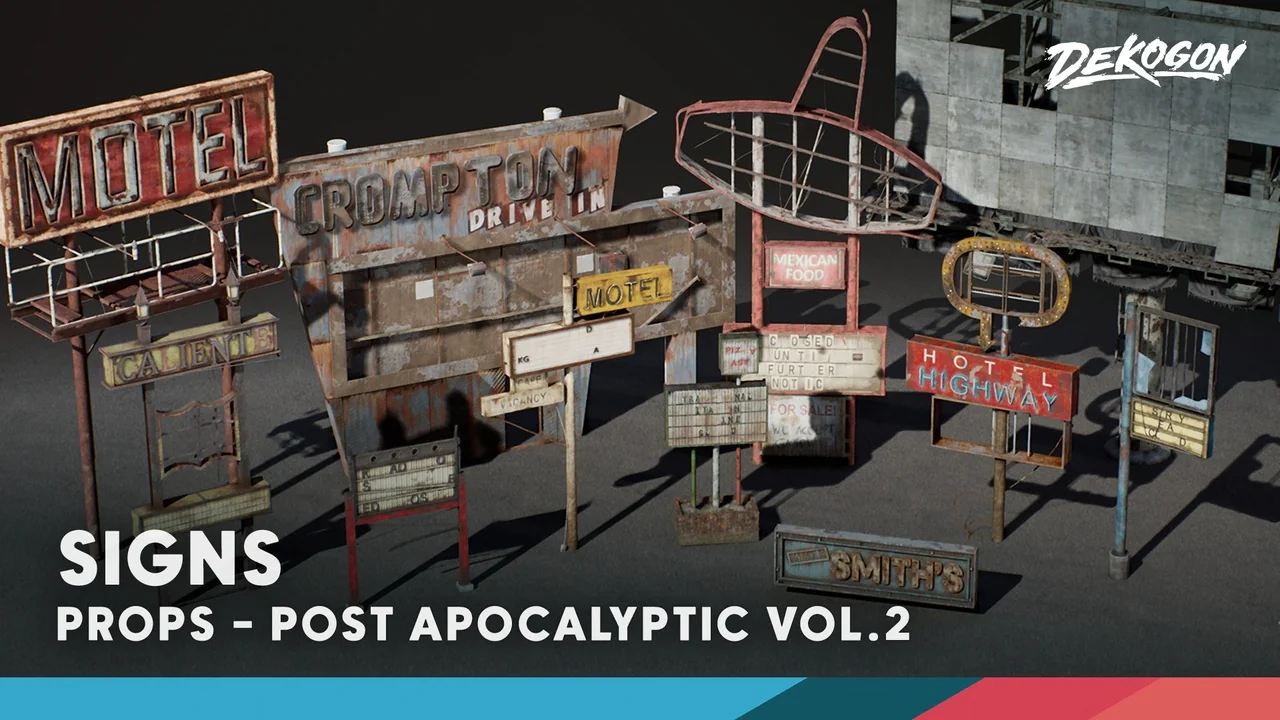
 Buildings
 Apocalyptic
 Weapons & Combat