"c68a05d5e51405b3"{"id":"25115","slug":"replicated-modular-vehicle-v2","title":"Replicated Modular Vehicle V2","category":"Game Mechanics","engine":"5.0+","assetVersion":"Engine version: 5.0+","engineVersion":"","tag":"Game Mechanics","accent":"blue","visual":"luts","summary":"Replicated Modular Vehicle V2 brings a Blueprint-only vehicle system to multiplayer Unreal Engine projects. It includes five game-ready vehicle models, modular placement options, and example blueprints for both 2-seater and 4-seater setups.","platform":"Unreal Engine","publishedAt":"2026-04-19T06:08:54.000Z","updatedAt":"2026-04-20T06:12:32.000Z","sourceNotes":[],"fileContents":[],"compatibility":["Unreal Engine","Engine version: 5.0+"],"featuredImage":{"alt":"Replicated Modular Vehicle V2","src":"https://3dcghub.com/wp-content/uploads/2026/04/be84efcf1880_96c4bb56-ed09-4e2c-8675-750650ec87e5.webp"},"hasDownloadLink":true,"downloads":1,"terms":[{"taxonomy":"category","slug":"game-mechanics","name":"Game Mechanics"},{"taxonomy":"post_tag","slug":"game-systems","name":"Game Systems"},{"taxonomy":"post_tag","slug":"unreal-engine-5","name":"Unreal Engine 5"},{"taxonomy":"post_tag","slug":"vehicles","name":"Vehicles"}],"galleryImages":[{"src":"https://3dcghub.com/wp-content/uploads/2026/04/1d3600c50bea_86129817-1f98-443b-935e-8b789dce4463.webp","alt":"Replicated Modular Vehicle V2"},{"src":"https://3dcghub.com/wp-content/uploads/2026/04/e3edff8d305f_2b5f77f0-a8e0-4e0c-b100-28351eee423c.webp","alt":"Replicated Modular Vehicle V2"},{"src":"https://3dcghub.com/wp-content/uploads/2026/04/f68c6f4a1453_be78be11-bb79-4e1e-a10e-1053f515b145.webp","alt":"Replicated Modular Vehicle V2"},{"src":"https://3dcghub.com/wp-content/uploads/2026/04/095d2cfe0509_f7fcc0ea-6792-4e7c-869a-508528fb7f0b.webp","alt":"Replicated Modular Vehicle V2"},{"src":"https://3dcghub.com/wp-content/uploads/2026/04/7711b4bb0cbe_d219b065-2552-4299-b56c-ade4b8b576aa.webp","alt":"Replicated Modular Vehicle V2"},{"src":"https://3dcghub.com/wp-content/uploads/2026/04/9ed5e9ddeae0_934e129c-7dc0-4f69-ba02-01e053f4454a.webp","alt":"Replicated Modular Vehicle V2"}],"accessPanel":{"kind":"resource","title":"Access this resource","eyebrow":"Free Download","message":"Log in or create a free account to start your download.","fileName":"ReplicatedModularVehicle.7z","safetyNote":"All resources are 100% manually reviewed to eliminate all risks.","actionLabel":"Download Free","resourceType":"Resource archive"},"contentHtml":"\u003ch2\u003eKeeping multiplayer vehicles in sync\u003c/h2\u003e \u003cp\u003eMultiplayer vehicle scenes need more than a drivable model. They need movement, seats, and interaction to stay aligned across players, and this system is built around that problem with fully replicated functionality. The setup uses a 100% Blueprint architecture, so it stays inside Unreal Engine’s visual scripting workflow and does not require C++.\u003c/p\u003e \u003cp\u003eThat makes it easier to drop into a project that needs functioning transport without building the full vehicle framework from scratch. The included models, materials, and animations are part of the system, so the vehicle setup arrives with the pieces needed to start working on gameplay rather than assembling the basics one by one.\u003c/p\u003e \u003ch2\u003eFive vehicle models and a modular layout\u003c/h2\u003e \u003cp\u003eThe core structure centers on five game-ready vehicle models, each paired with a modular approach that lets creators place five module options wherever they want. That gives the system a flexible footprint for scenes that need a vehicle to feel assembled rather than fixed to one rigid form.\u003c/p\u003e \u003cp\u003eBecause the modules can be positioned freely, the vehicle can be adapted to different gameplay needs without changing the overall workflow. A project can lean toward a more compact layout or a more open one, while still staying inside the same modular framework. The design keeps the focus on building with parts instead of rebuilding the entire vehicle for every variation.\u003c/p\u003e \u003ch2\u003eSeat setups for gameplay scenes\u003c/h2\u003e \u003cp\u003eExample blueprints are included for both 2-seater and 4-seater configurations. That is useful when a project needs a vehicle to support different passenger counts without inventing a new structure for each case. The seat layouts make the system relevant for multiplayer situations where players need to share a vehicle and remain synchronized inside it.\u003c/p\u003e \u003cp\u003eThese configurations also help define how the vehicle can fit into a scene. A 2-seater version suits smaller gameplay moments or more compact driving setups, while the 4-seater option opens room for larger party-style movement or group transport. Since the blueprints are part of the system, the seat behavior stays connected to the same replicated vehicle architecture.\u003c/p\u003e \u003ch2\u003eBlueprint comments and setup flow\u003c/h2\u003e \u003cp\u003eThe blueprints are fully commented, and the overall design is intended to be easy to understand, integrate, and develop. That matters when a project needs a vehicle system that can be read, adjusted, and expanded without relying on hidden logic. The structure is meant to make the workflow approachable even when custom additions are planned later.\u003c/p\u003e \u003cp\u003eThere is also a clear setup note: the Chaos Vehicles plugin should be enabled before migrating the files to a project in order for the system to work. That detail shapes the earliest part of the pipeline, especially for teams moving the vehicle into an existing Unreal Engine project. If custom changes create difficulties, support is available through Discord, which gives the setup process a direct place to raise implementation questions.\u003c/p\u003e \u003ch2\u003eUnreal Engine 5 features and project fit\u003c/h2\u003e \u003cp\u003eThe system supports Nanite for Unreal Engine 5.0+ and also supports Lumen for Unreal Engine 5.0+. Those compatibility notes make it a fit for UE5 projects that already use modern rendering features. The vehicle package sits naturally inside that environment while keeping the gameplay side focused on replication and Blueprint-based control.\u003c/p\u003e \u003cp\u003eFor artists and developers, the practical value is in how the system connects presentation and function. The included assets cover the models, materials, and animations, while the replication and Blueprint structure keep the vehicle ready for multiplayer use. It fits projects that need a modular car system with passenger support, interactive behavior, and a clear Unreal Engine workflow, especially when the goal is to build directly on a vehicle foundation that is already organized for shared gameplay.\u003c/p\u003e\n\n\u003ch2\u003eRelated Resources Worth Checking\u003c/h2\u003e\n\u003cul\u003e\n\u003cli\u003e\u003ca href=\"https://3dcghub.com/advanced-unreal-engine-5-multiplayer-gameplay-programming/\" title=\"Advanced Unreal Engine 5 Multiplayer Gameplay Programming\"\u003eAdvanced Unreal Engine 5 Multiplayer Gameplay Programming\u003c/a\u003e\u003c/li\u003e\n\u003cli\u003e\u003ca href=\"https://3dcghub.com/niagara-beginners-to-advanced-in-unreal-engine-5/\" title=\"Niagara Beginners to advanced in Unreal Engine 5\"\u003eNiagara Beginners to advanced in Unreal Engine 5\u003c/a\u003e\u003c/li\u003e\n\u003cli\u003e\u003ca href=\"https://3dcghub.com/create-zelda-like-skills-with-c-in-unreal-engine-5-2/\" title=\"Create Zelda-like skills with C++ in unreal engine 5\"\u003eCreate Zelda-like skills with C++ in unreal engine 5\u003c/a\u003e\u003c/li\u003e\n\u003cli\u003e\u003ca href=\"https://3dcghub.com/main-menus-beginner-class-unreal-engine-5/\" title=\"Main Menus Beginner Class – Unreal Engine 5\"\u003eMain Menus Beginner Class – Unreal Engine 5\u003c/a\u003e\u003c/li\u003e\n\u003cli\u003e\u003ca href=\"https://3dcghub.com/create-zelda-like-skills-with-c-in-unreal-engine-5/\" title=\"Create Zelda-like skills with C++ in unreal engine 5\"\u003eCreate Zelda-like skills with C++ in unreal engine 5\u003c/a\u003e\u003c/li\u003e\n\u003c/ul\u003e","contentTextLength":4223,"navigation":{"current":2220,"total":3860,"previous":{"id":"25129","slug":"road-creator-pro","title":"Road Creator Pro","category":"Procedural Systems","platform":"Unreal Engine","updatedAt":"2026-04-20T06:12:32.000Z"},"next":{"id":"25106","slug":"polygon-samurai-pack","title":"POLYGON - Samurai Pack","category":"Religious","platform":"Unreal Engine","updatedAt":"2026-04-20T06:12:32.000Z"}},"relatedResources":[{"id":"1001828","slug":"replicated-drivable-gokart-blueprint","title":"Replicated Drivable Gokart (Blueprint)","category":"Vehicles \u0026 Transportation","engine":"5.0+","assetVersion":"","engineVersion":"Engine Version: 5.0+","tag":"Vehicles","accent":"blue","visual":"mech","summary":"Explore the Replicated Drivable Gokart for Unreal Engine, featuring native vehicle physics, multiplayer replication, rigged skeletal meshes, and custom lighting","platform":"Unreal Engine","publishedAt":"2026-10-21T08:20:49.526Z","updatedAt":"2026-10-21T08:20:49.526Z","sourceNotes":[],"fileContents":[],"compatibility":["Unreal Engine","Engine Version: 5.0+"],"featuredImage":{"alt":"Replicated Drivable Gokart (Blueprint)","src":"/wp-content/uploads/published/2026/10/0158e36d8f36-baa6c062-d685-4943-b955-32c41359465d-ce1bf6a53f.webp"},"hasDownloadLink":true,"downloads":0},{"id":"1000444","slug":"trail-hunter-pro-footprints-and-tracks-with-multiplayer-and-worldpartition","title":"Trail Hunter PRO - Footprints and Tracks with Multiplayer \u0026 WorldPartition","category":"Game Mechanics","engine":"5.6 - 5.8","assetVersion":"Asset Version: 1.2.0","engineVersion":"Engine Version: 5.6 - 5.8","tag":"Game Mechanics","accent":"blue","visual":"mech","summary":"Trail Hunter PRO is an Unreal Engine footprint and surface deformation system supporting characters, vehicles, multiplayer, World Partition, and Nanite landscap","platform":"Unreal Engine","publishedAt":"2026-07-11T00:14:44.112Z","updatedAt":"2026-09-07T16:47:15.348Z","sourceNotes":[],"fileContents":[],"compatibility":["Unreal Engine","Asset Version: 1.2.0","Engine Version: 5.6 - 5.8"],"featuredImage":{"alt":"Trail Hunter PRO - Footprints and Tracks with Multiplayer \u0026 WorldPartition","src":"/wp-content/uploads/published/2026/07/5b17dd490cfd-2a6d2707-e6f6-4678-90e0-d85b0ade2a13-6b68ff6c25.webp"},"hasDownloadLink":true,"downloads":3},{"id":"1001298","slug":"advanced-phone-system-v3-replicated","title":"Advanced Phone System V3 Replicated","category":"Game Mechanics","engine":"5.1+","assetVersion":"","engineVersion":"Engine Version: 5.1+","tag":"Game Mechanics","accent":"blue","visual":"mech","summary":"Explore the Advanced Phone System V3 Replicated for Unreal Engine, featuring 15 Blueprints, multiplayer sync, NPC dialogue, and in-game smartphone apps.","platform":"Unreal Engine","publishedAt":"2026-10-02T06:00:01.725Z","updatedAt":"2026-10-02T06:00:01.725Z","sourceNotes":[],"fileContents":[],"compatibility":["Unreal Engine","Engine Version: 5.1+"],"featuredImage":{"alt":"Advanced Phone System V3 Replicated","src":"/wp-content/uploads/published/2026/10/085245bcd14e-a13d28d0-643a-4a32-bc84-d79f901d6112-a65bc3e443.webp"},"hasDownloadLink":true,"downloads":0}]}
Game Mechanics
Replicated Modular Vehicle V2
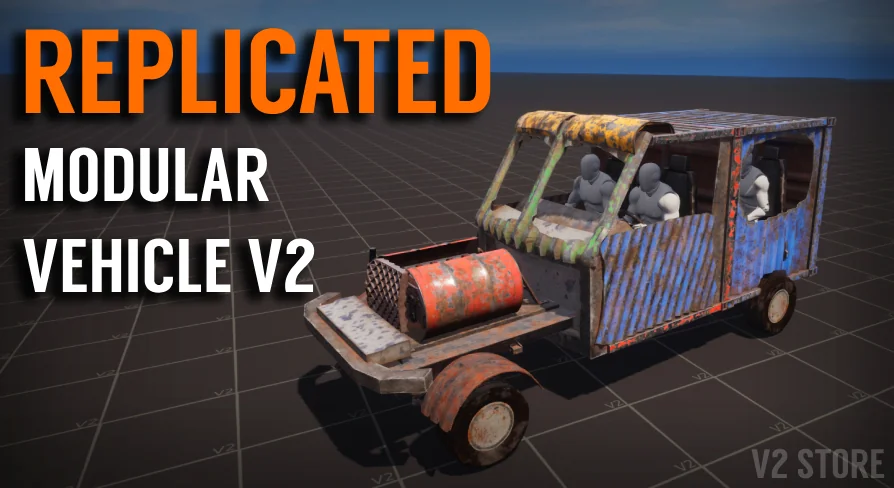
Replicated Modular Vehicle V2 brings a Blueprint-only vehicle system to multiplayer Unreal Engine projects. It includes five game-ready vehicle models, modular placement options, and example blueprints for both 2-seater and 4-seater setups.
Multiplayer vehicle scenes need more than a drivable model. They need movement, seats, and interaction to stay aligned across players, and this system is built around that problem with fully replicated functionality. The setup uses a 100% Blueprint architecture, so it stays inside Unreal Engine’s visual scripting workflow and does not require C++.
That makes it easier to drop into a project that needs functioning transport without building the full vehicle framework from scratch. The included models, materials, and animations are part of the system, so the vehicle setup arrives with the pieces needed to start working on gameplay rather than assembling the basics one by one.
Five vehicle models and a modular layout
The core structure centers on five game-ready vehicle models, each paired with a modular approach that lets creators place five module options wherever they want. That gives the system a flexible footprint for scenes that need a vehicle to feel assembled rather than fixed to one rigid form.
Because the modules can be positioned freely, the vehicle can be adapted to different gameplay needs without changing the overall workflow. A project can lean toward a more compact layout or a more open one, while still staying inside the same modular framework. The design keeps the focus on building with parts instead of rebuilding the entire vehicle for every variation.
Seat setups for gameplay scenes
Example blueprints are included for both 2-seater and 4-seater configurations. That is useful when a project needs a vehicle to support different passenger counts without inventing a new structure for each case. The seat layouts make the system relevant for multiplayer situations where players need to share a vehicle and remain synchronized inside it.
These configurations also help define how the vehicle can fit into a scene. A 2-seater version suits smaller gameplay moments or more compact driving setups, while the 4-seater option opens room for larger party-style movement or group transport. Since the blueprints are part of the system, the seat behavior stays connected to the same replicated vehicle architecture.
Blueprint comments and setup flow
The blueprints are fully commented, and the overall design is intended to be easy to understand, integrate, and develop. That matters when a project needs a vehicle system that can be read, adjusted, and expanded without relying on hidden logic. The structure is meant to make the workflow approachable even when custom additions are planned later.
There is also a clear setup note: the Chaos Vehicles plugin should be enabled before migrating the files to a project in order for the system to work. That detail shapes the earliest part of the pipeline, especially for teams moving the vehicle into an existing Unreal Engine project. If custom changes create difficulties, support is available through Discord, which gives the setup process a direct place to raise implementation questions.
Unreal Engine 5 features and project fit
The system supports Nanite for Unreal Engine 5.0+ and also supports Lumen for Unreal Engine 5.0+. Those compatibility notes make it a fit for UE5 projects that already use modern rendering features. The vehicle package sits naturally inside that environment while keeping the gameplay side focused on replication and Blueprint-based control.
For artists and developers, the practical value is in how the system connects presentation and function. The included assets cover the models, materials, and animations, while the replication and Blueprint structure keep the vehicle ready for multiplayer use. It fits projects that need a modular car system with passenger support, interactive behavior, and a clear Unreal Engine workflow, especially when the goal is to build directly on a vehicle foundation that is already organized for shared gameplay.
 Game Mechanics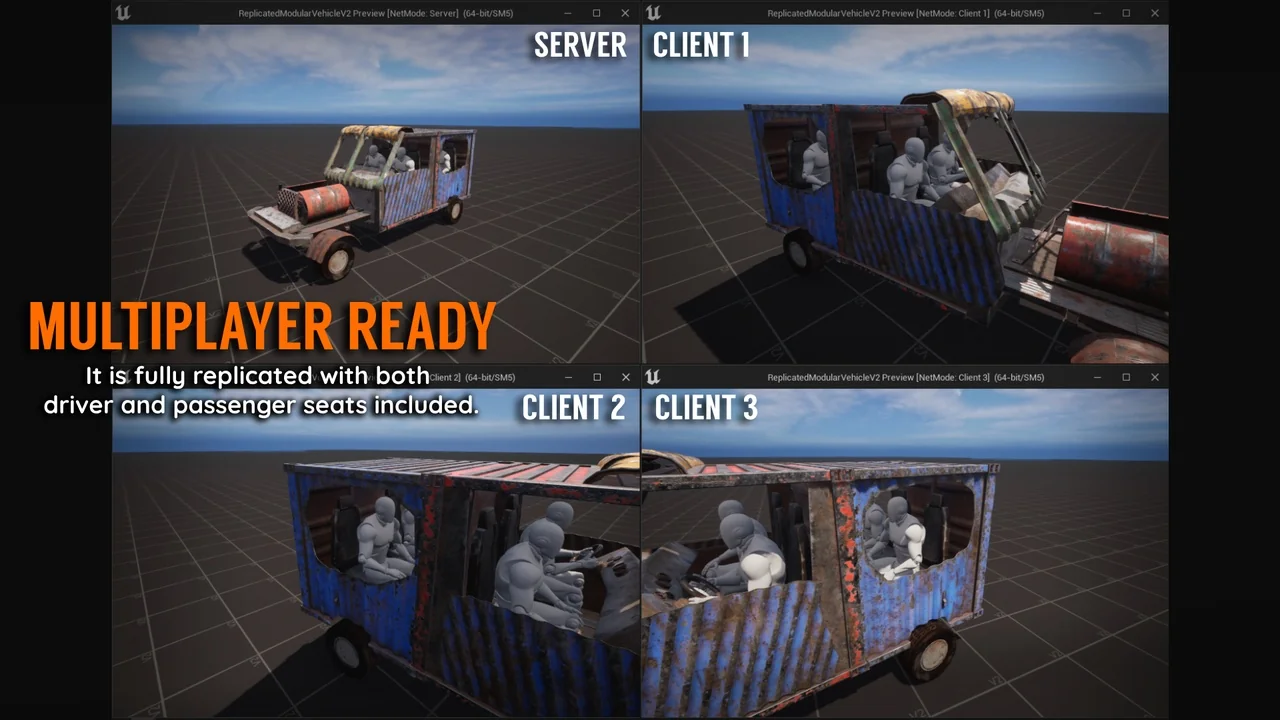
 Vehicles
 Game Mechanics
 Game Mechanics