"148d1066ed74e216"{"id":"1002967","slug":"modular-skeleton","title":"Modular skeleton","category":"Creatures \u0026 Monsters","engine":"5.0+","assetVersion":"","engineVersion":"Engine Version: 5.0+","tag":"Creatures","accent":"blue","visual":"character","summary":"Examine the low-poly Modular skeleton asset featuring 4K PBR textures, modular limb swaps, two skull variants, and Epic Skeleton compatibility.","platform":"Unreal Engine","indexPolicy":"index","publishedAt":"2026-11-22T13:00:39.145Z","updatedAt":"2026-11-22T13:00:39.145Z","sourceNotes":[],"fileContents":[],"compatibility":["Unreal Engine","Engine Version: 5.0+"],"featuredImage":{"alt":"Modular skeleton","src":"/wp-content/uploads/published/2026/11/4831ae262ca3-149745f9-9ce5-4f0a-9c0a-da3968c5ce1b-c53e482170.webp"},"fileSizeBytes":806427227,"hasDownloadLink":true,"downloads":0,"terms":[{"taxonomy":"category","slug":"creatures-and-monsters","name":"Creatures \u0026 Monsters"}],"galleryImages":[{"src":"/wp-content/uploads/published/2026/11/bed5640f8caf-c72a639d-2754-4036-8fb5-ff112737bf98-0927fe9790.webp","alt":"Modular skeleton"},{"src":"/wp-content/uploads/published/2026/11/849d51c1e7de-663b40e3-0ff8-4a2d-a06c-5eb93d7bb712-3e71572ef9.webp","alt":"Modular skeleton"},{"src":"/wp-content/uploads/published/2026/11/7f61a372340f-2c268236-f088-4582-a2ff-7f0a059f503a-6ac00629bc.webp","alt":"Modular skeleton"},{"src":"/wp-content/uploads/published/2026/11/ff278a08d3f6-65b61aa8-34df-4fb6-aa64-22623cf3d525-1240bfa31f.webp","alt":"Modular skeleton"},{"src":"/wp-content/uploads/published/2026/11/e1bcaa810f33-6b040650-e280-46da-81fc-cfd72b1a23bd-669fcb64ef.webp","alt":"Modular skeleton"},{"src":"/wp-content/uploads/published/2026/11/77f0eec22a8d-ff522ad3-68fe-477a-9cde-371e2440d086-887377ec6a.webp","alt":"Modular skeleton"},{"src":"/wp-content/uploads/published/2026/11/a2be56c48257-857d48f6-9c36-4a67-8e55-3b82e1c1bc90-db80624bdc.webp","alt":"Modular skeleton"}],"accessPanel":{"kind":"resource","title":"Get this resource","safetyNote":"Resources are manually reviewed before listing to improve quality and reduce obvious risks.","fileName":"Content.7z","resourceType":"Resource archive","versions":[]},"contentHtml":"\u003ch2\u003eCrypts, Catacombs, and Modular Skeleton Assembly\u003c/h2\u003e\u003cp\u003eDungeon corridors, ruined necropolises, and desolate battlefields consistently rely on the undead to populate combat spaces. Creating varied legions of skeletal enemies often presents a challenge when every wandering monster shares identical proportions and identical wear. The Modular skeleton tackles this repetition by giving developers a low-poly foundational creature asset configured for straightforward structural changes. Designed to represent the dead across several fantasy tropes—from mindless reanimated foot soldiers to sinister lich commanders—the asset provides the physical base needed to build varied undead rosters.\u003c/p\u003e\u003cp\u003eBecause environmental context dictates how decayed an encounter should feel, the mesh operates on an interchangeable logic. A damp tomb might demand ancient remains stripped of their weapons and half-broken, while a necromancer’s vanguard requires fully intact, threatening bone structures. By breaking the model into distinct anatomical segments, the asset lets creators populate catacombs without stamping out uniform copies across a level.\u003c/p\u003e\u003ch2\u003eBone Swaps and Structural Anatomy in the Skeleton Blueprint\u003c/h2\u003e\u003cp\u003eThe core utility of this low-poly character lies in its swappable component system. The model separates into discrete zones: hands, forearms, whole arms, skulls, jaws, and ribs. Rather than dealing with a single, rigid mesh that must be modified in external digital content creation tools, developers can detach or replace individual sections directly.\u003c/p\u003e\u003cp\u003ePhysical variation is further expanded through built-in alternate shapes. The package contains two distinct skulls, two separate jaws, and two different rib formations. Swapping between these shapes fundamentally alters the profile of the undead creature:\u003c/p\u003e\u003cul\u003e\u003cli\u003e\u003cstrong\u003eSkull and Jaw Variations:\u003c/strong\u003e Selecting between the two skulls and matching or mismatching the two jaws produces different head silhouettes, shifting a monster from a standard reanimated dead soldier to a snarling, misshapen horror.\u003c/li\u003e\u003cli\u003e\u003cstrong\u003eRib Formations:\u003c/strong\u003e Switching between the two rib cage designs alters the chest volume, allowing for hulking, broad-chested skeletal fighters or narrow, hollowed-out undead minions.\u003c/li\u003e\u003cli\u003e\u003cstrong\u003eComponent Removal:\u003c/strong\u003e Arms, forearms, and hands can be completely toggled off or mixed. An encounter can feature one-armed crawling corpses, skeletons missing a jawbone, or heavily degraded bone warriors stripped down to ribs and a skull.\u003c/li\u003e\u003c/ul\u003e\u003cp\u003eThe included demo blueprint demonstrates how these swappable meshes fit together. By combining the script setup with the modular parts, the project provides a clean reference for managing mesh components on a single character framework. Developers can inspect how the demo blueprint assigns each modular socket or component, streamlining the process of assembling specialized variants like skeletal archers, crippled graveyard wanderers, or two-handed juggernauts.\u003c/p\u003e\u003ch2\u003eAnimation Blueprint Readiness and the Epic Skeleton\u003c/h2\u003e\u003cp\u003eRigging and movement define how convincing an undead creature appears in motion, whether it lurches forward unevenly or attacks with precision. The asset is structured through the Epic skeleton standard and includes support for animation blueprints. This standard alignment ensures that existing walk cycles, combat stances, stagger reactions, and death falls can drive the bone mesh without extensive retargeting work.\u003c/p\u003e\u003cp\u003eBecause the hands, forearms, and larger arm assemblies can be removed or swapped independently, the skeletal mesh retains its skinning and weight data across the shared rig. If a developer needs an animation blueprint where a damaged monster drags a single remaining arm across stone flagstones, the underlying rig handles the movement while the missing limbs simply stay omitted. This script-friendly setup saves production time when implementing large enemy pools that must share state machines, hit-reaction blends, and ragdoll transitions.\u003c/p\u003e\u003ch2\u003eHigh-Resolution 4K Textures on Low-Poly Geometry\u003c/h2\u003e\u003cp\u003eMaintaining clear visual definition without ballooning polygon budgets is a constant balance in real-time game development. This model utilizes a low-poly geometry count paired with high-detail 4K PBR textures. The realistic bone material captures the pitted surfaces, calcified ridges, and weathered grime typical of long-buried remains.\u003c/p\u003e\u003cp\u003eMaterial customization is an explicit focus of the asset, supported directly by an included video tutorial. The 4K texture resolution ensures that close-up views—such as first-person combat strikes or dialogue cutscenes with an undead NPC—retain fine surface details like surface cracks and dry marrow. When configured for different lighting environments, the PBR maps respond accurately to flickering torches, moonlight, or magical spell effects. Creators looking to change bone coloration, apply mossy stains, or introduce wet rot to the surfaces can follow the video material breakdown to tune parameters without breaking texture fidelity.\u003c/p\u003e\u003ch2\u003eGenre Deployment Across Strategy, RPG, and First-Person Titles\u003c/h2\u003e\u003cp\u003eDifferent game genres pose distinct technical and stylistic requirements for creature models. Because of its low-poly foundation and high-resolution texturing, the Modular skeleton scales effectively across three distinct production types:\u003c/p\u003e\u003cp\u003eIn real-time strategy or top-down tactical games, rendering hundreds of units at once demands restrained polygon counts. The low-poly construction keeps baseline rendering overhead manageable, while the swappable ribs, arms, and skulls prevent massive swarms from looking like identical clones viewed from an isometric camera.\u003c/p\u003e\u003cp\u003eFor role-playing games, MMOs, and MMORPG environments, visual variety is critical for progression. Skeletons often serve as starter dungeon mobs, summoned familiars, mid-tier dungeon guardians, and high-level lich lieutenants. Leveraging the two skull types, alternating jaws, and removable limbs makes it straightforward to visually rank enemies from brittle, missing-limb fodder to fully assembled, armored undead champions.\u003c/p\u003e\u003cp\u003eFirst-person games place the player directly against the enemy’s face and weapon swings. In these perspectives, low-resolution surfaces immediately break immersion. The 4K PBR textures hold up under point-blank scrutiny, allowing the hollow eye sockets, individually defined teeth, and textured bone seams to deliver the necessary visual weight during immediate melee clashes.\u003c/p\u003e\u003ch2\u003eProject Implementation Strategy\u003c/h2\u003e\u003cp\u003eIntegrating the Modular skeleton into an active pipeline begins with reviewing the demo blueprint to understand how the meshes register with the skeleton hierarchy. Teams targeting dense enemy mobs should assemble preset blueprint variations beforehand—pairing specific skull types with distinct rib models and missing limbs to establish recognizable combat tiers. For projects requiring tight visual cohesion with existing environments, tuning the customizable materials via the provided tutorial ensures the bone surfaces match the exact age, dampness, and tone of the world they inhabit.\u003c/p\u003e\n\n\u003ch2\u003eMore From The Same Workflow\u003c/h2\u003e\n\u003cul\u003e\n\u003cli\u003e\u003ca href=\"https://3dcghub.com/stone-golem/\" rel=\"noopener noreferrer\"\u003eStone Golem\u003c/a\u003e\u003c/li\u003e\n\u003cli\u003e\u003ca href=\"https://3dcghub.com/monsters-skeleton/\" rel=\"noopener noreferrer\"\u003eMonsters - Skeleton\u003c/a\u003e\u003c/li\u003e\n\u003cli\u003e\u003ca href=\"https://3dcghub.com/orc-collection/\" rel=\"noopener noreferrer\"\u003eOrc Collection\u003c/a\u003e\u003c/li\u003e\n\u003cli\u003e\u003ca href=\"https://3dcghub.com/undead-knight/\" rel=\"noopener noreferrer\"\u003eUndead Knight\u003c/a\u003e\u003c/li\u003e\n\u003cli\u003e\u003ca href=\"https://3dcghub.com/demon-7/\" rel=\"noopener noreferrer\"\u003eDemon 7\u003c/a\u003e\u003c/li\u003e\n\u003c/ul\u003e","contentTextLength":7103,"navigation":{"current":2,"total":4890,"previous":{"id":"1002968","slug":"zombie-bloated-male","title":"Zombie - Bloated Male","category":"Characters \u0026 Creatures","platform":"Unreal Engine","updatedAt":"2026-11-22T14:36:15.265Z"},"next":{"id":"1002966","slug":"wild-tribe-warriors","title":"Wild Tribe warriors","category":"Characters \u0026 Creatures","platform":"Unreal Engine","updatedAt":"2026-11-22T12:58:29.358Z"}},"relatedResources":[{"id":"1002603","slug":"stone-golem","title":"Stone Golem","category":"Creatures \u0026 Monsters","engine":"5.0+","assetVersion":"","engineVersion":"Engine Version: 5.0+","tag":"Creatures","accent":"blue","visual":"character","summary":"Examine the Stone Golem asset, featuring a 3.2m scale, Epic skeleton rigging, 4-finger hand setup, customizable colors, and stone, snow, and lava materials.","platform":"Unreal Engine","indexPolicy":"index","publishedAt":"2026-11-14T05:57:34.256Z","updatedAt":"2026-11-14T05:57:34.256Z","sourceNotes":[],"fileContents":[],"compatibility":["Unreal Engine","Engine Version: 5.0+"],"featuredImage":{"alt":"Stone Golem","src":"/wp-content/uploads/published/2026/11/84fc89e5354d-a051387d-fec3-468a-ae45-47fc5e3bdd65-a86c288e90.webp"},"fileSizeBytes":144861077,"hasDownloadLink":true,"downloads":0},{"id":"2043","slug":"monsters-skeleton","title":"Monsters - Skeleton","category":"Creatures \u0026 Monsters","engine":"5.4+","assetVersion":"Engine version: 5.4+","engineVersion":"4.17","tag":"Creatures","accent":"blue","visual":"character","summary":"Enhance your game with this AAA-quality skeleton character. Optimized for VR, mobile, and PC, it features PBR textures and Epic Skeleton compatibility.","platform":"Unreal Engine","indexPolicy":"noindex","publishedAt":"2026-02-06T23:00:56.000Z","updatedAt":"2026-04-19T15:58:25.000Z","sourceNotes":[],"fileContents":[],"compatibility":["Unreal Engine","Engine version: 5.4+"],"featuredImage":{"alt":"Monsters - Skeleton","src":"https://3dcghub.com/wp-content/uploads/2026/02/e838c2c8-6e72-406b-b6c9-32c9be52581f.webp"},"fileSizeBytes":149044397,"hasDownloadLink":true,"downloads":0},{"id":"1001541","slug":"orc-collection","title":"Orc Collection","category":"Creatures \u0026 Monsters","engine":"4.18+,5.0+","assetVersion":"","engineVersion":"Engine Version: 4.18+,5.0+","tag":"Creatures","accent":"blue","visual":"character","summary":"A technical breakdown of the Orc Collection featuring five modular character models, Epic Skeleton rigs, texture setups, and engine cloth configurations.","platform":"Unreal Engine","indexPolicy":"index","publishedAt":"2026-10-09T17:34:05.651Z","updatedAt":"2026-10-09T17:34:05.651Z","sourceNotes":[],"fileContents":[],"compatibility":["Unreal Engine","Engine Version: 4.18+,5.0+"],"featuredImage":{"alt":"Orc Collection","src":"/wp-content/uploads/published/2026/10/9ff3bb5a9361-628d553e-be49-4cb9-9960-86f1d5ed21f2-13ae042025.webp"},"fileSizeBytes":5148554675,"hasDownloadLink":true,"downloads":0}]}[{"id":4225,"sourceId":4225,"taxonomyId":4225,"taxonomy":"category","slug":"asset-library","name":"Asset Library","parentId":null,"count":4744,"hasChildren":true,"href":"/","seoTitle":"Free Game Assets Library | 3DCGHUB","seoDescription":"Browse free Unreal Engine, Unity, Blender assets and game development tutorials on 3DCGHUB with previews, compatibility notes, and secure downloads.","sitemapEnabled":true,"children":[{"id":4227,"sourceId":4227,"taxonomyId":4227,"taxonomy":"category","slug":"blender-add-ons-plugins","name":"Blender Add-ons \u0026 Plugins","parentId":4225,"count":10,"hasChildren":false,"href":"/category/blender-add-ons-plugins/","seoTitle":"Free Blender Add-ons \u0026 Plugins | 3DCGHUB","seoDescription":"Browse free Blender Add-ons \u0026 Plugins tools for Blender on 3DCGHUB: curated downloads with preview images, compatibility notes and secure download access.","sitemapEnabled":true},{"id":514,"sourceId":514,"taxonomyId":514,"taxonomy":"category","slug":"unity-2","name":"Unity","parentId":4225,"count":453,"hasChildren":true,"href":"/category/unity-2/","seoTitle":"Free Unity Assets | 3DCGHUB","seoDescription":"Browse free Unity resources on 3DCGHUB: curated downloads with preview images, compatibility notes and secure download access.","sitemapEnabled":true,"children":[{"id":523,"sourceId":523,"taxonomyId":523,"taxonomy":"category","slug":"2d","name":"2D","parentId":514,"count":1,"hasChildren":true,"href":"/category/2d/","seoTitle":"Free Unity 2D | 3DCGHUB","seoDescription":"Browse free 2D assets for Unity on 3DCGHUB: curated downloads with preview images, compatibility notes and secure download access.","sitemapEnabled":true},{"id":515,"sourceId":515,"taxonomyId":515,"taxonomy":"category","slug":"3d-unity-2","name":"3D","parentId":514,"count":162,"hasChildren":true,"href":"/category/3d-unity-2/","seoTitle":"Free Unity 3D Assets | 3DCGHUB","seoDescription":"Browse free 3D assets for Unity on 3DCGHUB: curated downloads with preview images, compatibility notes and secure download access.","sitemapEnabled":true},{"id":565,"sourceId":565,"taxonomyId":565,"taxonomy":"category","slug":"add-ons","name":"Add-Ons","parentId":514,"count":2,"hasChildren":false,"href":"/category/add-ons/","seoTitle":"Free Unity Add-Ons | 3DCGHUB","seoDescription":"Browse free Add-Ons assets for Unity on 3DCGHUB: curated downloads with preview images, compatibility notes and secure download access.","sitemapEnabled":true},{"id":529,"sourceId":529,"taxonomyId":529,"taxonomy":"category","slug":"audio-unity-2","name":"Audio","parentId":514,"count":1,"hasChildren":true,"href":"/category/audio-unity-2/","seoTitle":"Free Unity Audio | 3DCGHUB","seoDescription":"Browse free Audio for Unity on 3DCGHUB: curated downloads with preview images, compatibility notes and secure download access.","sitemapEnabled":true},{"id":557,"sourceId":557,"taxonomyId":557,"taxonomy":"category","slug":"templates","name":"Templates","parentId":514,"count":36,"hasChildren":true,"href":"/category/templates/","seoTitle":"Free Unity Templates | 3DCGHUB","seoDescription":"Browse free Unity project templates on 3DCGHUB. Starter kits with previews, compatibility notes, and secure download access.","sitemapEnabled":true},{"id":533,"sourceId":533,"taxonomyId":533,"taxonomy":"category","slug":"tools-unity-2","name":"Tools","parentId":514,"count":0,"hasChildren":true,"href":"/category/tools-unity-2/","sitemapEnabled":true},{"id":554,"sourceId":554,"taxonomyId":554,"taxonomy":"category","slug":"vfx-unity-2","name":"VFX","parentId":514,"count":4,"hasChildren":true,"href":"/category/vfx-unity-2/","seoTitle":"Free Unity VFX | 3DCGHUB","seoDescription":"Browse free VFX for Unity on 3DCGHUB: curated downloads with preview images, compatibility notes and secure download access.","sitemapEnabled":true}]},{"id":511,"sourceId":511,"taxonomyId":511,"taxonomy":"category","slug":"unreal-engine-2","name":"Unreal Engine","parentId":4225,"count":4282,"hasChildren":true,"href":"/category/unreal-engine-2/","seoTitle":"Free Unreal Engine Assets | 3DCGHUB","seoDescription":"Browse free Unreal Engine resources on 3DCGHUB: curated downloads with preview images, compatibility notes and secure download access.","sitemapEnabled":true,"children":[{"id":54,"sourceId":54,"taxonomyId":54,"taxonomy":"category","slug":"3d","name":"3D","parentId":511,"count":2428,"hasChildren":true,"href":"/category/3d/","seoTitle":"Free Unreal Engine 3D | 3DCGHUB","seoDescription":"Browse free 3D assets for Unreal Engine on 3DCGHUB: curated downloads with preview images, compatibility notes and secure download access.","sitemapEnabled":true},{"id":441,"sourceId":441,"taxonomyId":441,"taxonomy":"category","slug":"animations","name":"Animations","parentId":511,"count":245,"hasChildren":true,"href":"/category/animations/","seoTitle":"Free Unreal Engine Animations | 3DCGHUB","seoDescription":"Browse free Animations for Unreal Engine on 3DCGHUB: curated downloads with preview images, compatibility notes and secure download access.","sitemapEnabled":true},{"id":446,"sourceId":446,"taxonomyId":446,"taxonomy":"category","slug":"audio","name":"Audio","parentId":511,"count":63,"hasChildren":true,"href":"/category/audio/","seoTitle":"Free Unreal Engine Audio Resources | 3DCGHUB","seoDescription":"Browse free Unreal Engine audio resources including sound effects, voices, dialogue, and ambient sounds. Curated free downloads on 3DCGHUB.","sitemapEnabled":true},{"id":466,"sourceId":466,"taxonomyId":466,"taxonomy":"category","slug":"game-systems","name":"Game Systems","parentId":511,"count":356,"hasChildren":true,"href":"/category/game-systems/","seoTitle":"Free Unreal Engine Game Systems | 3DCGHUB","seoDescription":"Browse free Game Systems tools for Unreal Engine on 3DCGHUB: curated downloads with preview images, compatibility notes and secure download access.","sitemapEnabled":true},{"id":478,"sourceId":478,"taxonomyId":478,"taxonomy":"category","slug":"game-templates","name":"Game Templates","parentId":511,"count":150,"hasChildren":true,"href":"/category/game-templates/","seoTitle":"Free Unreal Engine Game Templates | 3DCGHUB","seoDescription":"Browse free Game Templates for Unreal Engine on 3DCGHUB: curated downloads with preview images, compatibility notes and secure download access.","sitemapEnabled":true},{"id":432,"sourceId":432,"taxonomyId":432,"taxonomy":"category","slug":"hdri","name":"HDRI","parentId":511,"count":6,"hasChildren":true,"href":"/category/hdri/","seoTitle":"Free Unreal Engine HDRI | 3DCGHUB","seoDescription":"Browse free Unreal Engine HDRI skies and lighting maps on 3DCGHUB. Environment lighting with previews and secure downloads.","sitemapEnabled":true},{"id":228,"sourceId":228,"taxonomyId":228,"taxonomy":"category","slug":"material-and-textures","name":"Material \u0026 Textures","parentId":511,"count":172,"hasChildren":true,"href":"/category/material-and-textures/","seoTitle":"Free Unreal Engine Material \u0026 Textures | 3DCGHUB","seoDescription":"Browse free Material \u0026 Textures for Unreal Engine on 3DCGHUB: curated downloads with preview images, compatibility notes and secure download access.","sitemapEnabled":true},{"id":298,"sourceId":298,"taxonomyId":298,"taxonomy":"category","slug":"sprites-and-flipbooks","name":"Sprites \u0026 Flipbooks","parentId":511,"count":17,"hasChildren":true,"href":"/category/sprites-and-flipbooks/","seoTitle":"Free Unreal Engine Sprites \u0026 Flipbooks | 3DCGHUB","seoDescription":"Browse free Sprites \u0026 Flipbooks assets for Unreal Engine on 3DCGHUB: curated downloads with preview images, compatibility notes and secure download access.","sitemapEnabled":true},{"id":489,"sourceId":489,"taxonomyId":489,"taxonomy":"category","slug":"tools-and-plugins","name":"Tools \u0026 Plugins","parentId":511,"count":390,"hasChildren":true,"href":"/category/tools-and-plugins/","seoTitle":"Free Unreal Engine Tools \u0026 Plugins | 3DCGHUB","seoDescription":"Browse free Tools \u0026 Plugins for Unreal Engine on 3DCGHUB: curated downloads with preview images, compatibility notes and secure download access.","sitemapEnabled":true},{"id":459,"sourceId":459,"taxonomyId":459,"taxonomy":"category","slug":"ui","name":"UI","parentId":511,"count":43,"hasChildren":true,"href":"/category/ui/","seoTitle":"Free Unreal Engine UI | 3DCGHUB","seoDescription":"Browse free UI for Unreal Engine on 3DCGHUB: curated downloads with preview images, compatibility notes and secure download access.","sitemapEnabled":true},{"id":450,"sourceId":450,"taxonomyId":450,"taxonomy":"category","slug":"vfx","name":"VFX","parentId":511,"count":412,"hasChildren":true,"href":"/category/vfx/","seoTitle":"Free Unreal Engine VFX | 3DCGHUB","seoDescription":"Browse free VFX for Unreal Engine on 3DCGHUB: curated downloads with preview images, compatibility notes and secure download access.","sitemapEnabled":true}]}]},{"id":4222,"sourceId":4222,"taxonomyId":4222,"taxonomy":"category","slug":"tutorial-library","name":"Tutorial Library","parentId":null,"count":117,"hasChildren":false,"href":"/tutorials/","seoTitle":"Free Game Development Tutorial Library | 3DCGHUB","seoDescription":"Browse free game development tutorials for Unreal Engine, Unity, Blender, and more on 3DCGHUB with practical workflows and secure downloads.","sitemapEnabled":true}]
Resource screenshots
1 / 7
Join our channel
Follow 3DCGHUB on Telegram for new resource drops, migration updates, and community notices.
Dungeon corridors, ruined necropolises, and desolate battlefields consistently rely on the undead to populate combat spaces. Creating varied legions of skeletal enemies often presents a challenge when every wandering monster shares identical proportions and identical wear. The Modular skeleton tackles this repetition by giving developers a low-poly foundational creature asset configured for straightforward structural changes. Designed to represent the dead across several fantasy tropes—from mindless reanimated foot soldiers to sinister lich commanders—the asset provides the physical base needed to build varied undead rosters.
Because environmental context dictates how decayed an encounter should feel, the mesh operates on an interchangeable logic. A damp tomb might demand ancient remains stripped of their weapons and half-broken, while a necromancer’s vanguard requires fully intact, threatening bone structures. By breaking the model into distinct anatomical segments, the asset lets creators populate catacombs without stamping out uniform copies across a level.
Bone Swaps and Structural Anatomy in the Skeleton Blueprint
The core utility of this low-poly character lies in its swappable component system. The model separates into discrete zones: hands, forearms, whole arms, skulls, jaws, and ribs. Rather than dealing with a single, rigid mesh that must be modified in external digital content creation tools, developers can detach or replace individual sections directly.
Physical variation is further expanded through built-in alternate shapes. The package contains two distinct skulls, two separate jaws, and two different rib formations. Swapping between these shapes fundamentally alters the profile of the undead creature:
Skull and Jaw Variations: Selecting between the two skulls and matching or mismatching the two jaws produces different head silhouettes, shifting a monster from a standard reanimated dead soldier to a snarling, misshapen horror.
Rib Formations: Switching between the two rib cage designs alters the chest volume, allowing for hulking, broad-chested skeletal fighters or narrow, hollowed-out undead minions.
Component Removal: Arms, forearms, and hands can be completely toggled off or mixed. An encounter can feature one-armed crawling corpses, skeletons missing a jawbone, or heavily degraded bone warriors stripped down to ribs and a skull.
The included demo blueprint demonstrates how these swappable meshes fit together. By combining the script setup with the modular parts, the project provides a clean reference for managing mesh components on a single character framework. Developers can inspect how the demo blueprint assigns each modular socket or component, streamlining the process of assembling specialized variants like skeletal archers, crippled graveyard wanderers, or two-handed juggernauts.
Animation Blueprint Readiness and the Epic Skeleton
Rigging and movement define how convincing an undead creature appears in motion, whether it lurches forward unevenly or attacks with precision. The asset is structured through the Epic skeleton standard and includes support for animation blueprints. This standard alignment ensures that existing walk cycles, combat stances, stagger reactions, and death falls can drive the bone mesh without extensive retargeting work.
Because the hands, forearms, and larger arm assemblies can be removed or swapped independently, the skeletal mesh retains its skinning and weight data across the shared rig. If a developer needs an animation blueprint where a damaged monster drags a single remaining arm across stone flagstones, the underlying rig handles the movement while the missing limbs simply stay omitted. This script-friendly setup saves production time when implementing large enemy pools that must share state machines, hit-reaction blends, and ragdoll transitions.
High-Resolution 4K Textures on Low-Poly Geometry
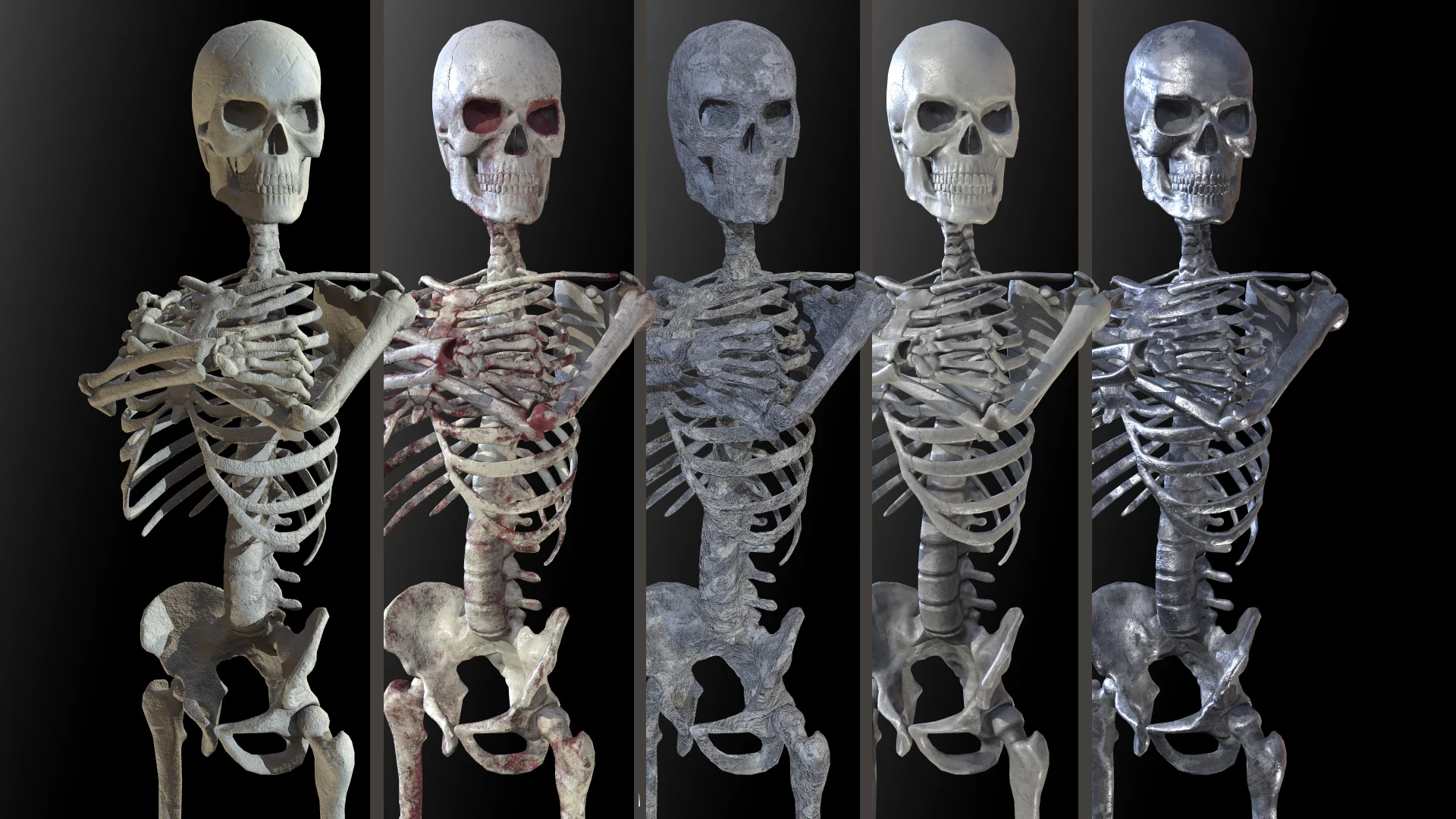
Maintaining clear visual definition without ballooning polygon budgets is a constant balance in real-time game development. This model utilizes a low-poly geometry count paired with high-detail 4K PBR textures. The realistic bone material captures the pitted surfaces, calcified ridges, and weathered grime typical of long-buried remains.
Material customization is an explicit focus of the asset, supported directly by an included video tutorial. The 4K texture resolution ensures that close-up views—such as first-person combat strikes or dialogue cutscenes with an undead NPC—retain fine surface details like surface cracks and dry marrow. When configured for different lighting environments, the PBR maps respond accurately to flickering torches, moonlight, or magical spell effects. Creators looking to change bone coloration, apply mossy stains, or introduce wet rot to the surfaces can follow the video material breakdown to tune parameters without breaking texture fidelity.
Genre Deployment Across Strategy, RPG, and First-Person Titles
Different game genres pose distinct technical and stylistic requirements for creature models. Because of its low-poly foundation and high-resolution texturing, the Modular skeleton scales effectively across three distinct production types:
In real-time strategy or top-down tactical games, rendering hundreds of units at once demands restrained polygon counts. The low-poly construction keeps baseline rendering overhead manageable, while the swappable ribs, arms, and skulls prevent massive swarms from looking like identical clones viewed from an isometric camera.
For role-playing games, MMOs, and MMORPG environments, visual variety is critical for progression. Skeletons often serve as starter dungeon mobs, summoned familiars, mid-tier dungeon guardians, and high-level lich lieutenants. Leveraging the two skull types, alternating jaws, and removable limbs makes it straightforward to visually rank enemies from brittle, missing-limb fodder to fully assembled, armored undead champions.
First-person games place the player directly against the enemy’s face and weapon swings. In these perspectives, low-resolution surfaces immediately break immersion. The 4K PBR textures hold up under point-blank scrutiny, allowing the hollow eye sockets, individually defined teeth, and textured bone seams to deliver the necessary visual weight during immediate melee clashes.
Project Implementation Strategy
Integrating the Modular skeleton into an active pipeline begins with reviewing the demo blueprint to understand how the meshes register with the skeleton hierarchy. Teams targeting dense enemy mobs should assemble preset blueprint variations beforehand—pairing specific skull types with distinct rib models and missing limbs to establish recognizable combat tiers. For projects requiring tight visual cohesion with existing environments, tuning the customizable materials via the provided tutorial ensures the bone surfaces match the exact age, dampness, and tone of the world they inhabit.
 Creatures
 Creatures
 Creatures