"0148f1904a9b0d16"{"id":"1002589","slug":"modular-container-houses-survival-base-pack","title":"Modular Container Houses - Survival Base Pack","category":"Buildings \u0026 Architecture","engine":"5.3+","assetVersion":"","engineVersion":"Engine Version: 5.3+","tag":"Buildings","accent":"blue","visual":"mech","summary":"Examine the technical layout, mesh variations, and assembly workflows inside the Modular Container Houses - Survival Base Pack for survival environments.","platform":"Unreal Engine","indexPolicy":"index","publishedAt":"2026-11-14T05:33:05.397Z","updatedAt":"2026-11-14T05:33:05.397Z","sourceNotes":[],"fileContents":[],"compatibility":["Unreal Engine","Engine Version: 5.3+"],"featuredImage":{"alt":"Modular Container Houses - Survival Base Pack","src":"/wp-content/uploads/published/2026/11/901f666fbd16-40502053-52f8-477f-981e-4da40fba7074-03b85a8d39.webp"},"hasDownloadLink":true,"downloads":0,"terms":[{"taxonomy":"category","slug":"buildings-and-architecture","name":"Buildings \u0026 Architecture"}],"galleryImages":[{"src":"/wp-content/uploads/published/2026/11/132f32c6ac2f-80ef96c1-5df3-422f-83b8-0445ac69109f-8f9540d194.webp","alt":"Modular Container Houses - Survival Base Pack"},{"src":"/wp-content/uploads/published/2026/11/9379ee2db649-ddefd5aa-e4f1-42ea-9b36-7d26d925b415-9b03ce83c9.webp","alt":"Modular Container Houses - Survival Base Pack"},{"src":"/wp-content/uploads/published/2026/11/079102e41fa4-5a3479be-4138-4121-acf7-4c672360c945-ad40378af5.webp","alt":"Modular Container Houses - Survival Base Pack"},{"src":"/wp-content/uploads/published/2026/11/3dbe9d76f129-c53e6ae1-e21e-4fe2-9e1d-c555c6b95dad-cd9af00b62.webp","alt":"Modular Container Houses - Survival Base Pack"},{"src":"/wp-content/uploads/published/2026/11/e76902721288-fac0eb97-5d99-4909-a0cb-7e7f3b6308e2-a93d9fdf89.webp","alt":"Modular Container Houses - Survival Base Pack"},{"src":"/wp-content/uploads/published/2026/11/a3b22db82cdf-c0fce82d-5594-4843-a9fc-2ccca27bfdc8-d48d4b782e.webp","alt":"Modular Container Houses - Survival Base Pack"},{"src":"/wp-content/uploads/published/2026/11/69381548f0d1-e0db3992-9f8f-43ba-b11f-dcaff53a45cd-340274b212.webp","alt":"Modular Container Houses - Survival Base Pack"}],"accessPanel":{"kind":"resource","title":"Get this resource","eyebrow":"Free resource","message":"Download this resource in your browser.","fileName":"Content.7z","safetyNote":"Resources are manually reviewed before listing to improve quality and reduce obvious risks.","actionLabel":"Get this resource","resourceType":"Resource archive","versions":[]},"contentHtml":"\u003ch2\u003eConstructing Survival Outposts and Fortifications\u003c/h2\u003e\n\u003cp\u003eSurvival game environments frequently rely on modular, repurposed architecture to establish tone, history, and player progression. The Modular Container Houses - Survival Base Pack provides a focused asset collection tailored to building everything from simple shelter compounds to fortified defensive complexes. By utilizing converted shipping containers alongside industrial framing, the package supports the layout of practical living quarters, defensive barricades, elevated transit bridges, and observation towers.\u003c/p\u003e\n\u003cp\u003eEnvironmental design in survival projects often requires balancing scrap-built aesthetics with sturdy industrial elements. Because the package divides its structural assets across distinct metal and wooden fabrications, developers can vary the defensive integrity and visual age of different player outposts. A newly fortified base might feature reinforced steel paneling and sealed container doors, while an improvised outpost deep in the wilderness can lean into wooden wall panels, open frames, and patched window openings.\u003c/p\u003e \u003ch2\u003eThe Core Modular Container Structural Elements\u003c/h2\u003e\n\u003cp\u003eAt the center of the package are static meshes built to conform to two standard container sizes. These core volumes define the footprints for individual rooms, storage bays, or multi-story structures. To adapt these basic shipping boxes into habitable or functional game spaces, the pack includes 82 static meshes that snap and fit across horizontal and vertical axes.\u003c/p\u003e\n\u003cp\u003eWall assemblies are split evenly between wood and metal options. Creators have access to five distinct metal wall models and five matching wood wall models for solid structural envelopes. When access and perimeter sightlines are required, the kit provides dedicated framing meshes:\u003c/p\u003e\n\u003cul\u003e \u003cli\u003eFive metal wall door models and five wood wall door models designed to accept standard passage doors.\u003c/li\u003e \u003cli\u003eSix metal window door variants and six wood window door variants for ventilation ports, firing slits, or observation gaps.\u003c/li\u003e \u003cli\u003eThree dedicated container door models crafted specifically for the ends of the large and small container hulls.\u003c/li\u003e \u003cli\u003eThree standalone metal door models and two wood door models to seal off interior and exterior access points.\u003c/li\u003e\n\u003c/ul\u003e\n\u003cp\u003eHaving matched sets of wood and metal wall components allows level designers to construct visual hierarchy within a single settlement. Critical sections like armories or perimeter chokepoints can be framed in heavy corrugated steel, while secondary partitions or residential dorms take advantage of timber cladding.\u003c/p\u003e \u003ch2\u003eBase Foundation and Vertical Framework\u003c/h2\u003e\n\u003cp\u003eTerrain irregularity is a common challenge when laying out survival bases across outdoor landscapes. The package solves elevation changes and foundational support through dedicated ground-interface pieces. Four metal base models serve as anchors beneath the primary container shells, lifting living units off uneven dirt, mud, or rocky surfaces.\u003c/p\u003e\n\u003cp\u003eWhen stacking units to build watchtowers or two-story habitation hubs, two metal support models act as structural load-bearing columns. Vertical circulation is handled through four metal stair models, which interface with container roofs and elevated platforms. Designers can turn the flat surfaces of shipping containers into walkable battlements or walkways by integrating five specialized metal grid models. These industrial grids function equally well as external catwalks, floor grates, safety rails, or modular bridge platforms spanning the gap between two separate container houses.\u003c/p\u003e\n\u003cp\u003eRoofing elements complete the exterior shell. The asset pack includes five metal roof models and five wood roof models, providing sloped or reinforced caps to place atop standard container boxes. These caps break up the boxy silhouettes typical of basic shipping units and prevent water pooling or visual repetition across larger compound settlements.\u003c/p\u003e \u003ch2\u003eSurfacing Workflow with 4K Textures and Material Instances\u003c/h2\u003e\n\u003cp\u003eMaterial flexibility and memory management are critical when instancing dozens of modular pieces across a large scene. The collection organizes its surface rendering through a single core master material that drives 29 distinct material instances. This structure allows global parameter adjustments while providing targeted visual divergence across metal plates, rough timber planks, rusted grids, and painted container sidings.\u003c/p\u003e\n\u003cp\u003eThe asset package includes 48 individual textures authored at 4096 x 4096 resolution. This 4K texture resolution maintains surface fidelity even when players inspect walls, door handles, and structural supports from immediate first-person camera distances. The wear, weathering, and material separation across the painted metals and wood grains provide the tactile quality required for grounded survival settings without demanding multiple disjointed shader setups.\u003c/p\u003e \u003ch2\u003eAssembly Templates and Merged Actor Layouts\u003c/h2\u003e\n\u003cp\u003eTo accelerate level assembly and provide clear references for scale, the pack includes five pre-configured house group models. These example templates demonstrate practical arrangements of container hulls, stairs, exterior catwalks, and roof coverings, serving as immediate drop-in dwellings for fast level prototyping.\u003c/p\u003e\n\u003cp\u003eIn addition to raw static meshes and reference groups, the collection contains 13 actor mergers. These merged actor configurations bundle complex groupings of walls, frames, and foundational steel pieces into unified objects. Utilizing these pre-combined assemblies reduces per-object draw overhead in dense encampments and streamlines the initial construction phase when laying down town layouts, military barricades, or multi-container compounds.\u003c/p\u003e\n\u003cp\u003eFor projects requiring extended industrial frameworks, the package maintains structural and aesthetic compatibility with the Modular Steel Structures Pack - Building \u0026 Watchtowers. Combining both collections allows developers to transition container-based living quarters directly into heavy-duty observation towers, industrial framework bridges, and expansive logistical outposts using a shared construction language.\u003c/p\u003e\n\n\u003ch2\u003eRelated Resources Worth Checking\u003c/h2\u003e\n\u003cul\u003e\n\u003cli\u003e\u003ca href=\"https://3dcghub.com/elven-modular-architecture/\" rel=\"noopener noreferrer\"\u003eElven Modular Architecture\u003c/a\u003e\u003c/li\u003e\n\u003cli\u003e\u003ca href=\"https://3dcghub.com/ghost-town-vol-2-abandoned-houses/\" rel=\"noopener noreferrer\"\u003eGhost Town VOL.2 - Abandoned Houses\u003c/a\u003e\u003c/li\u003e\n\u003cli\u003e\u003ca href=\"https://3dcghub.com/ghost-town-vol-4-abandoned-houses/\" rel=\"noopener noreferrer\"\u003eGhost Town VOL.4 - Abandoned Houses\u003c/a\u003e\u003c/li\u003e\n\u003cli\u003e\u003ca href=\"https://3dcghub.com/lake-house-01-with-interiors-4k-pbr/\" rel=\"noopener noreferrer\"\u003eLAKE HOUSE 01 with INTERIORS 4K PBR\u003c/a\u003e\u003c/li\u003e\n\u003cli\u003e\u003ca href=\"https://3dcghub.com/modular-wooden-buildings-modular-house-houses-modular-building/\" rel=\"noopener noreferrer\"\u003eModular Wooden Buildings (Modular House, Houses, Modular Building)\u003c/a\u003e\u003c/li\u003e\n\u003c/ul\u003e","contentTextLength":6304,"navigation":{"current":60,"total":4543,"previous":{"id":"1002590","slug":"modular-japanese-architecture-pack","title":"Modular Japanese Architecture Pack","category":"Buildings \u0026 Architecture","platform":"Unreal Engine","updatedAt":"2026-11-14T05:34:06.312Z"},"next":{"id":"1002588","slug":"modern-bridges","title":"Modern Bridges","category":"Buildings \u0026 Architecture","platform":"Unreal Engine","updatedAt":"2026-11-14T05:32:12.044Z"}},"relatedResources":[{"id":"1002594","slug":"poly-mega-survival-tools","title":"POLY - Mega Survival Tools","category":"Containers","engine":"5.0+","assetVersion":"","engineVersion":"Engine Version: 5.0+","tag":"Containers","accent":"blue","visual":"mech","summary":"POLY - Mega Survival Tools provides 219 low-poly 3D models of construction, storage, and utility props mapped to a single 1024x1024 texture for survival games.","platform":"Unreal Engine","indexPolicy":"index","publishedAt":"2026-11-14T05:38:36.992Z","updatedAt":"2026-11-14T05:38:36.992Z","sourceNotes":[],"fileContents":[],"compatibility":["Unreal Engine","Engine Version: 5.0+"],"featuredImage":{"alt":"POLY - Mega Survival Tools","src":"/wp-content/uploads/published/2026/11/8cef9e059f23-53eacb1f-b0c7-45b3-88ad-e254c17e2a94-3c32d78b8b.webp"},"hasDownloadLink":true,"downloads":0},{"id":"27618","slug":"elven-modular-architecture","title":"Elven Modular Architecture","category":"Buildings \u0026 Architecture","engine":"5.0+","assetVersion":"Engine version: 5.0+","engineVersion":"5.0","tag":"Buildings","accent":"blue","visual":"mech","summary":"Elven Modular Architecture brings together modular fantasy building pieces for towns, houses, mansions, castles, and city scenes. It combines Nanite-ready meshes, custom collision, and material controls for moss, dirt, and debris so the look can be adjusted...","platform":"Unreal Engine","indexPolicy":"index","publishedAt":"2026-04-26T13:27:49.000Z","updatedAt":"2026-04-26T13:27:50.000Z","sourceNotes":[],"fileContents":[],"compatibility":["Unreal Engine","Engine version: 5.0+"],"featuredImage":{"alt":"Elven Modular Architecture","src":"https://3dcghub.com/wp-content/uploads/2026/04/f362aaf7e1bd_188b6bc3-ef8d-4595-8ec8-e273f7835607.webp"},"hasDownloadLink":true,"downloads":2},{"id":"1000012","slug":"ghost-town-vol-2-abandoned-houses","title":"Ghost Town VOL.2 - Abandoned Houses","category":"Buildings \u0026 Architecture","engine":"5.1+","assetVersion":"","engineVersion":"5.1+","tag":"Buildings","accent":"blue","visual":"mech","summary":"Ghost Town VOL.2 - Abandoned Houses includes 81 detailed meshes, modular parts, and weathered wooden structures rendered in Unreal Engine 5.4.","platform":"Unreal Engine","indexPolicy":"index","publishedAt":"2026-05-19T17:52:50.617Z","updatedAt":"2026-05-22T20:13:28.985Z","sourceNotes":[],"fileContents":[],"compatibility":["Unreal Engine","Engine version: 5.1+"],"featuredImage":{"alt":"Ghost Town VOL.2 - Abandoned Houses","src":"/wp-content/uploads/published/2026/05/7f2664310d73-68a4378a-e060-4a40-9d89-bc1be7165f21-a9f14d2975.webp"},"hasDownloadLink":true,"downloads":1}]}
Buildings
Modular Container Houses - Survival Base Pack
Examine the technical layout, mesh variations, and assembly workflows inside the Modular Container Houses - Survival Base Pack for survival environments.
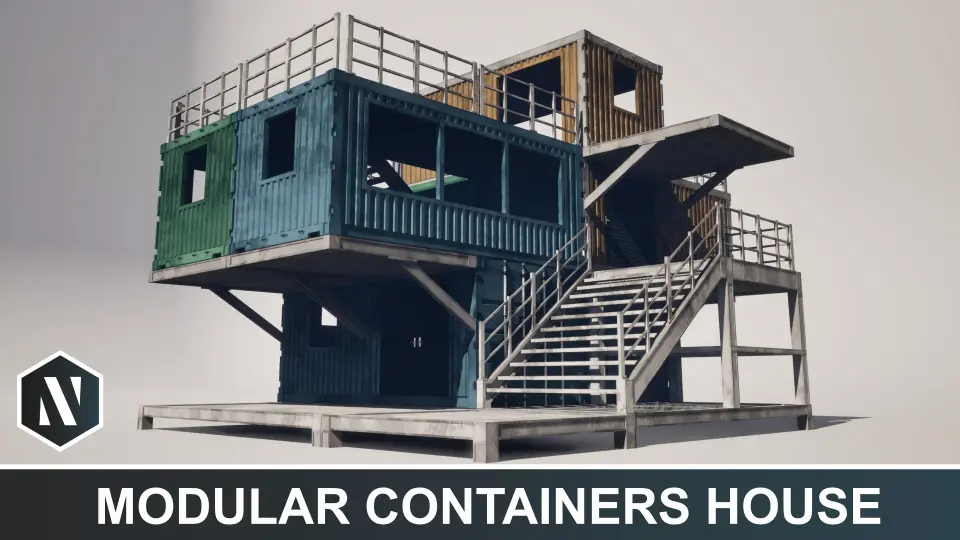
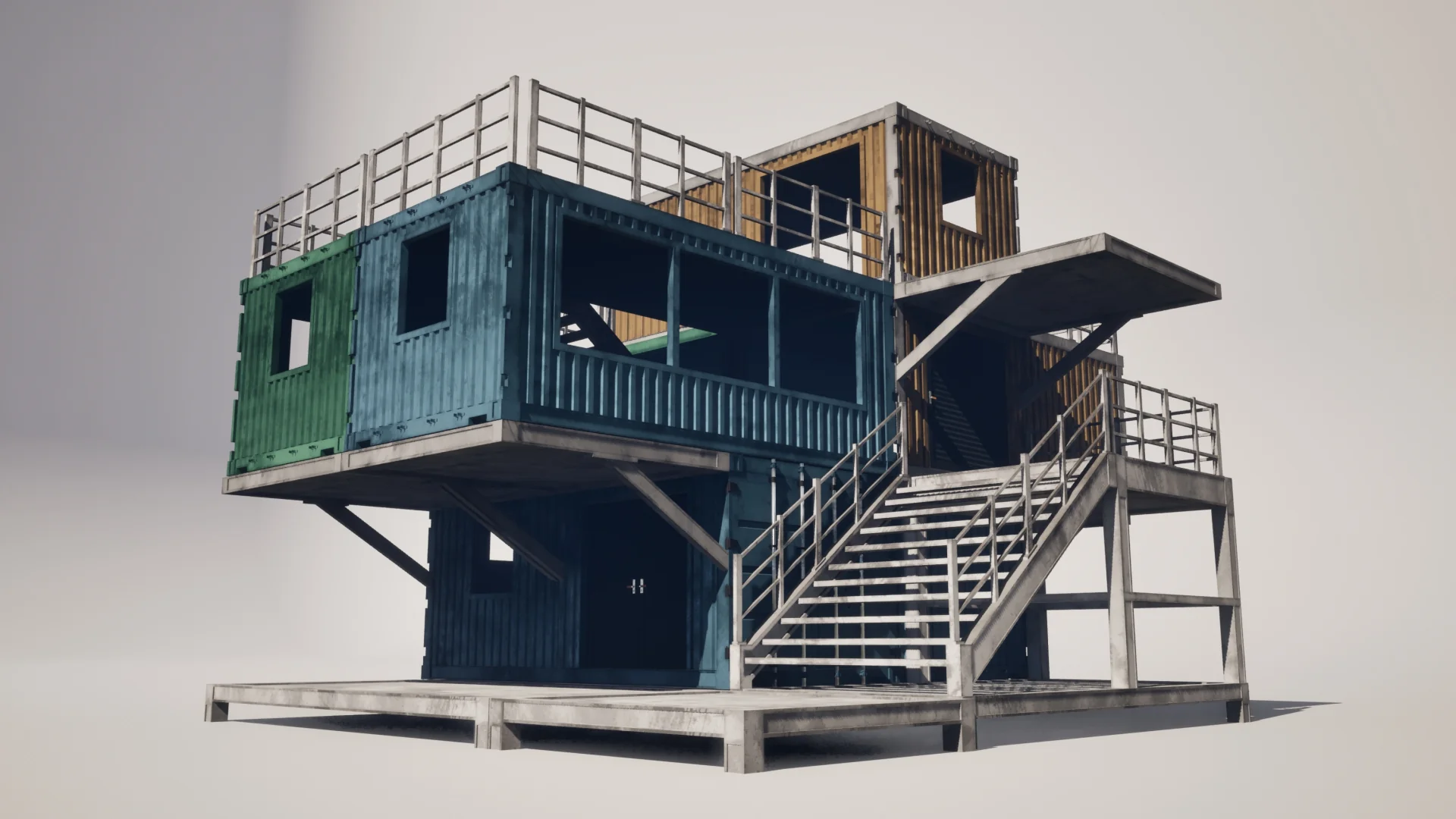
Survival game environments frequently rely on modular, repurposed architecture to establish tone, history, and player progression. The Modular Container Houses - Survival Base Pack provides a focused asset collection tailored to building everything from simple shelter compounds to fortified defensive complexes. By utilizing converted shipping containers alongside industrial framing, the package supports the layout of practical living quarters, defensive barricades, elevated transit bridges, and observation towers.
Environmental design in survival projects often requires balancing scrap-built aesthetics with sturdy industrial elements. Because the package divides its structural assets across distinct metal and wooden fabrications, developers can vary the defensive integrity and visual age of different player outposts. A newly fortified base might feature reinforced steel paneling and sealed container doors, while an improvised outpost deep in the wilderness can lean into wooden wall panels, open frames, and patched window openings.
The Core Modular Container Structural Elements
At the center of the package are static meshes built to conform to two standard container sizes. These core volumes define the footprints for individual rooms, storage bays, or multi-story structures. To adapt these basic shipping boxes into habitable or functional game spaces, the pack includes 82 static meshes that snap and fit across horizontal and vertical axes.
Wall assemblies are split evenly between wood and metal options. Creators have access to five distinct metal wall models and five matching wood wall models for solid structural envelopes. When access and perimeter sightlines are required, the kit provides dedicated framing meshes:
Five metal wall door models and five wood wall door models designed to accept standard passage doors.
Six metal window door variants and six wood window door variants for ventilation ports, firing slits, or observation gaps.
Three dedicated container door models crafted specifically for the ends of the large and small container hulls.
Three standalone metal door models and two wood door models to seal off interior and exterior access points.
Having matched sets of wood and metal wall components allows level designers to construct visual hierarchy within a single settlement. Critical sections like armories or perimeter chokepoints can be framed in heavy corrugated steel, while secondary partitions or residential dorms take advantage of timber cladding.
Base Foundation and Vertical Framework
Terrain irregularity is a common challenge when laying out survival bases across outdoor landscapes. The package solves elevation changes and foundational support through dedicated ground-interface pieces. Four metal base models serve as anchors beneath the primary container shells, lifting living units off uneven dirt, mud, or rocky surfaces.
When stacking units to build watchtowers or two-story habitation hubs, two metal support models act as structural load-bearing columns. Vertical circulation is handled through four metal stair models, which interface with container roofs and elevated platforms. Designers can turn the flat surfaces of shipping containers into walkable battlements or walkways by integrating five specialized metal grid models. These industrial grids function equally well as external catwalks, floor grates, safety rails, or modular bridge platforms spanning the gap between two separate container houses.
Roofing elements complete the exterior shell. The asset pack includes five metal roof models and five wood roof models, providing sloped or reinforced caps to place atop standard container boxes. These caps break up the boxy silhouettes typical of basic shipping units and prevent water pooling or visual repetition across larger compound settlements.
Surfacing Workflow with 4K Textures and Material Instances
Material flexibility and memory management are critical when instancing dozens of modular pieces across a large scene. The collection organizes its surface rendering through a single core master material that drives 29 distinct material instances. This structure allows global parameter adjustments while providing targeted visual divergence across metal plates, rough timber planks, rusted grids, and painted container sidings.
The asset package includes 48 individual textures authored at 4096 x 4096 resolution. This 4K texture resolution maintains surface fidelity even when players inspect walls, door handles, and structural supports from immediate first-person camera distances. The wear, weathering, and material separation across the painted metals and wood grains provide the tactile quality required for grounded survival settings without demanding multiple disjointed shader setups.
Assembly Templates and Merged Actor Layouts
To accelerate level assembly and provide clear references for scale, the pack includes five pre-configured house group models. These example templates demonstrate practical arrangements of container hulls, stairs, exterior catwalks, and roof coverings, serving as immediate drop-in dwellings for fast level prototyping.
In addition to raw static meshes and reference groups, the collection contains 13 actor mergers. These merged actor configurations bundle complex groupings of walls, frames, and foundational steel pieces into unified objects. Utilizing these pre-combined assemblies reduces per-object draw overhead in dense encampments and streamlines the initial construction phase when laying down town layouts, military barricades, or multi-container compounds.
For projects requiring extended industrial frameworks, the package maintains structural and aesthetic compatibility with the Modular Steel Structures Pack - Building & Watchtowers. Combining both collections allows developers to transition container-based living quarters directly into heavy-duty observation towers, industrial framework bridges, and expansive logistical outposts using a shared construction language.
 Buildings
 Containers
 Buildings
 Buildings