"0148f1904a9b0d16"{"id":"1002594","slug":"poly-mega-survival-tools","title":"POLY - Mega Survival Tools","category":"Containers","engine":"5.0+","assetVersion":"","engineVersion":"Engine Version: 5.0+","tag":"Containers","accent":"blue","visual":"mech","summary":"POLY - Mega Survival Tools provides 219 low-poly 3D models of construction, storage, and utility props mapped to a single 1024x1024 texture for survival games.","platform":"Unreal Engine","indexPolicy":"index","publishedAt":"2026-11-14T05:38:36.992Z","updatedAt":"2026-11-14T05:38:36.992Z","sourceNotes":[],"fileContents":[],"compatibility":["Unreal Engine","Engine Version: 5.0+"],"featuredImage":{"alt":"POLY - Mega Survival Tools","src":"/wp-content/uploads/published/2026/11/8cef9e059f23-53eacb1f-b0c7-45b3-88ad-e254c17e2a94-3c32d78b8b.webp"},"hasDownloadLink":true,"downloads":0,"terms":[{"taxonomy":"category","slug":"containers","name":"Containers"}],"galleryImages":[{"src":"/wp-content/uploads/published/2026/11/8583d2a289b1-33d376d8-a019-413f-85f7-e41027c01278-d246ab72d6.webp","alt":"POLY - Mega Survival Tools"},{"src":"/wp-content/uploads/published/2026/11/6525f89bf206-54916c47-8837-4669-98b7-09e369ed8a2f-6d1f3d6a92.webp","alt":"POLY - Mega Survival Tools"},{"src":"/wp-content/uploads/published/2026/11/9a8f33e7347b-86a38744-78cc-41ee-af5a-181c604c28c2-34afccc2ab.webp","alt":"POLY - Mega Survival Tools"},{"src":"/wp-content/uploads/published/2026/11/596e58a4184d-2a2158e5-8a36-499b-b752-a78ee4ee62a5-d26688a1f2.webp","alt":"POLY - Mega Survival Tools"},{"src":"/wp-content/uploads/published/2026/11/fd41798a8914-2859770b-621a-4c13-8cd4-5d214caecf69-2534c1d3c8.webp","alt":"POLY - Mega Survival Tools"},{"src":"/wp-content/uploads/published/2026/11/dd15582c6057-594bdf5d-b1c7-4998-8b3f-e0e5fb8a9ed8-a584a2869e.webp","alt":"POLY - Mega Survival Tools"},{"src":"/wp-content/uploads/published/2026/11/53cea4afcc10-d5d154e8-6734-4465-9c2b-42757e8c481c-f04b48ffd6.webp","alt":"POLY - Mega Survival Tools"},{"src":"/wp-content/uploads/published/2026/11/55541cbc44e4-2ca8d609-38b2-43ce-ac7d-965181728d31-7344aea753.webp","alt":"POLY - Mega Survival Tools"},{"src":"/wp-content/uploads/published/2026/11/df8c4e371234-b8db2124-7ff2-47f9-8121-f43a2e53d224-1acf90db63.webp","alt":"POLY - Mega Survival Tools"},{"src":"/wp-content/uploads/published/2026/11/3de003cb8e42-38788bc4-97d3-4a4a-85aa-2711a3d1e2e8-0dd272f772.webp","alt":"POLY - Mega Survival Tools"}],"accessPanel":{"kind":"resource","title":"Get this resource","eyebrow":"Free resource","message":"Download this resource in your browser.","fileName":"Content.7z","safetyNote":"Resources are manually reviewed before listing to improve quality and reduce obvious risks.","actionLabel":"Get this resource","resourceType":"Resource archive","versions":[]},"contentHtml":"\u003cp\u003eA makeshift settlement or workshop comes together through its physical maintenance gear: fuel reservoirs, stacked raw materials, heavy utility containers, and functional hardware. In interactive scenes that require players to salvage parts, shore up defenses, or craft basic machinery, environmental props must instantly communicate function without blowing through visual budgets. POLY - Mega Survival Tools approaches this challenge with a lightweight collection of low-poly models, offering 219 distinct model variations configured to populate industrial zones, survivor encampments, construction operations, and dilapidated storage yards.\u003c/p\u003e \u003ch2\u003ePopulating Scavenger Camps and Industrial Yards with POLY Assets\u003c/h2\u003e \u003cp\u003eStaging an authentic workspace requires a deliberate balance between large structural containers and smaller set-dressing objects. When laying out a container yard or an abandoned industrial facility, the kit supplies massive shipping containers alongside intermediate storage vessels like IBC containers, oil and fuel barrels, gas cylinders, and dedicated water tanks or storage cisterns. These larger elements form visual boundaries, pathing chokepoints, and structural perimeters for player encampments.\u003c/p\u003e \u003cp\u003eTo break up hard exterior geometry and simulate active building sites, the asset collection provides loose construction materials. Designers can scatter bricks, stacks of cement bags, wooden pallets, cable reels, timber, and timber planks across rough ground. These objects supply the visual rationale for uncompleted fortifications or salvage operations. In tighter workshop interiors, utility props like a dedicated workbench with an attached vise, portable generators, fire extinguishers, and work lights anchor player crafting stations. Fuel cans, sealant containers, and loose supply props fill in shelving units, creating the lived-in texture of an active repair bay or scavenger outpost.\u003c/p\u003e \u003ch2\u003eCategorizing the 219 Model Variations Across Utilities and Tools\u003c/h2\u003e \u003cp\u003eThe asset library distributes its 219 items across five discrete organizational categories, allowing developers to target specific mechanical systems:\u003c/p\u003e \u003cul\u003e \u003cli\u003e\u003cstrong\u003eUtilities (50 models):\u003c/strong\u003e Supplies the bulk infrastructure items, including fuel containers, water storage cisterns, gas cylinders, generator equipment, and logistical fixtures needed for base survival management.\u003c/li\u003e \u003cli\u003e\u003cstrong\u003eTools (70 models):\u003c/strong\u003e Features handheld manual and mechanical implements such as drills, angle grinders, chainsaws, saws, hammers, axes, bolt cutters, pliers, wrenches, and tape measures.\u003c/li\u003e \u003cli\u003e\u003cstrong\u003eSteel arms (25 models):\u003c/strong\u003e Encompasses heavy-duty metal instruments, utility blades, knives, and robust steel hardware suited for salvage or heavy mechanical leverage.\u003c/li\u003e \u003cli\u003e\u003cstrong\u003eProps models (39 models):\u003c/strong\u003e Covers miscellaneous workshop items, consumable cans, sealant, loose site materials, and secondary set-dressing elements.\u003c/li\u003e \u003cli\u003e\u003cstrong\u003eEnvironment (35 models):\u003c/strong\u003e Gathers ambient site elements, architectural storage materials, pallets, timber, bricks, and landscape clutter that define the boundaries of the scene.\u003c/li\u003e\n\u003c/ul\u003e \u003cp\u003eBy organizing assets into these precise counts, scene dressers can cleanly separate player-interactable tools from ambient yard clutter or static utilities.\u003c/p\u003e \u003ch2\u003eSurvival Crafting Kits Without Weapon Bloat\u003c/h2\u003e \u003cp\u003eMany asset collections mix survival items with contemporary military firearms, tactical armor, or combat gear. POLY - Mega Survival Tools deliberately omits conventional weapons, focusing entirely on practical survival, construction, and mechanical crafting content. This curation keeps the aesthetic anchored in blue-collar utility, repair, and raw resource extraction.\u003c/p\u003e \u003cp\u003eThe selection of tools reflects manual labor and mechanical fabrication. Cutting equipment includes standard hand saws, axes, chainsaws, and high-power angle grinders, each shaped with recognizable silhouettes that identify their mechanical role. Assembly and disassembly tasks are supported by hammers, adjustable wrenches, pliers, and bolt cutters. Precision implements such as measuring tape, utility knives, and specialized drills enable realistic staging around building benches. Even outdoor food gathering is represented by items like a fishing rod. Because the meshes remain rooted in utility rather than tactical warfare, they seamlessly serve games with deep building, harvesting, and base-maintenance loops.\u003c/p\u003e \u003ch2\u003eMesh Complexity and Multi-Perspective Camera Performance\u003c/h2\u003e \u003cp\u003eBalancing geometric cleanliness against silhouette clarity is crucial when a package supports multiple game camera perspectives. The models within this pack range from ultra-minimalist geometry to moderately detailed assemblies, running between a minimum polygon count of 20 polygons and a maximum polygon count of 15,000 polygons. The lower end of this range accommodates basic site props, straight planks, simple bricks, and straightforward fasteners, which consume negligible vertex rendering budgets.\u003c/p\u003e \u003cp\u003eThe upper limit of 15,000 polygons is reserved for intricate power tools, complex generators, coiled cable reels, and assemblies containing compound curves or layered mechanical details. This broad poly range ensures that the assets maintain silhouette definition whether viewed close up in a first-person scavenging inspection, over the shoulder in a third-person survival game, or pulled far back in an isometric top-down management interface. Items like the workbench with its vise retain functional visual detail from all camera distances without visual noise.\u003c/p\u003e \u003ch2\u003eSingle-Texture Atlas Integration Across Modular Polygon Environments\u003c/h2\u003e \u003cp\u003eAsset memory footprints and draw-call counts dictate the viability of prototyping packages. All 219 model variations in this collection reference a single 1024x1024 pixel texture. Using a unified texture atlas eliminates the overhead of managing dozens of individual material instances and unique maps, making it straightforward to batch draw calls across massive container yards or complex workshops.\u003c/p\u003e \u003cp\u003eThe flat, polygon art style relies on cohesive surface shading rather than complex micro-detail textures. This stylized treatment allows the pack to merge cleanly with other low-poly environments created in the same aesthetic space. It is directly compatible with companion releases such as POLY - Medieval Camp, enabling developers to bridge eras or assemble eclectic salvage settlements where rustic timber constructions sit alongside modern gas cylinders, shipping containers, and electrical generators. The combination of uniform UV space, single-texture efficiency, and clean low-poly styling makes the collection immediately deployable for prototyping runs or final production in stylized survival worlds.\u003c/p\u003e\n\n\u003ch2\u003eRelated Resources Worth Checking\u003c/h2\u003e\n\u003cul\u003e\n\u003cli\u003e\u003ca href=\"https://3dcghub.com/suburbs-vol-22-shed-and-garden-nanite-and-low-poly/\" rel=\"noopener noreferrer\"\u003eSuburbs VOL.22 - Shed \u0026amp; Garden (Nanite and Low Poly)\u003c/a\u003e\u003c/li\u003e\n\u003cli\u003e\u003ca href=\"https://3dcghub.com/jobsite-vol-3-postal-service-nanite-and-low-poly/\" rel=\"noopener noreferrer\"\u003eJobsite VOL.3 - Postal Service (Nanite \u0026amp; Low Poly)\u003c/a\u003e\u003c/li\u003e\n\u003cli\u003e\u003ca href=\"https://3dcghub.com/jobsite-vol-2-modular-storage-and-supplies-nanite-and-low-poly/\" rel=\"noopener noreferrer\"\u003eJobsite VOL.2 - Modular Storage and Supplies (Nanite \u0026amp; Low Poly)\u003c/a\u003e\u003c/li\u003e\n\u003cli\u003e\u003ca href=\"https://3dcghub.com/mega-candles-pack/\" rel=\"noopener noreferrer\"\u003eMega Candles Pack\u003c/a\u003e\u003c/li\u003e\n\u003cli\u003e\u003ca href=\"https://3dcghub.com/customisable-military-medic-container-vol-1/\" rel=\"noopener noreferrer\"\u003eCustomisable Military Medic Container Vol.1\u003c/a\u003e\u003c/li\u003e\n\u003c/ul\u003e","contentTextLength":6888,"navigation":{"current":55,"total":4543,"previous":{"id":"1002595","slug":"ruined-modern-buildings-pack","title":"Ruined Modern Buildings Pack","category":"Residential Buildings","platform":"Unreal Engine","updatedAt":"2026-11-14T05:40:08.584Z"},"next":{"id":"1002593","slug":"parry-attack-system","title":"Parry Attack System","category":"Weapons \u0026 Combat","platform":"Unreal Engine","updatedAt":"2026-11-14T05:37:20.771Z"}},"relatedResources":[{"id":"1001706","slug":"suburbs-vol-22-shed-and-garden-nanite-and-low-poly","title":"Suburbs VOL.22 - Shed \u0026 Garden (Nanite and Low Poly)","category":"Containers","engine":"5.1+","assetVersion":"","engineVersion":"Engine Version: 5.1+","tag":"Containers","accent":"blue","visual":"mech","summary":"Set up realistic exterior environments using Suburbs VOL.22 - Shed \u0026 Garden, featuring Nanite and low-poly meshes, 4K textures, and Lumen support.","platform":"Unreal Engine","indexPolicy":"index","publishedAt":"2026-10-14T17:11:51.565Z","updatedAt":"2026-10-14T17:11:51.565Z","sourceNotes":[],"fileContents":[],"compatibility":["Unreal Engine","Engine Version: 5.1+"],"featuredImage":{"alt":"Suburbs VOL.22 - Shed \u0026 Garden (Nanite and Low Poly)","src":"/wp-content/uploads/published/2026/10/10cc33cd78fc-de95f9eb-2f06-4b5b-a0e4-2ac7787f9ce9-5cbdd28d5c.webp"},"hasDownloadLink":true,"downloads":0},{"id":"1000627","slug":"jobsite-vol-3-postal-service-nanite-and-low-poly","title":"Jobsite VOL.3 - Postal Service (Nanite \u0026 Low Poly)","category":"Containers","engine":"5.2+","assetVersion":"","engineVersion":"Engine Version: 5.2+","tag":"Containers","accent":"blue","visual":"mech","summary":"Postal service themed Unreal Engine asset pack with 248 meshes, Nanite and low poly versions, 4K textures, channel-packed maps, and Lumen support.","platform":"Unreal Engine","indexPolicy":"index","publishedAt":"2026-07-21T13:56:03.805Z","updatedAt":"2026-07-21T13:56:03.805Z","sourceNotes":[],"fileContents":[],"compatibility":["Unreal Engine","Engine Version: 5.2+"],"featuredImage":{"alt":"Jobsite VOL.3 - Postal Service (Nanite \u0026 Low Poly)","src":"/wp-content/uploads/published/2026/07/869846dbea9d-c9a9b1d8-b3b3-4ea3-b41e-fba5a44bd18b-c66a26c60f.webp"},"hasDownloadLink":true,"downloads":0},{"id":"1000625","slug":"jobsite-vol-2-modular-storage-and-supplies-nanite-and-low-poly","title":"Jobsite VOL.2 - Modular Storage and Supplies (Nanite \u0026 Low Poly)","category":"Containers","engine":"5.2+","assetVersion":"","engineVersion":"Engine Version: 5.2+","tag":"Containers","accent":"blue","visual":"mech","summary":"Jobsite VOL.2 delivers 300 modular industrial storage meshes for Unreal Engine with Nanite and low poly versions, 4K textures, Lumen support, and custom brandin","platform":"Unreal Engine","indexPolicy":"index","publishedAt":"2026-07-21T09:53:24.679Z","updatedAt":"2026-07-21T09:53:24.679Z","sourceNotes":[],"fileContents":[],"compatibility":["Unreal Engine","Engine Version: 5.2+"],"featuredImage":{"alt":"Jobsite VOL.2 - Modular Storage and Supplies (Nanite \u0026 Low Poly)","src":"/wp-content/uploads/published/2026/07/12fa517bdebb-59c93ac8-91c6-492f-8f49-2f994e891477-a21f24fefe.webp"},"hasDownloadLink":true,"downloads":0}]}
Containers
POLY - Mega Survival Tools
POLY - Mega Survival Tools provides 219 low-poly 3D models of construction, storage, and utility props mapped to a single 1024x1024 texture for survival games.
Category:Unreal Engine,ContainersPlatform: Unreal EngineEngine Version: 5.0+Published: Nov 14, 2026
Containers
Resource overview
A makeshift settlement or workshop comes together through its physical maintenance gear: fuel reservoirs, stacked raw materials, heavy utility containers, and functional hardware. In interactive scenes that require players to salvage parts, shore up defenses, or craft basic machinery, environmental props must instantly communicate function without blowing through visual budgets. POLY - Mega Survival Tools approaches this challenge with a lightweight collection of low-poly models, offering 219 distinct model variations configured to populate industrial zones, survivor encampments, construction operations, and dilapidated storage yards.
Populating Scavenger Camps and Industrial Yards with POLY Assets
Staging an authentic workspace requires a deliberate balance between large structural containers and smaller set-dressing objects. When laying out a container yard or an abandoned industrial facility, the kit supplies massive shipping containers alongside intermediate storage vessels like IBC containers, oil and fuel barrels, gas cylinders, and dedicated water tanks or storage cisterns. These larger elements form visual boundaries, pathing chokepoints, and structural perimeters for player encampments.
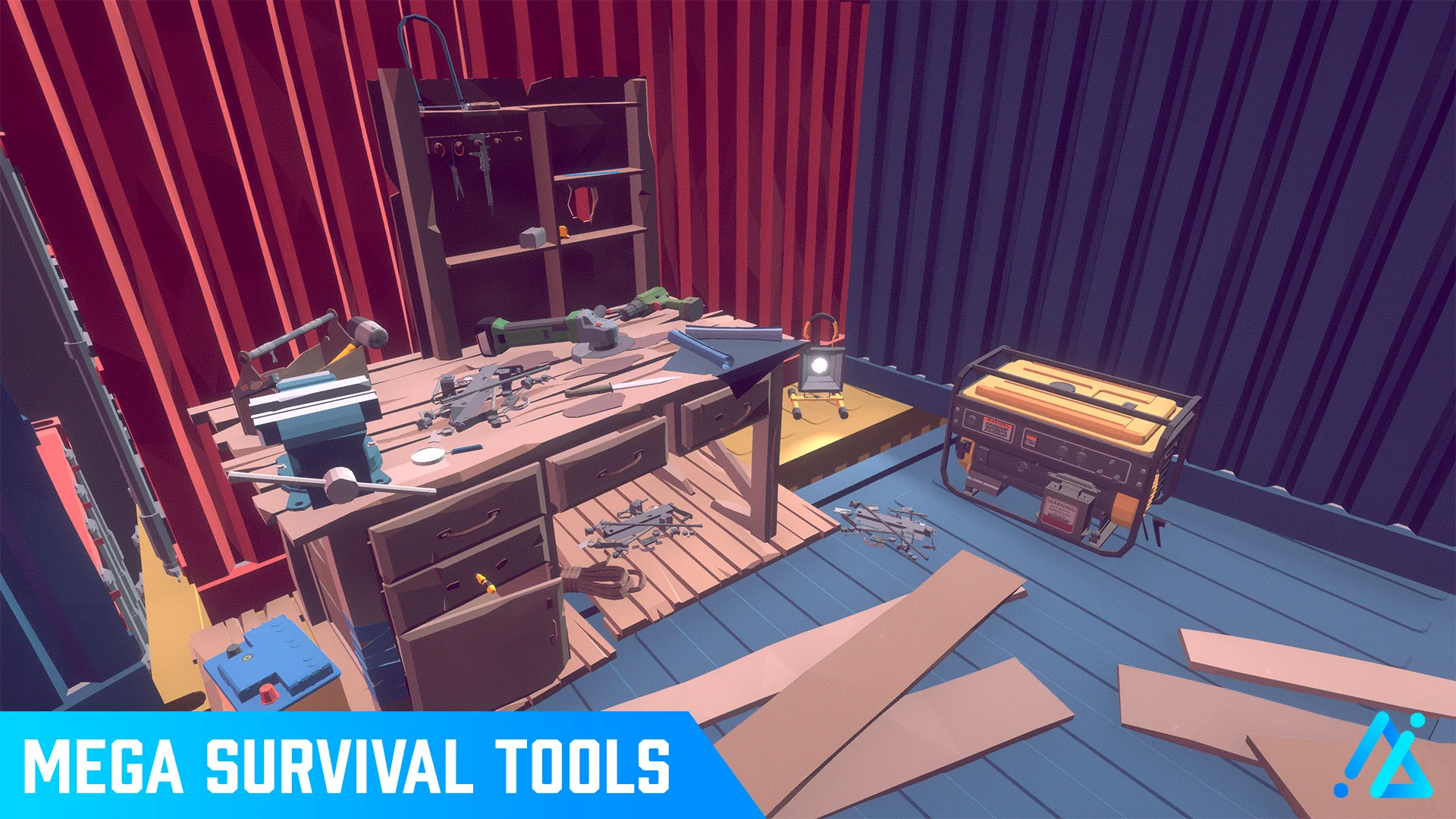
To break up hard exterior geometry and simulate active building sites, the asset collection provides loose construction materials. Designers can scatter bricks, stacks of cement bags, wooden pallets, cable reels, timber, and timber planks across rough ground. These objects supply the visual rationale for uncompleted fortifications or salvage operations. In tighter workshop interiors, utility props like a dedicated workbench with an attached vise, portable generators, fire extinguishers, and work lights anchor player crafting stations. Fuel cans, sealant containers, and loose supply props fill in shelving units, creating the lived-in texture of an active repair bay or scavenger outpost.
Categorizing the 219 Model Variations Across Utilities and Tools
The asset library distributes its 219 items across five discrete organizational categories, allowing developers to target specific mechanical systems:
Utilities (50 models): Supplies the bulk infrastructure items, including fuel containers, water storage cisterns, gas cylinders, generator equipment, and logistical fixtures needed for base survival management.
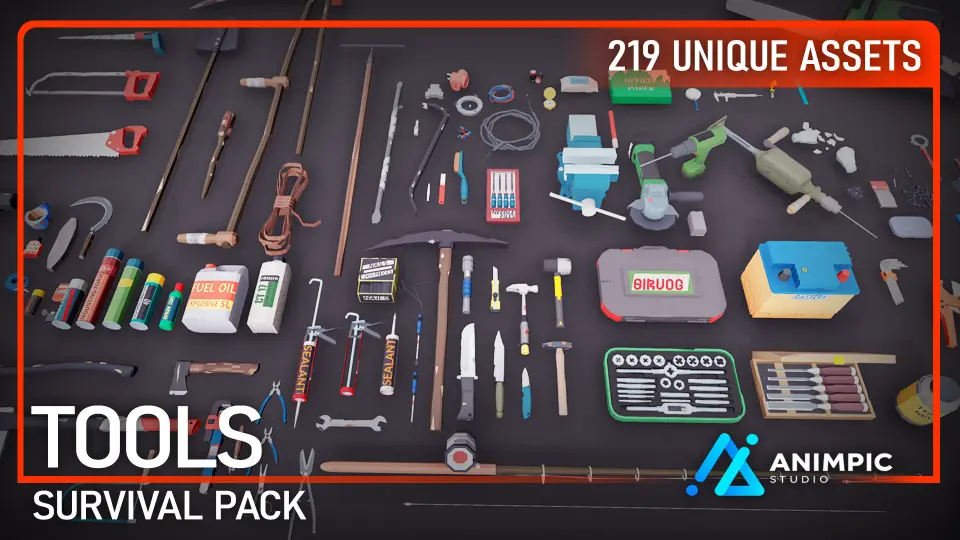
Tools (70 models): Features handheld manual and mechanical implements such as drills, angle grinders, chainsaws, saws, hammers, axes, bolt cutters, pliers, wrenches, and tape measures.
Steel arms (25 models): Encompasses heavy-duty metal instruments, utility blades, knives, and robust steel hardware suited for salvage or heavy mechanical leverage.
Props models (39 models): Covers miscellaneous workshop items, consumable cans, sealant, loose site materials, and secondary set-dressing elements.
Environment (35 models): Gathers ambient site elements, architectural storage materials, pallets, timber, bricks, and landscape clutter that define the boundaries of the scene.
By organizing assets into these precise counts, scene dressers can cleanly separate player-interactable tools from ambient yard clutter or static utilities.
Survival Crafting Kits Without Weapon Bloat
Many asset collections mix survival items with contemporary military firearms, tactical armor, or combat gear. POLY - Mega Survival Tools deliberately omits conventional weapons, focusing entirely on practical survival, construction, and mechanical crafting content. This curation keeps the aesthetic anchored in blue-collar utility, repair, and raw resource extraction.
The selection of tools reflects manual labor and mechanical fabrication. Cutting equipment includes standard hand saws, axes, chainsaws, and high-power angle grinders, each shaped with recognizable silhouettes that identify their mechanical role. Assembly and disassembly tasks are supported by hammers, adjustable wrenches, pliers, and bolt cutters. Precision implements such as measuring tape, utility knives, and specialized drills enable realistic staging around building benches. Even outdoor food gathering is represented by items like a fishing rod. Because the meshes remain rooted in utility rather than tactical warfare, they seamlessly serve games with deep building, harvesting, and base-maintenance loops.
Mesh Complexity and Multi-Perspective Camera Performance
Balancing geometric cleanliness against silhouette clarity is crucial when a package supports multiple game camera perspectives. The models within this pack range from ultra-minimalist geometry to moderately detailed assemblies, running between a minimum polygon count of 20 polygons and a maximum polygon count of 15,000 polygons. The lower end of this range accommodates basic site props, straight planks, simple bricks, and straightforward fasteners, which consume negligible vertex rendering budgets.
The upper limit of 15,000 polygons is reserved for intricate power tools, complex generators, coiled cable reels, and assemblies containing compound curves or layered mechanical details. This broad poly range ensures that the assets maintain silhouette definition whether viewed close up in a first-person scavenging inspection, over the shoulder in a third-person survival game, or pulled far back in an isometric top-down management interface. Items like the workbench with its vise retain functional visual detail from all camera distances without visual noise.
Single-Texture Atlas Integration Across Modular Polygon Environments
Asset memory footprints and draw-call counts dictate the viability of prototyping packages. All 219 model variations in this collection reference a single 1024x1024 pixel texture. Using a unified texture atlas eliminates the overhead of managing dozens of individual material instances and unique maps, making it straightforward to batch draw calls across massive container yards or complex workshops.
The flat, polygon art style relies on cohesive surface shading rather than complex micro-detail textures. This stylized treatment allows the pack to merge cleanly with other low-poly environments created in the same aesthetic space. It is directly compatible with companion releases such as POLY - Medieval Camp, enabling developers to bridge eras or assemble eclectic salvage settlements where rustic timber constructions sit alongside modern gas cylinders, shipping containers, and electrical generators. The combination of uniform UV space, single-texture efficiency, and clean low-poly styling makes the collection immediately deployable for prototyping runs or final production in stylized survival worlds.
 Containers
 Containers
 Containers
 Containers