"0148f1904a9b0d16"{"id":"1002595","slug":"ruined-modern-buildings-pack","title":"Ruined Modern Buildings Pack","category":"Residential Buildings","engine":"5.6+","assetVersion":"","engineVersion":"Engine Version: 5.6+","tag":"Residential Buildi","accent":"blue","visual":"mech","summary":"Explore the Ruined Modern Buildings Pack, featuring over 90 modular destroyed structures, 1-slot material efficiency, and Nanite support for UE 5.6+.","platform":"Unreal Engine","indexPolicy":"index","publishedAt":"2026-11-14T05:40:08.584Z","updatedAt":"2026-11-14T05:40:08.584Z","sourceNotes":[],"fileContents":[],"compatibility":["Unreal Engine","Engine Version: 5.6+"],"featuredImage":{"alt":"Ruined Modern Buildings Pack","src":"/wp-content/uploads/published/2026/11/f492722ed8d5-172d656a-0a73-41b9-a60d-49f86381ea3d-c59176cc63.webp"},"hasDownloadLink":true,"downloads":0,"terms":[{"taxonomy":"category","slug":"residential-buildings","name":"Residential Buildings"}],"galleryImages":[{"src":"/wp-content/uploads/published/2026/11/5368ee82767d-9cd4d62e-a806-49e8-a16a-8b18ab65109f-b6a0e3c25c.webp","alt":"Ruined Modern Buildings Pack"},{"src":"/wp-content/uploads/published/2026/11/1af3c2f32790-1f7f6637-3137-4464-9ef7-7c7396d3cf91-f992f4f176.webp","alt":"Ruined Modern Buildings Pack"},{"src":"/wp-content/uploads/published/2026/11/ea8a071c19b6-d31af885-2c2d-461a-8025-2606c507e39c-a89494dc38.webp","alt":"Ruined Modern Buildings Pack"},{"src":"/wp-content/uploads/published/2026/11/b16f7392e2af-2dc8fb25-3b09-4d5f-b1c1-19b1eb9face0-413588e151.webp","alt":"Ruined Modern Buildings Pack"},{"src":"/wp-content/uploads/published/2026/11/8b5a41e6605c-c774748a-dfad-4676-bfb5-96c609035021-f5618ebed8.webp","alt":"Ruined Modern Buildings Pack"},{"src":"/wp-content/uploads/published/2026/11/e75d75aec2e6-6249c900-4b95-44c6-9b6b-fe1953f005cf-160db088b8.webp","alt":"Ruined Modern Buildings Pack"},{"src":"/wp-content/uploads/published/2026/11/d4d71e9c8f6a-69d50704-6b6d-4bee-adba-08b70828c7e6-499276d132.webp","alt":"Ruined Modern Buildings Pack"},{"src":"/wp-content/uploads/published/2026/11/5fc6f8243c4f-55be2415-8be0-428b-84f1-20b3b9dc14ea-1fe180c506.webp","alt":"Ruined Modern Buildings Pack"},{"src":"/wp-content/uploads/published/2026/11/7a51da4f2afc-c1ff3c5a-ef96-4dfc-9149-92b57f1a7e2f-856a22018b.webp","alt":"Ruined Modern Buildings Pack"},{"src":"/wp-content/uploads/published/2026/11/999aa1378bb9-01e2bbaa-c915-43ca-a269-ee87b144eaa7-dcbed56838.webp","alt":"Ruined Modern Buildings Pack"}],"accessPanel":{"kind":"resource","title":"Get this resource","eyebrow":"Free resource","message":"Download this resource in your browser.","fileName":"Content.7z","safetyNote":"Resources are manually reviewed before listing to improve quality and reduce obvious risks.","actionLabel":"Get this resource","resourceType":"Resource archive","versions":[]},"contentHtml":"\u003ch2\u003eAssembling Destroyed Skylines with the Ruined Modern Buildings Pack\u003c/h2\u003e\u003cp\u003eDepicting modern urban collapse requires structural assets that balance scale, architectural realism, and performance overhead. Modern urban centers present complex geometry: vertical towers, distinct floor plates, curtain walls, and repetitive structural spans. When broken by combat or disaster, these clean silhouettes turn into jagged concrete, exposed infrastructure, and ragged silhouettes. The Ruined Modern Buildings Pack approaches this design challenge by supplying over 90 modular structures engineered to construct decaying modern cities across real-time game spaces and high-fidelity cinematic sequences.\u003c/p\u003e\u003cp\u003eInstead of relying on generic debris piles, the pack provides architectural components at several vertical and spatial tiers. This allows level designers and environment artists to construct believable sightlines ranging from distant, haze-shrouded skylines down to immediate, street-level devastation. Whether framing a war-torn frontline or a long-abandoned post-apocalyptic settlement, the asset collection provides the architectural vocabulary needed to communicate recent violence or gradual atmospheric decay.\u003c/p\u003e\u003ch2\u003eScale Distribution Across Over Ninety Ruined Structures\u003c/h2\u003e\u003cp\u003eUrban ruin operates at distinct focal distances. A convincing metropolitan wasteland requires clear separation between background silhouettes, playable mid-ground structures, and ground-level collapse. The collection organizes its architectural assets across three core categories to address each of these composition requirements directly.\u003c/p\u003e\u003cp\u003eThe first tier consists of 18 destroyed skyscrapers. These towering, fractured structures serve as skyline anchors and distant vista elements. Their broken profiles, severed crowns, and hollowed midsections interrupt uniform city horizons, producing the dramatic, uneven skylines essential for war zones and catastrophic backdrops. By varying height and fracture patterns, these high-rise models let artists build dense downtown cores where every tower displays distinct structural trauma.\u003c/p\u003e\u003cp\u003eThe bulk of the collection is found in its 74 destroyed buildings. These mid- and small-scale structures span various intermediate stages of ruin, providing the core volume for street corridors, plaza edges, and residential blocks. Because real-world damage rarely distributes evenly, these assets feature varying damage gradients: some show localized ballistic breaches and collapsed outer walls, while others stand as hollowed concrete shells. This variety allows creators to establish natural flow through urban canyons without immediately repeating visible damage patterns.\u003c/p\u003e\u003cp\u003eAt ground level, the pack provides 5 fully flattened buildings. Rather than standing tall, these assets represent total structural failure, functioning as broad footprint ruins and dense concrete mounds. They bridge the gap between standing walls and ground-level rubble, supplying the necessary foundation for heavy debris fields, collapsed thoroughfares, and traversable ruins where high-rise geometry has completely collapsed inward.\u003c/p\u003e\u003ch2\u003eSurface Customization in the Ruined Material Pipeline\u003c/h2\u003e\u003cp\u003eAsset geometry only tells half the story in catastrophe environments; surface aging, grime, and blast marks are equally vital for visual cohesion. The Ruined Modern Buildings Pack incorporates a dedicated texture and material pipeline built on 80 high-quality textures. Rather than locking artists into a static, baked aesthetic, these textures feed into a structured shading network composed of 4 master materials and 9 pre-configured material instances.\u003c/p\u003e\u003cp\u003eA critical functionality within these master materials is the ability to easily control the intensity of different types of dirt and wear. Urban structures subjected to heavy shelling, long-term exposure, or shockwaves accumulate layered surface degradation: fine dust settles along horizontal lips, soot stains char blast points, and general weathering dulls structural concrete. The material instance parameters allow developers to adjust these grime and wear layers interactively. By tuning wear intensity across instances, artists can place the same building mesh in multiple locations while varying its soot deposition, surface dirt, and wear levels to avoid repetitive tiling.\u003c/p\u003e\u003cp\u003eThis material structure also prioritizes texture interchangeability. While the pack includes 80 dedicated textures, the underlying master shaders are configured so developers can freely swap and replace texture inputs. This flexibility allows environment teams to match regional concrete tones, introduce custom surface damage, or shift the general color temperature of the entire district while retaining the pack's wear and masking logic.\u003c/p\u003e\u003ch2\u003eSingle-Slot Material Optimization and Nanite Integration\u003c/h2\u003e\u003cp\u003eLarge-scale architectural environments can quickly overwhelm hardware through draw-call saturation and shader complexity. This issue multiplies when an environment features dozens of shattered buildings with exposed structural layers. To mitigate performance bottlenecks, all buildings throughout this pack are optimized with just 1 material slot per mesh.\u003c/p\u003e\u003cp\u003eConfining each destroyed structure to a single material slot fundamentally changes scene efficiency in real-time game applications. Instead of each building issuing multiple draw calls for interior drywall, exterior concrete, steel rebar, and window frames, the entire structure resolves through a unified material pass. This single-slot pipeline reduces overhead when populating dense city districts with high asset counts, ensuring that complex geometry does not swamp the rendering thread during real-time gameplay.\u003c/p\u003e\u003cp\u003eAlongside material consolidation, the collection supports Nanite for Unreal Engine 5.6 and newer versions. With Nanite enabled, the intricate fractures, fractured structural edges, and ragged silhouettes can be rendered without requiring traditional manual LOD management or sacrificing geometric sharpness at long viewing distances. Real-time projects maintain stable framerates even when staging dense city vistas, while cinematic sequences gain clean geometric detail up to the edge of every concrete fracture.\u003c/p\u003e\u003ch2\u003eEnvironmental Staging Across War and Post-Apocalyptic Scenarios\u003c/h2\u003e\u003cp\u003eThe visual versatility of the pack makes it well-suited for two distinct environmental styles: immediate war zones and long-term post-apocalyptic settings. In active war environments, the sharp fractures of the skyscrapers and the heavy rubble of the flattened buildings reflect sudden concussive strikes, localized artillery damage, and recent structural failure. Pairing these assets with atmospheric destruction effects—such as smoke, embers, or localized detonations—creates an active combat zone filled with natural defensive cover and fractured sightlines.\u003c/p\u003e\u003cp\u003eFor post-apocalyptic environments, the pack's wear controls become the primary storytelling tool. Dialing up surface grime and weathering parameters transforms fresh concrete wounds into decades-old remnants exposed to the elements. The mix of 74 mid- and small-scale ruins provides the structural baseline for abandoned municipal centers, overgrown avenues, and decaying residential perimeters where human civilization has ceased maintenance.\u003c/p\u003e\u003cp\u003eThe package also integrates naturally into broader world-building ecosystems. It forms part of comprehensive collections such as the Destruction VFX \u0026 Environment Bundle as well as the Madyan 2026 Complete Asset Collection Bundle. Environment teams working across expansive scopes can pair these destroyed structural shells with complementary atmospheric sets—such as VDB-driven cinematic meteors, tornadoes, or hurricanes—to simulate catastrophic weather events impacting modern infrastructure. Similarly, placing these damaged assets alongside modern and sci-fi background building packs establishes visual contrast between untouched metropolis zones and ruined exclusion sectors.\u003c/p\u003e\u003cp\u003eBy unifying dense architectural destruction, single-slot rendering efficiency, dynamic wear adjustment, and native Nanite support in Unreal Engine 5.6+, the pack functions as a modular toolkit for bringing shattered urban landscapes to life.\u003c/p\u003e\n\n\u003ch2\u003eMore From The Same Workflow\u003c/h2\u003e\n\u003cul\u003e\n\u003cli\u003e\u003ca href=\"https://3dcghub.com/buildings-vol-12-town-doors-nanite-and-low-poly/\" rel=\"noopener noreferrer\"\u003eBuildings VOL.12 - Town Doors (Nanite \u0026amp; Low Poly)\u003c/a\u003e\u003c/li\u003e\n\u003cli\u003e\u003ca href=\"https://3dcghub.com/modern-bridges/\" rel=\"noopener noreferrer\"\u003eModern Bridges\u003c/a\u003e\u003c/li\u003e\n\u003cli\u003e\u003ca href=\"https://3dcghub.com/buildings-vol-9-modular-pipes-and-gutters-nanite-and-low-poly/\" rel=\"noopener noreferrer\"\u003eBuildings VOL.9 - Modular Pipes \u0026amp; Gutters (Nanite \u0026amp; Low Poly)\u003c/a\u003e\u003c/li\u003e\n\u003cli\u003e\u003ca href=\"https://3dcghub.com/modern-buildings-pack/\" rel=\"noopener noreferrer\"\u003eModern Buildings Pack\u003c/a\u003e\u003c/li\u003e\n\u003cli\u003e\u003ca href=\"https://3dcghub.com/lighting-vol-3-industrial-nanite-and-low-poly/\" rel=\"noopener noreferrer\"\u003eLighting VOL.3 - Industrial (Nanite and Low Poly)\u003c/a\u003e\u003c/li\u003e\n\u003c/ul\u003e","contentTextLength":8419,"navigation":{"current":54,"total":4543,"previous":{"id":"1002596","slug":"sci-fi-megaspikan","title":"SCI FI: MEGASPIKAN","category":"Characters \u0026 Creatures","platform":"Unreal Engine","updatedAt":"2026-11-14T05:42:51.540Z"},"next":{"id":"1002594","slug":"poly-mega-survival-tools","title":"POLY - Mega Survival Tools","category":"Containers","platform":"Unreal Engine","updatedAt":"2026-11-14T05:38:36.992Z"}},"relatedResources":[{"id":"1000728","slug":"buildings-vol-12-town-doors-nanite-and-low-poly","title":"Buildings VOL.12 - Town Doors (Nanite \u0026 Low Poly)","category":"Residential Buildings","engine":"5.1+","assetVersion":"","engineVersion":"Engine Version: 5.1+","tag":"Residential Buildi","accent":"blue","visual":"mech","summary":"90 town door meshes with Nanite and low-poly variants, 4K PBR textures, Lumen support, split-door interaction, and custom branding for Unreal Engine 5.0+.","platform":"Unreal Engine","indexPolicy":"index","publishedAt":"2026-07-26T15:48:07.062Z","updatedAt":"2026-07-26T15:48:07.062Z","sourceNotes":[],"fileContents":[],"compatibility":["Unreal Engine","Engine Version: 5.1+"],"featuredImage":{"alt":"Buildings VOL.12 - Town Doors (Nanite \u0026 Low Poly)","src":"/wp-content/uploads/published/2026/07/43efa6be23f8-4b643c83-034d-4823-bbec-64c6b58b6554-9c97137ffa.webp"},"hasDownloadLink":true,"downloads":2},{"id":"1002588","slug":"modern-bridges","title":"Modern Bridges","category":"Buildings \u0026 Architecture","engine":"5.0+","assetVersion":"","engineVersion":"Engine Version: 5.0+","tag":"Buildings","accent":"blue","visual":"mech","summary":"Examine the technical build, seamless material pipeline, and LOD optimization included in the Modern Bridges environment collection.","platform":"Unreal Engine","indexPolicy":"index","publishedAt":"2026-11-14T05:32:12.044Z","updatedAt":"2026-11-14T05:32:12.044Z","sourceNotes":[],"fileContents":[],"compatibility":["Unreal Engine","Engine Version: 5.0+"],"featuredImage":{"alt":"Modern Bridges","src":"/wp-content/uploads/published/2026/11/4c5c15832b31-2c6cad65-595f-4031-a3f1-850f453ce9c1-66fed6f7f6.webp"},"hasDownloadLink":true,"downloads":0},{"id":"1000453","slug":"buildings-vol-9-modular-pipes-and-gutters-nanite-and-low-poly","title":"Buildings VOL.9 - Modular Pipes \u0026 Gutters (Nanite \u0026 Low Poly)","category":"Residential Buildings","engine":"5.1+","assetVersion":"","engineVersion":"Engine Version: 5.1+","tag":"Residential Buildi","accent":"blue","visual":"mech","summary":"Unreal Engine modular pipes and gutters pack with 220 Nanite and low-poly meshes, 4K textures, channel-packed maps, Lumen support, and color-changeable painted","platform":"Unreal Engine","indexPolicy":"index","publishedAt":"2026-07-11T01:39:01.440Z","updatedAt":"2026-07-11T01:39:01.440Z","sourceNotes":[],"fileContents":[],"compatibility":["Unreal Engine","Engine Version: 5.1+"],"featuredImage":{"alt":"Buildings VOL.9 - Modular Pipes \u0026 Gutters (Nanite \u0026 Low Poly)","src":"/wp-content/uploads/published/2026/07/44ad0f52be13-919d78f7-3a95-4791-af9a-e7914b09902c-70e302bccb.webp"},"hasDownloadLink":true,"downloads":0}]}
Residential Buildi
Ruined Modern Buildings Pack
Explore the Ruined Modern Buildings Pack, featuring over 90 modular destroyed structures, 1-slot material efficiency, and Nanite support for UE 5.6+.
Assembling Destroyed Skylines with the Ruined Modern Buildings Pack
Depicting modern urban collapse requires structural assets that balance scale, architectural realism, and performance overhead. Modern urban centers present complex geometry: vertical towers, distinct floor plates, curtain walls, and repetitive structural spans. When broken by combat or disaster, these clean silhouettes turn into jagged concrete, exposed infrastructure, and ragged silhouettes. The Ruined Modern Buildings Pack approaches this design challenge by supplying over 90 modular structures engineered to construct decaying modern cities across real-time game spaces and high-fidelity cinematic sequences.
Instead of relying on generic debris piles, the pack provides architectural components at several vertical and spatial tiers. This allows level designers and environment artists to construct believable sightlines ranging from distant, haze-shrouded skylines down to immediate, street-level devastation. Whether framing a war-torn frontline or a long-abandoned post-apocalyptic settlement, the asset collection provides the architectural vocabulary needed to communicate recent violence or gradual atmospheric decay.
Scale Distribution Across Over Ninety Ruined Structures
Urban ruin operates at distinct focal distances. A convincing metropolitan wasteland requires clear separation between background silhouettes, playable mid-ground structures, and ground-level collapse. The collection organizes its architectural assets across three core categories to address each of these composition requirements directly.
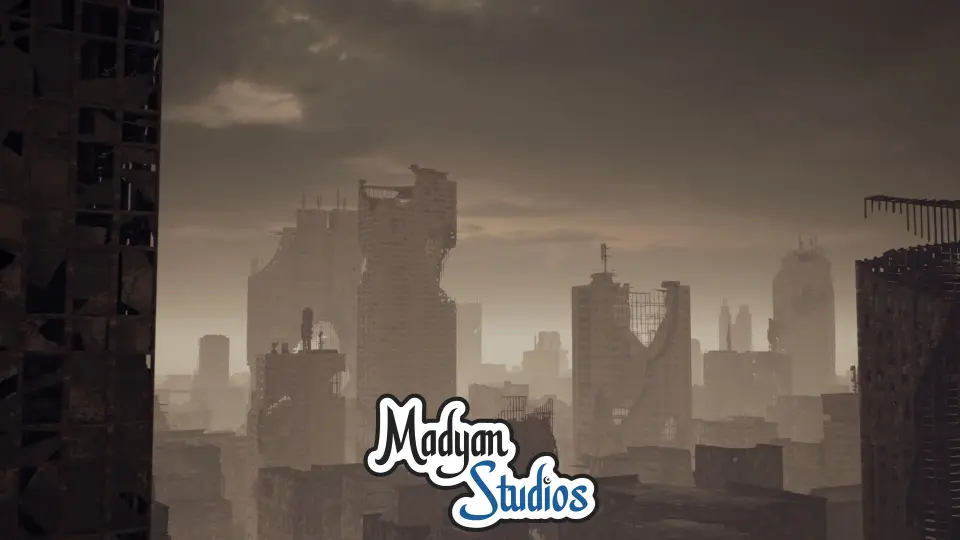
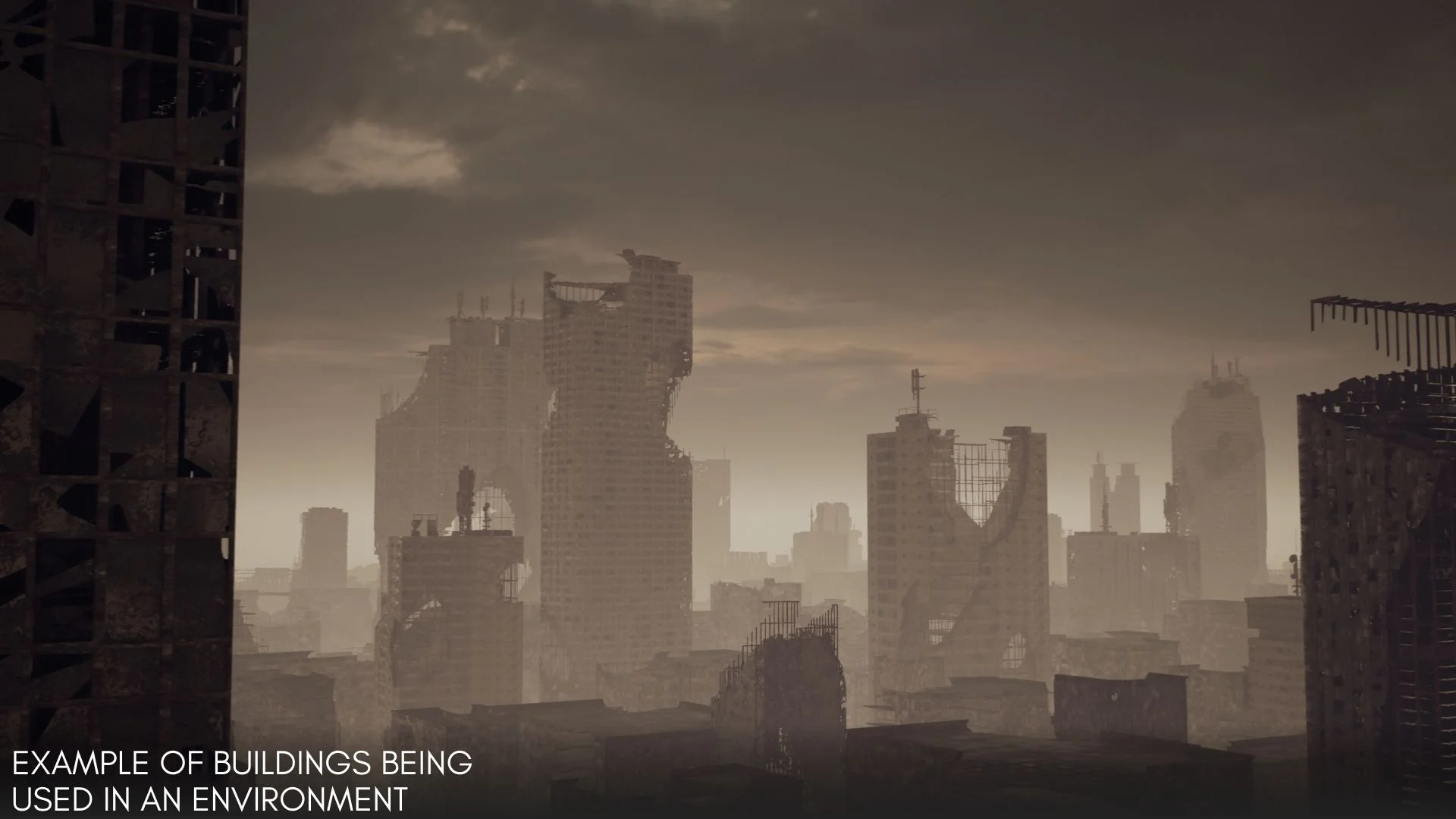
The first tier consists of 18 destroyed skyscrapers. These towering, fractured structures serve as skyline anchors and distant vista elements. Their broken profiles, severed crowns, and hollowed midsections interrupt uniform city horizons, producing the dramatic, uneven skylines essential for war zones and catastrophic backdrops. By varying height and fracture patterns, these high-rise models let artists build dense downtown cores where every tower displays distinct structural trauma.
The bulk of the collection is found in its 74 destroyed buildings. These mid- and small-scale structures span various intermediate stages of ruin, providing the core volume for street corridors, plaza edges, and residential blocks. Because real-world damage rarely distributes evenly, these assets feature varying damage gradients: some show localized ballistic breaches and collapsed outer walls, while others stand as hollowed concrete shells. This variety allows creators to establish natural flow through urban canyons without immediately repeating visible damage patterns.
At ground level, the pack provides 5 fully flattened buildings. Rather than standing tall, these assets represent total structural failure, functioning as broad footprint ruins and dense concrete mounds. They bridge the gap between standing walls and ground-level rubble, supplying the necessary foundation for heavy debris fields, collapsed thoroughfares, and traversable ruins where high-rise geometry has completely collapsed inward.
Surface Customization in the Ruined Material Pipeline
Asset geometry only tells half the story in catastrophe environments; surface aging, grime, and blast marks are equally vital for visual cohesion. The Ruined Modern Buildings Pack incorporates a dedicated texture and material pipeline built on 80 high-quality textures. Rather than locking artists into a static, baked aesthetic, these textures feed into a structured shading network composed of 4 master materials and 9 pre-configured material instances.
A critical functionality within these master materials is the ability to easily control the intensity of different types of dirt and wear. Urban structures subjected to heavy shelling, long-term exposure, or shockwaves accumulate layered surface degradation: fine dust settles along horizontal lips, soot stains char blast points, and general weathering dulls structural concrete. The material instance parameters allow developers to adjust these grime and wear layers interactively. By tuning wear intensity across instances, artists can place the same building mesh in multiple locations while varying its soot deposition, surface dirt, and wear levels to avoid repetitive tiling.
This material structure also prioritizes texture interchangeability. While the pack includes 80 dedicated textures, the underlying master shaders are configured so developers can freely swap and replace texture inputs. This flexibility allows environment teams to match regional concrete tones, introduce custom surface damage, or shift the general color temperature of the entire district while retaining the pack's wear and masking logic.
Single-Slot Material Optimization and Nanite Integration
Large-scale architectural environments can quickly overwhelm hardware through draw-call saturation and shader complexity. This issue multiplies when an environment features dozens of shattered buildings with exposed structural layers. To mitigate performance bottlenecks, all buildings throughout this pack are optimized with just 1 material slot per mesh.
Confining each destroyed structure to a single material slot fundamentally changes scene efficiency in real-time game applications. Instead of each building issuing multiple draw calls for interior drywall, exterior concrete, steel rebar, and window frames, the entire structure resolves through a unified material pass. This single-slot pipeline reduces overhead when populating dense city districts with high asset counts, ensuring that complex geometry does not swamp the rendering thread during real-time gameplay.
Alongside material consolidation, the collection supports Nanite for Unreal Engine 5.6 and newer versions. With Nanite enabled, the intricate fractures, fractured structural edges, and ragged silhouettes can be rendered without requiring traditional manual LOD management or sacrificing geometric sharpness at long viewing distances. Real-time projects maintain stable framerates even when staging dense city vistas, while cinematic sequences gain clean geometric detail up to the edge of every concrete fracture.
Environmental Staging Across War and Post-Apocalyptic Scenarios
The visual versatility of the pack makes it well-suited for two distinct environmental styles: immediate war zones and long-term post-apocalyptic settings. In active war environments, the sharp fractures of the skyscrapers and the heavy rubble of the flattened buildings reflect sudden concussive strikes, localized artillery damage, and recent structural failure. Pairing these assets with atmospheric destruction effects—such as smoke, embers, or localized detonations—creates an active combat zone filled with natural defensive cover and fractured sightlines.
For post-apocalyptic environments, the pack's wear controls become the primary storytelling tool. Dialing up surface grime and weathering parameters transforms fresh concrete wounds into decades-old remnants exposed to the elements. The mix of 74 mid- and small-scale ruins provides the structural baseline for abandoned municipal centers, overgrown avenues, and decaying residential perimeters where human civilization has ceased maintenance.
The package also integrates naturally into broader world-building ecosystems. It forms part of comprehensive collections such as the Destruction VFX & Environment Bundle as well as the Madyan 2026 Complete Asset Collection Bundle. Environment teams working across expansive scopes can pair these destroyed structural shells with complementary atmospheric sets—such as VDB-driven cinematic meteors, tornadoes, or hurricanes—to simulate catastrophic weather events impacting modern infrastructure. Similarly, placing these damaged assets alongside modern and sci-fi background building packs establishes visual contrast between untouched metropolis zones and ruined exclusion sectors.
By unifying dense architectural destruction, single-slot rendering efficiency, dynamic wear adjustment, and native Nanite support in Unreal Engine 5.6+, the pack functions as a modular toolkit for bringing shattered urban landscapes to life.
 Residential Buildi
 Residential Buildi
 Buildings
 Residential Buildi