"0148f1904a9b0d16"{"id":"1002588","slug":"modern-bridges","title":"Modern Bridges","category":"Buildings \u0026 Architecture","engine":"5.0+","assetVersion":"","engineVersion":"Engine Version: 5.0+","tag":"Buildings","accent":"blue","visual":"mech","summary":"Examine the technical build, seamless material pipeline, and LOD optimization included in the Modern Bridges environment collection.","platform":"Unreal Engine","indexPolicy":"index","publishedAt":"2026-11-14T05:32:12.044Z","updatedAt":"2026-11-14T05:32:12.044Z","sourceNotes":[],"fileContents":[],"compatibility":["Unreal Engine","Engine Version: 5.0+"],"featuredImage":{"alt":"Modern Bridges","src":"/wp-content/uploads/published/2026/11/4c5c15832b31-2c6cad65-595f-4031-a3f1-850f453ce9c1-66fed6f7f6.webp"},"hasDownloadLink":true,"downloads":0,"terms":[{"taxonomy":"category","slug":"buildings-and-architecture","name":"Buildings \u0026 Architecture"}],"galleryImages":[{"src":"/wp-content/uploads/published/2026/11/9eb8da2776ed-0aded9da-1e18-4680-b9c5-27fcde29ff88-752082fdf1.webp","alt":"Modern Bridges"},{"src":"/wp-content/uploads/published/2026/11/ef975205177a-1f267ce5-1561-4c84-af7f-e651891303fd-8fc0b24edb.webp","alt":"Modern Bridges"},{"src":"/wp-content/uploads/published/2026/11/fecc9e27210d-e55d46bf-cd01-43e1-8ab9-b657a620add1-f933730576.webp","alt":"Modern Bridges"},{"src":"/wp-content/uploads/published/2026/11/7af8f9906da9-650ab7dd-9dd1-4a25-826f-9ffd4ea7f9d4-a21bed6d8f.webp","alt":"Modern Bridges"},{"src":"/wp-content/uploads/published/2026/11/927c1abdea04-784f0f1a-6c76-4af8-86b9-9bee2f1f9583-d757fc7105.webp","alt":"Modern Bridges"},{"src":"/wp-content/uploads/published/2026/11/ac8e0b51a88e-c00a274c-9179-42db-aa9d-a304257d5091-24123da0ab.webp","alt":"Modern Bridges"},{"src":"/wp-content/uploads/published/2026/11/558a25190ed8-f5ba1b67-2738-4ea3-9a85-cabb02d37456-3a944b8cc0.webp","alt":"Modern Bridges"},{"src":"/wp-content/uploads/published/2026/11/01b90591996f-5669bfb5-d64f-4eb0-8804-3229c87b82dc-38e7f0fd87.webp","alt":"Modern Bridges"},{"src":"/wp-content/uploads/published/2026/11/d3ce2db9c2fc-d00344ea-83bc-46e9-9c03-5070b18f7670-d59b21c05f.webp","alt":"Modern Bridges"},{"src":"/wp-content/uploads/published/2026/11/8abc792aa4bc-bc15e78e-4304-4f34-add7-180531655a4a-20e1b44d5d.webp","alt":"Modern Bridges"}],"accessPanel":{"kind":"resource","title":"Get this resource","eyebrow":"Free resource","message":"Download this resource in your browser.","fileName":"Content.7z","safetyNote":"Resources are manually reviewed before listing to improve quality and reduce obvious risks.","actionLabel":"Get this resource","resourceType":"Resource archive","versions":[]},"contentHtml":"\u003cp\u003eTen individual modern bridges make up this environment package, providing structural spans engineered for urban towns, busy roadways, and heavy construction areas. Built to handle modern city crossings where steel framework and solid brick construction intersect, the collection offers ready-to-place infrastructure suited for both interactive real-time levels and high-fidelity video production. Each bridge targets AAA production visual standards, presenting distinct spans that carry vehicle routes, pedestrian walkways, and industrial links across riverbanks, rail corridors, and highway divides.\u003c/p\u003e \u003ch2\u003eTen Modern Bridges for Urban and Highway Infrastructure\u003c/h2\u003e\n\u003cp\u003eInfrastructure assets in modern city projects face severe scrutiny because cameras often track directly across road surfaces or linger under massive structural footings. The collection addresses this through ten dedicated designs reflecting modern civil engineering practices. The individual bridge structures feature configurations suited for heavy urban traffic, combining solid brick foundations, clean roadway spans, and industrial steel supports. These designs fit naturally into metropolitan centers, suburban road networks, rural river crossings, and active industrial construction sites where structural mass is essential.\u003c/p\u003e\n\u003cp\u003eBecause the set incorporates elements of both steelwork and heavy brick masonry, level designers can place these structures into varied municipal settings without visual clash. One span might bridge a broad valley carrying a multi-lane roadway, while another serves as an industrial rail or town crossing framed by thick structural pillars. The thematic focus spans municipal, urban, and industrial applications, delivering functional crossings that anchor large-scale terrain divides.\u003c/p\u003e \u003ch2\u003eSeamless Tiling Pipeline for Bridge Surfaces\u003c/h2\u003e\n\u003cp\u003eA central design choice throughout the assets is the complete reliance on tiled and seamless materials. Every model in the set uses only tiled materials, completely avoiding unique, locked texture bakes. This architectural texturing approach changes how surfaces can be adjusted, customized, and unified with the rest of an environment project.\u003c/p\u003e\n\u003cp\u003eBy enforcing seamless mapping across the models, you can apply your own library materials directly onto any bridge without re-baking UV maps or correcting distorted seams. Artists using Quixel material libraries can swap out surface treatments instantly, exchanging clean cast concrete for weather-stained industrial slabs, switching structural steel paint finishes, or swapping roadway asphalt to match surrounding terrain surfaces. This workflow guarantees that the bridges do not carry fixed, repetitive grunge marks that betray asset reuse across multiple scenes in the same project.\u003c/p\u003e\n\u003cp\u003eRelying exclusively on tiled textures also maintains uniform pixel density across massive spans. On large-scale bridge meshes, unique texture maps often suffer from blurry resolution when players walk near piers or railings. Because these assets map seamless surface patterns across their geometry, resolution stays crisp whether an overhead camera views the full crossing from kilometers away or a first-person character stands directly against a brick embankment.\u003c/p\u003e \u003ch2\u003eLOD Scaling and Close-Up Fidelity in Modern Bridges\u003c/h2\u003e\n\u003cp\u003eBalancing extreme visual density with runtime performance requires a controlled level-of-detail hierarchy. The bridge models begin at high-poly geometry at their base level. This baseline density ensures that structural bevels, steel joints, roadway barriers, and brick footings retain clean, rounded silhouettes during close-up cinematic passes and detailed hero shots.\u003c/p\u003e\n\u003cp\u003eTo keep these large assets practical for real-time game engines, each model includes two to three custom LOD stages. These transitions scale down the structural geometry systematically, progressing from the dense high-poly base to very-lowpoly meshes intended for distant vistas. The reduction curve strips out fine bevels and micro-geometry at distance while preserving the recognizable silhouette, road deck boundaries, and support pillar placement. This stepped optimization prevents vertex bottlenecks in open-world city maps where several large bridges might remain within the player's camera frustum simultaneously.\u003c/p\u003e \u003ch2\u003eCollision Meshes, Lightmaps, and Lumen Lighting Integration\u003c/h2\u003e\n\u003cp\u003eFunctional infrastructure requires clean interaction setups right out of the box. Every bridge in the package features pre-configured collision geometry. Vehicles, dynamic physical props, and player characters can traverse roadway decks, interact with bridge barriers, and pass under support arches without falling through gaps or catching on invisible geometric snags. Pre-built collision removes the need to generate automated, inaccurate bounding meshes that often block empty underpasses or fail on complex curved steel spans.\u003c/p\u003e\n\u003cp\u003eLighting workflows are similarly accounted for across both traditional and dynamic pipelines. All models come equipped with ready-to-use lightmaps, allowing developers targeting static or baked lighting environments to calculate clean indirect illumination without overlapping UV errors or light bleed on large flat panels. For teams operating in modern dynamic setups, the preview map includes default support for Lumen in Unreal Engine 5.0 and newer versions. Real-time global illumination bounces accurately under bridge arches and beneath road decks, though Lumen remains an optional feature rather than a strict requirement for utilizing the models.\u003c/p\u003e \u003ch2\u003eCross-Era Compatibility and Production Role\u003c/h2\u003e\n\u003cp\u003eWhile engineered for contemporary civil scenes, the structural grounding of the pack connects across broader building ecosystems, maintaining compatibility with the Medieval MEGA BUILDER COLLECTION. This structural flexibility allows developers working across multiple historical or modern eras to bridge civil engineering layouts with compatible construction modules.\u003c/p\u003e\n\u003cp\u003eThe package stands as an unencumbered utility for staging expansive town crossings, heavy city corridors, and highway overpasses. By uniting ten discrete structural spans under a uniform tiling texturing method, baked collision geometry, lightmap readiness, and multi-tier LOD ladders, the collection provides scalable infrastructural elements designed to drop straight into real-time levels and cinematics.\u003c/p\u003e\n\n\u003ch2\u003eContinue Browsing Similar Packs\u003c/h2\u003e\n\u003cul\u003e\n\u003cli\u003e\u003ca href=\"https://3dcghub.com/medieval-modular-wall-pack-kitbash-collection/\" rel=\"noopener noreferrer\"\u003eMedieval Modular Wall Pack - Kitbash Collection\u003c/a\u003e\u003c/li\u003e\n\u003cli\u003e\u003ca href=\"https://3dcghub.com/suburbs-vol-11-rugs-nanite-and-low-poly/\" rel=\"noopener noreferrer\"\u003eSuburbs VOL.11 - Rugs (Nanite and Low Poly)\u003c/a\u003e\u003c/li\u003e\n\u003cli\u003e\u003ca href=\"https://3dcghub.com/ucreate-fractal-toolkit/\" rel=\"noopener noreferrer\"\u003eUCreate - Fractal Toolkit\u003c/a\u003e\u003c/li\u003e\n\u003cli\u003e\u003ca href=\"https://3dcghub.com/post-apocalyptic-office/\" rel=\"noopener noreferrer\"\u003ePost Apocalyptic Office\u003c/a\u003e\u003c/li\u003e\n\u003cli\u003e\u003ca href=\"https://3dcghub.com/suburbs-vol-10-fireplaces-nanite-and-low-poly/\" rel=\"noopener noreferrer\"\u003eSuburbs VOL.10 - Fireplaces (Nanite and Low Poly)\u003c/a\u003e\u003c/li\u003e\n\u003c/ul\u003e","contentTextLength":6553,"navigation":{"current":61,"total":4543,"previous":{"id":"1002589","slug":"modular-container-houses-survival-base-pack","title":"Modular Container Houses - Survival Base Pack","category":"Buildings \u0026 Architecture","platform":"Unreal Engine","updatedAt":"2026-11-14T05:33:05.397Z"},"next":{"id":"1002587","slug":"military-mercenary-bandit","title":"Military Mercenary Bandit","category":"Humans","platform":"Unreal Engine","updatedAt":"2026-11-14T05:29:11.042Z"}},"relatedResources":[{"id":"1002586","slug":"medieval-modular-wall-pack-kitbash-collection","title":"Medieval Modular Wall Pack - Kitbash Collection","category":"Buildings \u0026 Architecture","engine":"5.5+","assetVersion":"","engineVersion":"Engine Version: 5.5+","tag":"Buildings","accent":"blue","visual":"mech","summary":"Explore the Medieval Modular Wall Pack, featuring 48 low-poly quad-based modular wall models with 4K PBR textures for games, film, and architectural visualizati","platform":"Unreal Engine","indexPolicy":"index","publishedAt":"2026-11-14T05:28:08.228Z","updatedAt":"2026-11-14T05:28:08.228Z","sourceNotes":[],"fileContents":[],"compatibility":["Unreal Engine","Engine Version: 5.5+"],"featuredImage":{"alt":"Medieval Modular Wall Pack - Kitbash Collection","src":"/wp-content/uploads/published/2026/11/f191105e608b-cbba5c3b-c4f9-41fb-b976-5f0c37868135-651ae337c8.webp"},"hasDownloadLink":true,"downloads":0},{"id":"1001459","slug":"suburbs-vol-11-rugs-nanite-and-low-poly","title":"Suburbs VOL.11 - Rugs (Nanite and Low Poly)","category":"Buildings \u0026 Architecture","engine":"5.1+","assetVersion":"","engineVersion":"Engine Version: 5.1+","tag":"Buildings","accent":"blue","visual":"mech","summary":"Explore Suburbs VOL.11 - Rugs featuring 30 Nanite and low-poly meshes, 4K channel-packed textures, master materials, and Lumen support in Unreal Engine.","platform":"Unreal Engine","indexPolicy":"index","publishedAt":"2026-10-08T01:04:12.761Z","updatedAt":"2026-10-08T01:04:12.761Z","sourceNotes":[],"fileContents":[],"compatibility":["Unreal Engine","Engine Version: 5.1+"],"featuredImage":{"alt":"Suburbs VOL.11 - Rugs (Nanite and Low Poly)","src":"/wp-content/uploads/published/2026/10/0586d3855e14-a9bb8f28-4c7f-4dd4-916f-6d288e7880b4-2b15276468.webp"},"hasDownloadLink":true,"downloads":1},{"id":"1001564","slug":"ucreate-fractal-toolkit","title":"UCreate - Fractal Toolkit","category":"Buildings \u0026 Architecture","engine":"5.3+","assetVersion":"","engineVersion":"Engine Version: 5.3+","tag":"Buildings","accent":"blue","visual":"mech","summary":"Explore UCreate - Fractal Toolkit for Unreal Engine, featuring 43 materials, procedural deformation blueprints, and modular architectural setups.","platform":"Unreal Engine","indexPolicy":"index","publishedAt":"2026-10-10T03:55:40.075Z","updatedAt":"2026-10-10T03:55:40.075Z","sourceNotes":[],"fileContents":[],"compatibility":["Unreal Engine","Engine Version: 5.3+"],"featuredImage":{"alt":"UCreate - Fractal Toolkit","src":"/wp-content/uploads/published/2026/10/e35586eedaeb-85a00bc5-fc61-4b36-8410-f9b57967ce59-4a9eac4256.webp"},"hasDownloadLink":true,"downloads":0}]}
Buildings
Modern Bridges
Examine the technical build, seamless material pipeline, and LOD optimization included in the Modern Bridges environment collection.
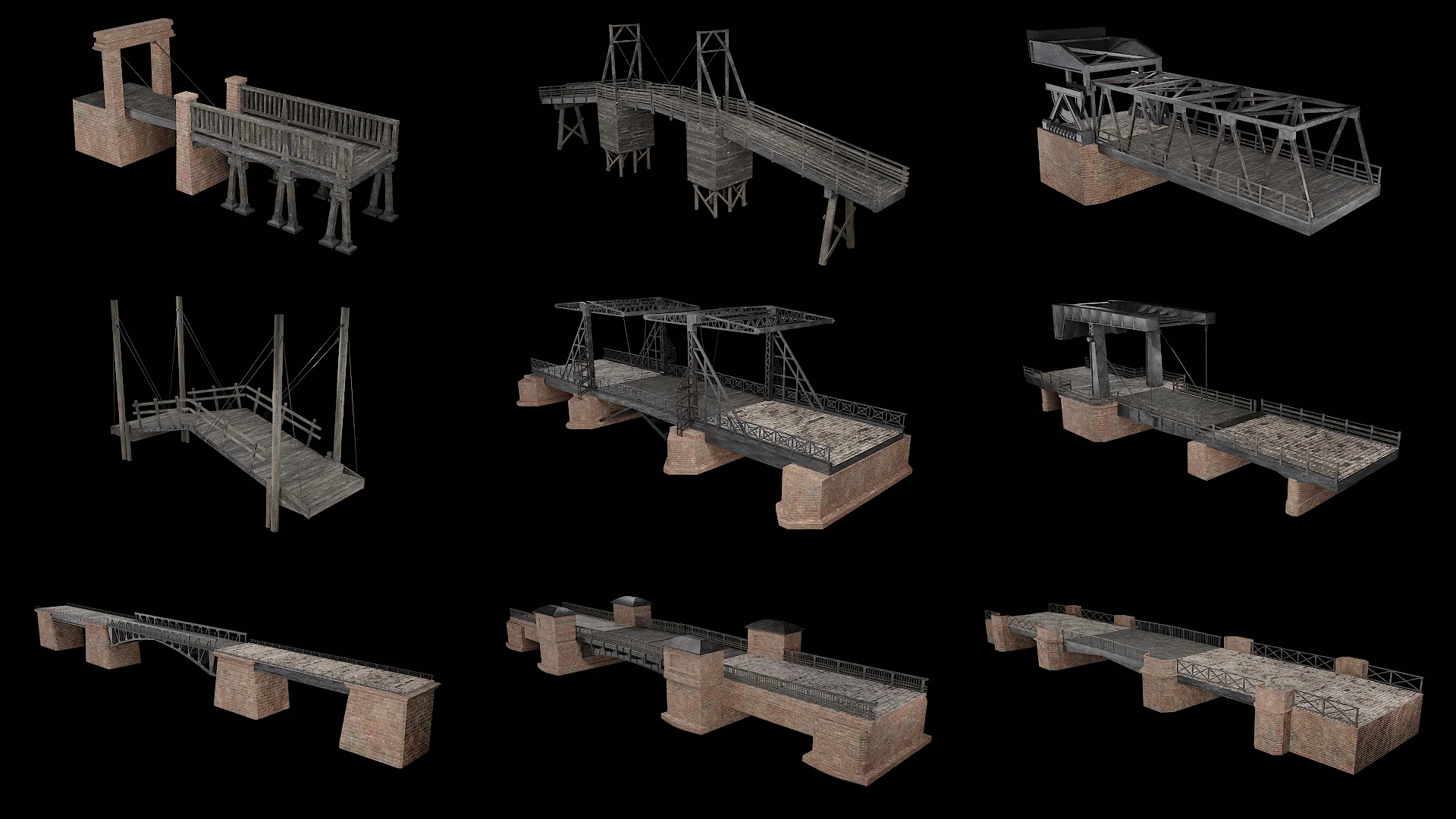
Ten individual modern bridges make up this environment package, providing structural spans engineered for urban towns, busy roadways, and heavy construction areas. Built to handle modern city crossings where steel framework and solid brick construction intersect, the collection offers ready-to-place infrastructure suited for both interactive real-time levels and high-fidelity video production. Each bridge targets AAA production visual standards, presenting distinct spans that carry vehicle routes, pedestrian walkways, and industrial links across riverbanks, rail corridors, and highway divides.
Ten Modern Bridges for Urban and Highway Infrastructure
Infrastructure assets in modern city projects face severe scrutiny because cameras often track directly across road surfaces or linger under massive structural footings. The collection addresses this through ten dedicated designs reflecting modern civil engineering practices. The individual bridge structures feature configurations suited for heavy urban traffic, combining solid brick foundations, clean roadway spans, and industrial steel supports. These designs fit naturally into metropolitan centers, suburban road networks, rural river crossings, and active industrial construction sites where structural mass is essential.
Because the set incorporates elements of both steelwork and heavy brick masonry, level designers can place these structures into varied municipal settings without visual clash. One span might bridge a broad valley carrying a multi-lane roadway, while another serves as an industrial rail or town crossing framed by thick structural pillars. The thematic focus spans municipal, urban, and industrial applications, delivering functional crossings that anchor large-scale terrain divides.
Seamless Tiling Pipeline for Bridge Surfaces
A central design choice throughout the assets is the complete reliance on tiled and seamless materials. Every model in the set uses only tiled materials, completely avoiding unique, locked texture bakes. This architectural texturing approach changes how surfaces can be adjusted, customized, and unified with the rest of an environment project.
By enforcing seamless mapping across the models, you can apply your own library materials directly onto any bridge without re-baking UV maps or correcting distorted seams. Artists using Quixel material libraries can swap out surface treatments instantly, exchanging clean cast concrete for weather-stained industrial slabs, switching structural steel paint finishes, or swapping roadway asphalt to match surrounding terrain surfaces. This workflow guarantees that the bridges do not carry fixed, repetitive grunge marks that betray asset reuse across multiple scenes in the same project.
Relying exclusively on tiled textures also maintains uniform pixel density across massive spans. On large-scale bridge meshes, unique texture maps often suffer from blurry resolution when players walk near piers or railings. Because these assets map seamless surface patterns across their geometry, resolution stays crisp whether an overhead camera views the full crossing from kilometers away or a first-person character stands directly against a brick embankment.
LOD Scaling and Close-Up Fidelity in Modern Bridges
Balancing extreme visual density with runtime performance requires a controlled level-of-detail hierarchy. The bridge models begin at high-poly geometry at their base level. This baseline density ensures that structural bevels, steel joints, roadway barriers, and brick footings retain clean, rounded silhouettes during close-up cinematic passes and detailed hero shots.
To keep these large assets practical for real-time game engines, each model includes two to three custom LOD stages. These transitions scale down the structural geometry systematically, progressing from the dense high-poly base to very-lowpoly meshes intended for distant vistas. The reduction curve strips out fine bevels and micro-geometry at distance while preserving the recognizable silhouette, road deck boundaries, and support pillar placement. This stepped optimization prevents vertex bottlenecks in open-world city maps where several large bridges might remain within the player's camera frustum simultaneously.
Collision Meshes, Lightmaps, and Lumen Lighting Integration
Functional infrastructure requires clean interaction setups right out of the box. Every bridge in the package features pre-configured collision geometry. Vehicles, dynamic physical props, and player characters can traverse roadway decks, interact with bridge barriers, and pass under support arches without falling through gaps or catching on invisible geometric snags. Pre-built collision removes the need to generate automated, inaccurate bounding meshes that often block empty underpasses or fail on complex curved steel spans.
Lighting workflows are similarly accounted for across both traditional and dynamic pipelines. All models come equipped with ready-to-use lightmaps, allowing developers targeting static or baked lighting environments to calculate clean indirect illumination without overlapping UV errors or light bleed on large flat panels. For teams operating in modern dynamic setups, the preview map includes default support for Lumen in Unreal Engine 5.0 and newer versions. Real-time global illumination bounces accurately under bridge arches and beneath road decks, though Lumen remains an optional feature rather than a strict requirement for utilizing the models.
Cross-Era Compatibility and Production Role
While engineered for contemporary civil scenes, the structural grounding of the pack connects across broader building ecosystems, maintaining compatibility with the Medieval MEGA BUILDER COLLECTION. This structural flexibility allows developers working across multiple historical or modern eras to bridge civil engineering layouts with compatible construction modules.
The package stands as an unencumbered utility for staging expansive town crossings, heavy city corridors, and highway overpasses. By uniting ten discrete structural spans under a uniform tiling texturing method, baked collision geometry, lightmap readiness, and multi-tier LOD ladders, the collection provides scalable infrastructural elements designed to drop straight into real-time levels and cinematics.
 Buildings
 Buildings
 Buildings
 Buildings