"97a40bbe7299aab0"{"id":"22654","slug":"love-hate","title":"Love/Hate","category":"Behavior AI","engine":"Original Unity version: 2020.3.0","assetVersion":"Original Unity version: 2020.3.0","engineVersion":"Asset Version:1.10.50","tag":"Behavior AI","accent":"cyan","visual":"animation","summary":"Love/Hate offers a sophisticated framework for Unity developers to implement emotional intelligence and social dynamics within their NPCs, allowing characters to judge actions, form relationships, and share gossip.","platform":"Unity","publishedAt":"2026-04-06T13:36:53.000Z","updatedAt":"2026-04-19T15:37:06.000Z","sourceNotes":[],"fileContents":[],"compatibility":["Unity","Original Unity version: 2020.3.0","Asset Version: 1.10.50"],"featuredImage":{"alt":"Love/Hate","src":"https://3dcghub.com/wp-content/uploads/2026/04/92fd181a9601_695233ea-b32c-4cee-a1b2-8069ba043cf9_1280x720_stretch.webp"},"hasDownloadLink":true,"downloads":0,"terms":[{"taxonomy":"category","slug":"behavior-ai","name":"Behavior AI"},{"taxonomy":"post_tag","slug":"characters","name":"Characters"},{"taxonomy":"post_tag","slug":"tools","name":"Tools"},{"taxonomy":"post_tag","slug":"unity","name":"Unity"}],"galleryImages":[{"src":"https://3dcghub.com/wp-content/uploads/2026/04/943e4fca8c87_b9ba9295-f13d-4637-95f7-5510b411238f_scaled.webp","alt":"Love/Hate"},{"src":"https://3dcghub.com/wp-content/uploads/2026/04/a3fd7b0c45b8_befcc1dc-a5c5-4e41-9a80-aec4e84160e8_scaled.webp","alt":"Love/Hate"},{"src":"https://3dcghub.com/wp-content/uploads/2026/04/e89b0425e5b6_21b5e7b8-0fd3-466e-a9ba-bdb743926ac9_scaled.webp","alt":"Love/Hate"},{"src":"https://3dcghub.com/wp-content/uploads/2026/04/c520120a744e_cc4067c5-adaf-42e3-a04a-e5eea83d3e4c_scaled.webp","alt":"Love/Hate"},{"src":"https://3dcghub.com/wp-content/uploads/2026/04/8639b3769496_dafd0673-3ae6-4885-ab09-1834f7fcf1a3_scaled.webp","alt":"Love/Hate"},{"src":"https://3dcghub.com/wp-content/uploads/2026/04/61cc136c4795_8006493a-ca00-4d82-9984-516bd6c01512_scaled.webp","alt":"Love/Hate"},{"src":"https://3dcghub.com/wp-content/uploads/2026/04/6ad4c71c6660_077a86d8-5517-4acd-bf92-5610a45054cb_scaled.webp","alt":"Love/Hate"},{"src":"https://3dcghub.com/wp-content/uploads/2026/04/11ff3b9bb606_bfb0c8b2-2bbd-4e36-b027-59460254395a_scaled.webp","alt":"Love/Hate"},{"src":"https://3dcghub.com/wp-content/uploads/2026/04/94f1b33c9c01_e36f5c41-29bb-447f-9360-9c35e7a46b1e_scaled.webp","alt":"Love/Hate"}],"accessPanel":{"kind":"resource","title":"Access this resource","eyebrow":"Free Download","message":"Log in or create a free account to start your download.","fileName":"LoveHate v1.10.50 (20 Nov 2024).7z","safetyNote":"All resources are 100% manually reviewed to eliminate all risks.","actionLabel":"Download Free","resourceType":"Resource archive"},"contentHtml":"\u003ch2\u003eDynamic Personality and Emotional Modeling\u003c/h2\u003e\n\u003cp\u003eLove/Hate serves as a relationship and personality simulator designed for the Unity engine, enabling developers to move beyond static NPC interactions. The system models how characters feel about one another using a combination of internal emotional states and value-based judgments. These models are highly customizable, allowing for the creation of distinct personalities that react uniquely to the same stimuli. Because the system is built on research into real-time emotion simulation and value-based appraisal, it incorporates academic and industry strategies to ensure characters respond realistically to gameplay events.\u003c/p\u003e\n\n\u003ch2\u003eThe Mechanics of Deeds and Social Judgment\u003c/h2\u003e\n\u003cp\u003eA core component of the workflow involves the 'deed' system. Rather than scripting specific reactions for every possible player interaction, the developer can define gameplay actions as deeds. Characters within the game world witness these deeds and evaluate them based on their own personality traits and existing relationships. This appraisal process results in an automated update to the character's emotional state and their affinity toward the individual who performed the action.\u003c/p\u003e\n\u003cp\u003eThis system extends beyond individual actors to include factions. Love/Hate tracks social ties across different groups, creating a dynamic web of relationships. If a character belongs to a specific faction, their judgment of a deed may be influenced by how that action affects their group, allowing for complex social consequences that ripple through the game world.\u003c/p\u003e\n\n\u003ch2\u003eMemory Management and Organic Information Spread\u003c/h2\u003e\n\u003cp\u003eCharacters in Love/Hate do not simply react in the moment; they maintain a memory of witnessed deeds. This memory system is the foundation for the gossip mechanic, which allows NPCs to share information with one another. When characters interact, they can exchange memories of actions they have witnessed or heard about, allowing news of the player's behavior to spread organically through the environment. This simulation of social communication ensures that a character's reputation can precede them, even when meeting an NPC who was not present during a specific event.\u003c/p\u003e\n\n\u003ch2\u003eIntegration and Workflow Compatibility\u003c/h2\u003e\n\u003cp\u003eThe system is designed to function without the requirement for custom scripting, making it accessible for rapid implementation across various project types, including 3D, 2D, AR, and VR. It is compatible with a wide range of Unity versions, specifically supporting Unity 6 and all versions from 2019 through 2022. The package includes 438 assets and provides fully documented source code for those who need to look deeper into the underlying logic.\u003c/p\u003e\n\u003cp\u003eFor developers utilizing third-party tools, the asset includes built-in support for a variety of popular Unity frameworks, including:\u003c/p\u003e\n\u003cul\u003e\n \u003cli\u003eVisual scripting tools like PlayMaker, Bolt, and Node Canvas.\u003c/li\u003e\n \u003cli\u003eAI and behavior systems such as Behavior Designer, Emerald AI, and Eliot AI.\u003c/li\u003e\n \u003cli\u003eNarrative and RPG frameworks including the Dialogue System for Unity, Quest Machine, RPG Builder, and ORK Framework.\u003c/li\u003e\n \u003cli\u003eCharacter and adventure controllers like Opsive Character Controllers and Adventure Creator.\u003c/li\u003e\n\u003c/ul\u003e\n\n\u003cp\u003eBy leveraging these integrations, the developer can connect emotional states and relationship changes directly to dialogue branches, quest triggers, and combat behaviors, ensuring that the social simulation has a tangible impact on the gameplay experience.\u003c/p\u003e\n\n\u003ch2\u003eRelated Resources Worth Checking\u003c/h2\u003e\n\u003cul\u003e\n\u003cli\u003e\u003ca href=\"https://3dcghub.com/ambient-sounds-interactive-soundscapes-for-unity-6/\" title=\"Ambient Sounds – Interactive Soundscapes for Unity 6\"\u003eAmbient Sounds – Interactive Soundscapes for Unity 6\u003c/a\u003e\u003c/li\u003e\n\u003cli\u003e\u003ca href=\"https://3dcghub.com/pegasus-flythroughs-for-unity-6/\" title=\"Pegasus – Flythroughs for Unity 6\"\u003ePegasus – Flythroughs for Unity 6\u003c/a\u003e\u003c/li\u003e\n\u003cli\u003e\u003ca href=\"https://3dcghub.com/motion-matching-for-unity/\" title=\"Motion Matching for Unity\"\u003eMotion Matching for Unity\u003c/a\u003e\u003c/li\u003e\n\u003cli\u003e\u003ca href=\"https://3dcghub.com/civil-ai-system/\" title=\"CIVIL-AI-SYSTEM\"\u003eCIVIL-AI-SYSTEM\u003c/a\u003e\u003c/li\u003e\n\u003cli\u003e\u003ca href=\"https://3dcghub.com/blaze-ai-engine/\" title=\"Blaze AI Engine\"\u003eBlaze AI Engine\u003c/a\u003e\u003c/li\u003e\n\u003c/ul\u003e","contentTextLength":3633,"navigation":{"current":3222,"total":3382,"previous":{"id":"22657","slug":"mobile-pedestrian-system","title":"Mobile Pedestrian System","category":"Behavior AI","platform":"Unity","updatedAt":"2026-04-19T15:37:06.000Z"},"next":{"id":"22686","slug":"transition-blocks","title":"Transition Blocks","category":"Camera","platform":"Unity","updatedAt":"2026-04-19T15:37:05.000Z"}},"relatedResources":[{"id":"22629","slug":"civil-ai-system","title":"CIVIL-AI-SYSTEM","category":"Behavior AI","engine":"Original Unity version: 2022.3.7","assetVersion":"Original Unity version: 2022.3.7","engineVersion":"","tag":"Behavior AI","accent":"cyan","visual":"mech","summary":"CIVIL-AI-SYSTEM provides a framework for creating lived-in digital environments without requiring manual coding or complex graphs. The system focuses on automated population, work and need behaviors, and detailed item interaction.","platform":"Unity","publishedAt":"2026-04-06T13:32:31.000Z","updatedAt":"2026-04-19T15:37:07.000Z","sourceNotes":[],"fileContents":[],"compatibility":["Unity","Original Unity version: 2022.3.7"],"featuredImage":{"alt":"CIVIL-AI-SYSTEM","src":"https://3dcghub.com/wp-content/uploads/2026/04/9d2dbe998cce_9050041d-d7c4-4dcc-916a-c08c9afd7189_1280x720_stretch.webp"},"hasDownloadLink":true,"downloads":1},{"id":"22621","slug":"blaze-ai-engine","title":"Blaze AI Engine","category":"Behavior AI","engine":"Original Unity version: 2022.3.53","assetVersion":"Original Unity version: 2022.3.53","engineVersion":"Asset Version:3.3.2 - 3.4.9","tag":"Behavior AI","accent":"cyan","visual":"character","summary":"Blaze AI provides a streamlined workflow for creating complex NPC behaviors in Unity, including support for off-mesh links and a simplified animation system that bypasses traditional triggers. It is designed to handle everything from melee brutes to tactica...","platform":"Unity","publishedAt":"2026-04-06T13:29:37.000Z","updatedAt":"2026-04-19T15:37:08.000Z","sourceNotes":[],"fileContents":[],"compatibility":["Unity","Original Unity version: 2022.3.53","Asset Version: 3.3.2 - 3.4.9"],"featuredImage":{"alt":"Blaze AI Engine","src":"https://3dcghub.com/wp-content/uploads/2026/04/7fa6bc676a49_4265806c-3b1c-4ec4-9293-dd9a2f822e67_1280x720_stretch.webp"},"hasDownloadLink":true,"downloads":0},{"id":"22657","slug":"mobile-pedestrian-system","title":"Mobile Pedestrian System","category":"Behavior AI","engine":"Original Unity version: 2021.3.45","assetVersion":"Original Unity version: 2021.3.45","engineVersion":"Asset Version:1.1.2","tag":"Behavior AI","accent":"cyan","visual":"luts","summary":"The Mobile Pedestrian System offers a framework for creating realistic urban movement through grid-based navigation and root motion animation. It supports dynamic zoning, obstacle avoidance, and seamless integration with traffic systems.","platform":"Unity","publishedAt":"2026-04-06T13:37:03.000Z","updatedAt":"2026-04-19T15:37:06.000Z","sourceNotes":[],"fileContents":[],"compatibility":["Unity","Original Unity version: 2021.3.45","Asset Version: 1.1.2"],"featuredImage":{"alt":"Mobile Pedestrian System","src":"https://3dcghub.com/wp-content/uploads/2026/04/2780ec011d3b_e7d03524-9803-4cab-8b61-c4b7c814f3d0_1280x720_stretch.webp"},"hasDownloadLink":true,"downloads":0}]}
Behavior AI
Love/Hate
Love/Hate offers a sophisticated framework for Unity developers to implement emotional intelligence and social dynamics within their NPCs, allowing characters to judge actions, form relationships, and share gossip.
Love/Hate serves as a relationship and personality simulator designed for the Unity engine, enabling developers to move beyond static NPC interactions. The system models how characters feel about one another using a combination of internal emotional states and value-based judgments. These models are highly customizable, allowing for the creation of distinct personalities that react uniquely to the same stimuli. Because the system is built on research into real-time emotion simulation and value-based appraisal, it incorporates academic and industry strategies to ensure characters respond realistically to gameplay events.
The Mechanics of Deeds and Social Judgment
A core component of the workflow involves the 'deed' system. Rather than scripting specific reactions for every possible player interaction, the developer can define gameplay actions as deeds. Characters within the game world witness these deeds and evaluate them based on their own personality traits and existing relationships. This appraisal process results in an automated update to the character's emotional state and their affinity toward the individual who performed the action.
This system extends beyond individual actors to include factions. Love/Hate tracks social ties across different groups, creating a dynamic web of relationships. If a character belongs to a specific faction, their judgment of a deed may be influenced by how that action affects their group, allowing for complex social consequences that ripple through the game world.
Memory Management and Organic Information Spread
Characters in Love/Hate do not simply react in the moment; they maintain a memory of witnessed deeds. This memory system is the foundation for the gossip mechanic, which allows NPCs to share information with one another. When characters interact, they can exchange memories of actions they have witnessed or heard about, allowing news of the player's behavior to spread organically through the environment. This simulation of social communication ensures that a character's reputation can precede them, even when meeting an NPC who was not present during a specific event.
Integration and Workflow Compatibility
The system is designed to function without the requirement for custom scripting, making it accessible for rapid implementation across various project types, including 3D, 2D, AR, and VR. It is compatible with a wide range of Unity versions, specifically supporting Unity 6 and all versions from 2019 through 2022. The package includes 438 assets and provides fully documented source code for those who need to look deeper into the underlying logic.
For developers utilizing third-party tools, the asset includes built-in support for a variety of popular Unity frameworks, including:
Visual scripting tools like PlayMaker, Bolt, and Node Canvas.
AI and behavior systems such as Behavior Designer, Emerald AI, and Eliot AI.
Narrative and RPG frameworks including the Dialogue System for Unity, Quest Machine, RPG Builder, and ORK Framework.
Character and adventure controllers like Opsive Character Controllers and Adventure Creator.
By leveraging these integrations, the developer can connect emotional states and relationship changes directly to dialogue branches, quest triggers, and combat behaviors, ensuring that the social simulation has a tangible impact on the gameplay experience.
 Behavior AI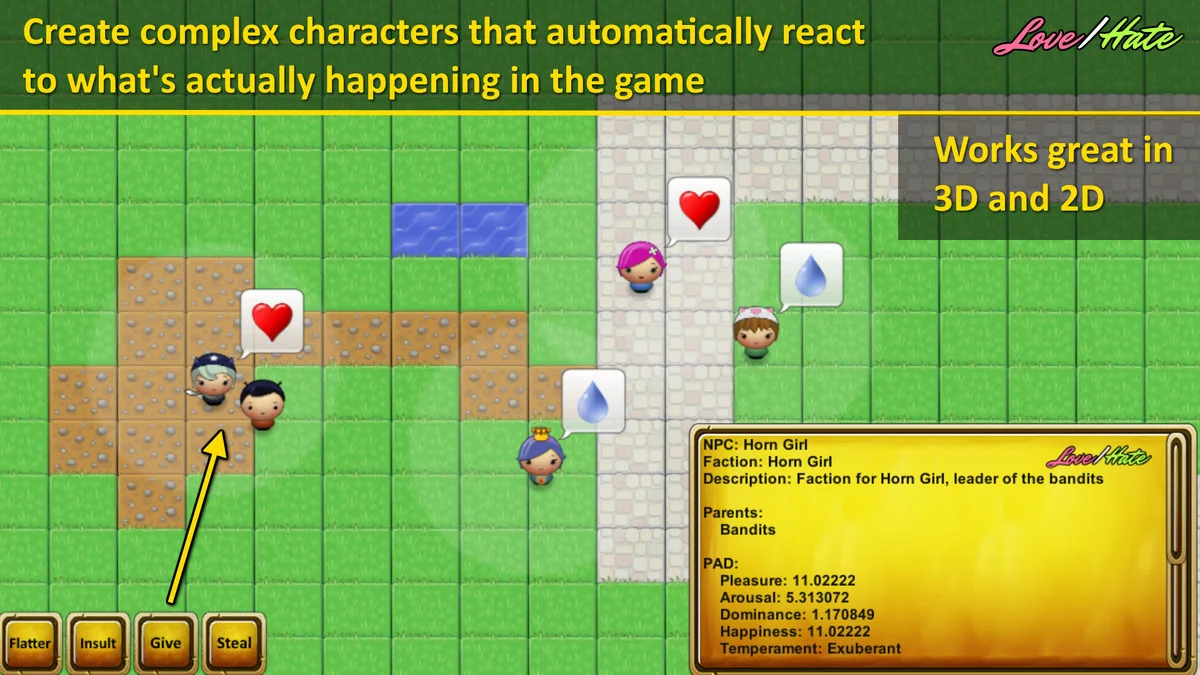
 Behavior AI
 Behavior AI
 Behavior AI