"a338a1d501976271"{"id":"1000305","slug":"json4ue-json-for-ue","title":"JSON4UE(JSON For UE)","category":"Engine Tools","engine":"5.6 - 5.7","assetVersion":"Asset Version: 1.2.4","engineVersion":"Engine Version: 5.6 - 5.7","tag":"Engine Tools","accent":"blue","visual":"mech","summary":"A lightweight, dependency-free UE4 plugin that provides 18 Blueprint nodes and 4 C++ classes for fast JSON string and file parsing across all platforms.","platform":"Unreal Engine","publishedAt":"2026-07-04T09:12:37.041Z","updatedAt":"2026-07-04T09:12:37.041Z","sourceNotes":[],"fileContents":[],"compatibility":["Unreal Engine","Asset Version: 1.2.4","Engine Version: 5.6 - 5.7"],"featuredImage":{"alt":"JSON4UE(JSON For UE)","src":"/wp-content/uploads/published/2026/07/a8b13b531e8c-f664d4e4-64b1-47da-86cc-351d892f1d6e-ca45898d7c.webp"},"hasDownloadLink":true,"downloads":1,"terms":[{"taxonomy":"category","slug":"engine-tools-tools-and-plugins","name":"Engine Tools"}],"galleryImages":[{"src":"/wp-content/uploads/published/2026/07/242ec835eb05-c41e82b9-c256-44dc-962f-1f4311fc174c-ec08338569.webp","alt":"JSON4UE(JSON For UE)"},{"src":"/wp-content/uploads/published/2026/07/1156e8379e64-74f95c2a-d4dd-4cd3-b7ca-7b7b9321d845-b7168a8a1f.webp","alt":"JSON4UE(JSON For UE)"},{"src":"/wp-content/uploads/published/2026/07/b146fcebde62-33c79c93-5ef6-4864-872b-6055496cd74c-396d43583b.webp","alt":"JSON4UE(JSON For UE)"},{"src":"/wp-content/uploads/published/2026/07/d68b09ff7b6f-5af8773e-a741-42c0-a80a-bb63feeaa4a7-ea8e47f178.webp","alt":"JSON4UE(JSON For UE)"}],"accessPanel":{"kind":"resource","title":"Download this resource","eyebrow":"Free Download","message":"Log in or create a free account to start your download.","fileName":"JSON4UE(JSON For UE).7z","safetyNote":"Resources are manually reviewed before listing to improve quality and reduce obvious risks.","actionLabel":"Download Free","resourceType":"Resource archive"},"contentHtml":"\u003ch2\u003eJSON4UE4 Runtime Module and Blueprint Architecture\u003c/h2\u003e\n\u003cp\u003eJSON4UE(JSON For UE) operates as a focused data-processing tool built directly around a single runtime code module designated as JSON4UE4. The core purpose of this package is to bring external data reading capabilities directly into the visual scripting environment of Unreal Engine 4. To achieve this, the architecture is divided between a highly streamlined backend and an accessible frontend interface for developers.\u003c/p\u003e\n\u003cp\u003eThe structural foundation of the plugin relies on just 4 C++ classes. These classes manage the underlying logic required to interpret text data and convert it into a format that the engine can utilize. By keeping the class count low, the module maintains a lightweight footprint within the broader project directory, minimizing compilation times and reducing the risk of code bloat.\u003c/p\u003e\n\u003cp\u003eOn the user-facing side, the plugin exposes its functionality through exactly 18 Blueprint nodes. These nodes serve as the bridge between the complex backend data interpretation and the intuitive, node-based visual scripting environment of UE4. Developers can drop these specific nodes directly into their graphs to manipulate, read, and route data without needing to write or modify any C++ code themselves. This clear separation between the 4 backend classes and the 18 frontend nodes ensures that technical artists, level designers, and gameplay programmers can all interface with complex data structures seamlessly.\u003c/p\u003e\n\u003ch2\u003eProcessing JSON Strings and Files\u003c/h2\u003e\n\u003cp\u003eThe operational behavior of the JSON4UE4 module is shaped by two primary methods of data ingestion: parsing raw JSON strings and loading JSON strings directly from formatted files. These two approaches provide the flexibility needed to handle different types of data pipelines within a standard game development workflow.\u003c/p\u003e\n\u003cp\u003eWhen dealing with dynamic data—such as information generated at runtime by other systems or passed through engine-level text variables—developers can utilize the feature dedicated to parsing JSON strings by UE4 Blueprints. This allows the logic graph to take a flat string of structured text and immediately evaluate it, breaking it down into usable variables and arrays that can drive gameplay logic, UI updates, or configuration settings.\u003c/p\u003e\n\u003cp\u003eAlternatively, projects that rely on static, pre-configured data can use the feature designed to load a JSON string from a JSON file. This is particularly useful for external configuration files, localized dialogue text, or level-generation parameters that are stored on the local disk. By pointing the Blueprint nodes to an external file, the system reads the document, extracts the contents as a string, and funnels it through the parser. In both scenarios, the plugin is engineered to execute these tasks with a very fast parsing speed, ensuring that large data sets or complex nested structures do not introduce significant performance bottlenecks or stuttering during runtime evaluation.\u003c/p\u003e\n\u003ch2\u003eNative UE4 C++ Code Integration\u003c/h2\u003e\n\u003cp\u003eA critical technical characteristic of the JSON4UE4 module is its strict adherence to the engine's native architecture. The plugin only uses native UE4 C++ code to execute its parsing operations. There are absolutely no other external C++ libraries, third-party frameworks, or external APIs integrated into the codebase.\u003c/p\u003e\n\u003cp\u003eThis design choice has significant implications for project health and maintenance. In typical development environments, relying on third-party solutions often introduces the risk of dependency conflicts, complex linking requirements during compilation, or broken code when the core engine receives an update. By completely avoiding external libraries, this package bypasses those common pipeline hurdles.\u003c/p\u003e\n\u003cp\u003eBecause the logic relies entirely on the tools and syntax already provided by Unreal Engine, it operates in perfect synchronization with the engine's internal build tools and memory management systems. This localized, dependency-free approach is specifically implemented to ensure maximum stability and compatibility. Developers can integrate the tool into existing, complex codebases without worrying that an external library will clash with their current setup or trigger unexpected compilation errors.\u003c/p\u003e\n\u003ch2\u003eUniversal Target Build Compatibility\u003c/h2\u003e\n\u003cp\u003eBecause the runtime module is built exclusively with native engine code and avoids OS-specific third-party libraries, it benefits from universal hardware compatibility. The package officially supports all development platforms, allowing teams to integrate and test their data-parsing logic whether they are building on a Windows machine, a Mac, or a Linux workstation.\u003c/p\u003e\n\u003cp\u003eMore importantly, this agnostic design extends to the final deployment phase. The plugin supports all target build platforms. When a project is packaged for distribution, the Blueprint logic and the 4 C++ classes compile cleanly for desktop environments, mobile devices, or home consoles. Developers do not need to author platform-specific conditional logic or custom workarounds to read configuration files on different hardware. The 18 Blueprint nodes will execute the exact same parsing behavior regardless of where the final application is deployed.\u003c/p\u003e\n\u003ch2\u003eData Handling for UE4 Projects\u003c/h2\u003e\n\u003cp\u003eJSON4UE(JSON For UE) is set up to handle the specific task of bridging external text data and internal visual scripting with minimal friction. It provides a highly focused, lightweight solution for bringing structured data files and dynamic text strings into the Blueprint environment. By relying entirely on native UE4 C++ and delivering a concise set of 18 nodes, it offers a fast, stable, and universally compatible method for managing configuration and data-driven systems across any target platform.\u003c/p\u003e\n\n\u003ch2\u003eRelated Resources Worth Checking\u003c/h2\u003e\n\u003cul\u003e\n\u003cli\u003e\u003ca href=\"https://3dcghub.com/blueprintjson/\" title=\"BlueprintJSON\"\u003eBlueprintJSON\u003c/a\u003e\u003c/li\u003e\n\u003cli\u003e\u003ca href=\"https://3dcghub.com/le-json/\" title=\"LE Json\"\u003eLE Json\u003c/a\u003e\u003c/li\u003e\n\u003cli\u003e\u003ca href=\"https://3dcghub.com/http-and-json/\" title=\"HTTP AND JSON\"\u003eHTTP AND JSON\u003c/a\u003e\u003c/li\u003e\n\u003cli\u003e\u003ca href=\"https://3dcghub.com/modular-gameplay-blueprint-systems/\" title=\"Modular Gameplay Blueprint Systems\"\u003eModular Gameplay Blueprint Systems\u003c/a\u003e\u003c/li\u003e\n\u003cli\u003e\u003ca href=\"https://3dcghub.com/make-modular-skeletal-mesh/\" title=\"Make Modular Skeletal Mesh\"\u003eMake Modular Skeletal Mesh\u003c/a\u003e\u003c/li\u003e\n\u003c/ul\u003e","contentTextLength":5855,"navigation":{"current":1171,"total":3338,"previous":{"id":"1000306","slug":"knight-vesuvius","title":"Knight Vesuvius","category":"Humans","platform":"Unreal Engine","updatedAt":"2026-07-04T09:23:21.715Z"},"next":{"id":"1000304","slug":"interact-sandbox","title":"Interact Sandbox","category":"Game Mechanics","platform":"Unreal Engine","updatedAt":"2026-07-04T08:54:18.742Z"}},"relatedResources":[{"id":"13767","slug":"blueprintjson","title":"BlueprintJSON","category":"Engine Tools","engine":"4.23 - 5.8","assetVersion":"Asset Version:1.0 - 1.0.6","engineVersion":"Engine version: 4.23 - 5.8","tag":"Engine Tools","accent":"blue","visual":"mech","summary":"BlueprintJSON is a comprehensive library designed to bring JSON functionality to Unreal Engine Blueprints. It enables developers to read, parse, edit, and save JSON data efficiently using asynchronous processing.","platform":"Unreal Engine","publishedAt":"2026-03-11T09:59:29.000Z","updatedAt":"2026-09-29T08:30:49.387Z","sourceNotes":[],"fileContents":[],"compatibility":["Unreal Engine","Asset Version:1.0 - 1.0.6","Engine version: 4.23 - 5.8"],"featuredImage":{"alt":"BlueprintJSON","src":"https://3dcghub.com/wp-content/uploads/2026/03/635658e0-64f1-431f-b6f4-59f2fe39da17.webp"},"hasDownloadLink":true,"downloads":1},{"id":"14060","slug":"http-and-json","title":"HTTP AND JSON","category":"Engine Tools","engine":"4.26 - 5.8","assetVersion":"Asset Version:1.1","engineVersion":"Engine version: 4.26 - 5.8","tag":"Engine Tools","accent":"blue","visual":"audio","summary":"Streamline your network workflows with the HTTP AND JSON plugin for Blueprints. This tool simplifies data analysis and interface docking by treating JSON data as manageable strings.","platform":"Unreal Engine","publishedAt":"2026-03-11T13:27:48.000Z","updatedAt":"2026-09-29T09:07:47.488Z","sourceNotes":[],"fileContents":[],"compatibility":["Unreal Engine","Asset Version:1.1","Engine version: 4.26 - 5.8"],"featuredImage":{"alt":"HTTP AND JSON","src":"https://3dcghub.com/wp-content/uploads/2026/03/b5285804-2d24-40c2-ab91-e872bc320095.webp"},"hasDownloadLink":true,"downloads":0},{"id":"14108","slug":"le-json","title":"LE Json","category":"Engine Tools","engine":"4.26 - 5.4","assetVersion":"Engine version: 4.26 - 5.4","engineVersion":"Asset Version:5.3.0","tag":"Engine Tools","accent":"blue","visual":"luts","summary":"Simplify your data management with LE Json. This plugin offers dedicated Blueprint nodes for creating and parsing JSON strings within the Unreal Engine environment.","platform":"Unreal Engine","publishedAt":"2026-03-11T15:50:52.000Z","updatedAt":"2026-04-19T15:45:53.000Z","sourceNotes":[],"fileContents":[],"compatibility":["Unreal Engine","Engine version: 4.26 - 5.4","Asset Version: 5.3.0"],"featuredImage":{"alt":"LE Json","src":"https://3dcghub.com/wp-content/uploads/2026/03/80373996-08f5-4318-8e7d-557d24f41fd5.webp"},"hasDownloadLink":true,"downloads":0}]}
Engine Tools
JSON4UE(JSON For UE)
A lightweight, dependency-free UE4 plugin that provides 18 Blueprint nodes and 4 C++ classes for fast JSON string and file parsing across all platforms.
JSON4UE4 Runtime Module and Blueprint Architecture
JSON4UE(JSON For UE) operates as a focused data-processing tool built directly around a single runtime code module designated as JSON4UE4. The core purpose of this package is to bring external data reading capabilities directly into the visual scripting environment of Unreal Engine 4. To achieve this, the architecture is divided between a highly streamlined backend and an accessible frontend interface for developers.
The structural foundation of the plugin relies on just 4 C++ classes. These classes manage the underlying logic required to interpret text data and convert it into a format that the engine can utilize. By keeping the class count low, the module maintains a lightweight footprint within the broader project directory, minimizing compilation times and reducing the risk of code bloat.
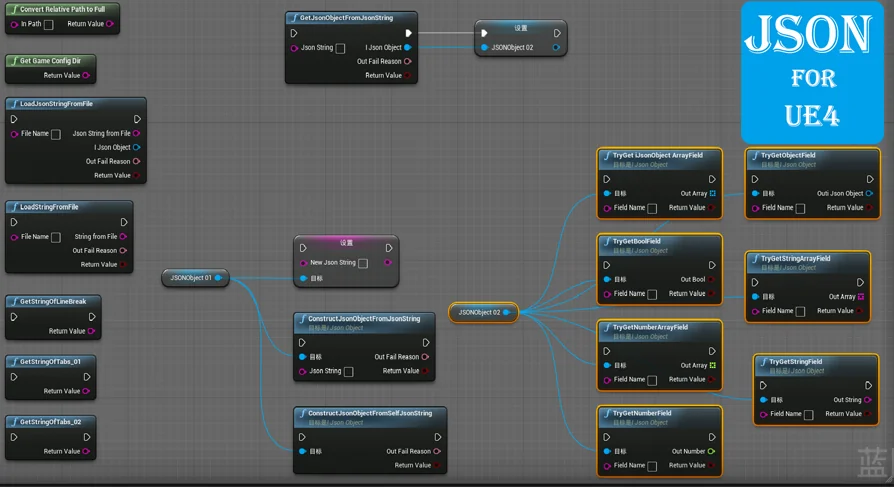
On the user-facing side, the plugin exposes its functionality through exactly 18 Blueprint nodes. These nodes serve as the bridge between the complex backend data interpretation and the intuitive, node-based visual scripting environment of UE4. Developers can drop these specific nodes directly into their graphs to manipulate, read, and route data without needing to write or modify any C++ code themselves. This clear separation between the 4 backend classes and the 18 frontend nodes ensures that technical artists, level designers, and gameplay programmers can all interface with complex data structures seamlessly.
Processing JSON Strings and Files
The operational behavior of the JSON4UE4 module is shaped by two primary methods of data ingestion: parsing raw JSON strings and loading JSON strings directly from formatted files. These two approaches provide the flexibility needed to handle different types of data pipelines within a standard game development workflow.
When dealing with dynamic data—such as information generated at runtime by other systems or passed through engine-level text variables—developers can utilize the feature dedicated to parsing JSON strings by UE4 Blueprints. This allows the logic graph to take a flat string of structured text and immediately evaluate it, breaking it down into usable variables and arrays that can drive gameplay logic, UI updates, or configuration settings.
Alternatively, projects that rely on static, pre-configured data can use the feature designed to load a JSON string from a JSON file. This is particularly useful for external configuration files, localized dialogue text, or level-generation parameters that are stored on the local disk. By pointing the Blueprint nodes to an external file, the system reads the document, extracts the contents as a string, and funnels it through the parser. In both scenarios, the plugin is engineered to execute these tasks with a very fast parsing speed, ensuring that large data sets or complex nested structures do not introduce significant performance bottlenecks or stuttering during runtime evaluation.
Native UE4 C++ Code Integration
A critical technical characteristic of the JSON4UE4 module is its strict adherence to the engine's native architecture. The plugin only uses native UE4 C++ code to execute its parsing operations. There are absolutely no other external C++ libraries, third-party frameworks, or external APIs integrated into the codebase.
This design choice has significant implications for project health and maintenance. In typical development environments, relying on third-party solutions often introduces the risk of dependency conflicts, complex linking requirements during compilation, or broken code when the core engine receives an update. By completely avoiding external libraries, this package bypasses those common pipeline hurdles.
Because the logic relies entirely on the tools and syntax already provided by Unreal Engine, it operates in perfect synchronization with the engine's internal build tools and memory management systems. This localized, dependency-free approach is specifically implemented to ensure maximum stability and compatibility. Developers can integrate the tool into existing, complex codebases without worrying that an external library will clash with their current setup or trigger unexpected compilation errors.
Universal Target Build Compatibility
Because the runtime module is built exclusively with native engine code and avoids OS-specific third-party libraries, it benefits from universal hardware compatibility. The package officially supports all development platforms, allowing teams to integrate and test their data-parsing logic whether they are building on a Windows machine, a Mac, or a Linux workstation.
More importantly, this agnostic design extends to the final deployment phase. The plugin supports all target build platforms. When a project is packaged for distribution, the Blueprint logic and the 4 C++ classes compile cleanly for desktop environments, mobile devices, or home consoles. Developers do not need to author platform-specific conditional logic or custom workarounds to read configuration files on different hardware. The 18 Blueprint nodes will execute the exact same parsing behavior regardless of where the final application is deployed.
Data Handling for UE4 Projects
JSON4UE(JSON For UE) is set up to handle the specific task of bridging external text data and internal visual scripting with minimal friction. It provides a highly focused, lightweight solution for bringing structured data files and dynamic text strings into the Blueprint environment. By relying entirely on native UE4 C++ and delivering a concise set of 18 nodes, it offers a fast, stable, and universally compatible method for managing configuration and data-driven systems across any target platform.
 Engine Tools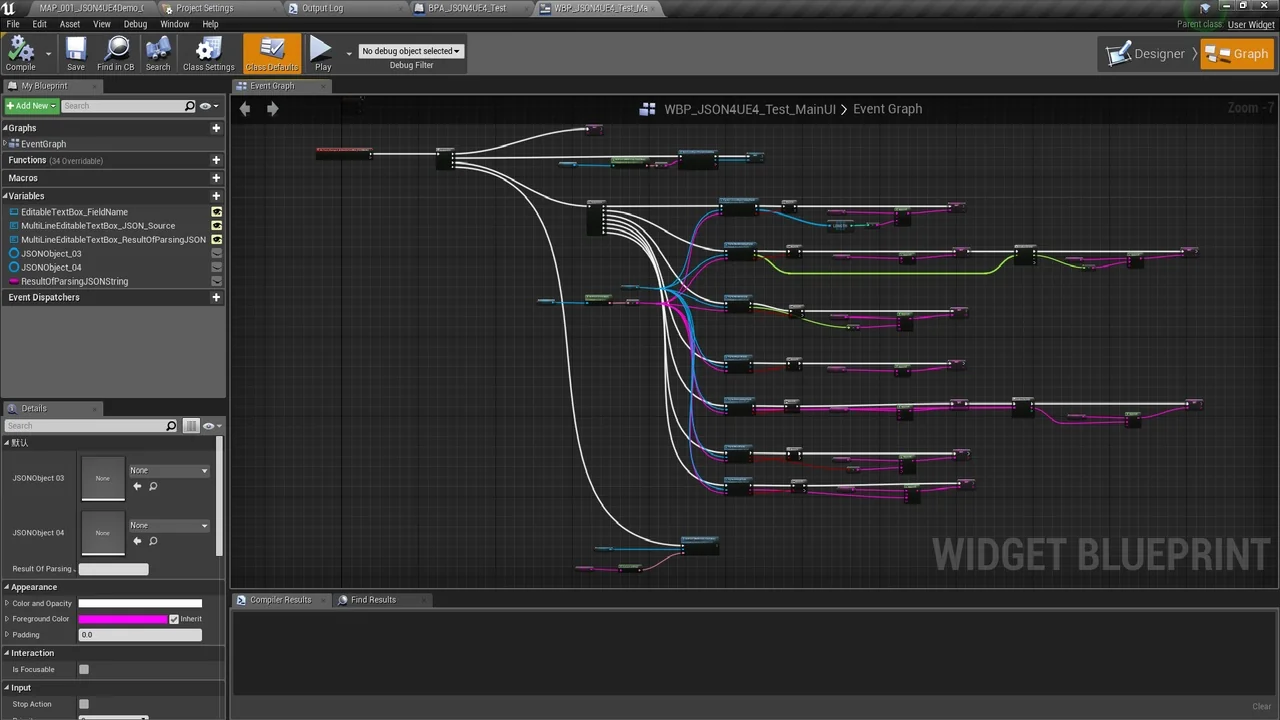
 Engine Tools
 Engine Tools
 Engine Tools