"a338a1d501976271"{"id":"1000304","slug":"interact-sandbox","title":"Interact Sandbox","category":"Game Mechanics","engine":"5.0+","assetVersion":"","engineVersion":"Engine Version: 5.0+","tag":"Game Mechanics","accent":"blue","visual":"mech","summary":"A modular, server-authoritative blueprint framework for UE5 featuring networked interaction, grab mechanics, decoupled inventories, and vehicle systems.","platform":"Unreal Engine","publishedAt":"2026-07-04T08:54:18.742Z","updatedAt":"2026-07-04T08:54:18.742Z","sourceNotes":[],"fileContents":[],"compatibility":["Unreal Engine","Engine Version: 5.0+"],"featuredImage":{"alt":"Interact Sandbox","src":"/wp-content/uploads/published/2026/07/1c481701ee06-bef6bd60-d208-4e65-ac31-9e1e8ffb63ca-26c352d19c.webp"},"hasDownloadLink":true,"downloads":0,"terms":[{"taxonomy":"category","slug":"game-mechanics","name":"Game Mechanics"}],"galleryImages":[{"src":"/wp-content/uploads/published/2026/07/be40663fa9a8-f767d678-6067-4bdc-b8fe-1b1d00160834-bb7a688d89.webp","alt":"Interact Sandbox"},{"src":"/wp-content/uploads/published/2026/07/6313e7818d46-ed6d7445-415f-4c2a-b471-5c15620e3b43-88e2924224.webp","alt":"Interact Sandbox"},{"src":"/wp-content/uploads/published/2026/07/07795ff6ad05-f34633df-8b5b-4602-95b4-4bd56ffd8838-9a0515ef1e.webp","alt":"Interact Sandbox"},{"src":"/wp-content/uploads/published/2026/07/89f4a5512936-3f022ccf-76d4-40c2-86b6-eee078e08562-ac0500fa53.webp","alt":"Interact Sandbox"},{"src":"/wp-content/uploads/published/2026/07/10a2bd007f15-ffcdc915-5c6b-4292-b7ba-f1e6d29e0ffb-fabe4f3342.webp","alt":"Interact Sandbox"},{"src":"/wp-content/uploads/published/2026/07/8228534d926e-024b5cee-c238-4908-a981-2f06469aae5d-6428060c4b.webp","alt":"Interact Sandbox"},{"src":"/wp-content/uploads/published/2026/07/c23a4c16c404-84209642-d7b7-4146-af78-9157a8766103-06beb0913a.webp","alt":"Interact Sandbox"},{"src":"/wp-content/uploads/published/2026/07/eab3e295ac2a-736b2e9e-1260-49e4-8452-da96357e58e8-ce9acb11b9.webp","alt":"Interact Sandbox"},{"src":"/wp-content/uploads/published/2026/07/b9717a9f1314-ea1fd22f-9bcf-4309-867c-ff67f247f381-6b577bd871.webp","alt":"Interact Sandbox"},{"src":"/wp-content/uploads/published/2026/07/b063d0862f9b-b49f5953-e967-40d6-a02b-b0bb3c18beeb-95233e1906.webp","alt":"Interact Sandbox"}],"accessPanel":{"kind":"resource","title":"Download this resource","eyebrow":"Free Download","message":"Log in or create a free account to start your download.","fileName":"InteractSandbox.7z","safetyNote":"Resources are manually reviewed before listing to improve quality and reduce obvious risks.","actionLabel":"Download Free","resourceType":"Resource archive"},"contentHtml":"\u003ch2\u003eThe Interact Sandbox Framework for UE5\u003c/h2\u003e\n\u003cp\u003eThe Interact Sandbox package provides a foundational suite of networked modules for Unreal Engine 5, specifically targeting the Interaction System, Inspection and Grab System, Inventory System, and Vehicle System. Built as a Blueprint framework, the project establishes a playable environment where developers can immediately test and expand upon core mechanics without having to build complex baseline features from scratch. By supplying these interconnected systems out of the box, the framework serves as a prototyping environment for multiplayer projects that require robust object handling, player inventories, and drivable transport. Every module within the package is heavily focused on networking, ensuring that actions performed by players are properly replicated and validated across a live multiplayer session.\u003c/p\u003e \u003ch2\u003eNetworked Inspection and Grab Mechanics\u003c/h2\u003e\n\u003cp\u003eThe physical handling of objects is managed through a dedicated networked Inspection and Grab System. This module allows players to pick up, hold freely, and move items around the game world. Rather than restricting interactions to simple button presses that trigger invisible logic, the sandbox enables physical manipulation and detailed inspection of actors within the 3D space. The system is highly extendable and configured to accept any actor type with ease. Developers can apply these grab and inspect mechanics to varied objects, scaling from small environmental props like eggs to massive interactive elements like rockets.\u003c/p\u003e\n\u003cp\u003eBecause the framework operates entirely on multiplayer functionality, the grab and inspect interactions are strictly authoritative. When a player grabs an object or moves an item around the world, the server governs the interaction. This setup ensures that object states remain synchronized across all connected clients, preventing scenarios where a held item appears in different locations for different players. The authoritative architecture of the physical interactions maintains the integrity of the sandbox, allowing developers to trust the underlying replication logic when adding new interactive actors to their environments.\u003c/p\u003e \u003ch2\u003eDecoupled Inventory Architecture and API Principles\u003c/h2\u003e\n\u003cp\u003eThe Inventory System included in the sandbox relies on a decoupled architecture that separates the back-end logic from the front-end graphical user interface (GUI). The inventory back-end operates independently, utilizing API principles to transcribe and process client requests. When a player interacts with an item or attempts to move an object into their inventory, the client sends a request through this API structure rather than directly manipulating the inventory data on their local machine.\u003c/p\u003e\n\u003cp\u003eThis separation provides significant flexibility for developers looking to implement custom user interfaces. Because the underlying logic is not hardcoded into the visual elements, the default GUI can be deleted entirely and replaced with custom widget designs without breaking the inventory mechanics. Developers can build entirely new visual representations of the inventory while relying on the existing API to handle the data transcription securely.\u003c/p\u003e\n\u003cp\u003eCrucially, the inventory system is governed by server authority. The project was structured from the ground up to prevent unauthorized changes to client inventories. By keeping authority with the server throughout the entire process of picking up, storing, and managing items, the framework prevents exploits or desynchronization issues in a multiplayer environment. The server validates all API requests from the client before updating the inventory state, ensuring a secure framework for item management.\u003c/p\u003e \u003ch2\u003eVehicle and Transport Integration\u003c/h2\u003e\n\u003cp\u003eBeyond item handling, the package includes a networked Vehicle System built to accommodate varied transport mechanics. The transport module supports any vehicle type, providing the necessary logic for players to mount, drive, and ride in vehicles across a multiplayer server.\u003c/p\u003e\n\u003cp\u003eThe system handles distinct attachment states, including driver, passenger, and possessive pawn configurations. The driver and passenger attachments allow multiple players to occupy the same vehicle simultaneously, with the framework handling the necessary replication for seating arrangements and player positioning. The possessive pawn attachment extends this functionality, allowing the player controller to take direct possession of the vehicle or specific mounted systems. This modular approach to transport means developers can integrate standard drivable cars, multi-crew transports, or unique controllable entities into the sandbox using the same underlying blueprint framework.\u003c/p\u003e \u003ch2\u003ePrototyping Complex Multiplayer Systems\u003c/h2\u003e\n\u003cp\u003eThe primary utility of the Interact Sandbox lies in its ability to facilitate quick prototyping. Interaction systems, inventory management, and vehicle networks are often conceptually trivial but technically complex to implement, particularly in a multiplayer context where client-server communication must be flawless. By providing a feature-rich, highly extendable blueprint structure, the package allows developers to bypass the initial setup phases of these common systems.\u003c/p\u003e\n\u003cp\u003eThe entire sandbox operates as an interconnected whole where items can be grabbed, placed in a secure server-authoritative inventory, or utilized alongside drivable vehicles. Because the framework is modular and fully networked for Unreal Engine 5, developers can drop their own custom meshes, widgets, and actor types into the systems to immediately test how they behave in a live multiplayer environment.\u003c/p\u003e\n\n\u003ch2\u003eContinue Browsing Similar Packs\u003c/h2\u003e\n\u003cul\u003e\n\u003cli\u003e\u003ca href=\"https://3dcghub.com/race-system/\" title=\"Race System\"\u003eRace System\u003c/a\u003e\u003c/li\u003e\n\u003cli\u003e\u003ca href=\"https://3dcghub.com/replicated-modular-vehicle-v2/\" title=\"Replicated Modular Vehicle V2\"\u003eReplicated Modular Vehicle V2\u003c/a\u003e\u003c/li\u003e\n\u003cli\u003e\u003ca href=\"https://3dcghub.com/water-interact-system/\" title=\"Water Interact System\"\u003eWater Interact System\u003c/a\u003e\u003c/li\u003e\n\u003cli\u003e\u003ca href=\"https://3dcghub.com/rpg-soulslike-stats-system/\" title=\"RPG/Soulslike Stats System\"\u003eRPG/Soulslike Stats System\u003c/a\u003e\u003c/li\u003e\n\u003cli\u003e\u003ca href=\"https://3dcghub.com/envirosense-immersive-hand-ik/\" title=\"EnviroSense: Immersive Hand IK\"\u003eEnviroSense: Immersive Hand IK\u003c/a\u003e\u003c/li\u003e\n\u003c/ul\u003e","contentTextLength":5755,"navigation":{"current":1172,"total":3338,"previous":{"id":"1000305","slug":"json4ue-json-for-ue","title":"JSON4UE(JSON For UE)","category":"Engine Tools","platform":"Unreal Engine","updatedAt":"2026-07-04T09:12:37.041Z"},"next":{"id":"1000303","slug":"imperfecter-post-process-toolkit","title":"IMPERFECTER - Post Process Toolkit","category":"Engine Tools","platform":"Unreal Engine","updatedAt":"2026-07-04T07:55:29.048Z"}},"relatedResources":[{"id":"1000444","slug":"trail-hunter-pro-footprints-and-tracks-with-multiplayer-and-worldpartition","title":"Trail Hunter PRO - Footprints and Tracks with Multiplayer \u0026 WorldPartition","category":"Game Mechanics","engine":"5.6 - 5.8","assetVersion":"Asset Version: 1.2.0","engineVersion":"Engine Version: 5.6 - 5.8","tag":"Game Mechanics","accent":"blue","visual":"mech","summary":"Trail Hunter PRO is an Unreal Engine footprint and surface deformation system supporting characters, vehicles, multiplayer, World Partition, and Nanite landscap","platform":"Unreal Engine","publishedAt":"2026-07-11T00:14:44.112Z","updatedAt":"2026-09-07T16:47:15.348Z","sourceNotes":[],"fileContents":[],"compatibility":["Unreal Engine","Asset Version: 1.2.0","Engine Version: 5.6 - 5.8"],"featuredImage":{"alt":"Trail Hunter PRO - Footprints and Tracks with Multiplayer \u0026 WorldPartition","src":"/wp-content/uploads/published/2026/07/5b17dd490cfd-2a6d2707-e6f6-4678-90e0-d85b0ade2a13-6b68ff6c25.webp"},"hasDownloadLink":true,"downloads":2},{"id":"10436","slug":"race-system","title":"Race System","category":"Game Mechanics","engine":"5.4+","assetVersion":"Engine version: 5.4+","engineVersion":"5.0","tag":"Game Mechanics","accent":"blue","visual":"audio","summary":"The Race System provides a robust blueprint-based foundation for managing racing mechanics, including position tracking, lap timing, and shortcut prevention. It is compatible with any vehicle blueprint and supports up to 16 players.","platform":"Unreal Engine","publishedAt":"2026-03-03T15:21:57.000Z","updatedAt":"2026-04-19T15:50:02.000Z","sourceNotes":[],"fileContents":[],"compatibility":["Unreal Engine","Engine version: 5.4+"],"featuredImage":{"alt":"Race System","src":"https://3dcghub.com/wp-content/uploads/2026/03/ad4f0d31-e83b-4c39-b7d2-cacb0a97069c.webp"},"hasDownloadLink":true,"downloads":0},{"id":"25115","slug":"replicated-modular-vehicle-v2","title":"Replicated Modular Vehicle V2","category":"Game Mechanics","engine":"5.0+","assetVersion":"Engine version: 5.0+","engineVersion":"","tag":"Game Mechanics","accent":"blue","visual":"luts","summary":"Replicated Modular Vehicle V2 brings a Blueprint-only vehicle system to multiplayer Unreal Engine projects. It includes five game-ready vehicle models, modular placement options, and example blueprints for both 2-seater and 4-seater setups.","platform":"Unreal Engine","publishedAt":"2026-04-19T06:08:54.000Z","updatedAt":"2026-04-20T06:12:32.000Z","sourceNotes":[],"fileContents":[],"compatibility":["Unreal Engine","Engine version: 5.0+"],"featuredImage":{"alt":"Replicated Modular Vehicle V2","src":"https://3dcghub.com/wp-content/uploads/2026/04/be84efcf1880_96c4bb56-ed09-4e2c-8675-750650ec87e5.webp"},"hasDownloadLink":true,"downloads":1}]}
Game Mechanics
Interact Sandbox
A modular, server-authoritative blueprint framework for UE5 featuring networked interaction, grab mechanics, decoupled inventories, and vehicle systems.
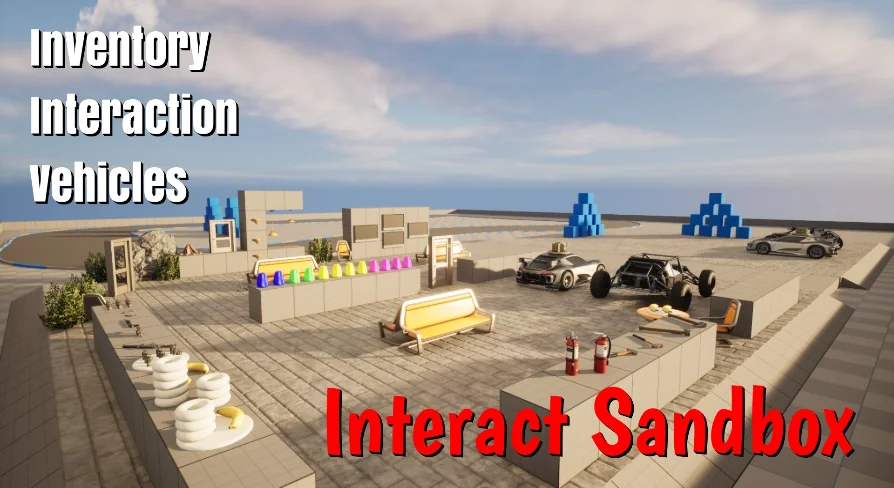
The Interact Sandbox package provides a foundational suite of networked modules for Unreal Engine 5, specifically targeting the Interaction System, Inspection and Grab System, Inventory System, and Vehicle System. Built as a Blueprint framework, the project establishes a playable environment where developers can immediately test and expand upon core mechanics without having to build complex baseline features from scratch. By supplying these interconnected systems out of the box, the framework serves as a prototyping environment for multiplayer projects that require robust object handling, player inventories, and drivable transport. Every module within the package is heavily focused on networking, ensuring that actions performed by players are properly replicated and validated across a live multiplayer session.
Networked Inspection and Grab Mechanics
The physical handling of objects is managed through a dedicated networked Inspection and Grab System. This module allows players to pick up, hold freely, and move items around the game world. Rather than restricting interactions to simple button presses that trigger invisible logic, the sandbox enables physical manipulation and detailed inspection of actors within the 3D space. The system is highly extendable and configured to accept any actor type with ease. Developers can apply these grab and inspect mechanics to varied objects, scaling from small environmental props like eggs to massive interactive elements like rockets.
Because the framework operates entirely on multiplayer functionality, the grab and inspect interactions are strictly authoritative. When a player grabs an object or moves an item around the world, the server governs the interaction. This setup ensures that object states remain synchronized across all connected clients, preventing scenarios where a held item appears in different locations for different players. The authoritative architecture of the physical interactions maintains the integrity of the sandbox, allowing developers to trust the underlying replication logic when adding new interactive actors to their environments.
Decoupled Inventory Architecture and API Principles
The Inventory System included in the sandbox relies on a decoupled architecture that separates the back-end logic from the front-end graphical user interface (GUI). The inventory back-end operates independently, utilizing API principles to transcribe and process client requests. When a player interacts with an item or attempts to move an object into their inventory, the client sends a request through this API structure rather than directly manipulating the inventory data on their local machine.
This separation provides significant flexibility for developers looking to implement custom user interfaces. Because the underlying logic is not hardcoded into the visual elements, the default GUI can be deleted entirely and replaced with custom widget designs without breaking the inventory mechanics. Developers can build entirely new visual representations of the inventory while relying on the existing API to handle the data transcription securely.
Crucially, the inventory system is governed by server authority. The project was structured from the ground up to prevent unauthorized changes to client inventories. By keeping authority with the server throughout the entire process of picking up, storing, and managing items, the framework prevents exploits or desynchronization issues in a multiplayer environment. The server validates all API requests from the client before updating the inventory state, ensuring a secure framework for item management.
Vehicle and Transport Integration
Beyond item handling, the package includes a networked Vehicle System built to accommodate varied transport mechanics. The transport module supports any vehicle type, providing the necessary logic for players to mount, drive, and ride in vehicles across a multiplayer server.
The system handles distinct attachment states, including driver, passenger, and possessive pawn configurations. The driver and passenger attachments allow multiple players to occupy the same vehicle simultaneously, with the framework handling the necessary replication for seating arrangements and player positioning. The possessive pawn attachment extends this functionality, allowing the player controller to take direct possession of the vehicle or specific mounted systems. This modular approach to transport means developers can integrate standard drivable cars, multi-crew transports, or unique controllable entities into the sandbox using the same underlying blueprint framework.
Prototyping Complex Multiplayer Systems
The primary utility of the Interact Sandbox lies in its ability to facilitate quick prototyping. Interaction systems, inventory management, and vehicle networks are often conceptually trivial but technically complex to implement, particularly in a multiplayer context where client-server communication must be flawless. By providing a feature-rich, highly extendable blueprint structure, the package allows developers to bypass the initial setup phases of these common systems.
The entire sandbox operates as an interconnected whole where items can be grabbed, placed in a secure server-authoritative inventory, or utilized alongside drivable vehicles. Because the framework is modular and fully networked for Unreal Engine 5, developers can drop their own custom meshes, widgets, and actor types into the systems to immediately test how they behave in a live multiplayer environment.
 Game Mechanics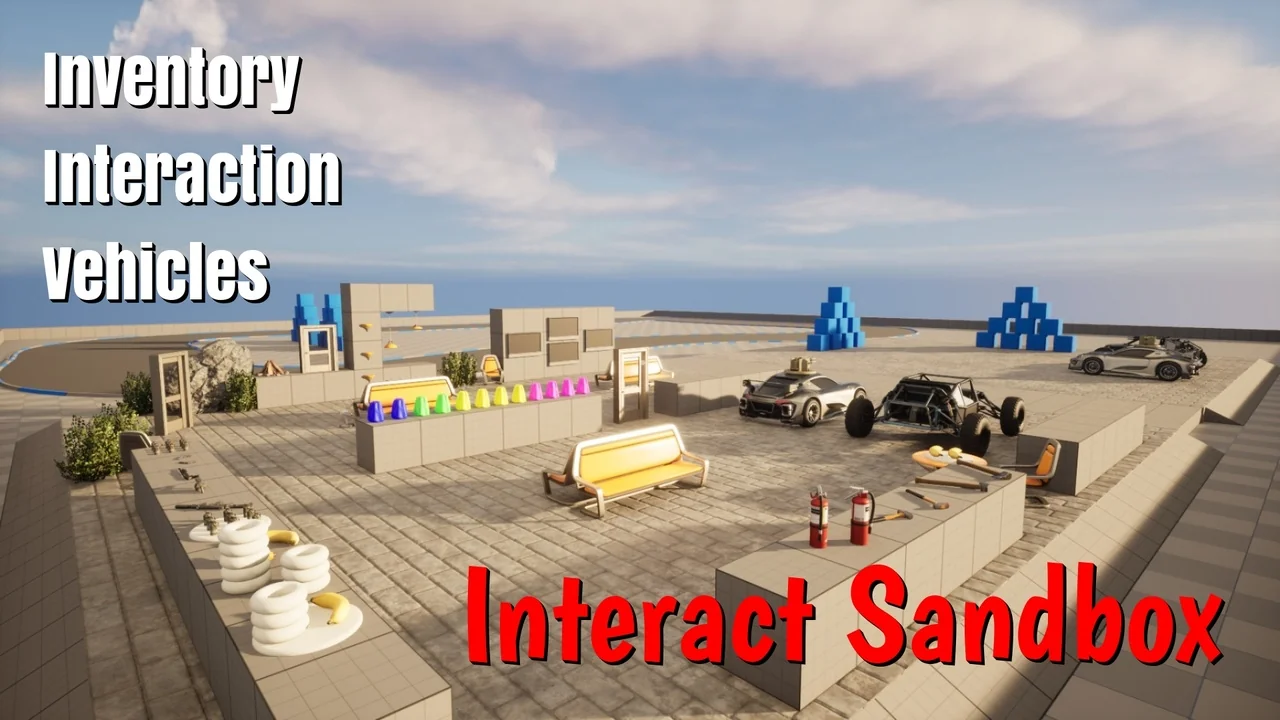
 Game Mechanics
 Game Mechanics
 Game Mechanics