"7ad89cffa44984cf"{"id":"1002539","slug":"john-farmer","title":"John Farmer","category":"Humans","engine":"4.22+,5.0+","assetVersion":"","engineVersion":"Engine Version: 4.22+,5.0+","tag":"Humans","accent":"blue","visual":"mech","summary":"A lowpoly anime NPC designed for farm settings, featuring separate texture zones, spade equipment, and cross-engine implementation details.","platform":"Unreal Engine","indexPolicy":"index","publishedAt":"2026-11-13T09:42:49.953Z","updatedAt":"2026-11-13T09:42:49.953Z","sourceNotes":[],"fileContents":[],"compatibility":["Unreal Engine","Engine Version: 4.22+,5.0+"],"featuredImage":{"alt":"John Farmer","src":"/wp-content/uploads/published/2026/11/aa38688d96a7-9920b373-a2e3-4a09-aab1-aca3ddd74620-225321562e.webp"},"hasDownloadLink":true,"downloads":0,"terms":[{"taxonomy":"category","slug":"humans","name":"Humans"}],"galleryImages":[{"src":"/wp-content/uploads/published/2026/11/22c016370ce0-b270a36e-c750-4c0f-a993-e2d485e166f2-7422d869da.webp","alt":"John Farmer"},{"src":"/wp-content/uploads/published/2026/11/49c17c0fdf5e-dd9805c6-4a61-4369-891b-cfc76d97dabf-ca3f1606e2.webp","alt":"John Farmer"},{"src":"/wp-content/uploads/published/2026/11/ff548b9d07c3-69fda512-f5a0-4ac4-9572-6920e97c6316-294c6cf29b.webp","alt":"John Farmer"}],"accessPanel":{"kind":"resource","title":"Get this resource","eyebrow":"Free resource","message":"Download this resource in your browser.","fileName":"Content.7z","safetyNote":"Resources are manually reviewed before listing to improve quality and reduce obvious risks.","actionLabel":"Get this resource","resourceType":"Resource archive","versions":[]},"contentHtml":"\u003ch2\u003ePopulating Stylized Agricultural Scenes with John Farmer\u003c/h2\u003e\n\u003cp\u003eRural environments in stylized titles often rely on expressive, clearly readable non-player characters to bring quiet pastures, fields, and village plots to life. John Farmer is structured specifically to meet the visual demands of cute, lowpoly anime settings where agricultural life forms either the backdrop or the central mechanic of the experience. The character embodies a working rural archetype, built from geometric simplicity that prioritizes clear silhouettes over dense polygonal detail. In village squares, harvest plots, or perimeter fences, having a character dedicated to field work gives immediate context to farming zones without requiring extensive custom character drafting from scratch.\u003c/p\u003e\n\u003cp\u003eBecause the asset is labeled under the cute and anime tags, the visual proportions lean away from strict realism, favoring stylized, accessible shapes that fit lighthearted adventure titles, life simulators, or casual farming role-playing games. Accompanied by a spade, John Farmer instantly communicates an active role in tilling, digging, and managing rural terrain. The inclusion of this dedicated implement means the character is ready to step directly into chore cycles, idle farming tasks, or quest-giving hubs focused on land cultivation.\u003c/p\u003e \u003ch2\u003eTexture Distribution across John Farmer's Modular Elements\u003c/h2\u003e\n\u003cp\u003eManaging the surface appearance of stylized models can become cumbersome when all elements are baked into a single unwieldy texture map. John Farmer bypasses this limitation by separating its textures into discrete, manageable regions: face, skin, hair, and armor. This four-way division establishes a clear boundary between organic character components and worn equipment, which directly simplifies downstream asset management.\u003c/p\u003e\n\u003cp\u003eThe separation of the face texture isolates expressive facial features from the broader body skin surface. This setup allows developers to swap facial textures for alternate expressions or localized adjustments without repainting arms, legs, or torso meshes. Similarly, having an independent skin texture ensures that overall skin tones can be shifted, tinted, or replaced uniformly without disturbing the fine graphic lines that define the anime face.\u003c/p\u003e\n\u003cp\u003eHair and armor receive their own dedicated texture assignments as well. Because color customization is explicitly straightforward, modifying these individual components does not require complex texture re-baking. Adjusting the hair texture can create visual variety across multiple background farmhands, preventing repetitive clones from walking the fields. Meanwhile, the standalone armor texture allows production teams to tint or modify worn attire to signify rank, team affiliation, village origin, or progression tiers. This modular separation gives technical artists and level designers fine-grained control over color palettes directly within engine material editors or external image-editing software.\u003c/p\u003e \u003ch2\u003eVisual Direction and Yippy Kawaii Aesthetic Matching\u003c/h2\u003e\n\u003cp\u003eA consistent art style is critical when assembling a cast of background characters, townspeople, and field laborers. John Farmer carries compatibility with the Yippy Kawaii lineup, positioning the character squarely within a broader ecosystem of lowpoly anime figures. This compatibility ensures that the character shares the core design grammar seen across the style family, including simplified lowpoly anatomy, vibrant surface reads, and clean geometry suitable for real-time performance.\u003c/p\u003e\n\u003cp\u003eLowpoly anime character models rely heavily on broad planar surfaces and distinct silhouette definition rather than micro-surface relief. In rural settings, this aesthetic keeps performance costs minimal while maintaining visual charm, even when several non-player characters are rendered on screen simultaneously tending to crops or patrolling pathways. The presence of the spade accentuates this design ethos; the prop shares the same simplified, readable lowpoly language, ensuring the character and its gear feel unified rather than mismatched.\u003c/p\u003e \u003ch2\u003eEngine Setup Differences and John Farmer Implementation Details\u003c/h2\u003e\n\u003cp\u003eIntegrating John Farmer into an active production requires close attention to the engine environment chosen for the project, as setup details diverge between Unity3D and Unreal Engine. Character motion is confirmed through dedicated animation checking, with the primary animation examples demonstrated inside Unity3D. For Unity projects, the asset provides a clear demonstration baseline for how the model moves, handles locomotion, and poses during activity.\u003c/p\u003e\n\u003cp\u003eProjects deploying John Farmer inside Unreal Engine require a distinct implementation pathway. The Unreal Engine version does not include the utility script or the custom Toon shader bundled with the Unity presentation. Consequently, developers targeting Unreal Engine must plan for these rendering and functional requirements independently:\u003c/p\u003e\n\u003cul\u003e\n\u003cli\u003e\u003cstrong\u003eShading Solutions:\u003c/strong\u003e Because the proprietary Toon shader is not included in the Unreal Engine package, teams must assign their own stylized or cel-shading material network to achieve the flat, shaded anime finish seen in the demonstration.\u003c/li\u003e\n\u003cli\u003e\u003cstrong\u003eScripting Systems:\u003c/strong\u003e Any functional character scripts demonstrated in the Unity environment must be recreated within Unreal Engine using Blueprints or C++, covering NPC movement routines, interaction logic, or animation state transitions.\u003c/li\u003e\n\u003cli\u003e\u003cstrong\u003eMaterial Assignment:\u003c/strong\u003e The distinct face, skin, hair, and armor textures must be linked to corresponding material slots within Unreal Engine's material pipeline, providing an opportunity to build custom parameter controls for real-time color shifting.\u003c/li\u003e\n\u003c/ul\u003e\n\u003cp\u003eRecognizing these engine-specific variances early prevents delays during asset ingestion. Unity users can assess the animated presentation directly, while Unreal Engine developers gain a clean geometric and textural foundation that integrates into existing custom shader graphs and controller pipelines.\u003c/p\u003e \u003ch2\u003eEquipping the Spade for Agricultural Roles\u003c/h2\u003e\n\u003cp\u003eThe functional identity of an agricultural NPC hinges heavily on the tools they carry. The spade provided alongside John Farmer defines the character's operational purpose across gameplay spaces. Rather than existing merely as an unarmed villager, the model is configured to step into soil preparation, trenching, planting, or landscaping roles within farm zones.\u003c/p\u003e\n\u003cp\u003eIn practice, the spade functions as a natural focal point for interaction loops. When configuring animation states, having a dedicated digging tool makes it simple to stage ambient field labor, such as an NPC perpetually working an orchard patch, or a quest contact leaning on their shovel awaiting player dialogue. The pairing of the cute, lowpoly anime aesthetic with functional agricultural equipment allows John Farmer to fulfill specialized ambient roles that generic townsperson models cannot satisfy without extensive external prop sourcing.\u003c/p\u003e\n\n\u003ch2\u003eContinue Browsing Similar Packs\u003c/h2\u003e\n\u003cul\u003e\n\u003cli\u003e\u003ca href=\"https://3dcghub.com/landon/\" rel=\"noopener noreferrer\"\u003eLandon\u003c/a\u003e\u003c/li\u003e\n\u003cli\u003e\u003ca href=\"https://3dcghub.com/carmel/\" rel=\"noopener noreferrer\"\u003eCarmel\u003c/a\u003e\u003c/li\u003e\n\u003cli\u003e\u003ca href=\"https://3dcghub.com/red-knight/\" rel=\"noopener noreferrer\"\u003eRed Knight\u003c/a\u003e\u003c/li\u003e\n\u003cli\u003e\u003ca href=\"https://3dcghub.com/anime-girl-cleric/\" rel=\"noopener noreferrer\"\u003eAnime Girl Cleric\u003c/a\u003e\u003c/li\u003e\n\u003cli\u003e\u003ca href=\"https://3dcghub.com/k-pop-series-sun/\" rel=\"noopener noreferrer\"\u003eK-POP SERIES - Sun\u003c/a\u003e\u003c/li\u003e\n\u003c/ul\u003e","contentTextLength":7000,"navigation":{"current":38,"total":4499,"previous":{"id":"1002540","slug":"juggernaut","title":"Juggernaut","category":"Game Development Resource","platform":"Unreal Engine","updatedAt":"2026-11-13T09:43:55.074Z"},"next":{"id":"1002538","slug":"infernal-dog","title":"Infernal Dog","category":"Characters \u0026 Creatures","platform":"Unreal Engine","updatedAt":"2026-11-13T09:41:37.586Z"}},"relatedResources":[{"id":"1002547","slug":"mistic","title":"Mistic","category":"Humans","engine":"4.22+,5.0+","assetVersion":"","engineVersion":"Engine Version: 4.22+,5.0+","tag":"Humans","accent":"blue","visual":"mech","summary":"Explore Mistic, a lowpoly anime-styled character asset featuring separate textures for face, hair, skin, and cloth, built for mage, guard, and NPC roles.","platform":"Unreal Engine","indexPolicy":"index","publishedAt":"2026-11-13T09:56:17.654Z","updatedAt":"2026-11-13T09:56:17.654Z","sourceNotes":[],"fileContents":[],"compatibility":["Unreal Engine","Engine Version: 4.22+,5.0+"],"featuredImage":{"alt":"Mistic","src":"/wp-content/uploads/published/2026/11/0063b16c26db-0c016656-1525-408e-bfbf-578a092a54fe-df94718e02.webp"},"hasDownloadLink":true,"downloads":0},{"id":"1002484","slug":"landon","title":"Landon","category":"Humans","engine":"4.22+,5.0+","assetVersion":"","engineVersion":"Engine Version: 4.22+,5.0+","tag":"Humans","accent":"blue","visual":"mech","summary":"Explore Landon, a lowpoly anime fantasy character featuring separate textures for face, hair, skin, and armor, ideal for archer and guard roles.","platform":"Unreal Engine","indexPolicy":"index","publishedAt":"2026-11-12T03:47:06.398Z","updatedAt":"2026-11-12T03:47:06.398Z","sourceNotes":[],"fileContents":[],"compatibility":["Unreal Engine","Engine Version: 4.22+,5.0+"],"featuredImage":{"alt":"Landon","src":"/wp-content/uploads/published/2026/11/ea3b0acab5a4-27cd2668-ce20-4397-a47d-69c1fab66c69-91dd5db839.webp"},"hasDownloadLink":true,"downloads":0},{"id":"1002468","slug":"carmel","title":"Carmel","category":"Humans","engine":"4.22+,5.0+","assetVersion":"","engineVersion":"Engine Version: 4.22+,5.0+","tag":"Humans","accent":"blue","visual":"mech","summary":"Carmel is a low-poly fantasy NPC character model featuring separated textures for face, skin, hair, and clothes, with verified animation support.","platform":"Unreal Engine","indexPolicy":"index","publishedAt":"2026-11-12T03:08:36.535Z","updatedAt":"2026-11-12T03:08:36.535Z","sourceNotes":[],"fileContents":[],"compatibility":["Unreal Engine","Engine Version: 4.22+,5.0+"],"featuredImage":{"alt":"Carmel","src":"/wp-content/uploads/published/2026/11/91525a699dff-42b5a9ca-487c-4df4-82d4-f7e5c2afaabe-2459f9cac6.webp"},"hasDownloadLink":true,"downloads":0}]}
Humans
John Farmer
A lowpoly anime NPC designed for farm settings, featuring separate texture zones, spade equipment, and cross-engine implementation details.
Category:Unreal Engine,HumansPlatform: Unreal EngineEngine Version: 4.22+,5.0+Published: Nov 13, 2026
Humans
Resource overview
Populating Stylized Agricultural Scenes with John Farmer
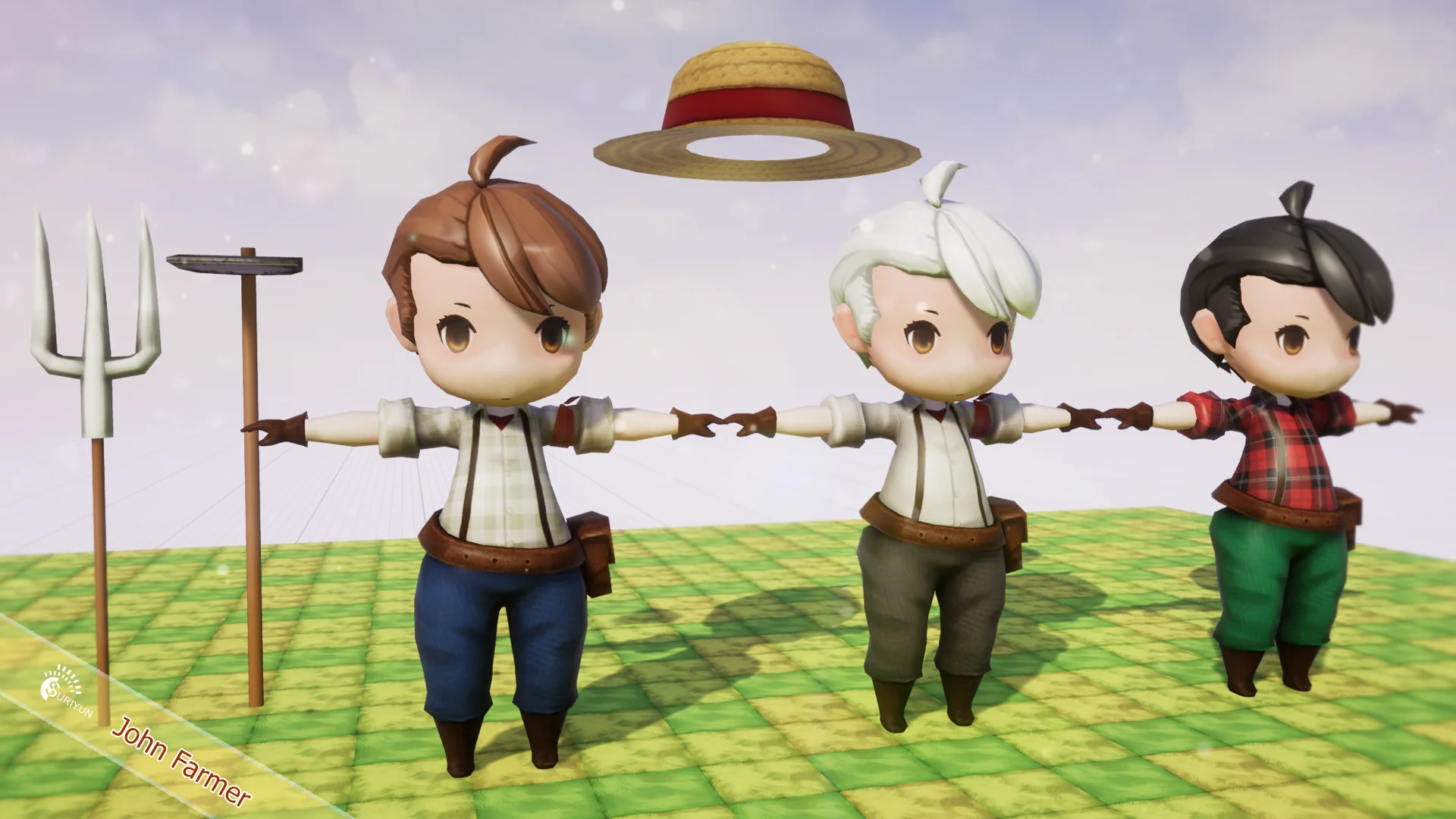
Rural environments in stylized titles often rely on expressive, clearly readable non-player characters to bring quiet pastures, fields, and village plots to life. John Farmer is structured specifically to meet the visual demands of cute, lowpoly anime settings where agricultural life forms either the backdrop or the central mechanic of the experience. The character embodies a working rural archetype, built from geometric simplicity that prioritizes clear silhouettes over dense polygonal detail. In village squares, harvest plots, or perimeter fences, having a character dedicated to field work gives immediate context to farming zones without requiring extensive custom character drafting from scratch.
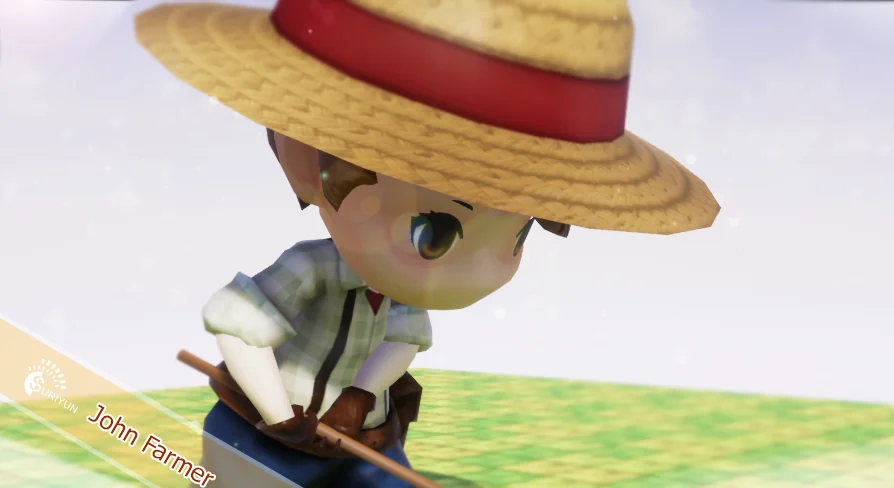
Because the asset is labeled under the cute and anime tags, the visual proportions lean away from strict realism, favoring stylized, accessible shapes that fit lighthearted adventure titles, life simulators, or casual farming role-playing games. Accompanied by a spade, John Farmer instantly communicates an active role in tilling, digging, and managing rural terrain. The inclusion of this dedicated implement means the character is ready to step directly into chore cycles, idle farming tasks, or quest-giving hubs focused on land cultivation.
Texture Distribution across John Farmer's Modular Elements
Managing the surface appearance of stylized models can become cumbersome when all elements are baked into a single unwieldy texture map. John Farmer bypasses this limitation by separating its textures into discrete, manageable regions: face, skin, hair, and armor. This four-way division establishes a clear boundary between organic character components and worn equipment, which directly simplifies downstream asset management.
The separation of the face texture isolates expressive facial features from the broader body skin surface. This setup allows developers to swap facial textures for alternate expressions or localized adjustments without repainting arms, legs, or torso meshes. Similarly, having an independent skin texture ensures that overall skin tones can be shifted, tinted, or replaced uniformly without disturbing the fine graphic lines that define the anime face.
Hair and armor receive their own dedicated texture assignments as well. Because color customization is explicitly straightforward, modifying these individual components does not require complex texture re-baking. Adjusting the hair texture can create visual variety across multiple background farmhands, preventing repetitive clones from walking the fields. Meanwhile, the standalone armor texture allows production teams to tint or modify worn attire to signify rank, team affiliation, village origin, or progression tiers. This modular separation gives technical artists and level designers fine-grained control over color palettes directly within engine material editors or external image-editing software.
Visual Direction and Yippy Kawaii Aesthetic Matching
A consistent art style is critical when assembling a cast of background characters, townspeople, and field laborers. John Farmer carries compatibility with the Yippy Kawaii lineup, positioning the character squarely within a broader ecosystem of lowpoly anime figures. This compatibility ensures that the character shares the core design grammar seen across the style family, including simplified lowpoly anatomy, vibrant surface reads, and clean geometry suitable for real-time performance.
Lowpoly anime character models rely heavily on broad planar surfaces and distinct silhouette definition rather than micro-surface relief. In rural settings, this aesthetic keeps performance costs minimal while maintaining visual charm, even when several non-player characters are rendered on screen simultaneously tending to crops or patrolling pathways. The presence of the spade accentuates this design ethos; the prop shares the same simplified, readable lowpoly language, ensuring the character and its gear feel unified rather than mismatched.
Engine Setup Differences and John Farmer Implementation Details
Integrating John Farmer into an active production requires close attention to the engine environment chosen for the project, as setup details diverge between Unity3D and Unreal Engine. Character motion is confirmed through dedicated animation checking, with the primary animation examples demonstrated inside Unity3D. For Unity projects, the asset provides a clear demonstration baseline for how the model moves, handles locomotion, and poses during activity.
Projects deploying John Farmer inside Unreal Engine require a distinct implementation pathway. The Unreal Engine version does not include the utility script or the custom Toon shader bundled with the Unity presentation. Consequently, developers targeting Unreal Engine must plan for these rendering and functional requirements independently:
Shading Solutions: Because the proprietary Toon shader is not included in the Unreal Engine package, teams must assign their own stylized or cel-shading material network to achieve the flat, shaded anime finish seen in the demonstration.
Scripting Systems: Any functional character scripts demonstrated in the Unity environment must be recreated within Unreal Engine using Blueprints or C++, covering NPC movement routines, interaction logic, or animation state transitions.
Material Assignment: The distinct face, skin, hair, and armor textures must be linked to corresponding material slots within Unreal Engine's material pipeline, providing an opportunity to build custom parameter controls for real-time color shifting.
Recognizing these engine-specific variances early prevents delays during asset ingestion. Unity users can assess the animated presentation directly, while Unreal Engine developers gain a clean geometric and textural foundation that integrates into existing custom shader graphs and controller pipelines.
Equipping the Spade for Agricultural Roles
The functional identity of an agricultural NPC hinges heavily on the tools they carry. The spade provided alongside John Farmer defines the character's operational purpose across gameplay spaces. Rather than existing merely as an unarmed villager, the model is configured to step into soil preparation, trenching, planting, or landscaping roles within farm zones.
In practice, the spade functions as a natural focal point for interaction loops. When configuring animation states, having a dedicated digging tool makes it simple to stage ambient field labor, such as an NPC perpetually working an orchard patch, or a quest contact leaning on their shovel awaiting player dialogue. The pairing of the cute, lowpoly anime aesthetic with functional agricultural equipment allows John Farmer to fulfill specialized ambient roles that generic townsperson models cannot satisfy without extensive external prop sourcing.
 Humans