"7ad89cffa44984cf"{"id":"1002538","slug":"infernal-dog","title":"Infernal Dog","category":"Characters \u0026 Creatures","engine":"4.18+,5.0+","assetVersion":"","engineVersion":"Engine Version: 4.18+,5.0+","tag":"Characters","accent":"blue","visual":"character","summary":"Implement the Infernal Dog character with its realistic lowpoly aesthetic, custom script, Animation Blueprint, and 56 creature animations for horror RPGs.","platform":"Unreal Engine","indexPolicy":"index","publishedAt":"2026-11-13T09:41:37.586Z","updatedAt":"2026-11-13T09:41:37.586Z","sourceNotes":[],"fileContents":[],"compatibility":["Unreal Engine","Engine Version: 4.18+,5.0+"],"featuredImage":{"alt":"Infernal Dog","src":"/wp-content/uploads/published/2026/11/c2e72d6b26cc-164adf26-1c10-4cd8-8c75-679c8508a9af-82a9b03fdb.webp"},"hasDownloadLink":true,"downloads":0,"terms":[{"taxonomy":"category","slug":"characters-and-creatures","name":"Characters \u0026 Creatures"}],"galleryImages":[{"src":"/wp-content/uploads/published/2026/11/392768d39053-1d166685-5e0b-4dde-b012-d41d4272ed52-0e86a424e5.webp","alt":"Infernal Dog"},{"src":"/wp-content/uploads/published/2026/11/e42bce1799c1-bcd402e9-8024-4163-a1bf-ba87fd333187-80167c122f.webp","alt":"Infernal Dog"},{"src":"/wp-content/uploads/published/2026/11/f00c13673075-b7b1f8c2-9313-4dca-bd2c-e33931b96676-a0f1512b72.webp","alt":"Infernal Dog"}],"accessPanel":{"kind":"resource","title":"Get this resource","eyebrow":"Free resource","message":"Download this resource in your browser.","fileName":"Content.7z","safetyNote":"Resources are manually reviewed before listing to improve quality and reduce obvious risks.","actionLabel":"Get this resource","resourceType":"Resource archive","versions":[]},"contentHtml":"\u003ch2\u003eIntegrating the Infernal Dog Animation Blueprint and Script Setup\u003c/h2\u003e\u003cp\u003eBringing a hostile creature into a project pipeline begins with establishing its baseline state control. The Infernal Dog relies on a dedicated Animation Blueprint alongside script components to govern how the entity transitions between rest, pursuit, and aggression. When setting up the character pawn, the initial task involves linking the mesh component to the skeleton assigned within the Animation Blueprint, ensuring all movement data maps directly to the character hierarchy without unexpected axis offsets.\u003c/p\u003e\u003cp\u003eThe inclusion of scripted logic allows gameplay variables to communicate directly with the animation graph. Speed vectors, target acquisition states, and attack triggers pass from the character controller script straight into the Animation Blueprint event graph. By structuring the variables to update per tick or via event dispatchers, the creature can blend cleanly from a dormant idle to full sprint. Handling locomotion through a structured state machine ensures that sudden stops, sharp turns, and sudden target shifts maintain visual stability, preventing rigid snapping during high-stress gameplay encounters.\u003c/p\u003e\u003cp\u003eConfiguring the scripting layer correctly simplifies how combat interactions resolve. When health values change or damage triggers register, the script can dispatch montage execution commands directly to the character mesh. This setup keeps the animation evaluation decoupled from raw game rules, allowing developers to tune gameplay numbers like damage windows or movement speed without breaking the core state transitions built into the Animation Blueprint.\u003c/p\u003e\u003ch2\u003eCreature Behavior and the 56 Animations For Creatures Library\u003c/h2\u003e\u003cp\u003eFluid motion is essential for selling the physical threat of a quadrupedal beast. The Infernal Dog features good animations and maintains direct compatibility with the 56 Animations For Creatures collection, providing a broad selection of clips that expand its mechanical range. Integrating this suite gives developers access to diverse movement variations, directional dodges, transitions, idle variants, and attack sequences needed to build convincing encounter pacing.\u003c/p\u003e\u003cp\u003eManaging a library of this size requires careful organization within blend spaces and montage slots. Directional blend spaces can ingest forward, backward, strafe, and turning clips to produce seamless motion along navigation mesh paths. When the creature navigates uneven ground or pursues an evasive target, these blend spaces calculate smooth transitions based on real-time velocity and turning rates, avoiding unnatural foot sliding.\u003c/p\u003e\u003cp\u003eCombat choreography benefits significantly from the depth of the 56-animation set. Attack montages can be split into quick strikes, lunges, and recovery poses, enabling developers to assign distinct attack patterns based on player distance. Branching states inside the Animation Blueprint allow the beast to feign an advance, break into an erratic circling run, or commit to a multi-stage bite routine. Hit-reaction animations and directional flinches provide responsive visual feedback during player attacks, maintaining physical impact without overriding ongoing movement logic unless a heavy stagger is triggered.\u003c/p\u003e\u003ch2\u003eVisual Realism Across Lowpoly Infernal Dog Meshes\u003c/h2\u003e\u003cp\u003ePerformance optimization often competes directly with visual fidelity, particularly when populating open spaces or dense interior levels with multiple active adversaries. The Infernal Dog balances these demands through a lowpoly structural approach paired with a realistic aesthetic style. The topology is constrained to maintain efficient rendering overhead, ensuring draw calls and polygon evaluations remain low even when packs of creatures swarm a scene simultaneously.\u003c/p\u003e\u003cp\u003eDespite the economical polygon footprint, the character carries a very nasty look crafted to provoke fear in players. Surface definition, musculature, and grotesque physical features are driven by high-detail realistic material rendering. The silhouette emphasizes tension and predatory hostility, presenting sharp anatomical contours that read clearly under various lighting conditions, from pitch-black dungeons to dimly lit forest paths.\u003c/p\u003e\u003cp\u003eIn practical rendering setups, realistic surface maps respond accurately to dynamic lighting systems. Specular highlights accent wet or leathery skin areas, while ambient occlusion maps preserve anatomical depth within the lowpoly geometry. This visual clarity ensures that the terrifying appearance remains intact at both close-range combat perspectives and distant silhouette encounters, delivering horror-grade tension without sacrificing hardware performance.\u003c/p\u003e\u003ch2\u003eDeployment in Dark Fantasy, Medieval, and Horror RPG Frameworks\u003c/h2\u003e\u003cp\u003eThe thematic crossover between fantasy, medieval settings, and horror makes the Infernal Dog an effective adversary across multiple game genres. In medieval dark fantasy titles, the creature fits naturally as a summoned minion, a demonic guardian patrolling ruined strongholds, or a cursed hound hunting in the wild. Its nasty presentation immediately communicates hostility, setting an ominous tone the moment players cross into its territory.\u003c/p\u003e\u003cp\u003eRPG mechanics impose specific requirements on enemy pawns, such as threat zones, variable aggro ranges, and encounter difficulty scaling. Combining the asset's script foundations with its responsive Animation Blueprint lets designers tune encounter scripting precisely. A creature can be placed as a stealth ambusher hidden in shadows, utilizing low-profile idle animations until an awareness threshold triggers a rapid burst of speed toward the player party.\u003c/p\u003e\u003cp\u003eHorror projects thrive on unpredictability and physical menace. By taking advantage of the creature's realistic design and extensive animation states, developers can construct encounters centered around sound cues, frantic evasion, and claustrophobic corridor combat. The combination of lightweight geometry, broad animation coverage, and horror-themed visual styling establishes a reliable enemy asset ready to populate hostile worlds across diverse role-playing experiences.\u003c/p\u003e\n\n\u003ch2\u003eContinue Browsing Similar Packs\u003c/h2\u003e\n\u003cul\u003e\n\u003cli\u003e\u003ca href=\"https://3dcghub.com/combat-dog/\" rel=\"noopener noreferrer\"\u003eCombat Dog\u003c/a\u003e\u003c/li\u003e\n\u003cli\u003e\u003ca href=\"https://3dcghub.com/assistant-dog/\" rel=\"noopener noreferrer\"\u003eAssistant Dog\u003c/a\u003e\u003c/li\u003e\n\u003cli\u003e\u003ca href=\"https://3dcghub.com/alien-dog/\" rel=\"noopener noreferrer\"\u003eAlien dog\u003c/a\u003e\u003c/li\u003e\n\u003cli\u003e\u003ca href=\"https://3dcghub.com/dogs-big-pack/\" rel=\"noopener noreferrer\"\u003eDogs Big pack\u003c/a\u003e\u003c/li\u003e\n\u003cli\u003e\u003ca href=\"https://3dcghub.com/character-captain/\" rel=\"noopener noreferrer\"\u003eCharacter Captain\u003c/a\u003e\u003c/li\u003e\n\u003c/ul\u003e","contentTextLength":6220,"navigation":{"current":39,"total":4499,"previous":{"id":"1002539","slug":"john-farmer","title":"John Farmer","category":"Humans","platform":"Unreal Engine","updatedAt":"2026-11-13T09:42:49.953Z"},"next":{"id":"1002537","slug":"humanoids-monsters-pack","title":"Humanoids Monsters Pack","category":"Game Development Resource","platform":"Unreal Engine","updatedAt":"2026-11-13T09:40:58.998Z"}},"relatedResources":[{"id":"1002562","slug":"ripper-dog","title":"Ripper Dog","category":"Characters \u0026 Creatures","engine":"4.26+,5.0+","assetVersion":"","engineVersion":"Engine Version: 4.26+,5.0+","tag":"Characters","accent":"blue","visual":"character","summary":"Explore the Ripper Dog creature asset, covering its lowpoly geometry, 56-animation set, Animation Blueprint, script setup, and multi-genre utility.","platform":"Unreal Engine","indexPolicy":"index","publishedAt":"2026-11-13T11:00:12.935Z","updatedAt":"2026-11-13T11:00:12.935Z","sourceNotes":[],"fileContents":[],"compatibility":["Unreal Engine","Engine Version: 4.26+,5.0+"],"featuredImage":{"alt":"Ripper Dog","src":"/wp-content/uploads/published/2026/11/f7198e610d0a-a23521b8-3f56-4041-ba52-ec7afff8799a-a527080c85.webp"},"hasDownloadLink":true,"downloads":0},{"id":"1002513","slug":"combat-dog","title":"Combat Dog","category":"Characters \u0026 Creatures","engine":"4.26+,5.0+","assetVersion":"","engineVersion":"Engine Version: 4.26+,5.0+","tag":"Characters","accent":"blue","visual":"character","summary":"A close look at Combat Dog, featuring Doberman monster styling, animation blueprint architecture, and script integration for dark game worlds.","platform":"Unreal Engine","indexPolicy":"index","publishedAt":"2026-11-13T08:49:52.464Z","updatedAt":"2026-11-13T08:49:52.464Z","sourceNotes":[],"fileContents":[],"compatibility":["Unreal Engine","Engine Version: 4.26+,5.0+"],"featuredImage":{"alt":"Combat Dog","src":"/wp-content/uploads/published/2026/11/7376ff80d991-1fa579a2-4256-4e5c-b80a-2929b78fa760-da922be745.webp"},"hasDownloadLink":true,"downloads":0},{"id":"1002452","slug":"assistant-dog","title":"Assistant Dog","category":"Characters \u0026 Creatures","engine":"4.21+,5.0+","assetVersion":"","engineVersion":"Engine Version: 4.21+,5.0+","tag":"Characters","accent":"blue","visual":"character","summary":"Explore the implementation of the Assistant Dog character, featuring low-poly PBR assets, Animation Blueprint support, and companion inventory scripts.","platform":"Unreal Engine","indexPolicy":"index","publishedAt":"2026-11-11T08:40:54.802Z","updatedAt":"2026-11-11T08:40:54.802Z","sourceNotes":[],"fileContents":[],"compatibility":["Unreal Engine","Engine Version: 4.21+,5.0+"],"featuredImage":{"alt":"Assistant Dog","src":"/wp-content/uploads/published/2026/11/e6b3dfb03b28-aa96a87f-92fc-4a61-847a-b28552965b4b-d7913f9d73.webp"},"hasDownloadLink":true,"downloads":0}]}
Characters
Infernal Dog
Implement the Infernal Dog character with its realistic lowpoly aesthetic, custom script, Animation Blueprint, and 56 creature animations for horror RPGs.
Integrating the Infernal Dog Animation Blueprint and Script Setup
Bringing a hostile creature into a project pipeline begins with establishing its baseline state control. The Infernal Dog relies on a dedicated Animation Blueprint alongside script components to govern how the entity transitions between rest, pursuit, and aggression. When setting up the character pawn, the initial task involves linking the mesh component to the skeleton assigned within the Animation Blueprint, ensuring all movement data maps directly to the character hierarchy without unexpected axis offsets.
The inclusion of scripted logic allows gameplay variables to communicate directly with the animation graph. Speed vectors, target acquisition states, and attack triggers pass from the character controller script straight into the Animation Blueprint event graph. By structuring the variables to update per tick or via event dispatchers, the creature can blend cleanly from a dormant idle to full sprint. Handling locomotion through a structured state machine ensures that sudden stops, sharp turns, and sudden target shifts maintain visual stability, preventing rigid snapping during high-stress gameplay encounters.
Configuring the scripting layer correctly simplifies how combat interactions resolve. When health values change or damage triggers register, the script can dispatch montage execution commands directly to the character mesh. This setup keeps the animation evaluation decoupled from raw game rules, allowing developers to tune gameplay numbers like damage windows or movement speed without breaking the core state transitions built into the Animation Blueprint.
Creature Behavior and the 56 Animations For Creatures Library
Fluid motion is essential for selling the physical threat of a quadrupedal beast. The Infernal Dog features good animations and maintains direct compatibility with the 56 Animations For Creatures collection, providing a broad selection of clips that expand its mechanical range. Integrating this suite gives developers access to diverse movement variations, directional dodges, transitions, idle variants, and attack sequences needed to build convincing encounter pacing.
Managing a library of this size requires careful organization within blend spaces and montage slots. Directional blend spaces can ingest forward, backward, strafe, and turning clips to produce seamless motion along navigation mesh paths. When the creature navigates uneven ground or pursues an evasive target, these blend spaces calculate smooth transitions based on real-time velocity and turning rates, avoiding unnatural foot sliding.
Combat choreography benefits significantly from the depth of the 56-animation set. Attack montages can be split into quick strikes, lunges, and recovery poses, enabling developers to assign distinct attack patterns based on player distance. Branching states inside the Animation Blueprint allow the beast to feign an advance, break into an erratic circling run, or commit to a multi-stage bite routine. Hit-reaction animations and directional flinches provide responsive visual feedback during player attacks, maintaining physical impact without overriding ongoing movement logic unless a heavy stagger is triggered.
Visual Realism Across Lowpoly Infernal Dog Meshes
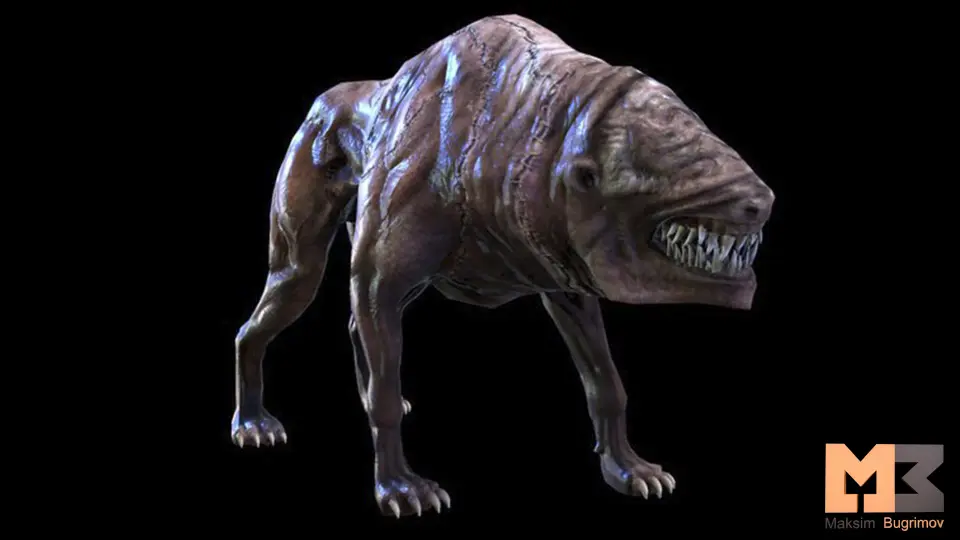
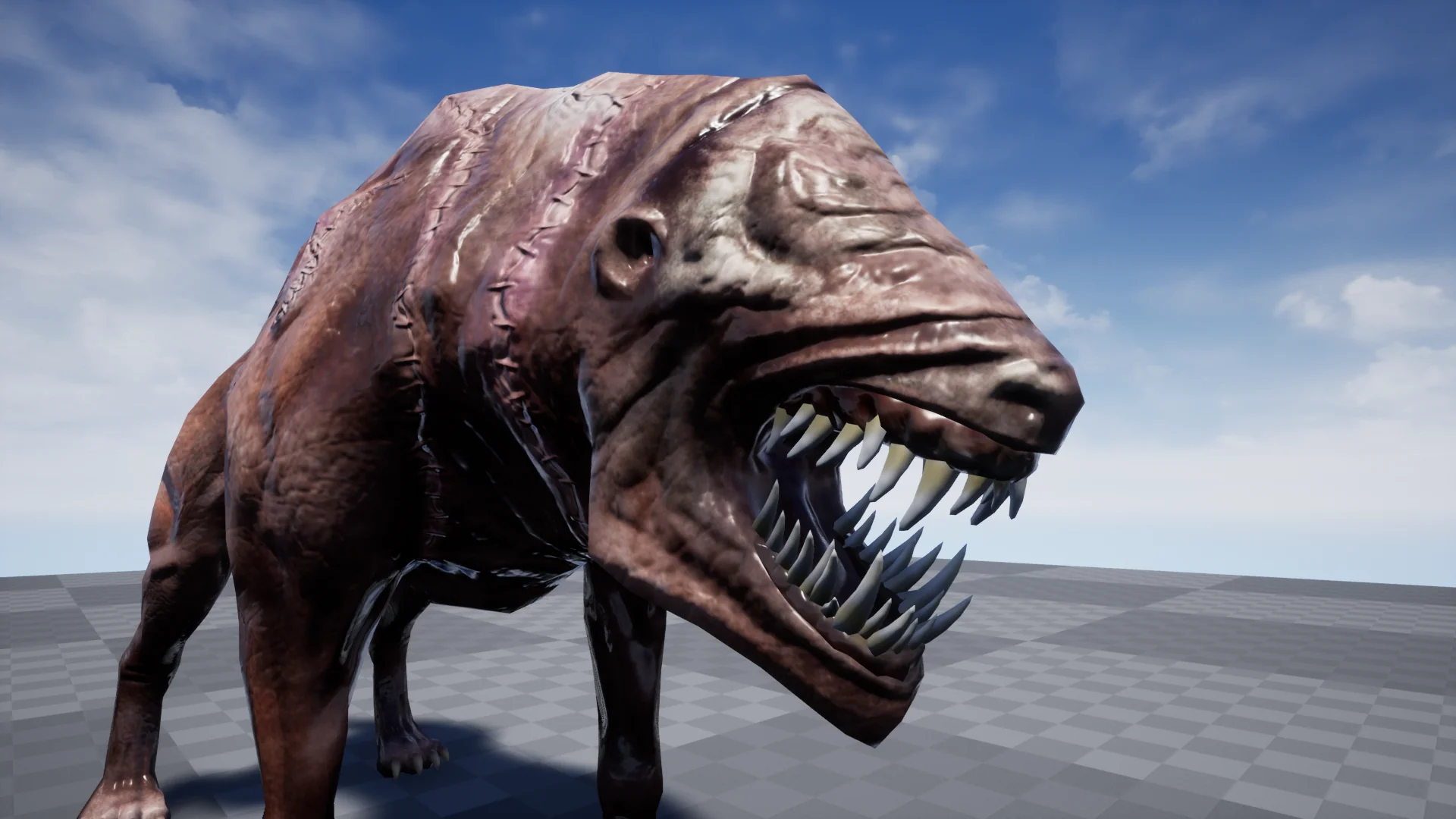
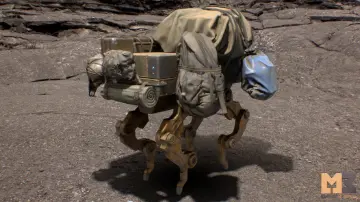
Performance optimization often competes directly with visual fidelity, particularly when populating open spaces or dense interior levels with multiple active adversaries. The Infernal Dog balances these demands through a lowpoly structural approach paired with a realistic aesthetic style. The topology is constrained to maintain efficient rendering overhead, ensuring draw calls and polygon evaluations remain low even when packs of creatures swarm a scene simultaneously.
Despite the economical polygon footprint, the character carries a very nasty look crafted to provoke fear in players. Surface definition, musculature, and grotesque physical features are driven by high-detail realistic material rendering. The silhouette emphasizes tension and predatory hostility, presenting sharp anatomical contours that read clearly under various lighting conditions, from pitch-black dungeons to dimly lit forest paths.
In practical rendering setups, realistic surface maps respond accurately to dynamic lighting systems. Specular highlights accent wet or leathery skin areas, while ambient occlusion maps preserve anatomical depth within the lowpoly geometry. This visual clarity ensures that the terrifying appearance remains intact at both close-range combat perspectives and distant silhouette encounters, delivering horror-grade tension without sacrificing hardware performance.
Deployment in Dark Fantasy, Medieval, and Horror RPG Frameworks
The thematic crossover between fantasy, medieval settings, and horror makes the Infernal Dog an effective adversary across multiple game genres. In medieval dark fantasy titles, the creature fits naturally as a summoned minion, a demonic guardian patrolling ruined strongholds, or a cursed hound hunting in the wild. Its nasty presentation immediately communicates hostility, setting an ominous tone the moment players cross into its territory.
RPG mechanics impose specific requirements on enemy pawns, such as threat zones, variable aggro ranges, and encounter difficulty scaling. Combining the asset's script foundations with its responsive Animation Blueprint lets designers tune encounter scripting precisely. A creature can be placed as a stealth ambusher hidden in shadows, utilizing low-profile idle animations until an awareness threshold triggers a rapid burst of speed toward the player party.
Horror projects thrive on unpredictability and physical menace. By taking advantage of the creature's realistic design and extensive animation states, developers can construct encounters centered around sound cues, frantic evasion, and claustrophobic corridor combat. The combination of lightweight geometry, broad animation coverage, and horror-themed visual styling establishes a reliable enemy asset ready to populate hostile worlds across diverse role-playing experiences.
 Characters
 Characters
 Characters
 Characters