"7ad89cffa44984cf"{"id":"1002562","slug":"ripper-dog","title":"Ripper Dog","category":"Characters \u0026 Creatures","engine":"4.26+,5.0+","assetVersion":"","engineVersion":"Engine Version: 4.26+,5.0+","tag":"Characters","accent":"blue","visual":"character","summary":"Explore the Ripper Dog creature asset, covering its lowpoly geometry, 56-animation set, Animation Blueprint, script setup, and multi-genre utility.","platform":"Unreal Engine","indexPolicy":"index","publishedAt":"2026-11-13T11:00:12.935Z","updatedAt":"2026-11-13T11:00:12.935Z","sourceNotes":[],"fileContents":[],"compatibility":["Unreal Engine","Engine Version: 4.26+,5.0+"],"featuredImage":{"alt":"Ripper Dog","src":"/wp-content/uploads/published/2026/11/f7198e610d0a-a23521b8-3f56-4041-ba52-ec7afff8799a-a527080c85.webp"},"hasDownloadLink":true,"downloads":0,"terms":[{"taxonomy":"category","slug":"characters-and-creatures","name":"Characters \u0026 Creatures"}],"galleryImages":[{"src":"/wp-content/uploads/published/2026/11/951836b6e779-68d38580-0cde-4148-8a9d-c05401f615f8-80cbfac0ce.webp","alt":"Ripper Dog"},{"src":"/wp-content/uploads/published/2026/11/9ee99a1795fc-0b6678f3-da32-4f79-a396-4bf777136bf9-f8561c81f4.webp","alt":"Ripper Dog"},{"src":"/wp-content/uploads/published/2026/11/e9e9d518f363-22850a03-68a6-4c78-9986-f0d6b841b042-29b1ebf241.webp","alt":"Ripper Dog"},{"src":"/wp-content/uploads/published/2026/11/d484db1797df-35ef3c84-9f67-4123-8d78-937a2b84d4c9-4a6b2cabe8.webp","alt":"Ripper Dog"}],"accessPanel":{"kind":"resource","title":"Get this resource","eyebrow":"Free resource","message":"Download this resource in your browser.","fileName":"Content.7z","safetyNote":"Resources are manually reviewed before listing to improve quality and reduce obvious risks.","actionLabel":"Get this resource","resourceType":"Resource archive","versions":[]},"contentHtml":"\u003ch2\u003eLowpoly Mesh Architecture of the Ripper Dog\u003c/h2\u003e\n\u003cp\u003eLowpoly modeling serves an essential functional role in real-time engine pipelines, particularly when populating environments with multiple interactive entities. The Ripper Dog incorporates this lowpoly geometry to deliver an aggressive monster silhouette without burdening runtime performance. By keeping vertex counts optimized, the model preserves frame pacing and reduces memory overhead during intense encounters, where dozens of combatants or environmental hazards may compete for system resources.\u003c/p\u003e\n\u003cp\u003eStriking an effective balance between mesh density and expressive anatomy is vital for quadrupeds and predatory creatures. The surface layout of the Ripper Dog is engineered to retain structural integrity through dynamic movement. Strategic edge placement across high-strain zones—such as shoulders, haunches, the spine, and the jaw—prevents unsightly polygon collapsing or mesh pinching when extreme poses are struck. This clean geometric layout ensures that normal maps and real-time lighting accentuate the muscularity and menace of the beast without requiring dense underlying topology.\u003c/p\u003e \u003ch2\u003eAnimating the Ripper Dog with the 56 Creature Animations\u003c/h2\u003e\n\u003cp\u003eLocomotion fidelity directly influences how convincing a beast feels during interactive gameplay. Ripper Dog comes equipped with high-quality animations, tying directly into a library of 56 animations for creatures. Having 56 separate animation assets available provides a comprehensive range of movement states, enabling fluid transitions between calm scouting routines, sudden turns, directional sprints, and multi-angled attacks. Instead of relying on repetitive, looping strides, the creature can navigate complex level geometry with realistic shifts in momentum.\u003c/p\u003e\n\u003cp\u003eA broad animation set is equally critical for combat feedback. Having discrete animations for impacts, staggering reactions, sudden directional changes, recovery states, and varied knockdown sequences allows the monster to communicate physical response convincingly. When players land attacks, the creature can physically register blows rather than sliding awkwardly through scripted sequences. The 56 animations offer sufficient coverage to build realistic attack chains, including lunges, bites, leaping swipes, and defensive circling, providing level designers with the tools necessary to craft distinct threat profiles.\u003c/p\u003e \u003ch2\u003eAnimation Blueprint Logic and Script Integration\u003c/h2\u003e\n\u003cp\u003ePairing character art with real-time logic requires structured animation handling. The Ripper Dog incorporates an Animation Blueprint, establishing a unified interface where motion states, blend spaces, and procedural adjustments converge. Within this system, raw movement data—such as forward speed, angular velocity, and vertical trajectory—drives state machine transitions cleanly. The Animation Blueprint coordinates smooth blending between base locomotion and additive upper-body gestures, allowing the creature to snap, snarl, or twist toward its target while continuously traversing terrain.\u003c/p\u003e\n\u003cp\u003eComplementing the animation architecture, the asset includes script components to facilitate core gameplay behaviors. Scripting handles the parameters governing AI activation, movement speeds, combat engagement ranges, and animation event notifications. When the creature enters an attack phase, script-triggered events can synchronize collision traces, particle effects, and audio cues directly with specific animation frames. This tight binding between animation notifies and script execution eliminates desynchronization between visual strikes and damage registration.\u003c/p\u003e \u003ch2\u003eAdapting the Monster to Shooter, Fantasy, and Horror Environments\u003c/h2\u003e\n\u003cp\u003eThe visual identity and behavioral setup of the Ripper Dog make it suitable across several distinct game styles. In fast-paced enemy shooters, the beast functions naturally as an agile skirmisher designed to close distances rapidly and force players out of stationary cover. Because shooter gameplay frequently demands large waves of hostile targets, the lowpoly nature of the asset ensures that groups of these creatures can swarm the player without degrading rendering performance or causing draw call bottlenecks.\u003c/p\u003e\n\u003cp\u003eWithin fantasy contexts, the monster adapts effortlessly into roles such as a subterranean predator, a summoned demonic hound, or a feral den-dweller patrolling ruins. The high-quality animation suite conveys the raw weight and biomechanical aggression expected of untamed fantasy fauna. The 56 creature animations supply the deliberate, stalking postures needed for dungeon encounters where anticipation and environmental sound cues precede an ambush.\u003c/p\u003e\n\u003cp\u003eIn horror games, pacing shifts from open combat to sustained dread, requiring subtle physical presence and sudden, violent spikes in movement. The Ripper Dog suits horror settings where players have limited defensive capability. The lowpoly construction integrates effectively into dim, high-contrast lighting schemes, while the Animation Blueprint enables eerie, irregular pacing, sudden predatory rushes, and unnerving idle behaviors that sustain tension in claustrophobic spaces.\u003c/p\u003e \u003ch2\u003eSetup Considerations for Gameplay Systems\u003c/h2\u003e\n\u003cp\u003eImplementing the Ripper Dog into a project workflow begins with aligning the Animation Blueprint to the existing character movement component. Velocity values, ground checks, and turning rates feed into the state machine to govern transitions across the 56 animations. Fine-tuning blend times between idling, trotting, and sprinting ensures the quadrupedal rig preserves weight distribution without sudden popping or sliding across varied surface friction.\u003c/p\u003e\n\u003cp\u003eConnecting the included script elements to AI navigation systems finalizes implementation. Behavior trees or state machine scripts dictate when the monster shifts from patrol modes into active tracking, feeding commands into the movement component to trigger attack animations and evasive maneuvers. Because the geometry remains lowpoly and the underlying animation system is already organized, configuring pathfinding, perception cones, and hit detection proceeds with minimal technical friction, leaving the creature ready for active deployment.\u003c/p\u003e\n\n\u003ch2\u003eContinue Browsing Similar Packs\u003c/h2\u003e\n\u003cul\u003e\n\u003cli\u003e\u003ca href=\"https://3dcghub.com/infernal-dog/\" rel=\"noopener noreferrer\"\u003eInfernal Dog\u003c/a\u003e\u003c/li\u003e\n\u003cli\u003e\u003ca href=\"https://3dcghub.com/combat-dog/\" rel=\"noopener noreferrer\"\u003eCombat Dog\u003c/a\u003e\u003c/li\u003e\n\u003cli\u003e\u003ca href=\"https://3dcghub.com/assistant-dog/\" rel=\"noopener noreferrer\"\u003eAssistant Dog\u003c/a\u003e\u003c/li\u003e\n\u003cli\u003e\u003ca href=\"https://3dcghub.com/alien-dog/\" rel=\"noopener noreferrer\"\u003eAlien dog\u003c/a\u003e\u003c/li\u003e\n\u003cli\u003e\u003ca href=\"https://3dcghub.com/dogs-big-pack/\" rel=\"noopener noreferrer\"\u003eDogs Big pack\u003c/a\u003e\u003c/li\u003e\n\u003c/ul\u003e","contentTextLength":6268,"navigation":{"current":15,"total":4499,"previous":{"id":"1002563","slug":"russian-soldier-military-and-police-customizable","title":"Russian Soldier, Military and Police, Customizable","category":"Characters \u0026 Creatures","platform":"Unreal Engine","updatedAt":"2026-11-13T11:51:18.227Z"},"next":{"id":"1002561","slug":"post-apocalyptic-character","title":"Post-Apocalyptic Character","category":"Characters \u0026 Creatures","platform":"Unreal Engine","updatedAt":"2026-11-13T10:58:03.300Z"}},"relatedResources":[{"id":"1002538","slug":"infernal-dog","title":"Infernal Dog","category":"Characters \u0026 Creatures","engine":"4.18+,5.0+","assetVersion":"","engineVersion":"Engine Version: 4.18+,5.0+","tag":"Characters","accent":"blue","visual":"character","summary":"Implement the Infernal Dog character with its realistic lowpoly aesthetic, custom script, Animation Blueprint, and 56 creature animations for horror RPGs.","platform":"Unreal Engine","indexPolicy":"index","publishedAt":"2026-11-13T09:41:37.586Z","updatedAt":"2026-11-13T09:41:37.586Z","sourceNotes":[],"fileContents":[],"compatibility":["Unreal Engine","Engine Version: 4.18+,5.0+"],"featuredImage":{"alt":"Infernal Dog","src":"/wp-content/uploads/published/2026/11/c2e72d6b26cc-164adf26-1c10-4cd8-8c75-679c8508a9af-82a9b03fdb.webp"},"hasDownloadLink":true,"downloads":0},{"id":"1002513","slug":"combat-dog","title":"Combat Dog","category":"Characters \u0026 Creatures","engine":"4.26+,5.0+","assetVersion":"","engineVersion":"Engine Version: 4.26+,5.0+","tag":"Characters","accent":"blue","visual":"character","summary":"A close look at Combat Dog, featuring Doberman monster styling, animation blueprint architecture, and script integration for dark game worlds.","platform":"Unreal Engine","indexPolicy":"index","publishedAt":"2026-11-13T08:49:52.464Z","updatedAt":"2026-11-13T08:49:52.464Z","sourceNotes":[],"fileContents":[],"compatibility":["Unreal Engine","Engine Version: 4.26+,5.0+"],"featuredImage":{"alt":"Combat Dog","src":"/wp-content/uploads/published/2026/11/7376ff80d991-1fa579a2-4256-4e5c-b80a-2929b78fa760-da922be745.webp"},"hasDownloadLink":true,"downloads":0},{"id":"1002452","slug":"assistant-dog","title":"Assistant Dog","category":"Characters \u0026 Creatures","engine":"4.21+,5.0+","assetVersion":"","engineVersion":"Engine Version: 4.21+,5.0+","tag":"Characters","accent":"blue","visual":"character","summary":"Explore the implementation of the Assistant Dog character, featuring low-poly PBR assets, Animation Blueprint support, and companion inventory scripts.","platform":"Unreal Engine","indexPolicy":"index","publishedAt":"2026-11-11T08:40:54.802Z","updatedAt":"2026-11-11T08:40:54.802Z","sourceNotes":[],"fileContents":[],"compatibility":["Unreal Engine","Engine Version: 4.21+,5.0+"],"featuredImage":{"alt":"Assistant Dog","src":"/wp-content/uploads/published/2026/11/e6b3dfb03b28-aa96a87f-92fc-4a61-847a-b28552965b4b-d7913f9d73.webp"},"hasDownloadLink":true,"downloads":0}]}
Characters
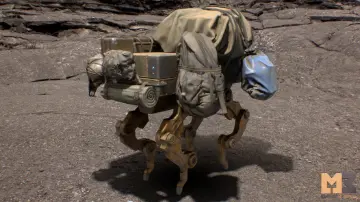
Ripper Dog
Explore the Ripper Dog creature asset, covering its lowpoly geometry, 56-animation set, Animation Blueprint, script setup, and multi-genre utility.
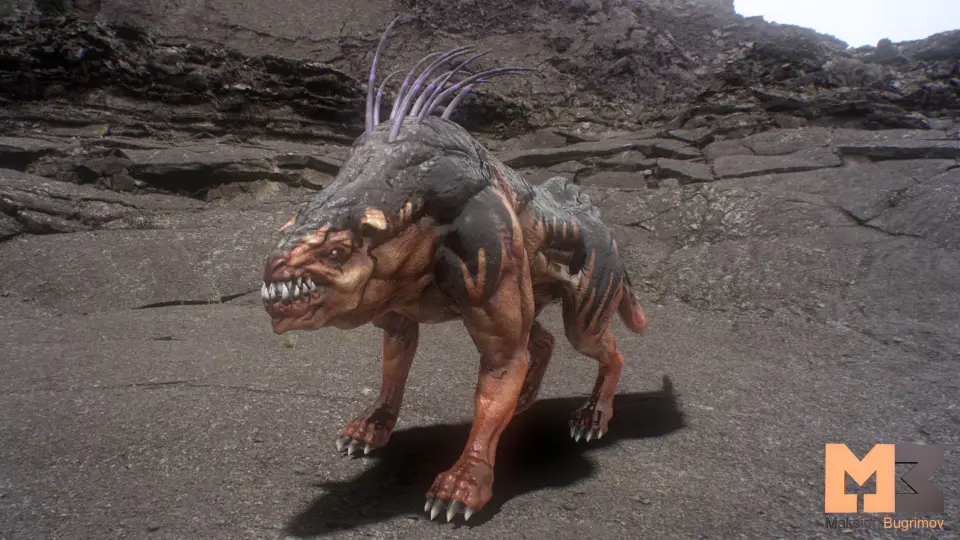
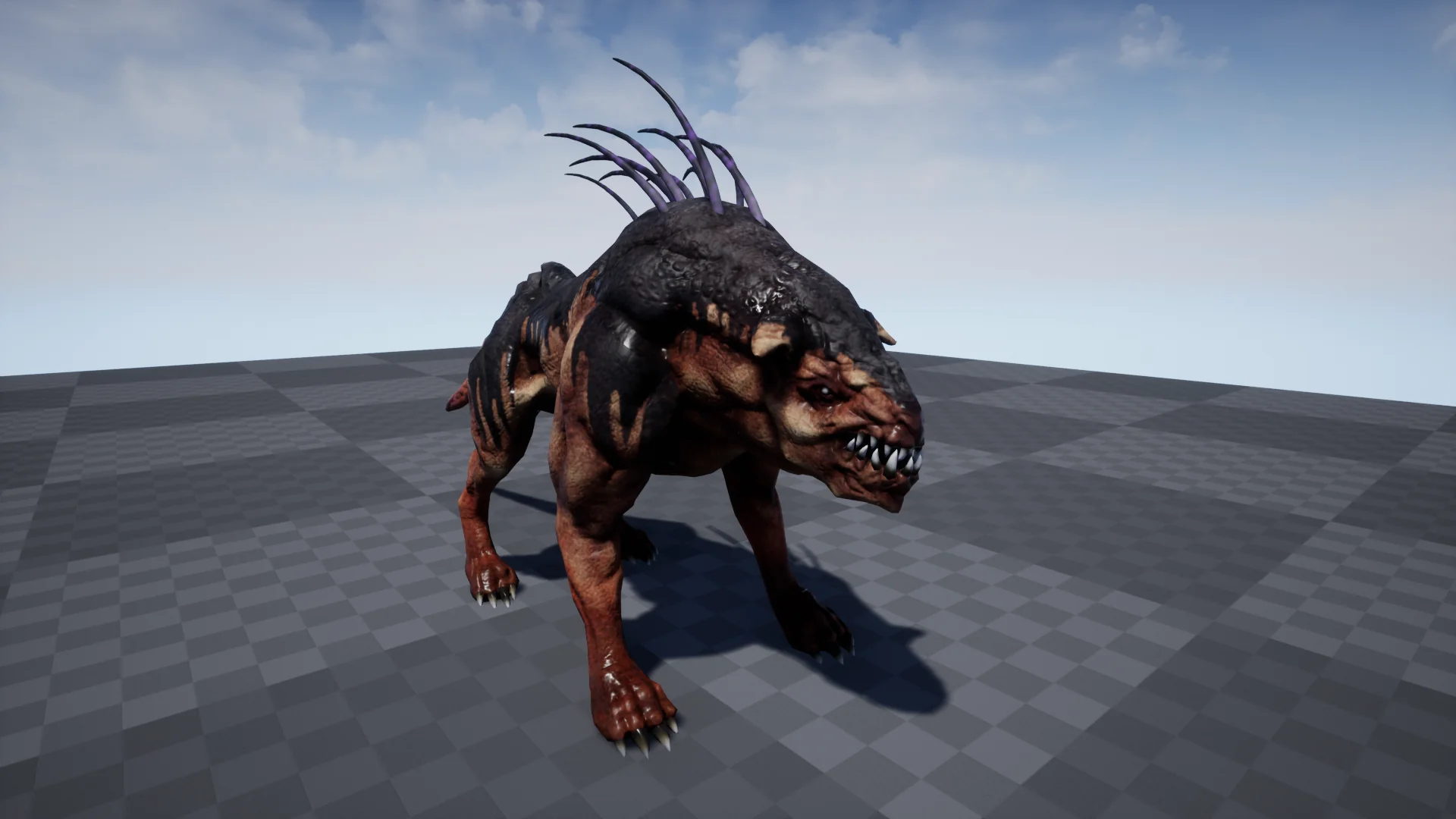
Lowpoly modeling serves an essential functional role in real-time engine pipelines, particularly when populating environments with multiple interactive entities. The Ripper Dog incorporates this lowpoly geometry to deliver an aggressive monster silhouette without burdening runtime performance. By keeping vertex counts optimized, the model preserves frame pacing and reduces memory overhead during intense encounters, where dozens of combatants or environmental hazards may compete for system resources.
Striking an effective balance between mesh density and expressive anatomy is vital for quadrupeds and predatory creatures. The surface layout of the Ripper Dog is engineered to retain structural integrity through dynamic movement. Strategic edge placement across high-strain zones—such as shoulders, haunches, the spine, and the jaw—prevents unsightly polygon collapsing or mesh pinching when extreme poses are struck. This clean geometric layout ensures that normal maps and real-time lighting accentuate the muscularity and menace of the beast without requiring dense underlying topology.
Animating the Ripper Dog with the 56 Creature Animations
Locomotion fidelity directly influences how convincing a beast feels during interactive gameplay. Ripper Dog comes equipped with high-quality animations, tying directly into a library of 56 animations for creatures. Having 56 separate animation assets available provides a comprehensive range of movement states, enabling fluid transitions between calm scouting routines, sudden turns, directional sprints, and multi-angled attacks. Instead of relying on repetitive, looping strides, the creature can navigate complex level geometry with realistic shifts in momentum.
A broad animation set is equally critical for combat feedback. Having discrete animations for impacts, staggering reactions, sudden directional changes, recovery states, and varied knockdown sequences allows the monster to communicate physical response convincingly. When players land attacks, the creature can physically register blows rather than sliding awkwardly through scripted sequences. The 56 animations offer sufficient coverage to build realistic attack chains, including lunges, bites, leaping swipes, and defensive circling, providing level designers with the tools necessary to craft distinct threat profiles.
Animation Blueprint Logic and Script Integration
Pairing character art with real-time logic requires structured animation handling. The Ripper Dog incorporates an Animation Blueprint, establishing a unified interface where motion states, blend spaces, and procedural adjustments converge. Within this system, raw movement data—such as forward speed, angular velocity, and vertical trajectory—drives state machine transitions cleanly. The Animation Blueprint coordinates smooth blending between base locomotion and additive upper-body gestures, allowing the creature to snap, snarl, or twist toward its target while continuously traversing terrain.
Complementing the animation architecture, the asset includes script components to facilitate core gameplay behaviors. Scripting handles the parameters governing AI activation, movement speeds, combat engagement ranges, and animation event notifications. When the creature enters an attack phase, script-triggered events can synchronize collision traces, particle effects, and audio cues directly with specific animation frames. This tight binding between animation notifies and script execution eliminates desynchronization between visual strikes and damage registration.
Adapting the Monster to Shooter, Fantasy, and Horror Environments
The visual identity and behavioral setup of the Ripper Dog make it suitable across several distinct game styles. In fast-paced enemy shooters, the beast functions naturally as an agile skirmisher designed to close distances rapidly and force players out of stationary cover. Because shooter gameplay frequently demands large waves of hostile targets, the lowpoly nature of the asset ensures that groups of these creatures can swarm the player without degrading rendering performance or causing draw call bottlenecks.
Within fantasy contexts, the monster adapts effortlessly into roles such as a subterranean predator, a summoned demonic hound, or a feral den-dweller patrolling ruins. The high-quality animation suite conveys the raw weight and biomechanical aggression expected of untamed fantasy fauna. The 56 creature animations supply the deliberate, stalking postures needed for dungeon encounters where anticipation and environmental sound cues precede an ambush.
In horror games, pacing shifts from open combat to sustained dread, requiring subtle physical presence and sudden, violent spikes in movement. The Ripper Dog suits horror settings where players have limited defensive capability. The lowpoly construction integrates effectively into dim, high-contrast lighting schemes, while the Animation Blueprint enables eerie, irregular pacing, sudden predatory rushes, and unnerving idle behaviors that sustain tension in claustrophobic spaces.
Setup Considerations for Gameplay Systems
Implementing the Ripper Dog into a project workflow begins with aligning the Animation Blueprint to the existing character movement component. Velocity values, ground checks, and turning rates feed into the state machine to govern transitions across the 56 animations. Fine-tuning blend times between idling, trotting, and sprinting ensures the quadrupedal rig preserves weight distribution without sudden popping or sliding across varied surface friction.
Connecting the included script elements to AI navigation systems finalizes implementation. Behavior trees or state machine scripts dictate when the monster shifts from patrol modes into active tracking, feeding commands into the movement component to trigger attack animations and evasive maneuvers. Because the geometry remains lowpoly and the underlying animation system is already organized, configuring pathfinding, perception cones, and hit detection proceeds with minimal technical friction, leaving the creature ready for active deployment.
 Characters
 Characters
 Characters
 Characters