"7ad89cffa44984cf"{"id":"1002561","slug":"post-apocalyptic-character","title":"Post-Apocalyptic Character","category":"Characters \u0026 Creatures","engine":"4.18+,5.0+","assetVersion":"","engineVersion":"Engine Version: 4.18+,5.0+","tag":"Characters","accent":"blue","visual":"character","summary":"Explore the Post-Apocalyptic Character asset, featuring standard Epic Skeleton rigging, modular gear, and integration with third-person blueprints.","platform":"Unreal Engine","indexPolicy":"index","publishedAt":"2026-11-13T10:58:03.300Z","updatedAt":"2026-11-13T10:58:03.300Z","sourceNotes":[],"fileContents":[],"compatibility":["Unreal Engine","Engine Version: 4.18+,5.0+"],"featuredImage":{"alt":"Post-Apocalyptic Character","src":"/wp-content/uploads/published/2026/11/b35fc4527bae-f00d27d2-1bca-4714-bdf6-7e2b2989ecab-2168373556.webp"},"hasDownloadLink":true,"downloads":0,"terms":[{"taxonomy":"category","slug":"characters-and-creatures","name":"Characters \u0026 Creatures"}],"galleryImages":[{"src":"/wp-content/uploads/published/2026/11/dd003c0bf76d-90c2f836-7642-4a47-b055-4481f37e7416-ee2fddc161.webp","alt":"Post-Apocalyptic Character"},{"src":"/wp-content/uploads/published/2026/11/bad2fea80372-f69dc050-300e-4e22-b55c-018be8387655-b410c1f356.webp","alt":"Post-Apocalyptic Character"},{"src":"/wp-content/uploads/published/2026/11/d659a173d174-1f889905-237a-4dce-9c37-e9410208a83b-5fe7a08134.webp","alt":"Post-Apocalyptic Character"},{"src":"/wp-content/uploads/published/2026/11/fde7d024707b-c956c2f7-eb9c-4a64-ab2c-e96613608ec7-aa6cc58850.webp","alt":"Post-Apocalyptic Character"},{"src":"/wp-content/uploads/published/2026/11/0f9913846f3a-f53be7be-ec25-4126-a396-32bb14f3c329-9061c3ee96.webp","alt":"Post-Apocalyptic Character"}],"accessPanel":{"kind":"resource","title":"Get this resource","eyebrow":"Free resource","message":"Download this resource in your browser.","fileName":"Content.7z","safetyNote":"Resources are manually reviewed before listing to improve quality and reduce obvious risks.","actionLabel":"Get this resource","resourceType":"Resource archive","versions":[]},"contentHtml":"\u003cp\u003eA survival scenario relies heavily on the physical credibility of its protagonist. In gameplay environments where resources are scarce and atmospheres lean into tension or horror, a protagonist must visually reflect the hazards of the world. The Post-Apocalyptic Character fills the role of a primary player model, arriving equipped with modular protective gear suited to hostile settings while maintaining a lightweight footprint tailored for real-time production.\u003c/p\u003e\u003ch2\u003eModular Elements on the Post-Apocalyptic Character\u003c/h2\u003e\u003cp\u003eFlexibility in character appearance often determines how well a model adapts to gameplay systems. This asset is built to serve as a main character, featuring three key removable gear components: a hood, a protective mask, and a survival backpack. These three modular items allow developers to adjust the character's visual hierarchy based on in-game context, equipment progression, or environmental conditions.\u003c/p\u003e\u003cp\u003eSeparating the mask from the base head mesh enables practical gameplay logic. In environmental hazard zones, such as gas-filled corridors or radiated sectors common in post-apocalyptic scenarios, scripts can toggle the mask's visibility or attach it dynamically when an inventory item is used. Removing the mask exposes the character's face, making the model equally functional for narrative dialogue scenes, safe-zone hubs, or early-game sequences where specialized gear has not yet been acquired.\u003c/p\u003e\u003cp\u003eThe hood and backpack function under similar practical logic. The removable hood alters the character's silhouette, moving between an enclosed, guarded look and an unshielded profile. The backpack serves as the direct visual representation of carrying capacity. In games utilizing active gear management, hiding the backpack allows the mesh to represent an unencumbered state, while enabling it visibly communicates that the character is carrying supplies, tools, or survival equipment. Managing these three modular assets through actor components or skeletal mesh merges keeps visual customization closely tied to functional player status.\u003c/p\u003e\u003ch2\u003eEpic Skeleton Rigging and Animation Blueprint Integration\u003c/h2\u003e\u003cp\u003eWhile the asset does not include standalone animation assets, it is rigged directly to the standard Epic Skeleton. This foundational choice bypasses the need for custom bone mapping, letting developers immediately connect the model to the extensive library of locomotion systems, combat animsets, and interaction montages already standardized around that skeletal hierarchy.\u003c/p\u003e\u003cp\u003eConforming to the standard Epic Skeleton means bone naming conventions, joint orientations, and hierarchy chains match standard engine expectations. Root, pelvis, spine segments, limb chains, and head bones are arranged so that retargeting steps can often be minimized or bypassed entirely when targeting standard motion collections. Socket placement for weapons, gear, or handheld tools follows standard offsets, allowing developers to reuse existing equipment attachment setups without manual realignment across custom bones.\u003c/p\u003e\u003cp\u003eBecause the character carries the Animationblueprint tag, integrating it into an existing animation pipeline requires straightforward state machine assignment. Locomotion logic, including multi-directional walk and run blend spaces, jump cycles, crouching mechanics, and aim offsets, links directly into the mesh through standard blueprint instances. The character accepts standard inputs without requiring alterations to native engine movement components, ensuring that developers can focus on gameplay mechanics rather than rebuilding base locomotion networks.\u003c/p\u003e\u003ch2\u003eInterfacing the Character with Third-Person Inventory Systems\u003c/h2\u003e\u003cp\u003eA key testing environment used during the asset's development is the Advanced TPS Inventory Pack. This specific controller pairing highlights the asset's direct readiness for third-person exploration, weapon handling, and gear-management gameplay loops without architectural friction.\u003c/p\u003e\u003cp\u003eOperating inside a third-person controller system requires stable root-motion handling and reliable socket tracking. When a character draws a weapon, accesses an inventory pouch, or swaps equipment, the underlying skeleton must accurately drive both the mesh and attached items. Because the Post-Apocalyptic Character has been verified against an established third-person inventory system, the mesh structure properly supports common gameplay interactions, including aim offsets, holstering routines, and camera collision boundaries typical of third-person perspectives.\u003c/p\u003e\u003cp\u003eThe presence of the Script tag further reflects this focus on functional implementation. When hooked into an advanced inventory controller, scripts can link the state of the character's inventory directly to the visibility of the removable mask, hood, and backpack. Rather than remaining static decorations, these elements become active representations of player gear, toggled on and off through inventory events, equipment equip-slots, and player-driven interaction triggers.\u003c/p\u003e\u003ch2\u003eLowpoly Horror Optimization and Motion Support\u003c/h2\u003e\u003cp\u003eDesigned with a lowpoly modeling approach, the asset is structured to maintain strong performance across dense game levels. Survival horror games frequently deploy heavy volumetric lighting, dense fog effects, dynamic shadows, and demanding atmospheric post-processing to establish mood. By keeping the mesh geometry lowpoly, rendering overhead is minimized, leaving substantial GPU headroom for visual effects, detailed environmental assets, and multiple dynamic light sources.\u003c/p\u003e\u003cp\u003eThe horror thematic tag reflects the visual styling of the character. The combination of survival gear, improvised protective layers, and practical travel equipment creates a grounded aesthetic that fits naturally into infected zones, abandoned urban ruins, and wasteland expanses. The model provides an immediate thematic fit for survival horror scenarios where a vulnerable, gear-reliant human protagonist must navigate dangerous environments.\u003c/p\u003e\u003cp\u003eIn addition to human locomotion libraries compatible with the standard Epic Skeleton, the character maintains noted compatibility with 56 Animations For Creatures. This extended animation compatibility offers unique possibilities for non-standard movement, stylized horror sequences, or specialized physical states, such as staggered reactions, crawling escapes, or erratic motion patterns. Whether utilizing standard humanoid locomotion or creature-specific motion profiles, the model retains structural integrity across diverse skeletal motion data.\u003c/p\u003e\u003ch2\u003eImplementation Workflow for Survival Projects\u003c/h2\u003e\u003cp\u003eDeploying the asset into an active project centers on assigning an existing animation blueprint, configuring mesh component hierarchies, and connecting modular attachments to player inventory events. Developers seeking an adaptable main character can leverage the unbundled animation structure to tailor motion sets specifically to their project's pacing, whether that requires slow, deliberate survival pacing or agile combat maneuvers.\u003c/p\u003e\u003cp\u003eThe combination of standard Epic Skeleton rigging, tested third-person inventory compatibility, lowpoly optimization, and modular equipment slots makes the Post-Apocalyptic Character a reliable base for survival, action, and horror gameplay systems where consistent implementation matters most.\u003c/p\u003e\n\n\u003ch2\u003eContinue Browsing Similar Packs\u003c/h2\u003e\n\u003cul\u003e\n\u003cli\u003e\u003ca href=\"https://3dcghub.com/customized-post-apocalyptic-characters/\" rel=\"noopener noreferrer\"\u003eCustomized Post Apocalyptic Characters\u003c/a\u003e\u003c/li\u003e\n\u003cli\u003e\u003ca href=\"https://3dcghub.com/customizable-survival-girl/\" rel=\"noopener noreferrer\"\u003eCustomizable Survival Girl\u003c/a\u003e\u003c/li\u003e\n\u003cli\u003e\u003ca href=\"https://3dcghub.com/post-apocalyptic-characters-pack/\" rel=\"noopener noreferrer\"\u003ePost-Apocalyptic Characters (Pack)\u003c/a\u003e\u003c/li\u003e\n\u003cli\u003e\u003ca href=\"https://3dcghub.com/adventure-characters-pack/\" rel=\"noopener noreferrer\"\u003eAdventure Characters (Pack)\u003c/a\u003e\u003c/li\u003e\n\u003cli\u003e\u003ca href=\"https://3dcghub.com/female-heroine-01/\" rel=\"noopener noreferrer\"\u003eFemale Heroine 01\u003c/a\u003e\u003c/li\u003e\n\u003c/ul\u003e","contentTextLength":7468,"navigation":{"current":16,"total":4499,"previous":{"id":"1002562","slug":"ripper-dog","title":"Ripper Dog","category":"Characters \u0026 Creatures","platform":"Unreal Engine","updatedAt":"2026-11-13T11:00:12.935Z"},"next":{"id":"1002560","slug":"polygon-city-zombies-low-poly-urban-zombie-character-pack","title":"POLYGON - City Zombies - Low Poly Urban Zombie Character Pack","category":"Characters \u0026 Creatures","platform":"Unreal Engine","updatedAt":"2026-11-13T10:56:06.391Z"}},"relatedResources":[{"id":"1000809","slug":"customized-post-apocalyptic-characters","title":"Customized Post Apocalyptic Characters","category":"Characters \u0026 Creatures","engine":"4.26+,5.0+","assetVersion":"","engineVersion":"Engine Version: 4.26+,5.0+","tag":"Characters","accent":"blue","visual":"character","summary":"Modular post-apocalyptic character pack with interchangeable heads, clothes, masks, backpacks, weapons, and Epic Skeleton rigging for survival and horror scenes","platform":"Unreal Engine","indexPolicy":"index","publishedAt":"2026-07-31T08:49:21.684Z","updatedAt":"2026-07-31T08:49:21.684Z","sourceNotes":[],"fileContents":[],"compatibility":["Unreal Engine","Engine Version: 4.26+,5.0+"],"featuredImage":{"alt":"Customized Post Apocalyptic Characters","src":"/wp-content/uploads/published/2026/07/82f2105f5d37-1650b3e7-da11-460d-952c-372e3c366b5b-6eac59119d.webp"},"hasDownloadLink":true,"downloads":2},{"id":"2125","slug":"customizable-survival-girl","title":"Customizable Survival Girl","category":"Characters \u0026 Creatures","engine":"4.26+,5.0+","assetVersion":"Engine version: 4.26+,5.0+","engineVersion":"4.19","tag":"Characters","accent":"blue","visual":"character","summary":"Create unique characters with the Modular Survival Girl asset. Features 4K PBR textures, Epic Skeleton rigging, and customizable outfits for survival games.","platform":"Unreal Engine","indexPolicy":"index","publishedAt":"2026-02-07T07:28:22.000Z","updatedAt":"2026-04-19T15:58:06.000Z","sourceNotes":[],"fileContents":[],"compatibility":["Unreal Engine","Engine version: 4.26+,5.0+"],"featuredImage":{"alt":"Customizable Survival Girl","src":"https://3dcghub.com/wp-content/uploads/2026/02/00f6d419-2e01-4606-9200-648551ffb216.webp"},"hasDownloadLink":true,"downloads":1},{"id":"1001906","slug":"post-apocalyptic-characters-pack","title":"Post-Apocalyptic Characters (Pack)","category":"Characters \u0026 Creatures","engine":"5.6+","assetVersion":"","engineVersion":"Engine Version: 5.6+","tag":"Characters","accent":"blue","visual":"character","summary":"Explore the Post-Apocalyptic Characters pack featuring 14 low-poly PBR models rigged to the UE4 Epic Skeleton with weapons and FPS Starter Pack compatibility.","platform":"Unreal Engine","indexPolicy":"index","publishedAt":"2026-10-22T11:44:21.876Z","updatedAt":"2026-10-22T11:44:21.876Z","sourceNotes":[],"fileContents":[],"compatibility":["Unreal Engine","Engine Version: 5.6+"],"featuredImage":{"alt":"Post-Apocalyptic Characters (Pack)","src":"/wp-content/uploads/published/2026/10/a22c7c35103d-2794a31e-e2eb-47f1-afeb-249405c9c085-f17027c066.webp"},"hasDownloadLink":true,"downloads":2}]}
Characters
Post-Apocalyptic Character
Explore the Post-Apocalyptic Character asset, featuring standard Epic Skeleton rigging, modular gear, and integration with third-person blueprints.
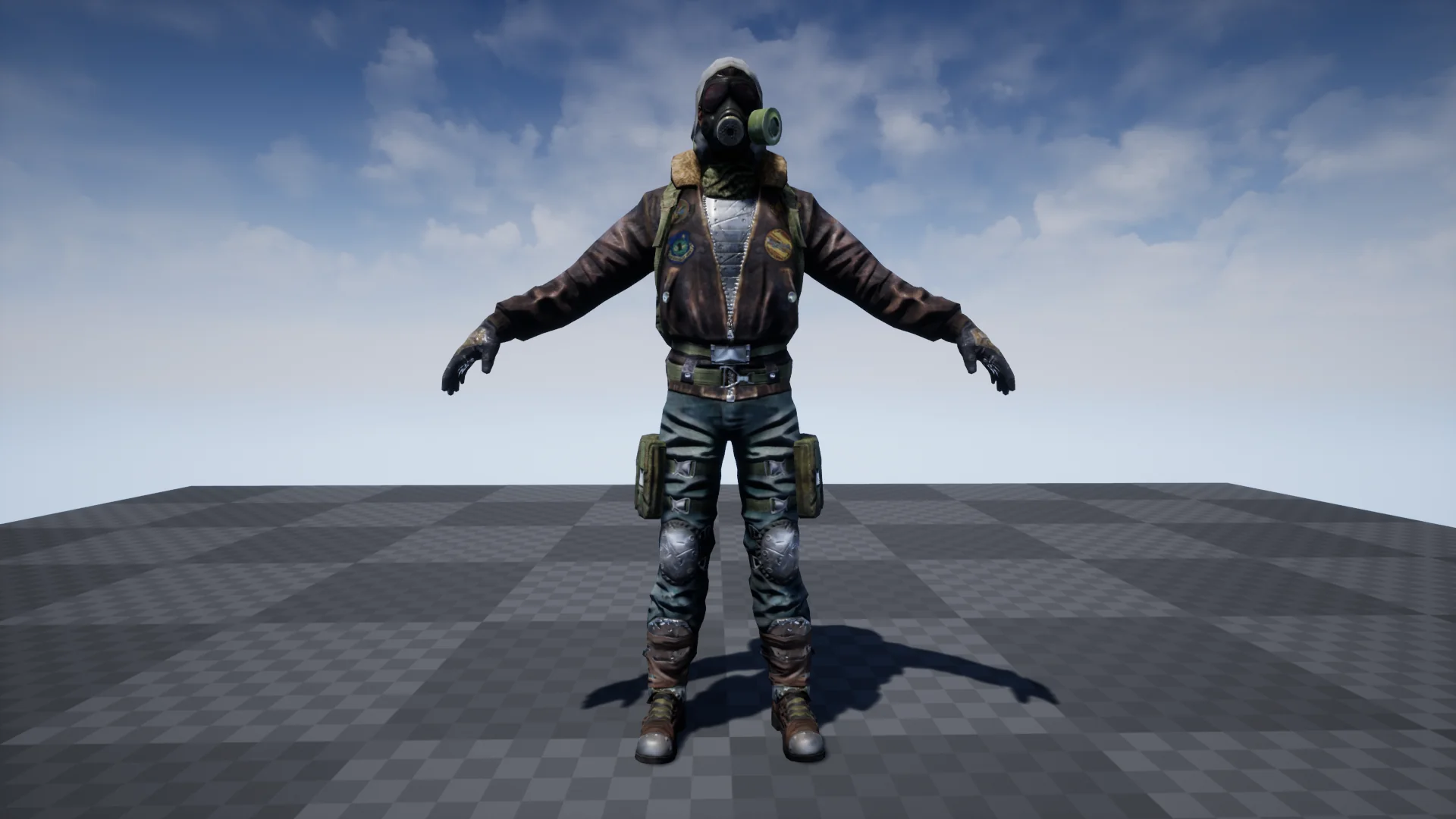
A survival scenario relies heavily on the physical credibility of its protagonist. In gameplay environments where resources are scarce and atmospheres lean into tension or horror, a protagonist must visually reflect the hazards of the world. The Post-Apocalyptic Character fills the role of a primary player model, arriving equipped with modular protective gear suited to hostile settings while maintaining a lightweight footprint tailored for real-time production.
Modular Elements on the Post-Apocalyptic Character
Flexibility in character appearance often determines how well a model adapts to gameplay systems. This asset is built to serve as a main character, featuring three key removable gear components: a hood, a protective mask, and a survival backpack. These three modular items allow developers to adjust the character's visual hierarchy based on in-game context, equipment progression, or environmental conditions.
Separating the mask from the base head mesh enables practical gameplay logic. In environmental hazard zones, such as gas-filled corridors or radiated sectors common in post-apocalyptic scenarios, scripts can toggle the mask's visibility or attach it dynamically when an inventory item is used. Removing the mask exposes the character's face, making the model equally functional for narrative dialogue scenes, safe-zone hubs, or early-game sequences where specialized gear has not yet been acquired.
The hood and backpack function under similar practical logic. The removable hood alters the character's silhouette, moving between an enclosed, guarded look and an unshielded profile. The backpack serves as the direct visual representation of carrying capacity. In games utilizing active gear management, hiding the backpack allows the mesh to represent an unencumbered state, while enabling it visibly communicates that the character is carrying supplies, tools, or survival equipment. Managing these three modular assets through actor components or skeletal mesh merges keeps visual customization closely tied to functional player status.
Epic Skeleton Rigging and Animation Blueprint Integration
While the asset does not include standalone animation assets, it is rigged directly to the standard Epic Skeleton. This foundational choice bypasses the need for custom bone mapping, letting developers immediately connect the model to the extensive library of locomotion systems, combat animsets, and interaction montages already standardized around that skeletal hierarchy.
Conforming to the standard Epic Skeleton means bone naming conventions, joint orientations, and hierarchy chains match standard engine expectations. Root, pelvis, spine segments, limb chains, and head bones are arranged so that retargeting steps can often be minimized or bypassed entirely when targeting standard motion collections. Socket placement for weapons, gear, or handheld tools follows standard offsets, allowing developers to reuse existing equipment attachment setups without manual realignment across custom bones.
Because the character carries the Animationblueprint tag, integrating it into an existing animation pipeline requires straightforward state machine assignment. Locomotion logic, including multi-directional walk and run blend spaces, jump cycles, crouching mechanics, and aim offsets, links directly into the mesh through standard blueprint instances. The character accepts standard inputs without requiring alterations to native engine movement components, ensuring that developers can focus on gameplay mechanics rather than rebuilding base locomotion networks.
Interfacing the Character with Third-Person Inventory Systems
A key testing environment used during the asset's development is the Advanced TPS Inventory Pack. This specific controller pairing highlights the asset's direct readiness for third-person exploration, weapon handling, and gear-management gameplay loops without architectural friction.
Operating inside a third-person controller system requires stable root-motion handling and reliable socket tracking. When a character draws a weapon, accesses an inventory pouch, or swaps equipment, the underlying skeleton must accurately drive both the mesh and attached items. Because the Post-Apocalyptic Character has been verified against an established third-person inventory system, the mesh structure properly supports common gameplay interactions, including aim offsets, holstering routines, and camera collision boundaries typical of third-person perspectives.
The presence of the Script tag further reflects this focus on functional implementation. When hooked into an advanced inventory controller, scripts can link the state of the character's inventory directly to the visibility of the removable mask, hood, and backpack. Rather than remaining static decorations, these elements become active representations of player gear, toggled on and off through inventory events, equipment equip-slots, and player-driven interaction triggers.
Lowpoly Horror Optimization and Motion Support
Designed with a lowpoly modeling approach, the asset is structured to maintain strong performance across dense game levels. Survival horror games frequently deploy heavy volumetric lighting, dense fog effects, dynamic shadows, and demanding atmospheric post-processing to establish mood. By keeping the mesh geometry lowpoly, rendering overhead is minimized, leaving substantial GPU headroom for visual effects, detailed environmental assets, and multiple dynamic light sources.
The horror thematic tag reflects the visual styling of the character. The combination of survival gear, improvised protective layers, and practical travel equipment creates a grounded aesthetic that fits naturally into infected zones, abandoned urban ruins, and wasteland expanses. The model provides an immediate thematic fit for survival horror scenarios where a vulnerable, gear-reliant human protagonist must navigate dangerous environments.
In addition to human locomotion libraries compatible with the standard Epic Skeleton, the character maintains noted compatibility with 56 Animations For Creatures. This extended animation compatibility offers unique possibilities for non-standard movement, stylized horror sequences, or specialized physical states, such as staggered reactions, crawling escapes, or erratic motion patterns. Whether utilizing standard humanoid locomotion or creature-specific motion profiles, the model retains structural integrity across diverse skeletal motion data.
Implementation Workflow for Survival Projects
Deploying the asset into an active project centers on assigning an existing animation blueprint, configuring mesh component hierarchies, and connecting modular attachments to player inventory events. Developers seeking an adaptable main character can leverage the unbundled animation structure to tailor motion sets specifically to their project's pacing, whether that requires slow, deliberate survival pacing or agile combat maneuvers.
The combination of standard Epic Skeleton rigging, tested third-person inventory compatibility, lowpoly optimization, and modular equipment slots makes the Post-Apocalyptic Character a reliable base for survival, action, and horror gameplay systems where consistent implementation matters most.
 Characters
 Characters
 Characters
 Characters