"6c6413bef81af556"{"id":"1000809","slug":"customized-post-apocalyptic-characters","title":"Customized Post Apocalyptic Characters","category":"Characters \u0026 Creatures","engine":"4.26+,5.0+","assetVersion":"","engineVersion":"Engine Version: 4.26+,5.0+","tag":"Characters","accent":"blue","visual":"character","summary":"Modular post-apocalyptic character pack with interchangeable heads, clothes, masks, backpacks, weapons, and Epic Skeleton rigging for survival and horror scenes","platform":"Unreal Engine","publishedAt":"2026-07-31T08:49:21.684Z","updatedAt":"2026-07-31T08:49:21.684Z","sourceNotes":[],"fileContents":[],"compatibility":["Unreal Engine","Engine Version: 4.26+,5.0+"],"featuredImage":{"alt":"Customized Post Apocalyptic Characters","src":"/wp-content/uploads/published/2026/07/82f2105f5d37-1650b3e7-da11-460d-952c-372e3c366b5b-6eac59119d.webp"},"hasDownloadLink":true,"downloads":1,"terms":[{"taxonomy":"category","slug":"characters-and-creatures","name":"Characters \u0026 Creatures"}],"galleryImages":[{"src":"/wp-content/uploads/published/2026/07/5de3f7051a62-b5032779-c412-4883-b3c3-d42c7fda2fd9-698a2af040.webp","alt":"Customized Post Apocalyptic Characters"},{"src":"/wp-content/uploads/published/2026/07/9470ed1d1812-c4b12c53-3445-4a63-b09e-fccd06de2c7b-09415cea9e.webp","alt":"Customized Post Apocalyptic Characters"},{"src":"/wp-content/uploads/published/2026/07/ade49f95af1e-d0a15875-1582-464b-8352-617a9e522fba-0faac1c99f.webp","alt":"Customized Post Apocalyptic Characters"},{"src":"/wp-content/uploads/published/2026/07/f426094db7dc-5c8c7cb0-b92d-4571-bba2-c104bef12a72-44269390bf.webp","alt":"Customized Post Apocalyptic Characters"},{"src":"/wp-content/uploads/published/2026/07/ae188c0e9596-37cc8a4c-b474-4bad-aa60-05456797dd26-4e4b15b0f0.webp","alt":"Customized Post Apocalyptic Characters"},{"src":"/wp-content/uploads/published/2026/07/9c933e87f41b-a65cbd5b-43c3-443a-b539-820d72c6759f-741548c4c2.webp","alt":"Customized Post Apocalyptic Characters"},{"src":"/wp-content/uploads/published/2026/07/40350cdb2743-c3e06c58-8d31-496f-ac7a-5d9107d16bbe-66e8c157d3.webp","alt":"Customized Post Apocalyptic Characters"}],"accessPanel":{"kind":"resource","title":"Download this resource","eyebrow":"Free Download","message":"Log in or create a free account to start your download.","fileName":"Content.7z","safetyNote":"Resources are manually reviewed before listing to improve quality and reduce obvious risks.","actionLabel":"Download Free","resourceType":"Resource archive"},"contentHtml":"\u003cp\u003eBuilding a wasteland scene often means populating it with survivors who look worn, equipped, and distinct enough to read as individuals rather than copies. A modular character system lets a team assemble those survivors from interchangeable parts, dressing each one for the environment and the role it needs to play. This is where \u003cem\u003eCustomized Post Apocalyptic Characters\u003c/em\u003e sits in a production pipeline: as a configurable roster of body components, gear, and weapons that all share the same underlying skeleton structure so everything moves together cleanly when animated.\u003c/p\u003e\n\n\u003cp\u003eBecause every part uses the Epic Skeleton, the rigged components slot into the same animation framework. That shared rig is the detail holding the whole system together—an armature designed to accept Epic-compatible animations and keep the modular pieces behaving consistently across different character configurations. For teams already working with Epic Skeleton-based animation sets, the parts are structured to drop into that same setup without forcing a re-rig.\u003c/p\u003e\n\n\u003ch2\u003eModular Character Components and Epic Skeleton Rigging\u003c/h2\u003e\n\u003cp\u003eThe character is assembled from a set of swappable elements, each category offering multiple variations so a single base body can cover a range of survivors:\u003c/p\u003e\n\u003cul\u003e\n \u003cli\u003e\u003cstrong\u003e3 heads:\u003c/strong\u003e Different facial structures and features for distinct character identities\u003c/li\u003e\n \u003cli\u003e\u003cstrong\u003e5 pants:\u003c/strong\u003e Lower-body clothing options, each contributing to silhouette variety\u003c/li\u003e\n \u003cli\u003e\u003cstrong\u003e5 types of clothes:\u003c/strong\u003e Torso and upper-body layers, from light gear to heavier coverage suited to hostile wasteland conditions\u003c/li\u003e\n \u003cli\u003e\u003cstrong\u003e5 types of shoes:\u003c/strong\u003e Footwear options that anchor the character's stance and visual weight\u003c/li\u003e\n \u003cli\u003e\u003cstrong\u003e5 backpacks:\u003c/strong\u003e Carry gear that signals a survivor's readiness and role in the field\u003c/li\u003e\n \u003cli\u003e\u003cstrong\u003e3 hats:\u003c/strong\u003e Headwear variations that further differentiate silhouettes\u003c/li\u003e\n \u003cli\u003e\u003cstrong\u003e12 different masks:\u003c/strong\u003e The largest single category of modular pieces, providing extensive facial coverage options for distinct looks in contaminated or hostile environments\u003c/li\u003e\n\u003c/ul\u003e\n\n\u003cp\u003eTwelve masks is a notably deep pool for a single modular category. In a genre where face coverings often carry narrative weight—protective equipment, scrap-built filters, improvised coverings—having 12 distinct choices allows for broad visual variety across a crowd scene or a roster of enemies.\u003c/p\u003e\n\n\u003cp\u003eThe backpacks and headwear work as secondary identity markers. A character carrying a loaded pack reads differently from one traveling light, and the different clothing and pants options let a team build everything from a lightly equipped scavenger to a heavily layered survivor without leaving the same modular system.\u003c/p\u003e\n\n\u003cp\u003eThat total comes to 38 modular parts across the clothing, gear, and head categories, before counting weapons.\u003c/p\u003e\n\n\u003ch2\u003eWeapon Variety for Post-Apocalyptic Characters\u003c/h2\u003e\n\u003cp\u003eOn top of the clothing and gear components, the system includes 8 types of weapons. These give each assembled character a tool suited to hostile environments, and the range allows different survivors to carry different loadouts within the same scene. A camp of armed characters can then hold mixed weapons rather than identical armaments.\u003c/p\u003e\n\n\u003cp\u003eBecause the weapons share the Epic Skeleton framework, they fit the same rigging logic as the character parts. That structure matters for animation: a weapon held by a character can follow the hand bones and body motion defined by the shared skeleton system.\u003c/p\u003e\n\n\u003ch2\u003eAnimation Compatibility Across the Parts\u003c/h2\u003e\n\u003cp\u003eThe Epic Skeleton foundation means the modular character and its attached gear are built to accept skeleton-driven animation. The tag set attached to this system—\u003cem\u003eCharacter\u003c/em\u003e, \u003cem\u003eSurvival\u003c/em\u003e, \u003cem\u003eLowpoly\u003c/em\u003e, \u003cem\u003eScript\u003c/em\u003e, \u003cem\u003eConstruction\u003c/em\u003e, \u003cem\u003eRPG\u003c/em\u003e, \u003cem\u003eWeapon\u003c/em\u003e, \u003cem\u003eHorror\u003c/em\u003e, \u003cem\u003eApocalyptic\u003c/em\u003e, and \u003ccode\u003eAnimation Blueprint\u003c/code\u003e—points to the asset's place in production workflows. The \u003ccode\u003eAnimation Blueprint\u003c/code\u003e tag signals that animation logic is part of the intended use, not just static mesh display.\u003c/p\u003e\n\n\u003cp\u003eA key compatibility note: 56 animations for creatures are available alongside this character system. This means a team working with the pack has access to a library of creature animations that can populate the same scenes. For survival and horror projects, where human survivors and mutant or creature threats share screen time, having both the modular character parts and a set of creature animations provides the raw material for populating both sides of a wasteland encounter.\u003c/p\u003e\n\n\u003ch2\u003eBuilt for Survival, Horror, and Wasteland Productions\u003c/h2\u003e\n\u003cp\u003eThe resource carries tags spanning \u003cem\u003eSurvival\u003c/em\u003e, \u003cem\u003eHorror\u003c/em\u003e, \u003cem\u003eRPG\u003c/em\u003e, and \u003cem\u003eApocalyptic\u003c/em\u003e categories. That tag combination points toward scenes focused on scavenging, RPG-style combat, horror tension, and end-of-the-world settings. The \u003cem\u003eLowpoly\u003c/em\u003e tag indicates the model approach leans toward lightweight geometry, a choice that matters for real-time production environments where scene complexity is a cost and populating a wasteland with multiple characters at once requires models that maintain frame rates.\u003c/p\u003e\n\n\u003cp\u003eThe \u003cem\u003eConstruction\u003c/em\u003e tag raises an interesting angle. It points to the modular, assembly-based nature of the character system, where characters are constructed from components rather than delivered as fixed sculpts. This is the system's core working principle.\u003c/p\u003e\n\n\u003cp\u003eFor a production team, the workflow runs like this:\u003c/p\u003e\n\u003col\u003e\n \u003cli\u003eSelect a head configuration from the 3 options available.\u003c/li\u003e\n \u003cli\u003eCombine it with a choice from the 5 clothing options and 5 pants options to establish the core silhouette.\u003c/li\u003e\n \u003cli\u003eAdd footwear from the 5 shoe types to complete the grounded body structure.\u003c/li\u003e\n \u003cli\u003eSelect a mask from the 12 variations, which significantly alters the character's facial identity and protective appearance.\u003c/li\u003e\n \u003cli\u003eOptionally add a hat from the 3 available styles to layer additional visual identity.\u003c/li\u003e\n \u003cli\u003eEquip one of the 8 weapon types to establish the character's combat role.\u003c/li\u003e\n \u003cli\u003eOptionally add one of the 5 backpacks to signal the character's preparedness and exploration-ready condition.\u003c/li\u003e\n\u003c/ol\u003e\n\n\u003cp\u003eEach step preserves Epic Skeleton compatibility, so the assembled character is animation-ready rather than requiring additional rigging work to function.\u003c/p\u003e\n\n\u003ch2\u003eTested Skeleton Integration and Tutorial References\u003c/h2\u003e\n\u003cp\u003eThe system includes references to a skeleton test and a tutorial, both relevant to verifying that the modular parts work correctly with the Epic Skeleton rig. A test video demonstrates the rigged parts in motion under the skeleton system, which is a crucial verification step for modular characters—confirming that swapping components does not break the deformation or movement expected from the shared armature.\u003c/p\u003e\n\n\u003cp\u003eThe tutorial reference suggests guidance on working with the system is available, which matters for teams integrating the modular parts into existing Animation Blueprints or populating scenes with characters that need to share animation states cleanly.\u003c/p\u003e\n\n\u003ch2\u003eParts Inventory Across the Epic Skeleton Framework\u003c/h2\u003e\n\u003cp\u003eTotaling the modular components gives a full picture of what the system can assemble:\u003c/p\u003e\n\u003cul\u003e\n \u003cli\u003e3 heads provide the base identity\u003c/li\u003e\n \u003cli\u003e5 pants and 5 types of clothes offer body coverage configurations\u003c/li\u003e\n \u003cli\u003e5 types of shoes complete the lower body\u003c/li\u003e\n \u003cli\u003e5 backpacks serve as load-carrying gear\u003c/li\u003e\n \u003cli\u003e3 hats add headwear identity\u003c/li\u003e\n \u003cli\u003e12 different masks provide the largest category of variation\u003c/li\u003e\n \u003cli\u003e8 types of weapons extend the system into combat-ready equipment\u003c/li\u003e\n\u003c/ul\u003e\n\n\u003cp\u003eAll of those parts sit on the Epic Skeleton, which means the character system is structured for animation from the start. That is the central working quality of the resource: not just a set of meshes, but a rigged modular framework designed to produce distinct post-apocalyptic survivors who follow a shared skeleton standard.\u003c/p\u003e\n\n\u003cp\u003eThe strongest practical takeaway for teams evaluating it: this is an Epic Skeleton-based modular assembly system with 38 gear and clothing pieces plus 8 weapons, compatible with 56 creature animations, built to populate survival, horror, and RPG scenes with characters that are animation-ready rather than static models fixed in a single configuration.\u003c/p\u003e\n\n\u003ch2\u003eMore From The Same Workflow\u003c/h2\u003e\n\u003cul\u003e\n\u003cli\u003e\u003ca href=\"https://3dcghub.com/customizable-survival-girl/\" title=\"Customizable Survival Girl\"\u003eCustomizable Survival Girl\u003c/a\u003e\u003c/li\u003e\n\u003cli\u003e\u003ca href=\"https://3dcghub.com/adventure-characters-pack/\" title=\"Adventure Characters (Pack)\"\u003eAdventure Characters (Pack)\u003c/a\u003e\u003c/li\u003e\n\u003cli\u003e\u003ca href=\"https://3dcghub.com/infected-rage-unleashed/\" title=\"INFECTED Rage Unleashed\"\u003eINFECTED Rage Unleashed\u003c/a\u003e\u003c/li\u003e\n\u003cli\u003e\u003ca href=\"https://3dcghub.com/polygon-apocalypse-wasteland/\" title=\"POLYGON - Apocalypse Wasteland\"\u003ePOLYGON - Apocalypse Wasteland\u003c/a\u003e\u003c/li\u003e\n\u003cli\u003e\u003ca href=\"https://3dcghub.com/junkyard-city/\" title=\"Junkyard City\"\u003eJunkyard City\u003c/a\u003e\u003c/li\u003e\n\u003c/ul\u003e","contentTextLength":7956,"navigation":{"current":415,"total":3140,"previous":{"id":"1000810","slug":"cyberpunk-holograms-neon-set-set-of-33-holograms","title":"Cyberpunk Holograms / Neon Set ( Set of 33 Holograms )","category":"Spacecraft","platform":"Unreal Engine","updatedAt":"2026-07-31T08:58:26.683Z"},"next":{"id":"1000808","slug":"crashed-airliner","title":"Crashed Airliner","category":"Vehicles \u0026 Transportation","platform":"Unreal Engine","updatedAt":"2026-07-31T06:58:18.421Z"}},"relatedResources":[{"id":"2125","slug":"customizable-survival-girl","title":"Customizable Survival Girl","category":"Characters \u0026 Creatures","engine":"4.26+,5.0+","assetVersion":"Engine version: 4.26+,5.0+","engineVersion":"4.19","tag":"Characters","accent":"blue","visual":"character","summary":"Create unique characters with the Modular Survival Girl asset. Features 4K PBR textures, Epic Skeleton rigging, and customizable outfits for survival games.","platform":"Unreal Engine","publishedAt":"2026-02-07T07:28:22.000Z","updatedAt":"2026-04-19T15:58:06.000Z","sourceNotes":[],"fileContents":[],"compatibility":["Unreal Engine","Engine version: 4.26+,5.0+"],"featuredImage":{"alt":"Customizable Survival Girl","src":"https://3dcghub.com/wp-content/uploads/2026/02/00f6d419-2e01-4606-9200-648551ffb216.webp"},"hasDownloadLink":true,"downloads":1},{"id":"1000555","slug":"adventure-characters-pack","title":"Adventure Characters (Pack)","category":"Characters \u0026 Creatures","engine":"4.26+,5.0+","assetVersion":"","engineVersion":"Engine Version: 4.26+,5.0+","tag":"Characters","accent":"blue","visual":"character","summary":"Adventure Characters (Pack) delivers five post-apocalyptic survivors with unique weapons and face morphs, compatible with Unreal Engine 4.18 through 5.8.","platform":"Unreal Engine","publishedAt":"2026-07-15T07:58:52.143Z","updatedAt":"2026-07-15T07:58:52.143Z","sourceNotes":[],"fileContents":[],"compatibility":["Unreal Engine","Engine Version: 4.26+,5.0+"],"featuredImage":{"alt":"Adventure Characters (Pack)","src":"/wp-content/uploads/published/2026/07/af73ee312e4b-1d8afbd9-6651-4984-89c8-83134510c22b-619d98654b.webp"},"hasDownloadLink":true,"downloads":1},{"id":"1000070","slug":"infected-rage-unleashed","title":"INFECTED Rage Unleashed","category":"Characters \u0026 Creatures","engine":"Engine Version: 5.5+","assetVersion":"Engine Version: 5.5+","engineVersion":"","tag":"Characters","accent":"blue","visual":"character","summary":"A post-apocalyptic crowd bundle with 300+ infected assets, 200 characters, modular parts, 9 groups, rigs, and Blender and UE5 workflow support.","platform":"Unreal Engine","publishedAt":"2026-06-01T15:15:17.561Z","updatedAt":"2026-06-01T15:49:49.372Z","sourceNotes":[],"fileContents":[],"compatibility":["Unreal Engine","Engine Version: 5.5+"],"featuredImage":{"alt":"INFECTED Rage Unleashed","src":"/wp-content/uploads/published/2026/06/3c8a2b26a8b1-infected-box3-57234c04b4.webp"},"hasDownloadLink":true,"downloads":1}]}
Characters
Customized Post Apocalyptic Characters
Modular post-apocalyptic character pack with interchangeable heads, clothes, masks, backpacks, weapons, and Epic Skeleton rigging for survival and horror scenes
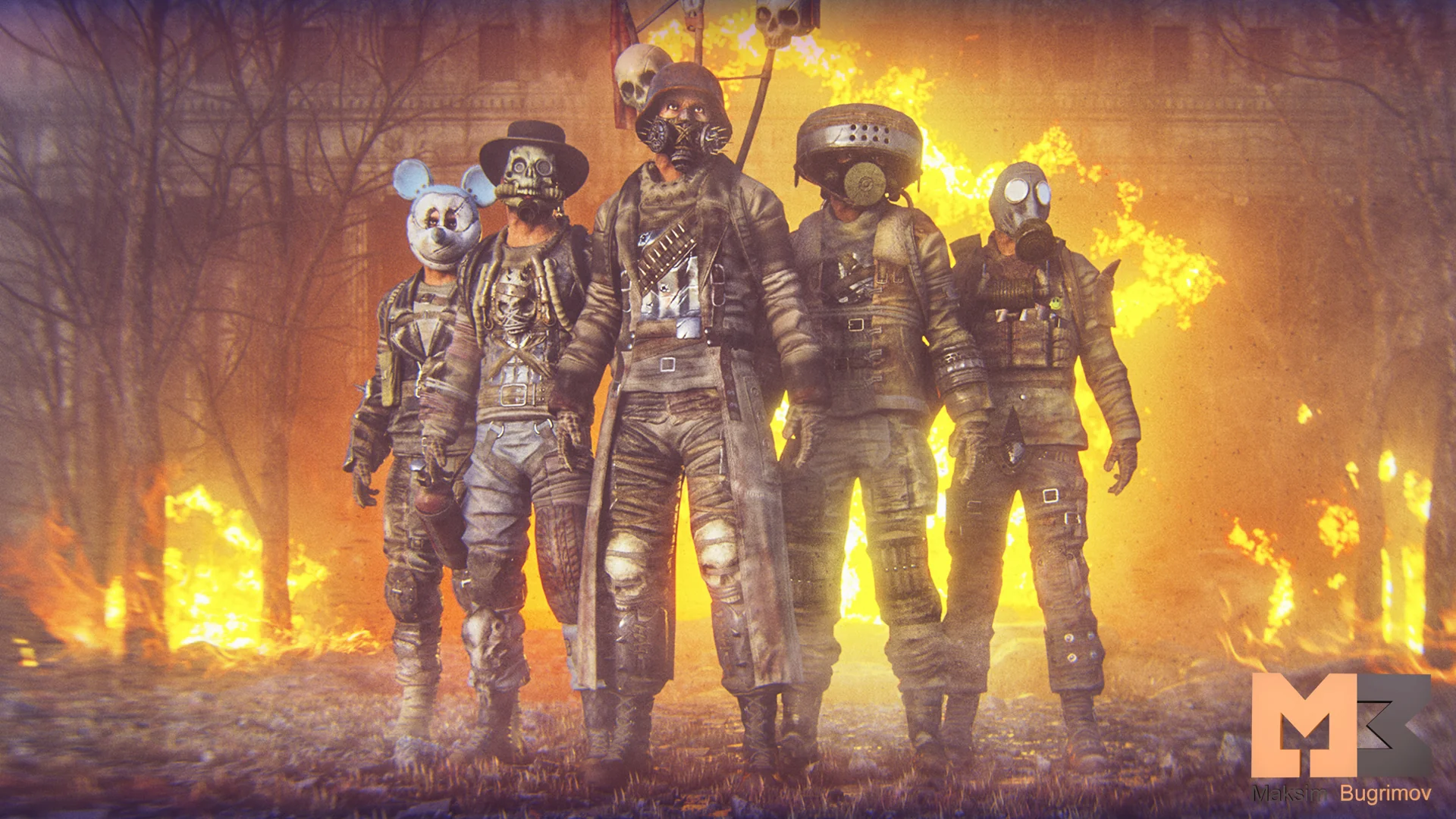
Building a wasteland scene often means populating it with survivors who look worn, equipped, and distinct enough to read as individuals rather than copies. A modular character system lets a team assemble those survivors from interchangeable parts, dressing each one for the environment and the role it needs to play. This is where Customized Post Apocalyptic Characters sits in a production pipeline: as a configurable roster of body components, gear, and weapons that all share the same underlying skeleton structure so everything moves together cleanly when animated.
Because every part uses the Epic Skeleton, the rigged components slot into the same animation framework. That shared rig is the detail holding the whole system together—an armature designed to accept Epic-compatible animations and keep the modular pieces behaving consistently across different character configurations. For teams already working with Epic Skeleton-based animation sets, the parts are structured to drop into that same setup without forcing a re-rig.
Modular Character Components and Epic Skeleton Rigging
The character is assembled from a set of swappable elements, each category offering multiple variations so a single base body can cover a range of survivors:
3 heads: Different facial structures and features for distinct character identities
5 pants: Lower-body clothing options, each contributing to silhouette variety
5 types of clothes: Torso and upper-body layers, from light gear to heavier coverage suited to hostile wasteland conditions
5 types of shoes: Footwear options that anchor the character's stance and visual weight
5 backpacks: Carry gear that signals a survivor's readiness and role in the field
3 hats: Headwear variations that further differentiate silhouettes
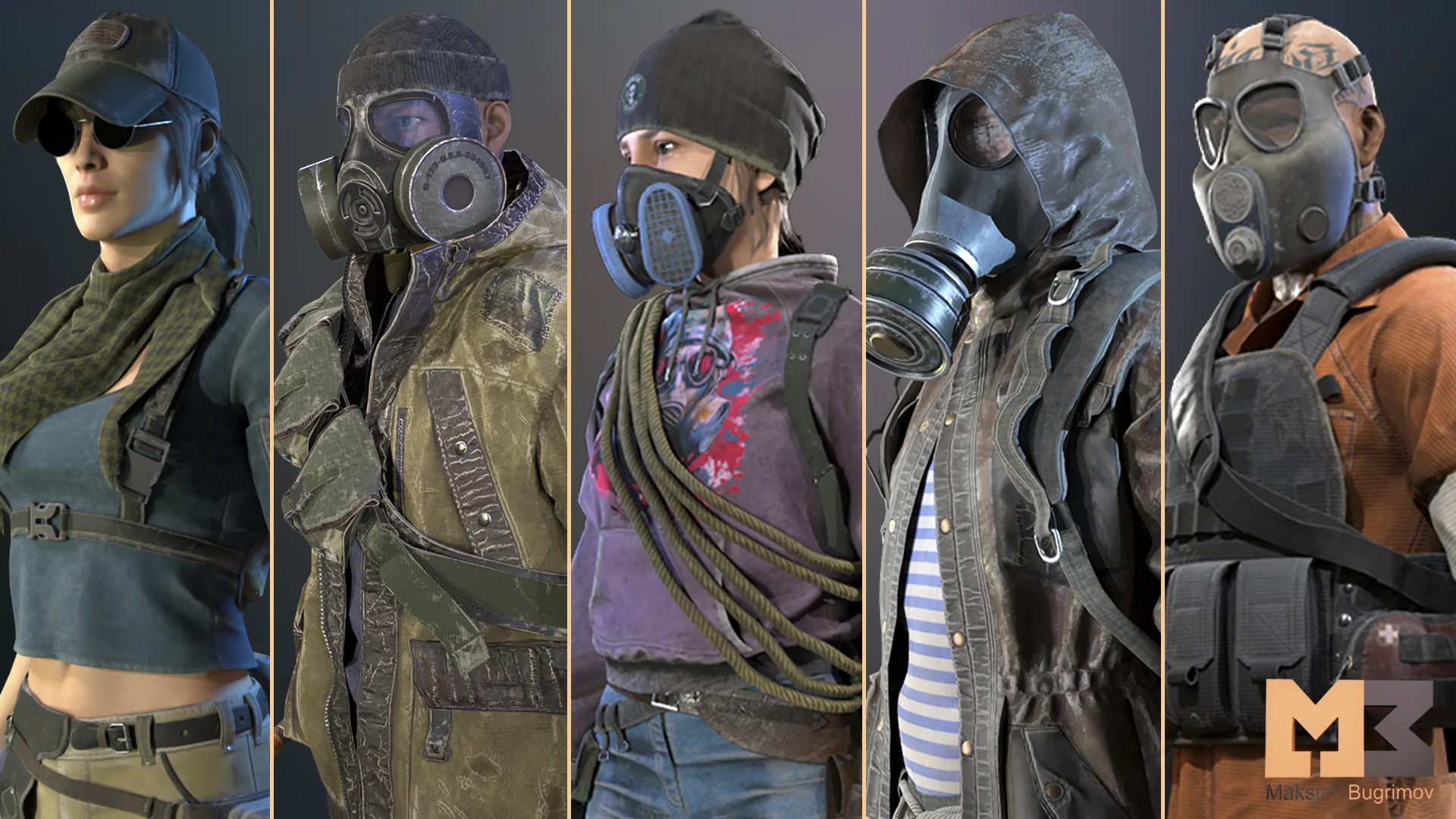
12 different masks: The largest single category of modular pieces, providing extensive facial coverage options for distinct looks in contaminated or hostile environments
Twelve masks is a notably deep pool for a single modular category. In a genre where face coverings often carry narrative weight—protective equipment, scrap-built filters, improvised coverings—having 12 distinct choices allows for broad visual variety across a crowd scene or a roster of enemies.
The backpacks and headwear work as secondary identity markers. A character carrying a loaded pack reads differently from one traveling light, and the different clothing and pants options let a team build everything from a lightly equipped scavenger to a heavily layered survivor without leaving the same modular system.
That total comes to 38 modular parts across the clothing, gear, and head categories, before counting weapons.
Weapon Variety for Post-Apocalyptic Characters
On top of the clothing and gear components, the system includes 8 types of weapons. These give each assembled character a tool suited to hostile environments, and the range allows different survivors to carry different loadouts within the same scene. A camp of armed characters can then hold mixed weapons rather than identical armaments.
Because the weapons share the Epic Skeleton framework, they fit the same rigging logic as the character parts. That structure matters for animation: a weapon held by a character can follow the hand bones and body motion defined by the shared skeleton system.
Animation Compatibility Across the Parts
The Epic Skeleton foundation means the modular character and its attached gear are built to accept skeleton-driven animation. The tag set attached to this system—Character, Survival, Lowpoly, Script, Construction, RPG, Weapon, Horror, Apocalyptic, and Animation Blueprint—points to the asset's place in production workflows. The Animation Blueprint tag signals that animation logic is part of the intended use, not just static mesh display.
A key compatibility note: 56 animations for creatures are available alongside this character system. This means a team working with the pack has access to a library of creature animations that can populate the same scenes. For survival and horror projects, where human survivors and mutant or creature threats share screen time, having both the modular character parts and a set of creature animations provides the raw material for populating both sides of a wasteland encounter.
Built for Survival, Horror, and Wasteland Productions
The resource carries tags spanning Survival, Horror, RPG, and Apocalyptic categories. That tag combination points toward scenes focused on scavenging, RPG-style combat, horror tension, and end-of-the-world settings. The Lowpoly tag indicates the model approach leans toward lightweight geometry, a choice that matters for real-time production environments where scene complexity is a cost and populating a wasteland with multiple characters at once requires models that maintain frame rates.
The Construction tag raises an interesting angle. It points to the modular, assembly-based nature of the character system, where characters are constructed from components rather than delivered as fixed sculpts. This is the system's core working principle.
For a production team, the workflow runs like this:
Select a head configuration from the 3 options available.
Combine it with a choice from the 5 clothing options and 5 pants options to establish the core silhouette.
Add footwear from the 5 shoe types to complete the grounded body structure.
Select a mask from the 12 variations, which significantly alters the character's facial identity and protective appearance.
Optionally add a hat from the 3 available styles to layer additional visual identity.
Equip one of the 8 weapon types to establish the character's combat role.
Optionally add one of the 5 backpacks to signal the character's preparedness and exploration-ready condition.
Each step preserves Epic Skeleton compatibility, so the assembled character is animation-ready rather than requiring additional rigging work to function.
Tested Skeleton Integration and Tutorial References
The system includes references to a skeleton test and a tutorial, both relevant to verifying that the modular parts work correctly with the Epic Skeleton rig. A test video demonstrates the rigged parts in motion under the skeleton system, which is a crucial verification step for modular characters—confirming that swapping components does not break the deformation or movement expected from the shared armature.
The tutorial reference suggests guidance on working with the system is available, which matters for teams integrating the modular parts into existing Animation Blueprints or populating scenes with characters that need to share animation states cleanly.
Parts Inventory Across the Epic Skeleton Framework
Totaling the modular components gives a full picture of what the system can assemble:
3 heads provide the base identity
5 pants and 5 types of clothes offer body coverage configurations
5 types of shoes complete the lower body
5 backpacks serve as load-carrying gear
3 hats add headwear identity
12 different masks provide the largest category of variation
8 types of weapons extend the system into combat-ready equipment
All of those parts sit on the Epic Skeleton, which means the character system is structured for animation from the start. That is the central working quality of the resource: not just a set of meshes, but a rigged modular framework designed to produce distinct post-apocalyptic survivors who follow a shared skeleton standard.
The strongest practical takeaway for teams evaluating it: this is an Epic Skeleton-based modular assembly system with 38 gear and clothing pieces plus 8 weapons, compatible with 56 creature animations, built to populate survival, horror, and RPG scenes with characters that are animation-ready rather than static models fixed in a single configuration.
 Characters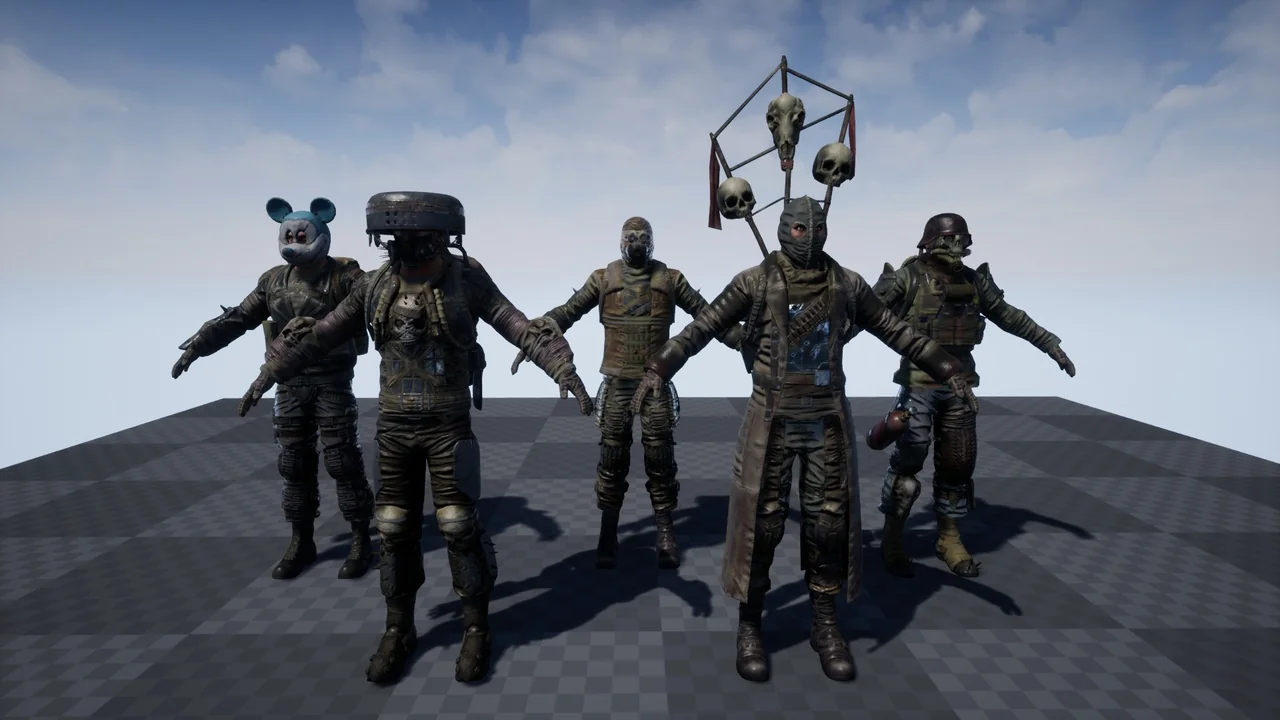
 Characters
 Characters
 Characters