"6c6413bef81af556"{"id":"1000808","slug":"crashed-airliner","title":"Crashed Airliner","category":"Vehicles \u0026 Transportation","engine":"4.26+,5.0+","assetVersion":"","engineVersion":"Engine Version: 4.26+,5.0+","tag":"Vehicles","accent":"blue","visual":"mech","summary":"Crashed Airliner is a 3D asset pack featuring a broken aircraft with interior and cockpit, built from separable parts to assemble varied crash sites for current","platform":"Unreal Engine","publishedAt":"2026-07-31T06:58:18.421Z","updatedAt":"2026-07-31T06:58:18.421Z","sourceNotes":[],"fileContents":[],"compatibility":["Unreal Engine","Engine Version: 4.26+,5.0+"],"featuredImage":{"alt":"Crashed Airliner","src":"/wp-content/uploads/published/2026/07/f958ddeb290f-35ffb9d1-548a-41fc-b08e-235ff6acd6a3-7d67ed6c4f.webp"},"hasDownloadLink":true,"downloads":0,"terms":[{"taxonomy":"category","slug":"vehicles-and-transportation","name":"Vehicles \u0026 Transportation"}],"galleryImages":[{"src":"/wp-content/uploads/published/2026/07/5dde27adb4f0-52386385-7b06-4008-b968-69e8d2e12af9-8e0c22257f.webp","alt":"Crashed Airliner"},{"src":"/wp-content/uploads/published/2026/07/bad529ce208d-434ee021-ff0e-4d08-adfa-9dbfdb0e48ad-44052c4234.webp","alt":"Crashed Airliner"},{"src":"/wp-content/uploads/published/2026/07/32e302e406df-0dbacfb6-b863-4fd4-8977-04f3a5ed728f-491ee940a0.webp","alt":"Crashed Airliner"},{"src":"/wp-content/uploads/published/2026/07/f3e29ac66ff2-2b35fa62-f9ca-4703-8fa7-d03a89ed65d6-76a646301c.webp","alt":"Crashed Airliner"},{"src":"/wp-content/uploads/published/2026/07/ec44800a6409-a30a7415-0dbb-45fe-9948-53daf3f40dec-4d4fd1b689.webp","alt":"Crashed Airliner"},{"src":"/wp-content/uploads/published/2026/07/cd3306a15c30-4f75e0cf-25fc-48e2-9032-bbd69374ea4c-92818a8ff4.webp","alt":"Crashed Airliner"},{"src":"/wp-content/uploads/published/2026/07/e1deef4e9470-25d60383-84d4-40d8-8d22-1ca7ce02bc70-da8d90697c.webp","alt":"Crashed Airliner"},{"src":"/wp-content/uploads/published/2026/07/79a9e5e77a2f-804bc4be-04fb-4589-9fca-efc8bf58bf6a-34b6e0f59f.webp","alt":"Crashed Airliner"},{"src":"/wp-content/uploads/published/2026/07/f80720936ef3-c36882b9-159e-4dbb-b49e-307312a202d7-e42c802e0c.webp","alt":"Crashed Airliner"},{"src":"/wp-content/uploads/published/2026/07/d724bb927489-db913b04-752f-4e40-b130-454f4bbf0cf9-3248a91177.webp","alt":"Crashed Airliner"}],"accessPanel":{"kind":"resource","title":"Download this resource","eyebrow":"Free Download","message":"Log in or create a free account to start your download.","fileName":"Content.7z","safetyNote":"Resources are manually reviewed before listing to improve quality and reduce obvious risks.","actionLabel":"Download Free","resourceType":"Resource archive"},"contentHtml":"\u003cp\u003eScenes involving downed aircraft demand a specific kind of geometry: enough structural damage to read convincingly, enough interior detail to support exploration, and enough modularity to avoid looking like a single rigid prop. \u003cem\u003eCrashed Airliner\u003c/em\u003e addresses those needs by shipping as a collection of separable aircraft components rather than one locked mesh. The pack includes a fully modeled interior and cockpit, allowing artists to build sequences where cameras or characters move through the wreckage rather than around it.\u003c/p\u003e\n\n\u003ch2\u003eModular Wreckage Construction with Aircraft Parts\u003c/h2\u003e\n\u003cp\u003eBreaking a scene like this into discrete pieces gives environment artists direct control over scale and layout. The fuselage panels, wing sections, tail structures, and internal cabin components can be positioned to fit a specific terrain or narrative beat. A crash site on a mountainside calls for a debris trail that stretches and scatters differently than one in a dense forest or an open field. By providing the aircraft in parts, the pack supports that kind of scene-specific arrangement without requiring custom geometry work.\u003c/p\u003e\n\n\u003cp\u003eThe interior and cockpit inclusion matters for gameplay-driven scenes. If a character needs to move through the cabin, retrieve something from the cockpit, or the camera needs to push through a ruptured fuselage section, those spaces already exist in the model. The readable tags on the asset—\u003cem\u003eVehicle\u003c/em\u003e, \u003cem\u003eCrash\u003c/em\u003e, \u003cem\u003eRealistic\u003c/em\u003e, \u003cem\u003eAircraft\u003c/em\u003e, \u003cem\u003eBroken\u003c/em\u003e, and \u003cem\u003ePlane\u003c/em\u003e—confirm the intended visual register. The word \"broken\" signals that the geometry already carries impact damage and deformation rather than requiring artists to apply destructive modifiers themselves.\u003c/p\u003e\n\n\u003ch3\u003eFrom Cockpit to Tail: Assembling Variations of the Crash Site\u003c/h3\u003e\n\u003cp\u003eBuilding different variations of a crash site from one asset set is a practical workflow advantage. A single mission might require establishing shots of the full wreck, a confined sequence inside the cabin, and scattered debris in the surrounding area. The same pack can serve all three shots by redistributing the parts. The tail section can rest hundreds of meters from the main fuselage. Interior cabin panels can be pulled out and strewn across the ground. The cockpit can be positioned nose-down in terrain or flipped on its side depending on the crash angle the story requires.\u003c/p\u003e\n\n\u003cp\u003eThis approach reduces the number of unique assets a production needs while increasing the visual variety possible within a single location. Rather than modeling three different crashed aircraft for three different levels, one team can reconfigure the same component set across multiple scenes and achieve distinct silhouettes each time.\u003c/p\u003e\n\n\u003ch2\u003eRealistic Aircraft Damage for Current-Generation Game Budgets\u003c/h2\u003e\n\u003cp\u003ePerformance targets define what current-generation game budgets mean in practice. The assets in this pack were created to correspond to those budgets, which tells an art director or technical artist that the geometry density, texture resolution, and Material complexity are tuned for real-time rendering rather than offline cinematic workflows. Models built to fit current-gen game budgets are designed to maintain visual fidelity under the memory and draw-call constraints of modern game engines.\u003c/p\u003e\n\n\u003cp\u003eThe \u003cem\u003eRealistic\u003c/em\u003e tag on the asset set indicates that the visual target is plausible, reference-driven wreckage rather than stylized or cartoonish damage. Surface Materials, panel separation, and structural breakup aim to read as authentic aircraft debris. This positioning makes the pack suitable for productions grounded in realistic visual language—survival scenarios, military simulations, narrative-driven adventure games, or cinematic sequences where environmental storytelling leans on the believable aftermath of an aviation disaster.\u003c/p\u003e\n\n\u003ch3\u003eWhere the Broken Plane Fits in a Production Workflow\u003c/h3\u003e\n\u003cp\u003eIn a Level Design pipeline, this asset functions as an environment centerpiece. The crash site acts as a landmark, a gameplay space, or a narrative anchor around which the surrounding terrain and props are built. Because the parts are separable, the Level Designer does not need to work around one monolithic object. They can place the fuselage, scatter the wings, and adjust the cockpit position independently until the composition serves the camera and gameplay needs.\u003c/p\u003e\n\n\u003cp\u003eFor prop artists, the inclusion of interior detail means less time spent filling empty cabin spaces with generic clutter. The cockpit provides a defined control area, and the cabin carries structure that can be lit and framed directly. Lighting artists gain alcoves, overhead bins, and structural ribs to bounce light off of, creating contrast and depth inside the wreck without adding extra geometry.\u003c/p\u003e\n\n\u003cp\u003eIf a production calls for an aircraft disaster site that characters interact with directly—moving through the cabin, climbing over displaced seating, or approaching the cockpit—the combination of modularity, interior detail, and current-gen budget alignment makes this pack a candidate worth evaluating. The strongest takeaway for teams assessing it: the separable parts turn one crash scene into a repeatable system. The same component set can serve establishing shots, interior exploration, and scattered aftermath across multiple locations without additional modeling investment, provided the visual register aligns with the project's realism target.\u003c/p\u003e\n\n\u003ch2\u003eMore From The Same Workflow\u003c/h2\u003e\n\u003cul\u003e\n\u003cli\u003e\u003ca href=\"https://3dcghub.com/airliner/\" title=\"Airliner\"\u003eAirliner\u003c/a\u003e\u003c/li\u003e\n\u003cli\u003e\u003ca href=\"https://3dcghub.com/dystopia-airship/\" title=\"Dystopia Airship\"\u003eDystopia Airship\u003c/a\u003e\u003c/li\u003e\n\u003cli\u003e\u003ca href=\"https://3dcghub.com/sci-fi-aircraft/\" title=\"Sci Fi Aircraft\"\u003eSci Fi Aircraft\u003c/a\u003e\u003c/li\u003e\n\u003cli\u003e\u003ca href=\"https://3dcghub.com/driveable-vehicle-seaplane/\" title=\"Driveable Vehicle: Seaplane\"\u003eDriveable Vehicle: Seaplane\u003c/a\u003e\u003c/li\u003e\n\u003cli\u003e\u003ca href=\"https://3dcghub.com/physics-based-helicopter/\" title=\"Physics Based Helicopter\"\u003ePhysics Based Helicopter\u003c/a\u003e\u003c/li\u003e\n\u003c/ul\u003e","contentTextLength":5449,"navigation":{"current":416,"total":3140,"previous":{"id":"1000809","slug":"customized-post-apocalyptic-characters","title":"Customized Post Apocalyptic Characters","category":"Characters \u0026 Creatures","platform":"Unreal Engine","updatedAt":"2026-07-31T08:49:21.684Z"},"next":{"id":"1000807","slug":"crane-balk-sci-fi-robotic-crane-system","title":"Crane Balk – Sci-Fi robotic crane system","category":"Procedural Systems","platform":"Unreal Engine","updatedAt":"2026-07-31T05:17:19.185Z"}},"relatedResources":[{"id":"1000558","slug":"airliner","title":"Airliner","category":"Vehicles \u0026 Transportation","engine":"4.26+,5.0+","assetVersion":"","engineVersion":"Engine Version: 4.26+,5.0+","tag":"Vehicles","accent":"blue","visual":"mech","summary":"Airliner 3D model with interior, cockpit, landing gears, and separated flaps. Includes functional blueprints and customizable materials for Unreal Engine game d","platform":"Unreal Engine","publishedAt":"2026-07-15T17:16:13.337Z","updatedAt":"2026-07-15T17:16:13.337Z","sourceNotes":[],"fileContents":[],"compatibility":["Unreal Engine","Engine Version: 4.26+,5.0+"],"featuredImage":{"alt":"Airliner","src":"/wp-content/uploads/published/2026/07/5de0e7ce974d-2f68b6f5-c017-4084-86d7-be2a1633c8d7-07814cc908.webp"},"hasDownloadLink":true,"downloads":1},{"id":"1000364","slug":"driveable-vehicle-seaplane","title":"Driveable Vehicle: Seaplane","category":"Vehicles \u0026 Transportation","engine":"4.26+,5.0+","assetVersion":"","engineVersion":"Engine Version: 4.26+,5.0+","tag":"Vehicles","accent":"blue","visual":"mech","summary":"A fully rigged, realistic seaplane mesh featuring a demonstration blueprint for flight simulation, designed primarily for exterior camera workflows.","platform":"Unreal Engine","publishedAt":"2026-07-06T08:06:17.339Z","updatedAt":"2026-07-06T08:06:17.339Z","sourceNotes":[],"fileContents":[],"compatibility":["Unreal Engine","Engine Version: 4.26+,5.0+"],"featuredImage":{"alt":"Driveable Vehicle: Seaplane","src":"/wp-content/uploads/published/2026/07/ededd00a4af6-34c774f8-1d98-426c-bfbb-37188df509db-e2065c6d6a.webp"},"hasDownloadLink":true,"downloads":0},{"id":"28621","slug":"dystopia-airship","title":"Dystopia Airship","category":"Vehicles \u0026 Transportation","engine":"4.26+,5.0+","assetVersion":"Engine version: 4.26+,5.0+","engineVersion":"","tag":"Vehicles","accent":"blue","visual":"mech","summary":"Dystopia Airship gives teams a ready-made flying vehicle for space, adventure, and dark fantasy scenes without starting from a static prop. It combines a rigged model, 10 animations, weapons, lighting, and a fabric physics banner in a single aircraft package.","platform":"Unreal Engine","publishedAt":"2026-05-17T15:03:32.000Z","updatedAt":"2026-05-17T15:03:33.000Z","sourceNotes":[],"fileContents":[],"compatibility":["Unreal Engine","Engine version: 4.26+,5.0+"],"featuredImage":{"alt":"Dystopia Airship","src":"https://3dcghub.com/wp-content/uploads/2026/05/b944786bd85b_d10d2c26-6d39-456d-97ca-043adc12e653.webp"},"hasDownloadLink":true,"downloads":1}]}
Vehicles
Crashed Airliner
Crashed Airliner is a 3D asset pack featuring a broken aircraft with interior and cockpit, built from separable parts to assemble varied crash sites for current
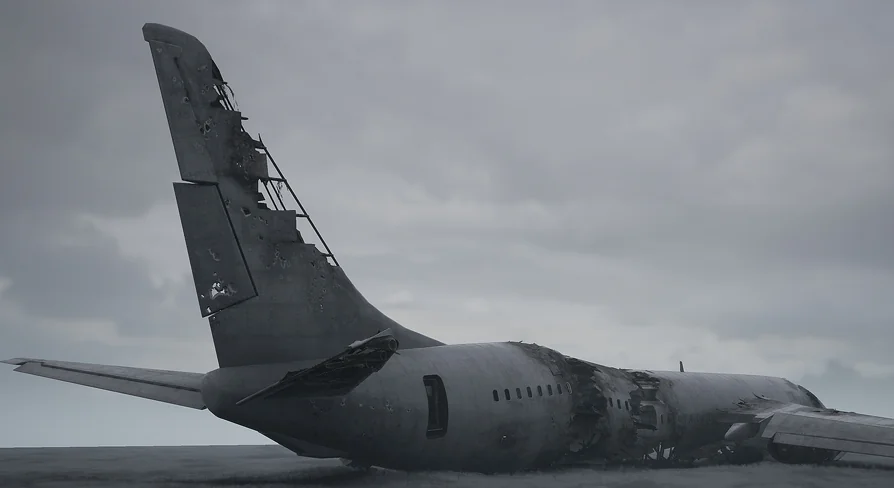
Scenes involving downed aircraft demand a specific kind of geometry: enough structural damage to read convincingly, enough interior detail to support exploration, and enough modularity to avoid looking like a single rigid prop. Crashed Airliner addresses those needs by shipping as a collection of separable aircraft components rather than one locked mesh. The pack includes a fully modeled interior and cockpit, allowing artists to build sequences where cameras or characters move through the wreckage rather than around it.
Modular Wreckage Construction with Aircraft Parts
Breaking a scene like this into discrete pieces gives environment artists direct control over scale and layout. The fuselage panels, wing sections, tail structures, and internal cabin components can be positioned to fit a specific terrain or narrative beat. A crash site on a mountainside calls for a debris trail that stretches and scatters differently than one in a dense forest or an open field. By providing the aircraft in parts, the pack supports that kind of scene-specific arrangement without requiring custom geometry work.
The interior and cockpit inclusion matters for gameplay-driven scenes. If a character needs to move through the cabin, retrieve something from the cockpit, or the camera needs to push through a ruptured fuselage section, those spaces already exist in the model. The readable tags on the asset—Vehicle, Crash, Realistic, Aircraft, Broken, and Plane—confirm the intended visual register. The word "broken" signals that the geometry already carries impact damage and deformation rather than requiring artists to apply destructive modifiers themselves.
From Cockpit to Tail: Assembling Variations of the Crash Site
Building different variations of a crash site from one asset set is a practical workflow advantage. A single mission might require establishing shots of the full wreck, a confined sequence inside the cabin, and scattered debris in the surrounding area. The same pack can serve all three shots by redistributing the parts. The tail section can rest hundreds of meters from the main fuselage. Interior cabin panels can be pulled out and strewn across the ground. The cockpit can be positioned nose-down in terrain or flipped on its side depending on the crash angle the story requires.
This approach reduces the number of unique assets a production needs while increasing the visual variety possible within a single location. Rather than modeling three different crashed aircraft for three different levels, one team can reconfigure the same component set across multiple scenes and achieve distinct silhouettes each time.
Realistic Aircraft Damage for Current-Generation Game Budgets
Performance targets define what current-generation game budgets mean in practice. The assets in this pack were created to correspond to those budgets, which tells an art director or technical artist that the geometry density, texture resolution, and Material complexity are tuned for real-time rendering rather than offline cinematic workflows. Models built to fit current-gen game budgets are designed to maintain visual fidelity under the memory and draw-call constraints of modern game engines.
The Realistic tag on the asset set indicates that the visual target is plausible, reference-driven wreckage rather than stylized or cartoonish damage. Surface Materials, panel separation, and structural breakup aim to read as authentic aircraft debris. This positioning makes the pack suitable for productions grounded in realistic visual language—survival scenarios, military simulations, narrative-driven adventure games, or cinematic sequences where environmental storytelling leans on the believable aftermath of an aviation disaster.
Where the Broken Plane Fits in a Production Workflow
In a Level Design pipeline, this asset functions as an environment centerpiece. The crash site acts as a landmark, a gameplay space, or a narrative anchor around which the surrounding terrain and props are built. Because the parts are separable, the Level Designer does not need to work around one monolithic object. They can place the fuselage, scatter the wings, and adjust the cockpit position independently until the composition serves the camera and gameplay needs.
For prop artists, the inclusion of interior detail means less time spent filling empty cabin spaces with generic clutter. The cockpit provides a defined control area, and the cabin carries structure that can be lit and framed directly. Lighting artists gain alcoves, overhead bins, and structural ribs to bounce light off of, creating contrast and depth inside the wreck without adding extra geometry.
If a production calls for an aircraft disaster site that characters interact with directly—moving through the cabin, climbing over displaced seating, or approaching the cockpit—the combination of modularity, interior detail, and current-gen budget alignment makes this pack a candidate worth evaluating. The strongest takeaway for teams assessing it: the separable parts turn one crash scene into a repeatable system. The same component set can serve establishing shots, interior exploration, and scattered aftermath across multiple locations without additional modeling investment, provided the visual register aligns with the project's realism target.
 Vehicles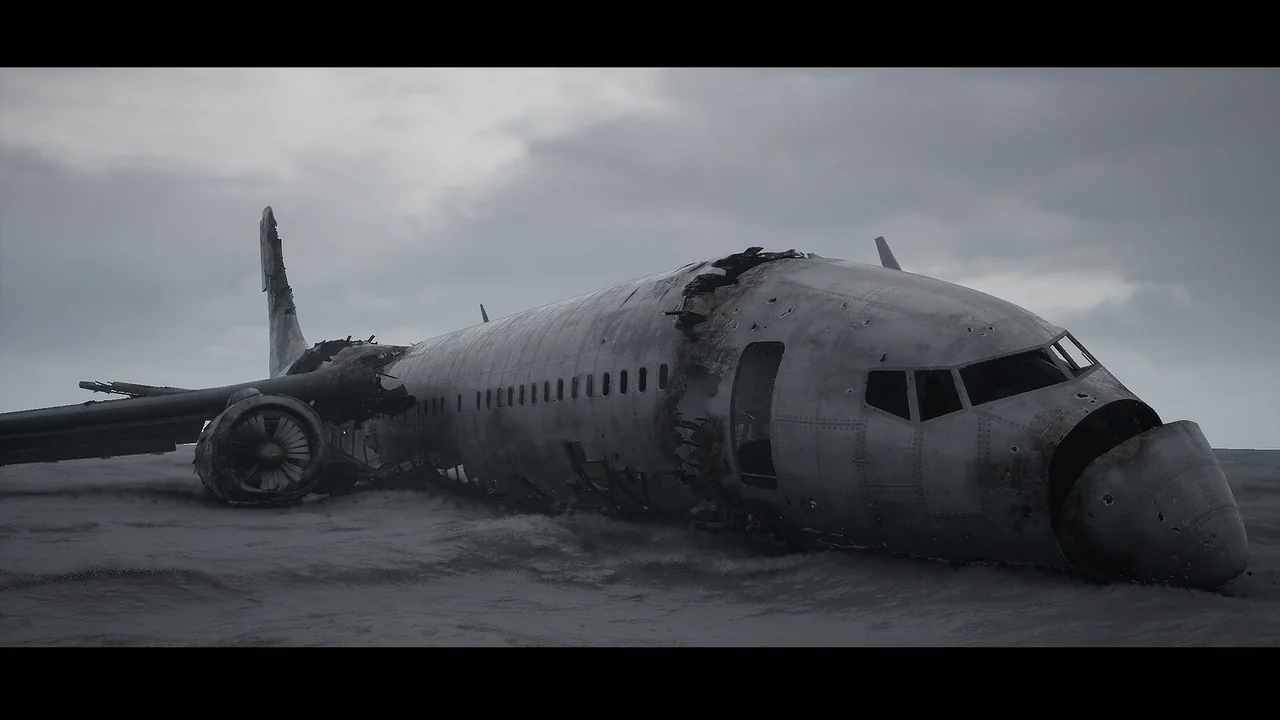
 Vehicles
 Vehicles
 Vehicles