"2ce90d1a6b5aea67"{"id":"1001443","slug":"japanese-insect-pack","title":"Japanese Insect Pack","category":"Characters \u0026 Creatures","engine":"4.22+,5.0+","assetVersion":"","engineVersion":"Engine Version: 4.22+,5.0+","tag":"Characters","accent":"blue","visual":"character","summary":"Japanese Insect Pack delivers 9 realistic insect characters and 54 dedicated animations, covering beetles, dragonflies, butterflies, cicadas, and spiders.","platform":"Unreal Engine","publishedAt":"2026-10-08T00:42:34.898Z","updatedAt":"2026-10-08T00:42:34.898Z","sourceNotes":[],"fileContents":[],"compatibility":["Unreal Engine","Engine Version: 4.22+,5.0+"],"featuredImage":{"alt":"Japanese Insect Pack","src":"/wp-content/uploads/published/2026/10/dcfb235eb055-59efdbec-832b-4e57-8b40-802f73ceaf26-88d7619436.webp"},"hasDownloadLink":true,"downloads":0,"terms":[{"taxonomy":"category","slug":"characters-and-creatures","name":"Characters \u0026 Creatures"}],"galleryImages":[{"src":"/wp-content/uploads/published/2026/10/1fa95b5f6b35-f3bbfefe-3b9c-484e-8fdc-3fb35e3385bc-98c913dc4d.webp","alt":"Japanese Insect Pack"},{"src":"/wp-content/uploads/published/2026/10/19fec5c77533-b1458d65-31d0-47ee-97de-0168621621bf-f46d66c93e.webp","alt":"Japanese Insect Pack"},{"src":"/wp-content/uploads/published/2026/10/00bb29bb5017-47b7936c-511a-46c4-b2ee-cb008fb1e877-24b6ab4314.webp","alt":"Japanese Insect Pack"},{"src":"/wp-content/uploads/published/2026/10/7f7ca27e7c97-326e8f0f-05bd-4d42-8fa2-0c21e8c68619-7f3669c48a.webp","alt":"Japanese Insect Pack"},{"src":"/wp-content/uploads/published/2026/10/38f90aae1e37-41000c1f-9f20-4575-ba9a-a5465369a590-950985da75.webp","alt":"Japanese Insect Pack"},{"src":"/wp-content/uploads/published/2026/10/a43fbd8e2f88-e193ad6c-f2ed-4a42-9770-1571688c5357-7f1e20bbe4.webp","alt":"Japanese Insect Pack"},{"src":"/wp-content/uploads/published/2026/10/da9af8aac1c3-e8a1496e-910b-43dc-9877-ebdacacf0568-f190ea0c0d.webp","alt":"Japanese Insect Pack"},{"src":"/wp-content/uploads/published/2026/10/8ec1613ecd3e-1d6979a9-3545-43ec-90d5-ef2fd410b53f-11a339df62.webp","alt":"Japanese Insect Pack"},{"src":"/wp-content/uploads/published/2026/10/ea7e8ffe33f7-be457393-0b19-4838-9dd7-92afd6d1e370-cbfbf2b6fb.webp","alt":"Japanese Insect Pack"},{"src":"/wp-content/uploads/published/2026/10/7a4e5a12acaf-d6342224-1694-4981-a2ce-9ade780ae032-f4e0eaf918.webp","alt":"Japanese Insect Pack"}],"accessPanel":{"kind":"resource","title":"Download this resource","eyebrow":"Free Download","message":"Log in or create a free account to start your download.","fileName":"Content.7z","safetyNote":"Resources are manually reviewed before listing to improve quality and reduce obvious risks.","actionLabel":"Download Free","resourceType":"Resource archive"},"contentHtml":"\u003ch2\u003ePopulating Outdoor Environments with Animated Arthropods\u003c/h2\u003e\u003cp\u003eOutdoor scenes often feel vacant when ground surfaces, foliage, and open air lack the subtle, continuous motion of micro-fauna.\u003c/p\u003e\u003cp\u003eJapanese Insect Pack resolves that stillness by providing nine realistic insect species built directly for real-time engine environments. Rather than static prop meshes or basic particle system sprites, each creature functions as an individual character with custom movement profiles. The collection includes 54 distinct animations spanning ground crawling, aerial maneuvers, idle postures, and death sequences. This distribution allows developers to populate forests, riverbanks, and rural landscapes with authentic East Asian wildlife that interacts dynamically with surroundings.\u003c/p\u003e\u003ch2\u003eRhinoceros Beetle and Stag Beetle Locomotion Mechanics\u003c/h2\u003e\u003cp\u003eHeavy coleopterans require weight-conscious gaits, specialized leg pacing, and articulated wing-case deployment during flight transitions.\u003c/p\u003e\u003cp\u003eThe pack tackles this mechanical complexity by providing matching 14-animation libraries for both the rhinoceros beetle (\u003cem\u003eTrypoxylus dichotomus\u003c/em\u003e) and the stag beetle (\u003cem\u003eDorcus rectus\u003c/em\u003e). Each beetle features grounded locomotion clips that include resting waits, forward walks, reverse walks, high-speed runs, and tight steering turns to both the left and right. When moving from ground surfaces into the air, the rigs support wing open and wing close stages alongside dedicated three-part takeoff phases: rift up, rifting, and rift end. Once airborne, they transition to sustained flying loops. The set also supplies reactive flounder animations for beetles flipped onto their carapaces, as well as final death states for hazard interactions or ecological storytelling.\u003c/p\u003e\u003ch2\u003eGround Navigation and Web Staging for the Wasp Spider\u003c/h2\u003e\u003cp\u003eArachnids introduce eight-legged coordination hurdles that demand grounded foot-planting routines to prevent sliding across terrain.\u003c/p\u003e\u003cp\u003eRepresented by the wasp spider (\u003cem\u003eArgiope bruennichi\u003c/em\u003e), this predatory character features six dedicated animation cycles aimed at surface traversal and stationary alertness. The spider utilizes a neutral wait cycle alongside standard walking and forward running clips, supported by directional turns to the left and right for reactive navigation around obstacles. A dedicated death animation enables physical vulnerability when interacting with player characters or external environmental hazards. This balance of walking, turning, and resting makes the wasp spider well-suited for deployment across low-hanging branches, undergrowth leaves, rock piles, and woven web props.\u003c/p\u003e\u003ch2\u003eFlight Trajectories for Butterflies and Dragonflies\u003c/h2\u003e\u003cp\u003eAirborne insects exhibit vastly different aerodynamics, shifting from erratic fluttering loops to high-velocity predatory hovering.\u003c/p\u003e\u003cp\u003eThe package addresses these aerodynamic differences by dividing five aerial characters into distinct biological categories with tailored behavioral clips:\u003c/p\u003e\u003cul\u003e\u003cli\u003e\u003cstrong\u003eSmall White Butterfly (\u003cem\u003ePieris rapae\u003c/em\u003e):\u003c/strong\u003e Equipped with wait1, wait2, and a continuous flying state for delicate vegetation fluttering.\u003c/li\u003e\u003cli\u003e\u003cstrong\u003eYellow Butterfly (\u003cem\u003eEurema mandarina\u003c/em\u003e):\u003c/strong\u003e Shares the twin resting wait cycles and sustained aerial flying animation for meadows and garden paths.\u003c/li\u003e\u003cli\u003e\u003cstrong\u003eIndian Fritillary (\u003cem\u003eArgyreus hyperbius\u003c/em\u003e / Butterfly Hyoumon):\u003c/strong\u003e Uses dual resting states and steady airborne flutter animations for field exploration.\u003c/li\u003e\u003cli\u003e\u003cstrong\u003eGolden-Ringed Dragonfly (\u003cem\u003eAnotogaster sieboldii\u003c/em\u003e / Dragonfly Oniyannma):\u003c/strong\u003e Features an idle wait state, two separate flight speed loops (flying1 and flying2), and a dedicated death animation.\u003c/li\u003e\u003cli\u003e\u003cstrong\u003eHime Skimmer (\u003cem\u003eSympetrum parvulum\u003c/em\u003e / Dragonfly Akiakane):\u003c/strong\u003e Utilizes stationary resting, dual-speed flight sequences (flying1 and flying2), and an impact or death clip.\u003c/li\u003e\u003c/ul\u003e\u003cp\u003eThese varied flight profiles let developers separate gentle background meadow life from swift, aggressive waterside predators without duplicating mechanical motions.\u003c/p\u003e\u003ch2\u003eCanopy Placement for the Tsuku-tsuku Cicada\u003c/h2\u003e\u003cp\u003eTemperate East Asian summer scenes depend on the visual and behavioral presence of cicadas clinging to bark and branches.\u003c/p\u003e\u003cp\u003eThe tsuku-tsuku cicada (\u003cem\u003eMeimuna opalifera\u003c/em\u003e) supplies three essential states designed specifically for vertical trunk and foliage placement. Its animation library covers stationary wait poses, high-speed wing-flapping flight transitions, and a death animation for fallen specimens. Placed along tree trunks, fences, and rural architecture, the cicada provides an authentic visual counterpart to ambient woodland audio cues. Its streamlined set of states makes it lightweight to manage across heavy tree canopy distributions where hundreds of ambient specimens might populate a single forest sector.\u003c/p\u003e\u003ch2\u003eAnimation Blueprint Implementation and Production Integration\u003c/h2\u003e\u003cp\u003eManaging over fifty individual insect clips demands flexible framework integration across state machines and event graphs.\u003c/p\u003e\u003cp\u003eThe collection integrates directly with Animation Blueprint setups and underlying script components to drive smooth transitions between walking, turning, launching, and airborne gliding. It maintains verified cross-compatibility with the Fishing Set ecosystem, allowing water margins, docks, reed beds, and river edges to immediately host interactive insect life. Released under the Creative Commons Attribution 4.0 International license (CC BY 4.0), the realistic assets give artists and technical animators the freedom to build living outdoor biomes across real-time natural simulations, survival titles, historical settings, and adventure games.\u003c/p\u003e\n\n\u003ch2\u003eExplore Similar Assets\u003c/h2\u003e\n\u003cul\u003e\n\u003cli\u003e\u003ca href=\"https://3dcghub.com/koi-japanese-carp/\" title=\"Koi. Japanese carp\"\u003eKoi. Japanese carp\u003c/a\u003e\u003c/li\u003e\n\u003cli\u003e\u003ca href=\"https://3dcghub.com/bloodthirsty-beetle/\" title=\"Bloodthirsty Beetle\"\u003eBloodthirsty Beetle\u003c/a\u003e\u003c/li\u003e\n\u003cli\u003e\u003ca href=\"https://3dcghub.com/animalia-meadow-grasshopper/\" title=\"Animalia - Meadow Grasshopper\"\u003eAnimalia - Meadow Grasshopper\u003c/a\u003e\u003c/li\u003e\n\u003cli\u003e\u003ca href=\"https://3dcghub.com/asian-gangster/\" title=\"Asian Gangster\"\u003eAsian Gangster\u003c/a\u003e\u003c/li\u003e\n\u003cli\u003e\u003ca href=\"https://3dcghub.com/samurai-girl/\" title=\"Samurai Girl\"\u003eSamurai Girl\u003c/a\u003e\u003c/li\u003e\n\u003c/ul\u003e","contentTextLength":5594,"navigation":{"current":111,"total":3488,"previous":{"id":"1001444","slug":"old-classroom","title":"Old Classroom","category":"Interior","platform":"Unreal Engine","updatedAt":"2026-10-08T00:44:15.847Z"},"next":{"id":"1001442","slug":"insane-pack-01-game-assets-extra-stigma-studios","title":"Insane Pack 01 - Game Assets + Extra | STIGMA STUDIOS","category":"Characters \u0026 Creatures","platform":"Unreal Engine","updatedAt":"2026-10-08T00:40:48.556Z"}},"relatedResources":[{"id":"1000463","slug":"koi-japanese-carp","title":"Koi. Japanese carp","category":"Characters \u0026 Creatures","engine":"4.26+,5.0+","assetVersion":"","engineVersion":"Engine Version: 4.26+,5.0+","tag":"Characters","accent":"blue","visual":"character","summary":"Game-ready low-poly koi model with PBR textures, stylized Japanese carp design, and animation blueprint for Unreal Engine 4.26 through 5.4.","platform":"Unreal Engine","publishedAt":"2026-07-11T17:12:57.461Z","updatedAt":"2026-07-11T17:12:57.461Z","sourceNotes":[],"fileContents":[],"compatibility":["Unreal Engine","Engine Version: 4.26+,5.0+"],"featuredImage":{"alt":"Koi. Japanese carp","src":"/wp-content/uploads/published/2026/07/83e2801c084d-16a5b9a9-2184-4af7-a155-d229d6c4b758-d0180d43a2.webp"},"hasDownloadLink":true,"downloads":0},{"id":"1798","slug":"bloodthirsty-beetle","title":"Bloodthirsty Beetle","category":"Characters \u0026 Creatures","engine":"4.26+,5.0+","assetVersion":"Engine version: 4.26+,5.0+","engineVersion":"4.18","tag":"Characters","accent":"blue","visual":"character","summary":"Discover the Bloodthirsty Beetle, a professional 3D creature asset. It features 4K PBR textures, 9 custom animations, and an optimized low-poly mesh for games.","platform":"Unreal Engine","publishedAt":"2026-02-06T21:56:35.000Z","updatedAt":"2026-04-19T15:58:29.000Z","sourceNotes":[],"fileContents":[],"compatibility":["Unreal Engine","Engine version: 4.26+,5.0+"],"featuredImage":{"alt":"Bloodthirsty Beetle","src":"https://3dcghub.com/wp-content/uploads/2026/02/2413bfc1-70b0-499a-b34c-e0a41ebf0721.webp"},"hasDownloadLink":true,"downloads":0},{"id":"1543","slug":"animalia-meadow-grasshopper","title":"Animalia - Meadow Grasshopper","category":"Characters \u0026 Creatures","engine":"4.26+5.0+","assetVersion":"Engine version: 4.26+5.0+","engineVersion":"4.20","tag":"Characters","accent":"blue","visual":"character","summary":"Enhance your digital environments with a realistic Meadow Grasshopper. This high-quality 3D asset features 4K textures, 11 animations, and full LOD support.","platform":"Unreal Engine","publishedAt":"2026-02-06T19:37:09.000Z","updatedAt":"2026-04-19T15:58:08.000Z","sourceNotes":[],"fileContents":[],"compatibility":["Unreal Engine","Engine version: 4.26+5.0+"],"featuredImage":{"alt":"Animalia - Meadow Grasshopper","src":"https://3dcghub.com/wp-content/uploads/2026/02/4cbc23c9-72c6-4340-9083-6bde2b07794c-1.webp"},"hasDownloadLink":true,"downloads":0}]}
Characters
Japanese Insect Pack
Japanese Insect Pack delivers 9 realistic insect characters and 54 dedicated animations, covering beetles, dragonflies, butterflies, cicadas, and spiders.
Populating Outdoor Environments with Animated Arthropods
Outdoor scenes often feel vacant when ground surfaces, foliage, and open air lack the subtle, continuous motion of micro-fauna.
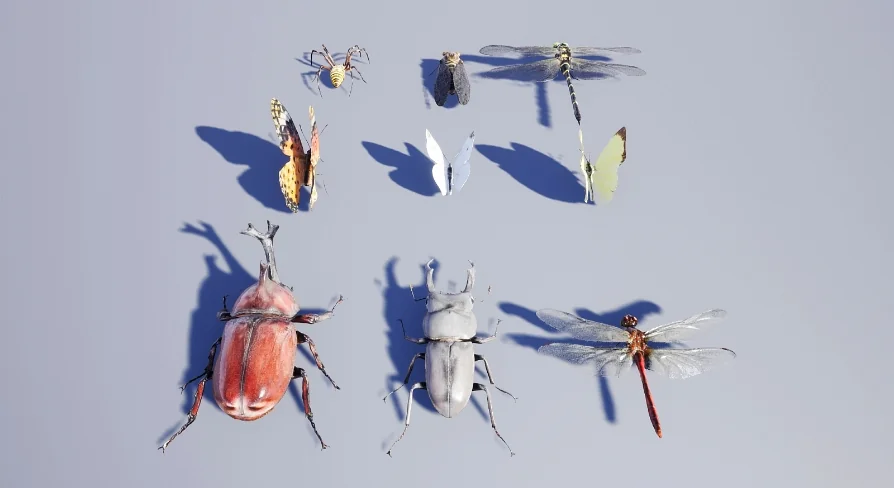
Japanese Insect Pack resolves that stillness by providing nine realistic insect species built directly for real-time engine environments. Rather than static prop meshes or basic particle system sprites, each creature functions as an individual character with custom movement profiles. The collection includes 54 distinct animations spanning ground crawling, aerial maneuvers, idle postures, and death sequences. This distribution allows developers to populate forests, riverbanks, and rural landscapes with authentic East Asian wildlife that interacts dynamically with surroundings.
Rhinoceros Beetle and Stag Beetle Locomotion Mechanics
Heavy coleopterans require weight-conscious gaits, specialized leg pacing, and articulated wing-case deployment during flight transitions.
The pack tackles this mechanical complexity by providing matching 14-animation libraries for both the rhinoceros beetle (Trypoxylus dichotomus) and the stag beetle (Dorcus rectus). Each beetle features grounded locomotion clips that include resting waits, forward walks, reverse walks, high-speed runs, and tight steering turns to both the left and right. When moving from ground surfaces into the air, the rigs support wing open and wing close stages alongside dedicated three-part takeoff phases: rift up, rifting, and rift end. Once airborne, they transition to sustained flying loops. The set also supplies reactive flounder animations for beetles flipped onto their carapaces, as well as final death states for hazard interactions or ecological storytelling.
Ground Navigation and Web Staging for the Wasp Spider
Arachnids introduce eight-legged coordination hurdles that demand grounded foot-planting routines to prevent sliding across terrain.
Represented by the wasp spider (Argiope bruennichi), this predatory character features six dedicated animation cycles aimed at surface traversal and stationary alertness. The spider utilizes a neutral wait cycle alongside standard walking and forward running clips, supported by directional turns to the left and right for reactive navigation around obstacles. A dedicated death animation enables physical vulnerability when interacting with player characters or external environmental hazards. This balance of walking, turning, and resting makes the wasp spider well-suited for deployment across low-hanging branches, undergrowth leaves, rock piles, and woven web props.
Flight Trajectories for Butterflies and Dragonflies
Airborne insects exhibit vastly different aerodynamics, shifting from erratic fluttering loops to high-velocity predatory hovering.
The package addresses these aerodynamic differences by dividing five aerial characters into distinct biological categories with tailored behavioral clips:
Small White Butterfly (Pieris rapae): Equipped with wait1, wait2, and a continuous flying state for delicate vegetation fluttering.
Yellow Butterfly (Eurema mandarina): Shares the twin resting wait cycles and sustained aerial flying animation for meadows and garden paths.
Indian Fritillary (Argyreus hyperbius / Butterfly Hyoumon): Uses dual resting states and steady airborne flutter animations for field exploration.
Golden-Ringed Dragonfly (Anotogaster sieboldii / Dragonfly Oniyannma): Features an idle wait state, two separate flight speed loops (flying1 and flying2), and a dedicated death animation.
Hime Skimmer (Sympetrum parvulum / Dragonfly Akiakane): Utilizes stationary resting, dual-speed flight sequences (flying1 and flying2), and an impact or death clip.
These varied flight profiles let developers separate gentle background meadow life from swift, aggressive waterside predators without duplicating mechanical motions.
Canopy Placement for the Tsuku-tsuku Cicada
Temperate East Asian summer scenes depend on the visual and behavioral presence of cicadas clinging to bark and branches.
The tsuku-tsuku cicada (Meimuna opalifera) supplies three essential states designed specifically for vertical trunk and foliage placement. Its animation library covers stationary wait poses, high-speed wing-flapping flight transitions, and a death animation for fallen specimens. Placed along tree trunks, fences, and rural architecture, the cicada provides an authentic visual counterpart to ambient woodland audio cues. Its streamlined set of states makes it lightweight to manage across heavy tree canopy distributions where hundreds of ambient specimens might populate a single forest sector.
Animation Blueprint Implementation and Production Integration
Managing over fifty individual insect clips demands flexible framework integration across state machines and event graphs.
The collection integrates directly with Animation Blueprint setups and underlying script components to drive smooth transitions between walking, turning, launching, and airborne gliding. It maintains verified cross-compatibility with the Fishing Set ecosystem, allowing water margins, docks, reed beds, and river edges to immediately host interactive insect life. Released under the Creative Commons Attribution 4.0 International license (CC BY 4.0), the realistic assets give artists and technical animators the freedom to build living outdoor biomes across real-time natural simulations, survival titles, historical settings, and adventure games.
 Characters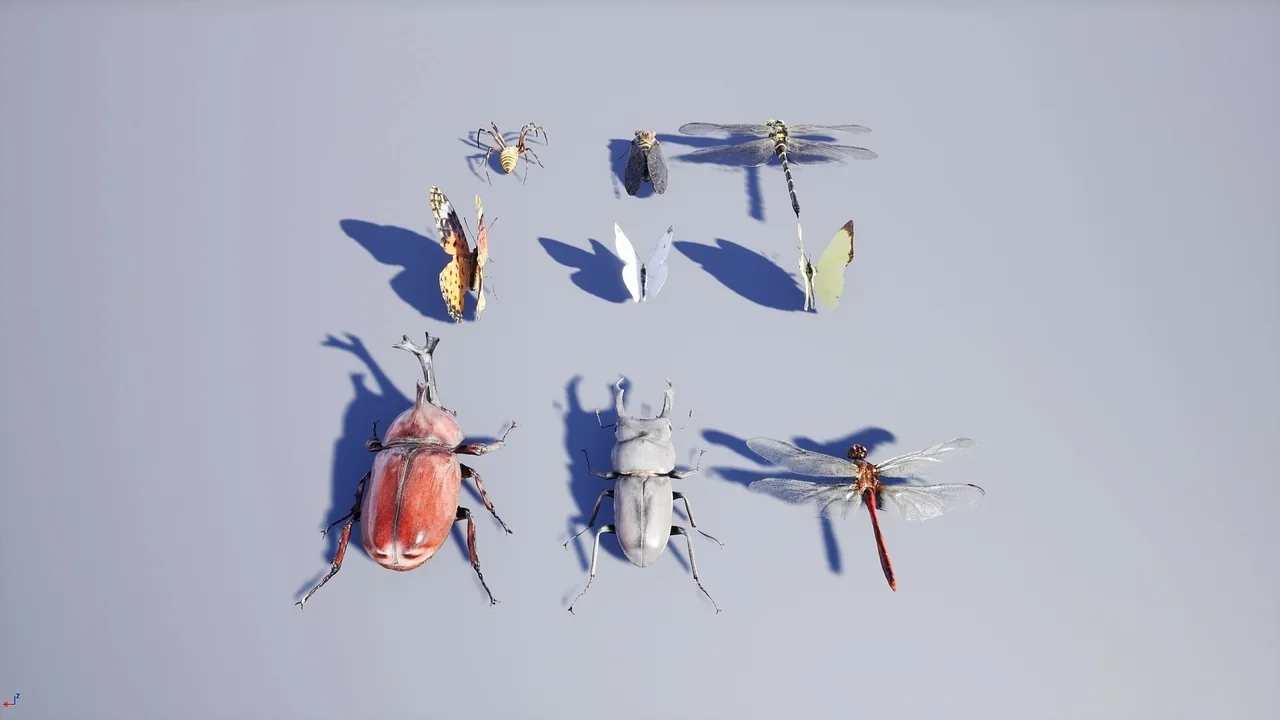
 Characters
 Characters
 Characters