"c14ff6bd758dadb1"{"id":"1000463","slug":"koi-japanese-carp","title":"Koi. Japanese carp","category":"Characters \u0026 Creatures","engine":"4.26+,5.0+","assetVersion":"","engineVersion":"Engine Version: 4.26+,5.0+","tag":"Characters","accent":"blue","visual":"character","summary":"Game-ready low-poly koi model with PBR textures, stylized Japanese carp design, and animation blueprint for Unreal Engine 4.26 through 5.4.","platform":"Unreal Engine","publishedAt":"2026-07-11T17:12:57.461Z","updatedAt":"2026-07-11T17:12:57.461Z","sourceNotes":[],"fileContents":[],"compatibility":["Unreal Engine","Engine Version: 4.26+,5.0+"],"featuredImage":{"alt":"Koi. Japanese carp","src":"/wp-content/uploads/published/2026/07/83e2801c084d-16a5b9a9-2184-4af7-a155-d229d6c4b758-d0180d43a2.webp"},"hasDownloadLink":true,"downloads":0,"terms":[{"taxonomy":"category","slug":"characters-and-creatures","name":"Characters \u0026 Creatures"}],"galleryImages":[{"src":"/wp-content/uploads/published/2026/07/1edb81659c61-504cac94-0b8e-4f08-a535-37a1791e2f2c-28b4386a10.webp","alt":"Koi. Japanese carp"},{"src":"/wp-content/uploads/published/2026/07/23f36be00350-368b028e-23fa-4ff1-ae6d-4bf5549e07df-5b739d690b.webp","alt":"Koi. Japanese carp"},{"src":"/wp-content/uploads/published/2026/07/ac307aea8b06-977059b0-e93f-4ba6-a244-898740e3cc2b-fd58d3373d.webp","alt":"Koi. Japanese carp"},{"src":"/wp-content/uploads/published/2026/07/9fd1c60a1309-7594d1e2-d4f4-4fb0-ad51-6a700f121112-6e35a4bcab.webp","alt":"Koi. Japanese carp"},{"src":"/wp-content/uploads/published/2026/07/88d12c65f365-9f832752-2962-4189-9dc0-6170fb93ae2c-973691c1c0.webp","alt":"Koi. Japanese carp"},{"src":"/wp-content/uploads/published/2026/07/4daee39f4928-5778c946-add8-4a62-a667-53650a323ba7-c40b9f80dd.webp","alt":"Koi. Japanese carp"},{"src":"/wp-content/uploads/published/2026/07/1a47a8aff6b0-4a265498-9dc0-4436-911a-5e85c54ac90f-765c86e2ca.webp","alt":"Koi. Japanese carp"},{"src":"/wp-content/uploads/published/2026/07/e21d3315ee41-89ade6cc-dfc7-4f6f-bf69-8743fc017fa5-5cd2d78827.webp","alt":"Koi. Japanese carp"},{"src":"/wp-content/uploads/published/2026/07/b6ec50a214eb-489b6608-b452-4729-aa3b-2d8e26d861a0-b0d2f6c819.webp","alt":"Koi. Japanese carp"}],"accessPanel":{"kind":"resource","title":"Download this resource","eyebrow":"Free Download","message":"Log in or create a free account to start your download.","fileName":"Content.7z","safetyNote":"Resources are manually reviewed before listing to improve quality and reduce obvious risks.","actionLabel":"Download Free","resourceType":"Resource archive"},"contentHtml":"\u003cp\u003eDropping a fully rigged carp into an Unreal Engine project usually means wrestling with retargeting, material assignment, and animation state machines before the fish ever touches water. \u003cstrong\u003eKoi. Japanese carp\u003c/strong\u003e Bypasses much of that setup work by shipping with an animation blueprint already wired into the asset. When imported into a project running Unreal Engine 4.26, 4.27, or any version from 5.0 through 5.4, the model arrives structured as a character-class asset rather than a static mesh, which means the swimming motion logic is prepared before the developer connects any input or AI controllers.\u003c/p\u003e \u003ch2\u003eAnimation Blueprint Integration for the Japanese Carp\u003c/h2\u003e \u003cp\u003eThe animation blueprint tag attached to this resource signals that the koi does not require a developer to build locomotion logic from scratch. In a practical Unreal scene, an animation blueprint governs how a skeletal mesh transitions between movement states—idle, swim, turn, accelerate, decelerate. Because the asset carries this blueprint internally, placing the koi into a level and connecting it to a pawn or character actor immediately provides access to those pre-built states. A developer building a pond environment, a decorative garden scene, or a water-based gameplay mechanic inherits the swimming animation pipeline without writing custom state machine logic.\u003c/p\u003e \u003cp\u003eThis integration approach keeps the carp functional across different game genres. A exploration-focused walking simulator can use the koi as ambient wildlife Population, with the animation blueprint looping swim cycles as the fish patrols a predefined path. A more mechanically driven project—say, an interaction system where the player feeds or observes fish—can map player proximity triggers to the same blueprint, using the existing states to drive reactions. The blueprint handles the movement logic; the developer decides when and how it activates.\u003c/p\u003e \u003ch2\u003ePBR Texturing and Stylized Visual Identity\u003c/h2\u003e \u003cp\u003eThe model is tagged as both PBR and stylized, which defines a specific visual territory. Physically based rendering means the koi's surface responds to light using realistic roughness, metallic, and albedo values, so the scales, fins, and body coloration catch scene lighting accurately. A stylized designation, though, indicates the textures step away from hyper-diffuse, pore-level biological accuracy. The koi reads as a crafted interpretation of a Japanese carp rather than a fish scan, with color blocking and surface treatment that hold up in scenes leaning toward illustrated or art-directed visuals.\u003c/p\u003e \u003cp\u003eIn rendering terms, this combination lets the asset sit comfortably in two types of projects. A realistic Unreal scene with strong dynamic lighting and post-processing volume effects will make the PBR materials respond as expected—specular highlights running along the body, subsurface-like falloff on the fins if the material graph supports it, and grounded shadow response. A stylized project with flatter lighting rigs benefits from the model's interpreted proportions and pattern work, where the koi maintains visual readability without fighting against a cartoon-rendered environment.\u003c/p\u003e \u003cp\u003eThe Japanese and animal tags confirm the design roots. Koi carry cultural and symbolic weight in Japanese visual language, often associated with perseverance, decorative water gardens, and seasonal imagery. A stylized, PBR-backed interpretation lets a developer place the fish in scenes that need that specific resonance without the asset looking out of place among other game-ready props.\u003c/p\u003e \u003ch2\u003eLow-Poly Geometry and Performance Placement\u003c/h2\u003e \u003cp\u003eThe low-poly classification positions this koi as a performance-conscious asset. In scenes where multiple koi need to swim simultaneously—a pond stocked with several fish, a river environment with ambient wildlife Populate, or a cutback shot where the camera pans across water—the geometry density supports instancing or repeated placement without choking the frame budget. Low-poly does not mean visually crude here; it means the silhouette, edge flow, and form rely on efficient topology rather than dense mesh resolution to communicate the carp's shape.\u003c/p\u003e \u003cp\u003eFor gameplay scenarios, this efficiency matters in specific ways. If the koi is used as an interactive element the player can approach, catch, or observe at close range, the stylized textures and PBR response carry the visual weight while the mesh itself stays light. If the koi serves as background wildlife Populate in an open-world pond, the low-poly foundation allows several instances to render on screen with minimal draw call overhead. The asset scales from hero prop to ambient detail without a pipeline change.\u003c/p\u003e \u003ch3\u003eCross-Genre Deployment of the Carp Asset\u003c/h3\u003e \u003cp\u003eThe resource description explicitly frames the model as suitable for games of different genres. That flexibility stems from how the asset is constructed: a character-class skeletal mesh with animation logic, PBR materials, and efficient geometry. In a narrative adventure game, the koi can anchor a contemplative pond scene where camera framing lingers on the fish as environmental storytelling. In a resource management or simulation game, the same asset functions as a placeable wildlife unit, with the animation blueprint providing the living-motion baseline while gameplay systems layer on top. A horror or atmospheric project could use the koi as a stark, isolated visual element in a still water body, relying on the stylized design to create unease through contrast.\u003c/p\u003e \u003cp\u003eThe character tag reinforces this versatility. The asset is not a static prop; it behaves as a character in engine terms, which means it slots into systems suited to actors that move and animate. A developer does not need to reclassify the koi or build a wrapper class to treat it as a living element in the scene.\u003c/p\u003e \u003ch2\u003eEngine Version Compatibility and Production Readiness\u003c/h2\u003e \u003cp\u003eCompatibility runs from Unreal Engine 4.26 and 4.27 through the 5.0 to 5.4 range. That spread covers late-generation Unreal 4 projects still in maintenance or shipping phases, alongside active Unreal 5 pipelines using Lumen, Nanite, and the updated editor frameworks. For a studio migrating a project from 4.27 to 5.4, the koi asset can cross that version boundary without requiring a re-export or material rework, which keeps it useful as a persistent scene element across engine transitions.\u003c/p\u003e \u003cp\u003eIn production terms, this version tolerance means the koi is not locked to a single engine generation. A project still shipping on 4.27 can use the asset today, and the same asset remains valid if the project upgrades to 5.4 later in development. The animation blueprint, materials, and skeletal setup hold across that range, so the fish does not become a throwaway prop when the engine versionmoves.\u003c/p\u003e \u003cp\u003eFor teams evaluating the resource for inclusion in a live project, the verified details point to an asset built for direct implementation. The animation blueprint reduces setup time. The PBR stylized texturing fits both realistic and art-directed scenes. The low-poly foundation supports placement in dense or repeated-use scenarios. And the cross-version compatibility ensures the koi remains usable through engine upgrades, making it a practical persistent element beyond one-version decoration.\u003c/p\u003e\n\n\u003ch2\u003eExplore Similar Assets\u003c/h2\u003e\n\u003cul\u003e\n\u003cli\u003e\u003ca href=\"https://3dcghub.com/samurai-girl/\" title=\"Samurai Girl\"\u003eSamurai Girl\u003c/a\u003e\u003c/li\u003e\n\u003cli\u003e\u003ca href=\"https://3dcghub.com/pink-cyber-girl/\" title=\"PINK CYBER GIRL\"\u003ePINK CYBER GIRL\u003c/a\u003e\u003c/li\u003e\n\u003cli\u003e\u003ca href=\"https://3dcghub.com/asian-gangster/\" title=\"Asian Gangster\"\u003eAsian Gangster\u003c/a\u003e\u003c/li\u003e\n\u003cli\u003e\u003ca href=\"https://3dcghub.com/character-military-bandit-2/\" title=\"Character Military Bandit 2\"\u003eCharacter Military Bandit 2\u003c/a\u003e\u003c/li\u003e\n\u003cli\u003e\u003ca href=\"https://3dcghub.com/astronaut-soldier/\" title=\"Astronaut Soldier\"\u003eAstronaut Soldier\u003c/a\u003e\u003c/li\u003e\n\u003c/ul\u003e","contentTextLength":7324,"navigation":{"current":1400,"total":3719,"previous":{"id":"1000464","slug":"sci-fi-assault-rifle","title":"Sci-Fi Assault Rifle","category":"Weapons \u0026 Combat","platform":"Unreal Engine","updatedAt":"2026-07-11T17:15:01.019Z"},"next":{"id":"1000462","slug":"japanese-tea-set","title":"Japanese Tea Set","category":"Tools, Objects \u0026 Decor","platform":"Unreal Engine","updatedAt":"2026-07-11T16:15:39.733Z"}},"relatedResources":[{"id":"3342","slug":"samurai-girl","title":"Samurai Girl","category":"Characters \u0026 Creatures","engine":"4.26,5.0+","assetVersion":"Engine version: 4.26,5.0+","engineVersion":"4.21","tag":"Characters","accent":"blue","visual":"character","summary":"Enhance your project with this realistic Samurai Girl 3D model. Features 4K PBR textures, Epic Skeleton rigging, and modular meshes for maximum flexibility.","platform":"Unreal Engine","publishedAt":"2026-02-09T06:42:24.000Z","updatedAt":"2026-04-19T15:57:39.000Z","sourceNotes":[],"fileContents":[],"compatibility":["Unreal Engine","Engine version: 4.26,5.0+"],"featuredImage":{"alt":"Samurai Girl","src":"https://3dcghub.com/wp-content/uploads/2026/02/79b7de26-5b71-4d6b-93cc-8ff9cec51529.webp"},"hasDownloadLink":true,"downloads":0},{"id":"1001443","slug":"japanese-insect-pack","title":"Japanese Insect Pack","category":"Characters \u0026 Creatures","engine":"4.22+,5.0+","assetVersion":"","engineVersion":"Engine Version: 4.22+,5.0+","tag":"Characters","accent":"blue","visual":"character","summary":"Japanese Insect Pack delivers 9 realistic insect characters and 54 dedicated animations, covering beetles, dragonflies, butterflies, cicadas, and spiders.","platform":"Unreal Engine","publishedAt":"2026-10-08T00:42:34.898Z","updatedAt":"2026-10-08T00:42:34.898Z","sourceNotes":[],"fileContents":[],"compatibility":["Unreal Engine","Engine Version: 4.22+,5.0+"],"featuredImage":{"alt":"Japanese Insect Pack","src":"/wp-content/uploads/published/2026/10/dcfb235eb055-59efdbec-832b-4e57-8b40-802f73ceaf26-88d7619436.webp"},"hasDownloadLink":true,"downloads":0},{"id":"1000129","slug":"pink-cyber-girl","title":"PINK CYBER GIRL","category":"Characters \u0026 Creatures","engine":"4.26+,5.0+","assetVersion":"","engineVersion":"Engine Version: 4.26+,5.0+","tag":"Characters","accent":"blue","visual":"character","summary":"PINK CYBER GIRL is a cyberpunk character with a Japanese sword, battle helmet option, 10 added animations, improved hair materials, and a base mesh FBX.","platform":"Unreal Engine","publishedAt":"2026-06-11T10:25:15.290Z","updatedAt":"2026-06-11T10:25:15.290Z","sourceNotes":[],"fileContents":[],"compatibility":["Unreal Engine","Engine Version: 4.26+,5.0+"],"featuredImage":{"alt":"PINK CYBER GIRL","src":"/wp-content/uploads/published/2026/06/f3f191b1d88d-f6f77fc2-a7b3-49bc-9924-fe527488e6fb-62d195f104.webp"},"hasDownloadLink":true,"downloads":1}]}
Characters
Koi. Japanese carp
Game-ready low-poly koi model with PBR textures, stylized Japanese carp design, and animation blueprint for Unreal Engine 4.26 through 5.4.
Dropping a fully rigged carp into an Unreal Engine project usually means wrestling with retargeting, material assignment, and animation state machines before the fish ever touches water. Koi. Japanese carp Bypasses much of that setup work by shipping with an animation blueprint already wired into the asset. When imported into a project running Unreal Engine 4.26, 4.27, or any version from 5.0 through 5.4, the model arrives structured as a character-class asset rather than a static mesh, which means the swimming motion logic is prepared before the developer connects any input or AI controllers.
Animation Blueprint Integration for the Japanese Carp
The animation blueprint tag attached to this resource signals that the koi does not require a developer to build locomotion logic from scratch. In a practical Unreal scene, an animation blueprint governs how a skeletal mesh transitions between movement states—idle, swim, turn, accelerate, decelerate. Because the asset carries this blueprint internally, placing the koi into a level and connecting it to a pawn or character actor immediately provides access to those pre-built states. A developer building a pond environment, a decorative garden scene, or a water-based gameplay mechanic inherits the swimming animation pipeline without writing custom state machine logic.
This integration approach keeps the carp functional across different game genres. A exploration-focused walking simulator can use the koi as ambient wildlife Population, with the animation blueprint looping swim cycles as the fish patrols a predefined path. A more mechanically driven project—say, an interaction system where the player feeds or observes fish—can map player proximity triggers to the same blueprint, using the existing states to drive reactions. The blueprint handles the movement logic; the developer decides when and how it activates.
PBR Texturing and Stylized Visual Identity
The model is tagged as both PBR and stylized, which defines a specific visual territory. Physically based rendering means the koi's surface responds to light using realistic roughness, metallic, and albedo values, so the scales, fins, and body coloration catch scene lighting accurately. A stylized designation, though, indicates the textures step away from hyper-diffuse, pore-level biological accuracy. The koi reads as a crafted interpretation of a Japanese carp rather than a fish scan, with color blocking and surface treatment that hold up in scenes leaning toward illustrated or art-directed visuals.
In rendering terms, this combination lets the asset sit comfortably in two types of projects. A realistic Unreal scene with strong dynamic lighting and post-processing volume effects will make the PBR materials respond as expected—specular highlights running along the body, subsurface-like falloff on the fins if the material graph supports it, and grounded shadow response. A stylized project with flatter lighting rigs benefits from the model's interpreted proportions and pattern work, where the koi maintains visual readability without fighting against a cartoon-rendered environment.
The Japanese and animal tags confirm the design roots. Koi carry cultural and symbolic weight in Japanese visual language, often associated with perseverance, decorative water gardens, and seasonal imagery. A stylized, PBR-backed interpretation lets a developer place the fish in scenes that need that specific resonance without the asset looking out of place among other game-ready props.
Low-Poly Geometry and Performance Placement
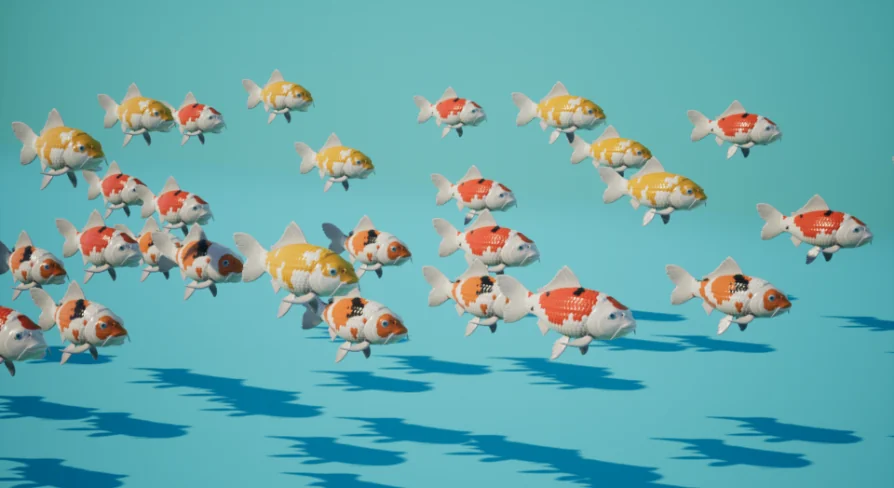
The low-poly classification positions this koi as a performance-conscious asset. In scenes where multiple koi need to swim simultaneously—a pond stocked with several fish, a river environment with ambient wildlife Populate, or a cutback shot where the camera pans across water—the geometry density supports instancing or repeated placement without choking the frame budget. Low-poly does not mean visually crude here; it means the silhouette, edge flow, and form rely on efficient topology rather than dense mesh resolution to communicate the carp's shape.
For gameplay scenarios, this efficiency matters in specific ways. If the koi is used as an interactive element the player can approach, catch, or observe at close range, the stylized textures and PBR response carry the visual weight while the mesh itself stays light. If the koi serves as background wildlife Populate in an open-world pond, the low-poly foundation allows several instances to render on screen with minimal draw call overhead. The asset scales from hero prop to ambient detail without a pipeline change.
Cross-Genre Deployment of the Carp Asset
The resource description explicitly frames the model as suitable for games of different genres. That flexibility stems from how the asset is constructed: a character-class skeletal mesh with animation logic, PBR materials, and efficient geometry. In a narrative adventure game, the koi can anchor a contemplative pond scene where camera framing lingers on the fish as environmental storytelling. In a resource management or simulation game, the same asset functions as a placeable wildlife unit, with the animation blueprint providing the living-motion baseline while gameplay systems layer on top. A horror or atmospheric project could use the koi as a stark, isolated visual element in a still water body, relying on the stylized design to create unease through contrast.
The character tag reinforces this versatility. The asset is not a static prop; it behaves as a character in engine terms, which means it slots into systems suited to actors that move and animate. A developer does not need to reclassify the koi or build a wrapper class to treat it as a living element in the scene.
Engine Version Compatibility and Production Readiness
Compatibility runs from Unreal Engine 4.26 and 4.27 through the 5.0 to 5.4 range. That spread covers late-generation Unreal 4 projects still in maintenance or shipping phases, alongside active Unreal 5 pipelines using Lumen, Nanite, and the updated editor frameworks. For a studio migrating a project from 4.27 to 5.4, the koi asset can cross that version boundary without requiring a re-export or material rework, which keeps it useful as a persistent scene element across engine transitions.
In production terms, this version tolerance means the koi is not locked to a single engine generation. A project still shipping on 4.27 can use the asset today, and the same asset remains valid if the project upgrades to 5.4 later in development. The animation blueprint, materials, and skeletal setup hold across that range, so the fish does not become a throwaway prop when the engine versionmoves.
For teams evaluating the resource for inclusion in a live project, the verified details point to an asset built for direct implementation. The animation blueprint reduces setup time. The PBR stylized texturing fits both realistic and art-directed scenes. The low-poly foundation supports placement in dense or repeated-use scenarios. And the cross-version compatibility ensures the koi remains usable through engine upgrades, making it a practical persistent element beyond one-version decoration.
 Characters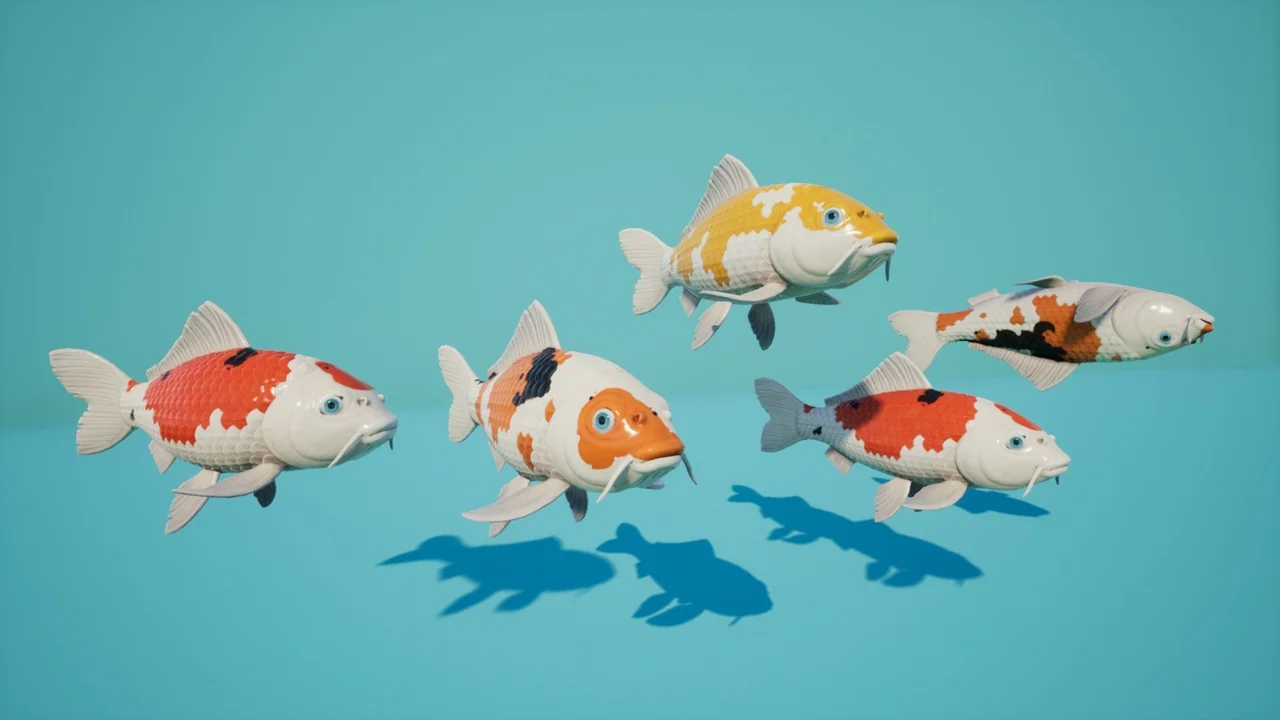
 Characters
 Characters
 Characters