"4481da9c895ef786"{"id":"1001300","slug":"hyper-attribute-manager-v4","title":"Hyper Attribute Manager v4","category":"Gameplay Features","engine":"5.0+","assetVersion":"","engineVersion":"Engine Version: 5.0+","tag":"Gameplay Features","accent":"blue","visual":"mech","summary":"Hyper Attribute Manager v4 delivers datatable-driven attributes, status effects, replication, and environmental temperature systems for Unreal Engine projects.","platform":"Unreal Engine","publishedAt":"2026-10-02T06:02:21.105Z","updatedAt":"2026-10-02T06:02:21.105Z","sourceNotes":[],"fileContents":[],"compatibility":["Unreal Engine","Engine Version: 5.0+"],"featuredImage":{"alt":"Hyper Attribute Manager v4","src":"/wp-content/uploads/published/2026/10/972a4b879638-0e0fc583-022d-42e5-8bc2-1dfcf595c3f2-651c2fceab.webp"},"hasDownloadLink":true,"downloads":0,"terms":[{"taxonomy":"category","slug":"gameplay-features","name":"Gameplay Features"}],"galleryImages":[{"src":"/wp-content/uploads/published/2026/10/ab5fcd0011f7-677c910e-c59a-43ab-8485-450d7bc0f7d6-d4cf2fda2a.webp","alt":"Hyper Attribute Manager v4"},{"src":"/wp-content/uploads/published/2026/10/0813fef26b6a-68bacc9d-0b1b-44ca-bfbe-7f73bd4cc218-018ba5b6c7.webp","alt":"Hyper Attribute Manager v4"},{"src":"/wp-content/uploads/published/2026/10/a8bcdecf9304-26857ae6-902b-483f-a2d1-70903844efe8-f1dcb4cd19.webp","alt":"Hyper Attribute Manager v4"},{"src":"/wp-content/uploads/published/2026/10/095a7db43a3a-63730142-9896-44d5-aeb1-79d4f383e074-c922009b06.webp","alt":"Hyper Attribute Manager v4"},{"src":"/wp-content/uploads/published/2026/10/86f7e2b02c05-f0b067f8-8e93-4b5d-b53f-6fa17b53581e-4f7b19a7e6.webp","alt":"Hyper Attribute Manager v4"},{"src":"/wp-content/uploads/published/2026/10/c8ef82c9f373-e079a298-c6d7-446b-a5c7-33a646ab8957-997bca51f2.webp","alt":"Hyper Attribute Manager v4"},{"src":"/wp-content/uploads/published/2026/10/8d3b5071190b-ec1b54a3-ebdc-4d4e-a8f9-28a7fcb11d01-250d139816.webp","alt":"Hyper Attribute Manager v4"},{"src":"/wp-content/uploads/published/2026/10/aec0fa5e4b19-5a8966d0-a2ec-4e31-acb2-a6dd45cb26be-f8ebfa32ef.webp","alt":"Hyper Attribute Manager v4"},{"src":"/wp-content/uploads/published/2026/10/1fec4bbf54f5-ef250847-7890-4603-9ee9-9f014d776b3a-f7dc378906.webp","alt":"Hyper Attribute Manager v4"},{"src":"/wp-content/uploads/published/2026/10/3841d37e12a4-24979690-6061-41cc-b3e1-8b10a71e635a-b5a40cd59c.webp","alt":"Hyper Attribute Manager v4"}],"accessPanel":{"kind":"resource","title":"Download this resource","eyebrow":"Free Download","message":"Log in or create a free account to start your download.","fileName":"AttributeManager.7z","safetyNote":"Resources are manually reviewed before listing to improve quality and reduce obvious risks.","actionLabel":"Download Free","resourceType":"Resource archive"},"contentHtml":"\u003ch2\u003eIntegrating Hyper Attribute Manager v4 into Gameplay Frameworks\u003c/h2\u003e\n\u003cp\u003eImplementing a scalable statistic pipeline in Unreal Engine typically demands custom networking logic, clamping rules, and variable synchronization across clients and servers. Hyper Attribute Manager v4 establishes this foundation using a modular Blueprint architecture that operates entirely without code requirements. By relying on structured data and data tables to dictate character values, the framework standardizes how stats like Health, Stamina, and Hunger interact with gameplay systems in real time.\u003c/p\u003e\n\u003cp\u003eThe configuration process centers on assigning reusable components to player characters or non-player entities. Out of the box, values feature full network replication, ensuring that changes initiated on the server accurately distribute to participating clients. Developers configure baseline properties, numerical clamping limits, and dynamic modifiers directly inside the designated data tables. Value decay is also handled systematically, allowing ongoing drains—such as passive hunger reduction or stamina depletion during physical exertion—to run continuously without dedicated per-tick scripting inside individual character Blueprints.\u003c/p\u003e\n\u003cp\u003eBecause the implementation uses clean overrides and child Blueprints, the component accommodates a broad range of production scopes. It integrates smoothly into RPGs, survival sandboxes, shooters, MMOs, and cooperative multiplayer projects where character condition drives second-to-second gameplay loops.\u003c/p\u003e \u003ch2\u003eStructuring the Six Core Attribute Categories\u003c/h2\u003e\n\u003cp\u003eRather than lumping all player stats into a single flat array, the system organizes attributes into six distinct categories. This separation enables targeted data handling, specific saving logic, and isolated clamping routines tailored to each category's gameplay role.\u003c/p\u003e\n\u003cul\u003e \u003cli\u003e\u003cstrong\u003eNon-Persistent Character Attributes:\u003c/strong\u003e Short-term or highly dynamic values that do not require state preservation between extended game sessions or level reloads, ideal for temporary reaction pools.\u003c/li\u003e \u003cli\u003e\u003cstrong\u003ePersistent Primary Character Attributes:\u003c/strong\u003e Core statistics that represent the character's baseline existence and identity, remaining saved across play sessions.\u003c/li\u003e \u003cli\u003e\u003cstrong\u003ePersistent Character Survival Attributes:\u003c/strong\u003e Variables that track physiological needs—such as Hunger, Thirst, or Oxygen—that continuously experience value decay and state-driven depletion.\u003c/li\u003e \u003cli\u003e\u003cstrong\u003ePersistent Generic Combat Attributes:\u003c/strong\u003e Universal combat figures, including defensive ratings, mitigation calculations, or baseline physical modifiers applicable across general battle scenarios.\u003c/li\u003e \u003cli\u003e\u003cstrong\u003ePersistent Ranged Combat Attributes:\u003c/strong\u003e Targeted statistics dedicated to firearm or projectile mechanics, separating ballistic scaling and projectile handling from melee or standard engagement pools.\u003c/li\u003e \u003cli\u003e\u003cstrong\u003ePersistent Level Attributes:\u003c/strong\u003e Progression tracking metrics tied to character rank, experience accumulation, and milestone growth structures.\u003c/li\u003e\n\u003c/ul\u003e\n\u003cp\u003eBy segmenting attributes along these lines, modifiers can target entire sets or individual entries without unintended side effects. Modifiers can apply flat adjustments or scaling percentage offsets, governed by the data table definitions that clamp final values within safe minimums and maximums.\u003c/p\u003e \u003ch2\u003eAutomating State Effects with Data Tables\u003c/h2\u003e\n\u003cp\u003eComplementing numeric attributes is a dedicated State Effect Manager. Instead of managing character debuffs or buffs through scattered timers, all state effects run directly through data-table-driven workflows. State effects can be manually activated or cleared through Blueprint events, or they can trigger automatically when certain threshold conditions are met or consumption actions take place.\u003c/p\u003e\n\u003cp\u003eA character consuming spoiled food or hazardous water can automatically receive specific negative statuses based on item parameters. The system features pre-configured states tailored for immediate use:\u003c/p\u003e\n\u003cul\u003e \u003cli\u003e\u003cstrong\u003eSick:\u003c/strong\u003e A broad illness status triggered by consumption or environmental hazards.\u003c/li\u003e \u003cli\u003e\u003cstrong\u003eHealthy:\u003c/strong\u003e A positive baseline state that can indicate optimal wellness or active recovery bonuses.\u003c/li\u003e \u003cli\u003e\u003cstrong\u003eInfection:\u003c/strong\u003e A persistent condition requiring specific treatment to halt degradation.\u003c/li\u003e \u003cli\u003e\u003cstrong\u003eWounded:\u003c/strong\u003e Physical impairment that can alter combat efficiency or stamina availability.\u003c/li\u003e \u003cli\u003e\u003cstrong\u003ePoisoned:\u003c/strong\u003e A damaging status effect inflicting damage over time alongside stat penalties.\u003c/li\u003e \u003cli\u003e\u003cstrong\u003eDrunk:\u003c/strong\u003e A consumption-induced state altering character parameters.\u003c/li\u003e\n\u003c/ul\u003e\n\u003cp\u003eBecause state effects operate via gameplay tags and structured records, teams can create custom states by mirroring the existing data schemas. This keeps status handling uniform whether a condition is applied by an enemy spell, an environmental hazard, or a consumable item.\u003c/p\u003e \u003ch2\u003eEnvironmental Chill and Temperature State Mechanics\u003c/h2\u003e\n\u003cp\u003eThe system features an environmental temperature system driven by dynamic actor evaluations. A character's temperature response does not simply match the raw ambient reading; instead, the system processes both an external temperature and an internal individual Chill temperature.\u003c/p\u003e\n\u003cp\u003eA character's internal Chill temperature differs dynamically based on personal penalty calculations. These penalties adjust according to active physical states and environmental exposure:\u003c/p\u003e\n\u003cul\u003e \u003cli\u003e\u003cstrong\u003eWet:\u003c/strong\u003e Increases the chill penalty, causing the character's internal warmth to drop more rapidly in cold settings.\u003c/li\u003e \u003cli\u003e\u003cstrong\u003eWarming:\u003c/strong\u003e Reduces chill penalties and counteracts freezing environments, typically applied when resting near heat sources.\u003c/li\u003e \u003cli\u003e\u003cstrong\u003eOn Fire:\u003c/strong\u003e A severe status applying acute heat, immediate damage modifiers, and aggressive internal temperature shifts.\u003c/li\u003e\n\u003c/ul\u003e\n\u003cp\u003eEquipment choices directly influence these mechanics. For instance, the chill temperature penalty shifts depending on clothing choices, especially if the worn gear becomes wet or if the player stands near a fire source. When shifts occur between different temperature states, the system displays corresponding screen animation effects to communicate thermal stress, frost buildup, or heat blur directly to the player without requiring external UI hooks.\u003c/p\u003e \u003ch2\u003eEcosystem Integration and Unreal Engine Version Compatibility\u003c/h2\u003e\n\u003cp\u003eHyper Attribute Manager v4 is developed within a technical ecosystem shaped by more than 75,000 hours of Unreal Engine systems design and multiplayer testing. It forms a central component of the flagship Multiplayer Survival Template Pro (MST Pro), where it functions alongside inventory management, crafting benches, equipment pipelines, interaction logic, combat frameworks, and AI systems.\u003c/p\u003e\n\u003cp\u003eThe architecture relies heavily on clean project boundaries, reusable actor components, and gameplay tags rather than rigid hard-references. Teams can adopt the asset standalone or deploy it as an integrated layer inside existing Hyper-compatible modules, replacing visual assets and tweaking data tables while retaining the core networking rules.\u003c/p\u003e\n\u003cp\u003eVersion alignment is strictly segmented across engine releases:\u003c/p\u003e\n\u003cul\u003e \u003cli\u003e\u003cstrong\u003eVersion 4:\u003c/strong\u003e Built natively for Unreal Engine 5.7 and subsequent releases.\u003c/li\u003e \u003cli\u003e\u003cstrong\u003eVersion 3:\u003c/strong\u003e Maintained for Unreal Engine 5.5 and 5.6 environments.\u003c/li\u003e \u003cli\u003e\u003cstrong\u003eVersion 2:\u003c/strong\u003e Designated for engine iterations prior to Unreal Engine 5.5.\u003c/li\u003e\n\u003c/ul\u003e\n\u003cp\u003eDeploying the correct version ensures full compatibility with the underlying Blueprint architecture, replication protocols, and serialization methods required for production-ready multiplayer projects.\u003c/p\u003e\n\n\u003ch2\u003eContinue Browsing Similar Packs\u003c/h2\u003e\n\u003cul\u003e\n\u003cli\u003e\u003ca href=\"https://3dcghub.com/hyper-time-manager-system-v4/\" title=\"Hyper Time Manager System v4\"\u003eHyper Time Manager System v4\u003c/a\u003e\u003c/li\u003e\n\u003cli\u003e\u003ca href=\"https://3dcghub.com/hyper-scalable-interaction-system-v4/\" title=\"Hyper Scalable Interaction System v4\"\u003eHyper Scalable Interaction System v4\u003c/a\u003e\u003c/li\u003e\n\u003cli\u003e\u003ca href=\"https://3dcghub.com/hyper-outliner-and-symbol-system-v4/\" title=\"Hyper Outliner and Symbol System v4\"\u003eHyper Outliner and Symbol System v4\u003c/a\u003e\u003c/li\u003e\n\u003cli\u003e\u003ca href=\"https://3dcghub.com/ultimate-quest-manager/\" title=\"Ultimate Quest Manager\"\u003eUltimate Quest Manager\u003c/a\u003e\u003c/li\u003e\n\u003cli\u003e\u003ca href=\"https://3dcghub.com/hyper-multiplayer-survival-template-pro-mst-v4/\" title=\"Hyper Multiplayer Survival Template Pro [MST] V4\"\u003eHyper Multiplayer Survival Template Pro [MST] V4\u003c/a\u003e\u003c/li\u003e\n\u003c/ul\u003e","contentTextLength":7443,"navigation":{"current":36,"total":3269,"previous":{"id":"1001302","slug":"inventory-system","title":"Inventory System","category":"Gameplay Features","platform":"Unreal Engine","updatedAt":"2026-10-02T06:05:08.067Z"},"next":{"id":"1001299","slug":"cine-cam","title":"Cine Cam","category":"Gameplay Features","platform":"Unreal Engine","updatedAt":"2026-10-02T06:01:01.399Z"}},"relatedResources":[{"id":"1001035","slug":"hyper-time-manager-system-v4","title":"Hyper Time Manager System v4","category":"Gameplay Features","engine":"5.7+","assetVersion":"Asset Version: v4","engineVersion":"Engine Version: 5.7+","tag":"Gameplay Features","accent":"blue","visual":"mech","summary":"Hyper Time Manager System v4 centralizes in-game time in the GameState, syncing NPC schedules, day-night cycles, and world events with Blueprint, multiplayer-re","platform":"Unreal Engine","publishedAt":"2026-08-25T11:24:46.098Z","updatedAt":"2026-08-25T11:24:46.098Z","sourceNotes":[],"fileContents":[],"compatibility":["Unreal Engine","Asset Version: v4","Engine Version: 5.7+"],"featuredImage":{"alt":"Hyper Time Manager System v4","src":"/wp-content/uploads/published/2026/08/0c6d2b9b85f3-d2a03156-4b13-4068-b29a-47eca06cd2d2-7cea1ff9c1.webp"},"hasDownloadLink":true,"downloads":2},{"id":"1001034","slug":"hyper-scalable-interaction-system-v4","title":"Hyper Scalable Interaction System v4","category":"Gameplay Features","engine":"5.7+","assetVersion":"Asset Version: v4","engineVersion":"Engine Version: 5.7+","tag":"Gameplay Features","accent":"blue","visual":"mech","summary":"Plug-and-play interaction for any Unreal Engine actor with prompts, progress bars, conditions, and network replication for Adventure, RPG, Co-op, and Simulation","platform":"Unreal Engine","publishedAt":"2026-08-25T11:18:18.819Z","updatedAt":"2026-08-25T11:18:18.819Z","sourceNotes":[],"fileContents":[],"compatibility":["Unreal Engine","Asset Version: v4","Engine Version: 5.7+"],"featuredImage":{"alt":"Hyper Scalable Interaction System v4","src":"/wp-content/uploads/published/2026/08/7bc00c753bb2-66597fe3-a933-47a3-b023-6e95ce537263-e5174f5999.webp"},"hasDownloadLink":true,"downloads":1},{"id":"1000705","slug":"hyper-outliner-and-symbol-system-v4","title":"Hyper Outliner and Symbol System v4","category":"Gameplay Features","engine":"5.0+","assetVersion":"Asset Version: v4","engineVersion":"Engine Version: 5.0+","tag":"Gameplay Features","accent":"blue","visual":"mech","summary":"A fully replicated Unreal Engine outline and symbol system for multiplayer games. Attach colored outlines and quest symbols to any actor with no code needed.","platform":"Unreal Engine","publishedAt":"2026-07-24T01:34:23.942Z","updatedAt":"2026-07-24T01:34:23.942Z","sourceNotes":[],"fileContents":[],"compatibility":["Unreal Engine","Asset Version: v4","Engine Version: 5.0+"],"featuredImage":{"alt":"Hyper Outliner and Symbol System v4","src":"/wp-content/uploads/published/2026/07/845c3d6251d1-155e2be8-d517-47c2-8082-3009d481e506-6f0111c465.webp"},"hasDownloadLink":true,"downloads":0}]}
Gameplay Features
Hyper Attribute Manager v4
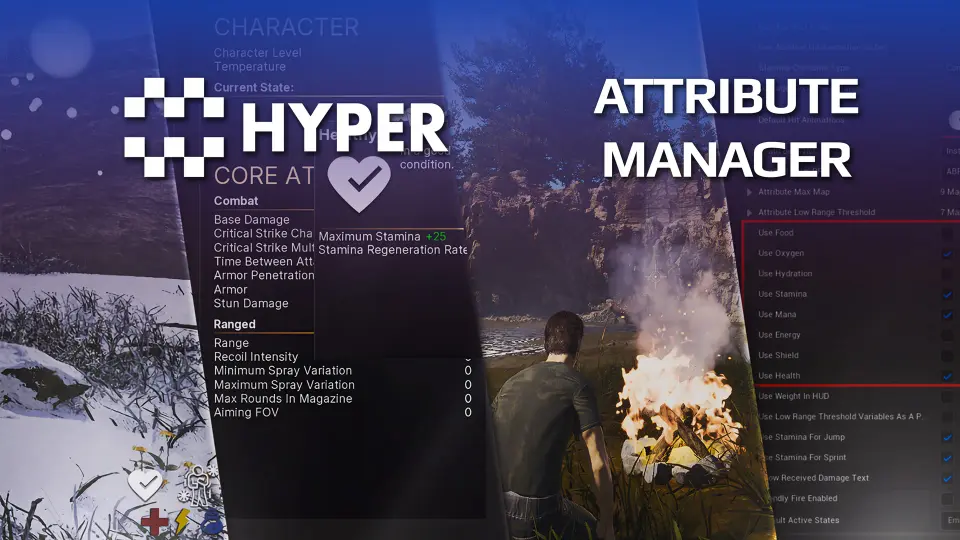
Hyper Attribute Manager v4 delivers datatable-driven attributes, status effects, replication, and environmental temperature systems for Unreal Engine projects.
Integrating Hyper Attribute Manager v4 into Gameplay Frameworks
Implementing a scalable statistic pipeline in Unreal Engine typically demands custom networking logic, clamping rules, and variable synchronization across clients and servers. Hyper Attribute Manager v4 establishes this foundation using a modular Blueprint architecture that operates entirely without code requirements. By relying on structured data and data tables to dictate character values, the framework standardizes how stats like Health, Stamina, and Hunger interact with gameplay systems in real time.
The configuration process centers on assigning reusable components to player characters or non-player entities. Out of the box, values feature full network replication, ensuring that changes initiated on the server accurately distribute to participating clients. Developers configure baseline properties, numerical clamping limits, and dynamic modifiers directly inside the designated data tables. Value decay is also handled systematically, allowing ongoing drains—such as passive hunger reduction or stamina depletion during physical exertion—to run continuously without dedicated per-tick scripting inside individual character Blueprints.
Because the implementation uses clean overrides and child Blueprints, the component accommodates a broad range of production scopes. It integrates smoothly into RPGs, survival sandboxes, shooters, MMOs, and cooperative multiplayer projects where character condition drives second-to-second gameplay loops.
Structuring the Six Core Attribute Categories
Rather than lumping all player stats into a single flat array, the system organizes attributes into six distinct categories. This separation enables targeted data handling, specific saving logic, and isolated clamping routines tailored to each category's gameplay role.
Non-Persistent Character Attributes: Short-term or highly dynamic values that do not require state preservation between extended game sessions or level reloads, ideal for temporary reaction pools.
Persistent Primary Character Attributes: Core statistics that represent the character's baseline existence and identity, remaining saved across play sessions.
Persistent Character Survival Attributes: Variables that track physiological needs—such as Hunger, Thirst, or Oxygen—that continuously experience value decay and state-driven depletion.
Persistent Generic Combat Attributes: Universal combat figures, including defensive ratings, mitigation calculations, or baseline physical modifiers applicable across general battle scenarios.
Persistent Ranged Combat Attributes: Targeted statistics dedicated to firearm or projectile mechanics, separating ballistic scaling and projectile handling from melee or standard engagement pools.
Persistent Level Attributes: Progression tracking metrics tied to character rank, experience accumulation, and milestone growth structures.
By segmenting attributes along these lines, modifiers can target entire sets or individual entries without unintended side effects. Modifiers can apply flat adjustments or scaling percentage offsets, governed by the data table definitions that clamp final values within safe minimums and maximums.
Automating State Effects with Data Tables
Complementing numeric attributes is a dedicated State Effect Manager. Instead of managing character debuffs or buffs through scattered timers, all state effects run directly through data-table-driven workflows. State effects can be manually activated or cleared through Blueprint events, or they can trigger automatically when certain threshold conditions are met or consumption actions take place.
A character consuming spoiled food or hazardous water can automatically receive specific negative statuses based on item parameters. The system features pre-configured states tailored for immediate use:
Sick: A broad illness status triggered by consumption or environmental hazards.
Healthy: A positive baseline state that can indicate optimal wellness or active recovery bonuses.
Infection: A persistent condition requiring specific treatment to halt degradation.
Wounded: Physical impairment that can alter combat efficiency or stamina availability.
Poisoned: A damaging status effect inflicting damage over time alongside stat penalties.
Drunk: A consumption-induced state altering character parameters.
Because state effects operate via gameplay tags and structured records, teams can create custom states by mirroring the existing data schemas. This keeps status handling uniform whether a condition is applied by an enemy spell, an environmental hazard, or a consumable item.
Environmental Chill and Temperature State Mechanics
The system features an environmental temperature system driven by dynamic actor evaluations. A character's temperature response does not simply match the raw ambient reading; instead, the system processes both an external temperature and an internal individual Chill temperature.
A character's internal Chill temperature differs dynamically based on personal penalty calculations. These penalties adjust according to active physical states and environmental exposure:
Wet: Increases the chill penalty, causing the character's internal warmth to drop more rapidly in cold settings.
Warming: Reduces chill penalties and counteracts freezing environments, typically applied when resting near heat sources.
On Fire: A severe status applying acute heat, immediate damage modifiers, and aggressive internal temperature shifts.
Equipment choices directly influence these mechanics. For instance, the chill temperature penalty shifts depending on clothing choices, especially if the worn gear becomes wet or if the player stands near a fire source. When shifts occur between different temperature states, the system displays corresponding screen animation effects to communicate thermal stress, frost buildup, or heat blur directly to the player without requiring external UI hooks.
Ecosystem Integration and Unreal Engine Version Compatibility
Hyper Attribute Manager v4 is developed within a technical ecosystem shaped by more than 75,000 hours of Unreal Engine systems design and multiplayer testing. It forms a central component of the flagship Multiplayer Survival Template Pro (MST Pro), where it functions alongside inventory management, crafting benches, equipment pipelines, interaction logic, combat frameworks, and AI systems.
The architecture relies heavily on clean project boundaries, reusable actor components, and gameplay tags rather than rigid hard-references. Teams can adopt the asset standalone or deploy it as an integrated layer inside existing Hyper-compatible modules, replacing visual assets and tweaking data tables while retaining the core networking rules.
Version alignment is strictly segmented across engine releases:
Version 4: Built natively for Unreal Engine 5.7 and subsequent releases.
Version 3: Maintained for Unreal Engine 5.5 and 5.6 environments.
Version 2: Designated for engine iterations prior to Unreal Engine 5.5.
Deploying the correct version ensures full compatibility with the underlying Blueprint architecture, replication protocols, and serialization methods required for production-ready multiplayer projects.
 Gameplay Features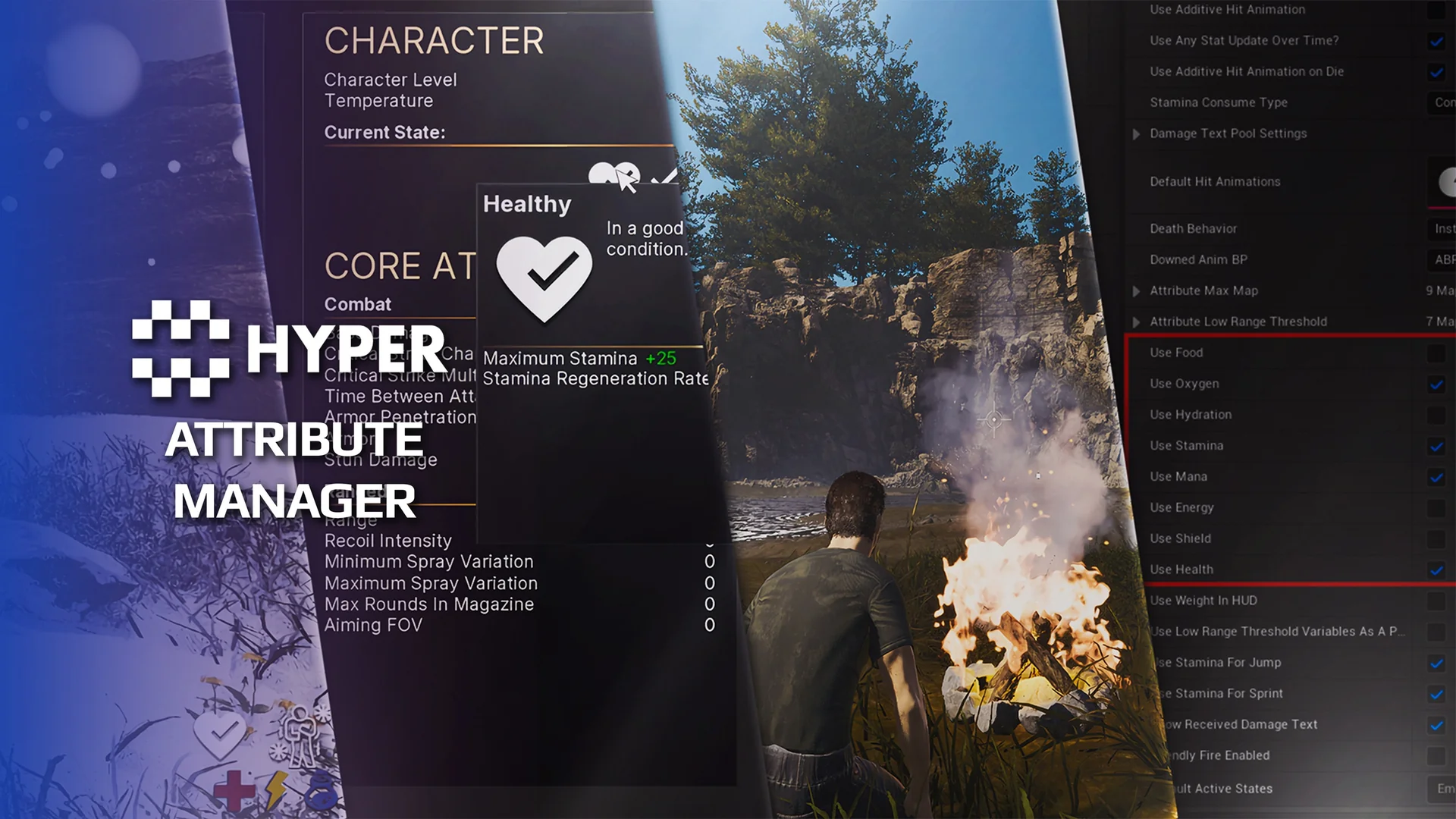
 Gameplay Features
 Gameplay Features
 Gameplay Features