"1c2c8b66743036b4"{"id":"1001697","slug":"hospital-combo-prop-pack-vol-1-6","title":"Hospital - COMBO Prop Pack (VOL 1-6)","category":"Buildings \u0026 Architecture","engine":"4.26+,5.0+","assetVersion":"","engineVersion":"Engine Version: 4.26+,5.0+","tag":"Buildings","accent":"blue","visual":"mech","summary":"Six bundled volumes of game-ready hospital machinery, medical props, and master materials created for Unreal Engine with dynamic lighting scenes.","platform":"Unreal Engine","publishedAt":"2026-10-14T09:16:34.005Z","updatedAt":"2026-10-14T09:16:34.005Z","sourceNotes":[],"fileContents":[],"compatibility":["Unreal Engine","Engine Version: 4.26+,5.0+"],"featuredImage":{"alt":"Hospital - COMBO Prop Pack (VOL 1-6)","src":"/wp-content/uploads/published/2026/10/a0ff161b3f4e-cfe800b5-ba53-48ff-aa6a-0031502dc450-af6ba09091.webp"},"hasDownloadLink":true,"downloads":0,"terms":[{"taxonomy":"category","slug":"buildings-and-architecture","name":"Buildings \u0026 Architecture"}],"galleryImages":[{"src":"/wp-content/uploads/published/2026/10/886fb4d550b9-f7270e97-1d62-4943-adfd-7f55cc1e8b8f-c3e765a0e6.webp","alt":"Hospital - COMBO Prop Pack (VOL 1-6)"},{"src":"/wp-content/uploads/published/2026/10/b1b23a82b5ef-ec05d912-361a-409e-9269-661efe765561-731cf4f914.webp","alt":"Hospital - COMBO Prop Pack (VOL 1-6)"},{"src":"/wp-content/uploads/published/2026/10/2cee272fa4c5-b7cab8e8-79b3-4671-9fb3-3150317d8d5f-24832670cb.webp","alt":"Hospital - COMBO Prop Pack (VOL 1-6)"},{"src":"/wp-content/uploads/published/2026/10/757a74226afe-795d562b-7f92-4f5d-9223-ed51e01eb294-b5f7be442a.webp","alt":"Hospital - COMBO Prop Pack (VOL 1-6)"},{"src":"/wp-content/uploads/published/2026/10/245d14631f61-57ee96b2-3818-452e-9565-5ca53f00b4bc-afbd35c1e4.webp","alt":"Hospital - COMBO Prop Pack (VOL 1-6)"},{"src":"/wp-content/uploads/published/2026/10/f5d0d2fbc188-34b1a876-01f6-41c7-8584-bdd67c4c0f3c-13beaa0db2.webp","alt":"Hospital - COMBO Prop Pack (VOL 1-6)"},{"src":"/wp-content/uploads/published/2026/10/a57db700ac2e-a26aeb6d-6fe3-41d9-a29a-a32df55ffe65-4dbd44a613.webp","alt":"Hospital - COMBO Prop Pack (VOL 1-6)"},{"src":"/wp-content/uploads/published/2026/10/ce771eb652f4-eeb6cac6-7177-4a27-a88e-1c6cca408fc2-83599f5780.webp","alt":"Hospital - COMBO Prop Pack (VOL 1-6)"},{"src":"/wp-content/uploads/published/2026/10/1278a1de5826-ca4d7c21-7f4c-4128-8402-8d12b3010b9f-f5c4a54a16.webp","alt":"Hospital - COMBO Prop Pack (VOL 1-6)"},{"src":"/wp-content/uploads/published/2026/10/23aca58226c7-42637eb2-1fc5-4114-a327-81f1fcd49f5e-49e19a9882.webp","alt":"Hospital - COMBO Prop Pack (VOL 1-6)"}],"accessPanel":{"kind":"resource","title":"Download this resource","eyebrow":"Free Download","message":"Log in or create a free account to start your download.","fileName":"Content.7z","safetyNote":"Resources are manually reviewed before listing to improve quality and reduce obvious risks.","actionLabel":"Download Free","resourceType":"Resource archive"},"contentHtml":"\u003ch2\u003eThe Six-Volume Dekogon Collection Assembly\u003c/h2\u003e\n\u003cp\u003eHospital - COMBO Prop Pack (VOL 1-6) consolidates six individual asset packs into a unified Unreal Engine project. Created by Dekogon Kollab artists, this compilation gathers hospital machinery, medical equipment, clinical furnishings, and healthcare fixtures built specifically for production environments. Bringing Volumes 1 through 6 together delivers a complete spectrum of interior clinical hardware, spanning diagnostic machines, treatment tools, patient care apparatus, and technical utility assets needed to furnish believable medical settings.\u003c/p\u003e\n\u003cp\u003eEvery asset across the six included volumes is built to balance visual fidelity with strict game-performance budgets. Rather than relying on cinematic meshes that strain real-time frame rates, the models use low-poly geometry tailored for interactive applications. The collection emphasizes realistic AAA visuals, matching the physical style, form factors, and utilitarian details found in working healthcare facilities, industrial clinics, and clinical simulation spaces.\u003c/p\u003e \u003ch2\u003eTexture Fidelity and Channel-Packed PBR Mapping\u003c/h2\u003e\n\u003cp\u003eSurfaces across the entire prop library use dedicated physically based rendering (PBR) texture maps intended for high visual fidelity. Most textures are authored at 2048 pixels or higher, preserving fine labels, metallic highlights, rubber grips, plastic casings, and industrial wear on diagnostic machines and treatment gear. These high-resolution maps ensure that props hold their detail when viewed up close in first-person perspectives or cinematic close-up shots.\u003c/p\u003e\n\u003cp\u003eTo keep the asset collection optimized for games, the texture workflows incorporate channel packing. Roughness, Metalness, and Ambient Occlusion data are combined into distinct channels of a single texture map. Packing Roughness, Metalness, and Ambient Occlusion reduces the total texture memory footprint and decreases texture sampler counts inside the engine shaders. This pipeline standard keeps draw calls efficient and memory overhead low, even when scenes contain dozens of distinct medical instruments, carts, and monitoring stations simultaneously.\u003c/p\u003e \u003ch2\u003eMaster Material Controls Across Prop Models\u003c/h2\u003e\n\u003cp\u003eManaging surface appearances across six full volumes of props is handled through a centralized master material setup. This master material controls the majority of all props and models in the project, providing a unified shader framework that feeds child material instances across the collection. A single, structured master material guarantees visual consistency across disparate models while keeping shader compilation fast and organized within Unreal Engine.\u003c/p\u003e\n\u003cp\u003eThe master material setup exposes specific parameters that give artists direct control over visual characteristics without modifying underlying textures. Users can tweak:\u003c/p\u003e\n\u003cul\u003e\n\u003cli\u003eRoughness parameters to adjust surface wear, glossiness, and matte finishes across plastic, rubber, and painted metal.\u003c/li\u003e\n\u003cli\u003eAlbedo color tinting and tone values to match specific institutional branding or sterile hospital color codes.\u003c/li\u003e\n\u003cli\u003eNormal map intensity to soften or emphasize surface relief, panel seams, screws, and structural recesses.\u003c/li\u003e\n\u003cli\u003eAdditional surface controls that govern fine PBR adjustments across individual prop instances.\u003c/li\u003e\n\u003c/ul\u003e\n\u003cp\u003eThese exposed controls streamline environment variation. A single medical cart or diagnostic console can be tuned from factory-clean clinical white to a scuffed, older utility finish through instance adjustments alone, preventing the need to export and re-import alternate texture maps.\u003c/p\u003e \u003ch2\u003eEvaluation Inside the Test Dynamic Lighting Scene\u003c/h2\u003e\n\u003cp\u003eThe package includes a dedicated test dynamic lighting scene built directly in Unreal Engine. This environment allows artists and level designers to inspect assets, maps, and materials under live light sources before placing props into production levels. Dynamic lighting exposes how the roughness maps scatter light, how normal maps respond to moving illumination, and how ambient occlusion maps ground the machinery against floors and walls.\u003c/p\u003e\n\u003cp\u003eTesting assets in a dynamic lighting environment verifies that the low-poly models maintain their silhouette and visual weight under sharp directional lights, fluorescent room strips, and point lights. Because the test scene contains all assets, maps, and materials fully wired to their master materials, it functions as a working visual library where props can be reviewed in real time, inspected for surface behavior, and copied directly into destination levels.\u003c/p\u003e \u003ch2\u003eHealthcare Environments and Simulation Workflows\u003c/h2\u003e\n\u003cp\u003eThe thematic scope of Volumes 1 through 6 encompasses machinery, hospital gear, X-ray equipment, and health devices. This variety makes the collection suited for realistic interactive games, emergency room walkthroughs, virtual healthcare training modules, and industrial laboratory simulations. The realistic aesthetic ensures that diagnostic units, monitors, and clinical tools fit together naturally within examination rooms, triage centers, intensive care wards, and sterile research facilities.\u003c/p\u003e\n\u003cp\u003eBeyond modern hospital interiors, the collection offers structural compatibility alongside larger world-building assets such as the Meridian 1988: King Wash Stripmall - Modular Environment (VOL 55). Studios building extensive urban maps, period facilities, or mixed-use commercial and medical spaces can pair the specialized clinical hardware from Volumes 1 through 6 with broader modular environment packs to build cohesive, detailed scenes.\u003c/p\u003e\n\n\u003ch2\u003eMore From The Same Workflow\u003c/h2\u003e\n\u003cul\u003e\n\u003cli\u003e\u003ca href=\"https://3dcghub.com/graveyard-and-nature-set/\" title=\"Graveyard and Nature Set\"\u003eGraveyard and Nature Set\u003c/a\u003e\u003c/li\u003e\n\u003cli\u003e\u003ca href=\"https://3dcghub.com/industrial-vol-4-electricity-hydro-and-water-treatment/\" title=\"Industrial VOL.4 - Electricity, Hydro, and Water Treatment\"\u003eIndustrial VOL.4 - Electricity, Hydro, and Water Treatment\u003c/a\u003e\u003c/li\u003e\n\u003cli\u003e\u003ca href=\"https://3dcghub.com/post-apocalyptic-signs-vol-2/\" title=\"Post Apocalyptic Signs - VOL 2\"\u003ePost Apocalyptic Signs - VOL 2\u003c/a\u003e\u003c/li\u003e\n\u003cli\u003e\u003ca href=\"https://3dcghub.com/medieval-props-vol-3-farm-2/\" title=\"Medieval Props Vol 3 Farm\"\u003eMedieval Props Vol 3 Farm\u003c/a\u003e\u003c/li\u003e\n\u003cli\u003e\u003ca href=\"https://3dcghub.com/construction-site-vol-2-tools-parts-and-machine-props/\" title=\"Construction Site VOL. 2 - Tools, Parts, and Machine Props\"\u003eConstruction Site VOL. 2 - Tools, Parts, and Machine Props\u003c/a\u003e\u003c/li\u003e\n\u003c/ul\u003e","contentTextLength":5716,"navigation":{"current":18,"total":3651,"previous":{"id":"1001698","slug":"post-apocalyptic-abandoned-coffee-shop-drive-thru","title":"Post Apocalyptic Abandoned Coffee Shop Drive Thru","category":"Apocalyptic / Post-apocalyptic","platform":"Unreal Engine","updatedAt":"2026-10-14T10:07:50.072Z"},"next":{"id":"1001696","slug":"shadows-reckoning-advanced-combat-system","title":"Shadows Reckoning (Advanced Combat System)","category":"Procedural Systems","platform":"Unreal Engine","updatedAt":"2026-10-14T09:14:57.652Z"}},"relatedResources":[{"id":"1001646","slug":"graveyard-and-nature-set","title":"Graveyard and Nature Set","category":"Buildings \u0026 Architecture","engine":"4.21+,5.0+","assetVersion":"","engineVersion":"Engine Version: 4.21+,5.0+","tag":"Buildings","accent":"blue","visual":"mech","summary":"Explore the Graveyard and Nature Set, featuring 762 modular PBR assets, photoscanned props, LOD billboards, and tesselated landscape materials.","platform":"Unreal Engine","publishedAt":"2026-10-13T02:30:35.472Z","updatedAt":"2026-10-13T02:30:35.472Z","sourceNotes":[],"fileContents":[],"compatibility":["Unreal Engine","Engine Version: 4.21+,5.0+"],"featuredImage":{"alt":"Graveyard and Nature Set","src":"/wp-content/uploads/published/2026/10/9240d4f7a8c2-cff0a82e-f997-402d-b42f-d764758f64a6-60522d3fbf.webp"},"hasDownloadLink":true,"downloads":0},{"id":"1000067","slug":"industrial-vol-4-electricity-hydro-and-water-treatment","title":"Industrial VOL.4 - Electricity, Hydro, and Water Treatment","category":"Buildings \u0026 Architecture","engine":"4.26+,5.0+","assetVersion":"","engineVersion":"4.26+,5.0+","tag":"Buildings","accent":"blue","visual":"city","summary":"A 30-mesh Unreal Engine industrial set with 2k+ textures, master materials, fake water shaders, and a test lighting scene for game-ready work.","platform":"Unreal Engine","publishedAt":"2026-05-29T13:50:53.215Z","updatedAt":"2026-05-29T13:50:53.215Z","sourceNotes":[],"fileContents":[],"compatibility":["Unreal Engine","Engine version: 4.26+,5.0+"],"featuredImage":{"alt":"Industrial VOL.4 - Electricity, Hydro, and Water Treatment","src":"/wp-content/uploads/published/2026/05/b143e96a436b-be91d910-a62c-4429-9d9f-1cddb6be762d-53d0bf0025.webp"},"hasDownloadLink":true,"downloads":1},{"id":"1000019","slug":"post-apocalyptic-signs-vol-2","title":"Post Apocalyptic Signs - VOL 2","category":"Buildings \u0026 Architecture","engine":"4.26+,5.0+","assetVersion":"","engineVersion":"4.26+,5.0+","tag":"Buildings","accent":"blue","visual":"mech","summary":"An Unreal Engine sign pack with 13 meshes, 2K-focused texture sets, master material controls, and a test lighting scene for post-apocalyptic environments.","platform":"Unreal Engine","publishedAt":"2026-05-20T08:56:10.607Z","updatedAt":"2026-05-20T08:56:10.607Z","sourceNotes":[],"fileContents":[],"compatibility":["Unreal Engine","Engine version: 4.26+,5.0+"],"featuredImage":{"alt":"Post Apocalyptic Signs - VOL 2","src":"/wp-content/uploads/published/2026/05/e6ffdf8a377c-71495d9c-c13f-4d54-880a-c78595efa7f4-fdcef70fe3.webp"},"hasDownloadLink":true,"downloads":0}]}
Buildings
Hospital - COMBO Prop Pack (VOL 1-6)
Six bundled volumes of game-ready hospital machinery, medical props, and master materials created for Unreal Engine with dynamic lighting scenes.
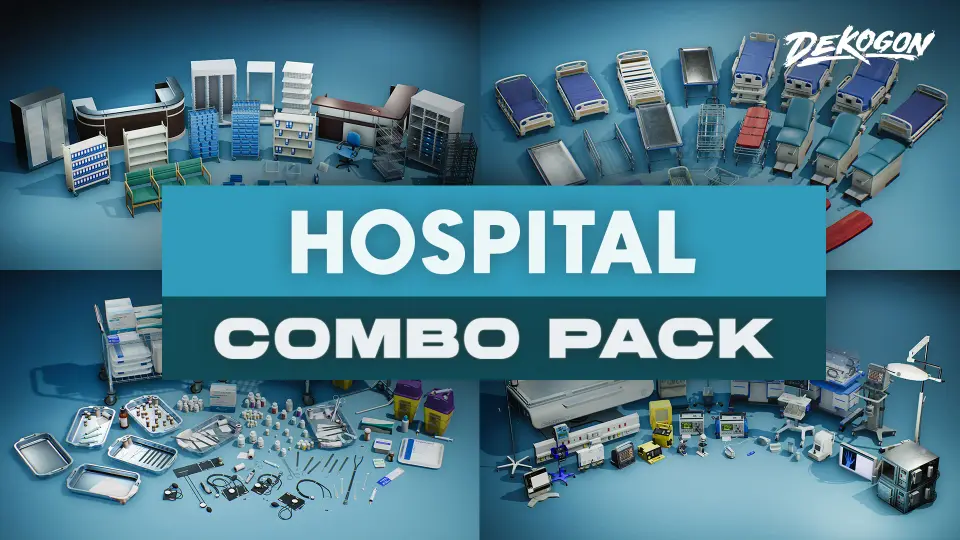
Hospital - COMBO Prop Pack (VOL 1-6) consolidates six individual asset packs into a unified Unreal Engine project. Created by Dekogon Kollab artists, this compilation gathers hospital machinery, medical equipment, clinical furnishings, and healthcare fixtures built specifically for production environments. Bringing Volumes 1 through 6 together delivers a complete spectrum of interior clinical hardware, spanning diagnostic machines, treatment tools, patient care apparatus, and technical utility assets needed to furnish believable medical settings.
Every asset across the six included volumes is built to balance visual fidelity with strict game-performance budgets. Rather than relying on cinematic meshes that strain real-time frame rates, the models use low-poly geometry tailored for interactive applications. The collection emphasizes realistic AAA visuals, matching the physical style, form factors, and utilitarian details found in working healthcare facilities, industrial clinics, and clinical simulation spaces.
Texture Fidelity and Channel-Packed PBR Mapping
Surfaces across the entire prop library use dedicated physically based rendering (PBR) texture maps intended for high visual fidelity. Most textures are authored at 2048 pixels or higher, preserving fine labels, metallic highlights, rubber grips, plastic casings, and industrial wear on diagnostic machines and treatment gear. These high-resolution maps ensure that props hold their detail when viewed up close in first-person perspectives or cinematic close-up shots.
To keep the asset collection optimized for games, the texture workflows incorporate channel packing. Roughness, Metalness, and Ambient Occlusion data are combined into distinct channels of a single texture map. Packing Roughness, Metalness, and Ambient Occlusion reduces the total texture memory footprint and decreases texture sampler counts inside the engine shaders. This pipeline standard keeps draw calls efficient and memory overhead low, even when scenes contain dozens of distinct medical instruments, carts, and monitoring stations simultaneously.
Master Material Controls Across Prop Models
Managing surface appearances across six full volumes of props is handled through a centralized master material setup. This master material controls the majority of all props and models in the project, providing a unified shader framework that feeds child material instances across the collection. A single, structured master material guarantees visual consistency across disparate models while keeping shader compilation fast and organized within Unreal Engine.
The master material setup exposes specific parameters that give artists direct control over visual characteristics without modifying underlying textures. Users can tweak:
Roughness parameters to adjust surface wear, glossiness, and matte finishes across plastic, rubber, and painted metal.
Albedo color tinting and tone values to match specific institutional branding or sterile hospital color codes.
Normal map intensity to soften or emphasize surface relief, panel seams, screws, and structural recesses.
Additional surface controls that govern fine PBR adjustments across individual prop instances.
These exposed controls streamline environment variation. A single medical cart or diagnostic console can be tuned from factory-clean clinical white to a scuffed, older utility finish through instance adjustments alone, preventing the need to export and re-import alternate texture maps.
Evaluation Inside the Test Dynamic Lighting Scene
The package includes a dedicated test dynamic lighting scene built directly in Unreal Engine. This environment allows artists and level designers to inspect assets, maps, and materials under live light sources before placing props into production levels. Dynamic lighting exposes how the roughness maps scatter light, how normal maps respond to moving illumination, and how ambient occlusion maps ground the machinery against floors and walls.
Testing assets in a dynamic lighting environment verifies that the low-poly models maintain their silhouette and visual weight under sharp directional lights, fluorescent room strips, and point lights. Because the test scene contains all assets, maps, and materials fully wired to their master materials, it functions as a working visual library where props can be reviewed in real time, inspected for surface behavior, and copied directly into destination levels.
Healthcare Environments and Simulation Workflows
The thematic scope of Volumes 1 through 6 encompasses machinery, hospital gear, X-ray equipment, and health devices. This variety makes the collection suited for realistic interactive games, emergency room walkthroughs, virtual healthcare training modules, and industrial laboratory simulations. The realistic aesthetic ensures that diagnostic units, monitors, and clinical tools fit together naturally within examination rooms, triage centers, intensive care wards, and sterile research facilities.
Beyond modern hospital interiors, the collection offers structural compatibility alongside larger world-building assets such as the Meridian 1988: King Wash Stripmall - Modular Environment (VOL 55). Studios building extensive urban maps, period facilities, or mixed-use commercial and medical spaces can pair the specialized clinical hardware from Volumes 1 through 6 with broader modular environment packs to build cohesive, detailed scenes.
 Buildings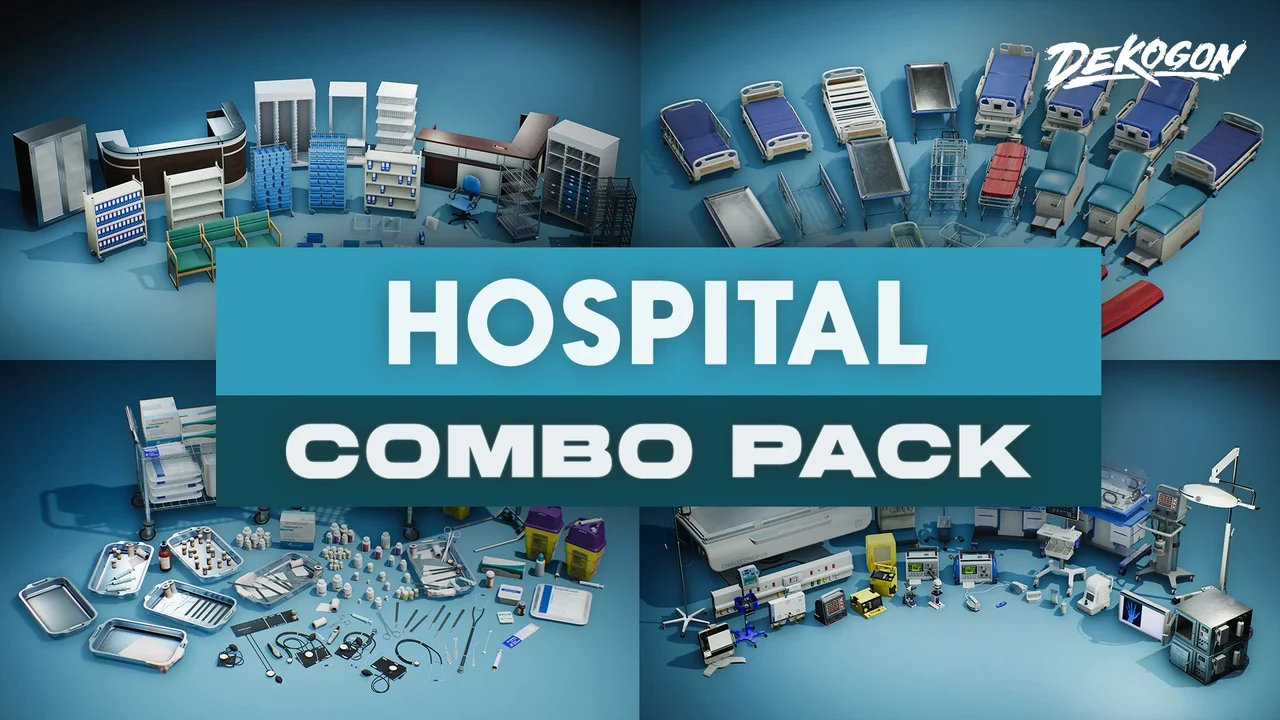
 Buildings
 Buildings
 Buildings