"4481da9c895ef786"{"id":"1000289","slug":"construction-site-vol-2-tools-parts-and-machine-props","title":"Construction Site VOL. 2 - Tools, Parts, and Machine Props","category":"Weapons \u0026 Combat","engine":"4.26+,5.0+","assetVersion":"","engineVersion":"Engine Version: 4.26+,5.0+","tag":"Weapons \u0026 Combat","accent":"blue","visual":"mech","summary":"A collection of 52 fully enclosed, AAA-quality construction and industrial meshes featuring channel-packed textures, master materials, and custom branding.","platform":"Unreal Engine","publishedAt":"2026-07-03T17:20:29.410Z","updatedAt":"2026-07-03T17:20:29.410Z","sourceNotes":[],"fileContents":[],"compatibility":["Unreal Engine","Engine Version: 4.26+,5.0+"],"featuredImage":{"alt":"Construction Site VOL. 2 - Tools, Parts, and Machine Props","src":"/wp-content/uploads/published/2026/07/a7331677dfa6-faca2441-88a4-4e43-8592-bc42f2ae4ebe-bd11c491c5.webp"},"hasDownloadLink":true,"downloads":0,"terms":[{"taxonomy":"category","slug":"weapons-and-combat","name":"Weapons \u0026 Combat"}],"galleryImages":[{"src":"/wp-content/uploads/published/2026/07/0bc77a9d1307-792a4892-636f-467d-8c77-ced0484f7d86-b763019143.webp","alt":"Construction Site VOL. 2 - Tools, Parts, and Machine Props"},{"src":"/wp-content/uploads/published/2026/07/a6aff0364857-8d153a41-dd12-48de-902c-a9e721a87f5a-533e05b0ec.webp","alt":"Construction Site VOL. 2 - Tools, Parts, and Machine Props"},{"src":"/wp-content/uploads/published/2026/07/73b78fa5e3a7-374bf5fc-cc0a-4497-8c40-fe1b39f984de-c251310d25.webp","alt":"Construction Site VOL. 2 - Tools, Parts, and Machine Props"},{"src":"/wp-content/uploads/published/2026/07/05ad6bbdf833-0d4cfc83-bac2-4224-acfe-a448d910ed42-f0620a1cd8.webp","alt":"Construction Site VOL. 2 - Tools, Parts, and Machine Props"},{"src":"/wp-content/uploads/published/2026/07/7e0d85332a9c-5d285492-c622-4c7a-be0d-53317a208617-1d348db709.webp","alt":"Construction Site VOL. 2 - Tools, Parts, and Machine Props"},{"src":"/wp-content/uploads/published/2026/07/053b1c214c9d-665b707a-67e3-4e5b-a91b-d7bf8ee81ecc-f92a50a938.webp","alt":"Construction Site VOL. 2 - Tools, Parts, and Machine Props"},{"src":"/wp-content/uploads/published/2026/07/c7c2eba4b6f6-8c3bae0c-2c3e-4767-a9f0-591de6ce9622-94482396fc.webp","alt":"Construction Site VOL. 2 - Tools, Parts, and Machine Props"},{"src":"/wp-content/uploads/published/2026/07/3e12ff807384-159a3e42-ee51-44a6-94a0-48d4e444357c-f55bbcdbb0.webp","alt":"Construction Site VOL. 2 - Tools, Parts, and Machine Props"},{"src":"/wp-content/uploads/published/2026/07/9c8ab77935d6-9365d6b7-3611-4d7f-b30b-3e294e162987-bc9e2a51d7.webp","alt":"Construction Site VOL. 2 - Tools, Parts, and Machine Props"},{"src":"/wp-content/uploads/published/2026/07/45c92400ec48-7a374ad5-1f1a-4478-a676-d44b7a4719cb-4bac5a9b3b.webp","alt":"Construction Site VOL. 2 - Tools, Parts, and Machine Props"}],"accessPanel":{"kind":"resource","title":"Download this resource","eyebrow":"Free Download","message":"Log in or create a free account to start your download.","fileName":"Content.7z","safetyNote":"Resources are manually reviewed before listing to improve quality and reduce obvious risks.","actionLabel":"Download Free","resourceType":"Resource archive"},"contentHtml":"\u003cp\u003eConstruction Site VOL. 2 - Tools, Parts, and Machine Props delivers a specialized collection of 52 distinct meshes engineered natively within Unreal Engine. The package provides a complete suite of assets, maps, materials, Blueprints, and visual effects geared toward realistic, AAA-quality production environments. Focusing heavily on industrial and garage settings, the collection supplies the essential components needed to populate a workshop, factory floor, or active building site with high-fidelity machinery and hand tools.\u003c/p\u003e \u003ch2\u003eThe 52-Mesh Construction Arsenal\u003c/h2\u003e \u003cp\u003eThe core of the project relies on 52 individual meshes covering a variety of industrial necessities. Based on the project parameters, these components span from heavy machine props and workbenches to ladders, saws, and specialized hand tools. Every model in the collection is fully enclosed and detailed from all sides. This 360-degree detailing is crucial for interactive environments, physics-driven simulations, and virtual reality applications where players might pick up, drop, or closely inspect an object. Because there are no missing back-faces or hollowed-out bottoms, the tools and parts can be scattered dynamically across a scene or knocked off a table without revealing broken geometry.\u003c/p\u003e \u003cp\u003eWhile the assets maintain a lowpoly framework for performance efficiency, they do not sacrifice visual complexity. The creators aimed for strict realism, ensuring the silhouettes and surface details match their real-world counterparts. This balance allows the props to function seamlessly across different project types, whether serving as background set dressing in an industrial simulation or operating as interactive items in a realistic horror game.\u003c/p\u003e \u003ch2\u003eCustom Branding and Legal Safety\u003c/h2\u003e \u003cp\u003ePopulating a realistic garage or construction site often presents a unique challenge regarding real-world trademarks and copyrighted logos. To bypass this friction, the development studio custom-designed all branding and labels present on the tools and machinery. Every logo, warning sticker, and manufacturer mark is an original creation. This ensures the entire collection remains entirely free of legal issues, allowing developers to deploy the assets in commercial projects, broadcasts, or architectural visualizations without the need to scrub or alter the existing textures.\u003c/p\u003e \u003ch2\u003eHigh-Resolution Texture Distribution\u003c/h2\u003e \u003cp\u003eSurface fidelity relies on a carefully distributed hierarchy of high-quality texture sets. The vast majority of the visual data is authored at 2048 pixels or higher, ensuring crisp readability when the camera is close to the machine props. The texture distribution is broken down by specific resolutions to optimize memory overhead based on the size and importance of the asset.\u003c/p\u003e \u003cp\u003eThe project includes 80 textures at the maximum 2048x2048 resolution, dedicating the most detail to the primary tools and large machine surfaces. To conserve resources on smaller components or secondary details, the collection scales down strategically, providing four 1024x1024 textures, three 512x512 textures, one 256x256 texture, and three 128x128 textures. This tiered approach allows the environment to look dense and realistic without unnecessarily bloating the texture memory budget.\u003c/p\u003e \u003ch2\u003eChannel Packed Textures for Optimization\u003c/h2\u003e \u003cp\u003eTo further streamline performance, the project relies on channel-packed textures. Instead of assigning a unique texture map to every single material property, multiple grayscale maps are consolidated into the individual Red, Green, Blue, and Alpha channels of a single image file. The collection packs Roughness, Metalness, Ambient Occlusion, and Emissive data into these shared channels.\u003c/p\u003e \u003cp\u003eThis packing method drastically reduces the number of texture draw calls the engine must process. A single texture lookup provides the shader with four distinct pieces of physically based rendering (PBR) information. As a result, the metallic sheen of a saw blade, the matte finish of a plastic handle, and the self-illuminated portions of a machine prop all render accurately with minimal performance cost.\u003c/p\u003e \u003ch2\u003eMaster Material Setup and Detail Maps\u003c/h2\u003e \u003cp\u003eThe visual consistency of the entire collection is anchored by a comprehensive master material setup. This unified architecture controls the vast majority of the included props and models. By utilizing a master material, developers can make global adjustments that propagate across the entire garage or construction site instantly, ensuring uniform lighting responses and cohesive art direction.\u003c/p\u003e \u003cp\u003eWithin this material framework, environment artists have access to additional parameter controls to fine-tune specific visual traits. The setup includes dedicated controls for roughness, albedo, and normals. When the camera pushes in close to a workbench or a heavy tool, the material system utilizes detail maps. These maps add a secondary layer of micro-detail—such as fine scratches, grain, or subtle color variation—along with specific controls for detail normal, roughness, and albedo. This breaks up the surface appearance at a granular level, preventing large metal parts or wide tables from looking artificially smooth or repetitive.\u003c/p\u003e \u003ch2\u003eEnvironmental Weathering via Vertex Blending\u003c/h2\u003e \u003cp\u003eIndustrial scenes rarely look pristine, and the collection provides built-in tools for grounding the props in gritty environments. The project includes two dirt vertex-blended textures and materials. Vertex blending allows developers to paint dirt, grime, or wear directly onto the meshes inside the Unreal Engine editor.\u003c/p\u003e \u003cp\u003eBy painting on the vertex colors of the tools and tables, an artist can manually dictate where dirt accumulates—such as in the crevices of a machine part, along the base of a ladder, or across the top of a heavily used workbench. This technique breaks up tiling textures and allows multiple instances of the exact same prop to look completely different depending on how they are painted in the level.\u003c/p\u003e \u003ch2\u003eScene Aesthetics and Post-Processing\u003c/h2\u003e \u003cp\u003eTo help integrate the 52 meshes into a cohesive final image, the collection includes a realistic Post Process setup and a custom Look Up Table (LUT). The LUT applies a specific color grading profile to the scene, shifting the contrast and color balance to match the intended AAA visual style. The included post-process configuration works in tandem with the PBR materials and channel-packed textures, ensuring the tools, parts, and machine props sit naturally within complex lighting environments. From a brightly lit industrial simulation to a dark, abandoned horror setting, the combination of detailed material controls and custom post-processing gives developers the flexibility to adapt the assets to their specific project requirements.\u003c/p\u003e\n\n\u003ch2\u003eMore From The Same Workflow\u003c/h2\u003e\n\u003cul\u003e\n\u003cli\u003e\u003ca href=\"https://3dcghub.com/post-apocalyptic-melee-weapons-vol-2-post-apocalyptic-melee-weapons-weapon-old/\" title=\"Post Apocalyptic Melee Weapons VOL.2 (Post Apocalyptic Melee Weapons Weapon Old)\"\u003ePost Apocalyptic Melee Weapons VOL.2 (Post Apocalyptic Melee Weapons Weapon Old)\u003c/a\u003e\u003c/li\u003e\n\u003cli\u003e\u003ca href=\"https://3dcghub.com/medieval-props-vol-3-farm/\" title=\"Medieval Props Vol 3 Farm\"\u003eMedieval Props Vol 3 Farm\u003c/a\u003e\u003c/li\u003e\n\u003cli\u003e\u003ca href=\"https://3dcghub.com/death-male-body-parts-collection-vol-vii/\" title=\"Death Male Body Parts Collection VOL.VII\"\u003eDeath Male Body Parts Collection VOL.VII\u003c/a\u003e\u003c/li\u003e\n\u003cli\u003e\u003ca href=\"https://3dcghub.com/driveable-animated-construction-truck-construction-truck-heavy-duty-3d-model/\" title=\"Driveable / Animated Construction Truck (Construction Truck Heavy Duty 3D Model)\"\u003eDriveable / Animated Construction Truck (Construction Truck Heavy Duty 3D Model)\u003c/a\u003e\u003c/li\u003e\n\u003cli\u003e\u003ca href=\"https://3dcghub.com/medieval-siege-weapons/\" title=\"Medieval Siege Weapons\"\u003eMedieval Siege Weapons\u003c/a\u003e\u003c/li\u003e\n\u003c/ul\u003e","contentTextLength":6982,"navigation":{"current":1116,"total":3269,"previous":{"id":"1000290","slug":"death-from-above-gunship-mini-game","title":"Death From Above - Gunship Mini-Game","category":"Weapons \u0026 Combat","platform":"Unreal Engine","updatedAt":"2026-07-03T17:22:49.725Z"},"next":{"id":"1000288","slug":"chinese-noble-lady","title":"Chinese Noble Lady","category":"Characters \u0026 Creatures","platform":"Unreal Engine","updatedAt":"2026-07-03T17:14:30.329Z"}},"relatedResources":[{"id":"1000382","slug":"military-supplies-vol-5-war-machines","title":"Military Supplies - VOL.5 - War Machines","category":"Weapons \u0026 Combat","engine":"4.26+,5.0+","assetVersion":"","engineVersion":"Engine Version: 4.26+,5.0+","tag":"Weapons \u0026 Combat","accent":"blue","visual":"mech","summary":"Explore the technical setup of Military Supplies - VOL.5 - War Machines, featuring Unreal Engine master materials, channel-packed textures, and custom branding.","platform":"Unreal Engine","publishedAt":"2026-07-07T08:05:40.545Z","updatedAt":"2026-07-07T08:05:40.545Z","sourceNotes":[],"fileContents":[],"compatibility":["Unreal Engine","Engine Version: 4.26+,5.0+"],"featuredImage":{"alt":"Military Supplies - VOL.5 - War Machines","src":"/wp-content/uploads/published/2026/07/d2265e2418dc-548e47e9-3407-4b71-a98f-9698f89b1ef3-51452d68e5.webp"},"hasDownloadLink":true,"downloads":1},{"id":"1000333","slug":"sci-fi-arsenal-vol-3-1","title":"Sci-fi Arsenal Vol 3.1","category":"Weapons \u0026 Combat","engine":"4.27,5.0+","assetVersion":"","engineVersion":"Engine Version: 4.27,5.0+","tag":"Weapons \u0026 Combat","accent":"blue","visual":"mech","summary":"A high-quality collection of sci-fi weapons for next-gen shooters in Unreal Engine, featuring custom blueprints, Control Rigs, and customizable materials.","platform":"Unreal Engine","publishedAt":"2026-07-05T07:27:08.923Z","updatedAt":"2026-07-05T07:27:08.923Z","sourceNotes":[],"fileContents":[],"compatibility":["Unreal Engine","Engine Version: 4.27,5.0+"],"featuredImage":{"alt":"Sci-fi Arsenal Vol 3.1","src":"/wp-content/uploads/published/2026/07/55f35fc469c7-e976b5d6-4493-484b-8d86-8e8c45e987e8-07f31ee841.webp"},"hasDownloadLink":true,"downloads":0},{"id":"1000417","slug":"abandoned-service-garage-vol-4-vehicles-and-service-machines","title":"Abandoned Service Garage - VOL.4 - Vehicles and Service Machines","category":"Cars \u0026 Trucks","engine":"4.26+,5.0+","assetVersion":"","engineVersion":"Engine Version: 4.26+,5.0+","tag":"Cars \u0026 Trucks","accent":"blue","visual":"mech","summary":"Explore the technical setup of Abandoned Service Garage - VOL.4, featuring Unreal Engine assets, vehicles, machinery, and a customized master material system.","platform":"Unreal Engine","publishedAt":"2026-07-08T21:45:16.576Z","updatedAt":"2026-07-08T21:45:16.576Z","sourceNotes":[],"fileContents":[],"compatibility":["Unreal Engine","Engine Version: 4.26+,5.0+"],"featuredImage":{"alt":"Abandoned Service Garage - VOL.4 - Vehicles and Service Machines","src":"/wp-content/uploads/published/2026/07/5ee6bf34b6e6-1a3b6f7e-3f8a-45fc-a351-7c7546eac482-a42bc5cdcd.webp"},"hasDownloadLink":true,"downloads":2}]}
Weapons & Combat
Construction Site VOL. 2 - Tools, Parts, and Machine Props
A collection of 52 fully enclosed, AAA-quality construction and industrial meshes featuring channel-packed textures, master materials, and custom branding.
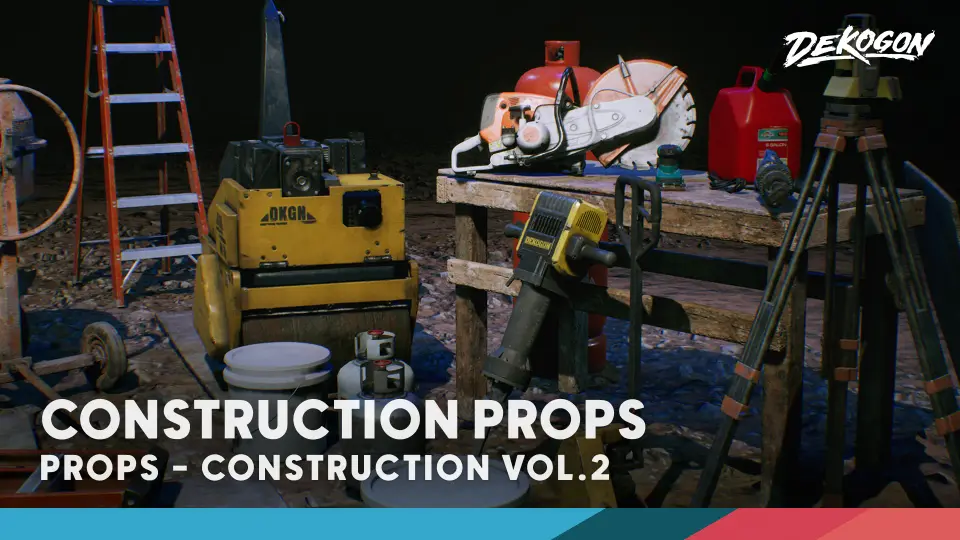
Construction Site VOL. 2 - Tools, Parts, and Machine Props delivers a specialized collection of 52 distinct meshes engineered natively within Unreal Engine. The package provides a complete suite of assets, maps, materials, Blueprints, and visual effects geared toward realistic, AAA-quality production environments. Focusing heavily on industrial and garage settings, the collection supplies the essential components needed to populate a workshop, factory floor, or active building site with high-fidelity machinery and hand tools.
The 52-Mesh Construction Arsenal
The core of the project relies on 52 individual meshes covering a variety of industrial necessities. Based on the project parameters, these components span from heavy machine props and workbenches to ladders, saws, and specialized hand tools. Every model in the collection is fully enclosed and detailed from all sides. This 360-degree detailing is crucial for interactive environments, physics-driven simulations, and virtual reality applications where players might pick up, drop, or closely inspect an object. Because there are no missing back-faces or hollowed-out bottoms, the tools and parts can be scattered dynamically across a scene or knocked off a table without revealing broken geometry.
While the assets maintain a lowpoly framework for performance efficiency, they do not sacrifice visual complexity. The creators aimed for strict realism, ensuring the silhouettes and surface details match their real-world counterparts. This balance allows the props to function seamlessly across different project types, whether serving as background set dressing in an industrial simulation or operating as interactive items in a realistic horror game.
Custom Branding and Legal Safety
Populating a realistic garage or construction site often presents a unique challenge regarding real-world trademarks and copyrighted logos. To bypass this friction, the development studio custom-designed all branding and labels present on the tools and machinery. Every logo, warning sticker, and manufacturer mark is an original creation. This ensures the entire collection remains entirely free of legal issues, allowing developers to deploy the assets in commercial projects, broadcasts, or architectural visualizations without the need to scrub or alter the existing textures.
High-Resolution Texture Distribution
Surface fidelity relies on a carefully distributed hierarchy of high-quality texture sets. The vast majority of the visual data is authored at 2048 pixels or higher, ensuring crisp readability when the camera is close to the machine props. The texture distribution is broken down by specific resolutions to optimize memory overhead based on the size and importance of the asset.
The project includes 80 textures at the maximum 2048x2048 resolution, dedicating the most detail to the primary tools and large machine surfaces. To conserve resources on smaller components or secondary details, the collection scales down strategically, providing four 1024x1024 textures, three 512x512 textures, one 256x256 texture, and three 128x128 textures. This tiered approach allows the environment to look dense and realistic without unnecessarily bloating the texture memory budget.
Channel Packed Textures for Optimization
To further streamline performance, the project relies on channel-packed textures. Instead of assigning a unique texture map to every single material property, multiple grayscale maps are consolidated into the individual Red, Green, Blue, and Alpha channels of a single image file. The collection packs Roughness, Metalness, Ambient Occlusion, and Emissive data into these shared channels.
This packing method drastically reduces the number of texture draw calls the engine must process. A single texture lookup provides the shader with four distinct pieces of physically based rendering (PBR) information. As a result, the metallic sheen of a saw blade, the matte finish of a plastic handle, and the self-illuminated portions of a machine prop all render accurately with minimal performance cost.
Master Material Setup and Detail Maps
The visual consistency of the entire collection is anchored by a comprehensive master material setup. This unified architecture controls the vast majority of the included props and models. By utilizing a master material, developers can make global adjustments that propagate across the entire garage or construction site instantly, ensuring uniform lighting responses and cohesive art direction.
Within this material framework, environment artists have access to additional parameter controls to fine-tune specific visual traits. The setup includes dedicated controls for roughness, albedo, and normals. When the camera pushes in close to a workbench or a heavy tool, the material system utilizes detail maps. These maps add a secondary layer of micro-detail—such as fine scratches, grain, or subtle color variation—along with specific controls for detail normal, roughness, and albedo. This breaks up the surface appearance at a granular level, preventing large metal parts or wide tables from looking artificially smooth or repetitive.
Environmental Weathering via Vertex Blending
Industrial scenes rarely look pristine, and the collection provides built-in tools for grounding the props in gritty environments. The project includes two dirt vertex-blended textures and materials. Vertex blending allows developers to paint dirt, grime, or wear directly onto the meshes inside the Unreal Engine editor.
By painting on the vertex colors of the tools and tables, an artist can manually dictate where dirt accumulates—such as in the crevices of a machine part, along the base of a ladder, or across the top of a heavily used workbench. This technique breaks up tiling textures and allows multiple instances of the exact same prop to look completely different depending on how they are painted in the level.
Scene Aesthetics and Post-Processing
To help integrate the 52 meshes into a cohesive final image, the collection includes a realistic Post Process setup and a custom Look Up Table (LUT). The LUT applies a specific color grading profile to the scene, shifting the contrast and color balance to match the intended AAA visual style. The included post-process configuration works in tandem with the PBR materials and channel-packed textures, ensuring the tools, parts, and machine props sit naturally within complex lighting environments. From a brightly lit industrial simulation to a dark, abandoned horror setting, the combination of detailed material controls and custom post-processing gives developers the flexibility to adapt the assets to their specific project requirements.
 Weapons & Combat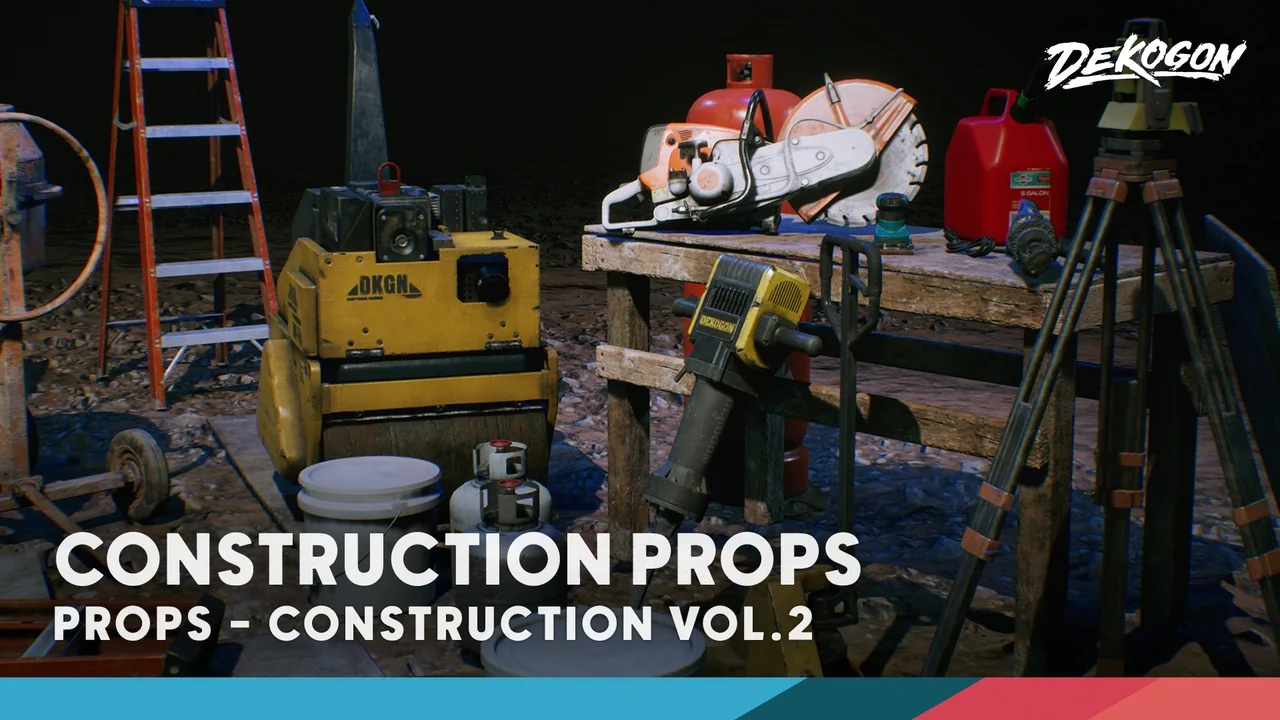
 Weapons & Combat
 Weapons & Combat
 Cars & Trucks