"4481da9c895ef786"{"id":"1000288","slug":"chinese-noble-lady","title":"Chinese Noble Lady","category":"Characters \u0026 Creatures","engine":"4.26+,5.0+","assetVersion":"","engineVersion":"Engine Version: 4.26+,5.0+","tag":"Characters","accent":"blue","visual":"character","summary":"A rigged 3D character model featuring an Epic Skeleton hierarchy, three body shapes, morph targets, and a modular 10-part 4K PBR texture workflow.","platform":"Unreal Engine","publishedAt":"2026-07-03T17:14:30.329Z","updatedAt":"2026-07-03T17:14:30.329Z","sourceNotes":[],"fileContents":[],"compatibility":["Unreal Engine","Engine Version: 4.26+,5.0+"],"featuredImage":{"alt":"Chinese Noble Lady","src":"/wp-content/uploads/published/2026/07/f0557a766620-5ad2eb8a-5979-4948-a50f-5e29da8379b6-60c7139b65.webp"},"hasDownloadLink":true,"downloads":0,"terms":[{"taxonomy":"category","slug":"characters-and-creatures","name":"Characters \u0026 Creatures"}],"galleryImages":[{"src":"/wp-content/uploads/published/2026/07/6e1a703a9937-3f02347f-21b0-4616-a61a-50229a111133-97a5237182.webp","alt":"Chinese Noble Lady"},{"src":"/wp-content/uploads/published/2026/07/3f6b8764d407-4a7a856a-b488-4ae4-b387-7acf4d948733-c0df4feac0.webp","alt":"Chinese Noble Lady"},{"src":"/wp-content/uploads/published/2026/07/a642b23f7a05-05f76675-7243-4805-ba61-942aa6b3a166-e77e2b7109.webp","alt":"Chinese Noble Lady"},{"src":"/wp-content/uploads/published/2026/07/fb21197170a4-e72fe646-d3d9-4c9b-a9f2-3bc6a478fd8d-4c20c94c83.webp","alt":"Chinese Noble Lady"},{"src":"/wp-content/uploads/published/2026/07/8dfd6801484a-5aef3d54-5aba-4749-b159-65fce22f1ad1-816514bff3.webp","alt":"Chinese Noble Lady"},{"src":"/wp-content/uploads/published/2026/07/783c5103b586-6e2dadae-17cc-44b1-aa02-caeff5bedc6e-49f0346045.webp","alt":"Chinese Noble Lady"},{"src":"/wp-content/uploads/published/2026/07/021172538736-b22c32c3-61e4-4914-bacf-e5ad9e8c1386-34246f5aea.webp","alt":"Chinese Noble Lady"},{"src":"/wp-content/uploads/published/2026/07/af2905c07d09-94967e0a-6c57-44ed-ab89-3828ac9119d9-18cec5d85b.webp","alt":"Chinese Noble Lady"},{"src":"/wp-content/uploads/published/2026/07/68d6a8cd7246-f86ecef3-534e-4278-891d-cc15a316fbbc-3c03d1f6e6.webp","alt":"Chinese Noble Lady"},{"src":"/wp-content/uploads/published/2026/07/0369e787413f-685441df-a467-4629-a23d-3c8517964171-e6899e8247.webp","alt":"Chinese Noble Lady"}],"accessPanel":{"kind":"resource","title":"Download this resource","eyebrow":"Free Download","message":"Log in or create a free account to start your download.","fileName":"Content.7z","safetyNote":"Resources are manually reviewed before listing to improve quality and reduce obvious risks.","actionLabel":"Download Free","resourceType":"Resource archive"},"contentHtml":"\u003ch2\u003eRigging and Epic Skeleton Implementation\u003c/h2\u003e\n\u003cp\u003eIntegrating the Chinese Noble Lady character model into a real-time environment begins directly at the rigging stage. Designed around the Epic Skeleton and standard Humanoid rig structures, the character is built to accept existing animation libraries immediately. Developers working in real-time engines can utilize standard retargeting pipelines to apply walk cycles, combat animations, or idle poses without needing to construct or re-rig the base bipedal hierarchy from scratch. This structural standard ensures that the implementation path remains predictable for teams relying on pre-existing motion capture data or standard marketplace animation packs, allowing for rapid prototyping and gameplay testing.\u003c/p\u003e\n\u003cp\u003eBeyond the primary bipedal skeleton, the mesh includes specific rigging for secondary elements to enhance dynamic movement. The eyes, coat, and breast are fully rigged, providing the necessary bone structure to implement physics-based movement or manual keyframing in engine. Because the asset strictly does not include any pre-configured Blueprints or Animation Blueprints, developers will need to set up their own physics assets, AnimDynamics, or rigid body spring controllers to drive the movement of the coat and other secondary bones. The presence of these specific bones, however, means the geometry is already mathematically weighted and prepared for dynamic motion, allowing the flowing fabric of the traditional dress to react naturally to character movement once the engine-side physics constraints are applied by the technical artist.\u003c/p\u003e\n\u003ch2\u003eManaging Body Shapes and Blendshapes\u003c/h2\u003e\n\u003cp\u003eThe model is delivered with three distinct body shapes, offering flexibility depending on the specific rendering or gameplay needs of the scene. These structural variations include fully clothed versions of the character as well as a base body without clothes, which is provided in a censored format. Having access to the underlying unclothed body shape is highly practical for developers who might want to layer custom garments, adjust the existing clothing fit, or ensure proper collision volumes when setting up real-time cloth physics simulations over the mesh. All three variations of the character are fully rigged, ensuring that switching between the body types does not require a new animation setup.\u003c/p\u003e\n\u003cp\u003eOn top of that, the character meshes are equipped with a complete set of morph targets and blendshapes. The inclusion of these morphs allows animators to drive facial expressions, lip-syncing for dialogue, or subtle anatomical and structural adjustments directly through the engine's animation sequencer or via runtime scripts. Because the blendshapes are integrated alongside the skeletal rig, developers can blend skeletal animation (like head turns and eye tracking) with morph-driven facial expressions to bring the character to life during cinematic sequences or close-up interactions.\u003c/p\u003e\n\u003ch2\u003e4K PBR Texturing and Material Sets\u003c/h2\u003e\n\u003cp\u003eFor the rendering pipeline, the Chinese Noble Lady relies on a comprehensive 4K Physically Based Rendering (PBR) workflow. The material setup follows the industry-standard Metal/Roughness methodology, utilizing specific high-resolution texture maps to define the surface properties of the skin, hair, and traditional attire. The provided map types include normal, metallic, roughness, albedo, and opacity. The inclusion of opacity maps is particularly critical for rendering the finer details of the model, specifically the isolated hair strands and the transition of the cornea, ensuring realistic light transmission, edge blending, and alpha clipping in close-up camera shots.\u003c/p\u003e\n\u003cp\u003eRather than relying on a single massive texture atlas, the character’s UVs and materials are divided across 10 distinct texture sets. This modular approach to texturing isolates different components of the character, allowing technical artists to assign specific shaders and material behaviors to different elements without complex masking. The texture sets are broken down into Body, Face, Cloth, Eyes, Cornea, Hair, Hanfu, Toushi, Shoes, and Hakama (which corresponds to the censored version). By separating the Hanfu (traditional robe) and Toushi (headpiece and ornaments) from the base cloth and body sets, developers can easily swap textures, adjust the tint of the fabric, or tweak the metallic reflectivity of the hair ornaments independently. Separating the cornea and eyes into two distinct sets also facilitates advanced eye shading techniques, such as rendering parallax depth or calculating realistic specular reflections on the surface of the eye.\u003c/p\u003e\n\u003ch2\u003eGeometry Profile and Mesh Topology\u003c/h2\u003e\n\u003cp\u003eStructurally, the character mesh is balanced for real-time performance while maintaining enough geometric density for close-up framing. The base geometry consists of 26,339 faces, yielding a total triangle count of 46,034 and 25,099 vertices. This specific polycount places the model in a versatile middle ground for modern development pipelines. At just over 46,000 triangles, it is detailed enough to serve as a primary hero character, a central NPC, or a cinematic asset in a high-fidelity environment. Simultaneously, it is lightweight enough that multiple instances of the character could potentially be rendered on-screen simultaneously without heavily bottlenecking the GPU.\u003c/p\u003e\n\u003cp\u003eThe vertex distribution supports the complex folds of the Hanfu and Hakama, ensuring that the silhouette holds up from multiple angles. This geometry also ensures that the facial topology deforms cleanly when the included blendshapes are activated, preventing texture stretching or unnatural shading artifacts during extreme facial expressions.\u003c/p\u003e\n\u003ch2\u003eStylistic Direction and Production Readiness\u003c/h2\u003e\n\u003cp\u003eVisually, the asset spans several stylistic categories, bridging the gap between realistic anatomical proportions and stylized, anime, or cartoon aesthetics. The design of the costume, featuring the intricate Hanfu and decorative Toushi, firmly grounds the character in a fantasy or historical Chinese setting, making it well-suited for roles such as a queen, noblewoman, or central narrative figure in a stylized universe.\u003c/p\u003e\n\u003cp\u003eFrom a production standpoint, it is important to factor in the exact scope of the provided files. This package provides the raw 3D assets essential for character art pipelines—meshes, rigs, morph targets, and 10 sets of 4K textures—but it strictly does not include any gameplay scripts or pre-built character controllers. Integration requires a developer or technical artist ready to assign the PBR materials, configure the runtime physics for the rigged coat and breast bones, and wire the morph targets into their engine's chosen animation or dialogue system.\u003c/p\u003e\n\n\u003ch2\u003eRelated Resources Worth Checking\u003c/h2\u003e\n\u003cul\u003e\n\u003cli\u003e\u003ca href=\"https://3dcghub.com/chinese-vampire/\" title=\"Chinese Vampire\"\u003eChinese Vampire\u003c/a\u003e\u003c/li\u003e\n\u003cli\u003e\u003ca href=\"https://3dcghub.com/asian-armour-metahuman/\" title=\"Asian Armour - Metahuman\"\u003eAsian Armour - Metahuman\u003c/a\u003e\u003c/li\u003e\n\u003cli\u003e\u003ca href=\"https://3dcghub.com/realistic-base-skeleton/\" title=\"Realistic Base Skeleton\"\u003eRealistic Base Skeleton\u003c/a\u003e\u003c/li\u003e\n\u003cli\u003e\u003ca href=\"https://3dcghub.com/l-chinesewarrior/\" title=\"L: ChineseWarrior\"\u003eL: ChineseWarrior\u003c/a\u003e\u003c/li\u003e\n\u003cli\u003e\u003ca href=\"https://3dcghub.com/eggo-the-talking-egg-face-morphs-epic-skeleton-skins-and-ultimate-material/\" title=\"Eggo the Talking Egg, face morphs, epic skeleton, skins and ultimate material\"\u003eEggo the Talking Egg, face morphs, epic skeleton, skins and ultimate material\u003c/a\u003e\u003c/li\u003e\n\u003c/ul\u003e","contentTextLength":6898,"navigation":{"current":1117,"total":3269,"previous":{"id":"1000289","slug":"construction-site-vol-2-tools-parts-and-machine-props","title":"Construction Site VOL. 2 - Tools, Parts, and Machine Props","category":"Weapons \u0026 Combat","platform":"Unreal Engine","updatedAt":"2026-07-03T17:20:29.410Z"},"next":{"id":"1000287","slug":"chairs-asset-pack","title":"Chairs - Asset Pack","category":"Furniture \u0026 Fixtures","platform":"Unreal Engine","updatedAt":"2026-07-03T17:08:09.906Z"}},"relatedResources":[{"id":"1902","slug":"chinese-vampire","title":"Chinese Vampire","category":"Characters \u0026 Creatures","engine":"4.26+,5.0+","assetVersion":"Engine version: 4.26+,5.0+","engineVersion":"4.21","tag":"Characters","accent":"blue","visual":"character","summary":"Discover a highly detailed Chinese Vampire character for your next horror project. This realistic 3D model is perfect for creating terrifying game environments.","platform":"Unreal Engine","publishedAt":"2026-02-06T22:20:45.000Z","updatedAt":"2026-04-19T15:58:27.000Z","sourceNotes":[],"fileContents":[],"compatibility":["Unreal Engine","Engine version: 4.26+,5.0+"],"featuredImage":{"alt":"Chinese Vampire","src":"https://3dcghub.com/wp-content/uploads/2026/02/0bb48d1b-7c2b-43df-9edc-a9f1bcc9df73.webp"},"hasDownloadLink":true,"downloads":0},{"id":"1650","slug":"asian-armour-metahuman","title":"Asian Armour - Metahuman","category":"Characters \u0026 Creatures","engine":"5.3+","assetVersion":"Engine version: 5.3+","engineVersion":"5.0","tag":"Characters","accent":"blue","visual":"character","summary":"Enhance your Unreal Engine project with the Asian Armour Pack. Featuring modular Chinese, Mongolian, and Samurai gear compatible with MetaHuman and UE5.","platform":"Unreal Engine","publishedAt":"2026-02-06T20:17:02.000Z","updatedAt":"2026-04-19T15:58:07.000Z","sourceNotes":[],"fileContents":[],"compatibility":["Unreal Engine","Engine version: 5.3+"],"featuredImage":{"alt":"Asian Armour - Metahuman","src":"https://3dcghub.com/wp-content/uploads/2026/02/47250ceb-dbcc-48c4-a64e-85f096544bda.webp"},"hasDownloadLink":true,"downloads":7},{"id":"1000638","slug":"mafioso","title":"Mafioso","category":"Characters \u0026 Creatures","engine":"4.26+,5.0+","assetVersion":"","engineVersion":"Engine Version: 4.26+,5.0+","tag":"Characters","accent":"blue","visual":"character","summary":"Mafioso rigged character asset with Epic Skeleton, modular mesh parts, PBR TGA textures, 5 ready-made skin variations, and overcoat closure blend shapes.","platform":"Unreal Engine","publishedAt":"2026-07-21T17:10:48.909Z","updatedAt":"2026-07-21T17:10:48.909Z","sourceNotes":[],"fileContents":[],"compatibility":["Unreal Engine","Engine Version: 4.26+,5.0+"],"featuredImage":{"alt":"Mafioso","src":"/wp-content/uploads/published/2026/07/39abfd261e4e-1e529bc4-2982-4915-982f-fab79b458eed-5c51acdf37.webp"},"hasDownloadLink":true,"downloads":0}]}
Characters
Chinese Noble Lady
A rigged 3D character model featuring an Epic Skeleton hierarchy, three body shapes, morph targets, and a modular 10-part 4K PBR texture workflow.
Integrating the Chinese Noble Lady character model into a real-time environment begins directly at the rigging stage. Designed around the Epic Skeleton and standard Humanoid rig structures, the character is built to accept existing animation libraries immediately. Developers working in real-time engines can utilize standard retargeting pipelines to apply walk cycles, combat animations, or idle poses without needing to construct or re-rig the base bipedal hierarchy from scratch. This structural standard ensures that the implementation path remains predictable for teams relying on pre-existing motion capture data or standard marketplace animation packs, allowing for rapid prototyping and gameplay testing.
Beyond the primary bipedal skeleton, the mesh includes specific rigging for secondary elements to enhance dynamic movement. The eyes, coat, and breast are fully rigged, providing the necessary bone structure to implement physics-based movement or manual keyframing in engine. Because the asset strictly does not include any pre-configured Blueprints or Animation Blueprints, developers will need to set up their own physics assets, AnimDynamics, or rigid body spring controllers to drive the movement of the coat and other secondary bones. The presence of these specific bones, however, means the geometry is already mathematically weighted and prepared for dynamic motion, allowing the flowing fabric of the traditional dress to react naturally to character movement once the engine-side physics constraints are applied by the technical artist.
Managing Body Shapes and Blendshapes
The model is delivered with three distinct body shapes, offering flexibility depending on the specific rendering or gameplay needs of the scene. These structural variations include fully clothed versions of the character as well as a base body without clothes, which is provided in a censored format. Having access to the underlying unclothed body shape is highly practical for developers who might want to layer custom garments, adjust the existing clothing fit, or ensure proper collision volumes when setting up real-time cloth physics simulations over the mesh. All three variations of the character are fully rigged, ensuring that switching between the body types does not require a new animation setup.
On top of that, the character meshes are equipped with a complete set of morph targets and blendshapes. The inclusion of these morphs allows animators to drive facial expressions, lip-syncing for dialogue, or subtle anatomical and structural adjustments directly through the engine's animation sequencer or via runtime scripts. Because the blendshapes are integrated alongside the skeletal rig, developers can blend skeletal animation (like head turns and eye tracking) with morph-driven facial expressions to bring the character to life during cinematic sequences or close-up interactions.
4K PBR Texturing and Material Sets
For the rendering pipeline, the Chinese Noble Lady relies on a comprehensive 4K Physically Based Rendering (PBR) workflow. The material setup follows the industry-standard Metal/Roughness methodology, utilizing specific high-resolution texture maps to define the surface properties of the skin, hair, and traditional attire. The provided map types include normal, metallic, roughness, albedo, and opacity. The inclusion of opacity maps is particularly critical for rendering the finer details of the model, specifically the isolated hair strands and the transition of the cornea, ensuring realistic light transmission, edge blending, and alpha clipping in close-up camera shots.
Rather than relying on a single massive texture atlas, the character’s UVs and materials are divided across 10 distinct texture sets. This modular approach to texturing isolates different components of the character, allowing technical artists to assign specific shaders and material behaviors to different elements without complex masking. The texture sets are broken down into Body, Face, Cloth, Eyes, Cornea, Hair, Hanfu, Toushi, Shoes, and Hakama (which corresponds to the censored version). By separating the Hanfu (traditional robe) and Toushi (headpiece and ornaments) from the base cloth and body sets, developers can easily swap textures, adjust the tint of the fabric, or tweak the metallic reflectivity of the hair ornaments independently. Separating the cornea and eyes into two distinct sets also facilitates advanced eye shading techniques, such as rendering parallax depth or calculating realistic specular reflections on the surface of the eye.
Geometry Profile and Mesh Topology
Structurally, the character mesh is balanced for real-time performance while maintaining enough geometric density for close-up framing. The base geometry consists of 26,339 faces, yielding a total triangle count of 46,034 and 25,099 vertices. This specific polycount places the model in a versatile middle ground for modern development pipelines. At just over 46,000 triangles, it is detailed enough to serve as a primary hero character, a central NPC, or a cinematic asset in a high-fidelity environment. Simultaneously, it is lightweight enough that multiple instances of the character could potentially be rendered on-screen simultaneously without heavily bottlenecking the GPU.
The vertex distribution supports the complex folds of the Hanfu and Hakama, ensuring that the silhouette holds up from multiple angles. This geometry also ensures that the facial topology deforms cleanly when the included blendshapes are activated, preventing texture stretching or unnatural shading artifacts during extreme facial expressions.
Stylistic Direction and Production Readiness
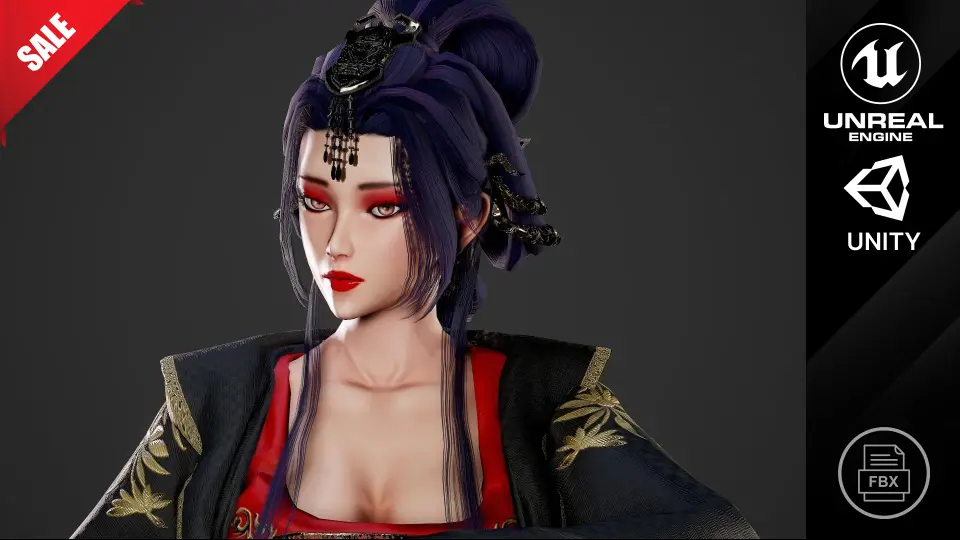
Visually, the asset spans several stylistic categories, bridging the gap between realistic anatomical proportions and stylized, anime, or cartoon aesthetics. The design of the costume, featuring the intricate Hanfu and decorative Toushi, firmly grounds the character in a fantasy or historical Chinese setting, making it well-suited for roles such as a queen, noblewoman, or central narrative figure in a stylized universe.
From a production standpoint, it is important to factor in the exact scope of the provided files. This package provides the raw 3D assets essential for character art pipelines—meshes, rigs, morph targets, and 10 sets of 4K textures—but it strictly does not include any gameplay scripts or pre-built character controllers. Integration requires a developer or technical artist ready to assign the PBR materials, configure the runtime physics for the rigged coat and breast bones, and wire the morph targets into their engine's chosen animation or dialogue system.
 Characters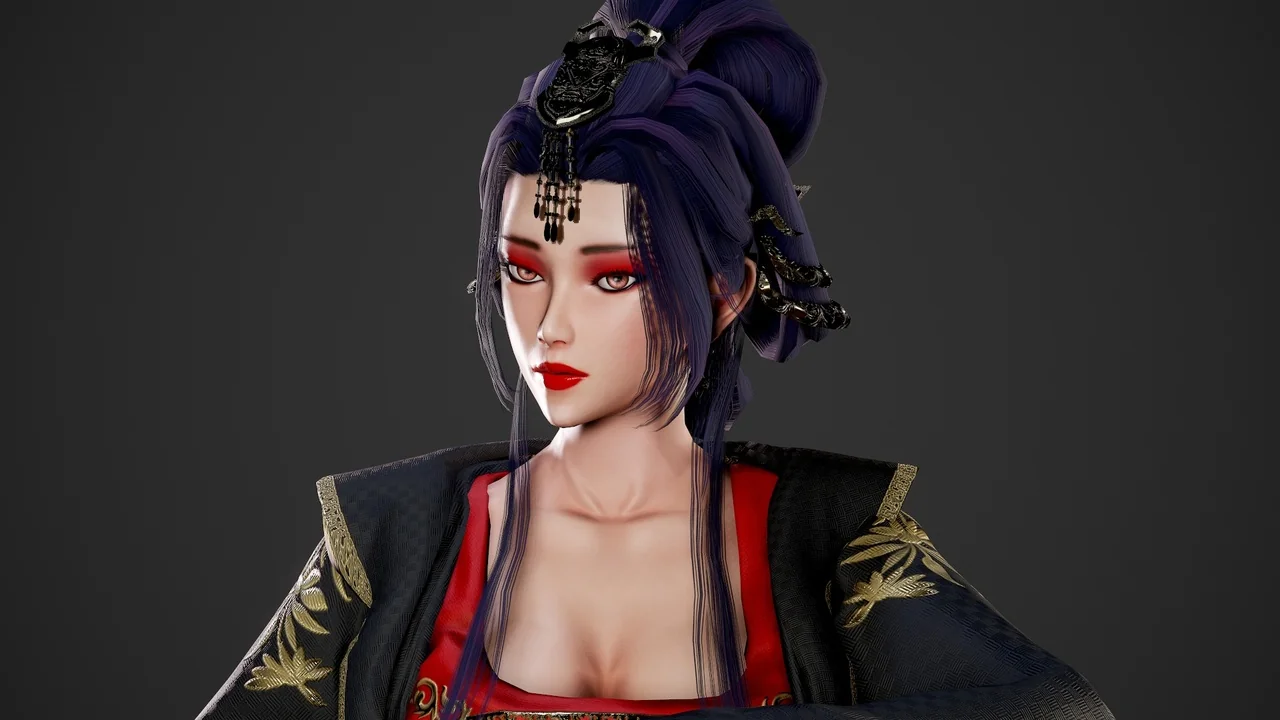
 Characters
 Characters
 Characters