"1c2c8b66743036b4"{"id":"1001698","slug":"post-apocalyptic-abandoned-coffee-shop-drive-thru","title":"Post Apocalyptic Abandoned Coffee Shop Drive Thru","category":"Apocalyptic / Post-apocalyptic","engine":"5.0+","assetVersion":"","engineVersion":"Engine Version: 5.0+","tag":"Apocalyptic","accent":"blue","visual":"mech","summary":"Examine the modular architecture, layered materials, texture budgets, and layout options in the Post Apocalyptic Abandoned Coffee Shop Drive Thru environment.","platform":"Unreal Engine","publishedAt":"2026-10-14T10:07:50.072Z","updatedAt":"2026-10-14T10:07:50.072Z","sourceNotes":[],"fileContents":[],"compatibility":["Unreal Engine","Engine Version: 5.0+"],"featuredImage":{"alt":"Post Apocalyptic Abandoned Coffee Shop Drive Thru","src":"/wp-content/uploads/published/2026/10/ef17473c3bd0-03682c0d-ee73-4661-9dba-feedf93c0a9d-516d90a349.webp"},"hasDownloadLink":true,"downloads":1,"terms":[{"taxonomy":"category","slug":"apocalyptic-post-apocalyptic","name":"Apocalyptic / Post-apocalyptic"}],"galleryImages":[{"src":"/wp-content/uploads/published/2026/10/d1784c0c16ea-c6534a2d-48bb-431b-9c11-a0b9a3ab1fdb-4782a0c05d.webp","alt":"Post Apocalyptic Abandoned Coffee Shop Drive Thru"},{"src":"/wp-content/uploads/published/2026/10/f197ae972ca3-a9452512-6b47-4038-bc33-e6c35cac6de4-78c5752e79.webp","alt":"Post Apocalyptic Abandoned Coffee Shop Drive Thru"},{"src":"/wp-content/uploads/published/2026/10/b8bbe62c4286-9fe1ee3f-098c-4096-9deb-caad5fa6f19e-95ce49a678.webp","alt":"Post Apocalyptic Abandoned Coffee Shop Drive Thru"},{"src":"/wp-content/uploads/published/2026/10/564cc645d23e-65d0326e-1632-450f-b4f3-35130c30ccda-ead9b4ef10.webp","alt":"Post Apocalyptic Abandoned Coffee Shop Drive Thru"},{"src":"/wp-content/uploads/published/2026/10/a4b80d5e69c2-0dbe9411-198c-4521-af5a-28f2431d6816-1e183ca9ba.webp","alt":"Post Apocalyptic Abandoned Coffee Shop Drive Thru"},{"src":"/wp-content/uploads/published/2026/10/b17ae18c7c3a-079dfd9e-b565-43b2-b831-db6fa97c07e6-a3fa284b9e.webp","alt":"Post Apocalyptic Abandoned Coffee Shop Drive Thru"},{"src":"/wp-content/uploads/published/2026/10/7263605639de-85b07322-bb87-4d22-b58a-0ae3d11bc115-deb84cd16c.webp","alt":"Post Apocalyptic Abandoned Coffee Shop Drive Thru"},{"src":"/wp-content/uploads/published/2026/10/fa89ba5672ac-bf5c23f8-012b-4e4c-9b78-6b0205855c03-4c77ff3371.webp","alt":"Post Apocalyptic Abandoned Coffee Shop Drive Thru"},{"src":"/wp-content/uploads/published/2026/10/f9834bdc75b2-218188d8-ab4b-4869-b33c-aeaa46184eef-b0eb6172b4.webp","alt":"Post Apocalyptic Abandoned Coffee Shop Drive Thru"},{"src":"/wp-content/uploads/published/2026/10/bfc6a13abb66-b73f9f47-2d6f-4120-8a48-b6dd29361637-6321370909.webp","alt":"Post Apocalyptic Abandoned Coffee Shop Drive Thru"}],"accessPanel":{"kind":"resource","title":"Download this resource","eyebrow":"Free Download","message":"Log in or create a free account to start your download.","fileName":"Content.7z","safetyNote":"Resources are manually reviewed before listing to improve quality and reduce obvious risks.","actionLabel":"Download Free","resourceType":"Resource archive"},"contentHtml":"\u003ch2\u003eAssembling the Modular Coffee Shop Drive Thru Architecture\u003c/h2\u003e\u003cp\u003eConstructing an abandoned roadside eatery begins with grid-aligned structural modules. The environment package provides 191 mesh assets engineered for modular assembly, allowing level designers to reproduce the default drive-thru layout or configure completely original architectural footprints. Structural pieces connect to form service windows, ordering lanes, seating areas, and commercial overhangs typical of American-style diner and coffee shop establishments.\u003c/p\u003e\u003cp\u003eProportions across the entire asset selection are calibrated directly to the Epic skeleton, ensuring player avatars interact realistically with counter heights, service openings, doors, and ceilings. Collision handling is pre-configured with simple collision meshes assigned to nearly all props, which reduces initial setup time when placing barricades, debris, furniture, and building components across an interactive level. The default assembled scene registers an overall triangle count of 4,715,287, representing a dense, fully dressed commercial property.\u003c/p\u003e\u003cp\u003eGeometric density varies intentionally according to asset scale and visual priority. The highest asset vertex count sits at 42,106 vertices for complex, focal geometry, while simple elements scale down to as low as 6 vertices. Across the entire asset library, the average vertex count settles at 1,573 vertices per mesh. Native level of detail (LOD) steps are not pre-baked into the static meshes, but the topology is structured to take immediate advantage of Unreal Engine's internal LOD generator tool to establish custom distance transitions.\u003c/p\u003e\u003ch2\u003eVertex Paint and Layered Materials for Weathered Surfaces\u003c/h2\u003e\u003cp\u003eSurface degradation across the architectural modules relies on specialized material construction rather than static, repetitious texturing. The environment features a dedicated vertex paint setup configured on the architectural geometry, enabling artists to manually paint wear, moisture, rust, and dirt transitions across walls, pillars, and floors directly within the level viewport.\u003c/p\u003e\u003cp\u003eThe package contains 146 material assets, broken down into 23 master materials, 98 material instances, and 25 shared material functions. Architectural surfaces leverage layered materials that combine multiple tileable material attributes with blending masks, which helps maintain close-up fidelity while eliminating recognizable texture repetition across expansive surface planes. Parameters exposed within the material instances allow fine-tuning of surface response, roughness influence, and damage localization across both the interior and exterior surfaces.\u003c/p\u003e\u003cp\u003eTextures are formatted using channel-packed setups to economize memory bandwidth and sampler slots. Metalness, Roughness, and Ambient Occlusion maps are consolidated into individual texture channels (R, G, and B), maintaining precise PBR shading while cutting down texture fetch overhead in complex rendering passes.\u003c/p\u003e\u003ch2\u003eTexture Distribution Across the Abandoned Prop Library\u003c/h2\u003e\u003cp\u003eThe visual variety within the drive-thru environment is backed by a collection of 315 textures, partitioned across several resolution steps to balance visual fidelity against rendering budgets. Texture sizing reflects structural importance, surface area, and prop prominence:\u003c/p\u003e\u003cul\u003e\u003cli\u003e\u003cstrong\u003e4096\u0026times;4096 (42 textures):\u003c/strong\u003e Reserved for dominant architectural surfaces, major structural elements, and large-format materials that require sharp close-up clarity.\u003c/li\u003e\u003cli\u003e\u003cstrong\u003e2048\u0026times;2048 (201 textures):\u003c/strong\u003e The core workhorse resolution covering the majority of props, interior furniture, counters, signs, and secondary assets.\u003c/li\u003e\u003cli\u003e\u003cstrong\u003e1024\u0026times;1024 (41 textures):\u003c/strong\u003e Allocated to smaller commercial items, medium trim elements, and secondary clutter meshes.\u003c/li\u003e\u003cli\u003e\u003cstrong\u003e512\u0026times;512 (18 textures):\u003c/strong\u003e Applied to small utility props, minor debris, and accent details.\u003c/li\u003e\u003cli\u003e\u003cstrong\u003e256\u0026times;256 (13 textures):\u003c/strong\u003e Used for compact utility masks, tiny hardware, and low-footprint detail maps.\u003c/li\u003e\u003c/ul\u003e\u003cp\u003eInterior decorative props include five framed 2D art assets—designated as T_ArtPrintA_A, T_CanvasPictureA_A, T_FramedPictureA_A, T_FramedPictureB_A, and T_PhotoPanelA_01_A. These assets use royalty-free imagery sourced under CC0 terms from Unsplash, completing the lived-in interior styling of the commercial dining area without introducing proprietary display art.\u003c/p\u003e\u003ch2\u003eLighting, Consistent Lightmap UVs, and Atmospheric Tuning\u003c/h2\u003e\u003cp\u003eIlluminating an abandoned commercial structure demands clean light baking pathways alongside dynamic rendering capabilities. Every mesh within the set includes consistent lightmap UV channels prepared specifically to prevent light leaks, overlapping bake errors, or unaligned contact shadows across modular seams. This clean UV mapping ensures reliable indirect lighting whether running static light bakes or relying entirely on dynamic illumination setups.\u003c/p\u003e\u003cp\u003eThe package incorporates an integrated cinematic post-processing volume tuned to emphasize the eerie, decaying mood of a post-disaster setting. Color grading, ambient shading, contrast parameters, and exposure profiles are pre-balanced to evoke scary, haunted, and horror-themed atmospheric conditions. Foliage elements such as scattered grass and overgrowing plants interlace with the cracked concrete and decaying diner perimeter, reinforcing an aesthetic where nature has begun reclaiming man-made commercial infrastructure.\u003c/p\u003e\u003ch2\u003ePlatform Deployment and Production Optimization\u003c/h2\u003e\u003cp\u003eProjects targeting varied deployment environments can adapt the scene to match specific platform performance targets. Supported development takes place on Windows, while target builds support deployment across Windows, macOS, PlayStation 4, and Xbox systems.\u003c/p\u003e\u003cp\u003eBecause the pack supplies fully detailed models ready for realistic AAA visual targets, platform optimization centers on generating appropriate LOD curves inside the engine and configuring instanced static mesh variations where modular pieces repeat extensively. Combining the built-in simple collision, consistent UV layouts, modular snapping, and channel-packed shader infrastructure yields a production-ready foundation for post-apocalyptic narrative set pieces, survival levels, and cinematic horror environments.\u003c/p\u003e\n\n\u003ch2\u003eExplore Similar Assets\u003c/h2\u003e\n\u003cul\u003e\n\u003cli\u003e\u003ca href=\"https://3dcghub.com/airport-terminal-interior/\" title=\"Airport Terminal Interior\"\u003eAirport Terminal Interior\u003c/a\u003e\u003c/li\u003e\n\u003cli\u003e\u003ca href=\"https://3dcghub.com/decay-oil-drums-district-rusty-industrial-slum/\" title=\"Decay: Oil Drums District - [Rusty Industrial Slum]\"\u003eDecay: Oil Drums District - [Rusty Industrial Slum]\u003c/a\u003e\u003c/li\u003e\n\u003cli\u003e\u003ca href=\"https://3dcghub.com/abandoned-gas-station-post-apocalyptic/\" title=\"Abandoned Gas Station - Post Apocalyptic\"\u003eAbandoned Gas Station - Post Apocalyptic\u003c/a\u003e\u003c/li\u003e\n\u003cli\u003e\u003ca href=\"https://3dcghub.com/surroundead-survival-game-assets-bundle/\" title=\"SurrounDead - Survival Game Assets (Bundle)\"\u003eSurrounDead - Survival Game Assets (Bundle)\u003c/a\u003e\u003c/li\u003e\n\u003cli\u003e\u003ca href=\"https://3dcghub.com/train-wreck-refuge/\" title=\"Train Wreck Refuge\"\u003eTrain Wreck Refuge\u003c/a\u003e\u003c/li\u003e\n\u003c/ul\u003e","contentTextLength":6371,"navigation":{"current":17,"total":3651,"previous":{"id":"1001699","slug":"abandoned-industrial-factory-environment-abandoned-industrial-factory-3d","title":"Abandoned Industrial Factory Environment ( Abandoned Industrial Factory 3D )","category":"Industrial","platform":"Unreal Engine","updatedAt":"2026-10-14T13:28:27.773Z"},"next":{"id":"1001697","slug":"hospital-combo-prop-pack-vol-1-6","title":"Hospital - COMBO Prop Pack (VOL 1-6)","category":"Buildings \u0026 Architecture","platform":"Unreal Engine","updatedAt":"2026-10-14T09:16:34.005Z"}},"relatedResources":[{"id":"1001045","slug":"airport-terminal-interior","title":"Airport Terminal Interior","category":"Apocalyptic / Post-apocalyptic","engine":"5.1+","assetVersion":"","engineVersion":"Engine Version: 5.1+","tag":"Apocalyptic","accent":"blue","visual":"mech","summary":"An Unreal Engine 5 airport terminal environment featuring over 250 modular assets, advanced master materials, Lumen lighting, and blueprint-driven controls for","platform":"Unreal Engine","publishedAt":"2026-08-27T15:15:18.323Z","updatedAt":"2026-08-27T15:15:18.323Z","sourceNotes":[],"fileContents":[],"compatibility":["Unreal Engine","Engine Version: 5.1+"],"featuredImage":{"alt":"Airport Terminal Interior","src":"/wp-content/uploads/published/2026/08/40189474eb31-0b21dda8-4ad5-440c-89b8-46954fb7eb3a-71576db436.webp"},"hasDownloadLink":true,"downloads":0},{"id":"6871","slug":"decay-oil-drums-district-rusty-industrial-slum","title":"Decay: Oil Drums District - [Rusty Industrial Slum]","category":"Apocalyptic / Post-apocalyptic","engine":"5.1+","assetVersion":"Engine version: 5.1+","engineVersion":"5.1","tag":"Apocalyptic","accent":"blue","visual":"city","summary":"Transform your game environments with a massive collection of over 450 industrial assets. This pack features smart shaders and blueprint tools to help you build realistic, weathered slums and wastelands.","platform":"Unreal Engine","publishedAt":"2026-02-20T15:48:34.000Z","updatedAt":"2026-04-19T15:56:06.000Z","sourceNotes":[],"fileContents":[],"compatibility":["Unreal Engine","Engine version: 5.1+"],"featuredImage":{"alt":"Decay: Oil Drums District - [Rusty Industrial Slum]","src":"https://3dcghub.com/wp-content/uploads/2026/02/9e2ac79e-b21a-487e-99d8-39ff14d9ba83.webp"},"hasDownloadLink":true,"downloads":1},{"id":"6805","slug":"abandoned-gas-station-post-apocalyptic","title":"Abandoned Gas Station - Post Apocalyptic","category":"Apocalyptic / Post-apocalyptic","engine":"5.5+","assetVersion":"Engine version: 5.5+","engineVersion":"5.5","tag":"Apocalyptic","accent":"blue","visual":"city","summary":"Discover a high-quality environment pack designed for post-apocalyptic settings. This resource features Nanite optimization and Substance Painter textures for ultimate realism.","platform":"Unreal Engine","publishedAt":"2026-02-20T15:29:49.000Z","updatedAt":"2026-04-19T15:56:07.000Z","sourceNotes":[],"fileContents":[],"compatibility":["Unreal Engine","Engine version: 5.5+"],"featuredImage":{"alt":"Abandoned Gas Station - Post Apocalyptic","src":"https://3dcghub.com/wp-content/uploads/2026/02/4cef6771-3c2f-4b18-bd61-81c0633478ea.webp"},"hasDownloadLink":true,"downloads":0}]}
Apocalyptic
Post Apocalyptic Abandoned Coffee Shop Drive Thru
Examine the modular architecture, layered materials, texture budgets, and layout options in the Post Apocalyptic Abandoned Coffee Shop Drive Thru environment.
Assembling the Modular Coffee Shop Drive Thru Architecture
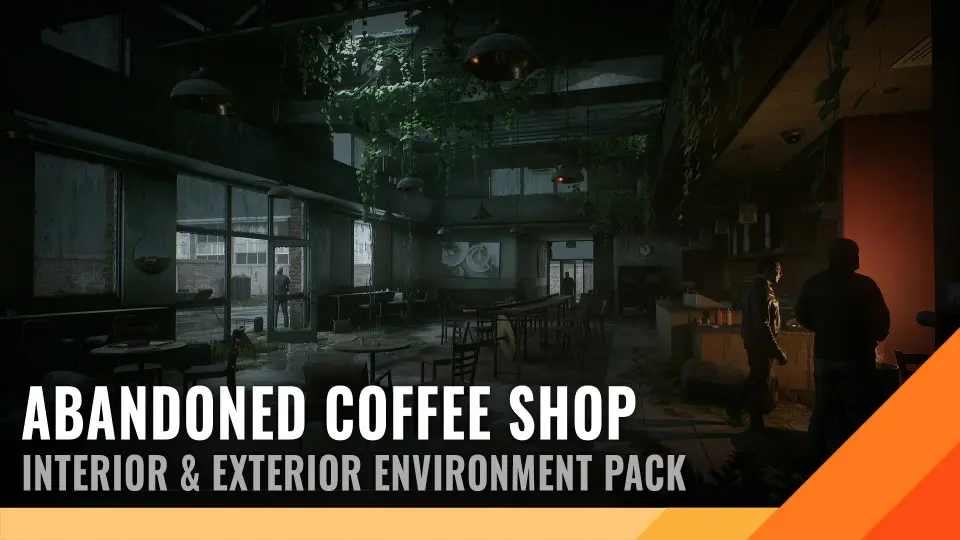
Constructing an abandoned roadside eatery begins with grid-aligned structural modules. The environment package provides 191 mesh assets engineered for modular assembly, allowing level designers to reproduce the default drive-thru layout or configure completely original architectural footprints. Structural pieces connect to form service windows, ordering lanes, seating areas, and commercial overhangs typical of American-style diner and coffee shop establishments.
Proportions across the entire asset selection are calibrated directly to the Epic skeleton, ensuring player avatars interact realistically with counter heights, service openings, doors, and ceilings. Collision handling is pre-configured with simple collision meshes assigned to nearly all props, which reduces initial setup time when placing barricades, debris, furniture, and building components across an interactive level. The default assembled scene registers an overall triangle count of 4,715,287, representing a dense, fully dressed commercial property.
Geometric density varies intentionally according to asset scale and visual priority. The highest asset vertex count sits at 42,106 vertices for complex, focal geometry, while simple elements scale down to as low as 6 vertices. Across the entire asset library, the average vertex count settles at 1,573 vertices per mesh. Native level of detail (LOD) steps are not pre-baked into the static meshes, but the topology is structured to take immediate advantage of Unreal Engine's internal LOD generator tool to establish custom distance transitions.
Vertex Paint and Layered Materials for Weathered Surfaces
Surface degradation across the architectural modules relies on specialized material construction rather than static, repetitious texturing. The environment features a dedicated vertex paint setup configured on the architectural geometry, enabling artists to manually paint wear, moisture, rust, and dirt transitions across walls, pillars, and floors directly within the level viewport.
The package contains 146 material assets, broken down into 23 master materials, 98 material instances, and 25 shared material functions. Architectural surfaces leverage layered materials that combine multiple tileable material attributes with blending masks, which helps maintain close-up fidelity while eliminating recognizable texture repetition across expansive surface planes. Parameters exposed within the material instances allow fine-tuning of surface response, roughness influence, and damage localization across both the interior and exterior surfaces.
Textures are formatted using channel-packed setups to economize memory bandwidth and sampler slots. Metalness, Roughness, and Ambient Occlusion maps are consolidated into individual texture channels (R, G, and B), maintaining precise PBR shading while cutting down texture fetch overhead in complex rendering passes.
Texture Distribution Across the Abandoned Prop Library
The visual variety within the drive-thru environment is backed by a collection of 315 textures, partitioned across several resolution steps to balance visual fidelity against rendering budgets. Texture sizing reflects structural importance, surface area, and prop prominence:
4096×4096 (42 textures): Reserved for dominant architectural surfaces, major structural elements, and large-format materials that require sharp close-up clarity.
2048×2048 (201 textures): The core workhorse resolution covering the majority of props, interior furniture, counters, signs, and secondary assets.
1024×1024 (41 textures): Allocated to smaller commercial items, medium trim elements, and secondary clutter meshes.
512×512 (18 textures): Applied to small utility props, minor debris, and accent details.
256×256 (13 textures): Used for compact utility masks, tiny hardware, and low-footprint detail maps.
Interior decorative props include five framed 2D art assets—designated as T_ArtPrintA_A, T_CanvasPictureA_A, T_FramedPictureA_A, T_FramedPictureB_A, and T_PhotoPanelA_01_A. These assets use royalty-free imagery sourced under CC0 terms from Unsplash, completing the lived-in interior styling of the commercial dining area without introducing proprietary display art.
Lighting, Consistent Lightmap UVs, and Atmospheric Tuning
Illuminating an abandoned commercial structure demands clean light baking pathways alongside dynamic rendering capabilities. Every mesh within the set includes consistent lightmap UV channels prepared specifically to prevent light leaks, overlapping bake errors, or unaligned contact shadows across modular seams. This clean UV mapping ensures reliable indirect lighting whether running static light bakes or relying entirely on dynamic illumination setups.
The package incorporates an integrated cinematic post-processing volume tuned to emphasize the eerie, decaying mood of a post-disaster setting. Color grading, ambient shading, contrast parameters, and exposure profiles are pre-balanced to evoke scary, haunted, and horror-themed atmospheric conditions. Foliage elements such as scattered grass and overgrowing plants interlace with the cracked concrete and decaying diner perimeter, reinforcing an aesthetic where nature has begun reclaiming man-made commercial infrastructure.
Platform Deployment and Production Optimization
Projects targeting varied deployment environments can adapt the scene to match specific platform performance targets. Supported development takes place on Windows, while target builds support deployment across Windows, macOS, PlayStation 4, and Xbox systems.
Because the pack supplies fully detailed models ready for realistic AAA visual targets, platform optimization centers on generating appropriate LOD curves inside the engine and configuring instanced static mesh variations where modular pieces repeat extensively. Combining the built-in simple collision, consistent UV layouts, modular snapping, and channel-packed shader infrastructure yields a production-ready foundation for post-apocalyptic narrative set pieces, survival levels, and cinematic horror environments.
 Apocalyptic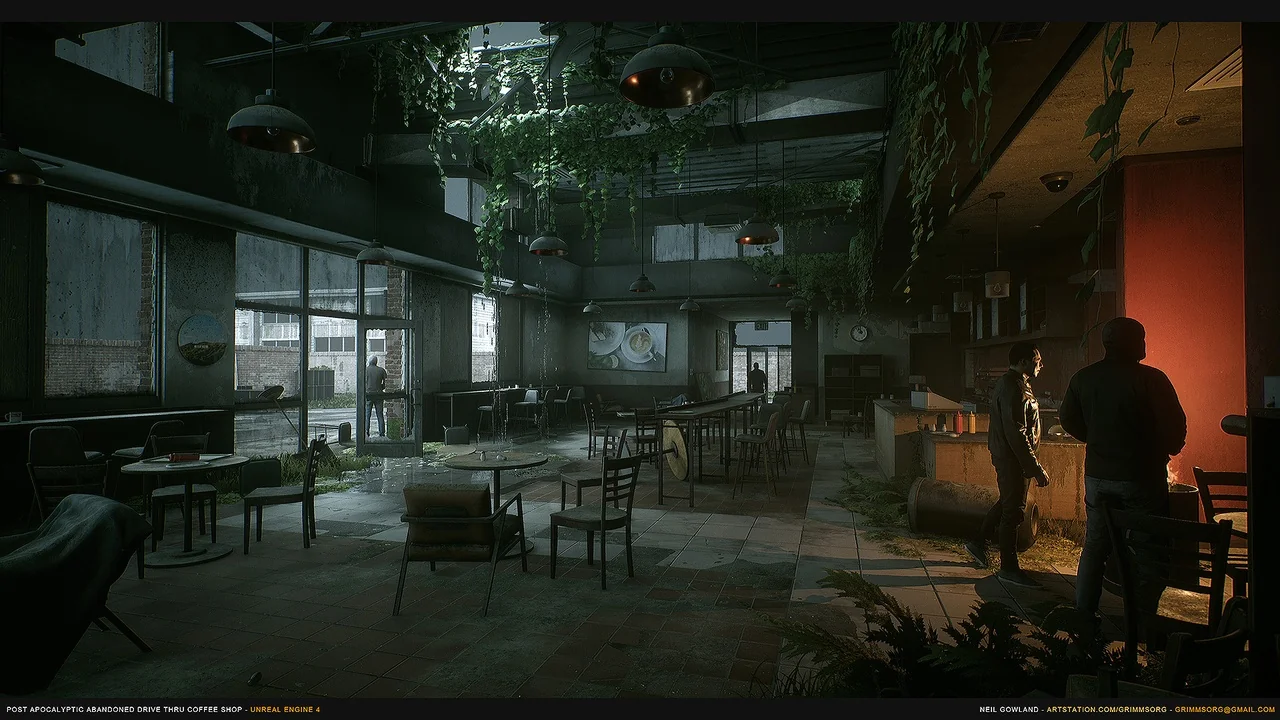
 Apocalyptic
![Decay: Oil Drums District - [Rusty Industrial Slum]](/_img/360/wp-content/uploads/2026/02/9e2ac79e-b21a-487e-99d8-39ff14d9ba83.webp) Apocalyptic
Apocalyptic Apocalyptic